K.VISHNU PRIYA
M.Pharm(pharmacology).
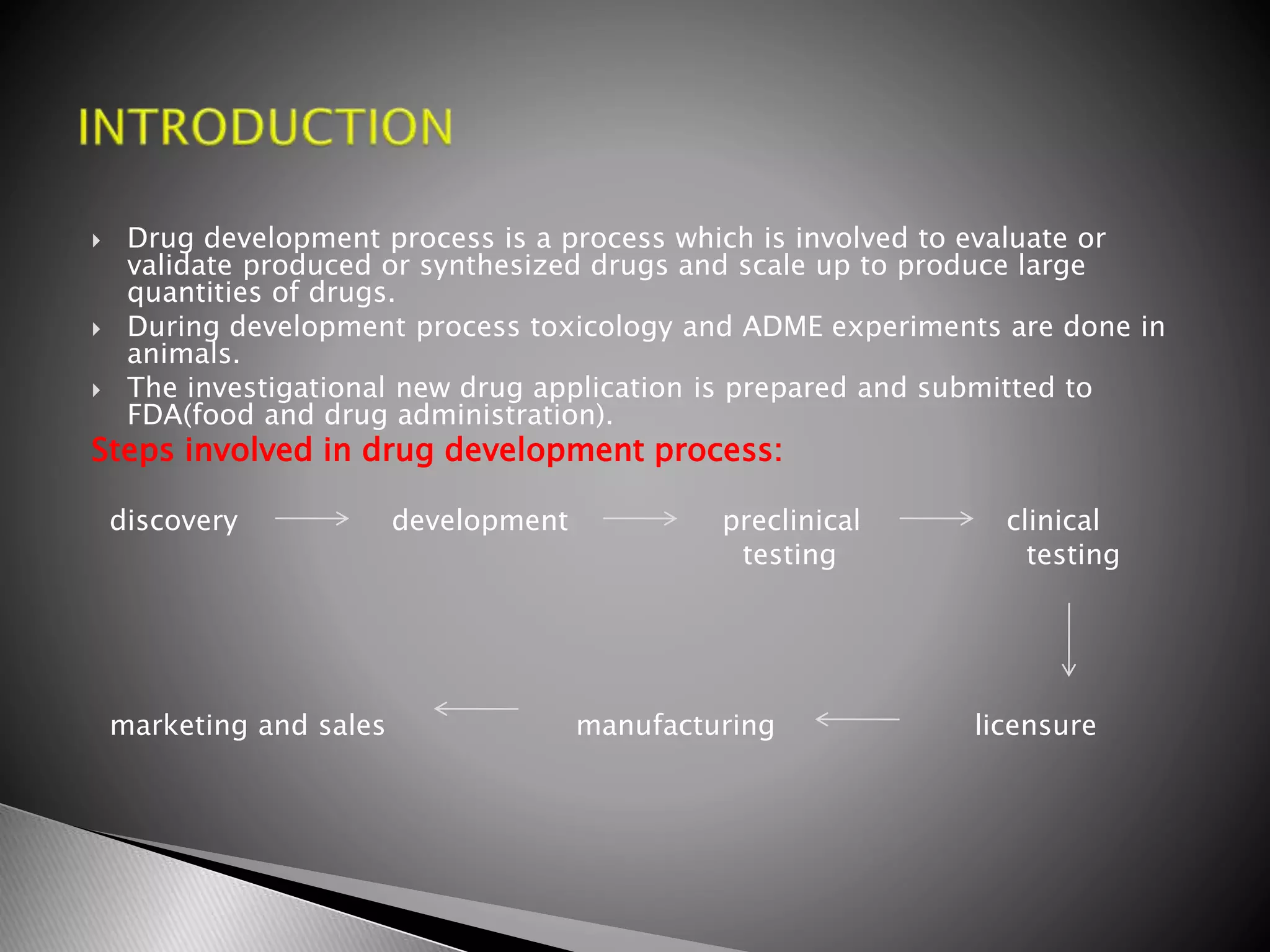
 Drug development process is a process which is involved to evaluate or
validate produced or synthesized drugs and scale up to produce large
quantities of drugs.
 During development process toxicology and ADME experiments are done in
animals.
 The investigational new drug application is prepared and submitted to
FDA(food and drug administration).
Steps involved in drug development process:
discovery development preclinical clinical
testing testing
marketing and sales manufacturing licensure
Discovery of biopharmaceuticals :
the Drug discovery process mainly focus on specific disease and patient
need.
 the scientist search the targets in the body which is responsible for disease
(usually the targets are proteins, receptors, genes / foreign substances like
virus / bacteria).
Discovery process:
the steps involved in discovery process are ,
1. pre discovery : understand the disease
2. Target identification: identify the target which is responsible for disease.
3. Target validation : test the target and confirm its role in disease.
4. Drug discovery: find out the lead compound which become as drug.
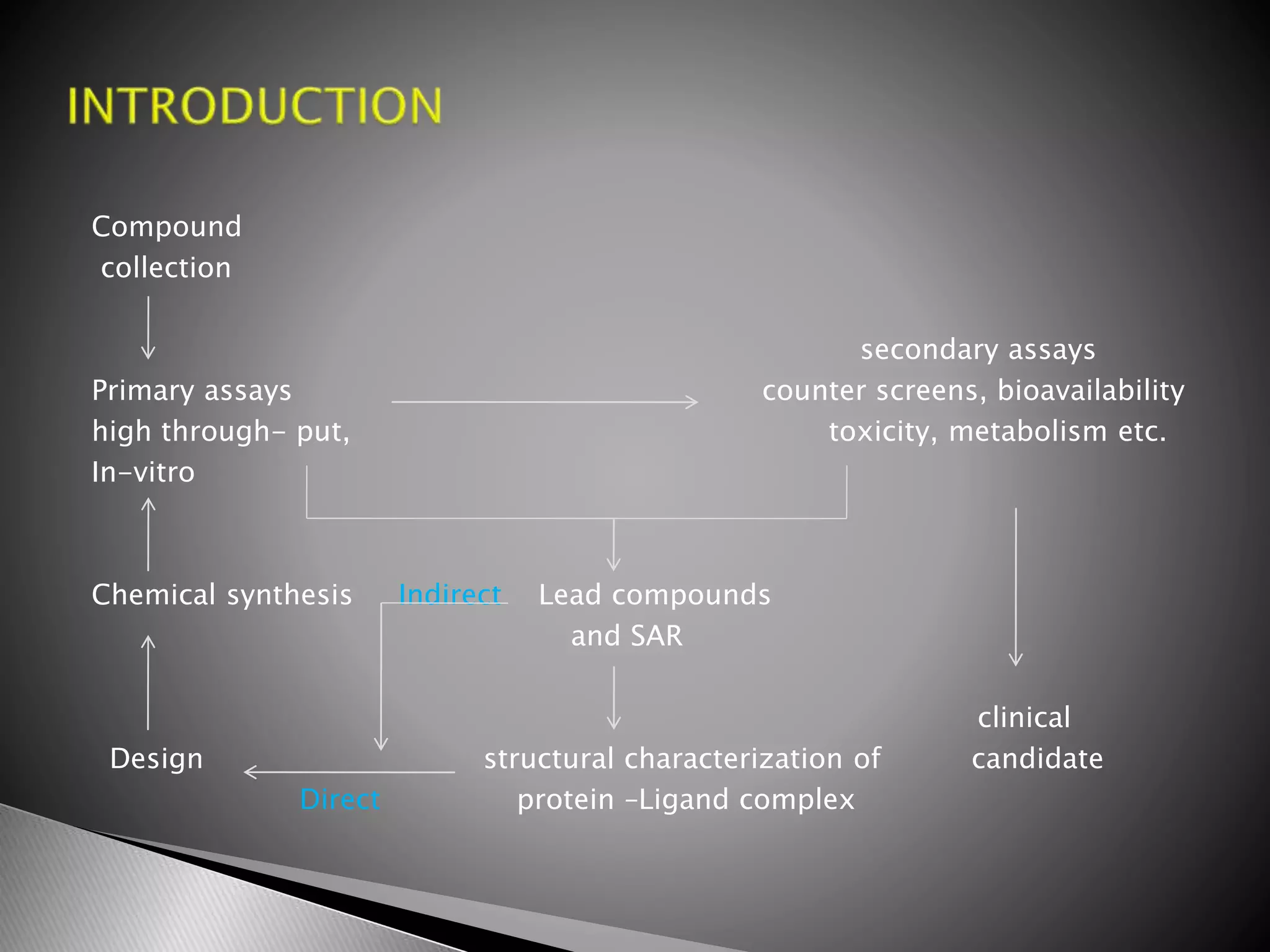
Compound
collection
secondary assays
Primary assays counter screens, bioavailability
high through- put, toxicity, metabolism etc.
In-vitro
Chemical synthesis Indirect Lead compounds
and SAR
clinical
Design structural characterization of candidate
Direct protein –Ligand complex
there are few ways to find out the lead compounds
 nature
 High throughput screening
 Biotechnology
Lead compound optimization :
 The lead compound which survive the initial screening should be optimized
or altered in-order to make more safer and effective drug.
 The optimization of lead compound is done by altering the structure of
compound .
 If the structure of compound is changed, it less likely interact with other
chemical pathways in the body and reduce side effects.
 The optimization is done by using technologies like magnetic resonance
imaging and X- ray crystallo modeling capabilities.
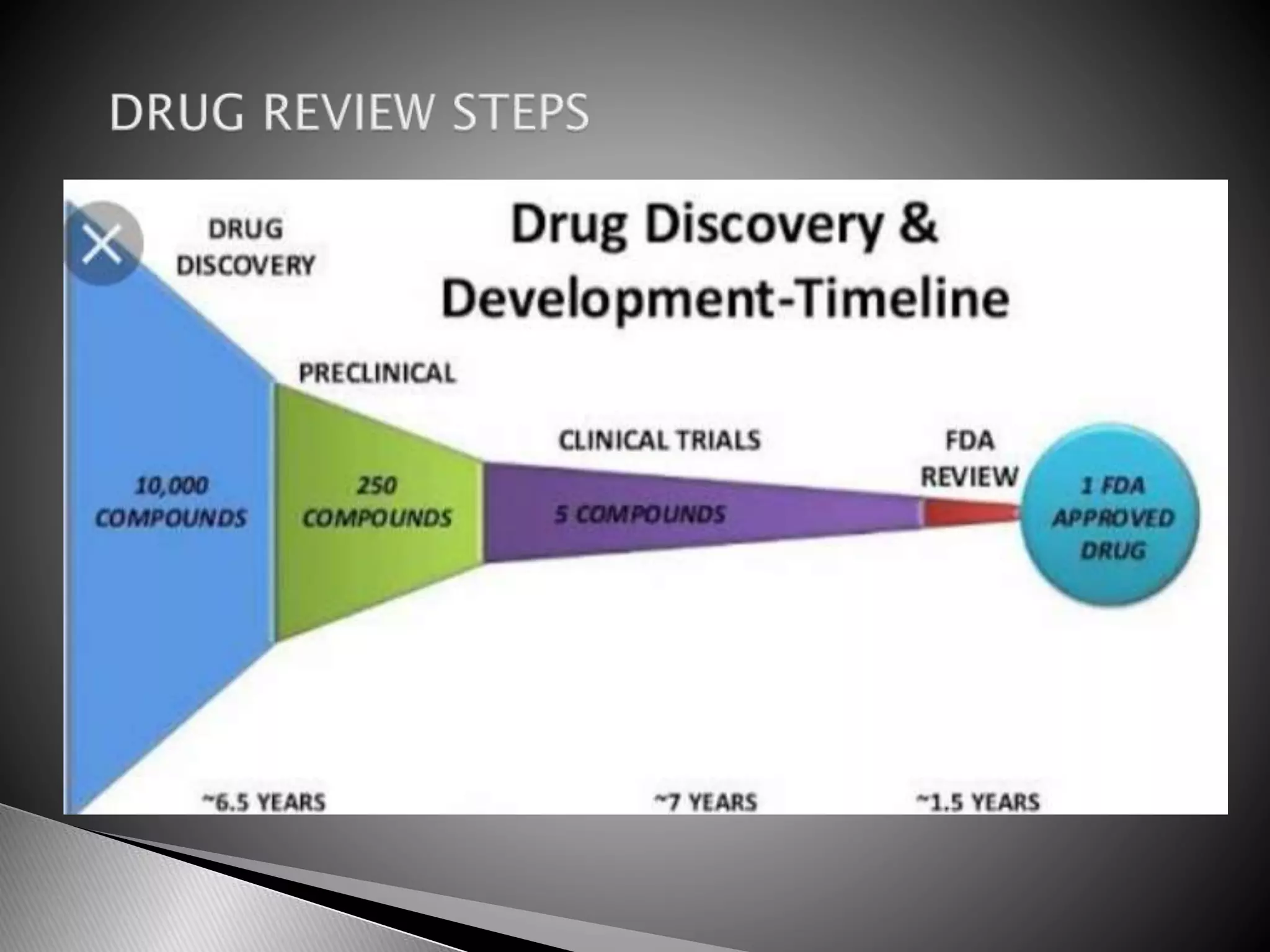
The drug review steps are of following,
1. pre-clinical trials
2. An investigational new drug application (IND) to FDA for approval of sponsor
to market a new drug
3. Clinical trials
i. Phase1 studies
ii. Phase2 studies
iii. Phase3 studies
iv. FDA approval
v. Patent
vi. Phase4/ post marketing surveillance
1. Pre-clinical trials:
preclinical studies are done before conducting the clinical trials. The
research on new drug/new medicine, device/treatment is done on animals
to know about the MOA, to determine how the treatment looks and its
safety on humans.
The tests done during preclinical studies:
pharmacokinetic profile ;
it relates fat of drug in body i.e., ADME of drug. The
pharmacokinetic studies are done in rats and dogs.
Pharmacodynamic profile;
it deals with MOA, pharmacological action, uses and
adverse effects of drugs.
Bioavailability and bioequivalence :
 BA involved to determine the rate and extent of absorption of unchanged
drug from its dosage form.
 BE is a relative term , the drug reaches to systemic circulation after
administration with same relative rate and to the relative extent i.e., their
plasma drug concentration – time profile is identical without statistical
significant difference.
Toxicity studies:
 Acute toxicity; it last for short duration and is done in both rats as well as
mice's of either sex.
 Chronic toxicity; it requires more no. of animals and last up to 2yrs.
Reproductive toxicity and teratogenicity:
 Fertility studies are done to determine the nature of effect due to drugs on
male /female reproductive functions.
 teratogenicity studies are done to determine whether the drugs shows
abnormalities in fetus or not.
Immunogenicity, carcinogenicity and Immuno toxicity:
 mutagenicity studies are assessed when the drug induces DNA damage by
altering the chromosomal structure or change in the nucleotide base
sequence.
 carcinogenicity studies are assessed to determine whether the drug is
carcinogenic or not.
 The immuno toxicity studies are assessed when the drug produces allergic
or hypersensitivity reactions.
2. An investigational new drug application(IND):
The application to FDA for requesting permission to test in humans
is called as IND. This IND permits use of an IND investigational new drug for
conducting the clinical trials.
Types of IND:
i. Investigator IND; it is submitted by physician, who initiates and conduct
investigation and under whose direction the investigational new drug is
administered or dispensed.
ii. Emergency use IND; which is submitted to FDA for the use of an
investigational new drug in an emergency situations.
iii. Treatment IND; it is submitted for an investigational new drug in clinical
testing for serious and threatening conditions.
APPLICATION OF IND:
IND is applicable in following areas ,
 Animal pharmacology and toxicology studies; the assessments are done to
know whether the product is safe in initial studies on humans or not.
 Manufacturing information; which includes composition, manufacturer,
stability and controls used for manufacturing the drugs.
 Clinical protocol and investigator information; commitments to obtain
information from research , to obtain basic scientific knowledge about new
drug.
Format of IND:
a. cover sheet (form FDA – 1571)
 Name, address, telephone no. of sponsor.
 Identification of phases.
 Commitment for not to do clinical trails until IND is approved.
 Commitment by IRB – form 56
 Commitment for conducting clinical trails, according to regulations.
 Name, title – monitor
 Name, title – person for reviewing
 Name, address of CRO, if any
 Signature of sponsor.
b. Table of content
c. Introductory statement and general investigational plan
d. Investigator brochure
e. Study protocol
f. Investigator facilities and IRB data
g. Chemical manufacturing and control data
h. Pharmacological and toxicological data
i. Previous human experience
3. Clinical trials:
these are set of tests in medical researches and in drug
development process used to examine and evaluate the safety and efficacy of
new drug/treatment.
Background of clinical trials:
 In 1902- Paul Erlich – Arsphenamine
 In 1929- Alexander Fleming – penicillin
 In 1935-gerhard gomargk- sulphonamide
 In 1944- schatz/ bogie/ Waksman- streptomycin
 In 1995, British medical research council develop an systematic methodology
to study and evaluate new drug or treatment.
Importance of clinical trials:
 In clinical trials, the researcher take results from basic scientific research and
then translate them into ways to diagnose the disease, treatment and
prevention.
 Without them, we could not ensure safe and effective treatment for disease.
 The clinical trials plays a major role to bring the new drug or treatment into
market.
Different types of clinical trials:
According to national institute of health, they are 5 types
 Treatment trials; Test new treatment, new combination of drugs or new
approaches for surgery/ radiation.
 Prevention trials; involves to determine the ways that prevent disease.
 Diagnosis trials; they involve to determine better test and procedures to
diagnose a particular disease.
 Screening trials; they determines the ways to detect or treatment for disease.
 Quality of life trials; they involve to determine the ways to improve comfort
and quality life of person with health illness.
How a trial can start :
Discuss idea with peers and colleagues.
generate idea in concept protocol prepare budget and other documents
protocol review meetings
submit final protocol to sponsor
Hire staff, write CRF,SOP’s, ethical research community,
Laboratory plans, organic committees engagement, DSMB
Transport, shipping and members, training
Ordering , monitoring plan records, equipment
ordering and servicing.
study start
 Phase 1 studies;
these studies are assessed with small no. of human subjects (20-
80) to test the safety of product or treatment. it is done in healthy volunteers
and the purpose of it is to evaluate the safety .
 phase 2 studies;
these studies are assessed with more no. of human subjects(100-
300) to know whether the product or treatment is helpful/not. It is done to
determine the effectiveness of treatment and further evaluation of its safety.
 Phase 3 studies;
these studies are assessed with large no. of human subjects(300-
3000) to examine final or comprehensive analysis for safety and efficacy of
products.
 FDA approval ;
the drug or treatment is proven satisfactory after phase3 trails, then
the results are documented. this documents contain description of methods,
trail results in humans and animal studies, manufacturing procedures,
formulation details and shelf life.
This documents is submitted to regulatory authorities like USFDA and the
USFDA grant approval for marketing of new drug or treatment.
 Patent;
it is monopoly which is granted by government to the inventor. So , the
inventor only exploit the invention or innovation for fixed period of time i.e.,
up to 20yrs.
 Phase 4/ post marketing surveillance;
After the drug is licensed i.e., approved by FDA or treatment is launched,
the researchers take information from drug or treatment risk, benefits and
use in individuals.
The pharmacovigilance methodologies are used to detect ADR’s.
There are some powerful and cost effective systems are used to identify the
unknown drug related ADR’s.
Limitations:
 The drug discovery and development process are long and complicated
processes.
 They are cost effective or expensive.

Drug discovery and development process

  • 1.
  • 2.
     Drug developmentprocess is a process which is involved to evaluate or validate produced or synthesized drugs and scale up to produce large quantities of drugs.  During development process toxicology and ADME experiments are done in animals.  The investigational new drug application is prepared and submitted to FDA(food and drug administration). Steps involved in drug development process: discovery development preclinical clinical testing testing marketing and sales manufacturing licensure
  • 3.
    Discovery of biopharmaceuticals: the Drug discovery process mainly focus on specific disease and patient need.  the scientist search the targets in the body which is responsible for disease (usually the targets are proteins, receptors, genes / foreign substances like virus / bacteria). Discovery process: the steps involved in discovery process are , 1. pre discovery : understand the disease 2. Target identification: identify the target which is responsible for disease. 3. Target validation : test the target and confirm its role in disease. 4. Drug discovery: find out the lead compound which become as drug.
  • 4.
    Compound collection secondary assays Primary assayscounter screens, bioavailability high through- put, toxicity, metabolism etc. In-vitro Chemical synthesis Indirect Lead compounds and SAR clinical Design structural characterization of candidate Direct protein –Ligand complex
  • 5.
    there are fewways to find out the lead compounds  nature  High throughput screening  Biotechnology Lead compound optimization :  The lead compound which survive the initial screening should be optimized or altered in-order to make more safer and effective drug.  The optimization of lead compound is done by altering the structure of compound .  If the structure of compound is changed, it less likely interact with other chemical pathways in the body and reduce side effects.  The optimization is done by using technologies like magnetic resonance imaging and X- ray crystallo modeling capabilities.
  • 6.
    The drug reviewsteps are of following, 1. pre-clinical trials 2. An investigational new drug application (IND) to FDA for approval of sponsor to market a new drug 3. Clinical trials i. Phase1 studies ii. Phase2 studies iii. Phase3 studies iv. FDA approval v. Patent vi. Phase4/ post marketing surveillance
  • 8.
    1. Pre-clinical trials: preclinicalstudies are done before conducting the clinical trials. The research on new drug/new medicine, device/treatment is done on animals to know about the MOA, to determine how the treatment looks and its safety on humans. The tests done during preclinical studies: pharmacokinetic profile ; it relates fat of drug in body i.e., ADME of drug. The pharmacokinetic studies are done in rats and dogs. Pharmacodynamic profile; it deals with MOA, pharmacological action, uses and adverse effects of drugs.
  • 9.
    Bioavailability and bioequivalence:  BA involved to determine the rate and extent of absorption of unchanged drug from its dosage form.  BE is a relative term , the drug reaches to systemic circulation after administration with same relative rate and to the relative extent i.e., their plasma drug concentration – time profile is identical without statistical significant difference. Toxicity studies:  Acute toxicity; it last for short duration and is done in both rats as well as mice's of either sex.  Chronic toxicity; it requires more no. of animals and last up to 2yrs.
  • 10.
    Reproductive toxicity andteratogenicity:  Fertility studies are done to determine the nature of effect due to drugs on male /female reproductive functions.  teratogenicity studies are done to determine whether the drugs shows abnormalities in fetus or not. Immunogenicity, carcinogenicity and Immuno toxicity:  mutagenicity studies are assessed when the drug induces DNA damage by altering the chromosomal structure or change in the nucleotide base sequence.  carcinogenicity studies are assessed to determine whether the drug is carcinogenic or not.  The immuno toxicity studies are assessed when the drug produces allergic or hypersensitivity reactions.
  • 11.
    2. An investigationalnew drug application(IND): The application to FDA for requesting permission to test in humans is called as IND. This IND permits use of an IND investigational new drug for conducting the clinical trials. Types of IND: i. Investigator IND; it is submitted by physician, who initiates and conduct investigation and under whose direction the investigational new drug is administered or dispensed. ii. Emergency use IND; which is submitted to FDA for the use of an investigational new drug in an emergency situations. iii. Treatment IND; it is submitted for an investigational new drug in clinical testing for serious and threatening conditions.
  • 12.
    APPLICATION OF IND: INDis applicable in following areas ,  Animal pharmacology and toxicology studies; the assessments are done to know whether the product is safe in initial studies on humans or not.  Manufacturing information; which includes composition, manufacturer, stability and controls used for manufacturing the drugs.  Clinical protocol and investigator information; commitments to obtain information from research , to obtain basic scientific knowledge about new drug.
  • 13.
    Format of IND: a.cover sheet (form FDA – 1571)  Name, address, telephone no. of sponsor.  Identification of phases.  Commitment for not to do clinical trails until IND is approved.  Commitment by IRB – form 56  Commitment for conducting clinical trails, according to regulations.  Name, title – monitor  Name, title – person for reviewing  Name, address of CRO, if any  Signature of sponsor.
  • 14.
    b. Table ofcontent c. Introductory statement and general investigational plan d. Investigator brochure e. Study protocol f. Investigator facilities and IRB data g. Chemical manufacturing and control data h. Pharmacological and toxicological data i. Previous human experience
  • 15.
    3. Clinical trials: theseare set of tests in medical researches and in drug development process used to examine and evaluate the safety and efficacy of new drug/treatment. Background of clinical trials:  In 1902- Paul Erlich – Arsphenamine  In 1929- Alexander Fleming – penicillin  In 1935-gerhard gomargk- sulphonamide  In 1944- schatz/ bogie/ Waksman- streptomycin  In 1995, British medical research council develop an systematic methodology to study and evaluate new drug or treatment. Importance of clinical trials:  In clinical trials, the researcher take results from basic scientific research and then translate them into ways to diagnose the disease, treatment and prevention.  Without them, we could not ensure safe and effective treatment for disease.
  • 16.
     The clinicaltrials plays a major role to bring the new drug or treatment into market. Different types of clinical trials: According to national institute of health, they are 5 types  Treatment trials; Test new treatment, new combination of drugs or new approaches for surgery/ radiation.  Prevention trials; involves to determine the ways that prevent disease.  Diagnosis trials; they involve to determine better test and procedures to diagnose a particular disease.  Screening trials; they determines the ways to detect or treatment for disease.  Quality of life trials; they involve to determine the ways to improve comfort and quality life of person with health illness.
  • 17.
    How a trialcan start : Discuss idea with peers and colleagues. generate idea in concept protocol prepare budget and other documents protocol review meetings submit final protocol to sponsor
  • 18.
    Hire staff, writeCRF,SOP’s, ethical research community, Laboratory plans, organic committees engagement, DSMB Transport, shipping and members, training Ordering , monitoring plan records, equipment ordering and servicing. study start
  • 19.
     Phase 1studies; these studies are assessed with small no. of human subjects (20- 80) to test the safety of product or treatment. it is done in healthy volunteers and the purpose of it is to evaluate the safety .  phase 2 studies; these studies are assessed with more no. of human subjects(100- 300) to know whether the product or treatment is helpful/not. It is done to determine the effectiveness of treatment and further evaluation of its safety.  Phase 3 studies; these studies are assessed with large no. of human subjects(300- 3000) to examine final or comprehensive analysis for safety and efficacy of products.  FDA approval ; the drug or treatment is proven satisfactory after phase3 trails, then the results are documented. this documents contain description of methods, trail results in humans and animal studies, manufacturing procedures, formulation details and shelf life.
  • 20.
    This documents issubmitted to regulatory authorities like USFDA and the USFDA grant approval for marketing of new drug or treatment.  Patent; it is monopoly which is granted by government to the inventor. So , the inventor only exploit the invention or innovation for fixed period of time i.e., up to 20yrs.  Phase 4/ post marketing surveillance; After the drug is licensed i.e., approved by FDA or treatment is launched, the researchers take information from drug or treatment risk, benefits and use in individuals. The pharmacovigilance methodologies are used to detect ADR’s. There are some powerful and cost effective systems are used to identify the unknown drug related ADR’s. Limitations:  The drug discovery and development process are long and complicated processes.  They are cost effective or expensive.