Drought Prone Areas
Programme
Rajinder Kaur Kalra
Professor and Head (Retired)
PAU Ludhiana
9814067709
• Drought Prone Areas Programme.
• Earliest area development programme.
• Launched by the Central Government in 1973-
74 to tackle the special problems faced by
those fragile areas which are constantly
affected by severe drought conditions.
DPAP
4/5/2022 2
• To minimize the adverse effects of drought on
the production of crops and livestock and
productivity of land, water and human
resources, thereby ultimately leading to the
drought proofing of the affected areas.
Objectives
4/5/2022 3
• Aims overall economic development and
improvement in the socio-economic condition of
the resource poor and disadvantaged sections
inhabiting the programme areas through
creation, widening and equitable distribution of
resource base.
• Increased employment opportunities.
Key Features
4/5/2022 4
• 961 blocks of 180 districts in 16 States.
• The States are Andhra Pradesh, Bihar , Gujarat,
Chattisgarh, Himachal Pradesh, Orissa,
Jammu & Kashmir, Jharkhand, Karnataka,
Madhya Pradesh, Maharashtra, Uttaranchal,
Tamil Nadu, Rajasthan, Uttar Pradesh
and West Bengal.
Coverage
4/5/2022 5
• Shared on 75:25 basis between the Centre
and State Government.
• An amount of Rs. 127.26 crores has already
been released under the programme upto
31.01.2001.
Funding
4/5/2022 6
• Implemented through the DRDAs/ ZPs at
district level.
source: (http://www.planningcommission.nic.in)
Implementing Agency
4/5/2022 7
 Started in 1977-78, both in the hot-desert areas of
Rajasthan, Gujarat, and Haryana, and the cold-desert
areas of Jammu & Kashmir and Himachal Pradesh.
 From 1995-96, covers few districts of Andhra Pradesh
and Karnataka.
 Covered 235 blocks of 40 districts in the above 7
states.
DDP
Desert Development Programme
4/5/2022 8
• To mitigate the adverse effects of climatic
conditions and combat desertification.
• To restore ecological balance by harnessing,
conserving and developing natural resources.
• To implement developmental work through
the watershed approach, for land, water and
pasture development.
Objectives
4/5/2022 9
• The Centre and State governments share in
75:25 ratio.
Funding
4/5/2022 10
• Implemented through the DRDAs/ ZPs at
district level.
source: (http://www.planningcommission.nic.in)
Implementing Agency
4/5/2022 11
SWOT Analysis of the programmes-
Strengths
Weaknesses
Opportunities
Threats
4/5/2022 12
 The programmes are conceptualised, keeping in view the needs of
the people and overcome the problems associated with the
multiplicity of programmes.
 The area-based needs and abilities are focussed.
 Strengthening of infrastructure is prime objective.
 Grass-root level participation is emphasized.
 People’s participation in groups is an important consideration.
 Employment generation is the selected means of alleviating
poverty.
Strengths of the programmes
4/5/2022 13
• Poor implementation and diverted action.
• Poor system of audit.
• Top-bottom approach in the concept.
• Less collaboration with non-governmental
bodies.
• Poor infrastructure and build-up.
Weaknesses of the programmes
4/5/2022 14
• The programmes provides unlimited scope for development
of the poor.
• The huge share of funds can generate loads of industrial
infrastructure.
• There are ample opportunities in the sector of employment
and job creation.
• The programmes donot only aim to alleviate poverty, but
have many-fold secondary benefits – nutritional security,
literacy, development of basic infrastructure and overall
improvement.
Opportunities of the programmes
4/5/2022 15
 The biggest threat to the programmes is the corruption, prevailing
at every step of implementation.
 Biasness and favourism also put forth problems.
 Scattered poor populations also hinder the success of the
programmes.
 Irregular and poor efficiency of officials add to the threats further.
 Uncollaborated efforts at national level also reduce their
effectiveness.
Threats to the programmes
4/5/2022 16
• Prevailing systems of caste and other social taboos.
• Political interference is another important threats.
4/5/2022 17
 Despite of so many efforts and government schemes, the
statistical data shows that in absolute terms there is minute
decrease in the number of people living below the poverty
line in our country.
 The rating of our country in the global living indices has
shown a declining graph.
 People in the country are still unable to meet the daily food
requirements.
Conclusion
4/5/2022 18
• However, this should not be concluded that work
has not been done to combat the situation.
• A lion’s share in our annual budget goes to these
projects.
• Somehow, the results are not encouraging except
in a few cases. The masses are still unable to reap
the benefits.
4/5/2022 19
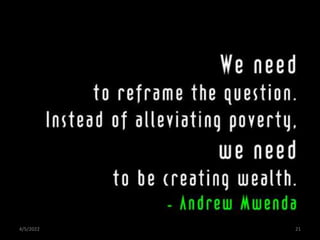
• Thus, may be we need to shift our view and focus
on the other side of the coin.
• Let our aim be to create wealth than to alleviate
poverty.
• We must keep moving towards the end, as this is
the biggest challenge, the country is facing.
• It needs persistent efforts and long gestation
periods, before we visualise, hunger free India.
4/5/2022 20
4/5/2022 21
Thank you all!
Have a great week ahead!
4/5/2022 22

Drought prone area prog

  • 1.
    Drought Prone Areas Programme RajinderKaur Kalra Professor and Head (Retired) PAU Ludhiana 9814067709
  • 2.
    • Drought ProneAreas Programme. • Earliest area development programme. • Launched by the Central Government in 1973- 74 to tackle the special problems faced by those fragile areas which are constantly affected by severe drought conditions. DPAP 4/5/2022 2
  • 3.
    • To minimizethe adverse effects of drought on the production of crops and livestock and productivity of land, water and human resources, thereby ultimately leading to the drought proofing of the affected areas. Objectives 4/5/2022 3
  • 4.
    • Aims overalleconomic development and improvement in the socio-economic condition of the resource poor and disadvantaged sections inhabiting the programme areas through creation, widening and equitable distribution of resource base. • Increased employment opportunities. Key Features 4/5/2022 4
  • 5.
    • 961 blocksof 180 districts in 16 States. • The States are Andhra Pradesh, Bihar , Gujarat, Chattisgarh, Himachal Pradesh, Orissa, Jammu & Kashmir, Jharkhand, Karnataka, Madhya Pradesh, Maharashtra, Uttaranchal, Tamil Nadu, Rajasthan, Uttar Pradesh and West Bengal. Coverage 4/5/2022 5
  • 6.
    • Shared on75:25 basis between the Centre and State Government. • An amount of Rs. 127.26 crores has already been released under the programme upto 31.01.2001. Funding 4/5/2022 6
  • 7.
    • Implemented throughthe DRDAs/ ZPs at district level. source: (http://www.planningcommission.nic.in) Implementing Agency 4/5/2022 7
  • 8.
     Started in1977-78, both in the hot-desert areas of Rajasthan, Gujarat, and Haryana, and the cold-desert areas of Jammu & Kashmir and Himachal Pradesh.  From 1995-96, covers few districts of Andhra Pradesh and Karnataka.  Covered 235 blocks of 40 districts in the above 7 states. DDP Desert Development Programme 4/5/2022 8
  • 9.
    • To mitigatethe adverse effects of climatic conditions and combat desertification. • To restore ecological balance by harnessing, conserving and developing natural resources. • To implement developmental work through the watershed approach, for land, water and pasture development. Objectives 4/5/2022 9
  • 10.
    • The Centreand State governments share in 75:25 ratio. Funding 4/5/2022 10
  • 11.
    • Implemented throughthe DRDAs/ ZPs at district level. source: (http://www.planningcommission.nic.in) Implementing Agency 4/5/2022 11
  • 12.
    SWOT Analysis ofthe programmes- Strengths Weaknesses Opportunities Threats 4/5/2022 12
  • 13.
     The programmesare conceptualised, keeping in view the needs of the people and overcome the problems associated with the multiplicity of programmes.  The area-based needs and abilities are focussed.  Strengthening of infrastructure is prime objective.  Grass-root level participation is emphasized.  People’s participation in groups is an important consideration.  Employment generation is the selected means of alleviating poverty. Strengths of the programmes 4/5/2022 13
  • 14.
    • Poor implementationand diverted action. • Poor system of audit. • Top-bottom approach in the concept. • Less collaboration with non-governmental bodies. • Poor infrastructure and build-up. Weaknesses of the programmes 4/5/2022 14
  • 15.
    • The programmesprovides unlimited scope for development of the poor. • The huge share of funds can generate loads of industrial infrastructure. • There are ample opportunities in the sector of employment and job creation. • The programmes donot only aim to alleviate poverty, but have many-fold secondary benefits – nutritional security, literacy, development of basic infrastructure and overall improvement. Opportunities of the programmes 4/5/2022 15
  • 16.
     The biggestthreat to the programmes is the corruption, prevailing at every step of implementation.  Biasness and favourism also put forth problems.  Scattered poor populations also hinder the success of the programmes.  Irregular and poor efficiency of officials add to the threats further.  Uncollaborated efforts at national level also reduce their effectiveness. Threats to the programmes 4/5/2022 16
  • 17.
    • Prevailing systemsof caste and other social taboos. • Political interference is another important threats. 4/5/2022 17
  • 18.
     Despite ofso many efforts and government schemes, the statistical data shows that in absolute terms there is minute decrease in the number of people living below the poverty line in our country.  The rating of our country in the global living indices has shown a declining graph.  People in the country are still unable to meet the daily food requirements. Conclusion 4/5/2022 18
  • 19.
    • However, thisshould not be concluded that work has not been done to combat the situation. • A lion’s share in our annual budget goes to these projects. • Somehow, the results are not encouraging except in a few cases. The masses are still unable to reap the benefits. 4/5/2022 19
  • 20.
    • Thus, maybe we need to shift our view and focus on the other side of the coin. • Let our aim be to create wealth than to alleviate poverty. • We must keep moving towards the end, as this is the biggest challenge, the country is facing. • It needs persistent efforts and long gestation periods, before we visualise, hunger free India. 4/5/2022 20
  • 21.
  • 22.
    Thank you all! Havea great week ahead! 4/5/2022 22