Watershed Management in Nepal
Practices and Lessons
Neupane, Madhab Raj
Madhab.Neupane@tu-dortmund.de
Land Use Planning and Environment Management
Outline
•Definition – Watershed and Watershed Management
•Country Context
•Legal and Institutional Framework
•Practices, Issues and Challenges
•Relevance to Spatial Planning
•Discussion
6/04/2020 Neupane, Madhab Raj 2
Definition
Watershed
A watershed is an area of land,
such as a mountain or valley, which
collects rainwater into a common
outlet.
6/04/2020 Neupane, Madhab Raj 3
Image from: http://hawp.org/what-is-a-watershed/
Every body of water has a watershed.
Definition
Watershed Management
Process of implementing land use
practices and water management
practices to protect and improve the
quality of the water and other natural
resources within a watershed by managing
the use of those land and water resources in
a comprehensive manner.
6/04/2020 Neupane, Madhab Raj 4
https://portal.ct.gov/DEEP/Water/Watershed-Management/Watershed-Management---Overview
https://www.geo.fu-berlin.de/en/v/iwm-network/learning_content/_archive/
bak_introduction_iwm/iwm_planning_approach/principles_IWM/index.html
Country Context
6/04/2020 Neupane, Madhab Raj 5
Population: 28.09 Million (2018) - World bank
Geographical Area: 147,516 Sq. KM
Forest Area: 44.74 % (MoPE, 2018)
Waterbodies: 6,000 rivers + 5,358 lakes
Snow Covered Area (Glaciers): 5,323 km2
Agriculture area: 28.748 % (2016) - World bank
Federal Democratic Republic (3 tier government)
1 Federal Government
7 Province Governments
273 Local Governments
Situation of Watersheds - Nepal
6/04/2020 Neupane, Madhab Raj 6
32%
6/04/2020 Neupane, Madhab Raj 7
Water
Resources
Land
Resources
Forest
Resources
Other
Environment
Policies Linked with Watershed Management
(Eco-system based) Integrated Watershed Management
Participatory and Integrated Watershed Management
River Basin Improvement and Management Programme
Water Resources Act, 1992
Water Resource Strategy,
2002
National Land Use Policy,
2015
National Forest Policy,
2018
Environment
Protection Act, 1996
Soil and Watershed Conservation Act, 1982 Protected Areas
Community Forest
Family Forest
6/04/2020 Neupane, Madhab Raj 8
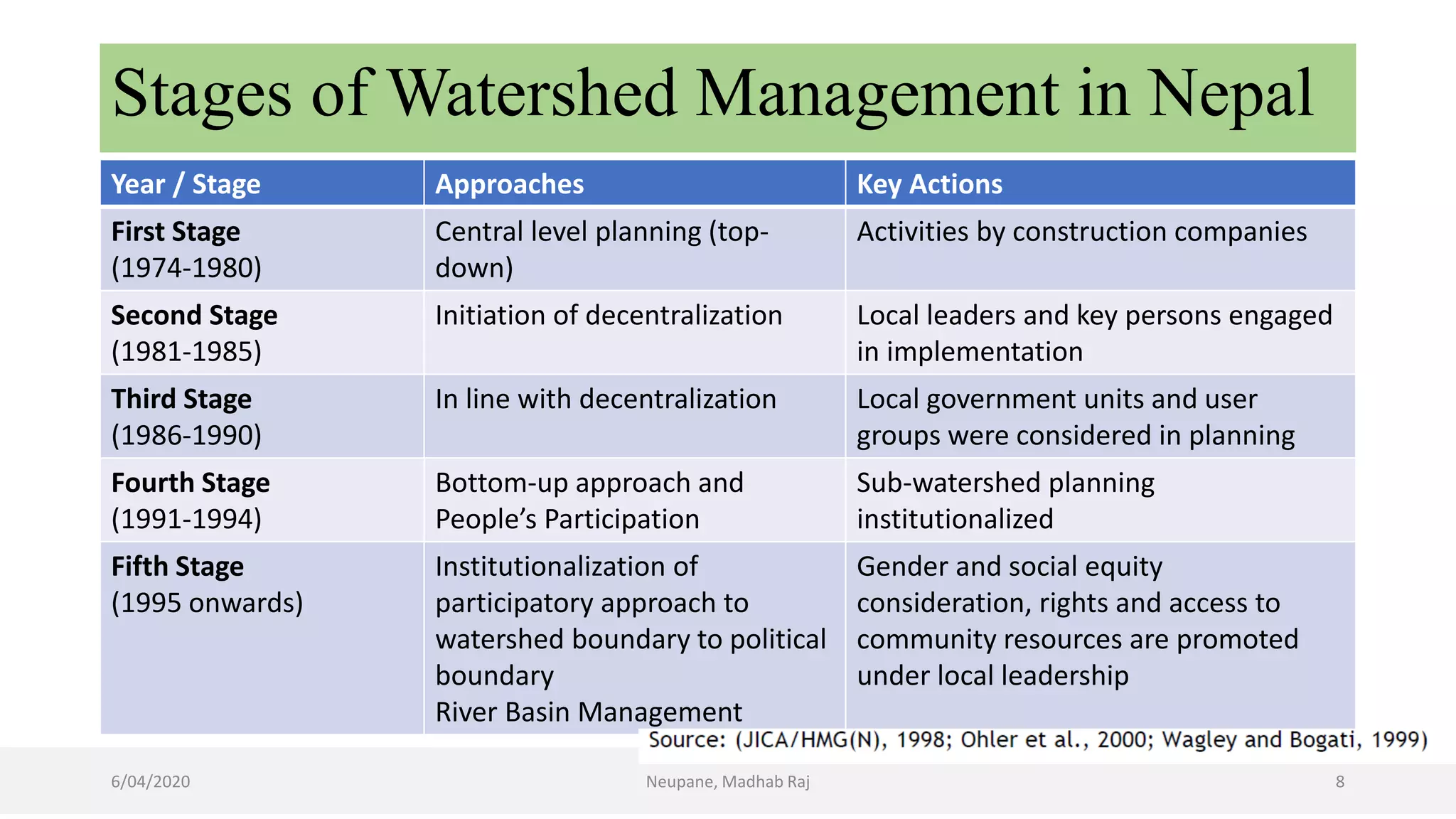
Stages of Watershed Management in Nepal
Year / Stage Approaches Key Actions
First Stage
(1974-1980)
Central level planning (top-
down)
Activities by construction companies
Second Stage
(1981-1985)
Initiation of decentralization Local leaders and key persons engaged
in implementation
Third Stage
(1986-1990)
In line with decentralization Local government units and user
groups were considered in planning
Fourth Stage
(1991-1994)
Bottom-up approach and
People’s Participation
Sub-watershed planning
institutionalized
Fifth Stage
(1995 onwards)
Institutionalization of
participatory approach to
watershed boundary to political
boundary
River Basin Management
Gender and social equity
consideration, rights and access to
community resources are promoted
under local leadership
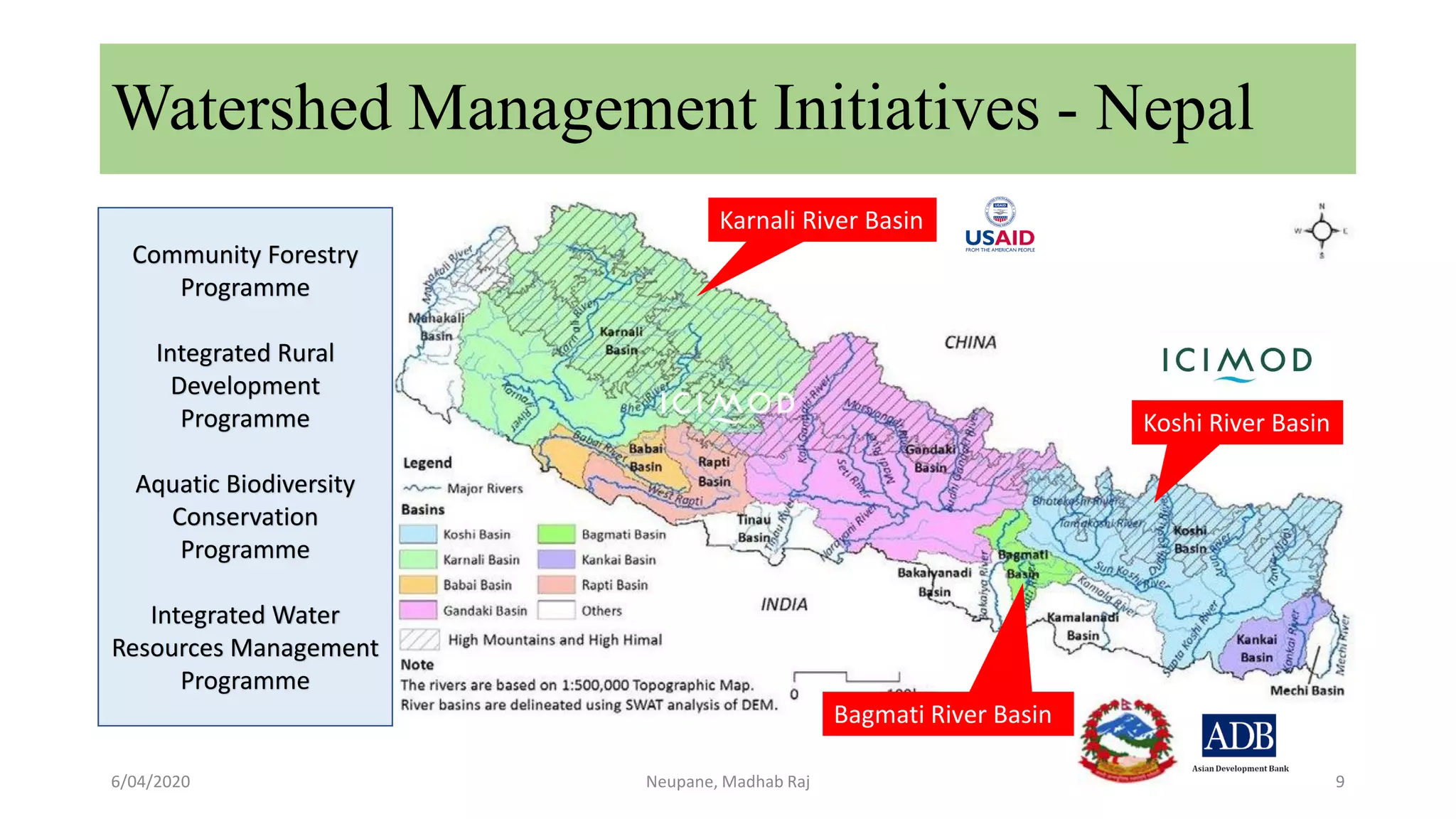
Watershed Management Initiatives - Nepal
6/04/2020 Neupane, Madhab Raj 9
Karnali River Basin
Koshi River Basin
Bagmati River Basin
Community Forestry
Programme
Integrated Rural
Development
Programme
Aquatic Biodiversity
Conservation
Programme
Integrated Water
Resources Management
Programme
Bagmati River Basin Improvement Project
6/04/2020 Neupane, Madhab Raj 10
Kathmandu Valley
Capital City
Bagmati River Watershed – Upper Part
6/04/2020 Neupane, Madhab Raj 11
Land Use Map
Issues / Problems of Bagmati in Kathmandu
6/04/2020 Neupane, Madhab Raj 12
Prioritizing and Categorizing the actions
6/04/2020 Neupane, Madhab Raj 13
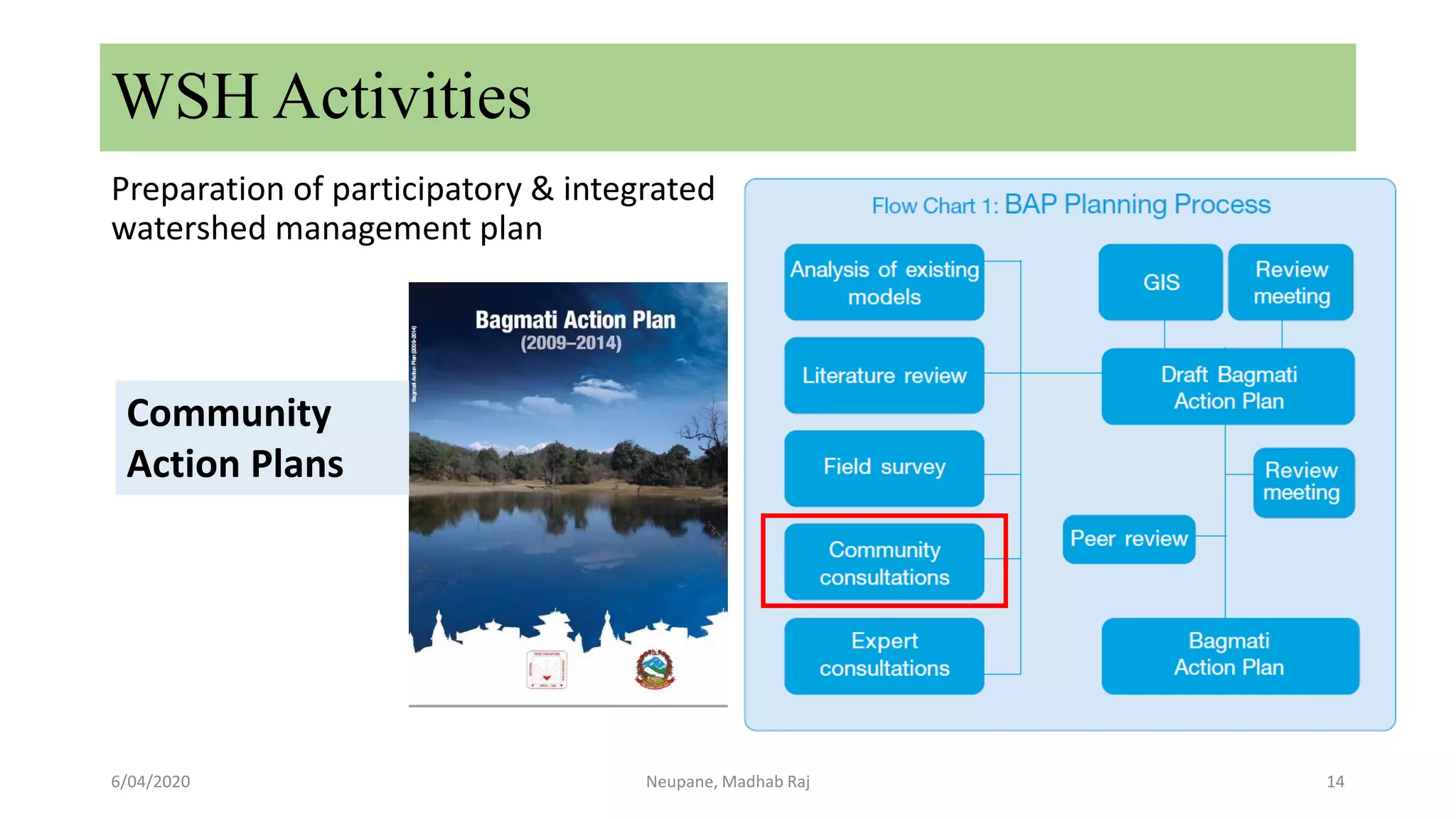
WSM Activities
Preparation of participatory & integrated
watershed management plan
6/04/2020 Neupane, Madhab Raj 14
WSH Activities
Community
Action Plans
• Awareness raising and
promoting echo
friendly cooking
stoves, environment
protection, organic
farming in watershed
area
6/04/2020 Neupane, Madhab Raj 15
WSH Activities
Connecting
Culture + Environment
+ Tourism
WSM Activities
• Conservation of
Water Recharge
Areas (Origin of Bagmati)
6/04/2020 Neupane, Madhab Raj 16
WSM Activities
• Construction of dams
6/04/2020 Neupane, Madhab Raj 17
• Construction of sewer lies, green belts, access roads
6/04/2020 Neupane, Madhab Raj 18
WSM Activities
• Waste Water Treatment
6/04/2020 Neupane, Madhab Raj 19
Key Activities
• Riverbank Protection
WSH Activities
• Dismantling encroachment
infrastructures within riverbank
6/04/2020 Neupane, Madhab Raj 20
Citizens’ Initiatives – Clean Bagmati Mega-Campaign
6/04/2020 Neupane, Madhab Raj 21
• Citizens led
campaign
• Each week (Saturday)
• 2 hours
• Specific Segment
• Voluntary
368 +
Weeks
Impacts to Human and Environment (forest, water, land)
6/04/2020 Neupane, Madhab Raj 22
Issues and Challenges
6/04/2020 Neupane, Madhab Raj 23
- Participatory process is a long and costly process
- Difficult to include representatives of all stakeholder groups in
management and decision-making
- Conflict between local level management in natural resources due to
national forest policy and local government policy (difference in rights
and roles),
- The poor sectors of society tend to have less participation due to several
constraints like lack of time, seasonal migration, low level of education
and awareness and lack of confidence
- Watershed boundaries and political boundaries do not coincide - each
agency has its own separate plans and responsibilities (hence challenges
of coordination among different agencies) – Transboundary Issues
Management issues
Policy issues
Poverty issues
Institutional issues
Rapid Urbanization
6/04/2020 Neupane, Madhab Raj 24
Temperature Trend : Increasing
Dhital and Shi, 2013
Ishtiaque, A.; Shrestha, M.; Chhetri, N., 2017
6/04/2020 Neupane, Madhab Raj 25
Land Ownership and Change in Land Use
Source: Ishtiaque, Asif &
Shrestha, Milan & Chhetri,
Netra. (2017)
6/04/2020 Neupane, Madhab Raj 26
Transboundary Water Management
Nepal - India
Mahakali
Karnali
Gandaki
Koshi
Relevance to Spatial Planning
• Spatial planning and Watershed Management are both about
• Setting a framework for land use, investments in large public or
private projects and protecting or enhancing our natural resources
and the environment.
• Both require engaging multiple stakeholders through
coordination, collaboration for integrated planning
6/04/2020 Neupane, Madhab Raj 27
Discussion
What watershed management
principles and approaches are used in
your home countries ?
6/04/2020 Neupane, Madhab Raj 28
1
Discussion
What are the key challenges of watershed
management practices in your home
countries? And how are they being
addressed ?
6/04/2020 Neupane, Madhab Raj 29
2
References
• Bagmati Buttetin. (2018). http://bagmati.gov.np/uploaded/Buletin-2075.pdf
• Bagmati Action Plan. (2009). http://bagmati.gov.np/uploaded/Bagmati-Action-Plan-En.pdf
• FAO. (2014).Watershed Management Case Study: Nepal
• NagarikNews. https://myrepublica.nagariknetwork.com/news/indian-dam-road-inundated-nepali-
villages-with-photos/
• Khadka, Ananda & Pokharel, Kiran. (2015). HIGH MOUNTAINS AND HIGH HIMAL
FORESTS Of NEPAL. https://www.researchgate.net/figure/River-basins-and-drainage-system-of-
Nepal_fig4_337830788
• http://hawp.org/what-is-a-watershed/
• https://www.land-links.org/country-profile/nepal-2/
• https://portal.ct.gov/DEEP/Water/Watershed-Management/Watershed-Management---Overview
• https://www.geo.fu-berlin.de/en/v/iwm-network/learning_content/_archive/
bak_introduction_iwm/iwm_planning_approach/principles_IWM/index.html
6/04/2020 Neupane, Madhab Raj 30
Thank You !!!

Watershed Management Practices in Nepal

  • 1.
    Watershed Management inNepal Practices and Lessons Neupane, Madhab Raj Madhab.Neupane@tu-dortmund.de Land Use Planning and Environment Management
  • 2.
    Outline •Definition – Watershedand Watershed Management •Country Context •Legal and Institutional Framework •Practices, Issues and Challenges •Relevance to Spatial Planning •Discussion 6/04/2020 Neupane, Madhab Raj 2
  • 3.
    Definition Watershed A watershed isan area of land, such as a mountain or valley, which collects rainwater into a common outlet. 6/04/2020 Neupane, Madhab Raj 3 Image from: http://hawp.org/what-is-a-watershed/ Every body of water has a watershed.
  • 4.
    Definition Watershed Management Process ofimplementing land use practices and water management practices to protect and improve the quality of the water and other natural resources within a watershed by managing the use of those land and water resources in a comprehensive manner. 6/04/2020 Neupane, Madhab Raj 4 https://portal.ct.gov/DEEP/Water/Watershed-Management/Watershed-Management---Overview https://www.geo.fu-berlin.de/en/v/iwm-network/learning_content/_archive/ bak_introduction_iwm/iwm_planning_approach/principles_IWM/index.html
  • 5.
    Country Context 6/04/2020 Neupane,Madhab Raj 5 Population: 28.09 Million (2018) - World bank Geographical Area: 147,516 Sq. KM Forest Area: 44.74 % (MoPE, 2018) Waterbodies: 6,000 rivers + 5,358 lakes Snow Covered Area (Glaciers): 5,323 km2 Agriculture area: 28.748 % (2016) - World bank Federal Democratic Republic (3 tier government) 1 Federal Government 7 Province Governments 273 Local Governments
  • 6.
    Situation of Watersheds- Nepal 6/04/2020 Neupane, Madhab Raj 6 32%
  • 7.
    6/04/2020 Neupane, MadhabRaj 7 Water Resources Land Resources Forest Resources Other Environment Policies Linked with Watershed Management (Eco-system based) Integrated Watershed Management Participatory and Integrated Watershed Management River Basin Improvement and Management Programme Water Resources Act, 1992 Water Resource Strategy, 2002 National Land Use Policy, 2015 National Forest Policy, 2018 Environment Protection Act, 1996 Soil and Watershed Conservation Act, 1982 Protected Areas Community Forest Family Forest
  • 8.
    6/04/2020 Neupane, MadhabRaj 8 Stages of Watershed Management in Nepal Year / Stage Approaches Key Actions First Stage (1974-1980) Central level planning (top- down) Activities by construction companies Second Stage (1981-1985) Initiation of decentralization Local leaders and key persons engaged in implementation Third Stage (1986-1990) In line with decentralization Local government units and user groups were considered in planning Fourth Stage (1991-1994) Bottom-up approach and People’s Participation Sub-watershed planning institutionalized Fifth Stage (1995 onwards) Institutionalization of participatory approach to watershed boundary to political boundary River Basin Management Gender and social equity consideration, rights and access to community resources are promoted under local leadership
  • 9.
    Watershed Management Initiatives- Nepal 6/04/2020 Neupane, Madhab Raj 9 Karnali River Basin Koshi River Basin Bagmati River Basin Community Forestry Programme Integrated Rural Development Programme Aquatic Biodiversity Conservation Programme Integrated Water Resources Management Programme
  • 10.
    Bagmati River BasinImprovement Project 6/04/2020 Neupane, Madhab Raj 10 Kathmandu Valley Capital City
  • 11.
    Bagmati River Watershed– Upper Part 6/04/2020 Neupane, Madhab Raj 11 Land Use Map
  • 12.
    Issues / Problemsof Bagmati in Kathmandu 6/04/2020 Neupane, Madhab Raj 12
  • 13.
    Prioritizing and Categorizingthe actions 6/04/2020 Neupane, Madhab Raj 13 WSM Activities
  • 14.
    Preparation of participatory& integrated watershed management plan 6/04/2020 Neupane, Madhab Raj 14 WSH Activities Community Action Plans
  • 15.
    • Awareness raisingand promoting echo friendly cooking stoves, environment protection, organic farming in watershed area 6/04/2020 Neupane, Madhab Raj 15 WSH Activities Connecting Culture + Environment + Tourism
  • 16.
    WSM Activities • Conservationof Water Recharge Areas (Origin of Bagmati) 6/04/2020 Neupane, Madhab Raj 16
  • 17.
    WSM Activities • Constructionof dams 6/04/2020 Neupane, Madhab Raj 17
  • 18.
    • Construction ofsewer lies, green belts, access roads 6/04/2020 Neupane, Madhab Raj 18 WSM Activities
  • 19.
    • Waste WaterTreatment 6/04/2020 Neupane, Madhab Raj 19 Key Activities • Riverbank Protection
  • 20.
    WSH Activities • Dismantlingencroachment infrastructures within riverbank 6/04/2020 Neupane, Madhab Raj 20
  • 21.
    Citizens’ Initiatives –Clean Bagmati Mega-Campaign 6/04/2020 Neupane, Madhab Raj 21 • Citizens led campaign • Each week (Saturday) • 2 hours • Specific Segment • Voluntary 368 + Weeks
  • 22.
    Impacts to Humanand Environment (forest, water, land) 6/04/2020 Neupane, Madhab Raj 22
  • 23.
    Issues and Challenges 6/04/2020Neupane, Madhab Raj 23 - Participatory process is a long and costly process - Difficult to include representatives of all stakeholder groups in management and decision-making - Conflict between local level management in natural resources due to national forest policy and local government policy (difference in rights and roles), - The poor sectors of society tend to have less participation due to several constraints like lack of time, seasonal migration, low level of education and awareness and lack of confidence - Watershed boundaries and political boundaries do not coincide - each agency has its own separate plans and responsibilities (hence challenges of coordination among different agencies) – Transboundary Issues Management issues Policy issues Poverty issues Institutional issues
  • 24.
    Rapid Urbanization 6/04/2020 Neupane,Madhab Raj 24 Temperature Trend : Increasing Dhital and Shi, 2013 Ishtiaque, A.; Shrestha, M.; Chhetri, N., 2017
  • 25.
    6/04/2020 Neupane, MadhabRaj 25 Land Ownership and Change in Land Use Source: Ishtiaque, Asif & Shrestha, Milan & Chhetri, Netra. (2017)
  • 26.
    6/04/2020 Neupane, MadhabRaj 26 Transboundary Water Management Nepal - India Mahakali Karnali Gandaki Koshi
  • 27.
    Relevance to SpatialPlanning • Spatial planning and Watershed Management are both about • Setting a framework for land use, investments in large public or private projects and protecting or enhancing our natural resources and the environment. • Both require engaging multiple stakeholders through coordination, collaboration for integrated planning 6/04/2020 Neupane, Madhab Raj 27
  • 28.
    Discussion What watershed management principlesand approaches are used in your home countries ? 6/04/2020 Neupane, Madhab Raj 28 1
  • 29.
    Discussion What are thekey challenges of watershed management practices in your home countries? And how are they being addressed ? 6/04/2020 Neupane, Madhab Raj 29 2
  • 30.
    References • Bagmati Buttetin.(2018). http://bagmati.gov.np/uploaded/Buletin-2075.pdf • Bagmati Action Plan. (2009). http://bagmati.gov.np/uploaded/Bagmati-Action-Plan-En.pdf • FAO. (2014).Watershed Management Case Study: Nepal • NagarikNews. https://myrepublica.nagariknetwork.com/news/indian-dam-road-inundated-nepali- villages-with-photos/ • Khadka, Ananda & Pokharel, Kiran. (2015). HIGH MOUNTAINS AND HIGH HIMAL FORESTS Of NEPAL. https://www.researchgate.net/figure/River-basins-and-drainage-system-of- Nepal_fig4_337830788 • http://hawp.org/what-is-a-watershed/ • https://www.land-links.org/country-profile/nepal-2/ • https://portal.ct.gov/DEEP/Water/Watershed-Management/Watershed-Management---Overview • https://www.geo.fu-berlin.de/en/v/iwm-network/learning_content/_archive/ bak_introduction_iwm/iwm_planning_approach/principles_IWM/index.html 6/04/2020 Neupane, Madhab Raj 30
  • 31.