AITPM SA – October Seminar
Beyond back to basics 2015 – What’s new?
23 October 2015
Driverless Cars
Matthew Leyson
Manager, Safer Vehicles and Technologies
Department of Planning, Transport and Infrastructure
Driverless Cars – Is the future now?
• Timeline for introduction – or are they here?
• Expected benefits
• Technology required – Vehicles? Roads? Infrastructure? IoT?
• The human machine interface
• What the future holds for the design for our cities and homes
• Where does Australia fit in the research
• Many challenges ahead;
– legislation, liability, security, technology
• South Australia are set to be global leaders in driverless cars
– Conference, legislation, trials & research
Driverless Cars – How long to wait
• Many automated vehicle technologies are here now or scheduled
for release
• Automated vehicles by 2020, common & affordable by 2025
• 2035 – 9% of vehicle sales will be driverless
• 2055 – 90% of vehicle sales will be driverless
• Driverless cars are being tested by Google, Volvo, GM, BMW,
Mercedes Benz, Audi, Tesla, Ford, Toyota and others
Adelaide demonstration – 7 November 2015
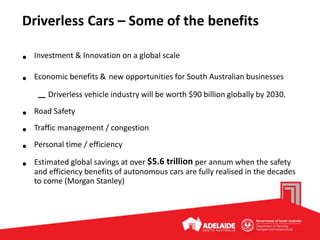
Driverless Cars – Some of the benefits
• Investment & Innovation on a global scale
• Economic benefits & new opportunities for South Australian businesses
– Driverless vehicle industry will be worth $90 billion globally by 2030.
• Road Safety
• Traffic management / congestion
• Personal time / efficiency
• Estimated global savings at over $5.6 trillion per annum when the safety
and efficiency benefits of autonomous cars are fully realised in the decades
to come (Morgan Stanley)
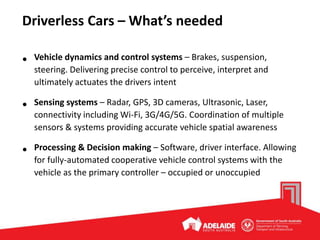
Driverless Cars – What’s needed
• Vehicle dynamics and control systems – Brakes, suspension,
steering. Delivering precise control to perceive, interpret and
ultimately actuates the drivers intent
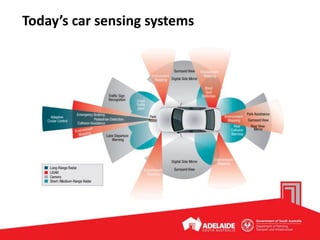
• Sensing systems – Radar, GPS, 3D cameras, Ultrasonic, Laser,
connectivity including Wi-Fi, 3G/4G/5G. Coordination of multiple
sensors & systems providing accurate vehicle spatial awareness
• Processing & Decision making – Software, driver interface. Allowing
for fully-automated cooperative vehicle control systems with the
vehicle as the primary controller – occupied or unoccupied
Today’s car sensing systems
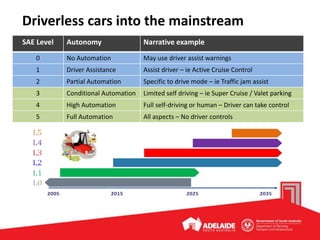
Driverless cars into the mainstream
SAE Level Autonomy Narrative example
0 No Automation May use driver assist warnings
1 Driver Assistance Assist driver – ie Active Cruise Control
2 Partial Automation Specific to drive mode – ie Traffic jam assist
3 Conditional Automation Limited self driving – ie Super Cruise / Valet parking
4 High Automation Full self-driving or human – Driver can take control
5 Full Automation All aspects – No driver controls
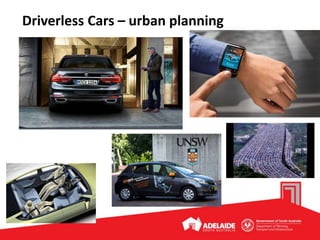
Driverless Cars – urban planning
Driverless Cars – Where does Australia fit?
• Research conducted in the UK, US & Australia measuring public attitudes
towards driverless cars – Australians recorded the highest positive
opinion (62% of respondents were positive)
• Australians have always been early adopters of innovations and new
technologies
• Australians are well-regarded internationally for being at the cutting
edge of innovation
• Ten years ago neither the iPhone nor Android even existed. Today three-
quarters of Australians own smartphones and its increasing
www.driverlesscars.sa.gov.au

Driverless Cars

  • 1.
    AITPM SA –October Seminar Beyond back to basics 2015 – What’s new? 23 October 2015 Driverless Cars Matthew Leyson Manager, Safer Vehicles and Technologies Department of Planning, Transport and Infrastructure
  • 2.
    Driverless Cars –Is the future now? • Timeline for introduction – or are they here? • Expected benefits • Technology required – Vehicles? Roads? Infrastructure? IoT? • The human machine interface • What the future holds for the design for our cities and homes • Where does Australia fit in the research • Many challenges ahead; – legislation, liability, security, technology • South Australia are set to be global leaders in driverless cars – Conference, legislation, trials & research
  • 4.
    Driverless Cars –How long to wait • Many automated vehicle technologies are here now or scheduled for release • Automated vehicles by 2020, common & affordable by 2025 • 2035 – 9% of vehicle sales will be driverless • 2055 – 90% of vehicle sales will be driverless • Driverless cars are being tested by Google, Volvo, GM, BMW, Mercedes Benz, Audi, Tesla, Ford, Toyota and others Adelaide demonstration – 7 November 2015
  • 5.
    Driverless Cars –Some of the benefits • Investment & Innovation on a global scale • Economic benefits & new opportunities for South Australian businesses – Driverless vehicle industry will be worth $90 billion globally by 2030. • Road Safety • Traffic management / congestion • Personal time / efficiency • Estimated global savings at over $5.6 trillion per annum when the safety and efficiency benefits of autonomous cars are fully realised in the decades to come (Morgan Stanley)
  • 6.
    Driverless Cars –What’s needed • Vehicle dynamics and control systems – Brakes, suspension, steering. Delivering precise control to perceive, interpret and ultimately actuates the drivers intent • Sensing systems – Radar, GPS, 3D cameras, Ultrasonic, Laser, connectivity including Wi-Fi, 3G/4G/5G. Coordination of multiple sensors & systems providing accurate vehicle spatial awareness • Processing & Decision making – Software, driver interface. Allowing for fully-automated cooperative vehicle control systems with the vehicle as the primary controller – occupied or unoccupied
  • 7.
  • 8.
    Driverless cars intothe mainstream SAE Level Autonomy Narrative example 0 No Automation May use driver assist warnings 1 Driver Assistance Assist driver – ie Active Cruise Control 2 Partial Automation Specific to drive mode – ie Traffic jam assist 3 Conditional Automation Limited self driving – ie Super Cruise / Valet parking 4 High Automation Full self-driving or human – Driver can take control 5 Full Automation All aspects – No driver controls
  • 10.
    Driverless Cars –urban planning
  • 11.
    Driverless Cars –Where does Australia fit? • Research conducted in the UK, US & Australia measuring public attitudes towards driverless cars – Australians recorded the highest positive opinion (62% of respondents were positive) • Australians have always been early adopters of innovations and new technologies • Australians are well-regarded internationally for being at the cutting edge of innovation • Ten years ago neither the iPhone nor Android even existed. Today three- quarters of Australians own smartphones and its increasing
  • 12.