DRIVERLESS
CAR
The Ethics Of Autonomous vehicles
DRIVERLESS CAR
 It is vehicle that can drive itself from one
point to another without assistance from a
driver , in other words , with an autopilot
system.
INTRODUCTION
 Driver error is the most common cause of
traffic accidents.
 Cell phones in car , entertainment system
,more traffic and more complicated road
making it more frequent.
 By this improving technology our car will do
the concentrating for us.
DRIVERLESS CARS WORK
 Driverless car sense their surrounding using technology.
 The sensory information is then processed to navigate
appropriate pathways for the vehicle to take , avoiding any
obstacles and also obeying the road signs.
 The car uses a digital map , which can be constantly
updated according to sensory input. This allows the vehicle
to adopt the changing situation , as well as travel through
previously unknown territories.
TECHNOLOGY MAKING ASYSTEM
FULLY AUTONOMOUS
 Anti-lock Brakes (ABS) System.
 Electronic Stability Control (ESC).
 Cruise Control.
 Lane Departure Warning System.
 Self Parking System.
 Lidar System.
 Radar System.
 GPS System.
ANTI- LOCK BRAKES SYSTEM
 It operate Automatic Brake , by
applying the brakes to slow the
vehicle without any driver input.
ELECTRONIC STABILITY
CONTROL
 Its a computerized
technology improves
vehicle stability by detecting
and minimizing skids.
 It helps to minimizing a loss
of control.
CRUISE CONTROL
 It keep the car at a constant
speed by taking over the throttle
of the car.
 It also maintain a set distance
between it and the car in front of
it.
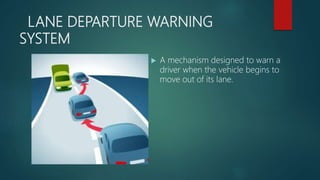
LANE DEPARTURE WARNING
SYSTEM
 A mechanism designed to warn a
driver when the vehicle begins to
move out of its lane.
SELF PARKING SYSTEM
 It’s a system that uses sensors
all around the car to guide it
into a parallel parking space.
LIDAR SYSTEM
 It used by Google Inc. for
detecting the surrounding of the
vehicle.
 360* degree static scanning.
RADAR SYSTEM
 It is an object detection
system that uses radio waves
to determine the range ,
angle , or velocity of objects.
GPS SYSTEM
 The Global Navigation Satellite
system that provides location and
time information in all weather
conditions , anywhere on or near
the earth.
ADVANTAGES
 Creating more free time.
 Improving safety.
 Reducing emission and easing congestion.
 Efficient travel also means fuel savings.
 To avoid accidents.
 It can allow the people to concentrate on other tasks or to
rest during their journeys.
 Increases access to vehicles for everyone.
DISADVANTAGES
 Poor performance in adverse weather condition.
 If the car crashes , without a driver , who`s fault is it.
Google/the software designer , or the owner of the vehicle.
 In case of failure of main sensor and backup sensors the
vehicle can create a chance of accident.
 Hackers can change the rout which is plotted in the system
(in rare cases).
 Truck drivers and taxi-drivers will lose their jobs , as
autonomous vehicles take over.
APPLICATION
 Cars
 Buses
 Commercial vehicle
CONCLUSION
 The driverless car`s technology improves vehicle`s
stability helps to minimize loss of control.
 Driver less cars are designed to minimize accidents by
addressing the main causes of collisions : driving error ,
distraction & drowsiness.
REFERENCES
 https://en.wikipedia.org/wiki/Driverless_car
 http://axleaddict.com
 www.slideshare.net
 https://www.gov.uk/government/speeches/driverless-vehicles-the-uses-
and-benefits
THANK YOU

Driverless car

  • 1.
    DRIVERLESS CAR The Ethics OfAutonomous vehicles
  • 2.
    DRIVERLESS CAR  Itis vehicle that can drive itself from one point to another without assistance from a driver , in other words , with an autopilot system.
  • 3.
    INTRODUCTION  Driver erroris the most common cause of traffic accidents.  Cell phones in car , entertainment system ,more traffic and more complicated road making it more frequent.  By this improving technology our car will do the concentrating for us.
  • 4.
    DRIVERLESS CARS WORK Driverless car sense their surrounding using technology.  The sensory information is then processed to navigate appropriate pathways for the vehicle to take , avoiding any obstacles and also obeying the road signs.  The car uses a digital map , which can be constantly updated according to sensory input. This allows the vehicle to adopt the changing situation , as well as travel through previously unknown territories.
  • 5.
    TECHNOLOGY MAKING ASYSTEM FULLYAUTONOMOUS  Anti-lock Brakes (ABS) System.  Electronic Stability Control (ESC).  Cruise Control.  Lane Departure Warning System.  Self Parking System.  Lidar System.  Radar System.  GPS System.
  • 6.
    ANTI- LOCK BRAKESSYSTEM  It operate Automatic Brake , by applying the brakes to slow the vehicle without any driver input.
  • 7.
    ELECTRONIC STABILITY CONTROL  Itsa computerized technology improves vehicle stability by detecting and minimizing skids.  It helps to minimizing a loss of control.
  • 8.
    CRUISE CONTROL  Itkeep the car at a constant speed by taking over the throttle of the car.  It also maintain a set distance between it and the car in front of it.
  • 9.
    LANE DEPARTURE WARNING SYSTEM A mechanism designed to warn a driver when the vehicle begins to move out of its lane.
  • 10.
    SELF PARKING SYSTEM It’s a system that uses sensors all around the car to guide it into a parallel parking space.
  • 11.
    LIDAR SYSTEM  Itused by Google Inc. for detecting the surrounding of the vehicle.  360* degree static scanning.
  • 12.
    RADAR SYSTEM  Itis an object detection system that uses radio waves to determine the range , angle , or velocity of objects.
  • 13.
    GPS SYSTEM  TheGlobal Navigation Satellite system that provides location and time information in all weather conditions , anywhere on or near the earth.
  • 14.
    ADVANTAGES  Creating morefree time.  Improving safety.  Reducing emission and easing congestion.  Efficient travel also means fuel savings.  To avoid accidents.  It can allow the people to concentrate on other tasks or to rest during their journeys.  Increases access to vehicles for everyone.
  • 15.
    DISADVANTAGES  Poor performancein adverse weather condition.  If the car crashes , without a driver , who`s fault is it. Google/the software designer , or the owner of the vehicle.  In case of failure of main sensor and backup sensors the vehicle can create a chance of accident.  Hackers can change the rout which is plotted in the system (in rare cases).  Truck drivers and taxi-drivers will lose their jobs , as autonomous vehicles take over.
  • 16.
  • 17.
    CONCLUSION  The driverlesscar`s technology improves vehicle`s stability helps to minimize loss of control.  Driver less cars are designed to minimize accidents by addressing the main causes of collisions : driving error , distraction & drowsiness.
  • 18.
    REFERENCES  https://en.wikipedia.org/wiki/Driverless_car  http://axleaddict.com www.slideshare.net  https://www.gov.uk/government/speeches/driverless-vehicles-the-uses- and-benefits
  • 19.