
AUTONOMOUS CAR 
SUBMITTED BY 
ABHISEK DAS 
REGN. NO. 1101109183 
GUIDED BY 
DR. TRILOCHAN ROUT
CONTENTS 
 Introduction 
 What is Autonomous car 
 Back Ground 
 Component Use 
 Working 
 Companies Name 
 Benefits
INTRODUCTION 
 Driver error is the most common cause of 
traffic accidents 
 India contributes 6 % of the world's road 
accident deaths 
 Cell phones in-car ,entertainment systems, more 
traffic and more complicated road systems 
making it more frequent 
 Drowsiness of the driver and failure in taking 
sudden decisions adds up to the factors . 
 The fully autonomous cars posses the 
technology which drives it the safest way 
possible and have been proved successful in this 
context till now .
WHAT IS A AUTONOMOUS CAR 
 Autonomous car are also called automated 
car or robotic vehicle or self-driving car . 
 That is designed to travel between 
destinations without a human interaction. 
 To qualify as fully autonomous, a vehicle 
must be able to navigate without human 
intervention to a predetermined destination 
over roads that have not been adapted for 
its use.
BACK GROUND 
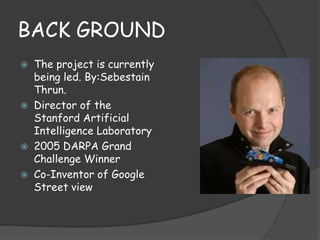
 The project is currently 
being led. By:Sebestain 
Thrun. 
 Director of the 
Stanford Artificial 
Intelligence Laboratory 
 2005 DARPA Grand 
Challenge Winner 
 Co-Inventor of Google 
Street view
ABOUT EXISTING AUTONOMOUS CARS 
 A lot of experiments where done regarding this topic 
but the only successful , fully autonomous , driverless 
car was finally invented by a team of engineers in 
Google . 
 Google Chauffer or Google Car is considered to be one 
of the best inventions in the last 25 years . 
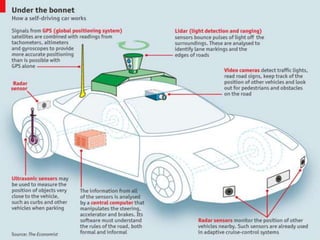
 Consisting of a whole lot of sensor systems and a 
powerful central processing unit , Google Car easily 
drives through any traffic conditions and topologies . 
 It detects pedestrians , cyclists , traffic signals , 
oncoming vehicles , speed and distance to be 
maintained between successive vehicles etc .
COMPONENTS USED 
 LIDAR( Light Detection And Ranging) 
 Automotive Radar System 
 Ultrasonic Sensors 
 Video Cameras 
 GPS( Global Positioning System) 
 Position Estimators 
 Inertial Measurement Unit 
 A central processing unit or computer unit to control all 
the above systems as well as systems like ABS 
(Antilock Braking System) , ESC ( Electronic Stability 
Control ) , Self Parking etc.
THE LIDAR SYSTEM 
 The Light Detection And Ranging system can be 
considered as the eye of the car . 
 It is a remote sensing technology which measures 
distance by illuminating a target with a light beam and 
analyses the reflected light . 
 It uses Laser beams , ultra violet , visible light or near 
infrared light to image objects . 
 It can target a wide range of materials . 
 Here , a narrow laser beam is used , which maps 
physical structures with a high resolution . 
 There are two types of LIDAR systems : Coherent and 
Incoherent . 
 Here , a Coherent LIDAR system is used which uses 
Optical Heterodyne Detection , which yields more 
sensitivity than Incoherent systems , but at the 
expense of more complex transceiver components .
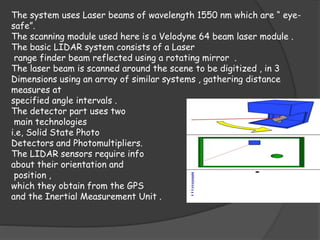
The system uses Laser beams of wavelength 1550 nm which are “ eye-safe”. 
The scanning module used here is a Velodyne 64 beam laser module . 
The basic LIDAR system consists of a Laser 
range finder beam reflected using a rotating mirror . 
The laser beam is scanned around the scene to be digitized , in 3 
Dimensions using an array of similar systems , gathering distance 
measures at 
specified angle intervals . 
The detector part uses two 
main technologies 
i.e, Solid State Photo 
Detectors and Photomultipliers. 
The LIDAR sensors require info 
about their orientation and 
position , 
which they obtain from the GPS 
and the Inertial Measurement Unit .
THE AUTOMOTIVE RADAR SYSTEM 
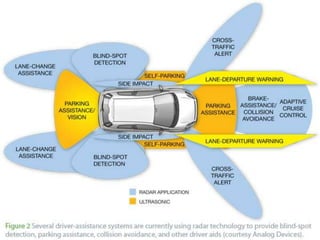
 The Radar system used here is of 24GHz domain which 
have good performance in range and azimuth angle 
measurement . 
 The range of radar systems used is up to 300m . 
 The radar system are used for detecting oncoming 
vehicles , their speed , other obstacles , for self parking 
, blind spot detection , pre-crash detection etc. 
 The Radar systems are installed on the bumper of the 
vehicle at the front 
as well as at the back side of the vehicle . 
For applications other than blind spot 
detection , higher precision , longer range and 
higher update rates are needed . 
 Radar systems detect the surrounding 
environment and the central computer combines 
this result with that of the LIDAR system .
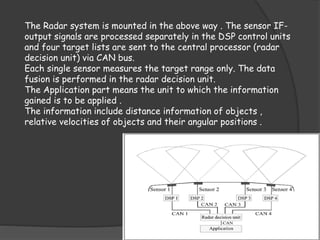
The Radar system is mounted in the above way . The sensor IF-output 
signals are processed separately in the DSP control units 
and four target lists are sent to the central processor (radar 
decision unit) via CAN bus. 
Each single sensor measures the target range only. The data 
fusion is performed in the radar decision unit. 
The Application part means the unit to which the information 
gained is to be applied . 
The information include distance information of objects , 
relative velocities of objects and their angular positions .
HOW THE CAR SEES THE WORLD 
 The information from the LIDAR system , the Radar Systems as 
well as The ULTRASONIC Sensors which are used for Blind Spot 
detection as well as to detect nearby objects and also some data 
from the video camera are combined by the central processing unit 
. 
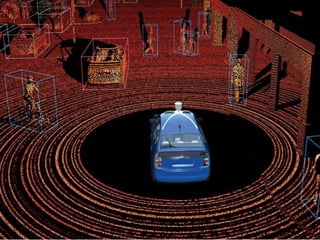
 By combining these data , a 3D map of the surroundings is 
generated by the central computer . 
 The 3D map will include detailed info. about moving and stationary 
objects , like pedestrians , cyclists , other vehicles , edges 
of roads . 
 Combining the 3D map with info. from the GPS module , the central 
processing unit controls the steering , accelerator brakes etc.
THE VIDEO CAMERA 
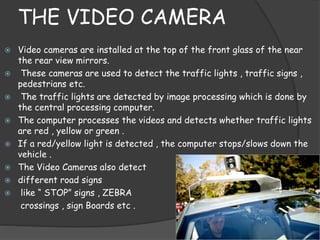
 Video cameras are installed at the top of the front glass of the near 
the rear view mirrors. 
 These cameras are used to detect the traffic lights , traffic signs , 
pedestrians etc. 
 The traffic lights are detected by image processing which is done by 
the central processing computer. 
 The computer processes the videos and detects whether traffic lights 
are red , yellow or green . 
 If a red/yellow light is detected , the computer stops/slows down the 
vehicle . 
 The Video Cameras also detect 
 different road signs 
 like “ STOP” signs , ZEBRA 
crossings , sign Boards etc .
THE GPS AND IMU SYSTEMS 
 GPS ( Global Positioning System ) , uses satellites to gather 
information about the current position of the vehicle , the 
topology and by using the GPS a map of the area is loaded into the 
central computer . 
 But data from GPS alone is less accurate . So , this data is 
combined with outputs from the IMU ( Inertial Measurement Unit 
) . 
 IMU is an electronic device which measures and gives information 
about the vehicle’s velocity , orientation , gravitational forces etc. 
 IMU uses a combination of accelerometers , gyroscopes and 
magnetometers . 
 An IMU helps GPS system to work when signals are unavailable 
such as in tunnels , buildings , bad weather conditions and when 
electromagnetic interference is present . 
 By combining data from IMU-GPS systems , a map is developed 
and is compared with the 3D map prepared by the computer for 
better results . 
 This system is also used in navigating the car by the user in which 
the passenger gives the destination he needs to reach using GPS 
systems .
THE CENTRAL COMPUTER 
 All the data obtained from each and every sensor systems is fed to 
the central computer . 
 The central computer is a very powerful processing unit mounted on 
the inside of the vehicle . 
 Position Estimator Sensor is an important part of the vehicle , which 
is an ultrasonic sensor used to detect the current position of the 
vehicle and respond to even a small movement of the vehicle . 
 It is used for constantly updating the position of the vehicle with 
respect to the 3D map . 
 It is mounted near the left rear wheel . 
 The central computer constantly receives data from the position 
estimator ( also called Wheel Encoder ) and combines it with the 
data from the other sensors . 
 The computer uses this data to control the steering , accelerator , 
brakes etc . 
 The computer also helps in navigating to a desired point through the 
shortest path . 
 It is also used for limiting the speed of the vehicle .
OTHER TECHNOLOGIES USD IN CAR 
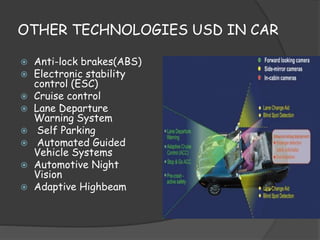
 Anti-lock brakes(ABS) 
 Electronic stability 
control (ESC) 
 Cruise control 
 Lane Departure 
Warning System 
 Self Parking 
 Automated Guided 
Vehicle Systems 
 Automotive Night 
Vision 
 Adaptive Highbeam
COMPANIES NAMES 
 Companies developing and/or testing cars 
include. 
 Audi 
 BMW 
 Ford 
 Google 
 General Motors 
 Volkswagen 
 Volvo
ADVANTAGES 
 Managing traffic flow to increase road capacity. 
 Relieving vehicle occupants from driving allowing 
them to concentrate on other tasks or to rest during 
their journeys. 
 To avoid accidents . 
 Increasing roadway capacity by managing the 
distances between cars. 
 The current location of vehicle can be determine 
using global positioning system (G.P.S) .
DISADVANTAGES 
 If the vehicle is using internet which is have less 
security then From the hackers point of view in 
some cases the vehicle can be switched off on the 
road(in rare cases) 
 Hackers can change the rout which is plotted in the 
system(in rare cases) 
 In case of failure of main sensor and backup 
sensors the vehicle can create a chance of accident 
 Also , there is difficulty for the system to 
understand hand-signals .
CONCLUSION 
 The driver less car is a technological 
masterpiece. 
 It is boon for handicapped people and for those 
who feel uncomfortable while driving . 
 It is very helpful in reducing the number of 
accidents . 
 The high cost of the sensor systems is a factor 
which can adversely affect it . But mass 
production of the vehicle can reduce the effect 
. 
 Also , if the nations like India approve such cars 
to be driven in the traffic , it will be very much 
helpful for us .
REFERENCES 
 http://en.wikipedia.org/wiki/driverless car 
 http://autocontrols.com.au/ 
 http://www.howstuffworks.com/cruise-control 
 http://www.howstuffworks.com/electronic 
stability control
Sazz

Sazz

  • 1.
    AUTONOMOUS CAR SUBMITTEDBY ABHISEK DAS REGN. NO. 1101109183 GUIDED BY DR. TRILOCHAN ROUT
  • 2.
    CONTENTS  Introduction  What is Autonomous car  Back Ground  Component Use  Working  Companies Name  Benefits
  • 3.
    INTRODUCTION  Drivererror is the most common cause of traffic accidents  India contributes 6 % of the world's road accident deaths  Cell phones in-car ,entertainment systems, more traffic and more complicated road systems making it more frequent  Drowsiness of the driver and failure in taking sudden decisions adds up to the factors .  The fully autonomous cars posses the technology which drives it the safest way possible and have been proved successful in this context till now .
  • 4.
    WHAT IS AAUTONOMOUS CAR  Autonomous car are also called automated car or robotic vehicle or self-driving car .  That is designed to travel between destinations without a human interaction.  To qualify as fully autonomous, a vehicle must be able to navigate without human intervention to a predetermined destination over roads that have not been adapted for its use.
  • 5.
    BACK GROUND The project is currently being led. By:Sebestain Thrun.  Director of the Stanford Artificial Intelligence Laboratory  2005 DARPA Grand Challenge Winner  Co-Inventor of Google Street view
  • 6.
    ABOUT EXISTING AUTONOMOUSCARS  A lot of experiments where done regarding this topic but the only successful , fully autonomous , driverless car was finally invented by a team of engineers in Google .  Google Chauffer or Google Car is considered to be one of the best inventions in the last 25 years .  Consisting of a whole lot of sensor systems and a powerful central processing unit , Google Car easily drives through any traffic conditions and topologies .  It detects pedestrians , cyclists , traffic signals , oncoming vehicles , speed and distance to be maintained between successive vehicles etc .
  • 7.
    COMPONENTS USED LIDAR( Light Detection And Ranging)  Automotive Radar System  Ultrasonic Sensors  Video Cameras  GPS( Global Positioning System)  Position Estimators  Inertial Measurement Unit  A central processing unit or computer unit to control all the above systems as well as systems like ABS (Antilock Braking System) , ESC ( Electronic Stability Control ) , Self Parking etc.
  • 9.
    THE LIDAR SYSTEM  The Light Detection And Ranging system can be considered as the eye of the car .  It is a remote sensing technology which measures distance by illuminating a target with a light beam and analyses the reflected light .  It uses Laser beams , ultra violet , visible light or near infrared light to image objects .  It can target a wide range of materials .  Here , a narrow laser beam is used , which maps physical structures with a high resolution .  There are two types of LIDAR systems : Coherent and Incoherent .  Here , a Coherent LIDAR system is used which uses Optical Heterodyne Detection , which yields more sensitivity than Incoherent systems , but at the expense of more complex transceiver components .
  • 10.
    The system usesLaser beams of wavelength 1550 nm which are “ eye-safe”. The scanning module used here is a Velodyne 64 beam laser module . The basic LIDAR system consists of a Laser range finder beam reflected using a rotating mirror . The laser beam is scanned around the scene to be digitized , in 3 Dimensions using an array of similar systems , gathering distance measures at specified angle intervals . The detector part uses two main technologies i.e, Solid State Photo Detectors and Photomultipliers. The LIDAR sensors require info about their orientation and position , which they obtain from the GPS and the Inertial Measurement Unit .
  • 11.
    THE AUTOMOTIVE RADARSYSTEM  The Radar system used here is of 24GHz domain which have good performance in range and azimuth angle measurement .  The range of radar systems used is up to 300m .  The radar system are used for detecting oncoming vehicles , their speed , other obstacles , for self parking , blind spot detection , pre-crash detection etc.  The Radar systems are installed on the bumper of the vehicle at the front as well as at the back side of the vehicle . For applications other than blind spot detection , higher precision , longer range and higher update rates are needed .  Radar systems detect the surrounding environment and the central computer combines this result with that of the LIDAR system .
  • 13.
    The Radar systemis mounted in the above way . The sensor IF-output signals are processed separately in the DSP control units and four target lists are sent to the central processor (radar decision unit) via CAN bus. Each single sensor measures the target range only. The data fusion is performed in the radar decision unit. The Application part means the unit to which the information gained is to be applied . The information include distance information of objects , relative velocities of objects and their angular positions .
  • 14.
    HOW THE CARSEES THE WORLD  The information from the LIDAR system , the Radar Systems as well as The ULTRASONIC Sensors which are used for Blind Spot detection as well as to detect nearby objects and also some data from the video camera are combined by the central processing unit .  By combining these data , a 3D map of the surroundings is generated by the central computer .  The 3D map will include detailed info. about moving and stationary objects , like pedestrians , cyclists , other vehicles , edges of roads .  Combining the 3D map with info. from the GPS module , the central processing unit controls the steering , accelerator brakes etc.
  • 16.
    THE VIDEO CAMERA  Video cameras are installed at the top of the front glass of the near the rear view mirrors.  These cameras are used to detect the traffic lights , traffic signs , pedestrians etc.  The traffic lights are detected by image processing which is done by the central processing computer.  The computer processes the videos and detects whether traffic lights are red , yellow or green .  If a red/yellow light is detected , the computer stops/slows down the vehicle .  The Video Cameras also detect  different road signs  like “ STOP” signs , ZEBRA crossings , sign Boards etc .
  • 17.
    THE GPS ANDIMU SYSTEMS  GPS ( Global Positioning System ) , uses satellites to gather information about the current position of the vehicle , the topology and by using the GPS a map of the area is loaded into the central computer .  But data from GPS alone is less accurate . So , this data is combined with outputs from the IMU ( Inertial Measurement Unit ) .  IMU is an electronic device which measures and gives information about the vehicle’s velocity , orientation , gravitational forces etc.  IMU uses a combination of accelerometers , gyroscopes and magnetometers .  An IMU helps GPS system to work when signals are unavailable such as in tunnels , buildings , bad weather conditions and when electromagnetic interference is present .  By combining data from IMU-GPS systems , a map is developed and is compared with the 3D map prepared by the computer for better results .  This system is also used in navigating the car by the user in which the passenger gives the destination he needs to reach using GPS systems .
  • 18.
    THE CENTRAL COMPUTER  All the data obtained from each and every sensor systems is fed to the central computer .  The central computer is a very powerful processing unit mounted on the inside of the vehicle .  Position Estimator Sensor is an important part of the vehicle , which is an ultrasonic sensor used to detect the current position of the vehicle and respond to even a small movement of the vehicle .  It is used for constantly updating the position of the vehicle with respect to the 3D map .  It is mounted near the left rear wheel .  The central computer constantly receives data from the position estimator ( also called Wheel Encoder ) and combines it with the data from the other sensors .  The computer uses this data to control the steering , accelerator , brakes etc .  The computer also helps in navigating to a desired point through the shortest path .  It is also used for limiting the speed of the vehicle .
  • 19.
    OTHER TECHNOLOGIES USDIN CAR  Anti-lock brakes(ABS)  Electronic stability control (ESC)  Cruise control  Lane Departure Warning System  Self Parking  Automated Guided Vehicle Systems  Automotive Night Vision  Adaptive Highbeam
  • 20.
    COMPANIES NAMES Companies developing and/or testing cars include.  Audi  BMW  Ford  Google  General Motors  Volkswagen  Volvo
  • 21.
    ADVANTAGES  Managingtraffic flow to increase road capacity.  Relieving vehicle occupants from driving allowing them to concentrate on other tasks or to rest during their journeys.  To avoid accidents .  Increasing roadway capacity by managing the distances between cars.  The current location of vehicle can be determine using global positioning system (G.P.S) .
  • 22.
    DISADVANTAGES  Ifthe vehicle is using internet which is have less security then From the hackers point of view in some cases the vehicle can be switched off on the road(in rare cases)  Hackers can change the rout which is plotted in the system(in rare cases)  In case of failure of main sensor and backup sensors the vehicle can create a chance of accident  Also , there is difficulty for the system to understand hand-signals .
  • 23.
    CONCLUSION  Thedriver less car is a technological masterpiece.  It is boon for handicapped people and for those who feel uncomfortable while driving .  It is very helpful in reducing the number of accidents .  The high cost of the sensor systems is a factor which can adversely affect it . But mass production of the vehicle can reduce the effect .  Also , if the nations like India approve such cars to be driven in the traffic , it will be very much helpful for us .
  • 24.
    REFERENCES  http://en.wikipedia.org/wiki/driverlesscar  http://autocontrols.com.au/  http://www.howstuffworks.com/cruise-control  http://www.howstuffworks.com/electronic stability control