WE
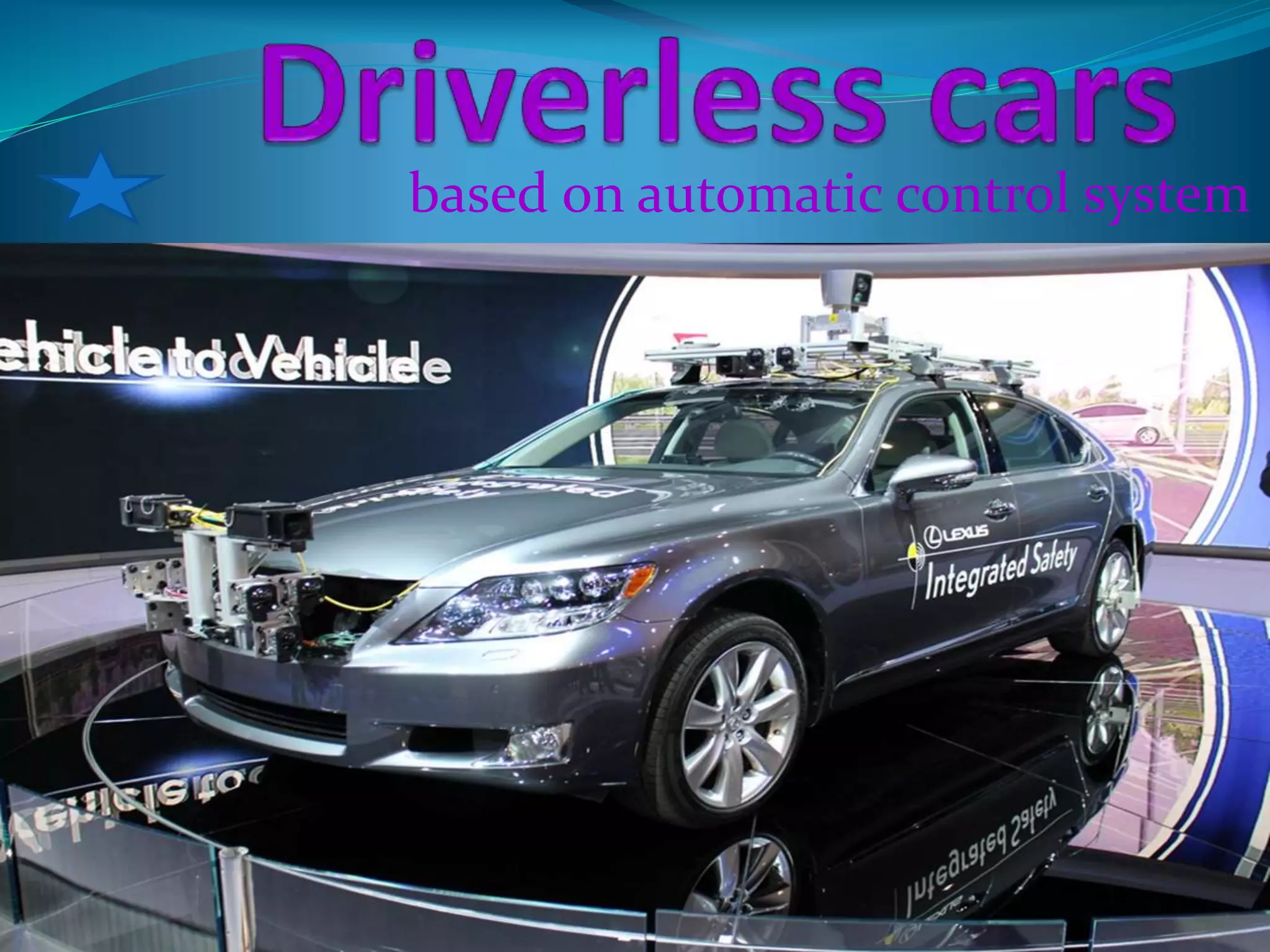
based on automatic control system
Introduction
History
Agenda
Component use
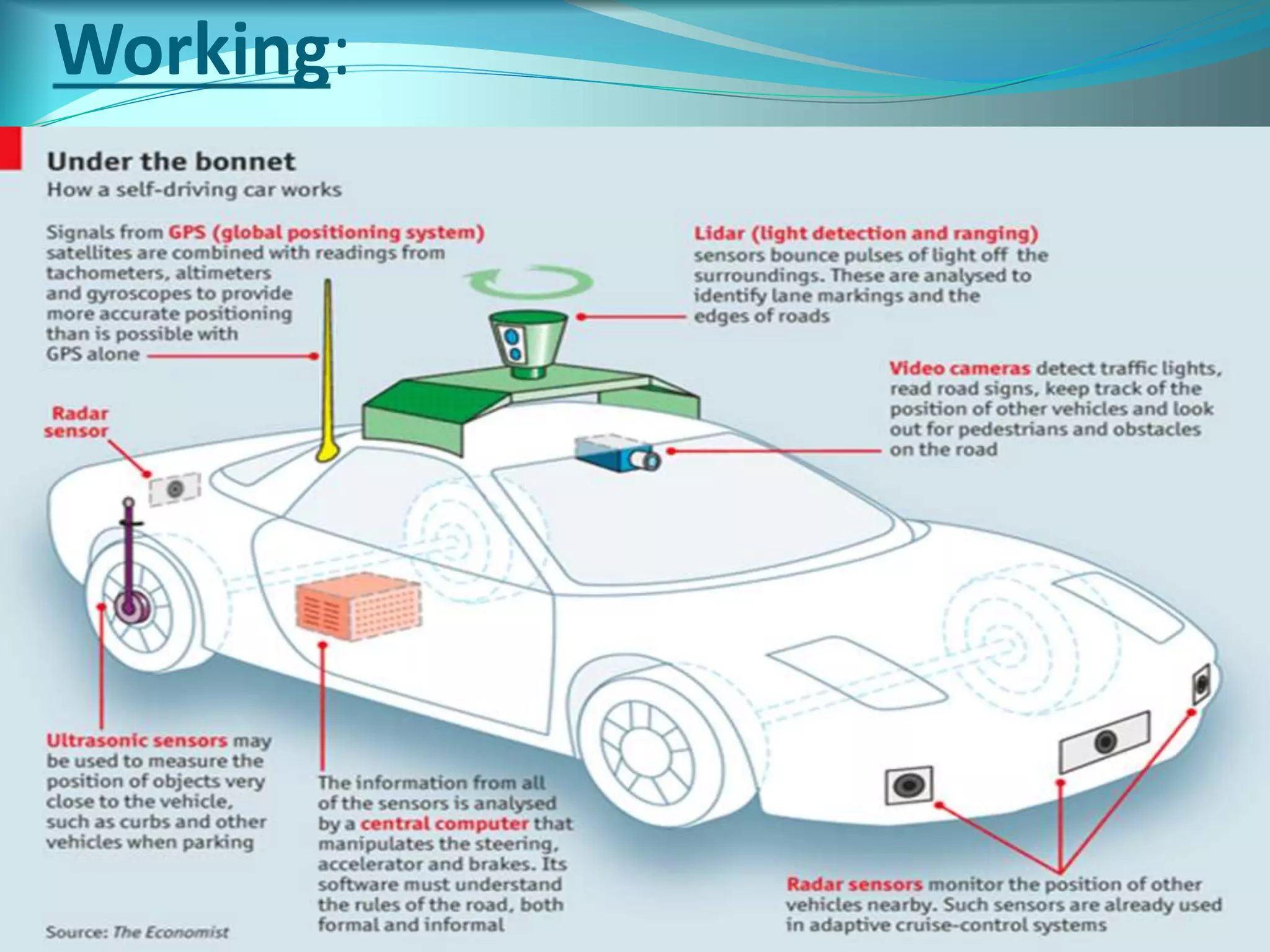
working
Advantages
Disadvantages
 Driver error is the most common cause of traffic
accidents
 India contributes 6 % of the world's road accident
deaths
 Cell phones in-car ,entertainment systems, more
traffic and more complicated road systems making it
more frequent
 Drowsiness of the driver and failure in taking
sudden decisions adds up to the factors .
 The fully autonomous cars posses the technology
which drives it the safest way possible and have been
proved successful in this context till now
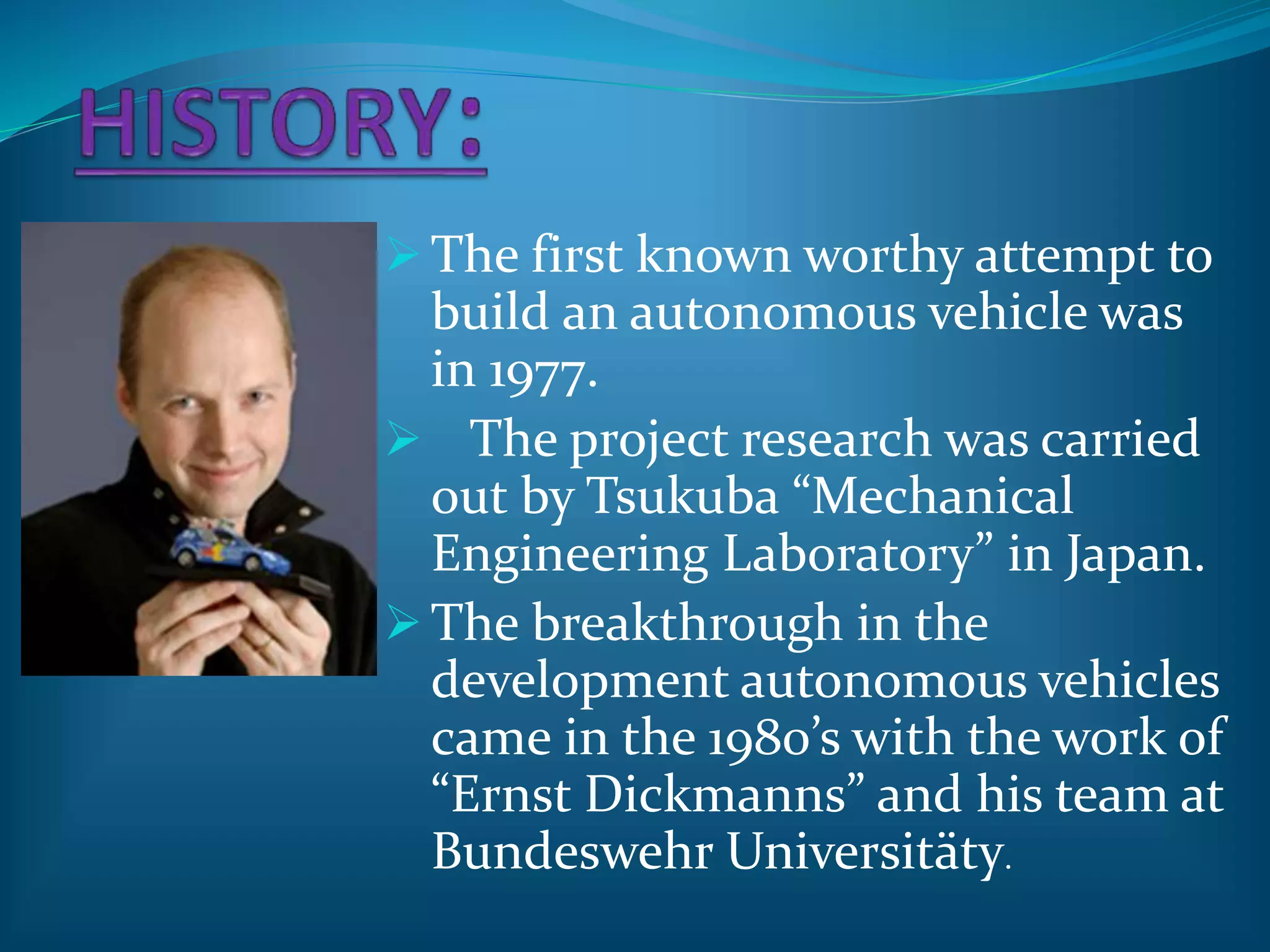
 The first known worthy attempt to
build an autonomous vehicle was
in 1977.
 The project research was carried
out by Tsukuba “Mechanical
Engineering Laboratory” in Japan.
 The breakthrough in the
development autonomous vehicles
came in the 1980’s with the work of
“Ernst Dickmanns” and his team at
Bundeswehr Universitäty.
What an automatic control system is?
What is a driverless vehicle
Types of driverless vehicles based on
different-2- technologies
*drones(signal controlled)
*automated highway system
*driverless cars based on automatic
control system
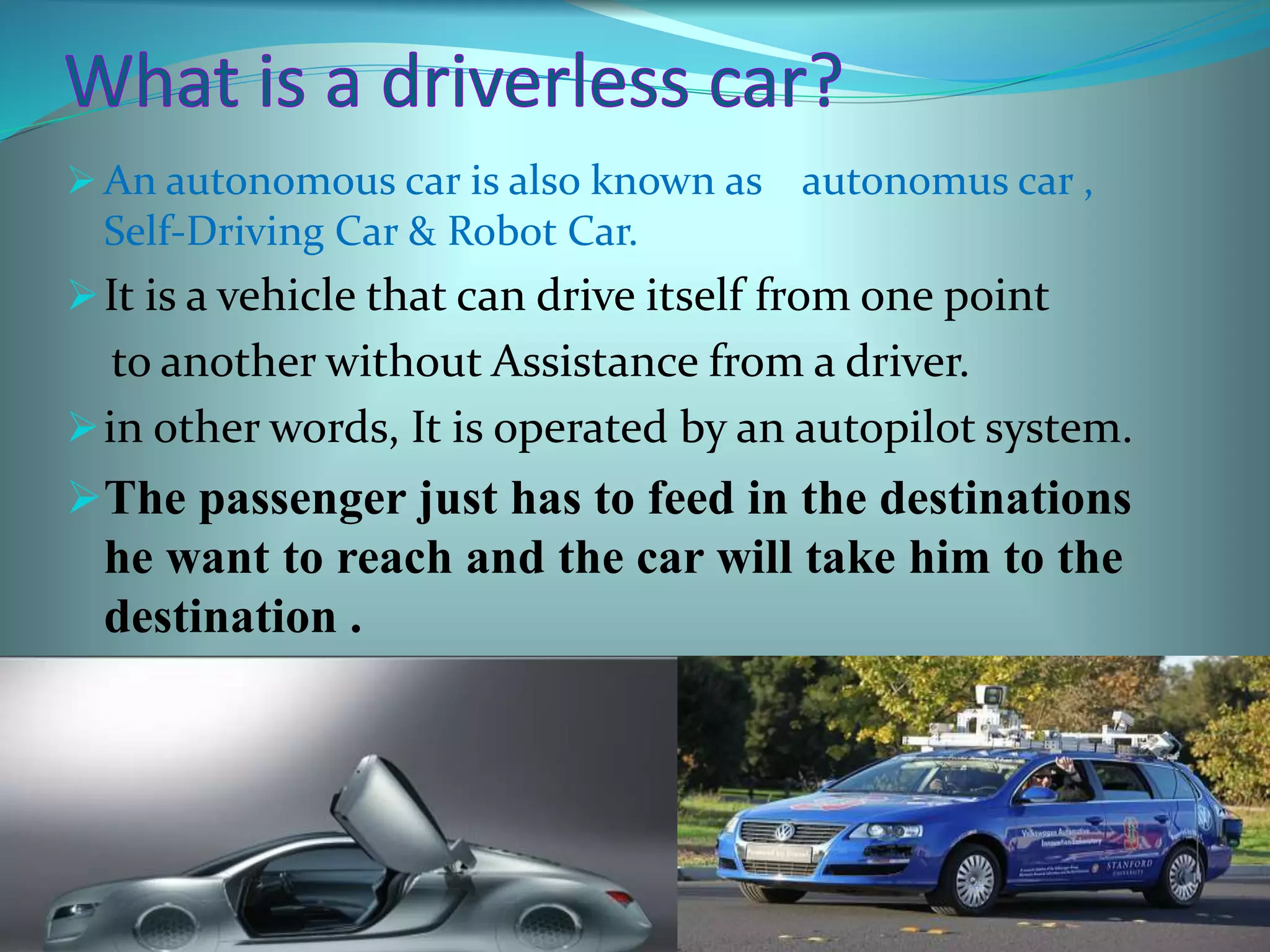
 An autonomous car is also known as autonomus car ,
Self-Driving Car & Robot Car.
It is a vehicle that can drive itself from one point
to another without Assistance from a driver.
in other words, It is operated by an autopilot system.
The passenger just has to feed in the destinations
he want to reach and the car will take him to the
destination .
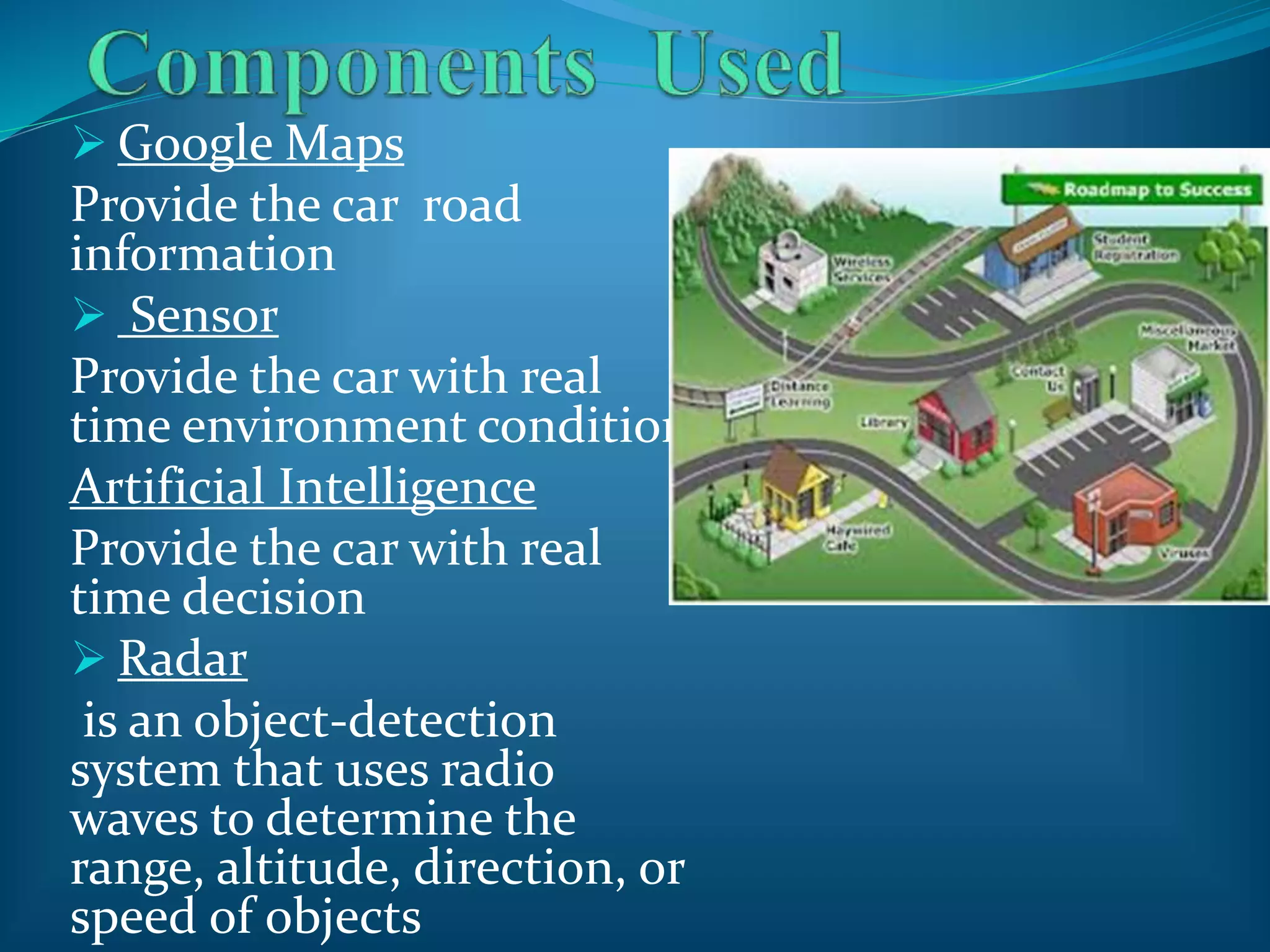
 Google Maps
Provide the car road
information
 Sensor
Provide the car with real
time environment condition
Artificial Intelligence
Provide the car with real
time decision
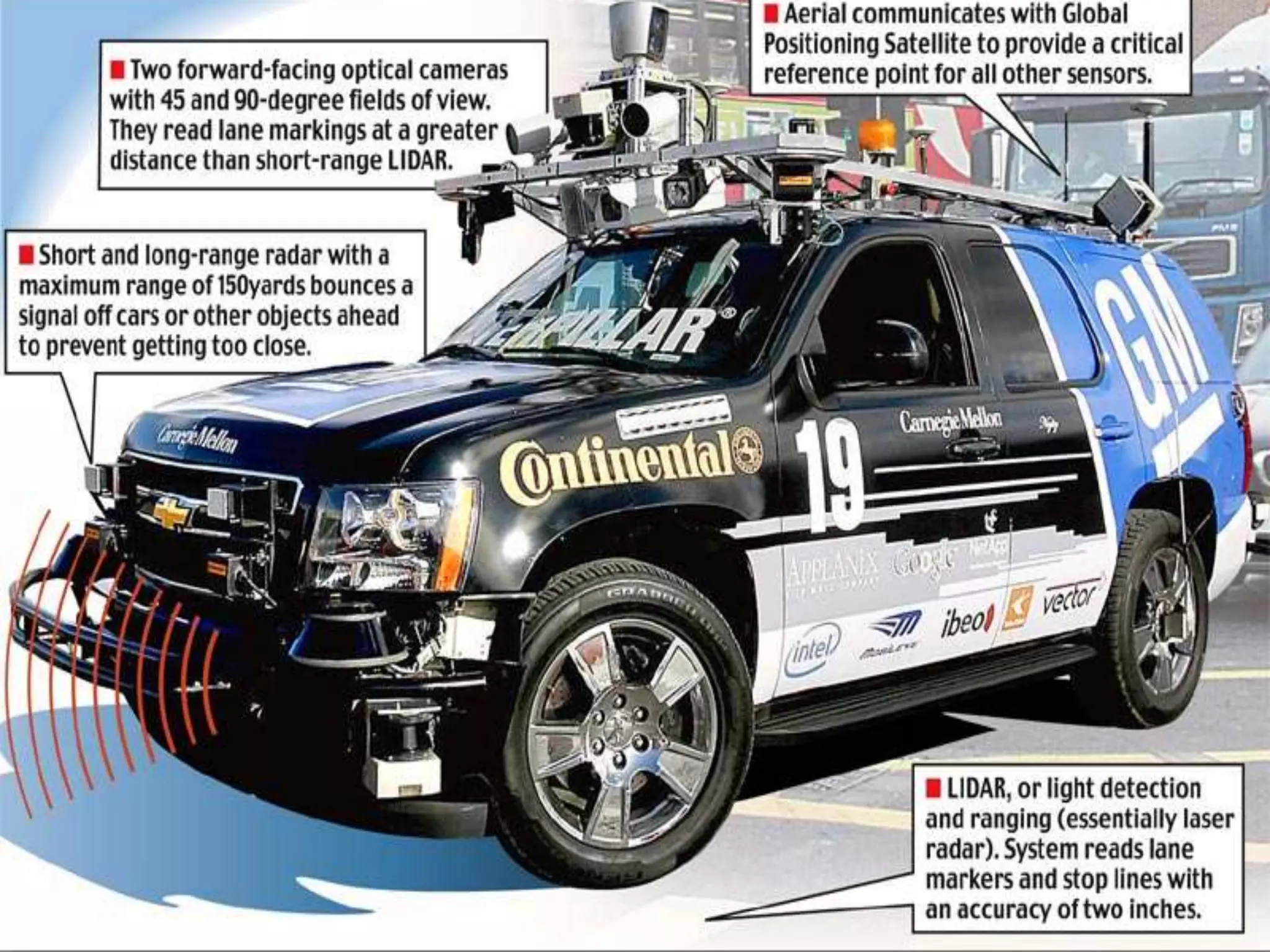
 Radar
is an object-detection
system that uses radio
waves to determine the
range, altitude, direction, or
speed of objects
 Global Positioning System(GPS)
is a space-based Satellite
navigation system that provides location
and time information in all weather
conditions.
Lidar
is a remote sensing technology that
measures distance by illuminating a
target with a laser and analyzing the
reflected light.
Working:
Sensors
Navigation
Motion planning(traffic)
Actuation(operates the mechanics of
vehicle)
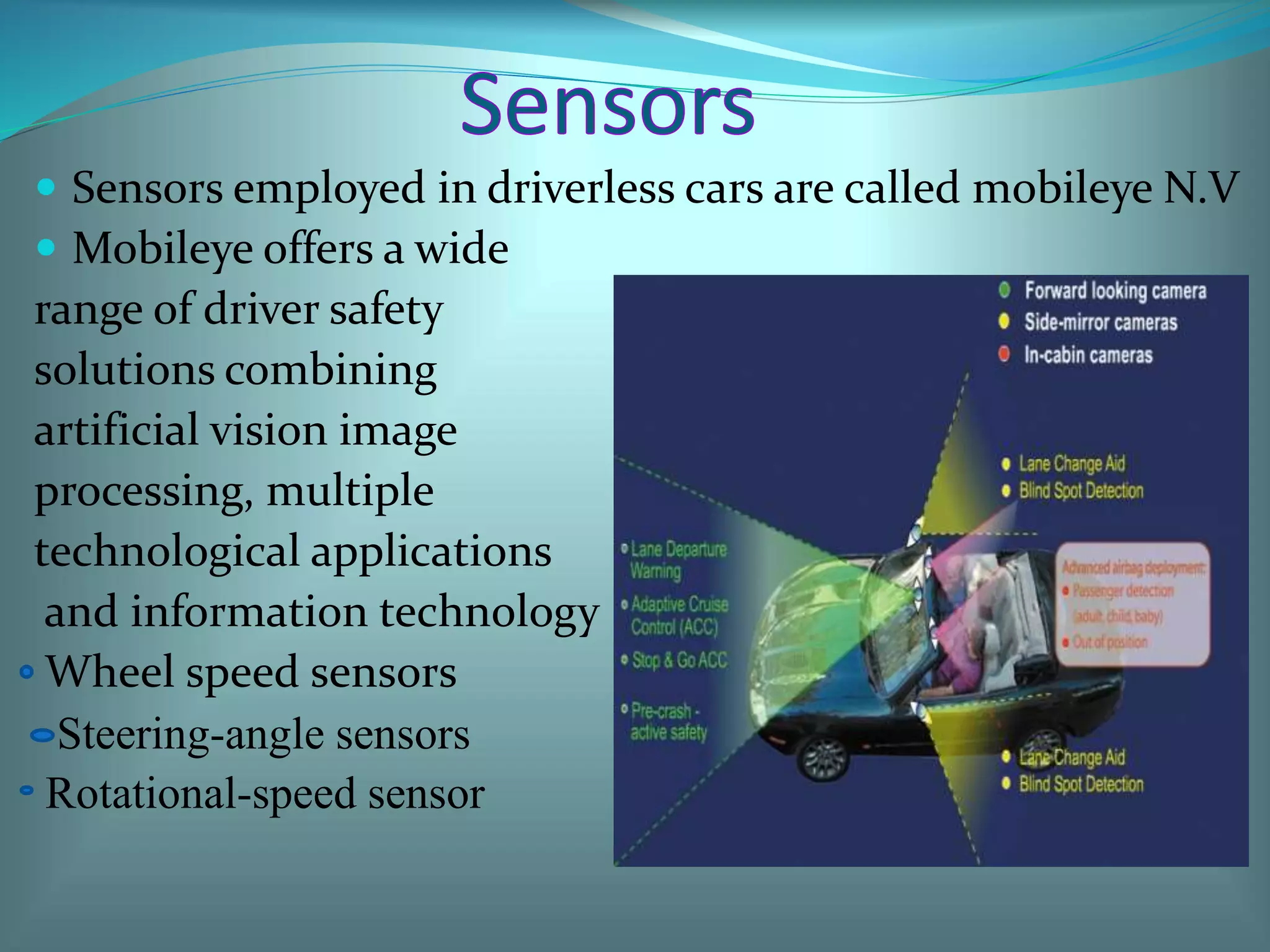
 Sensors employed in driverless cars are called mobileye N.V
 Mobileye offers a wide
range of driver safety
solutions combining
artificial vision image
processing, multiple
technological applications
and information technology
Wheel speed sensors
Steering-angle sensors
Rotational-speed sensor
 A sensor “actinometer “ is used to detect the intensity
of radiation
 Light of different colors will radiate different -2-
intensity of radiation
 Which will be detected by the sensor
 If the detected intensity is of red color or yellow color
The controller will send a command to stop the vehicle
The command will be followed by robot(to convert the
computer command into mechanical input)
 Anti-lock brakes(ABS)
 Cruise control
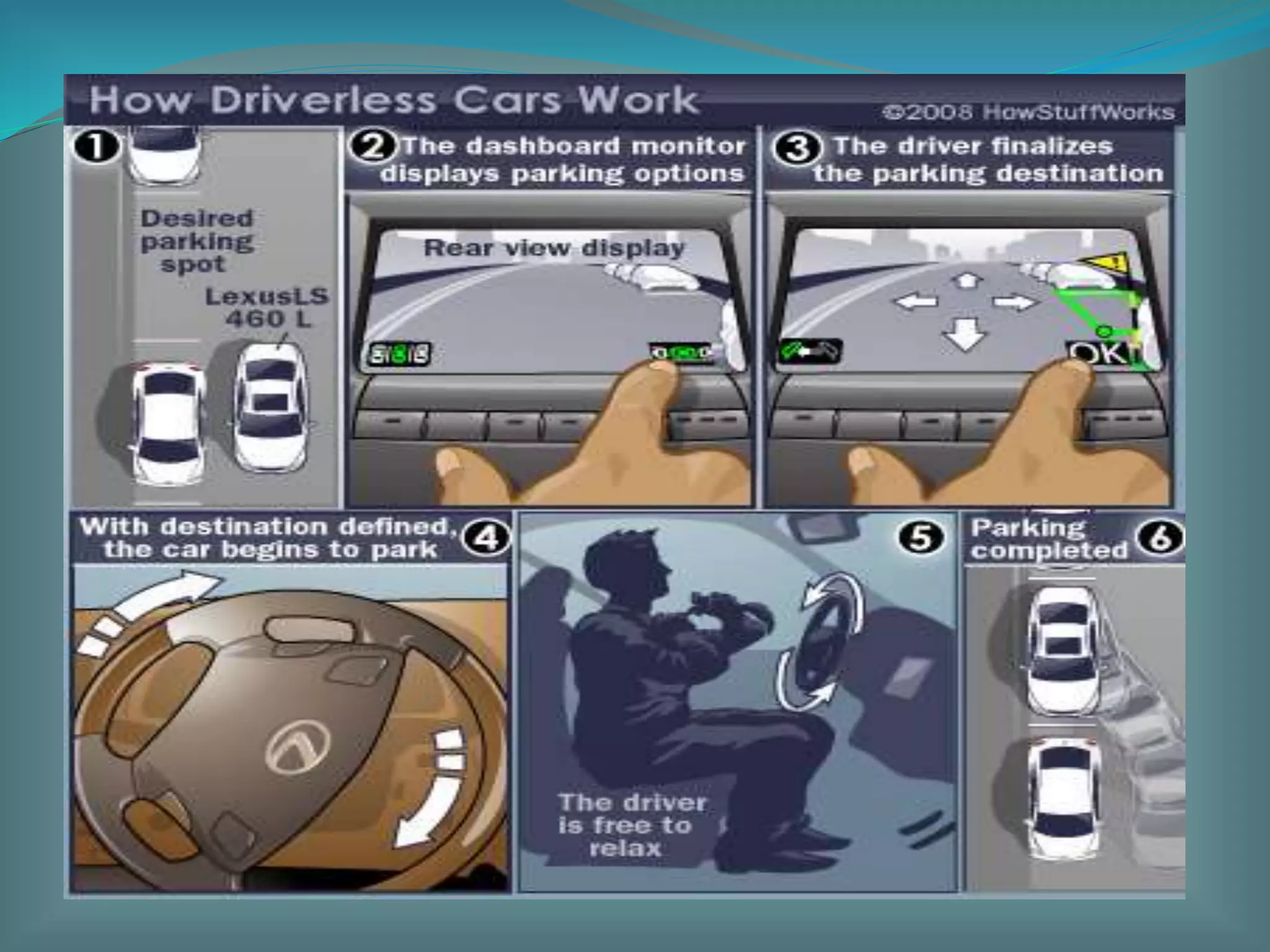
 Self Parking
 Automated Guided Vehicle Systems
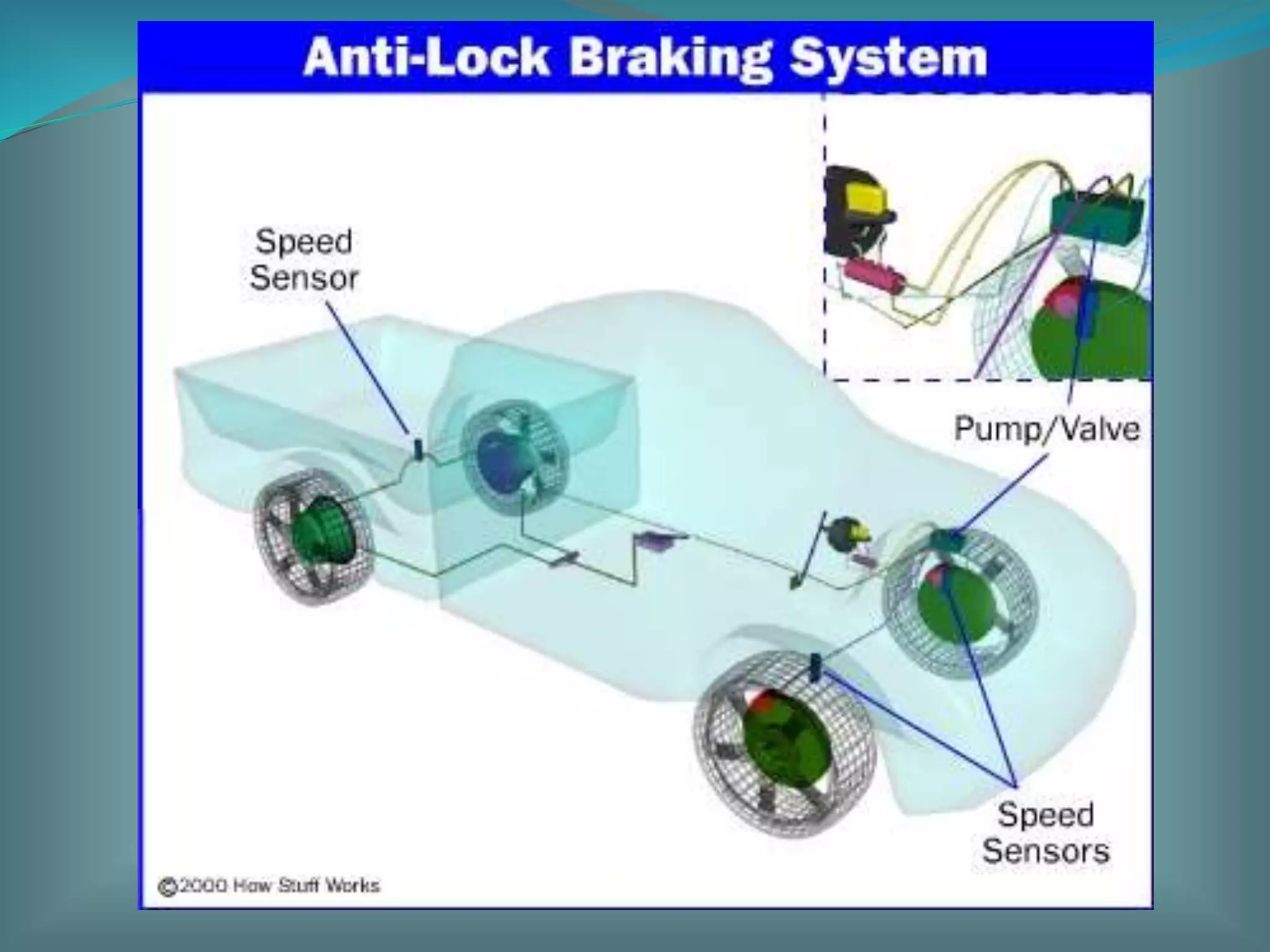
 While braking hard without anti-lock brakes, the wheels
can lock up, sending the car into an out-of-control skid.
and the driver has to pump the brake pedal to keep the
wheels from locking up
 With anti-lock brakes, the system does the pumping for
the driver - and does it better than the driver. The system
can read the wheels and knows when they are about to
lock and react faster
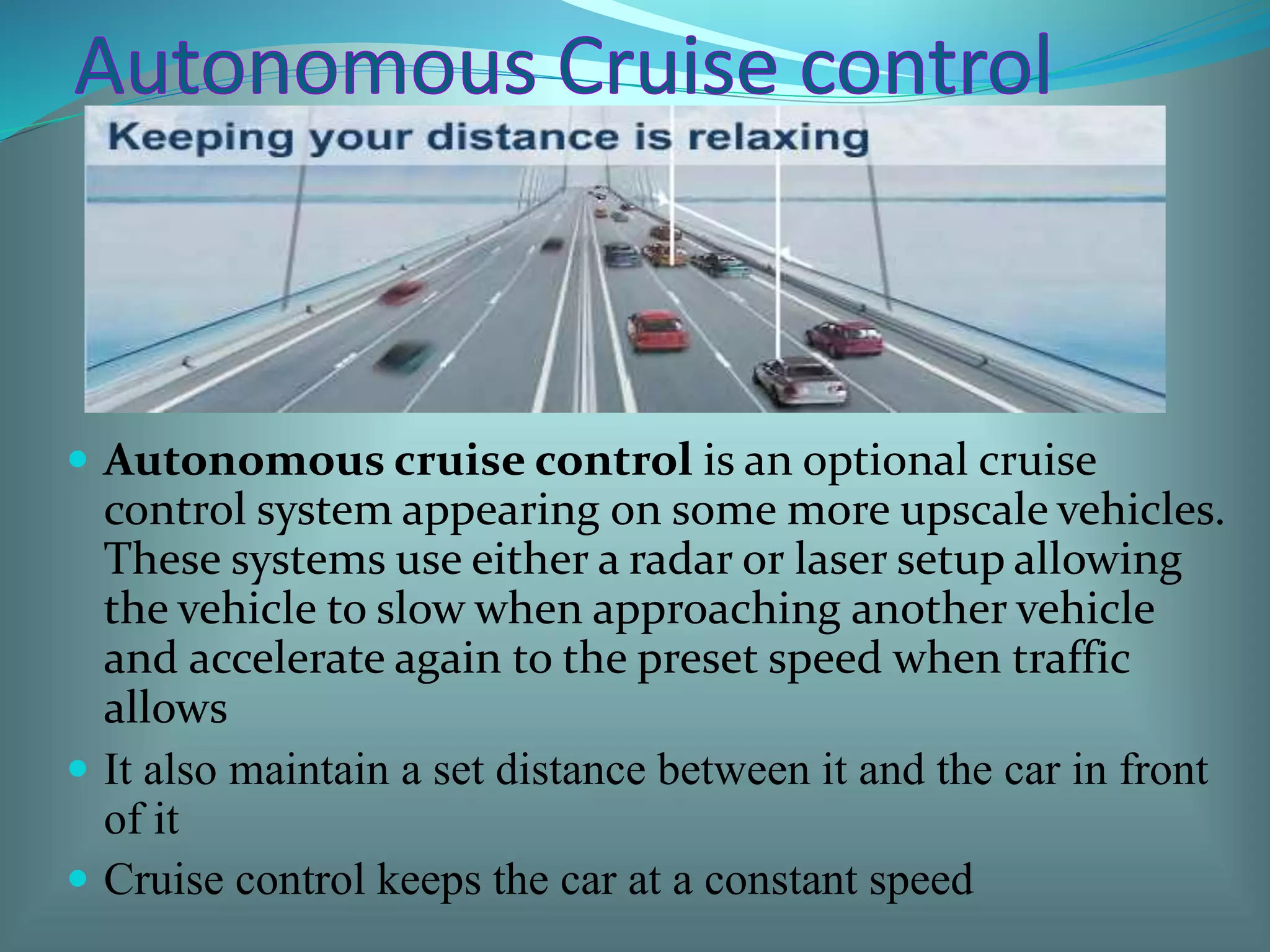
 Autonomous cruise control is an optional cruise
control system appearing on some more upscale vehicles.
These systems use either a radar or laser setup allowing
the vehicle to slow when approaching another vehicle
and accelerate again to the preset speed when traffic
allows
 It also maintain a set distance between it and the car in front
of it
 Cruise control keeps the car at a constant speed
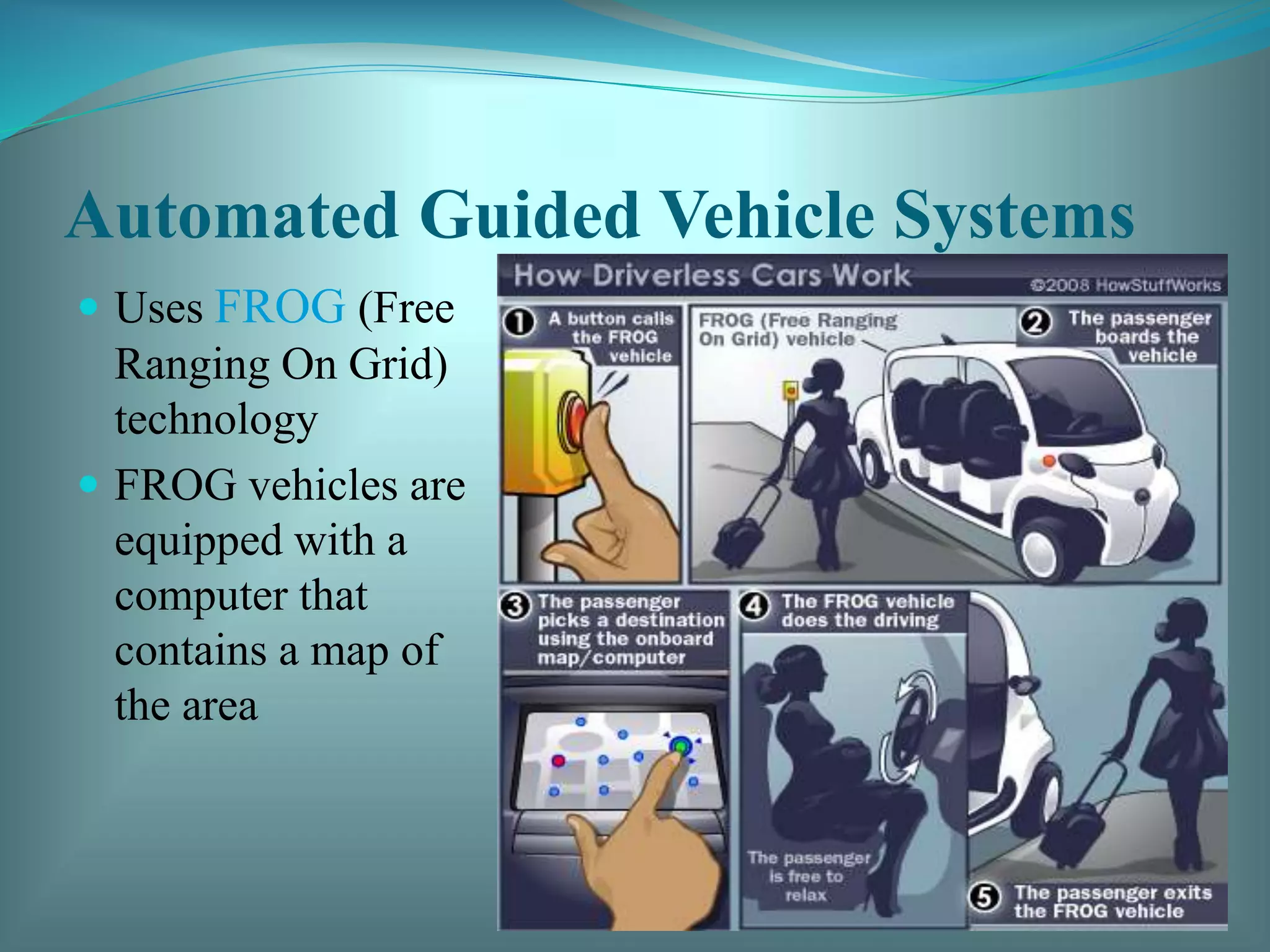
Automated Guided Vehicle Systems
 Uses FROG (Free
Ranging On Grid)
technology
 FROG vehicles are
equipped with a
computer that
contains a map of
the area
The ability to plot the rout from
where the vehicle is to where the
user wants to be has been available
for several years
 the more sophisticated system
also receives radio updates on road
blockages, and adapt accordingly
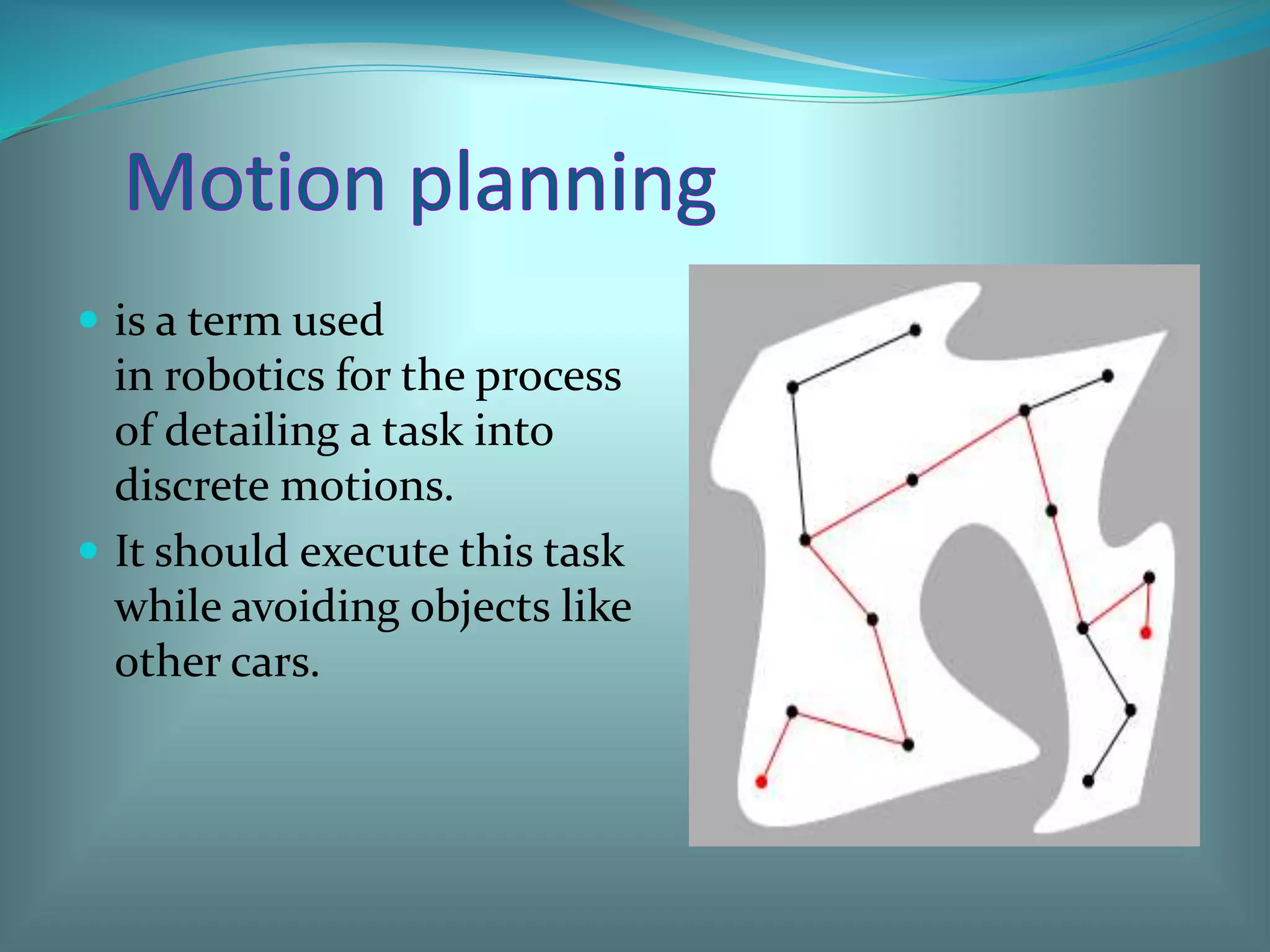
 is a term used
in robotics for the process
of detailing a task into
discrete motions.
 It should execute this task
while avoiding objects like
other cars.
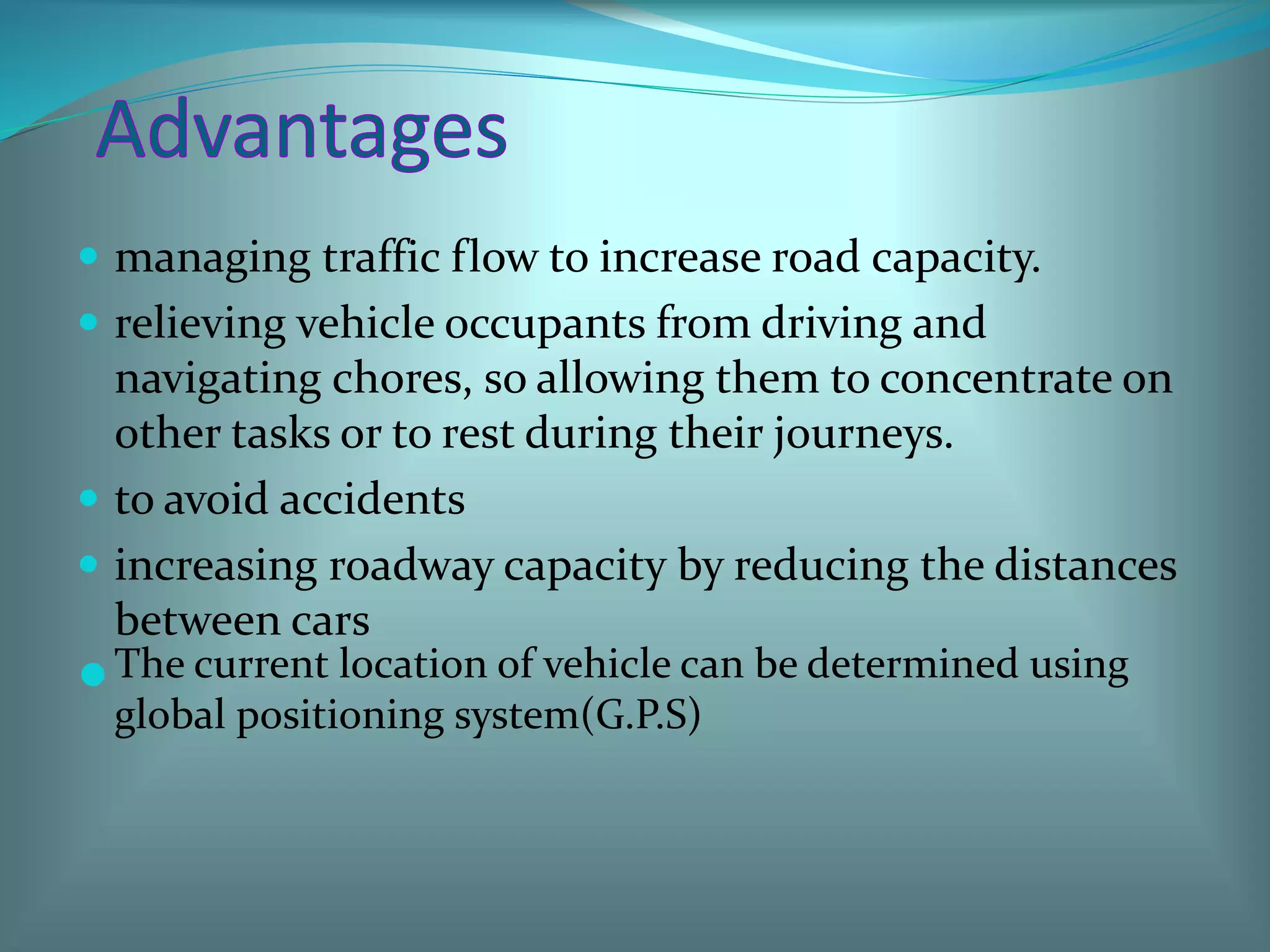
 managing traffic flow to increase road capacity.
 relieving vehicle occupants from driving and
navigating chores, so allowing them to concentrate on
other tasks or to rest during their journeys.
 to avoid accidents
 increasing roadway capacity by reducing the distances
between cars
The current location of vehicle can be determined using
global positioning system(G.P.S)
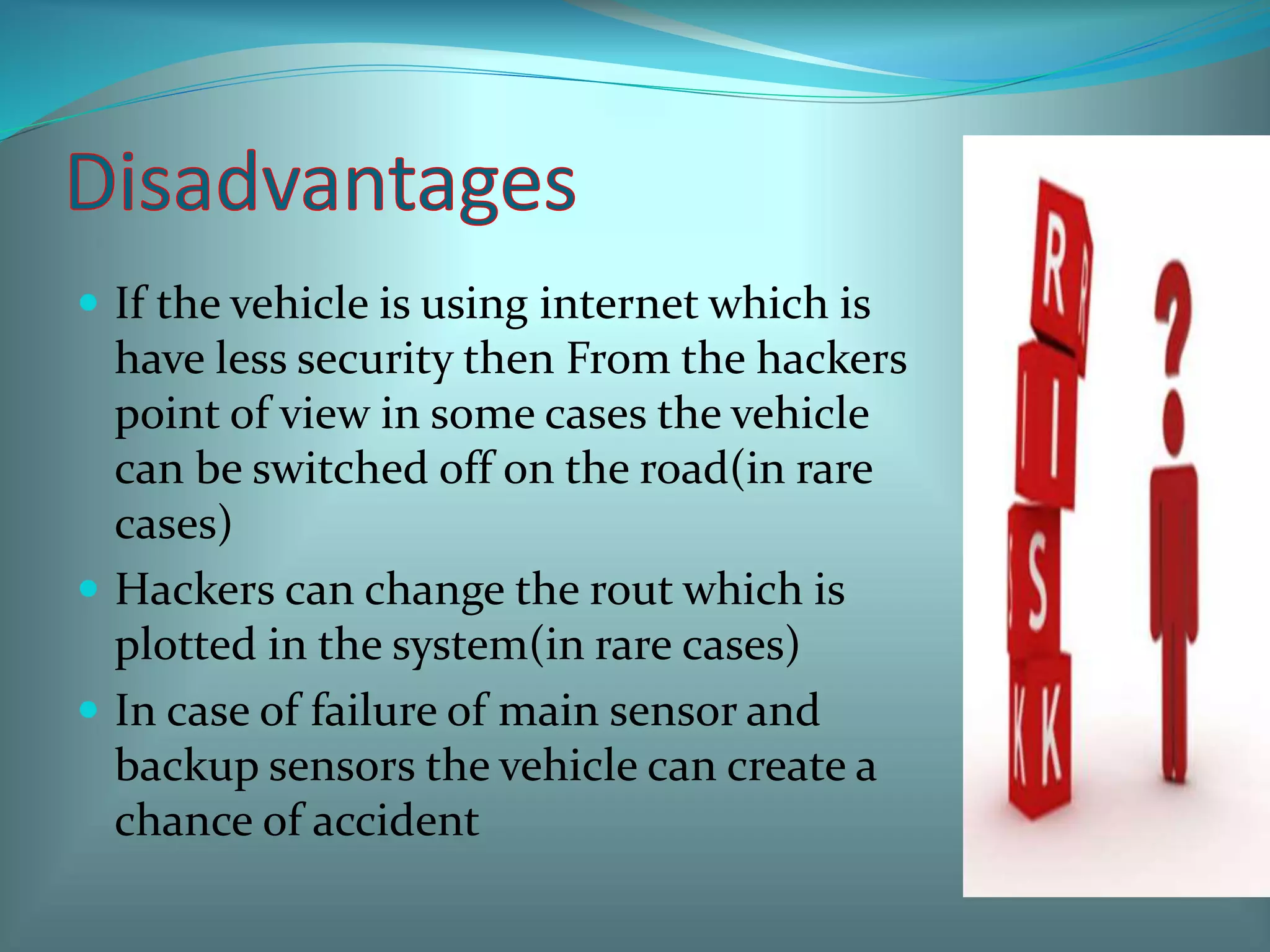
 If the vehicle is using internet which is
have less security then From the hackers
point of view in some cases the vehicle
can be switched off on the road(in rare
cases)
 Hackers can change the rout which is
plotted in the system(in rare cases)
 In case of failure of main sensor and
backup sensors the vehicle can create a
chance of accident
Best Driver less cars Ppt by-dinesh kumar from jaipur

Best Driver less cars Ppt by-dinesh kumar from jaipur

  • 1.
  • 2.
    based on automaticcontrol system
  • 3.
  • 4.
     Driver erroris the most common cause of traffic accidents  India contributes 6 % of the world's road accident deaths  Cell phones in-car ,entertainment systems, more traffic and more complicated road systems making it more frequent  Drowsiness of the driver and failure in taking sudden decisions adds up to the factors .  The fully autonomous cars posses the technology which drives it the safest way possible and have been proved successful in this context till now
  • 5.
     The firstknown worthy attempt to build an autonomous vehicle was in 1977.  The project research was carried out by Tsukuba “Mechanical Engineering Laboratory” in Japan.  The breakthrough in the development autonomous vehicles came in the 1980’s with the work of “Ernst Dickmanns” and his team at Bundeswehr Universitäty.
  • 6.
    What an automaticcontrol system is? What is a driverless vehicle Types of driverless vehicles based on different-2- technologies *drones(signal controlled) *automated highway system *driverless cars based on automatic control system
  • 7.
     An autonomouscar is also known as autonomus car , Self-Driving Car & Robot Car. It is a vehicle that can drive itself from one point to another without Assistance from a driver. in other words, It is operated by an autopilot system. The passenger just has to feed in the destinations he want to reach and the car will take him to the destination .
  • 8.
     Google Maps Providethe car road information  Sensor Provide the car with real time environment condition Artificial Intelligence Provide the car with real time decision  Radar is an object-detection system that uses radio waves to determine the range, altitude, direction, or speed of objects
  • 9.
     Global PositioningSystem(GPS) is a space-based Satellite navigation system that provides location and time information in all weather conditions. Lidar is a remote sensing technology that measures distance by illuminating a target with a laser and analyzing the reflected light.
  • 10.
  • 11.
  • 12.
     Sensors employedin driverless cars are called mobileye N.V  Mobileye offers a wide range of driver safety solutions combining artificial vision image processing, multiple technological applications and information technology Wheel speed sensors Steering-angle sensors Rotational-speed sensor
  • 13.
     A sensor“actinometer “ is used to detect the intensity of radiation  Light of different colors will radiate different -2- intensity of radiation  Which will be detected by the sensor  If the detected intensity is of red color or yellow color The controller will send a command to stop the vehicle The command will be followed by robot(to convert the computer command into mechanical input)
  • 14.
     Anti-lock brakes(ABS) Cruise control  Self Parking  Automated Guided Vehicle Systems
  • 15.
     While brakinghard without anti-lock brakes, the wheels can lock up, sending the car into an out-of-control skid. and the driver has to pump the brake pedal to keep the wheels from locking up  With anti-lock brakes, the system does the pumping for the driver - and does it better than the driver. The system can read the wheels and knows when they are about to lock and react faster
  • 17.
     Autonomous cruisecontrol is an optional cruise control system appearing on some more upscale vehicles. These systems use either a radar or laser setup allowing the vehicle to slow when approaching another vehicle and accelerate again to the preset speed when traffic allows  It also maintain a set distance between it and the car in front of it  Cruise control keeps the car at a constant speed
  • 19.
    Automated Guided VehicleSystems  Uses FROG (Free Ranging On Grid) technology  FROG vehicles are equipped with a computer that contains a map of the area
  • 20.
    The ability toplot the rout from where the vehicle is to where the user wants to be has been available for several years  the more sophisticated system also receives radio updates on road blockages, and adapt accordingly
  • 21.
     is aterm used in robotics for the process of detailing a task into discrete motions.  It should execute this task while avoiding objects like other cars.
  • 23.
     managing trafficflow to increase road capacity.  relieving vehicle occupants from driving and navigating chores, so allowing them to concentrate on other tasks or to rest during their journeys.  to avoid accidents  increasing roadway capacity by reducing the distances between cars The current location of vehicle can be determined using global positioning system(G.P.S)
  • 24.
     If thevehicle is using internet which is have less security then From the hackers point of view in some cases the vehicle can be switched off on the road(in rare cases)  Hackers can change the rout which is plotted in the system(in rare cases)  In case of failure of main sensor and backup sensors the vehicle can create a chance of accident