Shared Mobility
Barriers, Technologies, Policy
Prepared by Dr Li Meng
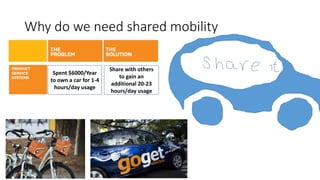
Why do we need shared mobility
Spent $6000/Year
to own a car for 1-4
hours/day usage
Share with others
to gain an
additional 20-23
hours/day usage
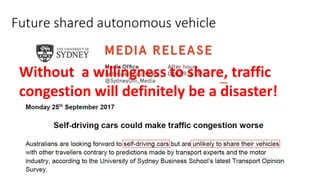
Future shared autonomous vehicle
Without a willingness to share, traffic
congestion will definitely be a disaster!
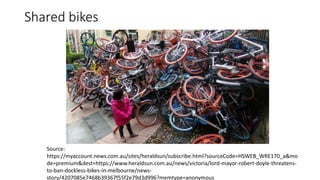
Shared bikes
Source:
https://myaccount.news.com.au/sites/heraldsun/subscribe.html?sourceCode=HSWEB_WRE170_a&mo
de=premium&dest=https://www.heraldsun.com.au/news/victoria/lord-mayor-robert-doyle-threatens-
to-ban-dockless-bikes-in-melbourne/news-
story/4207085e7468b39367f55f2e79d3d996?memtype=anonymous
Shared bikes
• Rebalancing
• Lack of optimal routes
• Lack of big data support
• Challenges in integrating with public transportation
• High costs to apply smart technologies
• Difficulties in fulfil user's convenience
• Challenge of rider safety
• Limited advertising budget
• Requirement for strong entrepreneurs
• Requirement for a strong innovative organisational strategy
• Lack of joint partnership
• Lack of financial funding
• Lack of data on the health impact
• Poor implementation approaches for emission-free transportation
Shared cars
• Requires car parking, on-street parking spaces are not easily obtained
• Car-sharing insurance requires approval by governmental policies
• Lack of privacy for personal travel
• Challenge in achieving synergies between autos and transit
Shared autonomous vehicle
• Social and moral dilemmas present a challenge in automation programming
• Absence of vehicle-to-vehicle (V2V) and vehicle to infrastructure (V2I)
communication
• Difficulties in insurance liabilities
• Substantially increase synergies between autos and transit
Technology supports
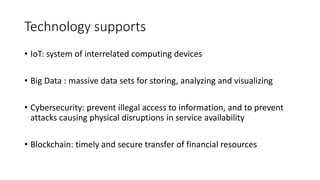
• IoT: system of interrelated computing devices
• Big Data : massive data sets for storing, analyzing and visualizing
• Cybersecurity: prevent illegal access to information, and to prevent
attacks causing physical disruptions in service availability
• Blockchain: timely and secure transfer of financial resources
Technology supports
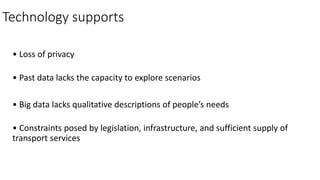
• Loss of privacy
• Past data lacks the capacity to explore scenarios
• Big data lacks qualitative descriptions of people’s needs
• Constraints posed by legislation, infrastructure, and sufficient supply of
transport services
Can policy help?
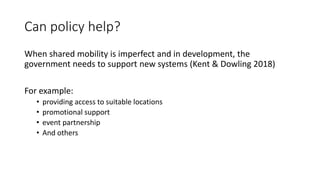
When shared mobility is imperfect and in development, the
government needs to support new systems (Kent & Dowling 2018)
For example:
• providing access to suitable locations
• promotional support
• event partnership
• And others
Difficulties for policy makers
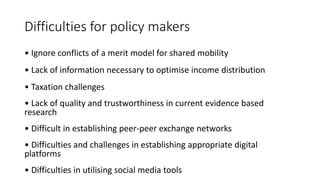
• Ignore conflicts of a merit model for shared mobility
• Lack of information necessary to optimise income distribution
• Taxation challenges
• Lack of quality and trustworthiness in current evidence based
research
• Difficult in establishing peer-peer exchange networks
• Difficulties and challenges in establishing appropriate digital
platforms
• Difficulties in utilising social media tools
Merit good of shared mobility
What is a merit good?
Merit goods are tools that institutional policies impose on the free
market to interfere with the wishes of at least some consumers. It
• has the intention to interfere with consumer behaviour
• is justified on moral grounds
• is financed in a different form
Can shared mobility be a merit good? Can government intervention
fail?
• distributional arguments
• market failure arguments
• merit good arguments
First-best policy and second-best policy
Introducing merit good into policy making being:
• First-best policy needs: an optimal lump-sum transfer of income and a direct
choice of the merit good quantity
• Second-best government policies are implemented when governments lack the
information necessary to optimise the income distribution. In the other words,
they may be unable to set tax rates that vary across individuals
Source: (Besley 1988)
Policy innovation
• The notion of policy learning was a social process built around
curiosity, exchange and trust (Peck 2011; Marsden et al. 2011)
• Policies cannot, merely be transferred over space, in fact, their form
and their effects are transformed by journeys of implementation
(Peck 2011)
Social media
Policy and social media
Social media increases our ability to share, cooperate and take
collective action(Rheingold, 2003; Shirky, 2008)
• Negative effects on freedom that impose damage to relations
between the media and the government (Shirky 2008)
• Campaigns in media to convince a potential shared mobility user to
become an actual user would receive both negative and positive
effects.
Value Proposition Canvas
Designed for: Designed by: Date: Version:
Shared mobility Li Meng 16/10/18 V1
Pain Reliever Gain Greater Shared mobility (Jobs) Pains
• Establishing peer-peer
exchange networks
• Establishing
appropriate digital
platforms
• Utilising social media
tools
• Powerful and direct
market intervention
• Providing financial
support or incentives
• Facilitating the
application of big data to
transit applications
• Promotes an economic
transport mode
• Enables MaaS and
Multimodal mobility
• Economic gains
• Improved sustainability
• Enjoyment
• Improved lifestyles
• Lack of public policy
implementation
campaign in public
policy
• Need a suitable
business model
• Backdrop of a digital
technology revolution,
massive flows of
information
• Lack of online security
• Fragmented politics
and government
inexperience
Policies Gains
• Reduction in private
car ownership and
usage
• Reduced transport
costs
• Building the necessary
network relations
between the private and
public sectors to deliver
Mobility as a Service
(MaaS) outcomes
• Improving social equity
in transport provision
• Travel time savings
• Saves valuable urban
space
• Travel cost savings
Everyone works together
Source: http://www.shropshiretogether.org.uk/wp-content/uploads/2014/12/Linked-hands.jpg
Future studies
• UniSA campus transport redesign --shared mobility (will start
December, 2018)
• Policy, infrastructure design and modelling for shared multimodal
motilities (Considering…)
• Thank you for your attention!

Li Meng - Shared mobility

  • 1.
    Shared Mobility Barriers, Technologies,Policy Prepared by Dr Li Meng
  • 2.
    Why do weneed shared mobility Spent $6000/Year to own a car for 1-4 hours/day usage Share with others to gain an additional 20-23 hours/day usage
  • 3.
    Future shared autonomousvehicle Without a willingness to share, traffic congestion will definitely be a disaster!
  • 4.
  • 5.
    Shared bikes • Rebalancing •Lack of optimal routes • Lack of big data support • Challenges in integrating with public transportation • High costs to apply smart technologies • Difficulties in fulfil user's convenience • Challenge of rider safety • Limited advertising budget • Requirement for strong entrepreneurs • Requirement for a strong innovative organisational strategy • Lack of joint partnership • Lack of financial funding • Lack of data on the health impact • Poor implementation approaches for emission-free transportation
  • 6.
    Shared cars • Requirescar parking, on-street parking spaces are not easily obtained • Car-sharing insurance requires approval by governmental policies • Lack of privacy for personal travel • Challenge in achieving synergies between autos and transit
  • 7.
    Shared autonomous vehicle •Social and moral dilemmas present a challenge in automation programming • Absence of vehicle-to-vehicle (V2V) and vehicle to infrastructure (V2I) communication • Difficulties in insurance liabilities • Substantially increase synergies between autos and transit
  • 8.
    Technology supports • IoT:system of interrelated computing devices • Big Data : massive data sets for storing, analyzing and visualizing • Cybersecurity: prevent illegal access to information, and to prevent attacks causing physical disruptions in service availability • Blockchain: timely and secure transfer of financial resources
  • 9.
    Technology supports • Lossof privacy • Past data lacks the capacity to explore scenarios • Big data lacks qualitative descriptions of people’s needs • Constraints posed by legislation, infrastructure, and sufficient supply of transport services
  • 10.
    Can policy help? Whenshared mobility is imperfect and in development, the government needs to support new systems (Kent & Dowling 2018) For example: • providing access to suitable locations • promotional support • event partnership • And others
  • 11.
    Difficulties for policymakers • Ignore conflicts of a merit model for shared mobility • Lack of information necessary to optimise income distribution • Taxation challenges • Lack of quality and trustworthiness in current evidence based research • Difficult in establishing peer-peer exchange networks • Difficulties and challenges in establishing appropriate digital platforms • Difficulties in utilising social media tools
  • 12.
    Merit good ofshared mobility What is a merit good? Merit goods are tools that institutional policies impose on the free market to interfere with the wishes of at least some consumers. It • has the intention to interfere with consumer behaviour • is justified on moral grounds • is financed in a different form Can shared mobility be a merit good? Can government intervention fail? • distributional arguments • market failure arguments • merit good arguments
  • 13.
    First-best policy andsecond-best policy Introducing merit good into policy making being: • First-best policy needs: an optimal lump-sum transfer of income and a direct choice of the merit good quantity • Second-best government policies are implemented when governments lack the information necessary to optimise the income distribution. In the other words, they may be unable to set tax rates that vary across individuals Source: (Besley 1988)
  • 14.
    Policy innovation • Thenotion of policy learning was a social process built around curiosity, exchange and trust (Peck 2011; Marsden et al. 2011) • Policies cannot, merely be transferred over space, in fact, their form and their effects are transformed by journeys of implementation (Peck 2011)
  • 15.
  • 16.
    Policy and socialmedia Social media increases our ability to share, cooperate and take collective action(Rheingold, 2003; Shirky, 2008) • Negative effects on freedom that impose damage to relations between the media and the government (Shirky 2008) • Campaigns in media to convince a potential shared mobility user to become an actual user would receive both negative and positive effects.
  • 17.
    Value Proposition Canvas Designedfor: Designed by: Date: Version: Shared mobility Li Meng 16/10/18 V1 Pain Reliever Gain Greater Shared mobility (Jobs) Pains • Establishing peer-peer exchange networks • Establishing appropriate digital platforms • Utilising social media tools • Powerful and direct market intervention • Providing financial support or incentives • Facilitating the application of big data to transit applications • Promotes an economic transport mode • Enables MaaS and Multimodal mobility • Economic gains • Improved sustainability • Enjoyment • Improved lifestyles • Lack of public policy implementation campaign in public policy • Need a suitable business model • Backdrop of a digital technology revolution, massive flows of information • Lack of online security • Fragmented politics and government inexperience Policies Gains • Reduction in private car ownership and usage • Reduced transport costs • Building the necessary network relations between the private and public sectors to deliver Mobility as a Service (MaaS) outcomes • Improving social equity in transport provision • Travel time savings • Saves valuable urban space • Travel cost savings
  • 18.
    Everyone works together Source:http://www.shropshiretogether.org.uk/wp-content/uploads/2014/12/Linked-hands.jpg
  • 19.
    Future studies • UniSAcampus transport redesign --shared mobility (will start December, 2018) • Policy, infrastructure design and modelling for shared multimodal motilities (Considering…) • Thank you for your attention!