International Research Journal of Engineering and Technology (IRJET) e-ISSN: 2395-0056
Volume: 10 Issue: 11 | Nov 2023 www.irjet.net p-ISSN: 2395-0072
DRIVER DROWSINESS DETECTION SYSTEM
B. Jagadeesh1,A. Umesh Chandra2,G. Uday Sankar Reddy3, G. Satish4, Md. Shakeel Ahmed5
1,2,3,4 Department of Information Technology, VVIT, AP, India
5Associate Professor, Dept. of Information Technology, VVIT, AP,India
-----------------------------------------------------------------------***-----------------------------------------------------------------------
Abstract - The proposed system is an intelligent driver
drowsiness and distraction detection system designed to
enhance road safety. By utilizing computer vision
techniques and facial landmarks analysis, the system aims
to monitor the driver's eye and mouth activities in real-
time. It triggers alarms and alerts the driver when signs of
drowsiness or distraction are detected. The system
contributes to reducing the risk of accidents caused by
driver fatigue and inattention
Key Words: OpenCV, Dlib, Face Recognition, Computer
Vision (CV), Drowsiness Detection.
1.INTRODUCTION
2.EXISTING SYSTEM
The existing system utilizes libraries such as scipy,
imutils, pygame, dlib, and cv2 to build a real-time driver
drowsiness detection system. It processes video frames
from a webcam, detects facial landmarks, calculates the
eye aspect ratio and triggers alarms when the driver is
detected to be drowsy. The system includes features to
handle different levels of drowsiness and distraction
scenarios.
Some of the major disadvantages includes:
(1) The existing system focuses solely on drowsiness
detection, not distraction detection.
(2) It lacks a comprehensive approach to handling different
types of distractions.
(3) The system might generate false alarms or fail to detect
certain scenarios due to limited feature coverage.
(4) The system might generate false alarms or fail to detect
certain scenarios due to limited feature coverage.
3.PROPOSED SYSTEM
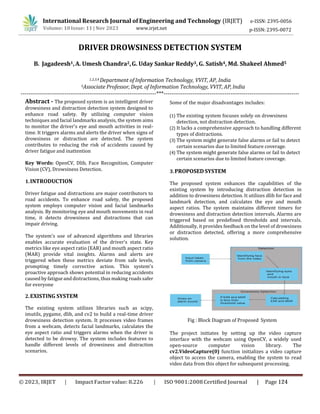
The proposed system enhances the capabilities of the
existing system by introducing distraction detection in
addition to drowsiness detection. It utilizes dlib for face and
landmark detection, and calculates the eye and mouth
aspect ratios. The system maintains different timers for
drowsiness and distraction detection intervals. Alarms are
triggered based on predefined thresholds and intervals.
Additionally, it provides feedback on the level of drowsiness
or distraction detected, offering a more comprehensive
solution.
The project initiates by setting up the video capture
interface with the webcam using OpenCV, a widely used
open-source computer vision library. The
cv2.VideoCapture(0) function initializes a video capture
object to access the camera, enabling the system to read
video data from this object for subsequent processing.
Driver fatigue and distractions are major contributors to
road accidents. To enhance road safety, the proposed
system employs computer vision and facial landmarks
analysis. By monitoring eye and mouth movements in real
time, it detects drowsiness and distractions that can
impair driving.
The system's use of advanced algorithms and libraries
enables accurate evaluation of the driver's state. Key
metrics like eye aspect ratio (EAR) and mouth aspect ratio
(MAR) provide vital insights. Alarms and alerts are
triggered when these metrics deviate from safe levels,
prompting timely corrective action. This system's
proactive approach shows potential in reducing accidents
causedby fatigueand distractions, thus making roads safer
for everyone
Fig : Block Diagram of Proposed System
© 2023, IRJET | Impact Factor value: 8.226 | ISO 9001:2008Certified Journal | Page 124
International Research Journal of Engineering and Technology (IRJET) e-ISSN: 2395-0056
p-ISSN: 2395-0072
Volume: 10 Issue: 10 | Oct 2023 www.irjet.net
OBJECTIVES
(1) Real-time detection of driver drowsiness and
distraction using facial landmarks.
(2) Utilizing eye aspect ratios (EAR) and mouth aspect
ratios (MAR) for drowsiness and distraction
identification.
(3) Implementing sound alarms to alert the driver
in case of drowsiness or distraction.
(4) Integrating computer vision techniques for accurate
facial feature extraction and analysis
(5) Providing a user-friendly interface with live video feed
for monitoring.
(6) Enabling automatic detectionand alertingwithout the
need for any external hardware.
5.METHODOLOGY
The methodology implemented in the system is divided
into four modules as follows:
1. Face Recognition
2. Detection of Drowsiness
3. Detection of Distraction
4. User Interface and Interaction
By implementing these four modules step by step Driver
Drowsiness Detection System is developed. In this
proposed framework, weare going to utilize camera and the
speaker for the reading inputs and playing outputs.
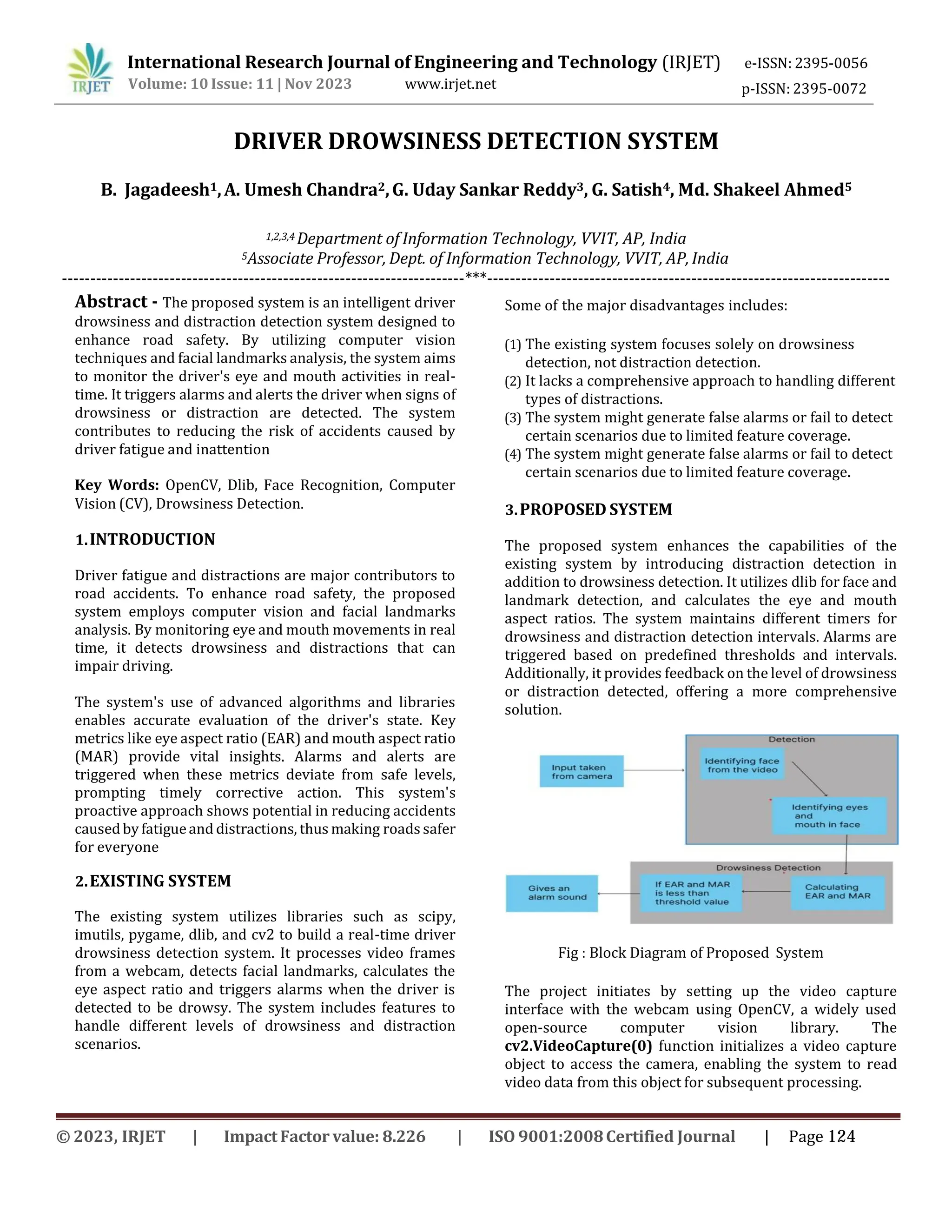
This module focuses on accurately detecting and
interpreting user hand gestures. Utilizes computer vision
libraries such as OpenCV for real-time video capturing.
5.2. DETECTION OF DROWSINESS
This module will identify whether the driver is drowsy or
not after detecting the face it analyzes the face which was
captured through webcam based on eye and mouth
movements of the driver. We have used Dlib library for
identifying facial landmarks.
4.
Moving forward, the system leverages the dlib and imutils
libraries for facial processing. The
dlib.get_frontal_face_detector () function detects the
presence of frontal faces in the video frames, while the
dlib.shape_predictor(shape_predictor_path) function
identifies the specific facial landmarks necessary for
calculating the eye and mouth aspect ratios.
The code continuously captures frames from the video
feed, processes them, and displays the frames in a window
using OpenCV's cv2.imshow() function. Various
computed parameters, such as the eye aspect ratio (EAR),
mouth aspect ratio (MAR), and the frames-per-second
(FPS), are displayed on the screen to provide real-time
feedback to the user. Additionally, the system triggers
audio alerts using the Pygame mixer library when
drowsiness, yawning, or distraction is detected based on
the computed facial parameters and predefined
thresholds.
The user can exit the application by pressing the 'q' key.
The proposed system integrates multiple components,
including facial landmark detection, aspect ratio
calculations, and real-time audiovisual feedback, to create
an effective driver drowsiness and distraction detection
mechanism using computer vision techniques.
5.1. FACE RECOGNITION
© 2023, IRJET | ImpactFactor value: 8.226 | ISO 9001:2008Certified Journal | Page 125
International Research Journal of Engineering and Technology (IRJET) e-ISSN: 2395-0056
p-ISSN: 2395-0072
Volume: 10 Issue: 10 | Oct 2023 www.irjet.net
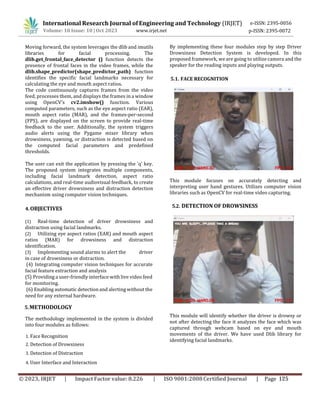
5.3. DETECTION OF DISTRACTION
5.4 USER INTERFACE AND INTERACTION
6.OUTPUT SNAPSHOTS
Ensures a user-friendly and intuitive interaction experience
by providing audio feedback. Includes a graphical user
interface for user guidance and interaction management.
This module will identify whether the user is distracted or
not after detecting the face through webcam it analyzes the
video and checks whether the driver is seeing the road or
not.
7.CONCLUSION
This real-time facial monitoring system is a significant step
toward making various activities safer, such as driving and
healthcare.
It's easy to customize and has the potential for more
improvements, like connecting to the internet or
understanding changes in how people talk.
This system leverages computer vision techniques and facial
landmark detection to address the critical issues of
drowsiness and distraction in individuals, alerting them
promptly to mitigate potential risks.
© 2023, IRJET | ImpactFactor value: 8.226 | ISO 9001:2008Certified Journal | Page 126
International Research Journal of Engineering and Technology (IRJET) e-ISSN: 2395-0056
p-ISSN: 2395-0072
Volume: 10 Issue: 10 | Oct 2023 www.irjet.net
8.FUTURE ENHANCEMENT
(1) Adaptive Alarms: Customize alarm responses based on
the severity of drowsiness or distraction. For instance, the
system can issue a gentle alert for mild drowsiness and a
more urgent warning for extreme cases.
(2) Multi-Modal Sensing: Integrate additional sensors, such
as heart rate monitors or EEG sensors, to complement facial
monitoring. Combining multiple sources of data can enhance
the system's accuracy and reliability in detecting drowsiness
and distraction.
(3) Integration with Wearables: Extend the system's
functionality to wearables, such as smart glasses or
augmented reality (AR) headsets. Users can benefit from
real-time alerts displayed in their field of vision.
(4) Alert Preferences: Allow users to customize their alert
preferences, including the choice of alarms, alarm volume,
and visual cues. Personalized settings can make the system
more user-friendly.
9.REFERENCES
1]. Ameratunga.S, Bailey.J, Connor.J, Civil.I, Dunn.R,
Jackson.R, Norton.R, and Robinson.E, ―Driver sleepiness and
risk of serious injury to car occupants: Population control
study. ‖ British Medical Journal, vol. 324, 2002, pp. 1125–
1129.
[2]. Bronte.S, Bergasa.L, Delgado.B, Garcia.I, Hernandez.N
and Sevillano.M, ―Vision- based drowsiness detector for a
realistic driving simulator, ‖ in IEEE Intelligent
Transportations Systems Conference (ITSC), 2010.
[3]. Distante. A, D’Orazio. T, Guaragnella. C and Leo .M, ―A
visual approach for driver inattention detection,
‖Pattern Recogn., vol.40, no. 8, 2007, pp. 2341–2355.
[4]. Bradski. G, Kaehler. A, -Learning OpenCV, O’Reilly, 2008.
[5]. Igarashi.K, Itou.K, Itakura.F, Miyajima.C, Ozawa.T,
Takeda.K and Wakita.T, ―Driver identification using
driving behavior signals, ‖ IEICE - Trans. Inf. Syst., vol. E89-
D, 2006.
individual differences. ‖ Systems, Man
[6]. Nakano.T, Suzuki.M, Yamamoto.N, Yamamoto.O
and Yamamoto.S, ―Measurement of driver’s
consciousness by image processing a method for
presuming driver’s drowsiness by eye-blinks coping
with
© 2023, IRJET | ImpactFactor value: 8.226 | ISO 9001:2008Certified Journal | Page 124

DRIVER DROWSINESS DETECTION SYSTEM

  • 1.
    International Research Journalof Engineering and Technology (IRJET) e-ISSN: 2395-0056 Volume: 10 Issue: 11 | Nov 2023 www.irjet.net p-ISSN: 2395-0072 DRIVER DROWSINESS DETECTION SYSTEM B. Jagadeesh1,A. Umesh Chandra2,G. Uday Sankar Reddy3, G. Satish4, Md. Shakeel Ahmed5 1,2,3,4 Department of Information Technology, VVIT, AP, India 5Associate Professor, Dept. of Information Technology, VVIT, AP,India -----------------------------------------------------------------------***----------------------------------------------------------------------- Abstract - The proposed system is an intelligent driver drowsiness and distraction detection system designed to enhance road safety. By utilizing computer vision techniques and facial landmarks analysis, the system aims to monitor the driver's eye and mouth activities in real- time. It triggers alarms and alerts the driver when signs of drowsiness or distraction are detected. The system contributes to reducing the risk of accidents caused by driver fatigue and inattention Key Words: OpenCV, Dlib, Face Recognition, Computer Vision (CV), Drowsiness Detection. 1.INTRODUCTION 2.EXISTING SYSTEM The existing system utilizes libraries such as scipy, imutils, pygame, dlib, and cv2 to build a real-time driver drowsiness detection system. It processes video frames from a webcam, detects facial landmarks, calculates the eye aspect ratio and triggers alarms when the driver is detected to be drowsy. The system includes features to handle different levels of drowsiness and distraction scenarios. Some of the major disadvantages includes: (1) The existing system focuses solely on drowsiness detection, not distraction detection. (2) It lacks a comprehensive approach to handling different types of distractions. (3) The system might generate false alarms or fail to detect certain scenarios due to limited feature coverage. (4) The system might generate false alarms or fail to detect certain scenarios due to limited feature coverage. 3.PROPOSED SYSTEM The proposed system enhances the capabilities of the existing system by introducing distraction detection in addition to drowsiness detection. It utilizes dlib for face and landmark detection, and calculates the eye and mouth aspect ratios. The system maintains different timers for drowsiness and distraction detection intervals. Alarms are triggered based on predefined thresholds and intervals. Additionally, it provides feedback on the level of drowsiness or distraction detected, offering a more comprehensive solution. The project initiates by setting up the video capture interface with the webcam using OpenCV, a widely used open-source computer vision library. The cv2.VideoCapture(0) function initializes a video capture object to access the camera, enabling the system to read video data from this object for subsequent processing. Driver fatigue and distractions are major contributors to road accidents. To enhance road safety, the proposed system employs computer vision and facial landmarks analysis. By monitoring eye and mouth movements in real time, it detects drowsiness and distractions that can impair driving. The system's use of advanced algorithms and libraries enables accurate evaluation of the driver's state. Key metrics like eye aspect ratio (EAR) and mouth aspect ratio (MAR) provide vital insights. Alarms and alerts are triggered when these metrics deviate from safe levels, prompting timely corrective action. This system's proactive approach shows potential in reducing accidents causedby fatigueand distractions, thus making roads safer for everyone Fig : Block Diagram of Proposed System © 2023, IRJET | Impact Factor value: 8.226 | ISO 9001:2008Certified Journal | Page 124
  • 2.
    International Research Journalof Engineering and Technology (IRJET) e-ISSN: 2395-0056 p-ISSN: 2395-0072 Volume: 10 Issue: 10 | Oct 2023 www.irjet.net OBJECTIVES (1) Real-time detection of driver drowsiness and distraction using facial landmarks. (2) Utilizing eye aspect ratios (EAR) and mouth aspect ratios (MAR) for drowsiness and distraction identification. (3) Implementing sound alarms to alert the driver in case of drowsiness or distraction. (4) Integrating computer vision techniques for accurate facial feature extraction and analysis (5) Providing a user-friendly interface with live video feed for monitoring. (6) Enabling automatic detectionand alertingwithout the need for any external hardware. 5.METHODOLOGY The methodology implemented in the system is divided into four modules as follows: 1. Face Recognition 2. Detection of Drowsiness 3. Detection of Distraction 4. User Interface and Interaction By implementing these four modules step by step Driver Drowsiness Detection System is developed. In this proposed framework, weare going to utilize camera and the speaker for the reading inputs and playing outputs. This module focuses on accurately detecting and interpreting user hand gestures. Utilizes computer vision libraries such as OpenCV for real-time video capturing. 5.2. DETECTION OF DROWSINESS This module will identify whether the driver is drowsy or not after detecting the face it analyzes the face which was captured through webcam based on eye and mouth movements of the driver. We have used Dlib library for identifying facial landmarks. 4. Moving forward, the system leverages the dlib and imutils libraries for facial processing. The dlib.get_frontal_face_detector () function detects the presence of frontal faces in the video frames, while the dlib.shape_predictor(shape_predictor_path) function identifies the specific facial landmarks necessary for calculating the eye and mouth aspect ratios. The code continuously captures frames from the video feed, processes them, and displays the frames in a window using OpenCV's cv2.imshow() function. Various computed parameters, such as the eye aspect ratio (EAR), mouth aspect ratio (MAR), and the frames-per-second (FPS), are displayed on the screen to provide real-time feedback to the user. Additionally, the system triggers audio alerts using the Pygame mixer library when drowsiness, yawning, or distraction is detected based on the computed facial parameters and predefined thresholds. The user can exit the application by pressing the 'q' key. The proposed system integrates multiple components, including facial landmark detection, aspect ratio calculations, and real-time audiovisual feedback, to create an effective driver drowsiness and distraction detection mechanism using computer vision techniques. 5.1. FACE RECOGNITION © 2023, IRJET | ImpactFactor value: 8.226 | ISO 9001:2008Certified Journal | Page 125
  • 3.
    International Research Journalof Engineering and Technology (IRJET) e-ISSN: 2395-0056 p-ISSN: 2395-0072 Volume: 10 Issue: 10 | Oct 2023 www.irjet.net 5.3. DETECTION OF DISTRACTION 5.4 USER INTERFACE AND INTERACTION 6.OUTPUT SNAPSHOTS Ensures a user-friendly and intuitive interaction experience by providing audio feedback. Includes a graphical user interface for user guidance and interaction management. This module will identify whether the user is distracted or not after detecting the face through webcam it analyzes the video and checks whether the driver is seeing the road or not. 7.CONCLUSION This real-time facial monitoring system is a significant step toward making various activities safer, such as driving and healthcare. It's easy to customize and has the potential for more improvements, like connecting to the internet or understanding changes in how people talk. This system leverages computer vision techniques and facial landmark detection to address the critical issues of drowsiness and distraction in individuals, alerting them promptly to mitigate potential risks. © 2023, IRJET | ImpactFactor value: 8.226 | ISO 9001:2008Certified Journal | Page 126
  • 4.
    International Research Journalof Engineering and Technology (IRJET) e-ISSN: 2395-0056 p-ISSN: 2395-0072 Volume: 10 Issue: 10 | Oct 2023 www.irjet.net 8.FUTURE ENHANCEMENT (1) Adaptive Alarms: Customize alarm responses based on the severity of drowsiness or distraction. For instance, the system can issue a gentle alert for mild drowsiness and a more urgent warning for extreme cases. (2) Multi-Modal Sensing: Integrate additional sensors, such as heart rate monitors or EEG sensors, to complement facial monitoring. Combining multiple sources of data can enhance the system's accuracy and reliability in detecting drowsiness and distraction. (3) Integration with Wearables: Extend the system's functionality to wearables, such as smart glasses or augmented reality (AR) headsets. Users can benefit from real-time alerts displayed in their field of vision. (4) Alert Preferences: Allow users to customize their alert preferences, including the choice of alarms, alarm volume, and visual cues. Personalized settings can make the system more user-friendly. 9.REFERENCES 1]. Ameratunga.S, Bailey.J, Connor.J, Civil.I, Dunn.R, Jackson.R, Norton.R, and Robinson.E, ―Driver sleepiness and risk of serious injury to car occupants: Population control study. ‖ British Medical Journal, vol. 324, 2002, pp. 1125– 1129. [2]. Bronte.S, Bergasa.L, Delgado.B, Garcia.I, Hernandez.N and Sevillano.M, ―Vision- based drowsiness detector for a realistic driving simulator, ‖ in IEEE Intelligent Transportations Systems Conference (ITSC), 2010. [3]. Distante. A, D’Orazio. T, Guaragnella. C and Leo .M, ―A visual approach for driver inattention detection, ‖Pattern Recogn., vol.40, no. 8, 2007, pp. 2341–2355. [4]. Bradski. G, Kaehler. A, -Learning OpenCV, O’Reilly, 2008. [5]. Igarashi.K, Itou.K, Itakura.F, Miyajima.C, Ozawa.T, Takeda.K and Wakita.T, ―Driver identification using driving behavior signals, ‖ IEICE - Trans. Inf. Syst., vol. E89- D, 2006. individual differences. ‖ Systems, Man [6]. Nakano.T, Suzuki.M, Yamamoto.N, Yamamoto.O and Yamamoto.S, ―Measurement of driver’s consciousness by image processing a method for presuming driver’s drowsiness by eye-blinks coping with © 2023, IRJET | ImpactFactor value: 8.226 | ISO 9001:2008Certified Journal | Page 124