Download to read offline
![International Research Journal of Engineering and Technology (IRJET) e-ISSN: 2395-0056
Volume: 10 Issue: 12 | Dec 2023 www.irjet.net p-ISSN: 2395-0072
© 2023, IRJET | Impact Factor value: 8.226 | ISO 9001:2008 Certified Journal | Page 946
DRIVER DROWSINESS DETECTION USING DEEP LEARNING
Mr.R.L.Phani Kumar1, R.Akshaya2, V.S.N.Tanuja3, M.Lok Satish4, K.Siva Ganapathi5,
M.H.V.Satya Sai6
1Faculty, Department of Artificial Intelligence and Machine Learning,
Sri Vasavi Engineering College, Pedatadepalli, Tadepalligudem, Andhra Pradesh, India
2-6Student, Department of Computer Science and Engineering,
Sri Vasavi Engineering College, Pedatadepalli, Tadepalligudem, Andhra Pradesh, India
---------------------------------------------------------------------***---------------------------------------------------------------------
Abstract - Drowsiness detection is an important
research area in the field of computer vision and driversafety.
It involves the use of image and video processingtechniques to
detect signs of drowsiness in drivers, such as drooping eyelids
or changes in facial expression. This can help to prevent
accidents caused by driver fatigue, which is a leading cause of
road accidents worldwide. Drowsiness detection systems
typically use machine learning algorithms and computer
vision techniques to analyze the driver's face in real-time and
identify signs of fatigue. This can involve detecting changes in
facial expressions, such asdroopingeyelidsoryawning, aswell
as tracking the driver's eye movements to detect signs of
drowsiness. Recent advances in deep learning and neural
networks have led to significantimprovementsintheaccuracy
and reliability of drowsiness detection systems, making them
an increasingly important tool for improving road safety.
These systems are now widely usedintheautomotive industry,
and are also being explored for use in other applications, such
as aviation and industrial safety.
Key Words: Computer vision, drowsiness,
Convolutional Neural Networks, Eye Aspect Ratio,
OpenCV, Haarcascade classifier.
1.INTRODUCTION
Every day, on average, 1200 traffic accidentsarerecorded in
India, of which 400 result in immediate fatalities and the
others have serious consequences. The main factors include
both alcohol and sleep. Driversmayexperiencesleepiness as
a result of lengthy periods of driving or being intoxicated,
which is their main source of distraction. This distraction
risks the life of driver, other passengers, and pedestrians in
addition to those in the other cars and on the road. To avoid
these circumstances, our team suggests a solution that uses
CNN (Convolutional Neural Network), Python, and OpenCV
to identify driver sleepiness. Here, we builta systemthatcan
recognise characteristics on a driver's face and warn them if
they ever nod off while driving using Python, Open CV, and
Keras (Tensor flow Library). The technology recognizes the
eyeballs and asks whether they are closed or open.
The alarm will sound to alert the driver to stop becausethey
are drowsy if their eyes are closed for more than three
seconds or if they blink more than ten times in one minute.
We created a CNN network that is trained using data that
can distinguish between closed and open eyes. The CNN
model is then applied to the live feed from the camera in
order to process it and determine whethertheeyesareopen
or closed.
2. LITERATURE REVIEW:
This study uses OpenCV to demonstrate a real-time system
for identifying eye blinks in video sequences.Itestimatesthe
eye aspect ratio (EAR), which describes the condition of the
eyes being open, using facial landmark detection. The study
explores several techniques, such as motion estimates and
decision-making based on eyelid coverage,forautomatically
recognising eye blinks. The suggested strategy beats
threshold-based techniques and employs SVM for
classification. The research emphasises how adaptable
contemporary facial landmark detectors are to changes in
head tilt, lighting, and facial emotions.[1]
The SVM (Support VectorMachine)methodisthefoundation
of the real-time driver tiredness detection system proposed
in this paper. The system collects information from video
recordings such as the percentage ofclosedeyes(PERCLOS),
the number of mouth openings, the number of blinks, and
head detection. SVM is used to categorise data and separate
drivers who are weary from those who are not. The system
will be trained using a dataset for the study, and real-time
video recordings will be used to assess the system's
performance. According to reports, the accuracy of the
system for detecting weariness can reach 97.93%.[2]
The creation of a driver drowsiness detection system based
on electroencephalography, electrooculography, and image
processing techniques is examined in this research. EOG
tracks eye movements, whereasEEGmeasuresbrainactivity.
The usage of electrodes and sensors for signal acquisition is
discussed in the study, along with improvementsinmaterial
science and MEMS (Microelectromechanical Systems)
technology. Through picture categorization, the open or
closed eye state is also examined. Deep learning methods,
including artificial neural networks, are used for
classification. In order to classify images for sleepiness
detection, the paper mentions the use of Deep Belief](https://image.slidesharecdn.com/irjet-v10i12131-240112123318-e4b3fe08/85/DRIVER-DROWSINESS-DETECTION-USING-DEEP-LEARNING-1-320.jpg)
![International Research Journal of Engineering and Technology (IRJET) e-ISSN: 2395-0056
Volume: 10 Issue: 12 | Dec 2023 www.irjet.net p-ISSN: 2395-0072
© 2023, IRJET | Impact Factor value: 8.226 | ISO 9001:2008 Certified Journal | Page 946
DRIVER DROWSINESS DETECTION USING DEEP LEARNING
Mr.R.L.Phani Kumar1, R.Akshaya2, V.S.N.Tanuja3, M.Lok Satish4, K.Siva Ganapathi5,
M.H.V.Satya Sai6
1Faculty, Department of Artificial Intelligence and Machine Learning,
Sri Vasavi Engineering College, Pedatadepalli, Tadepalligudem, Andhra Pradesh, India
2-6Student, Department of Computer Science and Engineering,
Sri Vasavi Engineering College, Pedatadepalli, Tadepalligudem, Andhra Pradesh, India
---------------------------------------------------------------------***---------------------------------------------------------------------
Abstract - Drowsiness detection is an important
research area in the field of computer vision and driversafety.
It involves the use of image and video processingtechniques to
detect signs of drowsiness in drivers, such as drooping eyelids
or changes in facial expression. This can help to prevent
accidents caused by driver fatigue, which is a leading cause of
road accidents worldwide. Drowsiness detection systems
typically use machine learning algorithms and computer
vision techniques to analyze the driver's face in real-time and
identify signs of fatigue. This can involve detecting changes in
facial expressions, such asdroopingeyelidsoryawning, aswell
as tracking the driver's eye movements to detect signs of
drowsiness. Recent advances in deep learning and neural
networks have led to significantimprovementsintheaccuracy
and reliability of drowsiness detection systems, making them
an increasingly important tool for improving road safety.
These systems are now widely usedintheautomotive industry,
and are also being explored for use in other applications, such
as aviation and industrial safety.
Key Words: Computer vision, drowsiness,
Convolutional Neural Networks, Eye Aspect Ratio,
OpenCV, Haarcascade classifier.
1.INTRODUCTION
Every day, on average, 1200 traffic accidentsarerecorded in
India, of which 400 result in immediate fatalities and the
others have serious consequences. The main factors include
both alcohol and sleep. Driversmayexperiencesleepiness as
a result of lengthy periods of driving or being intoxicated,
which is their main source of distraction. This distraction
risks the life of driver, other passengers, and pedestrians in
addition to those in the other cars and on the road. To avoid
these circumstances, our team suggests a solution that uses
CNN (Convolutional Neural Network), Python, and OpenCV
to identify driver sleepiness. Here, we builta systemthatcan
recognise characteristics on a driver's face and warn them if
they ever nod off while driving using Python, Open CV, and
Keras (Tensor flow Library). The technology recognizes the
eyeballs and asks whether they are closed or open.
The alarm will sound to alert the driver to stop becausethey
are drowsy if their eyes are closed for more than three
seconds or if they blink more than ten times in one minute.
We created a CNN network that is trained using data that
can distinguish between closed and open eyes. The CNN
model is then applied to the live feed from the camera in
order to process it and determine whethertheeyesareopen
or closed.
2. LITERATURE REVIEW:
This study uses OpenCV to demonstrate a real-time system
for identifying eye blinks in video sequences.Itestimatesthe
eye aspect ratio (EAR), which describes the condition of the
eyes being open, using facial landmark detection. The study
explores several techniques, such as motion estimates and
decision-making based on eyelid coverage,forautomatically
recognising eye blinks. The suggested strategy beats
threshold-based techniques and employs SVM for
classification. The research emphasises how adaptable
contemporary facial landmark detectors are to changes in
head tilt, lighting, and facial emotions.[1]
The SVM (Support VectorMachine)methodisthefoundation
of the real-time driver tiredness detection system proposed
in this paper. The system collects information from video
recordings such as the percentage ofclosedeyes(PERCLOS),
the number of mouth openings, the number of blinks, and
head detection. SVM is used to categorise data and separate
drivers who are weary from those who are not. The system
will be trained using a dataset for the study, and real-time
video recordings will be used to assess the system's
performance. According to reports, the accuracy of the
system for detecting weariness can reach 97.93%.[2]
The creation of a driver drowsiness detection system based
on electroencephalography, electrooculography, and image
processing techniques is examined in this research. EOG
tracks eye movements, whereasEEGmeasuresbrainactivity.
The usage of electrodes and sensors for signal acquisition is
discussed in the study, along with improvementsinmaterial
science and MEMS (Microelectromechanical Systems)
technology. Through picture categorization, the open or
closed eye state is also examined. Deep learning methods,
including artificial neural networks, are used for
classification. In order to classify images for sleepiness
detection, the paper mentions the use of Deep Belief](https://image.slidesharecdn.com/irjet-v10i12131-240112123318-e4b3fe08/75/DRIVER-DROWSINESS-DETECTION-USING-DEEP-LEARNING-1-2048.jpg)
![International Research Journal of Engineering and Technology (IRJET) e-ISSN: 2395-0056
Volume: 10 Issue: 12 | Dec 2023 www.irjet.net p-ISSN: 2395-0072
© 2023, IRJET | Impact Factor value: 8.226 | ISO 9001:2008 Certified Journal | Page 947
Networks, Restricted Boltzmann Machines, and Deep
Autoencoders.[3]
In this article, eye state is used to detect tiredness. This
assesses if the eye is in an alert or drowsy condition, with an
alarm sounding when the eye is in an alert state. Using the
Viola-Jones detection technique, the face and eye region are
identified. To extract features, stacked deep convolution
neural networks were developed and employed throughout
the learning phase. The CNN classifier uses a SoftMax layer
to classify the driver as either asleep or awake.In this, the
proposed system has an accuracy rate of 96.42%. When the
model predicts that the output state will be consistently
drowsy, this effectively identifies the driver's alertnesslevel
and sounds an alarm.[4]
The purpose of the paper is to analyse human eye blinks
using a recent facial landmark recognition and to apply
E.A.R. (eye aspect ratio) for simple, quick, and effectiveblink
detection. The system's ability to dependably and precisely
estimate the degree of eye opening indicated that it was
effective in detecting driver drowsiness. Because facial
landmark detection only incurs a very little performance
cost, this alert system can be employed in real-time.Because
a fixed blink time is assumed despite the fact thateveryone's
blink duration varies, this paperhassomedrawbacks.EARis
calculated using two-dimensional data, which cannot take
into account out-of-plane head orientation, and the model
only uses the eyes to detect tiredness.[5]
3. PROPOSED SYSTEM:
3.1 Proposed system algorithm:
1. Haar Cascade classifier is used for object detection. It is
used to extract eyes from the driver’s face and givenasinput
to CNN.
2. Deep features are extracted using CNN with four
convolutional layers, and thosefeaturesarethensenttofully
connected layer.
3. CNN classifies the photographs as having closed or open
eyes using the Soft Max layer.
The proposed system’s architecture is given in Fig- 3.1.1.
Fig- 3.1.1: System Architecture
3.2 Face detection and Eye Tracking:
Haar Cascade classifiers, which are based on the Viola-Jones
algorithm, are used to achieve face detection. The patterns
connected to faces, left eyes, and right eyes are already
known to these classifiers. In order to identify faces in the
video frames, the haarcascade_frontalface_default.xml is
used. It pinpoints areas of the picture that most likely have
faces. A bounding box is created around a face usingOpenCV
methods after it has been identified. Separate Haar Cascade
classifiers are utilised to identify the left and right eyes
within the detected face region. When eyes are found, the
eye areas are cropped and resized to a uniform size. These
resized images are prepared for further analysis.
Fig-3.2.1: Images of face detection and eye tracking
3.3 Feature Extraction and Classification
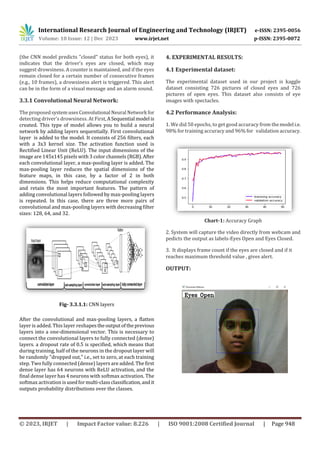
A pre-trained deep learning model (a Convolutional Neural
Network or CNN) is used to predict the state of the driver's
eyes based on the cropped and resized eye images. The
model has been trained to classify eye images as either
"open" or "closed". If both eyes are predicted to be "closed"](https://image.slidesharecdn.com/irjet-v10i12131-240112123318-e4b3fe08/85/DRIVER-DROWSINESS-DETECTION-USING-DEEP-LEARNING-2-320.jpg)
![International Research Journal of Engineering and Technology (IRJET) e-ISSN: 2395-0056
Volume: 10 Issue: 12 | Dec 2023 www.irjet.net p-ISSN: 2395-0072
© 2023, IRJET | Impact Factor value: 8.226 | ISO 9001:2008 Certified Journal | Page 949
4.2 System Testing:
The following table represents test cases observed while
doing the project to detect the driver’s drowsiness.
Test cases Eyes
detected
Eyes
closure
Result
Case 1 No No No result
Case 2 No Yes No result
Case 3 Yes No Eyes open
Case 4 Yes Yes Eyes closed,Voice
alert
Table-1: System Testing
The system's approach states that the driver is feeling
fatigued if their eyes are closed for an extended period of
time (greater than the specified number of frames). From
this point on, one of these exceptional cases occurs, and the
related outcome occurs.When the face is correctly oriented
and there are no wearing obstructions, the accuracy as
determined during the performance analysis step is almost
found to be 100%. When there is an obstruction, accuracy
slightly decreases. The right results depend greatly on the
ambient lighting conditions.
5. CONCLUSIONS:
Face and eyes were recognized on the footage of a person
driving in order to determine whether they were drowsy or
not. We employed a haar cascade classifier with OpenCV to
find faces and eyes. Eyes were categorized as open or closed
using a convolutional neural network. Based on how
frequently eyelids were closed, drowsiness was assessed.
The driver was warned by an alarmthatwasprogrammed to
sound following the detection. Due to variables such as
darkness, light reflection, obstructions caused by drivers'
hands, and the wearing of sunglasses, it will bemoredifficult
to discern drivers' situations and facial expressions. In
addition to being a drowsiness detection approach that is
frequently employed with other facial extraction methods,
convolutional neural provides greater performance.
6. REFERENCES:
[1] Rosebrock, Adrian. "Drowsiness detection with
OpenCV." Py Image Search (2017).
[2] Savaş, Burcu Kır, and Yaşar Becerikli. "Real time driver
fatigue detection based on SVM algorithm." 2018 6th
International Conference on Control Engineering &
Information Technology (CEIT). IEEE, 2018.
[3] Vesselenyi, Tiberiu, et al. "Driver drowsiness detection
using ANN image processing." IOP conference series:](https://image.slidesharecdn.com/irjet-v10i12131-240112123318-e4b3fe08/85/DRIVER-DROWSINESS-DETECTION-USING-DEEP-LEARNING-4-320.jpg)
![International Research Journal of Engineering and Technology (IRJET) e-ISSN: 2395-0056
Volume: 10 Issue: 12 | Dec 2023 www.irjet.net p-ISSN: 2395-0072
© 2023, IRJET | Impact Factor value: 8.226 | ISO 9001:2008 Certified Journal | Page 950
materials science and engineering. Vol. 252. No. 1. IOP
Publishing, 2017.
[4] Chirra, Venkata Rami Reddy, Srinivasulu Reddy Uyyala,
and Venkata Krishna Kishore Kolli. "Deep CNN: A Machine
Learning Approach for Driver Drowsiness Detection Based
on Eye State." Rev. d'Intelligence Artif. 33.6 (2019):461-466.
[5] Aditya Ranjan, Karan Vyas, Sujay Ghadge, Siddharth
Patel, Suvarna Sanjay Pawar, “Driver Drowsiness Detection
System Using Computer Vision.”, in International Research
Journal of Engineering and Technology(IRJET), 2020.
[6] Saini, Vandna, and Rekha Saini. "Driver drowsiness
detection system and techniques: a review." International
Journal of Computer Science and Information Technologies
5.3 (2014): 4245-4249.
[7] Alshaqaqi, Belal, et al. "Driver drowsiness detection
system." 2013 8thinternational workshoponsystems,signal
processing and their applications (WoSSPA). IEEE, 2013.
[8] Deng, Wanghua, and Ruoxue Wu. "Real-time driver-
drowsiness detection system using facial features." Ieee
Access 7 (2019): 118727-118738.
[9] Park, Sanghyuk, et al. "Driver drowsiness detection
system based on feature representation learning using
various deep networks." Asian Conference on Computer
Vision. Cham: Springer International Publishing, 2016.
[10] Hashemi, Maryam, Alireza Mirrashid, and Aliasghar
Beheshti Shirazi. "Driver safety development: Real-time
driver drowsiness detection system based on convolutional
neural network." SN Computer Science 1 (2020): 1-10.](https://image.slidesharecdn.com/irjet-v10i12131-240112123318-e4b3fe08/85/DRIVER-DROWSINESS-DETECTION-USING-DEEP-LEARNING-5-320.jpg)

This document presents a driver drowsiness detection system using deep learning. It begins with an introduction describing the safety issues caused by drowsy driving and the need for such a system. It then discusses the proposed system which uses a CNN trained on eye image data to classify eyes as open or closed in real-time video. If the eyes are classified as closed for a certain number of frames, an alert is triggered. The system achieved 96% accuracy on a test dataset. It concludes that CNNs provide better performance than other facial extraction methods for drowsiness detection.


