Hypernatremia in Neonates
Khazaei , MD
Associate Professor, Pediatric Nephrologist
Islamic Azad University – Masshad Branch
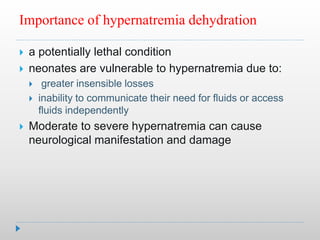
Importance of hypernatremia dehydration
 a potentially lethal condition
 neonates are vulnerable to hypernatremia due to:
 greater insensible losses
 inability to communicate their need for fluids or access
fluids independently
 Moderate to severe hypernatremia can cause
neurological manifestation and damage
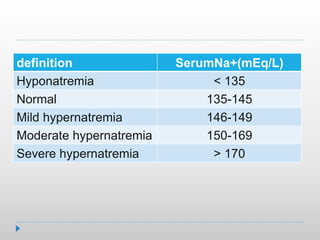
SerumNa+(mEq/L)
definition
< 135
Hyponatremia
135-145
Normal
146-149
Mild hypernatremia
150-169
Moderate hypernatremia
> 170
Severe hypernatremia
Neonatal HN: Causes
 Water loss in excess of sodium (more common):
 Poor feeding in the early days of life
 Increased insensible water losses through:
 an immature, water-permeable stratum corneum, (phototherapy, warmer!!)
 unproportional increased BSA,
 increased resp. rate
 Improper clothing (63.5% in fall & winter season)(Sanaei Z. Iranian Journal of Neonatology.
2017 Sep)
 Breast milk with high Na content (see next Slide)
 Immature renal function regarding U. concentration ability.
 Rare causes:
 central or nephrogenic diabetes insipidus.
 CAH
 Hyperaldostronism ( Con’s disease)
 Solute overload (rare):
 Adding too much salt when preparing homemade infant formula
 Hyperosmolar solutions. Fresh frozen plasma and human albumin
Breast milk sodium
 The sodium content of breast milk at birth is high and
declines rapidly over the subsequent days.(Macy IG. Am J Dis Child 1949;
78: 589-603.)
 Colostrum (in the first five days ): 22±12 mEq/ L,
 transitional milk (from day 5 to 10):13±3 mEq/L,
 mature milk (after 15 d): (7±2) mEq/ L.
 Normal physiological drop in breast milk sodium
concentration not occurred in cases with poor mother-
infant interaction. (Morton JA. Pediatrics 1994; 93: 802-6.)
 Commonest cause: low volume intake of breast milk.
 Low intake
 Incomplete response to Na load @ kidney
 High water loss through the skin, kidney and from the lungs.
Breastfed Hypernatremia
 Occurs in infants 1-3 weeks old
 First born children
 Cesarean
 Poor mother-infant interaction
 Limited human milk production
 Sodium content in human milk remains high
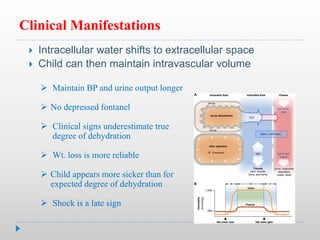
Clinical Manifestations
 Intracellular water shifts to extracellular space
 Child can then maintain intravascular volume
 Maintain BP and urine output longer
 No depressed fontanel
 Clinical signs underestimate true
degree of dehydration
 Wt. loss is more reliable
 Child appears more sicker than for
expected degree of dehydration
 Shock is a late sign
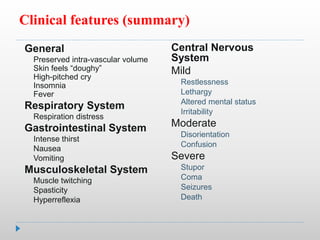
Clinical features (summary)
Central Nervous
System
Mild
Restlessness
Lethargy
Altered mental status
Irritability
Moderate
Disorientation
Confusion
Severe
Stupor
Coma
Seizures
Death
General
Preserved intra-vascular volume
Skin feels “doughy”
High-pitched cry
Insomnia
Fever
Respiratory System
Respiration distress
Gastrointestinal System
Intense thirst
Nausea
Vomiting
Musculoskeletal System
Muscle twitching
Spasticity
Hyperreflexia
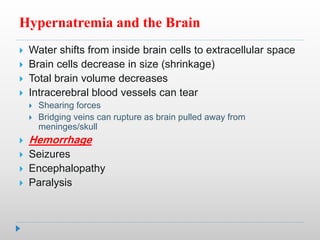
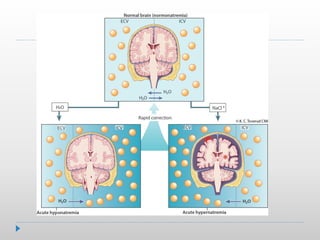
Hypernatremia and the Brain
 Water shifts from inside brain cells to extracellular space
 Brain cells decrease in size (shrinkage)
 Total brain volume decreases
 Intracerebral blood vessels can tear
 Shearing forces
 Bridging veins can rupture as brain pulled away from
meninges/skull
 Hemorrhage
 Seizures
 Encephalopathy
 Paralysis
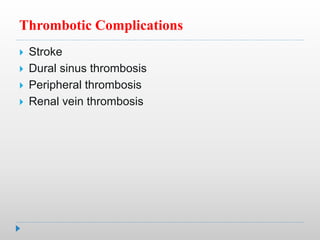
Thrombotic Complications
 Stroke
 Dural sinus thrombosis
 Peripheral thrombosis
 Renal vein thrombosis
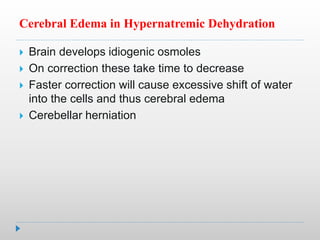
Cerebral Edema in Hypernatremic Dehydration
 Brain develops idiogenic osmoles
 On correction these take time to decrease
 Faster correction will cause excessive shift of water
into the cells and thus cerebral edema
 Cerebellar herniation
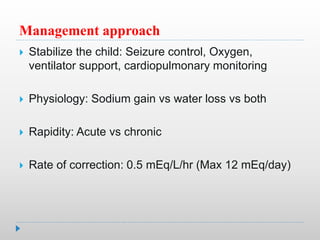
Management approach
 Stabilize the child: Seizure control, Oxygen,
ventilator support, cardiopulmonary monitoring
 Physiology: Sodium gain vs water loss vs both
 Rapidity: Acute vs chronic
 Rate of correction: 0.5 mEq/L/hr (Max 12 mEq/day)
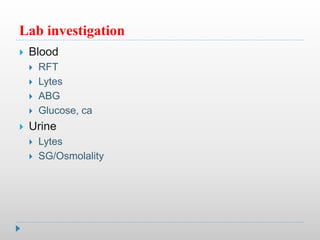
Lab investigation
 Blood
 RFT
 Lytes
 ABG
 Glucose, ca
 Urine
 Lytes
 SG/Osmolality
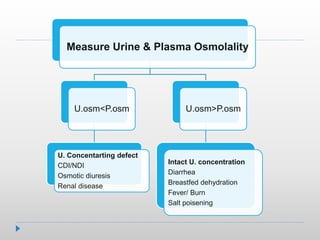
Measure Urine & Plasma Osmolality
U.osm<P.osm
U. Concentarting defect
CDI/NDI
Osmotic diuresis
Renal disease
U.osm>P.osm
Intact U. concentration
Diarrhea
Breastfed dehydration
Burn
/
Fever
Salt poisening
Treatment
 First priority is restoration of intravascular volume
 Goal: decrease serum sodium by 12-15 mEq/L/24
hours (0.5-0.6 mEq/L/hr)
 Frequent monitoring of serum sodium to ensure rate
of correction is not too fast
Treatment of hypernatremic dehydration:
Emergent phase
 Emergent Rehydration:
 Restoration of intravascular volume
 20 ml/kg NS (not ringer)
 Acute hypernatremia with neurological manifestation:
 Anticonvulsant
 Correct serum Na upto ↓5 mEq as rapid as 2 mEq/hr
 Neurological manifestation during correction
 Anticonvulsant
 Correct serum Na upto ↑5 mEq as rapid as 2 mEq/hr
Treatment of hypernatremic dehydration
 Phase 2: Determine the time of correction
 145-157: 24 hrs
 158-170: 48 hrs
 171-183: 72 hrs
 184-196: 84 hrs
 Replace ongoing losses with N/2 saline with KCl
Treatment of hypernatremic dehydration:
correction phase
 Step1:Estimate volume deficit (VD)
 Body wt. is best marker
 = free water loss + isotonic fluid deficit
 Step 2: calculate Free water deficit
 FWD= TBW(p)[(P.ser.Na/140)-1] (No Na)
 Isotonic F. loss= VD - FWD (140mEq Na/Lit
Example:
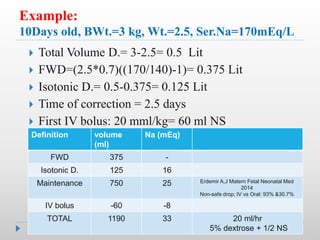
10Days old, BWt.=3 kg, Wt.=2.5, Ser.Na=170mEq/L
 Total Volume D.= 3-2.5= 0.5 Lit
 FWD=(2.5*0.7)((170/140)-1)= 0.375 Lit
 Isotonic D.= 0.5-0.375= 0.125 Lit
 Time of correction = 2.5 days
 First IV bolus: 20 mml/kg= 60 ml NS
Na (mEq)
volume
(ml)
Definition
-
375
FWD
16
125
Isotonic D.
Erdemir A,J Matern Fetal Neonatal Med
2014
Non-safe drop; IV vs Oral: 93% &30.7%
25
750
Maintenance
-8
-60
IV bolus
20 ml/hr
5% dextrose + 1/2 NS
33
1190
TOTAL
Type of fluid
 Does not matter, rate of correction matters
 May run two drips:
 1st: N/2 DNS with KCl
 2nd: N/5 + D5-10%W with KCl
 Monitor Na: 2- 6 hourly and adjust the rate
 Less decrease: increase N/5
 More decrease: increase N/2
 Thumb rule:(Nelson textbook of oediatrics, 20th ed.)
 Typical fluid: half normal salin + 5% D/W +Kcl
 Typical rate: 1.25-1.5 times maintanence
What if….
 Correction occurs too rapidly?
 Brain Edema
 Administer 3% NS to quickly reverse edema
 Dose: 4-6 ml/kg
 1ml/kg of 3% NS will change Na concentration by 1 meq/L
 Patient has hypernatremia secondary to sodium
administration
 The change is usually rapid-no time for idiogenic
osmoles to accumulate
 Can correct rapidly
 Peritoneal dialysis
 Administration D5W (no sodium) and loop diuretics
Key points
 Hypernatremia is usually due to dehydration (eg, caused by
diarrhea, vomiting, high fever); sodium overload is rare.
 Signs include lethargy, restlessness, hyperreflexia, spasticity,
hyperthermia, and seizures.
 Intracranial hemorrhage, venous sinus thrombosis, and acute
renal tubular necrosis may occur.
 Diagnose by finding serum sodium concentration > 150 mEq/L
(> 150 mmol/L).
 If the cause is dehydration, restore circulating blood volume
with 0.9% saline and then give 5% dextrose/0.3% to 0.45%
saline solution IV in volumes equal to the calculated fluid
deficit.
 Rehydrate over 2 to 3 days to avoid a too-rapid fall in serum
sodium, which can have significant adverse consequences.

Dr khazaei

  • 1.
    Hypernatremia in Neonates Khazaei, MD Associate Professor, Pediatric Nephrologist Islamic Azad University – Masshad Branch
  • 2.
    Importance of hypernatremiadehydration  a potentially lethal condition  neonates are vulnerable to hypernatremia due to:  greater insensible losses  inability to communicate their need for fluids or access fluids independently  Moderate to severe hypernatremia can cause neurological manifestation and damage
  • 3.
  • 4.
    Neonatal HN: Causes Water loss in excess of sodium (more common):  Poor feeding in the early days of life  Increased insensible water losses through:  an immature, water-permeable stratum corneum, (phototherapy, warmer!!)  unproportional increased BSA,  increased resp. rate  Improper clothing (63.5% in fall & winter season)(Sanaei Z. Iranian Journal of Neonatology. 2017 Sep)  Breast milk with high Na content (see next Slide)  Immature renal function regarding U. concentration ability.  Rare causes:  central or nephrogenic diabetes insipidus.  CAH  Hyperaldostronism ( Con’s disease)  Solute overload (rare):  Adding too much salt when preparing homemade infant formula  Hyperosmolar solutions. Fresh frozen plasma and human albumin
  • 5.
    Breast milk sodium The sodium content of breast milk at birth is high and declines rapidly over the subsequent days.(Macy IG. Am J Dis Child 1949; 78: 589-603.)  Colostrum (in the first five days ): 22±12 mEq/ L,  transitional milk (from day 5 to 10):13±3 mEq/L,  mature milk (after 15 d): (7±2) mEq/ L.  Normal physiological drop in breast milk sodium concentration not occurred in cases with poor mother- infant interaction. (Morton JA. Pediatrics 1994; 93: 802-6.)  Commonest cause: low volume intake of breast milk.  Low intake  Incomplete response to Na load @ kidney  High water loss through the skin, kidney and from the lungs.
  • 6.
    Breastfed Hypernatremia  Occursin infants 1-3 weeks old  First born children  Cesarean  Poor mother-infant interaction  Limited human milk production  Sodium content in human milk remains high
  • 7.
    Clinical Manifestations  Intracellularwater shifts to extracellular space  Child can then maintain intravascular volume  Maintain BP and urine output longer  No depressed fontanel  Clinical signs underestimate true degree of dehydration  Wt. loss is more reliable  Child appears more sicker than for expected degree of dehydration  Shock is a late sign
  • 8.
    Clinical features (summary) CentralNervous System Mild Restlessness Lethargy Altered mental status Irritability Moderate Disorientation Confusion Severe Stupor Coma Seizures Death General Preserved intra-vascular volume Skin feels “doughy” High-pitched cry Insomnia Fever Respiratory System Respiration distress Gastrointestinal System Intense thirst Nausea Vomiting Musculoskeletal System Muscle twitching Spasticity Hyperreflexia
  • 9.
    Hypernatremia and theBrain  Water shifts from inside brain cells to extracellular space  Brain cells decrease in size (shrinkage)  Total brain volume decreases  Intracerebral blood vessels can tear  Shearing forces  Bridging veins can rupture as brain pulled away from meninges/skull  Hemorrhage  Seizures  Encephalopathy  Paralysis
  • 10.
    Thrombotic Complications  Stroke Dural sinus thrombosis  Peripheral thrombosis  Renal vein thrombosis
  • 11.
    Cerebral Edema inHypernatremic Dehydration  Brain develops idiogenic osmoles  On correction these take time to decrease  Faster correction will cause excessive shift of water into the cells and thus cerebral edema  Cerebellar herniation
  • 13.
    Management approach  Stabilizethe child: Seizure control, Oxygen, ventilator support, cardiopulmonary monitoring  Physiology: Sodium gain vs water loss vs both  Rapidity: Acute vs chronic  Rate of correction: 0.5 mEq/L/hr (Max 12 mEq/day)
  • 14.
    Lab investigation  Blood RFT  Lytes  ABG  Glucose, ca  Urine  Lytes  SG/Osmolality
  • 15.
    Measure Urine &Plasma Osmolality U.osm<P.osm U. Concentarting defect CDI/NDI Osmotic diuresis Renal disease U.osm>P.osm Intact U. concentration Diarrhea Breastfed dehydration Burn / Fever Salt poisening
  • 16.
    Treatment  First priorityis restoration of intravascular volume  Goal: decrease serum sodium by 12-15 mEq/L/24 hours (0.5-0.6 mEq/L/hr)  Frequent monitoring of serum sodium to ensure rate of correction is not too fast
  • 17.
    Treatment of hypernatremicdehydration: Emergent phase  Emergent Rehydration:  Restoration of intravascular volume  20 ml/kg NS (not ringer)  Acute hypernatremia with neurological manifestation:  Anticonvulsant  Correct serum Na upto ↓5 mEq as rapid as 2 mEq/hr  Neurological manifestation during correction  Anticonvulsant  Correct serum Na upto ↑5 mEq as rapid as 2 mEq/hr
  • 18.
    Treatment of hypernatremicdehydration  Phase 2: Determine the time of correction  145-157: 24 hrs  158-170: 48 hrs  171-183: 72 hrs  184-196: 84 hrs  Replace ongoing losses with N/2 saline with KCl
  • 19.
    Treatment of hypernatremicdehydration: correction phase  Step1:Estimate volume deficit (VD)  Body wt. is best marker  = free water loss + isotonic fluid deficit  Step 2: calculate Free water deficit  FWD= TBW(p)[(P.ser.Na/140)-1] (No Na)  Isotonic F. loss= VD - FWD (140mEq Na/Lit
  • 20.
    Example: 10Days old, BWt.=3kg, Wt.=2.5, Ser.Na=170mEq/L  Total Volume D.= 3-2.5= 0.5 Lit  FWD=(2.5*0.7)((170/140)-1)= 0.375 Lit  Isotonic D.= 0.5-0.375= 0.125 Lit  Time of correction = 2.5 days  First IV bolus: 20 mml/kg= 60 ml NS Na (mEq) volume (ml) Definition - 375 FWD 16 125 Isotonic D. Erdemir A,J Matern Fetal Neonatal Med 2014 Non-safe drop; IV vs Oral: 93% &30.7% 25 750 Maintenance -8 -60 IV bolus 20 ml/hr 5% dextrose + 1/2 NS 33 1190 TOTAL
  • 21.
    Type of fluid Does not matter, rate of correction matters  May run two drips:  1st: N/2 DNS with KCl  2nd: N/5 + D5-10%W with KCl  Monitor Na: 2- 6 hourly and adjust the rate  Less decrease: increase N/5  More decrease: increase N/2  Thumb rule:(Nelson textbook of oediatrics, 20th ed.)  Typical fluid: half normal salin + 5% D/W +Kcl  Typical rate: 1.25-1.5 times maintanence
  • 22.
    What if….  Correctionoccurs too rapidly?  Brain Edema  Administer 3% NS to quickly reverse edema  Dose: 4-6 ml/kg  1ml/kg of 3% NS will change Na concentration by 1 meq/L  Patient has hypernatremia secondary to sodium administration  The change is usually rapid-no time for idiogenic osmoles to accumulate  Can correct rapidly  Peritoneal dialysis  Administration D5W (no sodium) and loop diuretics
  • 23.
    Key points  Hypernatremiais usually due to dehydration (eg, caused by diarrhea, vomiting, high fever); sodium overload is rare.  Signs include lethargy, restlessness, hyperreflexia, spasticity, hyperthermia, and seizures.  Intracranial hemorrhage, venous sinus thrombosis, and acute renal tubular necrosis may occur.  Diagnose by finding serum sodium concentration > 150 mEq/L (> 150 mmol/L).  If the cause is dehydration, restore circulating blood volume with 0.9% saline and then give 5% dextrose/0.3% to 0.45% saline solution IV in volumes equal to the calculated fluid deficit.  Rehydrate over 2 to 3 days to avoid a too-rapid fall in serum sodium, which can have significant adverse consequences.