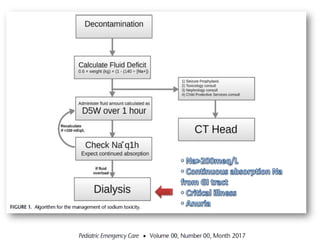
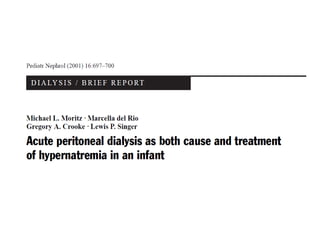
HyperNa and PD
(Salt toxicity)
Hooman N
Professor of Pediatric nephrology
IUMS
2020
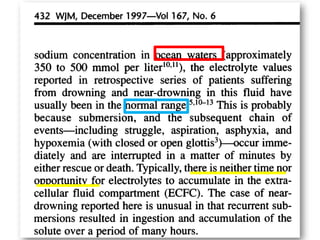
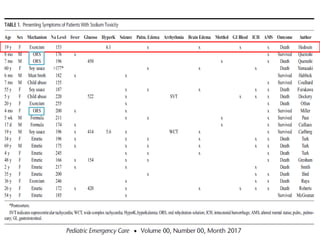
Slat toxicity definition
• Single massive exposure to salt (NaCl) over a
short period of time ( minutes to hours )
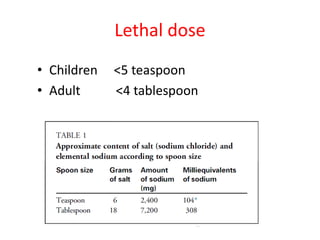
Lethal dose
• Children <5 teaspoon
• Adult <4 tablespoon
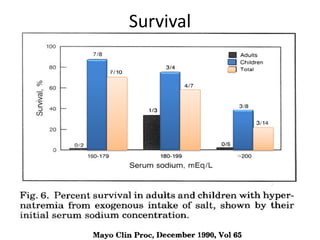
Survival
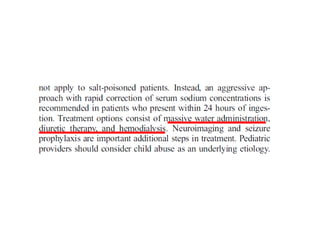
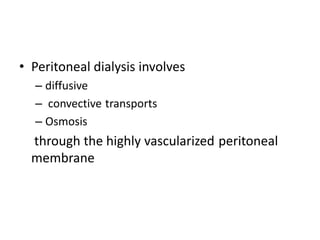
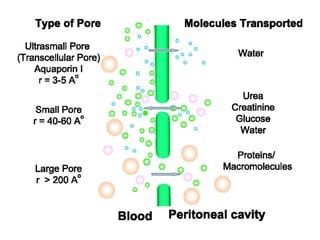
• Peritoneal dialysis involves
– diffusive
– convective transports
– Osmosis
through the highly vascularized peritoneal
membrane
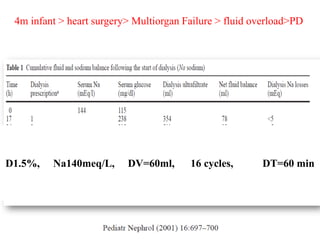
4m infant > heart surgery> Multiorgan Failure > fluid overload>PD
D1.5%, Na140meq/L, DV=60ml, 16 cycles, DT=60 min
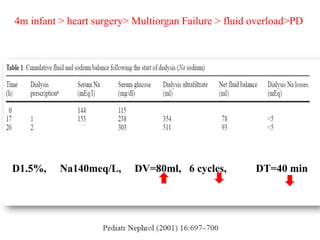
4m infant > heart surgery> Multiorgan Failure > fluid overload>PD
D1.5%, Na140meq/L, DV=80ml, 6 cycles, DT=40 min
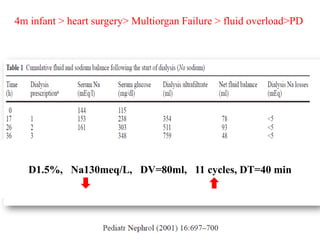
4m infant > heart surgery> Multiorgan Failure > fluid overload>PD
D1.5%, Na130meq/L, DV=80ml, 11 cycles, DT=40 min
4m infant > heart surgery> Multiorgan Failure > fluid overload>PD
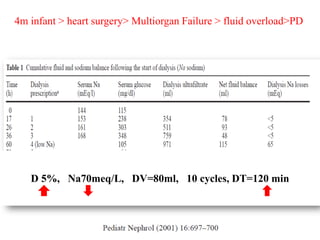
D 5%, Na70meq/L, DV=80ml, 10 cycles, DT=120 min
4m infant > heart surgery> Multiorgan Failure > fluid overload>PD
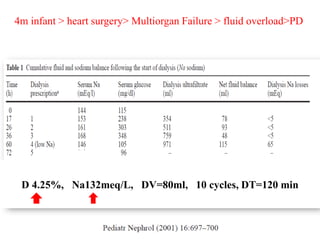
D 4.25%, Na132meq/L, DV=80ml, 10 cycles, DT=120 min
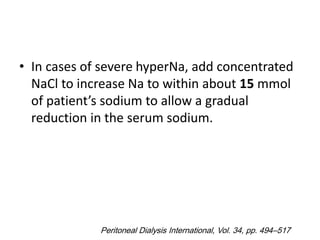
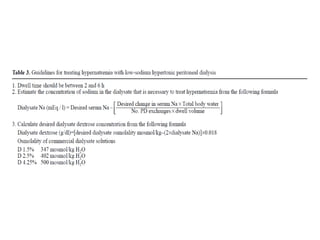
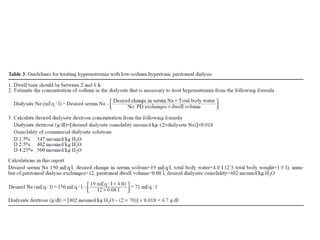
• In cases of severe hyperNa, add concentrated
NaCl to increase Na to within about 15 mmol
of patient’s sodium to allow a gradual
reduction in the serum sodium.
Peritoneal Dialysis International, Vol. 34, pp. 494–517
• [DNa ] =132 – 134 mmol/L.
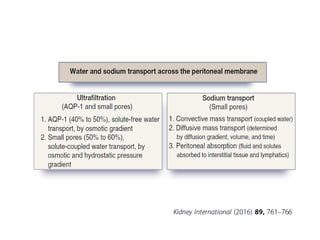
• with acute PD, rapid cycling with hypertonic dialysis
solutions to promote UF can result in hyperNa as a
result of enhanced free water clearance secondary
to sodium sieving and transport of water through
aquaporin channels
Peritoneal Dialysis International, Vol. 34, pp. 494–517
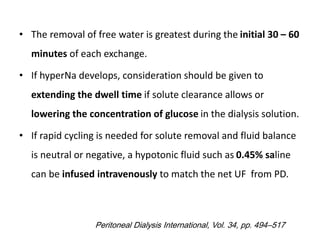
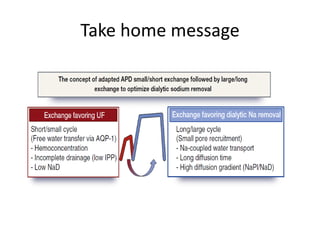
• The removal of free water is greatest during the initial 30 – 60
minutes of each exchange.
• If hyperNa develops, consideration should be given to
extending the dwell time if solute clearance allows or
lowering the concentration of glucose in the dialysis solution.
• If rapid cycling is needed for solute removal and fluid balance
is neutral or negative, a hypotonic fluid such as 0.45% saline
can be infused intravenously to match the net UF from PD.
Peritoneal Dialysis International, Vol. 34, pp. 494–517
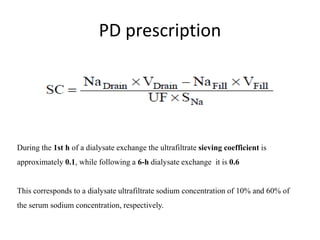
PD prescription
During the 1st h of a dialysate exchange the ultrafiltrate sieving coefficient is
approximately 0.1, while following a 6-h dialysate exchange it is 0.6
This corresponds to a dialysate ultrafiltrate sodium concentration of 10% and 60% of
the serum sodium concentration, respectively.
Take home message
questions
PD hypernatremia
PD hypernatremia
PD hypernatremia

PD hypernatremia

  • 1.
    HyperNa and PD (Salttoxicity) Hooman N Professor of Pediatric nephrology IUMS 2020
  • 2.
    Slat toxicity definition •Single massive exposure to salt (NaCl) over a short period of time ( minutes to hours )
  • 3.
    Lethal dose • Children<5 teaspoon • Adult <4 tablespoon
  • 6.
  • 9.
    • Peritoneal dialysisinvolves – diffusive – convective transports – Osmosis through the highly vascularized peritoneal membrane
  • 13.
    4m infant >heart surgery> Multiorgan Failure > fluid overload>PD D1.5%, Na140meq/L, DV=60ml, 16 cycles, DT=60 min
  • 14.
    4m infant >heart surgery> Multiorgan Failure > fluid overload>PD D1.5%, Na140meq/L, DV=80ml, 6 cycles, DT=40 min
  • 15.
    4m infant >heart surgery> Multiorgan Failure > fluid overload>PD D1.5%, Na130meq/L, DV=80ml, 11 cycles, DT=40 min
  • 16.
    4m infant >heart surgery> Multiorgan Failure > fluid overload>PD D 5%, Na70meq/L, DV=80ml, 10 cycles, DT=120 min
  • 17.
    4m infant >heart surgery> Multiorgan Failure > fluid overload>PD D 4.25%, Na132meq/L, DV=80ml, 10 cycles, DT=120 min
  • 18.
    • In casesof severe hyperNa, add concentrated NaCl to increase Na to within about 15 mmol of patient’s sodium to allow a gradual reduction in the serum sodium. Peritoneal Dialysis International, Vol. 34, pp. 494–517
  • 19.
    • [DNa ]=132 – 134 mmol/L. • with acute PD, rapid cycling with hypertonic dialysis solutions to promote UF can result in hyperNa as a result of enhanced free water clearance secondary to sodium sieving and transport of water through aquaporin channels Peritoneal Dialysis International, Vol. 34, pp. 494–517
  • 20.
    • The removalof free water is greatest during the initial 30 – 60 minutes of each exchange. • If hyperNa develops, consideration should be given to extending the dwell time if solute clearance allows or lowering the concentration of glucose in the dialysis solution. • If rapid cycling is needed for solute removal and fluid balance is neutral or negative, a hypotonic fluid such as 0.45% saline can be infused intravenously to match the net UF from PD. Peritoneal Dialysis International, Vol. 34, pp. 494–517
  • 21.
    PD prescription During the1st h of a dialysate exchange the ultrafiltrate sieving coefficient is approximately 0.1, while following a 6-h dialysate exchange it is 0.6 This corresponds to a dialysate ultrafiltrate sodium concentration of 10% and 60% of the serum sodium concentration, respectively.
  • 24.
  • 25.