Peritoneal Dialysis in Children
Hooman N
Professor
IUMS
2016
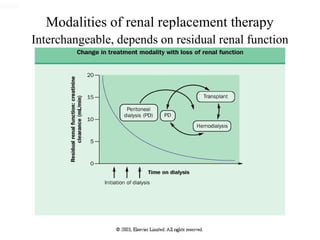
Modalities of renal replacement therapy
Interchangeable, depends on residual renal function
Peritoneal dialysis - outline
• Principles of PD
• PD solutions / PD catheter
• Indication / contraindication of PD
• PD schemes : CAPD, CCPD
• Assessement of PD adequacy/ Peritoneal
function/ultrafiltration
• Complications- Infectious/Non-infectious
• Perspectives – new dialysis solutions
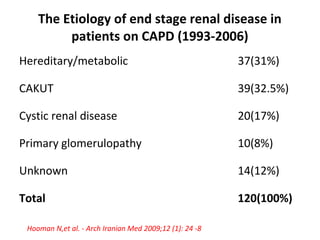
Hooman N,et al. - Arch Iranian Med 2009;12 (1): 24 -8
The Etiology of end stage renal disease in
patients on CAPD (1993-2006)
Hereditary/metabolic 37(31%)
CAKUT 39(32.5%)
Cystic renal disease 20(17%)
Primary glomerulopathy 10(8%)
Unknown 14(12%)
Total 120(100%)
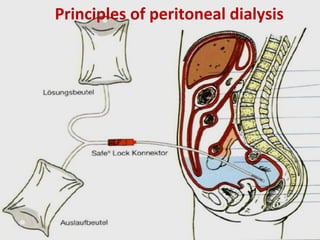
Principles of peritoneal dialysis
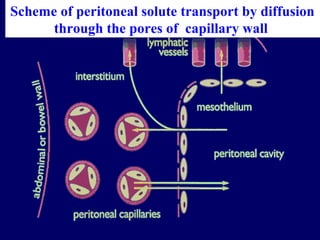
Scheme of peritoneal solute transport by diffusion
through the pores of capillary wall
Ramesh Khanna & Karl D. Nolph
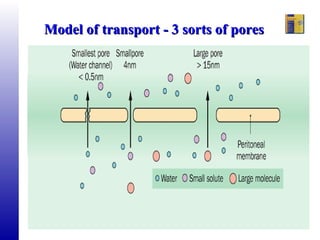
Model of transport - 3 sorts of poresModel of transport - 3 sorts of pores
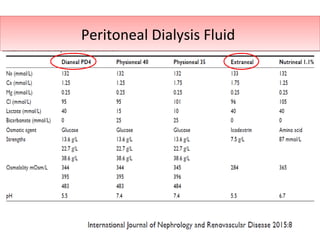
Peritoneal Dialysis FluidPeritoneal Dialysis Fluid
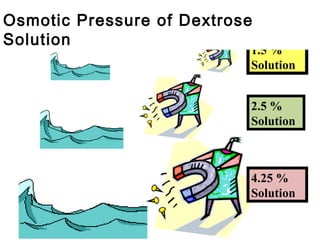
1.5 %
Solution
2.5 %
Solution
4.25 %
Solution
Osmotic Pressure of Dextrose
Solution
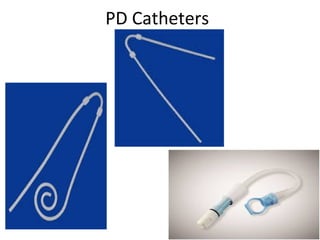
PD Catheters
Initiation of PD
• Start  one – two wks after Cath. insertion
• Fill volume
– 10ml/kg/dose increase within one week to
– 1100ml/m2 children above one year
– 600-800 ml/m2 children below one year
• Dwell Time  According PET
– Low transporter
– High transporter
– High average/ low average
• Dwell Time  According PET
– Low transporter
– High transporter
– High average/ low average
• IPP
– Children below 2 yrs 8-10 cm H2O ( 800 ml/m2)
– Above 2 yrs 13-14cmH2O (1400ml/m2)
Contraindications to CPD
● Omphalocele
● Gastroschisis
● Bladder exstrophy
● Diaphragmatic hernia
● Obliterated peritoneal cavity and peritoneal
membrane failure
Relative contraindications to CPD include:
● Impending abdominal surgery.
● Impending (<3 months) living-donor kidney
transplantation
● Lack of an appropriate caregiver for home therapy.
● Patient/caregiver choice for hemodialysis, which is
available and medically suitable
Choice of Modality
• Continuous ambulatory peritoneal
dialysi(CAPD)
• Automated peritoneal dialysis (APD)
– NIPD
– CCPD
– TPD
Peritoneal Membrane Function
• Ultrafiltration ( UF)
• Clearance ( KT/V)
• PET
– D/Pcr
– D/D0 Glucose
Dialysis Mode
Dwell time
PD solution
Fill volume/ Number of exchange
Dialysis Mode
Dwell time
PD solution
Fill volume/ Number of exchange
Complications
• Infectious
– Peritonitis
• Bacterial
• Fungal
• Culture negative
• Eosinophilic
– Exit site
– Tunnel
• Mechanical
• Technical
– Ultrafiltration failure
– Catheter –related
• Encapsulated Peritoneal Sclerosis
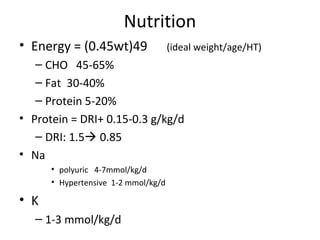
Nutrition
• Energy = (0.45wt)49 (ideal weight/age/HT)
– CHO 45-65%
– Fat 30-40%
– Protein 5-20%
• Protein = DRI+ 0.15-0.3 g/kg/d
– DRI: 1.5 0.85
• Na
• polyuric 4-7mmol/kg/d
• Hypertensive 1-2 mmol/kg/d
• K
– 1-3 mmol/kg/d
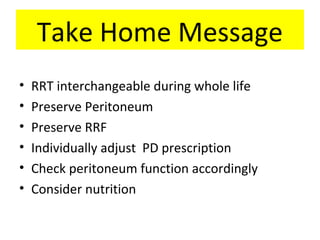
Take Home Message
• RRT interchangeable during whole life
• Preserve Peritoneum
• Preserve RRF
• Individually adjust PD prescription
• Check peritoneum function accordingly
• Consider nutrition

Peritoneal dialysis in children

  • 1.
    Peritoneal Dialysis inChildren Hooman N Professor IUMS 2016
  • 2.
    Modalities of renalreplacement therapy Interchangeable, depends on residual renal function
  • 3.
    Peritoneal dialysis -outline • Principles of PD • PD solutions / PD catheter • Indication / contraindication of PD • PD schemes : CAPD, CCPD • Assessement of PD adequacy/ Peritoneal function/ultrafiltration • Complications- Infectious/Non-infectious • Perspectives – new dialysis solutions
  • 4.
    Hooman N,et al.- Arch Iranian Med 2009;12 (1): 24 -8 The Etiology of end stage renal disease in patients on CAPD (1993-2006) Hereditary/metabolic 37(31%) CAKUT 39(32.5%) Cystic renal disease 20(17%) Primary glomerulopathy 10(8%) Unknown 14(12%) Total 120(100%)
  • 5.
  • 6.
    Scheme of peritonealsolute transport by diffusion through the pores of capillary wall
  • 7.
    Ramesh Khanna &Karl D. Nolph Model of transport - 3 sorts of poresModel of transport - 3 sorts of pores
  • 8.
  • 9.
    1.5 % Solution 2.5 % Solution 4.25% Solution Osmotic Pressure of Dextrose Solution
  • 10.
  • 11.
    Initiation of PD •Start  one – two wks after Cath. insertion • Fill volume – 10ml/kg/dose increase within one week to – 1100ml/m2 children above one year – 600-800 ml/m2 children below one year • Dwell Time  According PET – Low transporter – High transporter – High average/ low average
  • 12.
    • Dwell Time According PET – Low transporter – High transporter – High average/ low average • IPP – Children below 2 yrs 8-10 cm H2O ( 800 ml/m2) – Above 2 yrs 13-14cmH2O (1400ml/m2)
  • 13.
    Contraindications to CPD ●Omphalocele ● Gastroschisis ● Bladder exstrophy ● Diaphragmatic hernia ● Obliterated peritoneal cavity and peritoneal membrane failure
  • 14.
    Relative contraindications toCPD include: ● Impending abdominal surgery. ● Impending (<3 months) living-donor kidney transplantation ● Lack of an appropriate caregiver for home therapy. ● Patient/caregiver choice for hemodialysis, which is available and medically suitable
  • 15.
    Choice of Modality •Continuous ambulatory peritoneal dialysi(CAPD) • Automated peritoneal dialysis (APD) – NIPD – CCPD – TPD
  • 16.
    Peritoneal Membrane Function •Ultrafiltration ( UF) • Clearance ( KT/V) • PET – D/Pcr – D/D0 Glucose Dialysis Mode Dwell time PD solution Fill volume/ Number of exchange Dialysis Mode Dwell time PD solution Fill volume/ Number of exchange
  • 17.
    Complications • Infectious – Peritonitis •Bacterial • Fungal • Culture negative • Eosinophilic – Exit site – Tunnel
  • 18.
    • Mechanical • Technical –Ultrafiltration failure – Catheter –related • Encapsulated Peritoneal Sclerosis
  • 19.
    Nutrition • Energy =(0.45wt)49 (ideal weight/age/HT) – CHO 45-65% – Fat 30-40% – Protein 5-20% • Protein = DRI+ 0.15-0.3 g/kg/d – DRI: 1.5 0.85 • Na • polyuric 4-7mmol/kg/d • Hypertensive 1-2 mmol/kg/d • K – 1-3 mmol/kg/d
  • 20.
    Take Home Message •RRT interchangeable during whole life • Preserve Peritoneum • Preserve RRF • Individually adjust PD prescription • Check peritoneum function accordingly • Consider nutrition