

Perceptions of Feedback:
        Myth & Reality


               Jon Scott


     School of
Biological Sciences
Some of the Issues

•   What‟s the fuss about?
•   What is feedback?
•   A common understanding?
•   The module effect
•   Expectations
•   Utility & Utilisation
Learning how to eat Smarties…

• Active engagement
• Rewards
• Common view of success and its
  measurement
• Feedback shows what is OK and what
  needs changing for next time
• Review of original performance in the
  light of feedback
Feedback Projects

• Seeing Eye to Eye: Comparing the
  Perceptions of Students & Staff
• „Quick Wins‟ Campaign
• Peer Observation of Feedback
• Departmental Guidance
• Student Engagement with Feedback
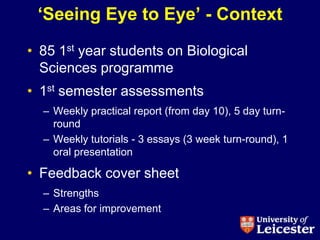
„Seeing Eye to Eye‟ - Context
• 85 1st year students on Biological
  Sciences programme
• 1st semester assessments
  – Weekly practical report (from day 10), 5 day turn-
    round
  – Weekly tutorials - 3 essays (3 week turn-round), 1
    oral presentation

• Feedback cover sheet
  – Strengths
  – Areas for improvement
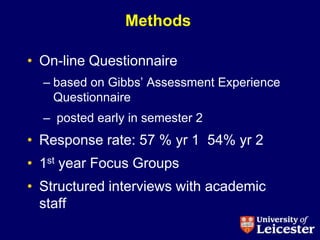
Methods

• On-line Questionnaire
  – based on Gibbs‟ Assessment Experience
    Questionnaire
  – posted early in semester 2
• Response rate: 57 % yr 1 54% yr 2
• 1st year Focus Groups
• Structured interviews with academic
  staff
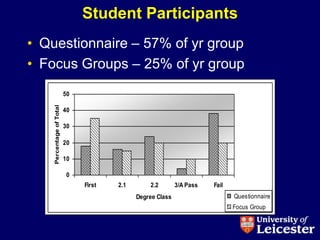
Student Participants
• Questionnaire – 57% of yr group
• Focus Groups – 25% of yr group
                          50
    Percentage of Total


                          40

                          30

                          20

                          10

                           0
                               First   2.1       2.2        3/A Pass   Fail
                                             Degree Class                     Questionnaire
                                                                              Focus Group
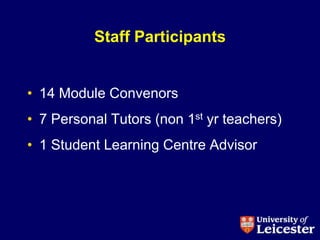
Staff Participants


• 14 Module Convenors
• 7 Personal Tutors (non 1st yr teachers)
• 1 Student Learning Centre Advisor
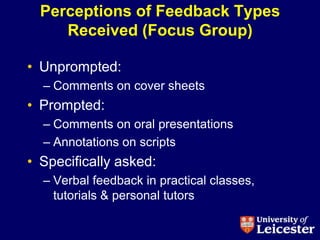
Perceptions of Feedback Types
     Received (Focus Group)

• Unprompted:
  – Comments on cover sheets
• Prompted:
  – Comments on oral presentations
  – Annotations on scripts
• Specifically asked:
  – Verbal feedback in practical classes,
    tutorials & personal tutors
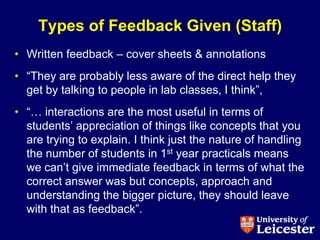
Types of Feedback Given (Staff)
• Written feedback – cover sheets & annotations
• “They are probably less aware of the direct help they
  get by talking to people in lab classes, I think”,
• “… interactions are the most useful in terms of
  students‟ appreciation of things like concepts that you
  are trying to explain. I think just the nature of handling
  the number of students in 1st year practicals means
  we can‟t give immediate feedback in terms of what the
  correct answer was but concepts, approach and
  understanding the bigger picture, they should leave
  with that as feedback”.
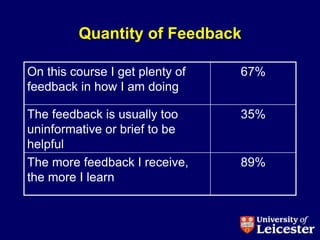
Quantity of Feedback

On this course I get plenty of   67%
feedback in how I am doing

The feedback is usually too      35%
uninformative or brief to be
helpful
The more feedback I receive,     89%
the more I learn
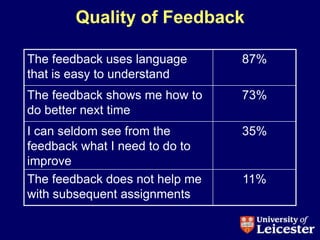
Quality of Feedback

The feedback uses language      87%
that is easy to understand
The feedback shows me how to    73%
do better next time
I can seldom see from the       35%
feedback what I need to do to
improve
The feedback does not help me   11%
with subsequent assignments
Quality & Utility of Feedback
• “Sometimes the comments are helpful but
  sometimes it‟s comments like when you get say
  60% in a practical report and they tell you it
  could be „better written‟. But you‟ve done all
  that you can to write it to the best of your ability,
  so it‟s kind of vague, I don‟t know where to
  improve”.
• “One of my friends had a higher mark than me
  and she got more comments than me in the
  „places to improve‟. I had nothing and was like
  „well I need to improve and you don‟t so why
  have you got the comments?‟. That‟s what I
  was thinking”.
Quality & Utility of Feedback

• “I got one write up which was 90% and
  she [the marker] was still like „you could
  improve it here or here‟. It was quite a
  lot of comments considering it was a
  high mark and it was really good
  because it was „ok, that‟s what I need to
  be doing”.
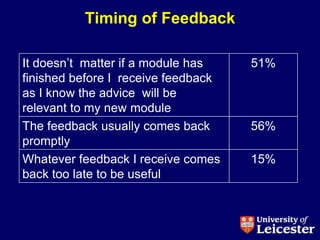
Timing of Feedback

It doesn‟t matter if a module has    51%
finished before I receive feedback
as I know the advice will be
relevant to my new module
The feedback usually comes back      56%
promptly
Whatever feedback I receive comes    15%
back too late to be useful
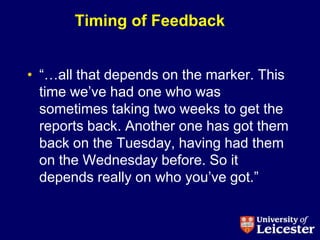
Timing of Feedback


• “…all that depends on the marker. This
  time we‟ve had one who was
  sometimes taking two weeks to get the
  reports back. Another one has got them
  back on the Tuesday, having had them
  on the Wednesday before. So it
  depends really on who you‟ve got.”
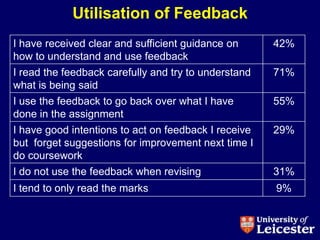
Utilisation of Feedback
I have received clear and sufficient guidance on      42%
how to understand and use feedback
I read the feedback carefully and try to understand   71%
what is being said
I use the feedback to go back over what I have        55%
done in the assignment
I have good intentions to act on feedback I receive   29%
but forget suggestions for improvement next time I
do coursework
I do not use the feedback when revising               31%
I tend to only read the marks                         9%
Utilisation of Feedback

• “A lot of the time it‟ll depend on the mark as to
  how much I do look at it [the feedback]. If I‟ve
  got a really high mark, I‟ll tend to look and think
  „oh I‟ve done well‟ and just put it away. If I‟ve
  got a really bad mark I‟ll look and think what
  I‟ve done wrong, why I got that mark”
• “If I expect a mark, low or high, and it‟s that, I
  don‟t really read the comments. If I get a mark
  that‟s really different from what I expected then
  I‟ll really read the comments”.
Students‟ Reflections on Staff Views
• They probably think we don‟t read it and
  just put it to one side.”
• “I‟m sure some of them think they‟re just
  doing it and it‟s a bit pointless and you‟re
  not going to look at it anyway.”
• “I suppose some of them [markers] must
  hope that if they bother to write
  something down then it gets read. But
  they must accept that there‟s a great deal
  of variation between students”.
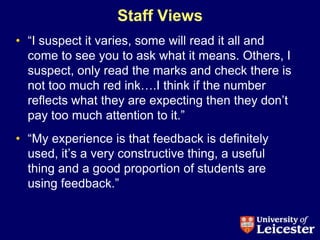
Staff Views
• “I suspect it varies, some will read it all and
  come to see you to ask what it means. Others, I
  suspect, only read the marks and check there is
  not too much red ink….I think if the number
  reflects what they are expecting then they don‟t
  pay too much attention to it.”
• “My experience is that feedback is definitely
  used, it‟s a very constructive thing, a useful
  thing and a good proportion of students are
  using feedback.”
Issues & Actions

• School vs University experience

• Recognition of feedback

• Consistency
      Timing
      Content & Structure

• Utility
      „Feed forward‟
       Encouraging engagement with feedback
       Language
Actions

• „Quick Wins‟ Campaign
• Peer Observation of Feedback
• Departmental Guidance
• Student Engagement with Feedback
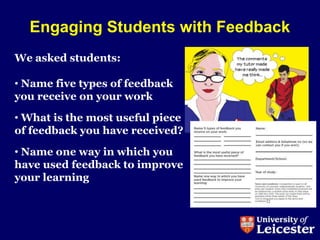
Engaging Students with Feedback
We asked students:

• Name five types of feedback
you receive on your work

• What is the most useful piece
of feedback you have received?

• Name one way in which you
have used feedback to improve
your learning
Postcard Campaign
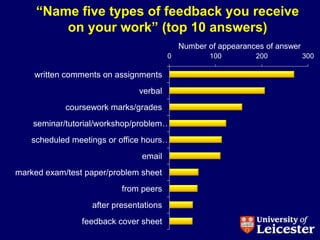
“Name five types of feedback you receive
         on your work” (top 10 answers)
                                            Number of appearances of answer
                                        0          100         200            300

    written comments on assignments
                              verbal
            coursework marks/grades
    seminar/tutorial/workshop/problem…
   scheduled meetings or office hours…
                               email
marked exam/test paper/problem sheet
                          from peers
                  after presentations
                feedback cover sheet
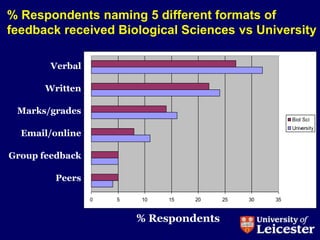
% Respondents naming 5 different formats of
feedback received Biological Sciences vs University

        Verbal

       Written

 Marks/grades
                                                        Biol Sci
                                                        University
  Email/online

Group feedback

         Peers

                 0   5   10   15   20    25   30   35


                         % Respondents
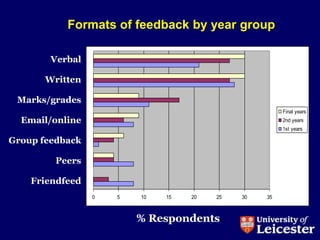
Formats of feedback by year group

        Verbal

       Written

 Marks/grades
                                                       Final years
  Email/online                                         2nd years
                                                       1st years

Group feedback

         Peers

    Friendfeed
                 0   5   10   15   20   25   30   35


                         % Respondents
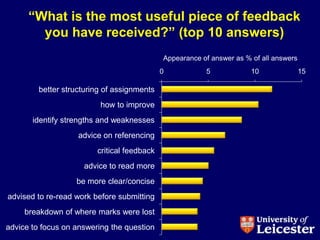
“What is the most useful piece of feedback
        you have received?” (top 10 answers)
                                             Appearance of answer as % of all answers
                                             0           5             10               15

         better structuring of assignments
                          how to improve
       identify strengths and weaknesses
                    advice on referencing
                         critical feedback
                     advice to read more
                   be more clear/concise
advised to re-read work before submitting
     breakdown of where marks were lost
advice to focus on answering the question
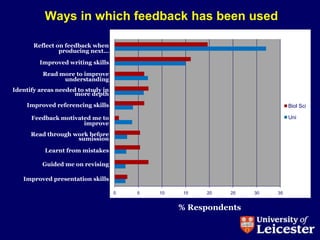
Ways in which feedback has been used

       Reflect on feedback when
                producing next…

         Improved writing skills
          Read more to improve
                understanding
Identify areas needed to study in
                     more depth
    Improved referencing skills                                            Biol Sci

      Feedback motivated me to                                             Uni
                      improve
      Read through work before
                    sumission

           Learnt from mistakes

          Guided me on revising

   Improved presentation skills

                                    0   5   10    15   20   25   30   35


                                                 % Respondents
Activities for next year include…

• Standardised information on feedback in Course
  handbooks
• Institutional guidelines on time taken for feedback
  to be received
• Consistency in feedback
• Keep up awareness of feedback as an issue –
  autumn term campaign working with the Students‟
  Union
• Repeat the Peer Observation of Marking exercise in
  2012-13
• Continuation of campaigns including: I love my
  academic
Perceptions of Feedback: Myth & Reality

Perceptions of Feedback: Myth & Reality

  • 1.
    Perceptions of Feedback: Myth & Reality Jon Scott School of Biological Sciences
  • 2.
    Some of theIssues • What‟s the fuss about? • What is feedback? • A common understanding? • The module effect • Expectations • Utility & Utilisation
  • 4.
    Learning how toeat Smarties… • Active engagement • Rewards • Common view of success and its measurement • Feedback shows what is OK and what needs changing for next time • Review of original performance in the light of feedback
  • 5.
    Feedback Projects • SeeingEye to Eye: Comparing the Perceptions of Students & Staff • „Quick Wins‟ Campaign • Peer Observation of Feedback • Departmental Guidance • Student Engagement with Feedback
  • 6.
    „Seeing Eye toEye‟ - Context • 85 1st year students on Biological Sciences programme • 1st semester assessments – Weekly practical report (from day 10), 5 day turn- round – Weekly tutorials - 3 essays (3 week turn-round), 1 oral presentation • Feedback cover sheet – Strengths – Areas for improvement
  • 7.
    Methods • On-line Questionnaire – based on Gibbs‟ Assessment Experience Questionnaire – posted early in semester 2 • Response rate: 57 % yr 1 54% yr 2 • 1st year Focus Groups • Structured interviews with academic staff
  • 8.
    Student Participants • Questionnaire– 57% of yr group • Focus Groups – 25% of yr group 50 Percentage of Total 40 30 20 10 0 First 2.1 2.2 3/A Pass Fail Degree Class Questionnaire Focus Group
  • 9.
    Staff Participants • 14Module Convenors • 7 Personal Tutors (non 1st yr teachers) • 1 Student Learning Centre Advisor
  • 10.
    Perceptions of FeedbackTypes Received (Focus Group) • Unprompted: – Comments on cover sheets • Prompted: – Comments on oral presentations – Annotations on scripts • Specifically asked: – Verbal feedback in practical classes, tutorials & personal tutors
  • 11.
    Types of FeedbackGiven (Staff) • Written feedback – cover sheets & annotations • “They are probably less aware of the direct help they get by talking to people in lab classes, I think”, • “… interactions are the most useful in terms of students‟ appreciation of things like concepts that you are trying to explain. I think just the nature of handling the number of students in 1st year practicals means we can‟t give immediate feedback in terms of what the correct answer was but concepts, approach and understanding the bigger picture, they should leave with that as feedback”.
  • 12.
    Quantity of Feedback Onthis course I get plenty of 67% feedback in how I am doing The feedback is usually too 35% uninformative or brief to be helpful The more feedback I receive, 89% the more I learn
  • 13.
    Quality of Feedback Thefeedback uses language 87% that is easy to understand The feedback shows me how to 73% do better next time I can seldom see from the 35% feedback what I need to do to improve The feedback does not help me 11% with subsequent assignments
  • 14.
    Quality & Utilityof Feedback • “Sometimes the comments are helpful but sometimes it‟s comments like when you get say 60% in a practical report and they tell you it could be „better written‟. But you‟ve done all that you can to write it to the best of your ability, so it‟s kind of vague, I don‟t know where to improve”. • “One of my friends had a higher mark than me and she got more comments than me in the „places to improve‟. I had nothing and was like „well I need to improve and you don‟t so why have you got the comments?‟. That‟s what I was thinking”.
  • 15.
    Quality & Utilityof Feedback • “I got one write up which was 90% and she [the marker] was still like „you could improve it here or here‟. It was quite a lot of comments considering it was a high mark and it was really good because it was „ok, that‟s what I need to be doing”.
  • 16.
    Timing of Feedback Itdoesn‟t matter if a module has 51% finished before I receive feedback as I know the advice will be relevant to my new module The feedback usually comes back 56% promptly Whatever feedback I receive comes 15% back too late to be useful
  • 17.
    Timing of Feedback •“…all that depends on the marker. This time we‟ve had one who was sometimes taking two weeks to get the reports back. Another one has got them back on the Tuesday, having had them on the Wednesday before. So it depends really on who you‟ve got.”
  • 18.
    Utilisation of Feedback Ihave received clear and sufficient guidance on 42% how to understand and use feedback I read the feedback carefully and try to understand 71% what is being said I use the feedback to go back over what I have 55% done in the assignment I have good intentions to act on feedback I receive 29% but forget suggestions for improvement next time I do coursework I do not use the feedback when revising 31% I tend to only read the marks 9%
  • 19.
    Utilisation of Feedback •“A lot of the time it‟ll depend on the mark as to how much I do look at it [the feedback]. If I‟ve got a really high mark, I‟ll tend to look and think „oh I‟ve done well‟ and just put it away. If I‟ve got a really bad mark I‟ll look and think what I‟ve done wrong, why I got that mark” • “If I expect a mark, low or high, and it‟s that, I don‟t really read the comments. If I get a mark that‟s really different from what I expected then I‟ll really read the comments”.
  • 20.
    Students‟ Reflections onStaff Views • They probably think we don‟t read it and just put it to one side.” • “I‟m sure some of them think they‟re just doing it and it‟s a bit pointless and you‟re not going to look at it anyway.” • “I suppose some of them [markers] must hope that if they bother to write something down then it gets read. But they must accept that there‟s a great deal of variation between students”.
  • 21.
    Staff Views • “Isuspect it varies, some will read it all and come to see you to ask what it means. Others, I suspect, only read the marks and check there is not too much red ink….I think if the number reflects what they are expecting then they don‟t pay too much attention to it.” • “My experience is that feedback is definitely used, it‟s a very constructive thing, a useful thing and a good proportion of students are using feedback.”
  • 22.
    Issues & Actions •School vs University experience • Recognition of feedback • Consistency Timing Content & Structure • Utility „Feed forward‟  Encouraging engagement with feedback  Language
  • 23.
    Actions • „Quick Wins‟Campaign • Peer Observation of Feedback • Departmental Guidance • Student Engagement with Feedback
  • 25.
    Engaging Students withFeedback We asked students: • Name five types of feedback you receive on your work • What is the most useful piece of feedback you have received? • Name one way in which you have used feedback to improve your learning
  • 26.
  • 27.
    “Name five typesof feedback you receive on your work” (top 10 answers) Number of appearances of answer 0 100 200 300 written comments on assignments verbal coursework marks/grades seminar/tutorial/workshop/problem… scheduled meetings or office hours… email marked exam/test paper/problem sheet from peers after presentations feedback cover sheet
  • 28.
    % Respondents naming5 different formats of feedback received Biological Sciences vs University Verbal Written Marks/grades Biol Sci University Email/online Group feedback Peers 0 5 10 15 20 25 30 35 % Respondents
  • 29.
    Formats of feedbackby year group Verbal Written Marks/grades Final years Email/online 2nd years 1st years Group feedback Peers Friendfeed 0 5 10 15 20 25 30 35 % Respondents
  • 30.
    “What is themost useful piece of feedback you have received?” (top 10 answers) Appearance of answer as % of all answers 0 5 10 15 better structuring of assignments how to improve identify strengths and weaknesses advice on referencing critical feedback advice to read more be more clear/concise advised to re-read work before submitting breakdown of where marks were lost advice to focus on answering the question
  • 31.
    Ways in whichfeedback has been used Reflect on feedback when producing next… Improved writing skills Read more to improve understanding Identify areas needed to study in more depth Improved referencing skills Biol Sci Feedback motivated me to Uni improve Read through work before sumission Learnt from mistakes Guided me on revising Improved presentation skills 0 5 10 15 20 25 30 35 % Respondents
  • 32.
    Activities for nextyear include… • Standardised information on feedback in Course handbooks • Institutional guidelines on time taken for feedback to be received • Consistency in feedback • Keep up awareness of feedback as an issue – autumn term campaign working with the Students‟ Union • Repeat the Peer Observation of Marking exercise in 2012-13 • Continuation of campaigns including: I love my academic