Assessment in challenging times

              Mantz Yorke
         mantzyorke@mantzyorke.plus.com


        LJMU 9 November 2011
Context
1. Pressure on staff as HE financing changes
2. Student expectations (esp. under new fee regime)


Key question
What’s ‘the deal’ (going to be)?
A ‘sustainability’ consideration for staff

Assessors have to be able to sustain the expectations laid
upon them.
What volume of good assessment practice can they realistically
undertake as the economic screw tightens?
(And does ‘the management’ know?)
Agenda (rather loosely organised)

1. Curricula for autonomy
2. Formative assessment, feedback and feedforward
3. Summative assessment (especially grading)
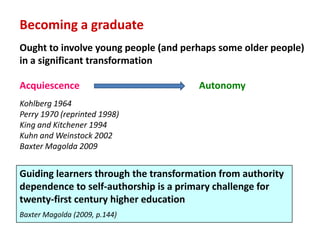
Becoming a graduate
Ought to involve young people (and perhaps some older people)
in a significant transformation

Acquiescence                           Autonomy
Kohlberg 1964
Perry 1970 (reprinted 1998)
King and Kitchener 1994
Kuhn and Weinstock 2002
Baxter Magolda 2009


Guiding learners through the transformation from authority
dependence to self-authorship is a primary challenge for
twenty-first century higher education
Baxter Magolda (2009, p.144)
Students often take time to ‘get it’
[School study] habits can continue well into the first year of
university.
(Leckey and Cook, 1999)


[N]ew undergraduates often see the tutor as the 'expert'
who can (and perhaps should) give them 'the information'.
By contrast university history teachers emphasise the need
for student autonomy and independent judgement.
(Booth, 2005)


There may not be a ‘truth’ that can be handed down
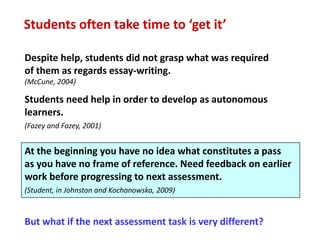
Students often take time to ‘get it’

Despite help, students did not grasp what was required
of them as regards essay-writing.
(McCune, 2004)

Students need help in order to develop as autonomous
learners.
(Fazey and Fazey, 2001)


At the beginning you have no idea what constitutes a pass
as you have no frame of reference. Need feedback on earlier
work before progressing to next assessment.
(Student, in Johnston and Kochanowska, 2009)


But what if the next assessment task is very different?
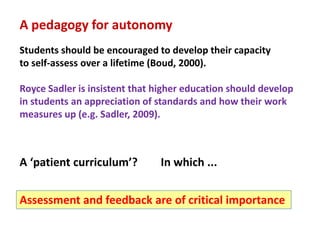
A pedagogy for autonomy
Students should be encouraged to develop their capacity
to self-assess over a lifetime (Boud, 2000).

Royce Sadler is insistent that higher education should develop
in students an appreciation of standards and how their work
measures up (e.g. Sadler, 2009).


A ‘patient curriculum’?        In which ...


Assessment and feedback are of critical importance
Formative assessment, feedback and feedforward
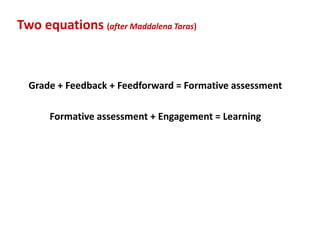
Two equations (after Maddalena Taras)


  Grade + Feedback + Feedforward = Formative assessment

      Formative assessment + Engagement = Learning
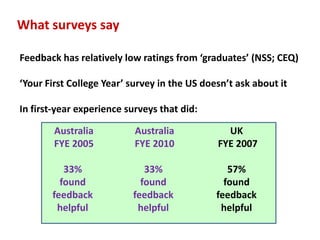
What surveys say

Feedback has relatively low ratings from ‘graduates’ (NSS; CEQ)

‘Your First College Year’ survey in the US doesn’t ask about it

In first-year experience surveys that did:

        Australia          Australia            UK
        FYE 2005           FYE 2010           FYE 2007

          33%                33%                 57%
         found              found               found
       feedback           feedback            feedback
        helpful            helpful             helpful
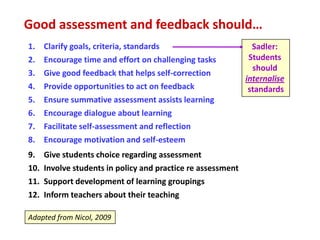
Good assessment and feedback should…
1.   Clarify goals, criteria, standards                       Sadler:
2.   Encourage time and effort on challenging tasks          Students
                                                              should
3.   Give good feedback that helps self-correction
                                                            internalise
4.   Provide opportunities to act on feedback                standards
5.   Ensure summative assessment assists learning
6.   Encourage dialogue about learning
7.   Facilitate self-assessment and reflection
8.   Encourage motivation and self-esteem
9. Give students choice regarding assessment
10. Involve students in policy and practice re assessment
11. Support development of learning groupings
12. Inform teachers about their teaching

Adapted from Nicol, 2009
So what about students’ expectations
          and experience?
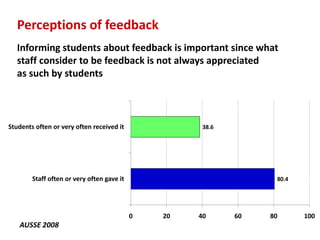
Perceptions of feedback
   Informing students about feedback is important since what
   staff consider to be feedback is not always appreciated
   as such by students


Students often or very often received it              38.6


        Staff often or very often gave it                          80.4


                                            0   20   40      60   80      100
   AUSSE 2008
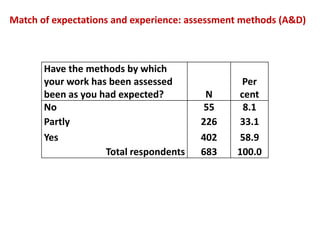
Match of expectations and experience: assessment methods (A&D)


       Have the methods by which
       your work has been assessed              Per
       been as you had expected?         N     cent
       No                                55     8.1
       Partly                           226     33.1
       Yes                              402     58.9
                    Total respondents   683    100.0
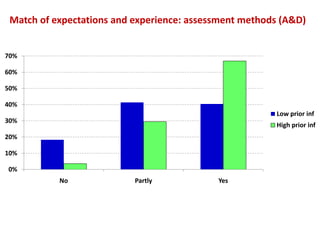
Match of expectations and experience: assessment methods (A&D)


70%

60%

50%

40%
                                                        Low prior inf
30%
                                                        High prior inf
20%

10%

0%
           No              Partly           Yes
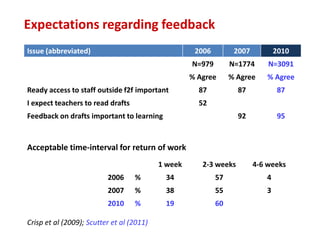
Expectations regarding feedback
Issue (abbreviated)                                  2006         2007          2010
                                                    N=979        N=1774      N=3091
                                                    % Agree      % Agree     % Agree
Ready access to staff outside f2f important           87           87           87
I expect teachers to read drafts                      52
Feedback on drafts important to learning                           92           95


Acceptable time-interval for return of work
                                           1 week      2-3 weeks         4-6 weeks
                          2006     %        34              57              4
                          2007     %        38              55              3
                          2010     %        19              60

Crisp et al (2009); Scutter et al (2011)
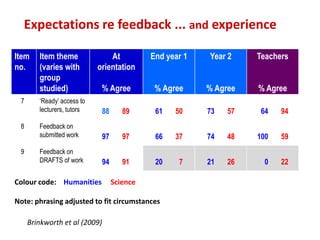
Expectations re feedback ... and experience

Item    Item theme              At            End year 1   Year 2    Teachers
no.     (varies with        orientation
        group
        studied)             % Agree           % Agree     % Agree   % Agree
 7      ‘Ready’ access to
        lecturers, tutors      88      89      61   50     73   57    64   94
 8      Feedback on
        submitted work         97      97      66   37     74   48   100   59
 9      Feedback on
        DRAFTS of work         94      91      20    7     21   26     0   22

Colour code: Humanities             Science

Note: phrasing adjusted to fit circumstances

     Brinkworth et al (2009)
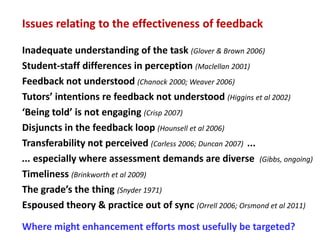
Issues relating to the effectiveness of feedback

Inadequate understanding of the task (Glover & Brown 2006)
Student-staff differences in perception (Maclellan 2001)
Feedback not understood (Chanock 2000; Weaver 2006)
Tutors’ intentions re feedback not understood (Higgins et al 2002)
‘Being told’ is not engaging (Crisp 2007)
Disjuncts in the feedback loop (Hounsell et al 2006)
Transferability not perceived (Carless 2006; Duncan 2007) ...
... especially where assessment demands are diverse (Gibbs, ongoing)
Timeliness (Brinkworth et al 2009)
The grade’s the thing (Snyder 1971)
Espoused theory & practice out of sync (Orrell 2006; Orsmond et al 2011)

Where might enhancement efforts most usefully be targeted?
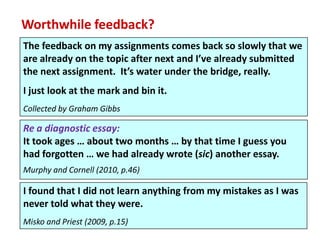
Worthwhile feedback?
The feedback on my assignments comes back so slowly that we
are already on the topic after next and I’ve already submitted
the next assignment. It’s water under the bridge, really.
I just look at the mark and bin it.
Collected by Graham Gibbs

Re a diagnostic essay:
It took ages … about two months … by that time I guess you
had forgotten … we had already wrote (sic) another essay.
Murphy and Cornell (2010, p.46)

I found that I did not learn anything from my mistakes as I was
never told what they were.
Misko and Priest (2009, p.15)
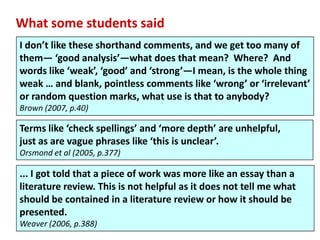
What some students said
I don’t like these shorthand comments, and we get too many of
them— ‘good analysis’—what does that mean? Where? And
words like ‘weak’, ‘good’ and ‘strong’—I mean, is the whole thing
weak … and blank, pointless comments like ‘wrong’ or ‘irrelevant’
or random question marks, what use is that to anybody?
Brown (2007, p.40)

Terms like ‘check spellings’ and ‘more depth’ are unhelpful,
just as are vague phrases like ‘this is unclear’.
Orsmond et al (2005, p.377)

... I got told that a piece of work was more like an essay than a
literature review. This is not helpful as it does not tell me what
should be contained in a literature review or how it should be
presented.
Weaver (2006, p.388)
When writing is not enough

When it (feedback) was written I didn’t understand it, but
obviously you make the appointment to follow through on
that and she clarifies what she means …

I didn’t know where I’d gone wrong, what she meant, and
she explained it, broke it down …

Murphy and Cornell (2010, p.47)
Some comments from a recent survey of
   first-year students in Art & Design
Criteria

The assessment criteria are thoroughly explained at numerous
points throughout the module so you know exactly what they
are looking for.

We get a copy of the assessment criteria with our brief so we
always have it to refer to so we understand what exactly is
expected.

To be honest, I'm not entirely clear how my work is assessed.
It's never been explained in simple terms, instead, paragraphs
of descriptions, I'm sure it must be simpler!
Timing

The written feedback was most helpful but was given too late
at the end of the projects meaning there was no opportunity
to improve.

My work is marked at several intervals throughout the year,
rather than everything being marked at the end of the year,
so I have several deadlines instead of one big final deadline.
This reduces stress and helps me to keep on top of my work.

Interim verbal and written feedback half way through an
assignment has been the most useful to me as it has allowed
me time to take on board what has been said and use (or not)
the comments made.
Outcomes

You get given a piece of paper at the end where they have
ticked some boxes and given you a percentage. That is not
an assessment, it’s disgusting for the amount of work you do.

Being given areas for improvement or development is the
most useful [aspect of assessment] and that the fact that the
formal aspect of this is written and you can reflect upon what
is written is very useful.
Don’t forget ‘the personal’
Motivation
Pedagogical approaches at tertiary level must motivate
students to learn if deep, effective and engaged learning
is to take place.
(Kift and Field, 2010, p.4, original emphasis)


With striking consistency, studies show that innovative,
active, collaborative, and constructivist instructional
approaches shape learning more powerfully, in some
forms by substantial margins, than do conventional
lecture-discussion and text-based approaches.

(Pascarella and Terenzini, 2005, p.646)
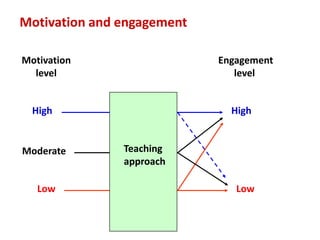
Motivation and engagement

Motivation                  Engagement
  level                        level


  High                        High


Moderate       Teaching
               approach

   Low                         Low
Encouraging motivation


 Students observed that feedback was given in such a way
 that they did not feel it was rejecting or discouraging . . .

 [and] that feedback procedures assisted them in forming
 accurate perceptions of their abilities and establishing
 internal standards with which to evaluate their own work

Mentkowski and Associates (2000, p.82), emphasis added


Boud and Sadler (who argue for students’ internalisation of
standards) would approve
Anxiety
I was really, really scared because it was my first report.
I had to hand it in just to see where I’m at. Where am I
standing?
(McGinty, 2011)


Psychological pain
They are writing all over my work and it is like mangled up
and most of the lecturers use red pen and I don’t know it
kind of gets to me if I open it up and it’s covered with red
crosses and marks and it’s horrible. It’s like my work is
bleeding.
(McGinty, 2011)
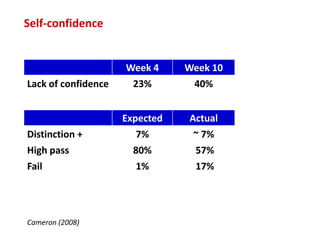
Self-confidence


                     Week 4     Week 10
Lack of confidence     23%       40%


                     Expected   Actual
Distinction +           7%       ~ 7%
High pass              80%       57%
Fail                    1%       17%


Cameron (2008)
Acknowledging emotion

For [first-year] students feedback goes beyond providing
information on how to improve assessment marks. The
‘effective feedback’ for these students is that which
provides emotional support and facilitates integration into
university.
(Poulos and Mahony, 2008)


To what extent can ‘the personal’ be accommodated in
contemporary HE?
Message not quite clear?


The numbers and language used in assessment are opaque
              and need to be demystified
Standards
Normative (even when expressed in criterion-referenced terms).
Discipline-driven, sometimes with external input.
Difficult to define (like QAA Subject Benchmarks?).
But ‘We know them when we see them’ – or we ought to).
Or assessors may think they know standards, but notions such as
• ‘graduateness’
• ‘employability’
• ‘wicked competences’
• ‘soft skills’
stretch assessors’ confidence to (beyond?) the limit.

Learning outcomes are a kind of proxy, but are inherently fuzzy.
Assessment criteria are likewise fuzzy.
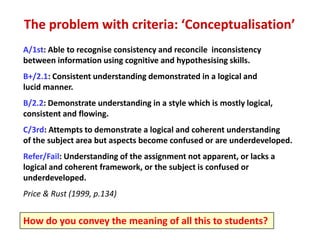
The problem with criteria: ‘Conceptualisation’
A/1st: Able to recognise consistency and reconcile inconsistency
between information using cognitive and hypothesising skills.
B+/2.1: Consistent understanding demonstrated in a logical and
lucid manner.
B/2.2: Demonstrate understanding in a style which is mostly logical,
consistent and flowing.
C/3rd: Attempts to demonstrate a logical and coherent understanding
of the subject area but aspects become confused or are underdeveloped.
Refer/Fail: Understanding of the assignment not apparent, or lacks a
logical and coherent framework, or the subject is confused or
underdeveloped.
Price & Rust (1999, p.134)


How do you convey the meaning of all this to students?
Dealing with multiple learning outcomes:
 a hypothetical example
 Learning outcome     Fully achieved   Partly achieved   Not achieved

 A

 B

 C

 ...
Intended learning outcomes [ILOs] might be categorised as
primary or secondary, thereby influencing the overall assessment.
Developed from Sadler (2005)

Do students appreciate the relative importance of ILOs?
The potential for confusion: some examples
Formal statements of expectations are fairly meaningless
without exemplification, even for staff (e.g. Wolf, 1995).

Students’ perceptions of what assessment is seeking may not
align with what staff think they ought to be perceiving
(Maclellan, 2001).

35 of 76 history and politics students did not understand the
meaning of ‘more analysis, less description’ (Chanock, 2000).

Staff themselves did not agree on what was meant by ‘analysis’
and ‘evaluation’ (Webster et al, 2000).

Whilst published assessment criteria are used, not all of them
may be applied – and some extraneous criteria may be invoked
(Webster et al, 2000, regarding u/g dissertations).
How well do grades inform?

The [honours degree] classifications are too general,
there’s no way of showing if you were close to the
grade above.

A straight percentage mark would be fairer.

‘Maria’

The Guardian RISE supplement, 18 December 2004


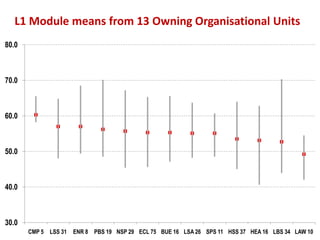
Not so. For a start, there’s variation between subject areas
L1 Module means from 13 Owning Organisational Units
80.0


70.0


60.0


50.0


40.0


30.0
       CMP 5 LSS 31   ENR 8 PBS 19 NSP 29 ECL 75 BUE 16 LSA 26 SPS 11 HSS 37 HEA 16 LBS 34 LAW 10
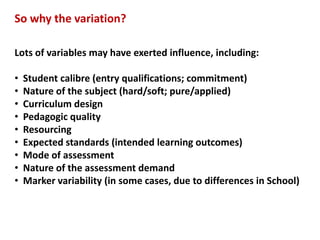
So why the variation?

Lots of variables may have exerted influence, including:

•   Student calibre (entry qualifications; commitment)
•   Nature of the subject (hard/soft; pure/applied)
•   Curriculum design
•   Pedagogic quality
•   Resourcing
•   Expected standards (intended learning outcomes)
•   Mode of assessment
•   Nature of the assessment demand
•   Marker variability (in some cases, due to differences in School)
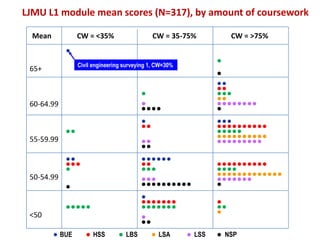
What is the relationship between mode of
   assessment and marks awarded?
LJMU L1 module mean scores (N=317), by amount of coursework

  Mean            CW = <35%                    CW = 35-75%       CW = >75%


                  Civil engineering surveying 1, CW=30%
 65+


 60-64.99


 55-59.99


 50-54.99


 <50

            BUE         HSS         LBS          LSA      LSS   NSP
LJMU uses ‘percentages’. If you are marking work out of 100,
how do you arrive at the ‘percentage’ mark?
(If marking work out of a smaller total, the same general question applies.)

• You might tot up the marks from components of the
  student’s performance.
• You might take a broad view of the overall performance
  (e.g. ‘this is of 2.1 standard’), and then decide where in
  the relevant band the actual mark should lie.
• You may have some other approach.

What approach do you use?
And what assumptions underlie your marking
methodology?
‘Fudges’? (e.g. Baume et al 2004; Bloxham et al 2011)
A question to ponder ...


Should you finely grade work-based achievements,
employability and ‘graduateness’?

If ‘yes’, then how?


Too complex an issue for this session, but a starting point is

Yorke M (2011) Assessing the complexity of professional achievement
http://learningtobeprofessional.pbworks.com/f/CHAPTER+A10+FINAL.pdf
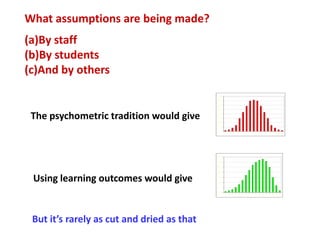
What assumptions are being made?
(a)By staff
(b)By students
(c)And by others
                                            40
                                            35
                                            30
                                            25


 The psychometric tradition would give      20
                                            15
                                            10
                                             5
                                             0
                                                 1   2   3   4   5   6   7   8       9    10 11 12 13 14   15 16 17


                                            35
                                            30
                                            25
                                            20

 Using learning outcomes would give         15
                                            10
                                             5
                                             0
                                                 1   2   3   4   5   6   7   8   9       10 11 12 13 14 15 16 17


 But it’s rarely as cut and dried as that
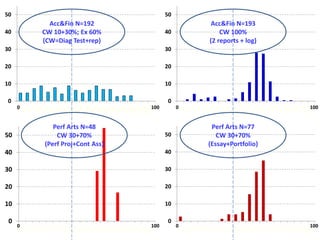
Four modules with varied mark profiles
50                                    50
           Acc&Fin N=192                        Acc&Fin N=193
40       CW 10+30%; Ex 60%            40           CW 100%
         (CW=Diag Test+rep)                    (2 reports + log)
30                                    30

20                                    20

10                                    10

0                                     0
     0                          100        0                       100


            Perf Arts N=48                      Perf Arts N=77
50           CW 30+70%                50          CW 30+70%
         (Perf Proj+Cont Ass)                  (Essay+Portfolio)
40                                    40

30                                    30

20                                    20

10                                    10

 0                                    0
     0                          100        0                       100
Grades are not transparent

They can demoralise if they are awarded on a basis that
differs (negatively) from students’ previous experience.

Grading at A-level, or in other countries’ systems, may not
align with UK HE practices.

What does a mark of 64% mean?
And what does the ‘missing’ 36% relate to?

How different is 53% from 54%?

And so on ...
Some other issues
Grade only on assignment and/or feedback boxes ticked (or not)

Mark out of sync with comment

Feedback comment on matters outside stated criteria

Students not taught how to use feedback

The difference between being positive and being constructive

The need to provide emotional support (esp for 1st year students)
Rounding up:

Some ‘big picture’ issues
In a nutshell ...
1. Don’t assume that students will understand ‘assessment
   language’. Give explanations and, particularly, examples.
2. Provide opportunities for students to develop their
   capacity to self-assess, without undue risk.
3. Find ways to make feedback (and feedforward) effective.
4. Clarify what grades signify, in the subject context.


1 and 4 are the responsibility of teachers, and are fairly
straightforward.
2 and 3 are much more challenging, in that they may require
a measure of innovation – creativity even – on the part of
teachers and certainly the active engagement of the students.
Some references
Assessment and Evaluation in Higher Education is a particularly useful source of relevant articles, e.g.
• Maclellan, 2001
• Orsmond et al, 2005
• Weaver, 2006
• Webster et al, 2000

Bloxham S and Boyd P (2007) Developing effective assessment in higher education: a practical guide.
Maidenhead: Open University Press.
Boud D & Falchikov N, eds (2007) Rethinking assessment in higher education: learning for the longer term.
London: Routledge.
Nicol D (2009) Transforming assessment and feedback: enhancing integration and empowerment
in the first year. http://www.enhancementthemes.ac.uk/documents/firstyear/First_Year_Transforming_Assess.pdf
Yorke M (2008) Assessing student achievement in higher education: signals and shortcomings.
Abingdon: Routledge (Contains a wide range of references.)
Yorke M (2011) Assessing the complexity of professional achievement
http://learningtobeprofessional.pbworks.com/f/CHAPTER+A10+FINAL.pdf
Yorke M (2011) Assessment and feedback in the first year: the professional and the personal.
At www.fyhe.com.au/past_papers/papers11/FYHE-2011/content/pdf/MantzYorke_abstract.pdf

My 091111 presentation for blackboard

  • 1.
    Assessment in challengingtimes Mantz Yorke mantzyorke@mantzyorke.plus.com LJMU 9 November 2011
  • 2.
    Context 1. Pressure onstaff as HE financing changes 2. Student expectations (esp. under new fee regime) Key question What’s ‘the deal’ (going to be)?
  • 3.
    A ‘sustainability’ considerationfor staff Assessors have to be able to sustain the expectations laid upon them. What volume of good assessment practice can they realistically undertake as the economic screw tightens? (And does ‘the management’ know?)
  • 4.
    Agenda (rather looselyorganised) 1. Curricula for autonomy 2. Formative assessment, feedback and feedforward 3. Summative assessment (especially grading)
  • 5.
    Becoming a graduate Oughtto involve young people (and perhaps some older people) in a significant transformation Acquiescence Autonomy Kohlberg 1964 Perry 1970 (reprinted 1998) King and Kitchener 1994 Kuhn and Weinstock 2002 Baxter Magolda 2009 Guiding learners through the transformation from authority dependence to self-authorship is a primary challenge for twenty-first century higher education Baxter Magolda (2009, p.144)
  • 6.
    Students often taketime to ‘get it’ [School study] habits can continue well into the first year of university. (Leckey and Cook, 1999) [N]ew undergraduates often see the tutor as the 'expert' who can (and perhaps should) give them 'the information'. By contrast university history teachers emphasise the need for student autonomy and independent judgement. (Booth, 2005) There may not be a ‘truth’ that can be handed down
  • 7.
    Students often taketime to ‘get it’ Despite help, students did not grasp what was required of them as regards essay-writing. (McCune, 2004) Students need help in order to develop as autonomous learners. (Fazey and Fazey, 2001) At the beginning you have no idea what constitutes a pass as you have no frame of reference. Need feedback on earlier work before progressing to next assessment. (Student, in Johnston and Kochanowska, 2009) But what if the next assessment task is very different?
  • 8.
    A pedagogy forautonomy Students should be encouraged to develop their capacity to self-assess over a lifetime (Boud, 2000). Royce Sadler is insistent that higher education should develop in students an appreciation of standards and how their work measures up (e.g. Sadler, 2009). A ‘patient curriculum’? In which ... Assessment and feedback are of critical importance
  • 9.
  • 10.
    Two equations (afterMaddalena Taras) Grade + Feedback + Feedforward = Formative assessment Formative assessment + Engagement = Learning
  • 11.
    What surveys say Feedbackhas relatively low ratings from ‘graduates’ (NSS; CEQ) ‘Your First College Year’ survey in the US doesn’t ask about it In first-year experience surveys that did: Australia Australia UK FYE 2005 FYE 2010 FYE 2007 33% 33% 57% found found found feedback feedback feedback helpful helpful helpful
  • 12.
    Good assessment andfeedback should… 1. Clarify goals, criteria, standards Sadler: 2. Encourage time and effort on challenging tasks Students should 3. Give good feedback that helps self-correction internalise 4. Provide opportunities to act on feedback standards 5. Ensure summative assessment assists learning 6. Encourage dialogue about learning 7. Facilitate self-assessment and reflection 8. Encourage motivation and self-esteem 9. Give students choice regarding assessment 10. Involve students in policy and practice re assessment 11. Support development of learning groupings 12. Inform teachers about their teaching Adapted from Nicol, 2009
  • 13.
    So what aboutstudents’ expectations and experience?
  • 14.
    Perceptions of feedback Informing students about feedback is important since what staff consider to be feedback is not always appreciated as such by students Students often or very often received it 38.6 Staff often or very often gave it 80.4 0 20 40 60 80 100 AUSSE 2008
  • 15.
    Match of expectationsand experience: assessment methods (A&D) Have the methods by which your work has been assessed Per been as you had expected? N cent No 55 8.1 Partly 226 33.1 Yes 402 58.9 Total respondents 683 100.0
  • 16.
    Match of expectationsand experience: assessment methods (A&D) 70% 60% 50% 40% Low prior inf 30% High prior inf 20% 10% 0% No Partly Yes
  • 17.
    Expectations regarding feedback Issue(abbreviated) 2006 2007 2010 N=979 N=1774 N=3091 % Agree % Agree % Agree Ready access to staff outside f2f important 87 87 87 I expect teachers to read drafts 52 Feedback on drafts important to learning 92 95 Acceptable time-interval for return of work 1 week 2-3 weeks 4-6 weeks 2006 % 34 57 4 2007 % 38 55 3 2010 % 19 60 Crisp et al (2009); Scutter et al (2011)
  • 18.
    Expectations re feedback... and experience Item Item theme At End year 1 Year 2 Teachers no. (varies with orientation group studied) % Agree % Agree % Agree % Agree 7 ‘Ready’ access to lecturers, tutors 88 89 61 50 73 57 64 94 8 Feedback on submitted work 97 97 66 37 74 48 100 59 9 Feedback on DRAFTS of work 94 91 20 7 21 26 0 22 Colour code: Humanities Science Note: phrasing adjusted to fit circumstances Brinkworth et al (2009)
  • 19.
    Issues relating tothe effectiveness of feedback Inadequate understanding of the task (Glover & Brown 2006) Student-staff differences in perception (Maclellan 2001) Feedback not understood (Chanock 2000; Weaver 2006) Tutors’ intentions re feedback not understood (Higgins et al 2002) ‘Being told’ is not engaging (Crisp 2007) Disjuncts in the feedback loop (Hounsell et al 2006) Transferability not perceived (Carless 2006; Duncan 2007) ... ... especially where assessment demands are diverse (Gibbs, ongoing) Timeliness (Brinkworth et al 2009) The grade’s the thing (Snyder 1971) Espoused theory & practice out of sync (Orrell 2006; Orsmond et al 2011) Where might enhancement efforts most usefully be targeted?
  • 20.
    Worthwhile feedback? The feedbackon my assignments comes back so slowly that we are already on the topic after next and I’ve already submitted the next assignment. It’s water under the bridge, really. I just look at the mark and bin it. Collected by Graham Gibbs Re a diagnostic essay: It took ages … about two months … by that time I guess you had forgotten … we had already wrote (sic) another essay. Murphy and Cornell (2010, p.46) I found that I did not learn anything from my mistakes as I was never told what they were. Misko and Priest (2009, p.15)
  • 21.
    What some studentssaid I don’t like these shorthand comments, and we get too many of them— ‘good analysis’—what does that mean? Where? And words like ‘weak’, ‘good’ and ‘strong’—I mean, is the whole thing weak … and blank, pointless comments like ‘wrong’ or ‘irrelevant’ or random question marks, what use is that to anybody? Brown (2007, p.40) Terms like ‘check spellings’ and ‘more depth’ are unhelpful, just as are vague phrases like ‘this is unclear’. Orsmond et al (2005, p.377) ... I got told that a piece of work was more like an essay than a literature review. This is not helpful as it does not tell me what should be contained in a literature review or how it should be presented. Weaver (2006, p.388)
  • 22.
    When writing isnot enough When it (feedback) was written I didn’t understand it, but obviously you make the appointment to follow through on that and she clarifies what she means … I didn’t know where I’d gone wrong, what she meant, and she explained it, broke it down … Murphy and Cornell (2010, p.47)
  • 23.
    Some comments froma recent survey of first-year students in Art & Design
  • 24.
    Criteria The assessment criteriaare thoroughly explained at numerous points throughout the module so you know exactly what they are looking for. We get a copy of the assessment criteria with our brief so we always have it to refer to so we understand what exactly is expected. To be honest, I'm not entirely clear how my work is assessed. It's never been explained in simple terms, instead, paragraphs of descriptions, I'm sure it must be simpler!
  • 25.
    Timing The written feedbackwas most helpful but was given too late at the end of the projects meaning there was no opportunity to improve. My work is marked at several intervals throughout the year, rather than everything being marked at the end of the year, so I have several deadlines instead of one big final deadline. This reduces stress and helps me to keep on top of my work. Interim verbal and written feedback half way through an assignment has been the most useful to me as it has allowed me time to take on board what has been said and use (or not) the comments made.
  • 26.
    Outcomes You get givena piece of paper at the end where they have ticked some boxes and given you a percentage. That is not an assessment, it’s disgusting for the amount of work you do. Being given areas for improvement or development is the most useful [aspect of assessment] and that the fact that the formal aspect of this is written and you can reflect upon what is written is very useful.
  • 27.
  • 28.
    Motivation Pedagogical approaches attertiary level must motivate students to learn if deep, effective and engaged learning is to take place. (Kift and Field, 2010, p.4, original emphasis) With striking consistency, studies show that innovative, active, collaborative, and constructivist instructional approaches shape learning more powerfully, in some forms by substantial margins, than do conventional lecture-discussion and text-based approaches. (Pascarella and Terenzini, 2005, p.646)
  • 29.
    Motivation and engagement Motivation Engagement level level High High Moderate Teaching approach Low Low
  • 30.
    Encouraging motivation Studentsobserved that feedback was given in such a way that they did not feel it was rejecting or discouraging . . . [and] that feedback procedures assisted them in forming accurate perceptions of their abilities and establishing internal standards with which to evaluate their own work Mentkowski and Associates (2000, p.82), emphasis added Boud and Sadler (who argue for students’ internalisation of standards) would approve
  • 31.
    Anxiety I was really,really scared because it was my first report. I had to hand it in just to see where I’m at. Where am I standing? (McGinty, 2011) Psychological pain They are writing all over my work and it is like mangled up and most of the lecturers use red pen and I don’t know it kind of gets to me if I open it up and it’s covered with red crosses and marks and it’s horrible. It’s like my work is bleeding. (McGinty, 2011)
  • 32.
    Self-confidence Week 4 Week 10 Lack of confidence 23% 40% Expected Actual Distinction + 7% ~ 7% High pass 80% 57% Fail 1% 17% Cameron (2008)
  • 33.
    Acknowledging emotion For [first-year]students feedback goes beyond providing information on how to improve assessment marks. The ‘effective feedback’ for these students is that which provides emotional support and facilitates integration into university. (Poulos and Mahony, 2008) To what extent can ‘the personal’ be accommodated in contemporary HE?
  • 34.
    Message not quiteclear? The numbers and language used in assessment are opaque and need to be demystified
  • 35.
    Standards Normative (even whenexpressed in criterion-referenced terms). Discipline-driven, sometimes with external input. Difficult to define (like QAA Subject Benchmarks?). But ‘We know them when we see them’ – or we ought to). Or assessors may think they know standards, but notions such as • ‘graduateness’ • ‘employability’ • ‘wicked competences’ • ‘soft skills’ stretch assessors’ confidence to (beyond?) the limit. Learning outcomes are a kind of proxy, but are inherently fuzzy. Assessment criteria are likewise fuzzy.
  • 36.
    The problem withcriteria: ‘Conceptualisation’ A/1st: Able to recognise consistency and reconcile inconsistency between information using cognitive and hypothesising skills. B+/2.1: Consistent understanding demonstrated in a logical and lucid manner. B/2.2: Demonstrate understanding in a style which is mostly logical, consistent and flowing. C/3rd: Attempts to demonstrate a logical and coherent understanding of the subject area but aspects become confused or are underdeveloped. Refer/Fail: Understanding of the assignment not apparent, or lacks a logical and coherent framework, or the subject is confused or underdeveloped. Price & Rust (1999, p.134) How do you convey the meaning of all this to students?
  • 37.
    Dealing with multiplelearning outcomes: a hypothetical example Learning outcome Fully achieved Partly achieved Not achieved A B C ... Intended learning outcomes [ILOs] might be categorised as primary or secondary, thereby influencing the overall assessment. Developed from Sadler (2005) Do students appreciate the relative importance of ILOs?
  • 38.
    The potential forconfusion: some examples Formal statements of expectations are fairly meaningless without exemplification, even for staff (e.g. Wolf, 1995). Students’ perceptions of what assessment is seeking may not align with what staff think they ought to be perceiving (Maclellan, 2001). 35 of 76 history and politics students did not understand the meaning of ‘more analysis, less description’ (Chanock, 2000). Staff themselves did not agree on what was meant by ‘analysis’ and ‘evaluation’ (Webster et al, 2000). Whilst published assessment criteria are used, not all of them may be applied – and some extraneous criteria may be invoked (Webster et al, 2000, regarding u/g dissertations).
  • 39.
    How well dogrades inform? The [honours degree] classifications are too general, there’s no way of showing if you were close to the grade above. A straight percentage mark would be fairer. ‘Maria’ The Guardian RISE supplement, 18 December 2004 Not so. For a start, there’s variation between subject areas
  • 40.
    L1 Module meansfrom 13 Owning Organisational Units 80.0 70.0 60.0 50.0 40.0 30.0 CMP 5 LSS 31 ENR 8 PBS 19 NSP 29 ECL 75 BUE 16 LSA 26 SPS 11 HSS 37 HEA 16 LBS 34 LAW 10
  • 41.
    So why thevariation? Lots of variables may have exerted influence, including: • Student calibre (entry qualifications; commitment) • Nature of the subject (hard/soft; pure/applied) • Curriculum design • Pedagogic quality • Resourcing • Expected standards (intended learning outcomes) • Mode of assessment • Nature of the assessment demand • Marker variability (in some cases, due to differences in School)
  • 42.
    What is therelationship between mode of assessment and marks awarded?
  • 43.
    LJMU L1 modulemean scores (N=317), by amount of coursework Mean CW = <35% CW = 35-75% CW = >75% Civil engineering surveying 1, CW=30% 65+ 60-64.99 55-59.99 50-54.99 <50 BUE HSS LBS LSA LSS NSP
  • 44.
    LJMU uses ‘percentages’.If you are marking work out of 100, how do you arrive at the ‘percentage’ mark? (If marking work out of a smaller total, the same general question applies.) • You might tot up the marks from components of the student’s performance. • You might take a broad view of the overall performance (e.g. ‘this is of 2.1 standard’), and then decide where in the relevant band the actual mark should lie. • You may have some other approach. What approach do you use? And what assumptions underlie your marking methodology? ‘Fudges’? (e.g. Baume et al 2004; Bloxham et al 2011)
  • 45.
    A question toponder ... Should you finely grade work-based achievements, employability and ‘graduateness’? If ‘yes’, then how? Too complex an issue for this session, but a starting point is Yorke M (2011) Assessing the complexity of professional achievement http://learningtobeprofessional.pbworks.com/f/CHAPTER+A10+FINAL.pdf
  • 46.
    What assumptions arebeing made? (a)By staff (b)By students (c)And by others 40 35 30 25 The psychometric tradition would give 20 15 10 5 0 1 2 3 4 5 6 7 8 9 10 11 12 13 14 15 16 17 35 30 25 20 Using learning outcomes would give 15 10 5 0 1 2 3 4 5 6 7 8 9 10 11 12 13 14 15 16 17 But it’s rarely as cut and dried as that
  • 47.
    Four modules withvaried mark profiles
  • 48.
    50 50 Acc&Fin N=192 Acc&Fin N=193 40 CW 10+30%; Ex 60% 40 CW 100% (CW=Diag Test+rep) (2 reports + log) 30 30 20 20 10 10 0 0 0 100 0 100 Perf Arts N=48 Perf Arts N=77 50 CW 30+70% 50 CW 30+70% (Perf Proj+Cont Ass) (Essay+Portfolio) 40 40 30 30 20 20 10 10 0 0 0 100 0 100
  • 49.
    Grades are nottransparent They can demoralise if they are awarded on a basis that differs (negatively) from students’ previous experience. Grading at A-level, or in other countries’ systems, may not align with UK HE practices. What does a mark of 64% mean? And what does the ‘missing’ 36% relate to? How different is 53% from 54%? And so on ...
  • 50.
    Some other issues Gradeonly on assignment and/or feedback boxes ticked (or not) Mark out of sync with comment Feedback comment on matters outside stated criteria Students not taught how to use feedback The difference between being positive and being constructive The need to provide emotional support (esp for 1st year students)
  • 51.
    Rounding up: Some ‘bigpicture’ issues
  • 52.
    In a nutshell... 1. Don’t assume that students will understand ‘assessment language’. Give explanations and, particularly, examples. 2. Provide opportunities for students to develop their capacity to self-assess, without undue risk. 3. Find ways to make feedback (and feedforward) effective. 4. Clarify what grades signify, in the subject context. 1 and 4 are the responsibility of teachers, and are fairly straightforward. 2 and 3 are much more challenging, in that they may require a measure of innovation – creativity even – on the part of teachers and certainly the active engagement of the students.
  • 53.
    Some references Assessment andEvaluation in Higher Education is a particularly useful source of relevant articles, e.g. • Maclellan, 2001 • Orsmond et al, 2005 • Weaver, 2006 • Webster et al, 2000 Bloxham S and Boyd P (2007) Developing effective assessment in higher education: a practical guide. Maidenhead: Open University Press. Boud D & Falchikov N, eds (2007) Rethinking assessment in higher education: learning for the longer term. London: Routledge. Nicol D (2009) Transforming assessment and feedback: enhancing integration and empowerment in the first year. http://www.enhancementthemes.ac.uk/documents/firstyear/First_Year_Transforming_Assess.pdf Yorke M (2008) Assessing student achievement in higher education: signals and shortcomings. Abingdon: Routledge (Contains a wide range of references.) Yorke M (2011) Assessing the complexity of professional achievement http://learningtobeprofessional.pbworks.com/f/CHAPTER+A10+FINAL.pdf Yorke M (2011) Assessment and feedback in the first year: the professional and the personal. At www.fyhe.com.au/past_papers/papers11/FYHE-2011/content/pdf/MantzYorke_abstract.pdf