Supporting the prevention of influenza in GM
Dr Jennifer Hoyle
Chest Consultant at North Manchester General Hospital
Clinical Lead Strategic Clinical Network Respiratory GM
Background-
Why are respiratory clinicians involved?
The basic facts:
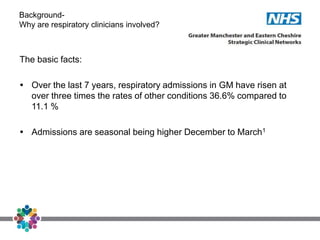
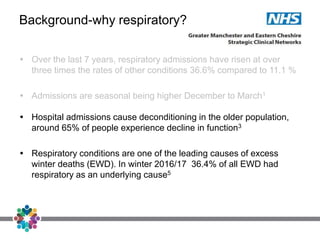
 Over the last 7 years, respiratory admissions in GM have risen at
over three times the rates of other conditions 36.6% compared to
11.1 %
 Admissions are seasonal being higher December to March1
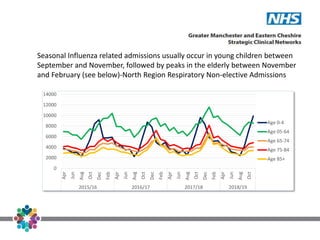
Seasonal Influenza related admissions usually occur in young children between
September and November, followed by peaks in the elderly between November
and February (see below)-North Region Respiratory Non-elective Admissions
0
2000
4000
6000
8000
10000
12000
14000
Apr
Jun
Aug
Oct
Dec
Feb
Apr
Jun
Aug
Oct
Dec
Feb
Apr
Jun
Aug
Oct
Dec
Feb
Apr
Jun
Aug
Oct
2015/16 2016/17 2017/18 2018/19
Age 0-4
Age 05-64
Age 65-74
Age 75-84
Age 85+
Background-why respiratory?
 Over the last 7 years, respiratory admissions have risen at over
three times the rates of other conditions 36.6% compared to 11.1 %
 Admissions are seasonal being higher December to March1
 Hospital admissions cause deconditioning in the older population,
around 65% of people experience decline in function3
 Respiratory conditions are one of the leading causes of excess
winter deaths (EWD). In winter 2016/17 36.4% of all EWD had
respiratory as an underlying cause5
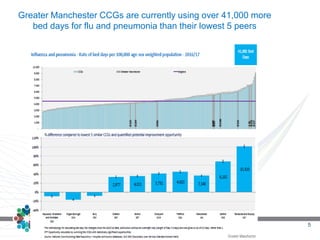
Greater Manchester CCGs are currently using over 41,000 more
bed days for flu and pneumonia than their lowest 5 peers
5
What do we know?
 The single most effective strategy for preventing influenza and related complications is the
seasonal influenza vaccine.
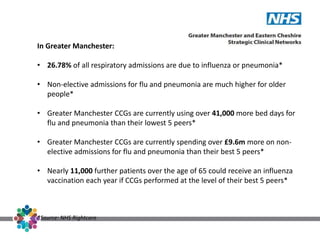
In Greater Manchester:
• 26.78% of all respiratory admissions are due to influenza or pneumonia*
• Non-elective admissions for flu and pneumonia are much higher for older
people*
• Greater Manchester CCGs are currently using over 41,000 more bed days for
flu and pneumonia than their lowest 5 peers*
• Greater Manchester CCGs are currently spending over £9.6m more on non-
elective admissions for flu and pneumonia than their best 5 peers*
• Nearly 11,000 further patients over the age of 65 could receive an influenza
vaccination each year if CCGs performed at the level of their best 5 peers*
*Source: NHS Rightcare
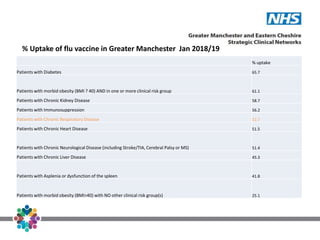
% Uptake of flu vaccine in Greater Manchester Jan 2018/19
% uptake
Patients with Diabetes 65.7
Patients with morbid obesity (BMI ? 40) AND in one or more clinical risk group 61.1
Patients with Chronic Kidney Disease 58.7
Patients with Immunosuppression 56.2
Patients with Chronic Respiratory Disease 52.7
Patients with Chronic Heart Disease 51.5
Patients with Chronic Neurological Disease (including Stroke/TIA, Cerebral Palsy or MS) 51.4
Patients with Chronic Liver Disease 45.3
Patients with Asplenia or dysfunction of the spleen 41.8
Patients with morbid obesity (BMI>40) with NO other clinical risk group(s) 25.1
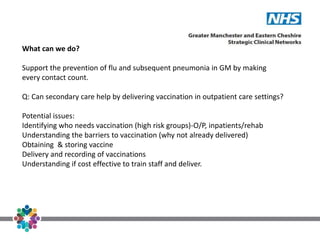
What can we do?
Support the prevention of flu and subsequent pneumonia in GM by making
every contact count.
Q: Can secondary care help by delivering vaccination in outpatient care settings?
Potential issues:
Identifying who needs vaccination (high risk groups)-O/P, inpatients/rehab
Understanding the barriers to vaccination (why not already delivered)
Obtaining & storing vaccine
Delivery and recording of vaccinations
Understanding if cost effective to train staff and deliver.
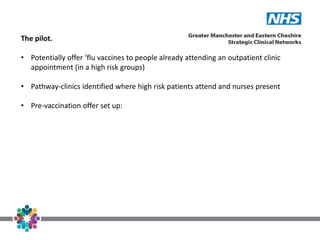
The pilot.
• Potentially offer ‘flu vaccines to people already attending an outpatient clinic
appointment (in a high risk groups)
• Pathway-clinics identified where high risk patients attend and nurses present
• Pre-vaccination offer set up:
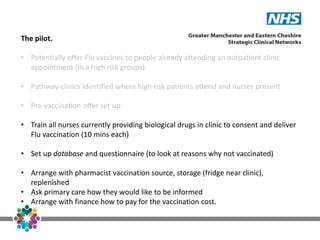
The pilot.
• Potentially offer Flu vaccines to people already attending an outpatient clinic
appointment (in a high risk groups)
• Pathway-clinics identified where high risk patients attend and nurses present
• Pre-vaccination offer set up:
• Train all nurses currently providing biological drugs in clinic to consent and deliver
Flu vaccination (10 mins each)
• Set up database and questionnaire (to look at reasons why not vaccinated)
• Arrange with pharmacist vaccination source, storage (fridge near clinic),
replenished
• Ask primary care how they would like to be informed
• Arrange with finance how to pay for the vaccination cost.
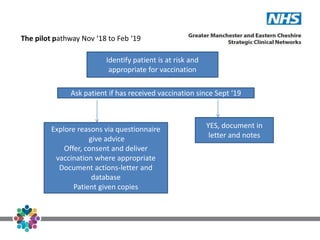
The pilot pathway Nov ‘18 to Feb ‘19
Identify patient is at risk and
appropriate for vaccination
Ask patient if has received vaccination since Sept ‘19
YES, document in
letter and notes
NO:
Explore reasons via questionnaire
give advice
Offer, consent and deliver
vaccination where appropriate
Document actions-letter and
database
Patient given copies
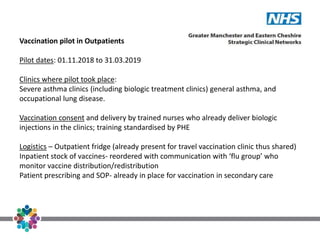
Vaccination pilot in Outpatients
Pilot dates: 01.11.2018 to 31.03.2019
Clinics where pilot took place:
Severe asthma clinics (including biologic treatment clinics) general asthma, and
occupational lung disease.
Vaccination consent and delivery by trained nurses who already deliver biologic
injections in the clinics; training standardised by PHE
Logistics – Outpatient fridge (already present for travel vaccination clinic thus shared)
Inpatient stock of vaccines- reordered with communication with ‘flu group’ who
monitor vaccine distribution/redistribution
Patient prescribing and SOP- already in place for vaccination in secondary care
Vaccination pilot in Outpatients
Consent
Batch information - as per standardised proforma from PHE
Copies returned to patient and with letters back to GP, recorded as a standard
subheading on letters.
Previous vaccination via questioning patient, if unclear contact with GP surgery
(number in the pilot zero).
Initial vaccination order was from hospital stock, re-filled by redistribution centrally of
vaccine by working with ‘flu group GM.
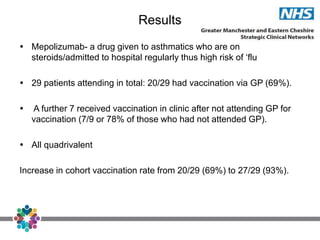
Results
 Mepolizumab- a drug given to asthmatics who are on
steroids/admitted to hospital regularly thus high risk of ‘flu
 29 patients attending in total: 20/29 had vaccination via GP (69%).
 A further 7 received vaccination in clinic after not attending GP for
vaccination (7/9 or 78% of those who had not attended GP).
 All quadrivalent
Increase in cohort vaccination rate from 20/29 (69%) to 27/29 (93%).
Vaccination pilot in Outpatients
Why not vaccinated
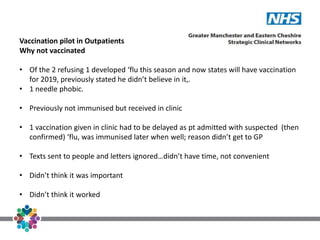
• Of the 2 refusing 1 developed ‘flu this season and now states will have vaccination
for 2019, previously stated he didn’t believe in it,.
• 1 needle phobic.
• Previously not immunised but received in clinic
• 1 vaccination given in clinic had to be delayed as pt admitted with suspected (then
confirmed) ‘flu, was immunised later when well; reason didn’t get to GP
• Texts sent to people and letters ignored…didn’t have time, not convenient
• Didn’t think it was important
• Didn’t think it worked
Omalizumab clinic
(biologic clinic -high risk for ‘flu)
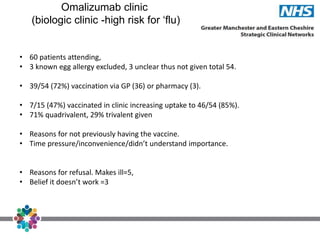
• 60 patients attending,
• 3 known egg allergy excluded, 3 unclear thus not given total 54.
• 39/54 (72%) vaccination via GP (36) or pharmacy (3).
• 7/15 (47%) vaccinated in clinic increasing uptake to 46/54 (85%).
• 71% quadrivalent, 29% trivalent given
• Reasons for not previously having the vaccine.
• Time pressure/inconvenience/didn’t understand importance.
• Reasons for refusal. Makes ill=5,
• Belief it doesn’t work =3
Pilot conclusions
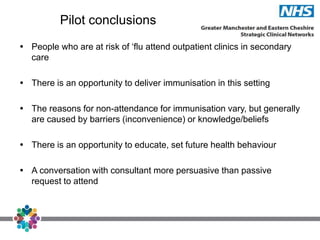
 People who are at risk of ‘flu attend outpatient clinics in secondary
care
 There is an opportunity to deliver immunisation in this setting
 The reasons for non-attendance for immunisation vary, but generally
are caused by barriers (inconvenience) or knowledge/beliefs
 There is an opportunity to educate, set future health behaviour
 A conversation with consultant more persuasive than passive
request to attend
Future proposal
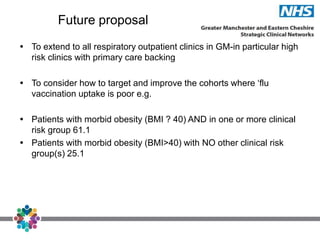
 To extend to all respiratory outpatient clinics in GM-in particular high
risk clinics with primary care backing
 To consider how to target and improve the cohorts where ‘flu
vaccination uptake is poor e.g.
 Patients with morbid obesity (BMI ? 40) AND in one or more clinical
risk group 61.1
 Patients with morbid obesity (BMI>40) with NO other clinical risk
group(s) 25.1
Lessons learned from this season
 Change in contract between public health and providers (trusts) to
allow inpatient and outpatient vaccination generally successful
 Problems with hospitals holding on to vaccine (change in formula
earlier in year)
 Respiratory outpatients all ready to deliver-pharmacy obstacle
 Gap between infection control and clinicians
 Order early (meet Jan/Feb)
 Identify clinicians incl nurses, pharmacy, finance.
Summary
 ‘flu (and subsequent pneumonia) is a major driver for respiratory
admissions across GM.
 Offering vaccination in secondary care outpatient (and inpatient)
settings can help drive up vaccination rates significantly for at risk
cohorts.
 The reasons for not attending despite being aware of offers in
Primary care and high street pharmacy have general themes of:
 Poor knowledge/misbelief
 Inconvenience
 Breaking down barriers works…
Referenced studies
References
1 British Lung Foundation “Out in the cold” December 2017,
https://www.blf.org.uk/policy/out-in-the-cold
2 Quick Guide: Planning for increased seasonal demand in respiratory
illness, NHS England and NHS Improvement, December 2017
3 British Geriatric Society Briefing on Deconditioning:
http://www.bgs.org.uk/ethicslaw-2/deconditioning-
awareness/deconditioning-into
4 Risk of Frailty in Elderly With COPD: A Population-Based Study, The
Journals of Gerontology: Series A, Volume 71, Issue 5, 1 May 2016,
Pages 689–695, https://doi.org/10.1093/gerona/glv154
5 Office for National Statistics statistical bulletin: Excess Winter Mortality
in England and Wales 2016 to 2017 (provisional)
6 NHS RightCare Intelligence
7 PHE Point of Care Tests for Influenza and other Respiratory Viruses

Dr Jennifer Hoyle - ECO 21

  • 1.
    Supporting the preventionof influenza in GM Dr Jennifer Hoyle Chest Consultant at North Manchester General Hospital Clinical Lead Strategic Clinical Network Respiratory GM
  • 2.
    Background- Why are respiratoryclinicians involved? The basic facts:  Over the last 7 years, respiratory admissions in GM have risen at over three times the rates of other conditions 36.6% compared to 11.1 %  Admissions are seasonal being higher December to March1
  • 3.
    Seasonal Influenza relatedadmissions usually occur in young children between September and November, followed by peaks in the elderly between November and February (see below)-North Region Respiratory Non-elective Admissions 0 2000 4000 6000 8000 10000 12000 14000 Apr Jun Aug Oct Dec Feb Apr Jun Aug Oct Dec Feb Apr Jun Aug Oct Dec Feb Apr Jun Aug Oct 2015/16 2016/17 2017/18 2018/19 Age 0-4 Age 05-64 Age 65-74 Age 75-84 Age 85+
  • 4.
    Background-why respiratory?  Overthe last 7 years, respiratory admissions have risen at over three times the rates of other conditions 36.6% compared to 11.1 %  Admissions are seasonal being higher December to March1  Hospital admissions cause deconditioning in the older population, around 65% of people experience decline in function3  Respiratory conditions are one of the leading causes of excess winter deaths (EWD). In winter 2016/17 36.4% of all EWD had respiratory as an underlying cause5
  • 5.
    Greater Manchester CCGsare currently using over 41,000 more bed days for flu and pneumonia than their lowest 5 peers 5
  • 6.
    What do weknow?  The single most effective strategy for preventing influenza and related complications is the seasonal influenza vaccine.
  • 7.
    In Greater Manchester: •26.78% of all respiratory admissions are due to influenza or pneumonia* • Non-elective admissions for flu and pneumonia are much higher for older people* • Greater Manchester CCGs are currently using over 41,000 more bed days for flu and pneumonia than their lowest 5 peers* • Greater Manchester CCGs are currently spending over £9.6m more on non- elective admissions for flu and pneumonia than their best 5 peers* • Nearly 11,000 further patients over the age of 65 could receive an influenza vaccination each year if CCGs performed at the level of their best 5 peers* *Source: NHS Rightcare
  • 8.
    % Uptake offlu vaccine in Greater Manchester Jan 2018/19 % uptake Patients with Diabetes 65.7 Patients with morbid obesity (BMI ? 40) AND in one or more clinical risk group 61.1 Patients with Chronic Kidney Disease 58.7 Patients with Immunosuppression 56.2 Patients with Chronic Respiratory Disease 52.7 Patients with Chronic Heart Disease 51.5 Patients with Chronic Neurological Disease (including Stroke/TIA, Cerebral Palsy or MS) 51.4 Patients with Chronic Liver Disease 45.3 Patients with Asplenia or dysfunction of the spleen 41.8 Patients with morbid obesity (BMI>40) with NO other clinical risk group(s) 25.1
  • 9.
    What can wedo? Support the prevention of flu and subsequent pneumonia in GM by making every contact count. Q: Can secondary care help by delivering vaccination in outpatient care settings? Potential issues: Identifying who needs vaccination (high risk groups)-O/P, inpatients/rehab Understanding the barriers to vaccination (why not already delivered) Obtaining & storing vaccine Delivery and recording of vaccinations Understanding if cost effective to train staff and deliver.
  • 10.
    The pilot. • Potentiallyoffer ‘flu vaccines to people already attending an outpatient clinic appointment (in a high risk groups) • Pathway-clinics identified where high risk patients attend and nurses present • Pre-vaccination offer set up:
  • 11.
    The pilot. • Potentiallyoffer Flu vaccines to people already attending an outpatient clinic appointment (in a high risk groups) • Pathway-clinics identified where high risk patients attend and nurses present • Pre-vaccination offer set up: • Train all nurses currently providing biological drugs in clinic to consent and deliver Flu vaccination (10 mins each) • Set up database and questionnaire (to look at reasons why not vaccinated) • Arrange with pharmacist vaccination source, storage (fridge near clinic), replenished • Ask primary care how they would like to be informed • Arrange with finance how to pay for the vaccination cost.
  • 12.
    The pilot pathwayNov ‘18 to Feb ‘19 Identify patient is at risk and appropriate for vaccination Ask patient if has received vaccination since Sept ‘19 YES, document in letter and notes NO: Explore reasons via questionnaire give advice Offer, consent and deliver vaccination where appropriate Document actions-letter and database Patient given copies
  • 13.
    Vaccination pilot inOutpatients Pilot dates: 01.11.2018 to 31.03.2019 Clinics where pilot took place: Severe asthma clinics (including biologic treatment clinics) general asthma, and occupational lung disease. Vaccination consent and delivery by trained nurses who already deliver biologic injections in the clinics; training standardised by PHE Logistics – Outpatient fridge (already present for travel vaccination clinic thus shared) Inpatient stock of vaccines- reordered with communication with ‘flu group’ who monitor vaccine distribution/redistribution Patient prescribing and SOP- already in place for vaccination in secondary care
  • 14.
    Vaccination pilot inOutpatients Consent Batch information - as per standardised proforma from PHE Copies returned to patient and with letters back to GP, recorded as a standard subheading on letters. Previous vaccination via questioning patient, if unclear contact with GP surgery (number in the pilot zero). Initial vaccination order was from hospital stock, re-filled by redistribution centrally of vaccine by working with ‘flu group GM.
  • 15.
    Results  Mepolizumab- adrug given to asthmatics who are on steroids/admitted to hospital regularly thus high risk of ‘flu  29 patients attending in total: 20/29 had vaccination via GP (69%).  A further 7 received vaccination in clinic after not attending GP for vaccination (7/9 or 78% of those who had not attended GP).  All quadrivalent Increase in cohort vaccination rate from 20/29 (69%) to 27/29 (93%).
  • 16.
    Vaccination pilot inOutpatients Why not vaccinated • Of the 2 refusing 1 developed ‘flu this season and now states will have vaccination for 2019, previously stated he didn’t believe in it,. • 1 needle phobic. • Previously not immunised but received in clinic • 1 vaccination given in clinic had to be delayed as pt admitted with suspected (then confirmed) ‘flu, was immunised later when well; reason didn’t get to GP • Texts sent to people and letters ignored…didn’t have time, not convenient • Didn’t think it was important • Didn’t think it worked
  • 17.
    Omalizumab clinic (biologic clinic-high risk for ‘flu) • 60 patients attending, • 3 known egg allergy excluded, 3 unclear thus not given total 54. • 39/54 (72%) vaccination via GP (36) or pharmacy (3). • 7/15 (47%) vaccinated in clinic increasing uptake to 46/54 (85%). • 71% quadrivalent, 29% trivalent given • Reasons for not previously having the vaccine. • Time pressure/inconvenience/didn’t understand importance. • Reasons for refusal. Makes ill=5, • Belief it doesn’t work =3
  • 18.
    Pilot conclusions  Peoplewho are at risk of ‘flu attend outpatient clinics in secondary care  There is an opportunity to deliver immunisation in this setting  The reasons for non-attendance for immunisation vary, but generally are caused by barriers (inconvenience) or knowledge/beliefs  There is an opportunity to educate, set future health behaviour  A conversation with consultant more persuasive than passive request to attend
  • 19.
    Future proposal  Toextend to all respiratory outpatient clinics in GM-in particular high risk clinics with primary care backing  To consider how to target and improve the cohorts where ‘flu vaccination uptake is poor e.g.  Patients with morbid obesity (BMI ? 40) AND in one or more clinical risk group 61.1  Patients with morbid obesity (BMI>40) with NO other clinical risk group(s) 25.1
  • 20.
    Lessons learned fromthis season  Change in contract between public health and providers (trusts) to allow inpatient and outpatient vaccination generally successful  Problems with hospitals holding on to vaccine (change in formula earlier in year)  Respiratory outpatients all ready to deliver-pharmacy obstacle  Gap between infection control and clinicians  Order early (meet Jan/Feb)  Identify clinicians incl nurses, pharmacy, finance.
  • 21.
    Summary  ‘flu (andsubsequent pneumonia) is a major driver for respiratory admissions across GM.  Offering vaccination in secondary care outpatient (and inpatient) settings can help drive up vaccination rates significantly for at risk cohorts.  The reasons for not attending despite being aware of offers in Primary care and high street pharmacy have general themes of:  Poor knowledge/misbelief  Inconvenience  Breaking down barriers works…
  • 22.
    Referenced studies References 1 BritishLung Foundation “Out in the cold” December 2017, https://www.blf.org.uk/policy/out-in-the-cold 2 Quick Guide: Planning for increased seasonal demand in respiratory illness, NHS England and NHS Improvement, December 2017 3 British Geriatric Society Briefing on Deconditioning: http://www.bgs.org.uk/ethicslaw-2/deconditioning- awareness/deconditioning-into 4 Risk of Frailty in Elderly With COPD: A Population-Based Study, The Journals of Gerontology: Series A, Volume 71, Issue 5, 1 May 2016, Pages 689–695, https://doi.org/10.1093/gerona/glv154 5 Office for National Statistics statistical bulletin: Excess Winter Mortality in England and Wales 2016 to 2017 (provisional) 6 NHS RightCare Intelligence 7 PHE Point of Care Tests for Influenza and other Respiratory Viruses