Hepatitis C Prevention Daniel Raymond Policy Director Harm Reduction Coalition
Challenges in preventing HCV among injection drug users (IDUs) HCV is more infectious than HIV HCV is more prevalent among IDUs Greater transmission risk linked to sharing drugs & paraphernalia (e.g. cookers, cotton) Weaker cultural norms around HCV prevention Lack of vaccine, behavioral interventions
Reasons for pessimism Annual incidence among IDUs ranges from 10% to >40% Even countries that have successfully contained HIV epidemics among IDUs have not controlled HCV transmission Observed spikes in incidence rates despite established harm reduction in London, Australia
Reasons for (cautious) optimism Epidemiologic data suggests declining HCV prevalence among IDUs in U.S. Wider “window of opportunity” for preventing HCV among new/young IDUs: Median 3.4 years from initiating injecting to HCV seroconversion Foundation of progress in structural, cultural, behavioral changes reducing HIV risk
Key questions Syringe access HCV antibody testing Risk reduction education and counseling Treatment of acute & chronic infection
Syringe access Correlated with lower/declining HCV prevalence at population level No clear evidence of protection against transmission at individual level Developing body of research examining necessary coverage levels Benefits of syringe exchange in U.S. hampered by federal funding ban, legal/political constraints
HCV antibody testing Knowledge of negative HCV antibody status  may  promote risk reduction Knowledge of positive HCV antibody status has no demonstrated effect on risk practices Indications of HIV status-informed norms & approaches to risk management & “strategic” sharing do not extend to HCV
Challenges in HCV testing Making test results clear and meaningful Linking people receiving positive HCV antibody test results to HCV RNA testing to diagnose chronic vs. cleared infection Preparing for introduction of rapid oral HCV antibody test Understanding disclosure norms & strategies among IDU networks
Risk reduction education and counseling Substantial literature documenting interventions that significantly reduce injection-related risks Lack of clarity on what degree of reduction of which injection-related risks is necessary for effective HCV prevention DUIT: greater decline in risk vs. control, but no difference in HCV incidence
Treatment of acute & chronic infections IDUs can achieve comparable SVR rates New HCV treatments (e.g. protease inhibitors) may shorten treatment and increase efficacy Early detection and treatment of acute infection yields very high SVR rates and may interruption chains of transmission during periods of high infectiousness Reinfection after SVR has been documented among some treated IDUs
Lessons Syringe access, knowledge of HCV status, and current levels of risk reduction are necessary but not sufficient: expand and intensify Treatment will most likely have an indirect effect on HCV prevention by increasing IDU attention to risk and status rather than reducing the pool of HCV-infected IDUs
Future directions Develop messages, norms, and interventions to address contextual risks (environmental, social network) and individualized prevention strategies Craft social marketing and community mobilization campaigns to establish HCV as a priority for IDUs Support research on new interventions powered to demonstrate changes in incidence
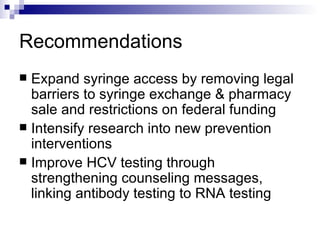
Recommendations Expand syringe access by removing legal barriers to syringe exchange & pharmacy sale and restrictions on federal funding Intensify research into new prevention interventions Improve HCV testing through strengthening counseling messages, linking antibody testing to RNA testing
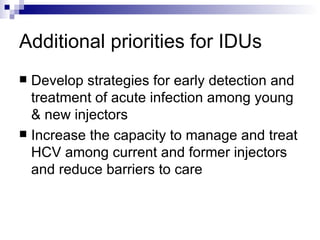
Additional priorities for IDUs Develop strategies for early detection and treatment of acute infection among young & new injectors Increase the capacity to manage and treat HCV among current and former injectors and reduce barriers to care
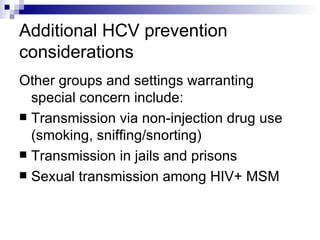
Additional HCV prevention considerations Other groups and settings warranting special concern include: Transmission via non-injection drug use (smoking, sniffing/snorting) Transmission in jails and prisons Sexual transmission among HIV+ MSM

Hepatitis C Prevention - testimony to IOM

  • 1.
    Hepatitis C PreventionDaniel Raymond Policy Director Harm Reduction Coalition
  • 2.
    Challenges in preventingHCV among injection drug users (IDUs) HCV is more infectious than HIV HCV is more prevalent among IDUs Greater transmission risk linked to sharing drugs & paraphernalia (e.g. cookers, cotton) Weaker cultural norms around HCV prevention Lack of vaccine, behavioral interventions
  • 3.
    Reasons for pessimismAnnual incidence among IDUs ranges from 10% to >40% Even countries that have successfully contained HIV epidemics among IDUs have not controlled HCV transmission Observed spikes in incidence rates despite established harm reduction in London, Australia
  • 4.
    Reasons for (cautious)optimism Epidemiologic data suggests declining HCV prevalence among IDUs in U.S. Wider “window of opportunity” for preventing HCV among new/young IDUs: Median 3.4 years from initiating injecting to HCV seroconversion Foundation of progress in structural, cultural, behavioral changes reducing HIV risk
  • 5.
    Key questions Syringeaccess HCV antibody testing Risk reduction education and counseling Treatment of acute & chronic infection
  • 6.
    Syringe access Correlatedwith lower/declining HCV prevalence at population level No clear evidence of protection against transmission at individual level Developing body of research examining necessary coverage levels Benefits of syringe exchange in U.S. hampered by federal funding ban, legal/political constraints
  • 7.
    HCV antibody testingKnowledge of negative HCV antibody status may promote risk reduction Knowledge of positive HCV antibody status has no demonstrated effect on risk practices Indications of HIV status-informed norms & approaches to risk management & “strategic” sharing do not extend to HCV
  • 8.
    Challenges in HCVtesting Making test results clear and meaningful Linking people receiving positive HCV antibody test results to HCV RNA testing to diagnose chronic vs. cleared infection Preparing for introduction of rapid oral HCV antibody test Understanding disclosure norms & strategies among IDU networks
  • 9.
    Risk reduction educationand counseling Substantial literature documenting interventions that significantly reduce injection-related risks Lack of clarity on what degree of reduction of which injection-related risks is necessary for effective HCV prevention DUIT: greater decline in risk vs. control, but no difference in HCV incidence
  • 10.
    Treatment of acute& chronic infections IDUs can achieve comparable SVR rates New HCV treatments (e.g. protease inhibitors) may shorten treatment and increase efficacy Early detection and treatment of acute infection yields very high SVR rates and may interruption chains of transmission during periods of high infectiousness Reinfection after SVR has been documented among some treated IDUs
  • 11.
    Lessons Syringe access,knowledge of HCV status, and current levels of risk reduction are necessary but not sufficient: expand and intensify Treatment will most likely have an indirect effect on HCV prevention by increasing IDU attention to risk and status rather than reducing the pool of HCV-infected IDUs
  • 12.
    Future directions Developmessages, norms, and interventions to address contextual risks (environmental, social network) and individualized prevention strategies Craft social marketing and community mobilization campaigns to establish HCV as a priority for IDUs Support research on new interventions powered to demonstrate changes in incidence
  • 13.
    Recommendations Expand syringeaccess by removing legal barriers to syringe exchange & pharmacy sale and restrictions on federal funding Intensify research into new prevention interventions Improve HCV testing through strengthening counseling messages, linking antibody testing to RNA testing
  • 14.
    Additional priorities forIDUs Develop strategies for early detection and treatment of acute infection among young & new injectors Increase the capacity to manage and treat HCV among current and former injectors and reduce barriers to care
  • 15.
    Additional HCV preventionconsiderations Other groups and settings warranting special concern include: Transmission via non-injection drug use (smoking, sniffing/snorting) Transmission in jails and prisons Sexual transmission among HIV+ MSM