Welcome!
Mastering cholesterol to optimise CVD
prevention – Targeting lipids: A primary
and secondary care perspective
Please note this session will be recorded
MUTE BUTTON
Attendees’ microphones will be automatically muted,
to minimise background noise.
QUESTIONS
Please use the Q&A button to submit questions.
These will be addressed during the Q&A session.
Introducing
Lipids:
A Primary Care
Approach
Dr Sue Kemsley
GP
Primary Care Lipid Lead for Innovation Agency (AHSN NWC)
Primary Care Co-Lead for C&M Strategic Cardiac Network
GPwSI Cardiology
LDL-C causes
atherosclerosis; a disease
process directly causing
ASCVD & CVD events
CVD
EVENTS
LDL-C
ABC of CVD
Prevention
Atrial Fibrillation
Blood Pressure
Cholesterol
Optimising statins predicted to save over £700m in 5 years
NHS CVD
Prevention
Recovery
• 25% of all UK deaths
• Largest cause of
premature deaths in
deprived areas
• NHS Long Term Plan:
Single biggest area
where NHS can save
lives in next 10 years
ASCVD
NHS CVD
Prevention
Recovery
For every 1 mmol/L reduction in LDL-C, there is a reduction in annual
CVD risk of 28%.
National ambitions for
cholesterol state by 2029:
75% of 40–74-year-olds will
have a CVD risk assessment &
cholesterol reading recorded
on a primary care data system
in the last five years
45% of 40–74-year-olds with
=> 20% 10-year risk of
developing CVD in primary
care are treated with statins
And by 2024:
25% of people with Familial
Hypercholesterolaemia (FH)
are diagnosed and treated
optimally according to NICE FH
guidance
Why should primary care focus on lipids now?
PCN DES & IIF Targets 2022: CVD risk & FH detection
New guidance & clinical targets: NHS Lipid Pathway and
Statin Intolerance Pathway
Multidrug approach to lipids: Statins, Ezetimibe, Bempedoic acid,
Inclisiran, PCSK9i and Vazkepa
Why are we
not managing
lipids better?
• Lipid disorders not perceived as causing a disease process
• Lipids often thought difficult to treat so why bother?
• Bad press for lipid medications
• Statin "side effects”, statin reluctance and nocebo effect
• Often poor compliance
• Confusion over guidance and treatment targets
• Often tagged on to a consultations in primary care with
multiple issues making a difficult conversation unmanageable
• Clinician and patient inertia
Aims
Who should have a cholesterol test and when
Discuss the range of treatment options
The NHS Lipid Pathway as a lipid therapy decision
aid
The statin intolerance pathway to address side effects
How to work at scale to optimise lipid therapies
Primary Prevention
<=84yrs & QRISK=>10%
T2DM & QRISK=>10%
T1DM (plus risk factor*)
CKD eGFR<60 and/or albuminuria
All age >84 (consider frailty etc)
Secondary Prevention
All ASCVD
(MI/angina/revascularisation
TIA/stoke/PAD)
When to think lipid intervention in primary care?
Familial Hyperlipidaemia
Chronic Long Term Condition Reviews
• All ASVCD
• Coronary artery disease: Angina, MI, CABG, stent
• Cerebrovascular disease: stroke, TIA
• Peripheral arterial disease including AAA
• Genetic or suspected diagnosis of FH
• Hypertension
• AF
• Diabetes
• CKD
• All 84+ years! (but tailor this to the individual)
• CVD risk >10%
• Other chronic diseases e.g. COPD, inflammatory disease, severe psoriasis
When to think lipid therapies? Who is high risk?
40-74 Years NHS Health Check
• Currently only around 45% of eligible patients have an NHS health check
• Only eligible if fit and well
• Not eligible if,
• ASVCD
• HTN
• AF
• Heart failure
• Diagnosis of FH
• Diagnosis of CVD risk >10% & already on lipid therapy
• Treat if QRISK>10%
When to consider lipid disorders in primary care?
Finding high risk undiagnosed patients
Familial
Hypercholesterolaemia
• Think identification
• Refer for genetic and cascade testing
• Do not use QRISK
• 50% reduction in non-HDL-C
PCN DES & GP data
searches
• Age <=29 total
cholesterol >7.5
• Age >=30 total
cholesterol >9.0
• UCLP Lipids search
18-39 Years
• Single lipid
profile to
consider FH
• Point of care
test
Childhood
• 12 month
heel-prick test
• Genetic
testing if high
• Family
cascade
testing if baby
has positive
results
• Lifestyle
advice for ALL
families
Finding familial hypercholesterolaemia in primary care
Suspected heterozygous FH diagnosis
Fasting lipid profile
Criteria levels more accurate for people <30 years
Criteria levels increase as people get older
• Adult <30 years: Fasting TC >7.5 and/or LDL-C >4.9 and/or non-HDL-C >5.9
• Child <16 years: Fasting TC >6.7 and/or LDL-C >4.0
• Anyone with TC>9.0mmol/L and/or LDL-C >6.5mmol/L and/or non-HDL-C >7.5mmol/L or fasting
triglycerides > 10mmol/L
Especially if; personal and/or family history of confirmed CHD (<60 years) and with no secondary
causes
Refer to diagnose FH if severe Hyperlipidemia, and especially if;
Use FH risk calculator
Suspected homozygous FH diagnosis
Adult under 30 years: LDL-C >13
Child under16 years: LDL-C >11
CM.FHS@nhs.net / 0151 254 3248
• Pilot service April 22-Sept 23 with aim to become a fully commissioned long term
service.
• Service aim: Identify individuals across C&M who are at risk of FH. The 1:250 incidence
equates to 10,000 people.
• Specialist nurse-led with paediatric and adult training. Lipidologist clinical lead.
• Remote consultations provide counselling, support and genetic testing to confirm and
discuss FH diagnosis and provide detailed patient information to support effective
treatment with lipid therapies.
• Cascade genetic testing for family members.
• All referrals welcome via referral form available in EMIS (includes Welsh Lipid Score)
• FH team are supporting education in the region through a series of webinars, drop-in
meetings (MS Teams) and tailored educational sessions
Treatment Options
Lipid Therapies
Statins
• 40-50% LDL-C
reduction
• LFT baseline,
each
titration, 12
months and
then not
again if
normal
• Need to
manage
“intolerance”
Ezetimibe
• Add on to
statin with
additional
24% LDL-C
reduction, or
monotherapy
• No
monitoring
• Well
tolerated
Bempedoic
acid
• Add on to
Ezetimibe
monotherapy
with
additional
28% LDL-C
reduction
• Only need to
monitor
renal/liver
function if
severe
impairment
Inclisiran
• ASCVD after
max statin ±
Ezetemibe
• Additional
50% LDL-C
reduction
• Twice yearly
injection
• Can be
administered
in primary
care
PCSK9i
• ASCVD
and/or FH
• 25-75% LDL-C
reduction
• 2 weekly self
injector
• Secondary
care only
Vazkepa
• Add on
therapy to
reduce
triglycerides
• Included in
updated NHS
Lipid Pathway
Dec 2022
NHS Lipid
Pathway
Statin
Intensity
Ezetimibe,
Bempedoic Acid,
Inclisiran &
PCSK9i
Secondary
Prevention Only
(*FH)
Eligibility
criteria for
injectables
If non-HDL-C >2.5 check fasting lipid profile
to check LDL-C to determine eligibility.
(Could consider use of equation to calculate
LDL-C equivalent.)
Inclisiran may be used if fasting LDL-C
(or equivalent) =>2.6
PCSK9i
Without CVD High risk Very high
risk
Not FH Not indicated LDL-C >4.0 LDL-C >3.5
FH LDL-C >5.0 LDL-C>3.5
Statin Reluctance Nocebo effect
Summary of when to check a blood test for lipid profile
• Any age to assess risk of FH if no previous assessment,
• Assess CVD risk for primary prevention in patients 40-74 years 5 yearly
(NHS health check)
• Check treatment to target (non-HDL-C <= 2.5) for ALL on lipid therapies
annually (Except FH>50% reduction from baseline)
• Reassess CVD risk when treating new diagnosis of diabetes or
hypothyroidism or significant lifestyle interventions
Random lipids if,
• Significantly raised triglycerides
• Patient with ASCVD being considered for Inclisiran
• Patient with FH being considered for PCSK9i
Fasting lipids if,
Optimising Lipids at Scale
Using Digital Tools: UCLP Framework
Secondary Prevention Stratification
Primary Prevention Stratification
UCLP secondary prevention lipid search run across all practices in PCN
PCN care co-ordinator ensures up to date blood tests and offers lipid
review to patients in order from UCLP groups 1, 2, and 3 in a Clinical
Pharmacist/ANP clinic
Prescriber-led clinic optimises oral lipid therapy according to the NHS
lipid pathway and statin intolerance pathway with lifestyle
counselling
Patients identified as eligible for Inclisiran if not to target following
optimisation of oral therapies
Inclisiran clinic with care co-ordinator recall system for 3-month
and 6-month injections
Initial weekly
MDT for
advice and
support
FH
suspects
referred
to lipid
clinic
PCN approach to optimising lipid therapies
Summary: Lipid disorders in primary care
Case finding and MECC for lipid disorders including FH
Multi drug approach
Manage statin intolerance
Treat to target
Consider pathways to optimise at scale
Maximise
prevention
by optimising
all CVD risks
CVD risk
Lifestyle
Atrial
Fibrillation
Blood
pressure
Cholesterol
Diabetes
CKD
Inflammatory
Disease
Heart failure
Ethnicity
Family
history
Age & sex
Thank you
Introducing lipids:
A secondary care approach
DR GAVIN GALASKO
CONSULTANT INTERVENTIONAL CARDIOLOGIST
CLINICAL LEAD FOR THE BLACKPOOL LIPID CLINIC
DIRECTOR OF RESEARCH, DEVELOPMENT AND INNOVATION
BLACKPOOL TEACHING HOSPITALS NHS FOUNDATION TRUST
IA AND CARDIAC NETWORK LIPID LEAD FOR L&SC
Who should secondary care treat
with lipid lowering therapy and how?
 Lipid lowering guidelines
 NICE clinical guideline 181 [Lipid Modification for 1o and 2o prevention],
July 2014 (currently being updated)
 NICE approved NHS/Accelerated Access Collaborative Guideline (lipid
pathway), Dec 2022
 AHSN Lipid Optimisation Pathway following acute cardiovascular event,
Nov 2022
 NICE clinical guideline 71 [Familial Hypercholesterolaemia], Aug 2008
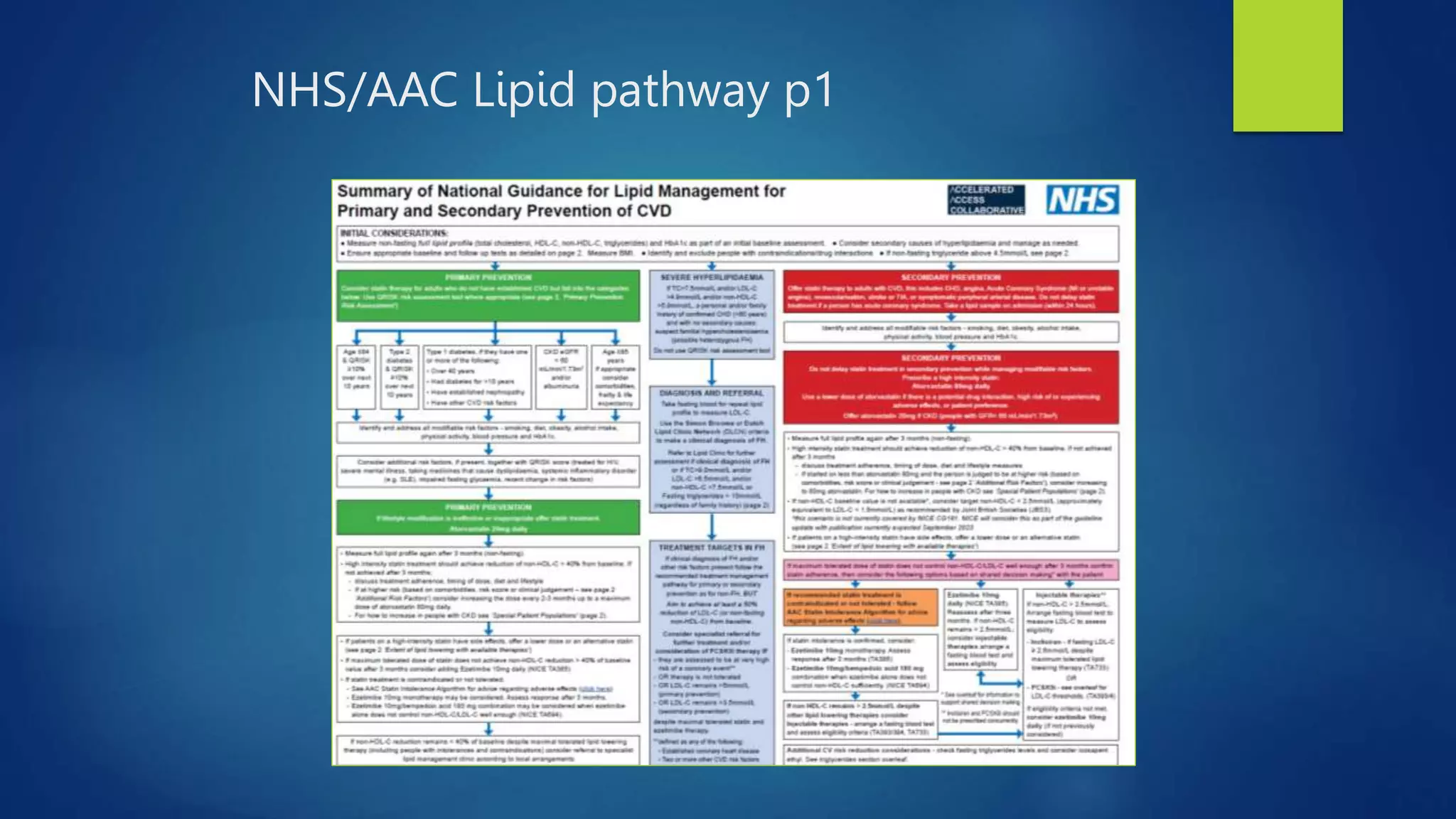
NHS/AAC Lipid pathway p1
NHS/AAC Lipid pathway p2
AHSN Lipid optimisation pathway
following acute cardiovascular event
Primary prevention
Assessment and diagnosis
 For primary prevention of CVD in primary care, a systematic strategy
should be used to identify people likely to be at high risk of CVD
(≥10%,10 yr risk)
 Use QRISK2/3 risk assessment tool to assess CVD risk for primary
prevention in people 40-84 years of age
 Consider FH (familial hypercholesterolaemia) if chol >7.5mM
(especially if family history of premature CVD)
 Do not use risk assessment tool in people with eGFR < 60
ml/min/1.73m2 and/or albuminuria
 Do not use risk score in patients with proven CHD, ischaemic stroke,
type 1 DM, PVD, familial ↑ lipidaemia
 Treat secondary causes of dyslipidaemia first
 E.g. nephrotic syn/DM/↑EtoH/dTFTs/medications eg steroids/biliary
obstruction/pregnancy
Key assessments/advice
 Smoking status
 Alcohol consumption
 Blood pressure
 BMI or other measure of obesity
 U&Es and eGFR, LFTs
 Total Chol, non-HDL chol, HDL and triglycerides
 HbA1c
 TSH
 Recommend healthy lifestyle changes
Statins
 After managing modifiable RFs, if still appropriate and after informed
discussion start Atorvastatin 20mg od
 Measure full non-fasting lipid profile after 3 months
 Target: >40% reduction in non-HDL cholesterol
 If not achieved discuss adherence, diet, lifestyle
 If at higher risk consider increasing dose up to 80mg
 If still not achieved consider adding Ezetimibe 10mg od
 Annual review to ensure ongoing adherence
Diabetes
 Use QRISK2 risk assessment tool to assess CVD in people with type 2
diabetes
 Offer Atorvastatin 20mg for those with ≥10% 10-year risk of developing
CVD
 Offer Atorvastatin 20mg for primary prevention of CVD for adults
with type 1 DM who:
 Are >40 or
 Have had type I DM for >10 years or
 Have established nephropathy or
 Have other CVD risk factors
 Consider Atorvastatin 20 mg for all adults with type 1 diabetes
Renal Failure
 Offer Atorvastatin 20mg for 1o and 2o prevention of CVD
 Increase dose if a >40% ↓ in non-HDL chol is not achieved (total chol –
HDL-chol)
 Discuss use of higher doses with renal specialist if eGFR is
<30ml/min/1.73m2
Secondary prevention
Statins
 Offer statin therapy to patients with acute or established CVD (CHD, PVD,
ischaemic CVA). Take lipid sample within 24o of admission
 Address all modifiable risk factors – smoking, diet, BP, DM, obesity etc
 Initiate treatment with Atorvastatin 80mg od
 Use a lower dose if:
 Potential drug interactions
 High risk of adverse events
 Patient preference
 Reassess lipid profile after 3 months high-intensity statin and see if target
reached (non-HDL chol ↓ >40%)
 If target not reached;
 Discuss adherence and timing of dose
 Optimise adherence to diet and lifestyle measures
 Consider increasing dose if started on <80mg Atorvastatin
 Consider role of other NICE-approved agents;
 Ezetimibe/Bempedoic acid/Inclisiran/PCSK9 inhibitors/Icosapent ethyl
Pre-statin advice
 Before offering statin, ask about persistent generalised muscle pains.
If yes, measure CK
 If CK > 5xULN do not start statin
 If CK 1-5x ULN start at a lower dose
 Advise that if they develop muscle symptoms (pain, tenderness or
weakness) seek medical advice and measure CK levels
 Statins are contraindicated in pregnancy (potential teratogenic risk)
so stop them if pregnancy possible
Statins follow up
 Measure total, HDL and non-HDL chol in all people who have been
started on high intensity statin treatment at 3 months (non-fasting)
 Provide annual medication reviews
 Discuss medicine adherence, lifestyle modification and address CVD risk
factors
 Consider annual non-fasting blood test for non-HDL cholesterol
 Do not measure CK levels routinely
 Do measure CK levels if muscle symptoms occur (pain, tenderness,
weakness)
Monitoring patients on statins
 Baseline liver enzymes should be measured before starting statin.
LFTs should then be measured within 3 months and at 12 months,
but not again unless clinically indicated
 People with ↑transaminases but <3xULN should not be excluded
from statin use
 If an unexplained peripheral neuropathy develops then stop statin
and seek specialist advice
Statin therapy alternatives
NICE CG 181: Lipid modification July 2014
 For primary or secondary prevention of CVD, or in CKD or Type 1 DM,
do not offer:
 Nicotinic acid (Niacin)
 Anion exchange resins
 Omega-3 fatty acid compounds
 Do not routinely offer fibrates (sometimes used in specialist lipid
clinics)
 People with primary hypercholesterolaemia should be considered for
Ezetimibe in line with NICE TA 132+385 guidance
 (acts synergistically with statins: ↓ intestinal cholesterol absorption vs
statins ↓ chol production)
 10-20% reduction in LDL-C
Treatment option
0
-5
-10
-15
-20
-25
-30
Baseline
%
LDL-C
reduction
from
baseline
In a randomised, multicentre, double-blind, parallel-
group study that measured % change from baseline
in LDL-C after 6 weeks’ treatment.
(n=579)
Up titrating to 80 mg
of atorvastatin
Atorvastatin 40 mg plus
10 mg of ezetimibe
% LDL-C reduction
from baseline
11%
27%
1. Leiter LA et al. Am J Cardiol 2008; 102(11): 1495–1501.
P<0.001
Ezetimibe
Adding 10mg to Atorvastatin 40mg superior to ↑ Atorv. to 80mg
Bempedoic acid
 NICE TA 694 approved, April ‘21, 180mg od
 Adenosine triphosphate citrate lyase (ACL) inhibitor which inhibits
cholesterol synthesis in the liver, thereby lowering LDL-C
 Always recommended with Ezetimibe and only if:
 Statins contraindicated or not tolerated
 Ezetimibe monotherapy does not hit target
 Agreed company pricing structure adhered to (confidential)
 c15% reduction in LDL-C
 SEs: ↑LFTs, ↑uric acid/gout, joint pains
Inclisiran
 NICE TA 733 approved, Oct ’21
 284 mg Inclisiran in 1.5ml solution, subcutaneous dose
 Give after 3 months then 6 monthly (2x/yr)
 Small interfering RNA (siRNA) that ↑LDLRs via interference of PCSK-
9 production
 Secondary prevention only (CHD, ischaemic stroke, PVD) and LDL-C
≥2.6mM
 Must be on maximum tolerated statin ± Ezetemibe
 Lowers LDL-C by approx. 50%
 Can be prescribed in primary and secondary care
PCSK9 inhibitors
 Monoclonal antibodies that inactivate proprotein convertase subtilisin-
kexin type 9 (PCSK9)
 Alirocumab (Praluent) and Evolocumab (Repatha)
 Increase LDL-receptors on the surface of hepatocytes 
↑uptake/degradation of LDL by liver
 Given by fortnightly subcutaneous injections (75-150 or 140mg)
  Dramatic ↓LDL and ↓Non-HDL chol levels (50-60% reductions)
 Act synergistically with statins
 Statins reduce cholesterol synthesis + ↑ hepatocyte LDL-receptor levels
 but increase PCSK9 levels (which act to reduce LDL-receptor levels)
 Main role in FH, but role in non-FH 2o prevention
 MMGs red coding (hospital prescription only)
NICE PCSK9 inhibitor guidance
NICE TA 393 + TA 394, 2016
Icosapent ethyl (Vazkepa)
 NICE TA 805 approved, July ’22
 Stable ethyl ester of omega-3 fatty acid
 Mechanism of action not fully understood
 998mg capsules, 2xbd
 Secondary prevention (CHD, ischaemic stroke, PVD) or DM and at
least one other risk factor
 Must be on statin therapy
 Must have: LDL-C 1.04-2.6mM + TG≥1.7mM
 ↓TG c20%, ↓non-HDL-C c10-15%
 SEs: ↑bleeding time, AF, constipation, MSk pains
 Can be prescribed in primary + secondary care
Familial Hypercholesterolaemia
Nice Guidelines (CG71), 2008 (last updated Nov 2017)
Very common - frequency ~1/300-500 > 120,000 in UK
Often underdiagnosed < 15,000 cases known in 2008 (12.5%)
Very High CHD event rates untreated
0
20000
40000
60000
80000
100000
120000
140000
2000 2004 2008 2012 2016 2020
Number
FH
known
Survey UK Lipid Clinics
Missing >85%
of predicted
Marks, et al 2004
HEARTUK 2008
Neil, et al BMJ 2000
How common is FH?
Age
(years)
♂
% CHD
♀
% CHD
<30 5 0
30-39 22 2
40-49 48 7
50-59 80 51
60-69 100 75
Slack, Lancet.1969;1380-2
Natural History
Diagnosing FH (NICE CG 71)
 Consider FH in adults with total cholesterol >7.5mM, especially if there
is a family history of premature CHD
 Exclude secondary causes of hyperlipidaemia
 Use the Simon Broome Criteria for diagnosis (can also use Dutch Lipid
Clinic Network Score)
 Absence of clinical signs (e.g. tendon xanthomata) does not exclude
the diagnosis
 Take two fasting LDL-C measurements to confirm diagnosis
Simon Broome Diagnostic Criteria
Definite FH:
 TC > 6.7 mmol/l or LDL-C >4.0 mmol/l (child <16y)
or TC > 7.5 mmol/l or LDL-C >4.9 mmol/l (adult)
plus one of:
 tendon xanthomas in patient, or in 10 relative (parent, sibling,
child), or in 20 relative (grandparent, uncle, aunt), or
 DNA-based evidence of an LDL receptor mutation, familial
defective apo B-100, or a PCSK9 mutation.
Possible FH is defined as the above lipid cut-offs plus one of:
 family history of myocardial infarction: below age of 50 years in
20 relative or below age 60 years in 10 relative, or
 family history of raised TC >7.5 mmol/l in adult 10 or 20 relative
or > 6.7 mmol/l in child or sibling <16y
Xanthomata
Xanthelasma Tendon Xanthomata
Palmar Xanthomata Tendon Xanthomata
Tuberous Xanthomata
Eruptive Xanthomata
FH Management
 Start Statin ± Ezetimibe
 Onward referral to lipid clinic:
 For confirmation of diagnosis ± cascade testing
 For consideration of PCSK9i therapy
 Known FH who fail to achieve a reduction of LDL-C from baseline
of >50% despite maximum tolerated dose of statin + ezetimibe
 Young people with FH should be referred to paediatric FH
specialist. Therapy to be considered from age 10
 Any adult with FH at very high risk of a coronary event
 Established coronary disease
 A family history of premature coronary disease
 Two or more other cardiovascular risk factors
Blackpool Lipid Clinic
(established October 2018)
The team
 Marie Wilcock - Advanced Nurse Practitioner
 Dr Gavin Galasko – Consultant Cardiologist
 Dr Tawfiq Choudhury – Consultant Cardiologist
 Noel Topping – Cardiac Pharmacist
 Clinical Biochemist due to start shortly
 2018/19 – 1 monthly clinic
 2022 – 4-5 clinics per week plus weekly MDT
Referral criteria
1. Possible Familial Hypercholesterolaemia (FH):
Pre-treatment total chol >7.5mM and either a family history of myocardial
infarction at age < 50-60 years or a family history of FH (Simon Broome)
2. Unexplained severe hyperlipidaemia without a family history
Total chol > 9mM, or fasting LDL chol >6.5mM, or non-HDL chol > 7.5mM, or
fasting triglycerides > 10mM (once other causes excluded e.g. EtOH/TFT)
3. Secondary prevention:
In patients with established CVD (ischaemic stroke/TIA, PVD, ACS, coronary
revascularisation) refer if total chol >6mM or fasting LDL chol >4mM despite
best-tolerated lipid-lowering therapy, or if statin intolerant
Suggested Investigations Prior to Referral:
FBC, Biochemical profile, ALT/AST, TSH and fasting lipid profile
Demographics to date
Year Mean age
(years)
Average max
chol (when
known)
Range of
chol levels
Proportion
with max
≥7.5mM
2019 54.9 8.9mM 5.5 - 14mM 87%
2020 57.0 9.0mM 5.6 - 19.5mM 87%
2021 54.2 9.1mM 5.5 - 14mM 89%
2022 54.5 8.7mM 3.1 – 20mM 81%
Genetic Testing for FH 2021/22
 Testing of referred patients for FH
 Criteria used:
 Simon Broome criteria for possible FH
 Dutch lipid score for probable FH (score ≥6)
 Welsh score
 26 patients found to have FH on genetic testing
 16/110 new FH cases found (15% pick up) (proband
testing)
 10/27 cases found (37% pick up) in relatives of patients
with FH (cascade testing)
Lipid management quiz
Case study one
 45 year old ♂ type II diabetic with hypertension
 Total chol 6.5mM, LDL 3.2mM, HDL 1.0mM
 Calculated 10 year QRISK 2 CVD risk of .....
 What initial lipid therapy would you recommend?
1. None - dietary advice only
2. Atorvastatin 20mg od
3. Atorvastatin 80mg od
4. Alternative statin – which one
5. Statin + Ezetimibe
6. Something else
17 %
Case study two
 55 year old ♂ with BP, T2DM, old MI, PVD
 Total chol 5.0mM, LDL 2.8mM, HDL 1.0mM, on Simvastatin 40mg
 Would you recommend any change in lipid therapy?
1. None - dietary advice only
2. Change to Atorvastatin 20mg od
3. Change to Atorvastatin 80mg od
4. Change to another statin and/or medication
5. Something else
Case study three
 62 year old ♀ smoker, BP, angina
 Baseline LDL-C: 4.24 mM
 On Simvastatin 40mg od but experiencing muscle pains too severe
to continue treatment
 What alternative lipid lowering therapy might you advise?
1. Anion exchange resin eg cholestyramine
2. Nicotinic acid (Niacin)
3. Fibrate e.g. fenofibrate
4. Omega-3 fatty acid preparation
5. Alternative statin / lower dose statin
6. Ezetimibe monotherapy
7. Measure CK levels
Case study four
 47 year old ♂ smoker
 Discharged on Atorvastatin 80mg after recent NSTEMI, treated with
PCI and stent
 Father died of a heart attack at 51
 Total chol 6.1mM, LDL-C 4.24 mM on Rx
 What might you advise?
1. Addition of Omega-3 fatty acids
2. Addition of Ezetimibe 10mg od
3. Alternative statin – if so which?
4. Something else – if so what?
5. Check he is actually taking his atorvastatin
6. Refer to local lipid clinic (for assessment of possible FH and for
consideration of PCSK9i)
Case study five
 55 year old ♂ with BP, previous MI, CKD
 Baseline Total chol 7.6mM, HDL 0.9mM, LDL-C: 5.5mM prior to statins
(non HDL-chol ..........)
 Initiated on Atorvastatin 40mg but was titrated down to 20mg od due
to severe muscle pain
 Currently LDL-C 3.9mM, Total chol 5.7mM, HDL 1.0mM (non HDL–chol
4.7mM -30% reduction on treatment)
 Would you recommend any change in lipid therapy?
1. No change
2. Up titrate to Atorvastatin 40mg again
3. Change to Rosuvastatin 20mg od
4. Add Ezetimibe 10mg od to Atorvastatin
5. Consider FH + referral to lipid clinic if family history of IHD
6. Consider Inclisiran if LDL-C >2.6mM after adding ezetimibe
6.7mM
Learning points
 Primary prevention: Atorvastatin 20mg
 Secondary prevention: Atorvastatin 80mg
 Think FH if chol > 7.5mM + FHx IHD <50/60 yrs
 Aim for 40% reduction in non-HDL Chol (so pre-treatment lvls key)
 Consider Ezetimibe if statin intolerant / lipid targets not achieved
 Consider referral to lipid clinic if ?FH
 Consider referral to lipid clinic in secondary prevention if fasting LDL
persistently >4mM despite statin therapy or if statin intolerant
Any questions?

Targeting lipids: a primary and secondary care perspective

  • 1.
    Welcome! Mastering cholesterol tooptimise CVD prevention – Targeting lipids: A primary and secondary care perspective Please note this session will be recorded MUTE BUTTON Attendees’ microphones will be automatically muted, to minimise background noise. QUESTIONS Please use the Q&A button to submit questions. These will be addressed during the Q&A session.
  • 2.
    Introducing Lipids: A Primary Care Approach DrSue Kemsley GP Primary Care Lipid Lead for Innovation Agency (AHSN NWC) Primary Care Co-Lead for C&M Strategic Cardiac Network GPwSI Cardiology
  • 3.
    LDL-C causes atherosclerosis; adisease process directly causing ASCVD & CVD events CVD EVENTS LDL-C
  • 5.
    ABC of CVD Prevention AtrialFibrillation Blood Pressure Cholesterol
  • 6.
    Optimising statins predictedto save over £700m in 5 years
  • 7.
    NHS CVD Prevention Recovery • 25%of all UK deaths • Largest cause of premature deaths in deprived areas • NHS Long Term Plan: Single biggest area where NHS can save lives in next 10 years ASCVD
  • 8.
    NHS CVD Prevention Recovery For every1 mmol/L reduction in LDL-C, there is a reduction in annual CVD risk of 28%. National ambitions for cholesterol state by 2029: 75% of 40–74-year-olds will have a CVD risk assessment & cholesterol reading recorded on a primary care data system in the last five years 45% of 40–74-year-olds with => 20% 10-year risk of developing CVD in primary care are treated with statins And by 2024: 25% of people with Familial Hypercholesterolaemia (FH) are diagnosed and treated optimally according to NICE FH guidance
  • 9.
    Why should primarycare focus on lipids now? PCN DES & IIF Targets 2022: CVD risk & FH detection New guidance & clinical targets: NHS Lipid Pathway and Statin Intolerance Pathway Multidrug approach to lipids: Statins, Ezetimibe, Bempedoic acid, Inclisiran, PCSK9i and Vazkepa
  • 10.
    Why are we notmanaging lipids better? • Lipid disorders not perceived as causing a disease process • Lipids often thought difficult to treat so why bother? • Bad press for lipid medications • Statin "side effects”, statin reluctance and nocebo effect • Often poor compliance • Confusion over guidance and treatment targets • Often tagged on to a consultations in primary care with multiple issues making a difficult conversation unmanageable • Clinician and patient inertia
  • 11.
    Aims Who should havea cholesterol test and when Discuss the range of treatment options The NHS Lipid Pathway as a lipid therapy decision aid The statin intolerance pathway to address side effects How to work at scale to optimise lipid therapies
  • 12.
    Primary Prevention <=84yrs &QRISK=>10% T2DM & QRISK=>10% T1DM (plus risk factor*) CKD eGFR<60 and/or albuminuria All age >84 (consider frailty etc) Secondary Prevention All ASCVD (MI/angina/revascularisation TIA/stoke/PAD) When to think lipid intervention in primary care? Familial Hyperlipidaemia
  • 14.
    Chronic Long TermCondition Reviews • All ASVCD • Coronary artery disease: Angina, MI, CABG, stent • Cerebrovascular disease: stroke, TIA • Peripheral arterial disease including AAA • Genetic or suspected diagnosis of FH • Hypertension • AF • Diabetes • CKD • All 84+ years! (but tailor this to the individual) • CVD risk >10% • Other chronic diseases e.g. COPD, inflammatory disease, severe psoriasis When to think lipid therapies? Who is high risk?
  • 15.
    40-74 Years NHSHealth Check • Currently only around 45% of eligible patients have an NHS health check • Only eligible if fit and well • Not eligible if, • ASVCD • HTN • AF • Heart failure • Diagnosis of FH • Diagnosis of CVD risk >10% & already on lipid therapy • Treat if QRISK>10% When to consider lipid disorders in primary care? Finding high risk undiagnosed patients
  • 16.
    Familial Hypercholesterolaemia • Think identification •Refer for genetic and cascade testing • Do not use QRISK • 50% reduction in non-HDL-C
  • 17.
    PCN DES &GP data searches • Age <=29 total cholesterol >7.5 • Age >=30 total cholesterol >9.0 • UCLP Lipids search 18-39 Years • Single lipid profile to consider FH • Point of care test Childhood • 12 month heel-prick test • Genetic testing if high • Family cascade testing if baby has positive results • Lifestyle advice for ALL families Finding familial hypercholesterolaemia in primary care
  • 18.
    Suspected heterozygous FHdiagnosis Fasting lipid profile Criteria levels more accurate for people <30 years Criteria levels increase as people get older • Adult <30 years: Fasting TC >7.5 and/or LDL-C >4.9 and/or non-HDL-C >5.9 • Child <16 years: Fasting TC >6.7 and/or LDL-C >4.0 • Anyone with TC>9.0mmol/L and/or LDL-C >6.5mmol/L and/or non-HDL-C >7.5mmol/L or fasting triglycerides > 10mmol/L Especially if; personal and/or family history of confirmed CHD (<60 years) and with no secondary causes Refer to diagnose FH if severe Hyperlipidemia, and especially if; Use FH risk calculator
  • 19.
    Suspected homozygous FHdiagnosis Adult under 30 years: LDL-C >13 Child under16 years: LDL-C >11
  • 20.
    CM.FHS@nhs.net / 0151254 3248 • Pilot service April 22-Sept 23 with aim to become a fully commissioned long term service. • Service aim: Identify individuals across C&M who are at risk of FH. The 1:250 incidence equates to 10,000 people. • Specialist nurse-led with paediatric and adult training. Lipidologist clinical lead. • Remote consultations provide counselling, support and genetic testing to confirm and discuss FH diagnosis and provide detailed patient information to support effective treatment with lipid therapies. • Cascade genetic testing for family members. • All referrals welcome via referral form available in EMIS (includes Welsh Lipid Score) • FH team are supporting education in the region through a series of webinars, drop-in meetings (MS Teams) and tailored educational sessions
  • 21.
  • 22.
    Lipid Therapies Statins • 40-50%LDL-C reduction • LFT baseline, each titration, 12 months and then not again if normal • Need to manage “intolerance” Ezetimibe • Add on to statin with additional 24% LDL-C reduction, or monotherapy • No monitoring • Well tolerated Bempedoic acid • Add on to Ezetimibe monotherapy with additional 28% LDL-C reduction • Only need to monitor renal/liver function if severe impairment Inclisiran • ASCVD after max statin ± Ezetemibe • Additional 50% LDL-C reduction • Twice yearly injection • Can be administered in primary care PCSK9i • ASCVD and/or FH • 25-75% LDL-C reduction • 2 weekly self injector • Secondary care only Vazkepa • Add on therapy to reduce triglycerides • Included in updated NHS Lipid Pathway Dec 2022
  • 23.
  • 24.
  • 25.
  • 26.
    Eligibility criteria for injectables If non-HDL-C>2.5 check fasting lipid profile to check LDL-C to determine eligibility. (Could consider use of equation to calculate LDL-C equivalent.) Inclisiran may be used if fasting LDL-C (or equivalent) =>2.6 PCSK9i Without CVD High risk Very high risk Not FH Not indicated LDL-C >4.0 LDL-C >3.5 FH LDL-C >5.0 LDL-C>3.5
  • 27.
  • 28.
    Summary of whento check a blood test for lipid profile • Any age to assess risk of FH if no previous assessment, • Assess CVD risk for primary prevention in patients 40-74 years 5 yearly (NHS health check) • Check treatment to target (non-HDL-C <= 2.5) for ALL on lipid therapies annually (Except FH>50% reduction from baseline) • Reassess CVD risk when treating new diagnosis of diabetes or hypothyroidism or significant lifestyle interventions Random lipids if, • Significantly raised triglycerides • Patient with ASCVD being considered for Inclisiran • Patient with FH being considered for PCSK9i Fasting lipids if,
  • 29.
  • 30.
    Using Digital Tools:UCLP Framework Secondary Prevention Stratification Primary Prevention Stratification
  • 31.
    UCLP secondary preventionlipid search run across all practices in PCN PCN care co-ordinator ensures up to date blood tests and offers lipid review to patients in order from UCLP groups 1, 2, and 3 in a Clinical Pharmacist/ANP clinic Prescriber-led clinic optimises oral lipid therapy according to the NHS lipid pathway and statin intolerance pathway with lifestyle counselling Patients identified as eligible for Inclisiran if not to target following optimisation of oral therapies Inclisiran clinic with care co-ordinator recall system for 3-month and 6-month injections Initial weekly MDT for advice and support FH suspects referred to lipid clinic PCN approach to optimising lipid therapies
  • 32.
    Summary: Lipid disordersin primary care Case finding and MECC for lipid disorders including FH Multi drug approach Manage statin intolerance Treat to target Consider pathways to optimise at scale
  • 33.
    Maximise prevention by optimising all CVDrisks CVD risk Lifestyle Atrial Fibrillation Blood pressure Cholesterol Diabetes CKD Inflammatory Disease Heart failure Ethnicity Family history Age & sex
  • 34.
  • 35.
    Introducing lipids: A secondarycare approach DR GAVIN GALASKO CONSULTANT INTERVENTIONAL CARDIOLOGIST CLINICAL LEAD FOR THE BLACKPOOL LIPID CLINIC DIRECTOR OF RESEARCH, DEVELOPMENT AND INNOVATION BLACKPOOL TEACHING HOSPITALS NHS FOUNDATION TRUST IA AND CARDIAC NETWORK LIPID LEAD FOR L&SC
  • 36.
    Who should secondarycare treat with lipid lowering therapy and how?  Lipid lowering guidelines  NICE clinical guideline 181 [Lipid Modification for 1o and 2o prevention], July 2014 (currently being updated)  NICE approved NHS/Accelerated Access Collaborative Guideline (lipid pathway), Dec 2022  AHSN Lipid Optimisation Pathway following acute cardiovascular event, Nov 2022  NICE clinical guideline 71 [Familial Hypercholesterolaemia], Aug 2008
  • 37.
  • 38.
  • 39.
    AHSN Lipid optimisationpathway following acute cardiovascular event
  • 40.
  • 41.
    Assessment and diagnosis For primary prevention of CVD in primary care, a systematic strategy should be used to identify people likely to be at high risk of CVD (≥10%,10 yr risk)  Use QRISK2/3 risk assessment tool to assess CVD risk for primary prevention in people 40-84 years of age  Consider FH (familial hypercholesterolaemia) if chol >7.5mM (especially if family history of premature CVD)  Do not use risk assessment tool in people with eGFR < 60 ml/min/1.73m2 and/or albuminuria  Do not use risk score in patients with proven CHD, ischaemic stroke, type 1 DM, PVD, familial ↑ lipidaemia  Treat secondary causes of dyslipidaemia first  E.g. nephrotic syn/DM/↑EtoH/dTFTs/medications eg steroids/biliary obstruction/pregnancy
  • 42.
    Key assessments/advice  Smokingstatus  Alcohol consumption  Blood pressure  BMI or other measure of obesity  U&Es and eGFR, LFTs  Total Chol, non-HDL chol, HDL and triglycerides  HbA1c  TSH  Recommend healthy lifestyle changes
  • 43.
    Statins  After managingmodifiable RFs, if still appropriate and after informed discussion start Atorvastatin 20mg od  Measure full non-fasting lipid profile after 3 months  Target: >40% reduction in non-HDL cholesterol  If not achieved discuss adherence, diet, lifestyle  If at higher risk consider increasing dose up to 80mg  If still not achieved consider adding Ezetimibe 10mg od  Annual review to ensure ongoing adherence
  • 44.
    Diabetes  Use QRISK2risk assessment tool to assess CVD in people with type 2 diabetes  Offer Atorvastatin 20mg for those with ≥10% 10-year risk of developing CVD  Offer Atorvastatin 20mg for primary prevention of CVD for adults with type 1 DM who:  Are >40 or  Have had type I DM for >10 years or  Have established nephropathy or  Have other CVD risk factors  Consider Atorvastatin 20 mg for all adults with type 1 diabetes
  • 45.
    Renal Failure  OfferAtorvastatin 20mg for 1o and 2o prevention of CVD  Increase dose if a >40% ↓ in non-HDL chol is not achieved (total chol – HDL-chol)  Discuss use of higher doses with renal specialist if eGFR is <30ml/min/1.73m2
  • 46.
  • 47.
    Statins  Offer statintherapy to patients with acute or established CVD (CHD, PVD, ischaemic CVA). Take lipid sample within 24o of admission  Address all modifiable risk factors – smoking, diet, BP, DM, obesity etc  Initiate treatment with Atorvastatin 80mg od  Use a lower dose if:  Potential drug interactions  High risk of adverse events  Patient preference  Reassess lipid profile after 3 months high-intensity statin and see if target reached (non-HDL chol ↓ >40%)  If target not reached;  Discuss adherence and timing of dose  Optimise adherence to diet and lifestyle measures  Consider increasing dose if started on <80mg Atorvastatin  Consider role of other NICE-approved agents;  Ezetimibe/Bempedoic acid/Inclisiran/PCSK9 inhibitors/Icosapent ethyl
  • 48.
    Pre-statin advice  Beforeoffering statin, ask about persistent generalised muscle pains. If yes, measure CK  If CK > 5xULN do not start statin  If CK 1-5x ULN start at a lower dose  Advise that if they develop muscle symptoms (pain, tenderness or weakness) seek medical advice and measure CK levels  Statins are contraindicated in pregnancy (potential teratogenic risk) so stop them if pregnancy possible
  • 49.
    Statins follow up Measure total, HDL and non-HDL chol in all people who have been started on high intensity statin treatment at 3 months (non-fasting)  Provide annual medication reviews  Discuss medicine adherence, lifestyle modification and address CVD risk factors  Consider annual non-fasting blood test for non-HDL cholesterol  Do not measure CK levels routinely  Do measure CK levels if muscle symptoms occur (pain, tenderness, weakness)
  • 50.
    Monitoring patients onstatins  Baseline liver enzymes should be measured before starting statin. LFTs should then be measured within 3 months and at 12 months, but not again unless clinically indicated  People with ↑transaminases but <3xULN should not be excluded from statin use  If an unexplained peripheral neuropathy develops then stop statin and seek specialist advice
  • 51.
    Statin therapy alternatives NICECG 181: Lipid modification July 2014  For primary or secondary prevention of CVD, or in CKD or Type 1 DM, do not offer:  Nicotinic acid (Niacin)  Anion exchange resins  Omega-3 fatty acid compounds  Do not routinely offer fibrates (sometimes used in specialist lipid clinics)  People with primary hypercholesterolaemia should be considered for Ezetimibe in line with NICE TA 132+385 guidance  (acts synergistically with statins: ↓ intestinal cholesterol absorption vs statins ↓ chol production)  10-20% reduction in LDL-C
  • 52.
    Treatment option 0 -5 -10 -15 -20 -25 -30 Baseline % LDL-C reduction from baseline In arandomised, multicentre, double-blind, parallel- group study that measured % change from baseline in LDL-C after 6 weeks’ treatment. (n=579) Up titrating to 80 mg of atorvastatin Atorvastatin 40 mg plus 10 mg of ezetimibe % LDL-C reduction from baseline 11% 27% 1. Leiter LA et al. Am J Cardiol 2008; 102(11): 1495–1501. P<0.001 Ezetimibe Adding 10mg to Atorvastatin 40mg superior to ↑ Atorv. to 80mg
  • 53.
    Bempedoic acid  NICETA 694 approved, April ‘21, 180mg od  Adenosine triphosphate citrate lyase (ACL) inhibitor which inhibits cholesterol synthesis in the liver, thereby lowering LDL-C  Always recommended with Ezetimibe and only if:  Statins contraindicated or not tolerated  Ezetimibe monotherapy does not hit target  Agreed company pricing structure adhered to (confidential)  c15% reduction in LDL-C  SEs: ↑LFTs, ↑uric acid/gout, joint pains
  • 54.
    Inclisiran  NICE TA733 approved, Oct ’21  284 mg Inclisiran in 1.5ml solution, subcutaneous dose  Give after 3 months then 6 monthly (2x/yr)  Small interfering RNA (siRNA) that ↑LDLRs via interference of PCSK- 9 production  Secondary prevention only (CHD, ischaemic stroke, PVD) and LDL-C ≥2.6mM  Must be on maximum tolerated statin ± Ezetemibe  Lowers LDL-C by approx. 50%  Can be prescribed in primary and secondary care
  • 55.
    PCSK9 inhibitors  Monoclonalantibodies that inactivate proprotein convertase subtilisin- kexin type 9 (PCSK9)  Alirocumab (Praluent) and Evolocumab (Repatha)  Increase LDL-receptors on the surface of hepatocytes  ↑uptake/degradation of LDL by liver  Given by fortnightly subcutaneous injections (75-150 or 140mg)   Dramatic ↓LDL and ↓Non-HDL chol levels (50-60% reductions)  Act synergistically with statins  Statins reduce cholesterol synthesis + ↑ hepatocyte LDL-receptor levels  but increase PCSK9 levels (which act to reduce LDL-receptor levels)  Main role in FH, but role in non-FH 2o prevention  MMGs red coding (hospital prescription only)
  • 56.
    NICE PCSK9 inhibitorguidance NICE TA 393 + TA 394, 2016
  • 57.
    Icosapent ethyl (Vazkepa) NICE TA 805 approved, July ’22  Stable ethyl ester of omega-3 fatty acid  Mechanism of action not fully understood  998mg capsules, 2xbd  Secondary prevention (CHD, ischaemic stroke, PVD) or DM and at least one other risk factor  Must be on statin therapy  Must have: LDL-C 1.04-2.6mM + TG≥1.7mM  ↓TG c20%, ↓non-HDL-C c10-15%  SEs: ↑bleeding time, AF, constipation, MSk pains  Can be prescribed in primary + secondary care
  • 58.
    Familial Hypercholesterolaemia Nice Guidelines(CG71), 2008 (last updated Nov 2017)
  • 59.
    Very common -frequency ~1/300-500 > 120,000 in UK Often underdiagnosed < 15,000 cases known in 2008 (12.5%) Very High CHD event rates untreated 0 20000 40000 60000 80000 100000 120000 140000 2000 2004 2008 2012 2016 2020 Number FH known Survey UK Lipid Clinics Missing >85% of predicted Marks, et al 2004 HEARTUK 2008 Neil, et al BMJ 2000 How common is FH? Age (years) ♂ % CHD ♀ % CHD <30 5 0 30-39 22 2 40-49 48 7 50-59 80 51 60-69 100 75 Slack, Lancet.1969;1380-2 Natural History
  • 60.
    Diagnosing FH (NICECG 71)  Consider FH in adults with total cholesterol >7.5mM, especially if there is a family history of premature CHD  Exclude secondary causes of hyperlipidaemia  Use the Simon Broome Criteria for diagnosis (can also use Dutch Lipid Clinic Network Score)  Absence of clinical signs (e.g. tendon xanthomata) does not exclude the diagnosis  Take two fasting LDL-C measurements to confirm diagnosis
  • 61.
    Simon Broome DiagnosticCriteria Definite FH:  TC > 6.7 mmol/l or LDL-C >4.0 mmol/l (child <16y) or TC > 7.5 mmol/l or LDL-C >4.9 mmol/l (adult) plus one of:  tendon xanthomas in patient, or in 10 relative (parent, sibling, child), or in 20 relative (grandparent, uncle, aunt), or  DNA-based evidence of an LDL receptor mutation, familial defective apo B-100, or a PCSK9 mutation. Possible FH is defined as the above lipid cut-offs plus one of:  family history of myocardial infarction: below age of 50 years in 20 relative or below age 60 years in 10 relative, or  family history of raised TC >7.5 mmol/l in adult 10 or 20 relative or > 6.7 mmol/l in child or sibling <16y
  • 62.
    Xanthomata Xanthelasma Tendon Xanthomata PalmarXanthomata Tendon Xanthomata Tuberous Xanthomata Eruptive Xanthomata
  • 63.
    FH Management  StartStatin ± Ezetimibe  Onward referral to lipid clinic:  For confirmation of diagnosis ± cascade testing  For consideration of PCSK9i therapy  Known FH who fail to achieve a reduction of LDL-C from baseline of >50% despite maximum tolerated dose of statin + ezetimibe  Young people with FH should be referred to paediatric FH specialist. Therapy to be considered from age 10  Any adult with FH at very high risk of a coronary event  Established coronary disease  A family history of premature coronary disease  Two or more other cardiovascular risk factors
  • 64.
  • 65.
    The team  MarieWilcock - Advanced Nurse Practitioner  Dr Gavin Galasko – Consultant Cardiologist  Dr Tawfiq Choudhury – Consultant Cardiologist  Noel Topping – Cardiac Pharmacist  Clinical Biochemist due to start shortly  2018/19 – 1 monthly clinic  2022 – 4-5 clinics per week plus weekly MDT
  • 66.
    Referral criteria 1. PossibleFamilial Hypercholesterolaemia (FH): Pre-treatment total chol >7.5mM and either a family history of myocardial infarction at age < 50-60 years or a family history of FH (Simon Broome) 2. Unexplained severe hyperlipidaemia without a family history Total chol > 9mM, or fasting LDL chol >6.5mM, or non-HDL chol > 7.5mM, or fasting triglycerides > 10mM (once other causes excluded e.g. EtOH/TFT) 3. Secondary prevention: In patients with established CVD (ischaemic stroke/TIA, PVD, ACS, coronary revascularisation) refer if total chol >6mM or fasting LDL chol >4mM despite best-tolerated lipid-lowering therapy, or if statin intolerant Suggested Investigations Prior to Referral: FBC, Biochemical profile, ALT/AST, TSH and fasting lipid profile
  • 67.
    Demographics to date YearMean age (years) Average max chol (when known) Range of chol levels Proportion with max ≥7.5mM 2019 54.9 8.9mM 5.5 - 14mM 87% 2020 57.0 9.0mM 5.6 - 19.5mM 87% 2021 54.2 9.1mM 5.5 - 14mM 89% 2022 54.5 8.7mM 3.1 – 20mM 81%
  • 68.
    Genetic Testing forFH 2021/22  Testing of referred patients for FH  Criteria used:  Simon Broome criteria for possible FH  Dutch lipid score for probable FH (score ≥6)  Welsh score  26 patients found to have FH on genetic testing  16/110 new FH cases found (15% pick up) (proband testing)  10/27 cases found (37% pick up) in relatives of patients with FH (cascade testing)
  • 69.
  • 70.
    Case study one 45 year old ♂ type II diabetic with hypertension  Total chol 6.5mM, LDL 3.2mM, HDL 1.0mM  Calculated 10 year QRISK 2 CVD risk of .....  What initial lipid therapy would you recommend? 1. None - dietary advice only 2. Atorvastatin 20mg od 3. Atorvastatin 80mg od 4. Alternative statin – which one 5. Statin + Ezetimibe 6. Something else 17 %
  • 71.
    Case study two 55 year old ♂ with BP, T2DM, old MI, PVD  Total chol 5.0mM, LDL 2.8mM, HDL 1.0mM, on Simvastatin 40mg  Would you recommend any change in lipid therapy? 1. None - dietary advice only 2. Change to Atorvastatin 20mg od 3. Change to Atorvastatin 80mg od 4. Change to another statin and/or medication 5. Something else
  • 72.
    Case study three 62 year old ♀ smoker, BP, angina  Baseline LDL-C: 4.24 mM  On Simvastatin 40mg od but experiencing muscle pains too severe to continue treatment  What alternative lipid lowering therapy might you advise? 1. Anion exchange resin eg cholestyramine 2. Nicotinic acid (Niacin) 3. Fibrate e.g. fenofibrate 4. Omega-3 fatty acid preparation 5. Alternative statin / lower dose statin 6. Ezetimibe monotherapy 7. Measure CK levels
  • 73.
    Case study four 47 year old ♂ smoker  Discharged on Atorvastatin 80mg after recent NSTEMI, treated with PCI and stent  Father died of a heart attack at 51  Total chol 6.1mM, LDL-C 4.24 mM on Rx  What might you advise? 1. Addition of Omega-3 fatty acids 2. Addition of Ezetimibe 10mg od 3. Alternative statin – if so which? 4. Something else – if so what? 5. Check he is actually taking his atorvastatin 6. Refer to local lipid clinic (for assessment of possible FH and for consideration of PCSK9i)
  • 74.
    Case study five 55 year old ♂ with BP, previous MI, CKD  Baseline Total chol 7.6mM, HDL 0.9mM, LDL-C: 5.5mM prior to statins (non HDL-chol ..........)  Initiated on Atorvastatin 40mg but was titrated down to 20mg od due to severe muscle pain  Currently LDL-C 3.9mM, Total chol 5.7mM, HDL 1.0mM (non HDL–chol 4.7mM -30% reduction on treatment)  Would you recommend any change in lipid therapy? 1. No change 2. Up titrate to Atorvastatin 40mg again 3. Change to Rosuvastatin 20mg od 4. Add Ezetimibe 10mg od to Atorvastatin 5. Consider FH + referral to lipid clinic if family history of IHD 6. Consider Inclisiran if LDL-C >2.6mM after adding ezetimibe 6.7mM
  • 75.
    Learning points  Primaryprevention: Atorvastatin 20mg  Secondary prevention: Atorvastatin 80mg  Think FH if chol > 7.5mM + FHx IHD <50/60 yrs  Aim for 40% reduction in non-HDL Chol (so pre-treatment lvls key)  Consider Ezetimibe if statin intolerant / lipid targets not achieved  Consider referral to lipid clinic if ?FH  Consider referral to lipid clinic in secondary prevention if fasting LDL persistently >4mM despite statin therapy or if statin intolerant
  • 76.