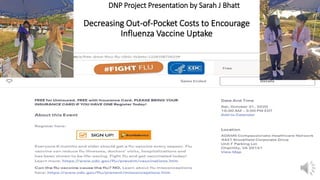
DNP Project Presentation by Sarah J Bhatt
Decreasing Out-of-Pocket Costs to Encourage
Influenza Vaccine Uptake
Introduction: Problem Description
Influenza, commonly known as the “flu”, kills thousands each year and costs millions of dollars in healthcare expenditures in the
United States; influenza also poses an annual threat that is preventable through receipt of the influenza vaccine. Despite goals to
raise the influenza vaccination rate to 70% of the U.S. population, barriers exist that keep our nation from reaching this goal.
1. Health department closures
2. Decrease in non urgent office visits
3. Decrease in vaccination
4. Social distancing has limited flu
clinics
5. Financial hardships are amplified in
the current environment of the
pandemic
6. Disadvantaged groups are at EVEN
MORE increased risk
Unique barriers to influenza vaccination have arisen as a result of the current
COVID19 pandemic
ADAMS Compassionate Healthcare Network (ACHN)
• Founded in 2013 as a place to expand comprehensive healthcare services to low income and uninsured
individuals.
• Has an active patient population of 1,331 individuals who fall below 200% of the federal poverty line and
adults over the age of 18 make up 89% of the clinic population.
• The majority of ACHN patients are uninsured, low income adults who have chronic health conditions such
as diabetes and hypertension.
• Based out of Chantilly, Virginia, the clinic is a 501(c)(3) organization which means it is non-profit,
charitable, and carries a tax-exempt status
• ACHN’s mission is to deliver quality healthcare to vulnerable populations at low or free cost and its
philosophy of promoting healthcare equity are supportive of efforts to decrease costs to increase influenza
vaccination uptake in their population.
Problem description at ACHN
• Small quantity of vaccines available
from the Health Dept.
• Referral to the Health Dept. creates
more barriers
• Patient population is resource poor
• Unable to host a health fair this year
• Lack influenza coordinator role
• Lack consistent community partners
Root Cause Analysis of Barriers to Influenza Vaccination at ACHN
• 1. There are a limited number of free vaccines provided by VDH that are made available to the ACHN patient population. Once this vaccine supply is exhausted,
patients have to overcome additional barriers in order to get vaccinated and these are often prohibitive or inconvenient. Stockpiling vaccines is not possible in
the clinic due to limited refrigeration capacity.
• 2. Partnerships with retail pharmacies and the health department are inconsistent. In the past, partnerships have led to increased access to free vaccines and
increased vaccine uptake. Originally, these partnerships were initiated by student volunteers in the clinic but as these students have rotated out of the clinic,
these partnerships were not sustained.
• 3. There is no influenza vaccine administrator role at ACHN in which an individual is designated as a champion for this cause. Because of this, partnerships are
not effectively managed, EBP is not consistently implemented and there are lost opportunities to increase vaccination. The responsibility of addressing this
issue usually falls on the Clinic Manager, who has competing responsibilities and is unable to devote the necessary time to coordinate these activities in an
evidenced based way.
• 4. Volunteer healthcare providers do not consistently offer the influenza vaccine to all eligible patients because there is an inconsistent supply in the clinic.
When influenza vaccines are unavailable in the clinic, education relating to the importance of vaccination often does not take place as there are barriers for the
patient to overcome to access the vaccine such as scheduling an appointment with the health department, transportation to the health department, finding
time and paying for costs associated with getting the vaccine. This decreases the demand for influenza vaccine among patients.
PICO Question
“How does decreasing out-of-pocket costs
affect influenza vaccination rates in
adults?”
SWOT Analysis (Internal Evidence)
Strengths
 Strong EMR
 Dedicated staff of volunteers
 Connection of clinic to established religious community
with capability to advertise to a larger audience.
 Partnerships with VDH
 Past partnerships with community collaborators
Weaknesses
 Limited number of vaccines for distribution
 Non-sustained partnerships with pharmacy collaborators
 No influenza vaccine facilitator role
 No paid medical practitioners, reliance of volunteers
 Limited budget
 Educational and cultural biases against vaccination are
present in the community
Opportunities
 New opportunity to collaborate with VA Immunization
Coalition to help facilitate
 Sustained community collaborations are possible
 Exploration of EMR capabilities for advertising new services
Threats
 Anti-vaccination proponents in the community
 Limited face to face encounters related to COVID19
PRISMA Diagram (External Evidence Search Process)
Additional records identified through other sources
(n = 10)
Records identified through searching CINAHL Plus with Full Text, Medline Plus
with Full Text and Web of Science Core Collection databases (n=161)
Screening
Eligibility
Included
Identification
Records excluded
(n = 99)
Records screened by title and abstract
(n = 115)
Studies included in quantitative synthesis
(n = 13)
Full-text articles assessed for eligibility (n = 16)
Records after duplicates removed (n=115)
Full-text articles excluded
(n =3)
Reasons:
 Addressed a specific population with a medical
condition
 Focused on an age group outside adults 18 years +
 Examined how reduced out of pocket costs affected
regional level influenza activity instead of uptake.
 Examined intentions rather than actual vaccination
uptake rates.
Literature review
Levels of Evidence Synthesis Table
Level
1 2 3 4 5 6 7 8 9 10 11 12 13
Level I: Randomized controlled trial (RCT) or Systematic review of
RCTs
Level II: Systematic review of a combination of RCTs and quasi
experimental studies
Level III: Non-experimental study or Systematic review of a
combination of RCTs and non-experimental studies/non-
experimental studies only with or without meta -analysis
X X X X X X X X X
Level IV: Opinion of respected authorities and/or nationally
recognized expert committees or consensus panels based on
scientific evidence.
X
Level V: Based on experiential and non-research evidence
including quality improvement programs.
X X X
1 = Abbas et al., (2018); 2 = Akpalu et al., (2020); 3 = Bach et al., (2019); 4 =Falcone, (2019); 5 =Falcone et al., (2019); 6 =Husain et al., (2016); 7 =National Vaccine Advisory
Committee [NVAC], (2012); 8 =Okoro et al., (2017); 9 =Singh et al., (2020); 10 = Williams et al., (2017); 11 =Yeung et al., (2016); 12 =Community Preventative Services Taskforce
[CPSTF], (2015); 13 =CPSTF, (2014
Outcomes Synthesis
, , —, NE, NR,  1 2 3 4 5 6 7 8 9 10 11 12 13
Outcome #1 – Influenza vaccine uptake in uninsured
adults
    — NE NE NR  NE NE NE NE
Outcome #2 – Influenza vaccine uptake in adults
(generalized)
   NE NE  

(insured)
NE    
Outcome #3 – Healthcare cost savings/Benefit NE  NE   NE    NE NE NE 
Outcome #4 – Cost of Intervention/Expenditure NR NR NR NR NR NR  NE NR NE NE  
Outcome #5 – Morbidity   NE   NE      NE 
Outcome #6 - Mortality   NE   NE     NE NE 
SYMBOL KEY
↑ = Increased, ↓ = Decreased, — = No Change, NE = Not Examined, NR = Not Reported
1 = Abbas et al., (2018); 2 = Akpalu et al., (2020); 3 = Bach et al., (2019); 4 = Falcone, (2019); 5 =Falcone et al., (2019); 6 = Husain et al., (2016); 7 = National Vaccine Advisory Committee
[NVAC], (2012); 8 = Okoro et al., (2017); 9 = Singh et al., (2020); 10 = Williams et al., (2017); 11 = Yeung et al., (2016); 12 = Community Preventative Services Taskforce [CPSTF], (2015);
13 = CPSTF, (2014)
• Analysis of ACHN’s influenza vaccination system shows gaps
related to access barriers including an inadequate supply of
free or low-cost vaccines resulting in an inconvenient referral
process that may discourage individuals from seeking out
vaccination services.
• Through the collaboration of stakeholders, additional free
vaccines were acquired and a drive-thru influenza vaccination
event was scheduled at the end of October, 2020 in which
uninsured individuals would be offered free influenza vaccines
and insured individuals would pay no out of pocket costs.
• The role of the VA Immunization Coalition is essential in
connecting community partners and helping to facilitate
coordination of the collaboration. The collaboration between
partners is indispensable in acquiring additional vaccines and
vaccination capabilities. The toolkit created as a result of this
event will serve to guide future events.
Proposed Practice Change
Goals
• By February 1, 2021, there will be an increase of at least 50% in the number of
adults aged 18+ receiving the influenza vaccine through ACHN as compared with
previous flu seasons during which there were no collaborative events.
• By April 2021, a toolkit will be developed and disseminated to enable
statewide replication of vaccination events using evidence-based practices in order
to increase vaccine uptake in adults towards the Healthy People 2030 goal of 70%.
Project: Decreasing Out-of-Pocket Costs to Encourage Influenza Vaccine Uptake
Situation: After reviewing vaccination protocols at the ADAMS Compassionate Healthcare Network, evidence-based strategies were identified
to increase influenza vaccine uptake through the development of a collaborative drive-thru influenza event in which free vaccines are
administered to uninsured individuals and at no out-of-pocket cost to insured individuals.
Inputs
Outputs
Outcomes --
Impact
Activities Participation Short Medium Long

Activities
-Development of a free drive-thru flu clinic event to serve
both insured and uninsured populations
-Targeted messaging and education regarding the influenza
vaccine to the ACHN patient population and general
public.
-Creation of a toolkit to decrease out-of-pocket costs for
influenza vaccination and replicate vaccination events like
this
-Securing of free vaccine supply for uninsured individuals
-Program evaluation to identify perceived barriers to
accessing influenza vaccination through a survey of
participants post vaccination.
-Data collection to assess the needs of the population being
served
Participants
-130 free vaccines secured for uninsured individuals
-107 individuals served during flu event
-5 organizational partnerships built
-Over 1000 emails sent with links to influenza vaccination
educational materials
- By February 1, 2021, there will
be an increase of at least 50% in
the number of adults aged 18+
receiving the influenza vaccine
through ACHN as compared
with previous flu seasons during
which there were no
collaborative events.
-By April 2021, a toolkit will be
developed and disseminated to
enable statewide replication of
vaccination events using
evidence-based practices in order
to increase vaccine uptake in
adults towards the Healthy
People 2030 goal of 70%.
-Narrowing of the access gap
created by the closure of health
departments
-Increase in knowledge
regarding importance of the
influenza vaccine through
education via links in advertising
materials.
-Increase in demand for the
influenza vaccine
-Collect data via survey to assess
the needs of the population
regarding flu vaccination
Create sustainable partnerships
-Evaluation of survey
findings
-Increased utilization of
free clinic’s health
services to the uninsured
population
-Creation of toolkit to
replicate vaccination
events
-Decreased morbidity and
mortality related to flu
complications during the
2020-2021 flu season
-Increase in consistent
public messaging related to
influenza vaccination
-Disseminate data from flu
event to support healthcare
policy advancing low cost
or free access to the flu
vaccine
-Increased collaboration of
community organizations to
benefit public health.
-Utilization of toolkit to
expand vaccination services
-Increased uptake in
influenza vaccine in the
population to national goal
of 70%
-Expansion of free or
decreased out-of-pocket
cost of influenza vaccine
-ACHN Support in donating
50 vaccines, supplies, event
space and logistics
coordination
-Donation of 30 free vaccines
by Inova Hospital
-14 staff volunteers from
VCU School of Pharmacy
-Immunize VA Coalition
support in coordination
-Financial support from
ACHN to pay for vaccines
above free vaccine quota
-Event advertising on Poplar
Tree Elementary parent
email listserv
-Donation of 50 free vaccines
and two vaccinators by
Safeway pharmacy
-CDC Influenza vaccine
recommendations
Theoretical Model: Pender’s Model of Health Promotion
Evaluation
• A comparison of the total number of people vaccinated for influenza at ACHN
using only their clinic vaccine supply with the total number of people
vaccinated at ACHN this flu season including those vaccinated at the event.
• The number of people vaccinated at ACHN during last flu season will also be
compared with the 2020 flu season. This data will be translated to show the
percent change in vaccination at ACHN with the intervention and the percent
change in capability to vaccinate individuals in the clinic.
• The effectiveness of the change will also include responses from the survey
given post vaccination to participants, which will help to identify their
perceptions of cost savings in relation to influenza vaccine uptake.
1. Have you received a flu shot before? YES NO
2. Do you currently have a Primary Care
Provider? Is there a place that you usually go
when you are sick or need advice about your
health or other medical related things?
YES NO
3. Do you currently have health insurance? YES NO
4. What is your biggest barrier to receiving the
flu shot?
Lack of transportation
Too costly
Not convenient
Lack of insurance
Don’t know where to go to get one
Don’t have a regular healthcare provider
Don’t think it’s very important
Worried about side effects
Don’t think it will work
Other? (specify)________________________
5. If your flu vaccine was not free (if you had to
pay some money out of pocket for it) would you
still get it?
YES NO
6. How important is low cost when it comes to
you getting the flu vaccine?
Very Somewhat Not
Important important important
7. How did you hear about this event?
8. What is your Ethnicity?
9. What is your preferred language?
ACHN Drive Thru Flu Event Questionnaire
Barriers/Mitigation
• Resistance to vaccination from within the community due to
misinformation and misconceptions regarding the influenza vaccine.
• Inadequate supply of free vaccines despite the acquisition of additional
vaccines.
• Compromised vaccines or inadequate storage and handling of the vaccine
can create a potential barrier by decreasing the quantity of vaccines
available.
Sustainability
• With the formation of the VA Immunization Coalition as a partner in forming
collaborations, this will place less stress on the clinic manager to coordinate future
events. The coalition will remain available as a resource for ACHN and its partners in
the future.
• The creation of an EBP toolkit to replicate events will be available for the manager or
other staff such as student volunteers, to undertake seasonally. The EBP toolkit will
consist of a step-by-step guide on how to establish partnerships and create a low-cost
event to encourage vaccination uptake. There will be links to CDC materials as well as
other vetted documents and templates to help facilitate this process. The toolkit will be
fully accessible to the public through the VA Immunization Coalition website.
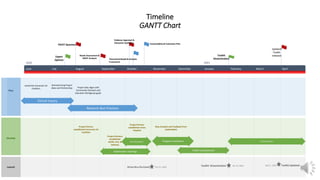
Timeline
GANTT Chart
Clinical Inquiry
Toolkit development
Plan
Develop
Launch
June July August September October November December January February March April
2020
Joined the Immunize VA
Coalition
Brainstorming Project
ideas and Partnerships Project idea aligns with
Community Outreach and
Education Workgroup goals
Project Partner
established: Immunize VA
Coalition
Drive thru Flu Event Oct 31, 2020
Toolkit Dissemination Jan 31, 2021
Expert
Opinion
PICOT Question
Needs Assessment &
SWOT Analysis Theoretical Model & Analytic
Framework 2021
Project Partners
established:
ACHN, VCU, &
Safeway
Project Partner
established: Inova
Hospital
Stakeholder meetings
Research Best Practices
Tools developed Program evaluation Final Evaluation
Data Analysis and Feedback from
stakeholders
Evidence Appraisal &
Outcomes Synthesis Sustainability & Evaluation Plan
Toolkit Updated
April 1. 2021
Toolkit
Dissemination
Updated
Toolkit
released
• 107 people vaccinated at no out-of-pocket cost to all
individuals, 23 additional free vaccines donated to clinic
patients
• 5 community partnerships built
• 249% increase in influenza vaccinations through ACHN, with
a projected 296% increase from last year by the end of the
flu season

Dnp project presentation nurs 883

  • 1.
    DNP Project Presentationby Sarah J Bhatt Decreasing Out-of-Pocket Costs to Encourage Influenza Vaccine Uptake
  • 2.
    Introduction: Problem Description Influenza,commonly known as the “flu”, kills thousands each year and costs millions of dollars in healthcare expenditures in the United States; influenza also poses an annual threat that is preventable through receipt of the influenza vaccine. Despite goals to raise the influenza vaccination rate to 70% of the U.S. population, barriers exist that keep our nation from reaching this goal.
  • 3.
    1. Health departmentclosures 2. Decrease in non urgent office visits 3. Decrease in vaccination 4. Social distancing has limited flu clinics 5. Financial hardships are amplified in the current environment of the pandemic 6. Disadvantaged groups are at EVEN MORE increased risk Unique barriers to influenza vaccination have arisen as a result of the current COVID19 pandemic
  • 4.
    ADAMS Compassionate HealthcareNetwork (ACHN) • Founded in 2013 as a place to expand comprehensive healthcare services to low income and uninsured individuals. • Has an active patient population of 1,331 individuals who fall below 200% of the federal poverty line and adults over the age of 18 make up 89% of the clinic population. • The majority of ACHN patients are uninsured, low income adults who have chronic health conditions such as diabetes and hypertension. • Based out of Chantilly, Virginia, the clinic is a 501(c)(3) organization which means it is non-profit, charitable, and carries a tax-exempt status • ACHN’s mission is to deliver quality healthcare to vulnerable populations at low or free cost and its philosophy of promoting healthcare equity are supportive of efforts to decrease costs to increase influenza vaccination uptake in their population.
  • 5.
    Problem description atACHN • Small quantity of vaccines available from the Health Dept. • Referral to the Health Dept. creates more barriers • Patient population is resource poor • Unable to host a health fair this year • Lack influenza coordinator role • Lack consistent community partners
  • 6.
    Root Cause Analysisof Barriers to Influenza Vaccination at ACHN • 1. There are a limited number of free vaccines provided by VDH that are made available to the ACHN patient population. Once this vaccine supply is exhausted, patients have to overcome additional barriers in order to get vaccinated and these are often prohibitive or inconvenient. Stockpiling vaccines is not possible in the clinic due to limited refrigeration capacity. • 2. Partnerships with retail pharmacies and the health department are inconsistent. In the past, partnerships have led to increased access to free vaccines and increased vaccine uptake. Originally, these partnerships were initiated by student volunteers in the clinic but as these students have rotated out of the clinic, these partnerships were not sustained. • 3. There is no influenza vaccine administrator role at ACHN in which an individual is designated as a champion for this cause. Because of this, partnerships are not effectively managed, EBP is not consistently implemented and there are lost opportunities to increase vaccination. The responsibility of addressing this issue usually falls on the Clinic Manager, who has competing responsibilities and is unable to devote the necessary time to coordinate these activities in an evidenced based way. • 4. Volunteer healthcare providers do not consistently offer the influenza vaccine to all eligible patients because there is an inconsistent supply in the clinic. When influenza vaccines are unavailable in the clinic, education relating to the importance of vaccination often does not take place as there are barriers for the patient to overcome to access the vaccine such as scheduling an appointment with the health department, transportation to the health department, finding time and paying for costs associated with getting the vaccine. This decreases the demand for influenza vaccine among patients.
  • 7.
    PICO Question “How doesdecreasing out-of-pocket costs affect influenza vaccination rates in adults?”
  • 8.
    SWOT Analysis (InternalEvidence) Strengths  Strong EMR  Dedicated staff of volunteers  Connection of clinic to established religious community with capability to advertise to a larger audience.  Partnerships with VDH  Past partnerships with community collaborators Weaknesses  Limited number of vaccines for distribution  Non-sustained partnerships with pharmacy collaborators  No influenza vaccine facilitator role  No paid medical practitioners, reliance of volunteers  Limited budget  Educational and cultural biases against vaccination are present in the community Opportunities  New opportunity to collaborate with VA Immunization Coalition to help facilitate  Sustained community collaborations are possible  Exploration of EMR capabilities for advertising new services Threats  Anti-vaccination proponents in the community  Limited face to face encounters related to COVID19
  • 9.
    PRISMA Diagram (ExternalEvidence Search Process) Additional records identified through other sources (n = 10) Records identified through searching CINAHL Plus with Full Text, Medline Plus with Full Text and Web of Science Core Collection databases (n=161) Screening Eligibility Included Identification Records excluded (n = 99) Records screened by title and abstract (n = 115) Studies included in quantitative synthesis (n = 13) Full-text articles assessed for eligibility (n = 16) Records after duplicates removed (n=115) Full-text articles excluded (n =3) Reasons:  Addressed a specific population with a medical condition  Focused on an age group outside adults 18 years +  Examined how reduced out of pocket costs affected regional level influenza activity instead of uptake.  Examined intentions rather than actual vaccination uptake rates.
  • 10.
    Literature review Levels ofEvidence Synthesis Table Level 1 2 3 4 5 6 7 8 9 10 11 12 13 Level I: Randomized controlled trial (RCT) or Systematic review of RCTs Level II: Systematic review of a combination of RCTs and quasi experimental studies Level III: Non-experimental study or Systematic review of a combination of RCTs and non-experimental studies/non- experimental studies only with or without meta -analysis X X X X X X X X X Level IV: Opinion of respected authorities and/or nationally recognized expert committees or consensus panels based on scientific evidence. X Level V: Based on experiential and non-research evidence including quality improvement programs. X X X 1 = Abbas et al., (2018); 2 = Akpalu et al., (2020); 3 = Bach et al., (2019); 4 =Falcone, (2019); 5 =Falcone et al., (2019); 6 =Husain et al., (2016); 7 =National Vaccine Advisory Committee [NVAC], (2012); 8 =Okoro et al., (2017); 9 =Singh et al., (2020); 10 = Williams et al., (2017); 11 =Yeung et al., (2016); 12 =Community Preventative Services Taskforce [CPSTF], (2015); 13 =CPSTF, (2014
  • 11.
    Outcomes Synthesis , ,—, NE, NR,  1 2 3 4 5 6 7 8 9 10 11 12 13 Outcome #1 – Influenza vaccine uptake in uninsured adults     — NE NE NR  NE NE NE NE Outcome #2 – Influenza vaccine uptake in adults (generalized)    NE NE    (insured) NE     Outcome #3 – Healthcare cost savings/Benefit NE  NE   NE    NE NE NE  Outcome #4 – Cost of Intervention/Expenditure NR NR NR NR NR NR  NE NR NE NE   Outcome #5 – Morbidity   NE   NE      NE  Outcome #6 - Mortality   NE   NE     NE NE  SYMBOL KEY ↑ = Increased, ↓ = Decreased, — = No Change, NE = Not Examined, NR = Not Reported 1 = Abbas et al., (2018); 2 = Akpalu et al., (2020); 3 = Bach et al., (2019); 4 = Falcone, (2019); 5 =Falcone et al., (2019); 6 = Husain et al., (2016); 7 = National Vaccine Advisory Committee [NVAC], (2012); 8 = Okoro et al., (2017); 9 = Singh et al., (2020); 10 = Williams et al., (2017); 11 = Yeung et al., (2016); 12 = Community Preventative Services Taskforce [CPSTF], (2015); 13 = CPSTF, (2014)
  • 12.
    • Analysis ofACHN’s influenza vaccination system shows gaps related to access barriers including an inadequate supply of free or low-cost vaccines resulting in an inconvenient referral process that may discourage individuals from seeking out vaccination services. • Through the collaboration of stakeholders, additional free vaccines were acquired and a drive-thru influenza vaccination event was scheduled at the end of October, 2020 in which uninsured individuals would be offered free influenza vaccines and insured individuals would pay no out of pocket costs. • The role of the VA Immunization Coalition is essential in connecting community partners and helping to facilitate coordination of the collaboration. The collaboration between partners is indispensable in acquiring additional vaccines and vaccination capabilities. The toolkit created as a result of this event will serve to guide future events. Proposed Practice Change
  • 13.
    Goals • By February1, 2021, there will be an increase of at least 50% in the number of adults aged 18+ receiving the influenza vaccine through ACHN as compared with previous flu seasons during which there were no collaborative events. • By April 2021, a toolkit will be developed and disseminated to enable statewide replication of vaccination events using evidence-based practices in order to increase vaccine uptake in adults towards the Healthy People 2030 goal of 70%.
  • 14.
    Project: Decreasing Out-of-PocketCosts to Encourage Influenza Vaccine Uptake Situation: After reviewing vaccination protocols at the ADAMS Compassionate Healthcare Network, evidence-based strategies were identified to increase influenza vaccine uptake through the development of a collaborative drive-thru influenza event in which free vaccines are administered to uninsured individuals and at no out-of-pocket cost to insured individuals. Inputs Outputs Outcomes -- Impact Activities Participation Short Medium Long  Activities -Development of a free drive-thru flu clinic event to serve both insured and uninsured populations -Targeted messaging and education regarding the influenza vaccine to the ACHN patient population and general public. -Creation of a toolkit to decrease out-of-pocket costs for influenza vaccination and replicate vaccination events like this -Securing of free vaccine supply for uninsured individuals -Program evaluation to identify perceived barriers to accessing influenza vaccination through a survey of participants post vaccination. -Data collection to assess the needs of the population being served Participants -130 free vaccines secured for uninsured individuals -107 individuals served during flu event -5 organizational partnerships built -Over 1000 emails sent with links to influenza vaccination educational materials - By February 1, 2021, there will be an increase of at least 50% in the number of adults aged 18+ receiving the influenza vaccine through ACHN as compared with previous flu seasons during which there were no collaborative events. -By April 2021, a toolkit will be developed and disseminated to enable statewide replication of vaccination events using evidence-based practices in order to increase vaccine uptake in adults towards the Healthy People 2030 goal of 70%. -Narrowing of the access gap created by the closure of health departments -Increase in knowledge regarding importance of the influenza vaccine through education via links in advertising materials. -Increase in demand for the influenza vaccine -Collect data via survey to assess the needs of the population regarding flu vaccination Create sustainable partnerships -Evaluation of survey findings -Increased utilization of free clinic’s health services to the uninsured population -Creation of toolkit to replicate vaccination events -Decreased morbidity and mortality related to flu complications during the 2020-2021 flu season -Increase in consistent public messaging related to influenza vaccination -Disseminate data from flu event to support healthcare policy advancing low cost or free access to the flu vaccine -Increased collaboration of community organizations to benefit public health. -Utilization of toolkit to expand vaccination services -Increased uptake in influenza vaccine in the population to national goal of 70% -Expansion of free or decreased out-of-pocket cost of influenza vaccine -ACHN Support in donating 50 vaccines, supplies, event space and logistics coordination -Donation of 30 free vaccines by Inova Hospital -14 staff volunteers from VCU School of Pharmacy -Immunize VA Coalition support in coordination -Financial support from ACHN to pay for vaccines above free vaccine quota -Event advertising on Poplar Tree Elementary parent email listserv -Donation of 50 free vaccines and two vaccinators by Safeway pharmacy -CDC Influenza vaccine recommendations
  • 15.
    Theoretical Model: Pender’sModel of Health Promotion
  • 18.
    Evaluation • A comparisonof the total number of people vaccinated for influenza at ACHN using only their clinic vaccine supply with the total number of people vaccinated at ACHN this flu season including those vaccinated at the event. • The number of people vaccinated at ACHN during last flu season will also be compared with the 2020 flu season. This data will be translated to show the percent change in vaccination at ACHN with the intervention and the percent change in capability to vaccinate individuals in the clinic. • The effectiveness of the change will also include responses from the survey given post vaccination to participants, which will help to identify their perceptions of cost savings in relation to influenza vaccine uptake. 1. Have you received a flu shot before? YES NO 2. Do you currently have a Primary Care Provider? Is there a place that you usually go when you are sick or need advice about your health or other medical related things? YES NO 3. Do you currently have health insurance? YES NO 4. What is your biggest barrier to receiving the flu shot? Lack of transportation Too costly Not convenient Lack of insurance Don’t know where to go to get one Don’t have a regular healthcare provider Don’t think it’s very important Worried about side effects Don’t think it will work Other? (specify)________________________ 5. If your flu vaccine was not free (if you had to pay some money out of pocket for it) would you still get it? YES NO 6. How important is low cost when it comes to you getting the flu vaccine? Very Somewhat Not Important important important 7. How did you hear about this event? 8. What is your Ethnicity? 9. What is your preferred language? ACHN Drive Thru Flu Event Questionnaire
  • 19.
    Barriers/Mitigation • Resistance tovaccination from within the community due to misinformation and misconceptions regarding the influenza vaccine. • Inadequate supply of free vaccines despite the acquisition of additional vaccines. • Compromised vaccines or inadequate storage and handling of the vaccine can create a potential barrier by decreasing the quantity of vaccines available.
  • 20.
    Sustainability • With theformation of the VA Immunization Coalition as a partner in forming collaborations, this will place less stress on the clinic manager to coordinate future events. The coalition will remain available as a resource for ACHN and its partners in the future. • The creation of an EBP toolkit to replicate events will be available for the manager or other staff such as student volunteers, to undertake seasonally. The EBP toolkit will consist of a step-by-step guide on how to establish partnerships and create a low-cost event to encourage vaccination uptake. There will be links to CDC materials as well as other vetted documents and templates to help facilitate this process. The toolkit will be fully accessible to the public through the VA Immunization Coalition website.
  • 21.
    Timeline GANTT Chart Clinical Inquiry Toolkitdevelopment Plan Develop Launch June July August September October November December January February March April 2020 Joined the Immunize VA Coalition Brainstorming Project ideas and Partnerships Project idea aligns with Community Outreach and Education Workgroup goals Project Partner established: Immunize VA Coalition Drive thru Flu Event Oct 31, 2020 Toolkit Dissemination Jan 31, 2021 Expert Opinion PICOT Question Needs Assessment & SWOT Analysis Theoretical Model & Analytic Framework 2021 Project Partners established: ACHN, VCU, & Safeway Project Partner established: Inova Hospital Stakeholder meetings Research Best Practices Tools developed Program evaluation Final Evaluation Data Analysis and Feedback from stakeholders Evidence Appraisal & Outcomes Synthesis Sustainability & Evaluation Plan Toolkit Updated April 1. 2021 Toolkit Dissemination Updated Toolkit released
  • 22.
    • 107 peoplevaccinated at no out-of-pocket cost to all individuals, 23 additional free vaccines donated to clinic patients • 5 community partnerships built • 249% increase in influenza vaccinations through ACHN, with a projected 296% increase from last year by the end of the flu season

Editor's Notes

  • #2 Hello This is Sarah Bhatt. This presentation will be about my dnp project, titled Decreasing out of pocket costs to encourage influenza vaccine uptake.
  • #3 I’d like to start out with the bigger picture. My Project focuses on the topic of influenza, commonly known as the flu. As you may already know, the flu is a big deal. It kills thousands of American’s each year and costs millions of dollars in healthcare expenditures in the United States; influenza also poses an annual threat that is preventable through receipt of the influenza vaccine. Despite goals to raise the influenza vaccination rate to 70% of the U.S. population, barriers exist that keep our nation from reaching this goal – this is a healthy people 2030 goal and was a healthy people 2020 and 2010 goal as well – unfortunately, we are consistently falling short of the target. In the past flu seasons, our vaccination rates are only about 45%.
  • #4 With the onset of the COVID 19 pandemic, there are unique barriers that have arisen that make it even more difficult and cumbersome to get vaccinated against influenza. Due to the COVID-19 pandemic, two of the five health departments in Fairfax County, Virginia (VA) have closed, and the remaining three health departments no longer allow walk in appointments and administer the vaccine by pre-registration only during operating hours. Consequently, this has created a gap in access to the influenza vaccination for individuals who would normally be immunized through the health department, especially those that are uninsured/self-pay, underinsured, or those with Medicaid. Additionally, there has been a decrease in non urgent office visits and a decrease in vaccinations generally (probably as a result of this). Social distancing measures don’t allow congregate vaccination events in their traditional form. Financial hardships faced during this time make essential expenses a priority over the cost of vaccination. Lastly, already disadvantaged groups are at increased risk because of lack of resources and being disconnected from regular healthcare.
  • #5 I’d like to now tell you about the site of my Project, the ADAMS Compassionate HealthCare Clinic (ACHN), a free clinic for low income and uninsured individuals in Chantilly VA where I completed a clinical rotation during my FNP years. ACHN has about 1300 active patients in their population who fall below 200% of the federal poverty line. The majority of ACHN patients are uninsured, low income adults who have chronic health conditions such as diabetes and hypertension. The clinic’s mission is to deliver quality healthcare to vulnerable populations at low or free cost and its philosophy of promoting healthcare equity are supportive of efforts to decrease costs to increase influenza vaccination uptake in their population.
  • #6 These are some of the problems surrounding influenza vaccination at ACHN. There is a small quantity of free vaccines available to ACHN from the Health Dept. Once these are exhausted, they must refer patients to the Health Dept., creating additional barriers to vaccination. The patient population is resource poor and may not be able to afford the cost of vaccines, transportation or logistics of obtaining vaccination. ACHN has been able to hold health fairs in the past to attract collaborators and vaccinate additional people, but is unable to host a health fair this year. The lack of an influenza coordinator role at ACHN puts the burden of coordinating a flu campaign on the Clinic Manager, who has competing responsibilities. Student volunteers often lead initiatives but there is a lack of consistent community partnerships after students and interns rotate out of their roles at the clinic.
  • #7 A root cause analysis was done to identify the cause of decreased uptake of the influenza vaccine at ACHN and 4 key issues were identified: Limited number of free vaccines Inconsistent partnerships No vaccine administrator role Decreased patient demand (because of cost, inconvenience and lack of education)
  • #8 Knowing the low income status of this population, and the results of my RCA, I came up with the PICO question “How does decreasing out-of-pocket costs affect influenza vaccination rates in adults?”
  • #9 Alongside my search for external evidence through a rigorous literature search, I sought internal evidence as well. Part of this involved completing a SWOT Analysis where I identified the strength, weaknesses, opportunities and threats that exist in the internal and external environment of ACHN.
  • #10 Using CINAHL, Medline and Web of Science databases, I began an exhaustive literature search process. After several rounds of screening and elimination to determine eligibility, my search resulted in 13 terminal studies which I included in my quantitative synthesis.
  • #11 I used the Johns Hopkins EBP Research Evidence Appraisal Tool to guide my Literature appraisal. Here you can see my Levels of Evidence Synthesis Table.
  • #12 And finally, here is my outcomes synthesis of the 13 keeper articles that I appraised. The big takeaways from my outcomes synthesis were: Overall, decreasing the cost of the vaccination was strongly correlated with an increased uptake of the vaccine in both uninsured adults and adults in general. Bundled interventions that include reducing out-of-pocket costs are more effective in increasing vaccine uptake. Bundled interventions included having an influenza facilitator role, mass communication advertising, using client reminder and recall systems, client and community education, and expanded access in non-traditional settings Several studies consistently indicated that lowering out of pocket costs for the vaccine increased healthcare cost savings through the avoidance of hospitalization and medical fees as well as lost work time and productivity There was consistent evidence that the intervention of lowering out of pocket costs of the flu vaccine was correlated with decreased morbidity and mortality
  • #13 My proposed practice change involves using the Immunize VA Coalition to help facilitate a collaborative, free drive thru flu vaccination event at ACHN. Development of a toolkit informed by this process will serve to replicate events like this and provide sustainability for future collaborations.
  • #14 The goals of my intervention are: By February 1, 2020, there will be an increase of at least 50% in the number of adults aged 18+ receiving the influenza vaccine through ACHN as compared with previous flu seasons during which there were no collaborative events. By April 2021, a toolkit will be developed and disseminated to enable statewide replication of vaccination events using evidence-based practices in order to increase vaccine uptake in adults towards the Healthy People 2030 goal of 70%.
  • #15 I created a logic model as a visual depiction of the resources put into my project and the logical outcomes that can be derived from the project. It also highlights the dependent relationships between the inputs and outputs of this intervention and shows the short, medium, and long-term projected outcomes of the intervention.
  • #16 I chose Nola J. Pender’s Model of Health Promotion to guide my project ideas. This theory describes health as “a positive dynamic state” rather than simply the absence of disease. I liked this theory because it accepts individuals as multidimensional and recognizes how environmental interaction (such as economic conditions) can cause people to pursue or neglect their health.
  • #17 I chose this analytic framework to guide my project. This framework was designed by the Community Preventative Services Taskforce (CPSTF) as part of their strong recommendation to utilize this intervention alone or in combination with other EBP approaches to increase vaccine uptake As you can see here it clearly and logically links the intervention with associated outcomes using direct and indirect relationships. Ultimately, as a result of this logical chain of behavior and events, there is reduction in morbidity and mortality from the influenza virus as a result of reducing client out of pocket costs for the vaccine.
  • #18 Using resources and connections obtained through my engagement with the Immunize VA Coalition, I was able to develop a partnerships between these 4 key collaborators. This collaboration was mutually beneficial to all parties. I was able to lead the team using advanced interprofessional communication skills and by facilitating regular meetings to keep the stakeholders appraised in all stages of planning. ACHN hosted the event and provided essential supplies, as well as 50 free vaccines for uninsured individuals specially allocated by the Department of Health. VCU School of Pharmacy faculty and Level 3 pharmacy students staffed the event and donated 30 free vaccines obtained through a partnership with Inova Hospital. Safeway Pharmacy donated two pharmacists, 50 additional free vaccines and an unlimited number of vaccines for insured individuals, expanding the number of people we could serve.
  • #19 Outcome measures to evaluate the effectiveness of this project will include a statistical analysis of flu vaccine uptake data across different flu seasons. The measuring the effectiveness of the change will also include responses from a survey given post vaccination to participants, which will help to identify their perceptions of cost savings in relation to influenza vaccine uptake. This survey will be administered verbally to each vehicle of participants after they have received their vaccination and while they are in the post vaccination holding area prior to departing from the event site. You can see the 9 question survey on this slide
  • #20 Several barriers to successful implementation of this intervention were identified. For example, there may be resistance to vaccination from within the community due to misinformation and misconceptions regarding the influenza vaccine. We mitigated this through consistent, clear messaging from vetted sources on all advertising materials. We also provided staff tools to clear misconceptions when talking to clients and enlisted influential community members, such as clergy to support our efforts. . Another potential barrier is Inadequate supply of free vaccines despite the acquisition of additional vaccines. . In order to avoid this complication, ACHN sought internal funding from its board to cover the cost of vaccines above the quantity available in order to meet the needs of the event participants because they do not want to turn anyone away who cannot afford the vaccine. Compromised vaccines or inadequate storage and handling of the vaccine can create a potential barrier by decreasing the quantity of vaccines available . In order to mitigate this threat, a standardized process was followed and efforts were made by stakeholders to locate additional backup vaccines
  • #21 The intervention developed in this project will remain sustainable in the future through the support of the Immunize VA Coalition, ongoing partnerships and through the utilization of an EBP toolkit designed to replicate this kind of event seasonally.
  • #22 Because the flu season is time limited and recommendations for vaccination ideally take place by the end of October, I was able to start implementing my project earlier than other students. Our pilot event took place on Oct 31 and was very successful. Data continues to be collected and analyzed and I am in the process of developing the toolkit I discussed earlier. This Gantt chart highlights important milestones in my project timeline, some of which I have met and others I continue to work towards.
  • #23 These are some of the data so far that show how at least one of my goals has been reached and surpassed. This entire process was and continues to be an amazing immersive learning experience for me and I am grateful to be able to apply all the skills I have learned in this program. Thank you!