Addressing Hesitancy to
Covid-19 Vaccination
Professor Azeem Majeed
Imperial College London
NIHR ARC NW London
Vaccine hesitancy
“A delay in acceptance or refusal of safe vaccines despite availability of vaccine services.” World
Health Organization (WHO)
WHO has named vaccine hesitancy as one of the top 10 threats to global health
“Vaccines only work if people receive them”
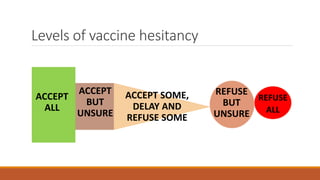
Levels of vaccine hesitancy
ACCEPT
ALL
ACCEPT SOME,
DELAY AND
REFUSE SOME
ACCEPT
BUT
UNSURE
REFUSE
ALL
REFUSE
BUT
UNSURE
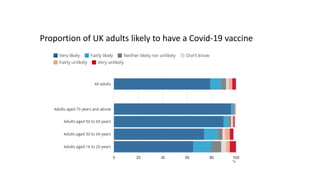
Proportion of UK adults likely to have a Covid-19 vaccine
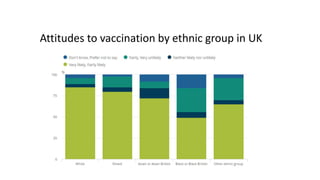
Attitudes to vaccination by ethnic group in UK
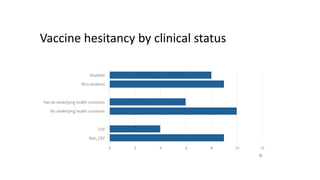
Vaccine hesitancy by clinical status
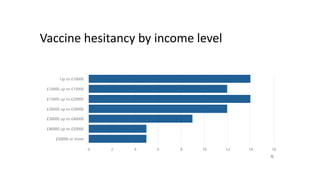
Vaccine hesitancy by income level
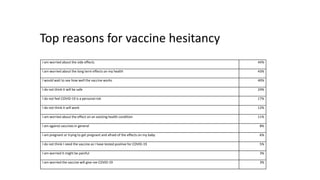
Top reasons for vaccine hesitancy
I am worried about the side effects 44%
I am worried about the long term effects on my health 43%
I would wait to see how well the vaccine works 40%
I do not think it will be safe 24%
I do not feel COVID-19 is a personal risk 17%
I do not think it will work 12%
I am worried about the effect on an existing health condition 11%
I am against vaccines in general 8%
I am pregnant or trying to get pregnant and afraid of the effects on my baby 6%
I do not think I need the vaccine as I have tested positive for COVID-19 5%
I am worried it might be painful 3%
I am worried the vaccine will give me COVID-19 3%
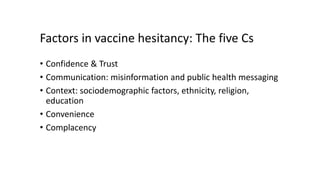
Factors in vaccine hesitancy: The five Cs
• Confidence & Trust
• Communication: misinformation and public health messaging
• Context: sociodemographic factors, ethnicity, religion,
education
• Convenience
• Complacency
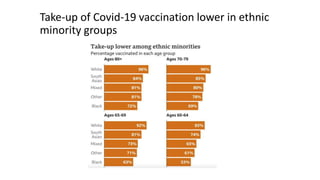
Take-up of Covid-19 vaccination lower in ethnic
minority groups
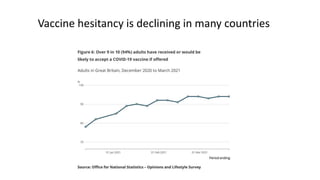
Vaccine hesitancy is declining in many countries
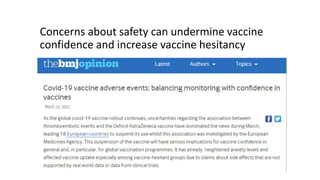
Concerns about safety can undermine vaccine
confidence and increase vaccine hesitancy
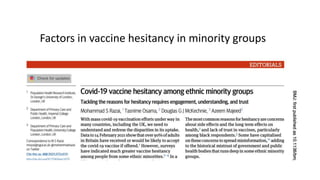
Factors in vaccine hesitancy in minority groups
What can be done to address vaccine hesitancy?
• Tailored communication from trusted sources (eg, healthcare
providers, community representatives)
• Access to community groups and local NHS Services – primary
and community-led vaccination
• Engagement by community champions, faith leaders, youth
ambassadors, healthcare workers
• Communication training and education of those involved with
engagement activities at a local level
• Listen, respect, address information needs
Some additional tips
• Remember to acknowledge any concerns
• Try to remain non-judgemental
• Be knowledgeable about vaccines
• Provide evidence-based information
• Discuss the risks and benefits of vaccination
• Vaccines are extensively studied before being licensed
• Vaccine safety monitoring continues after they enter use
Health system and provider level interventions also essential
• Call-Recall Systems (computer, not paper-based)
• Reminders – Text message, letter, email, telephone
• Financial reimbursement and incentives for providers
• Feedback of data on provider performance
• Mass media campaigns
• Endorsements by local and national figures
Issues to be addressed
• How long does immunity last after vaccination?
• How effective are current vaccines against new variants?
• Will booster doses be needed and, if so, how frequently?
• How will the NHS implement vaccination programmes if
booster doses are needed?
Conclusions
• Vaccines offer the best method for controlling the global
Covid-19 pandemic
• Vaccines only work if people are prepared to receive them
• Vaccine hesitancy is a key issue globally, particularly among
marginalised groups, minorities and the poor
• Addressing vaccine hesitancy requires both individual and
population-based approaches
• Healthcare professionals and occupational health specialists
have a key role to play in promoting vaccination
Acknowledgements
• UK Office for National Statistics
• World Health Organization
• Our World in Data
• Dr Mohammad Razai
• Dr Tatiana Christmas
• Dr Tasnime Osama
• Twitter @Azeem_Majeed

Covid 19 vaccination-hesitancy_may_2021

  • 1.
    Addressing Hesitancy to Covid-19Vaccination Professor Azeem Majeed Imperial College London NIHR ARC NW London
  • 2.
    Vaccine hesitancy “A delayin acceptance or refusal of safe vaccines despite availability of vaccine services.” World Health Organization (WHO) WHO has named vaccine hesitancy as one of the top 10 threats to global health “Vaccines only work if people receive them”
  • 3.
    Levels of vaccinehesitancy ACCEPT ALL ACCEPT SOME, DELAY AND REFUSE SOME ACCEPT BUT UNSURE REFUSE ALL REFUSE BUT UNSURE
  • 4.
    Proportion of UKadults likely to have a Covid-19 vaccine
  • 5.
    Attitudes to vaccinationby ethnic group in UK
  • 6.
    Vaccine hesitancy byclinical status
  • 7.
  • 8.
    Top reasons forvaccine hesitancy I am worried about the side effects 44% I am worried about the long term effects on my health 43% I would wait to see how well the vaccine works 40% I do not think it will be safe 24% I do not feel COVID-19 is a personal risk 17% I do not think it will work 12% I am worried about the effect on an existing health condition 11% I am against vaccines in general 8% I am pregnant or trying to get pregnant and afraid of the effects on my baby 6% I do not think I need the vaccine as I have tested positive for COVID-19 5% I am worried it might be painful 3% I am worried the vaccine will give me COVID-19 3%
  • 9.
    Factors in vaccinehesitancy: The five Cs • Confidence & Trust • Communication: misinformation and public health messaging • Context: sociodemographic factors, ethnicity, religion, education • Convenience • Complacency
  • 10.
    Take-up of Covid-19vaccination lower in ethnic minority groups
  • 11.
    Vaccine hesitancy isdeclining in many countries
  • 12.
    Concerns about safetycan undermine vaccine confidence and increase vaccine hesitancy
  • 14.
    Factors in vaccinehesitancy in minority groups
  • 16.
    What can bedone to address vaccine hesitancy? • Tailored communication from trusted sources (eg, healthcare providers, community representatives) • Access to community groups and local NHS Services – primary and community-led vaccination • Engagement by community champions, faith leaders, youth ambassadors, healthcare workers • Communication training and education of those involved with engagement activities at a local level • Listen, respect, address information needs
  • 17.
    Some additional tips •Remember to acknowledge any concerns • Try to remain non-judgemental • Be knowledgeable about vaccines • Provide evidence-based information • Discuss the risks and benefits of vaccination • Vaccines are extensively studied before being licensed • Vaccine safety monitoring continues after they enter use
  • 18.
    Health system andprovider level interventions also essential • Call-Recall Systems (computer, not paper-based) • Reminders – Text message, letter, email, telephone • Financial reimbursement and incentives for providers • Feedback of data on provider performance • Mass media campaigns • Endorsements by local and national figures
  • 20.
    Issues to beaddressed • How long does immunity last after vaccination? • How effective are current vaccines against new variants? • Will booster doses be needed and, if so, how frequently? • How will the NHS implement vaccination programmes if booster doses are needed?
  • 21.
    Conclusions • Vaccines offerthe best method for controlling the global Covid-19 pandemic • Vaccines only work if people are prepared to receive them • Vaccine hesitancy is a key issue globally, particularly among marginalised groups, minorities and the poor • Addressing vaccine hesitancy requires both individual and population-based approaches • Healthcare professionals and occupational health specialists have a key role to play in promoting vaccination
  • 22.
    Acknowledgements • UK Officefor National Statistics • World Health Organization • Our World in Data • Dr Mohammad Razai • Dr Tatiana Christmas • Dr Tasnime Osama • Twitter @Azeem_Majeed