Syndromic approaches for common outpatient conditions in adults: a priority revitalising primary care Bawoh. M  PhD.
Service delivery at primary care Multi-purpose health worker is expected to: See all types of clients attending services < 5 years, > 5 years, young and old, men and (pregnant) women, HIV(+) and HIV(-) Perform all functions Health promotion, prevention, care and service management Manage all disease types Acute, chronic, communicable, non-communicable Irrespective of HIV status
Why  syndromic  guidelines for primary care? Care currently not standardized Standard practice guidelines are known to improve process, quality and outcome of care Majority of patients present first at primary care level Possibilities to confirm diagnoses are very limited Etiological diagnosis not necessary, as long as treatment is correct  No knowledge of HIV status Care as entry point for prevention
Standardised case management: experiences and successes Integrated Management of Childhood Illness Syndromic Approach to STIs DOTS strategy to control tuberculosis Practical Approach to Lung health (PAL)
Benefits of standardised case  management Standardisation of diagnosis and treatment Standardisation of referral Case management at appropriate level of care Rationalisation of drug use Strengthening primary care to cope with common outpatient conditions, including HIV and its related  diseases
Development of syndromic practice guidelines: a priority September 2000: Rockefeller consultation Formation of a Syndromic Management Working Group and preparation of background paper  April 2001: “AIDS care in Africa meeting” Development and research on syndromic practice guidelines for high HIV prevalence settings is a priority
Ongoing and planned research Development by doing syndromic guideline development in Zimbabwe and Uganda incorporating existing STI, PAL and IMCI experience  Strengthening the evidence base appropriate selection of diseases and interventions to include in the guideline for high HIV prevalence areas closing the guideline - implementation gap evaluation of implementation
Deciding on case management priorities for primary care General health service attendance (proxy to disease episodes and demand for care of all people attending first level facilities) Disease episodes encountered in HIV-infected individuals (proxy to demand for care) Cause specific mortality Response to treatment
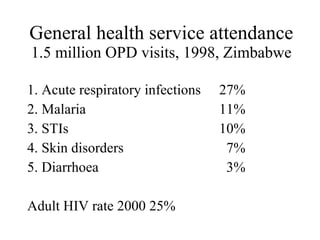
General health service attendance 1.5 million OPD visits, 1998, Zimbabwe 1. Acute respiratory infections  27% 2. Malaria  11% 3. STIs  10% 4. Skin disorders    7% 5. Diarrhoea   3% Adult HIV rate 2000 25%
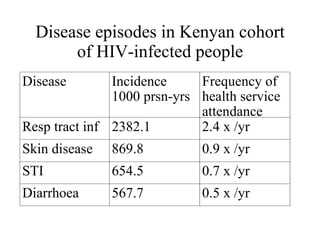
Disease episodes in Kenyan cohort of HIV-infected people
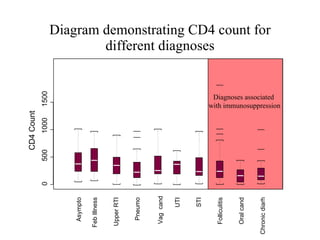
Diagram demonstrating CD4 count for different diagnoses Asympto Feb Illness Upper RTI Pneumo Vag  cand UTI STI Folliculitis Oral cand Chronic diarh Diagnoses associated  with immunosuppression 0 500 1000 1500 CD4 Count
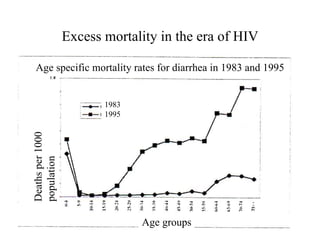
Excess mortality in the era of HIV Age specific mortality rates for diarrhea in 1983 and 1995 Age groups 1983 1995 Deaths per 1000 population
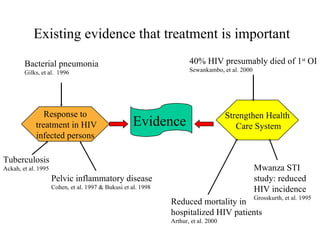
Existing evidence that treatment is important Pelvic inflammatory disease Cohen, et al. 1997 & Bukusi et al. 1998 Bacterial pneumonia Gilks, et al.  1996 Tuberculosis Ackah, et al. 1995 Strengthen Health Care System Mwanza STI study: reduced HIV incidence Grosskurth, et al. 1995 Reduced mortality in  hospitalized HIV patients Arthur, et al. 2000 40% HIV presumably died of 1 st  OI Sewankambo, et al. 2000 Evidence  Response to treatment in HIV infected persons
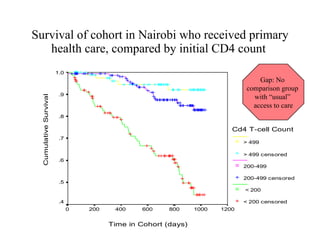
Survival of cohort in Nairobi who received primary health care, compared by initial CD4 count  Gap: No  comparison group  with “usual”  access to care
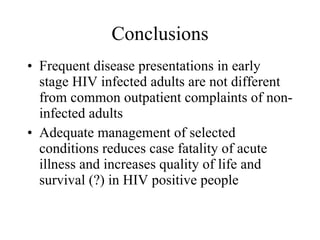
Conclusions Frequent disease presentations in early stage HIV infected adults are not different from common outpatient complaints of non-infected adults Adequate management of selected conditions reduces case fatality of acute illness and increases quality of life and survival (?) in HIV positive people
Collaborating institutions Biomedical Research and Training Institute, University of Zimbabwe, Harare Kenya Medical Research Institute, Nairobi London School of Hygiene and Tropical Medicine, UK Nuffield Institute for Health, Leeds, UK University of California San Francisco, USA University of Washington, Seattle, USA Clinical Research Centre, State Medical Academy, Russia World Health Organization
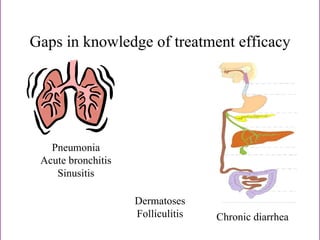
Gaps in knowledge of treatment efficacy Pneumonia Acute bronchitis Sinusitis Dermatoses Folliculitis Chronic diarrhea                                 
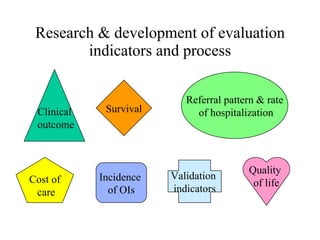
Research & development of evaluation indicators and process Clinical outcome Referral pattern & rate of hospitalization Incidence  of OIs Survival Validation  indicators Cost of care Quality  of life

Aids Care Scheme

  • 1.
    Syndromic approaches forcommon outpatient conditions in adults: a priority revitalising primary care Bawoh. M PhD.
  • 2.
    Service delivery atprimary care Multi-purpose health worker is expected to: See all types of clients attending services < 5 years, > 5 years, young and old, men and (pregnant) women, HIV(+) and HIV(-) Perform all functions Health promotion, prevention, care and service management Manage all disease types Acute, chronic, communicable, non-communicable Irrespective of HIV status
  • 3.
    Why syndromic guidelines for primary care? Care currently not standardized Standard practice guidelines are known to improve process, quality and outcome of care Majority of patients present first at primary care level Possibilities to confirm diagnoses are very limited Etiological diagnosis not necessary, as long as treatment is correct No knowledge of HIV status Care as entry point for prevention
  • 4.
    Standardised case management:experiences and successes Integrated Management of Childhood Illness Syndromic Approach to STIs DOTS strategy to control tuberculosis Practical Approach to Lung health (PAL)
  • 5.
    Benefits of standardisedcase management Standardisation of diagnosis and treatment Standardisation of referral Case management at appropriate level of care Rationalisation of drug use Strengthening primary care to cope with common outpatient conditions, including HIV and its related diseases
  • 6.
    Development of syndromicpractice guidelines: a priority September 2000: Rockefeller consultation Formation of a Syndromic Management Working Group and preparation of background paper April 2001: “AIDS care in Africa meeting” Development and research on syndromic practice guidelines for high HIV prevalence settings is a priority
  • 7.
    Ongoing and plannedresearch Development by doing syndromic guideline development in Zimbabwe and Uganda incorporating existing STI, PAL and IMCI experience Strengthening the evidence base appropriate selection of diseases and interventions to include in the guideline for high HIV prevalence areas closing the guideline - implementation gap evaluation of implementation
  • 8.
    Deciding on casemanagement priorities for primary care General health service attendance (proxy to disease episodes and demand for care of all people attending first level facilities) Disease episodes encountered in HIV-infected individuals (proxy to demand for care) Cause specific mortality Response to treatment
  • 9.
    General health serviceattendance 1.5 million OPD visits, 1998, Zimbabwe 1. Acute respiratory infections 27% 2. Malaria 11% 3. STIs 10% 4. Skin disorders 7% 5. Diarrhoea 3% Adult HIV rate 2000 25%
  • 10.
    Disease episodes inKenyan cohort of HIV-infected people
  • 11.
    Diagram demonstrating CD4count for different diagnoses Asympto Feb Illness Upper RTI Pneumo Vag cand UTI STI Folliculitis Oral cand Chronic diarh Diagnoses associated with immunosuppression 0 500 1000 1500 CD4 Count
  • 12.
    Excess mortality inthe era of HIV Age specific mortality rates for diarrhea in 1983 and 1995 Age groups 1983 1995 Deaths per 1000 population
  • 13.
    Existing evidence thattreatment is important Pelvic inflammatory disease Cohen, et al. 1997 & Bukusi et al. 1998 Bacterial pneumonia Gilks, et al. 1996 Tuberculosis Ackah, et al. 1995 Strengthen Health Care System Mwanza STI study: reduced HIV incidence Grosskurth, et al. 1995 Reduced mortality in hospitalized HIV patients Arthur, et al. 2000 40% HIV presumably died of 1 st OI Sewankambo, et al. 2000 Evidence Response to treatment in HIV infected persons
  • 14.
    Survival of cohortin Nairobi who received primary health care, compared by initial CD4 count Gap: No comparison group with “usual” access to care
  • 15.
    Conclusions Frequent diseasepresentations in early stage HIV infected adults are not different from common outpatient complaints of non-infected adults Adequate management of selected conditions reduces case fatality of acute illness and increases quality of life and survival (?) in HIV positive people
  • 16.
    Collaborating institutions BiomedicalResearch and Training Institute, University of Zimbabwe, Harare Kenya Medical Research Institute, Nairobi London School of Hygiene and Tropical Medicine, UK Nuffield Institute for Health, Leeds, UK University of California San Francisco, USA University of Washington, Seattle, USA Clinical Research Centre, State Medical Academy, Russia World Health Organization
  • 17.
    Gaps in knowledgeof treatment efficacy Pneumonia Acute bronchitis Sinusitis Dermatoses Folliculitis Chronic diarrhea                                 
  • 18.
    Research & developmentof evaluation indicators and process Clinical outcome Referral pattern & rate of hospitalization Incidence of OIs Survival Validation indicators Cost of care Quality of life