Supporting Recovery in Primary Care
UCLP Proactive Care Frameworks for
Long Term Conditions
Dr Julia Reynolds PhD
Associate Director for Transformation
Innovation Agency
Welcome!
HOUSEKEEPING
Delegates are muted for this session.
This session will be recorded and shared with delegates post event.
QUESTIONS
If you have any questions about the presentations you have seen, please enter them into the
Q&A box.
AGENDA
3 presentations – Case Studies
• Blood Pressure (PCN)
• Respiratory (GP Federation)
• Multimorbidity (GP practice)
COVID-19: Impact on Proactive Care in
Long Term Conditions
Urgent challenge
• Pandemic resulted in overnight transformation in primary care: universal shift to remote
care and reduced face to face access
• Disruption of routine, proactive care in long term conditions such as CVD, hypertension,
diabetes, COPD, asthma
• Risk of deterioration/exacerbation in long term conditions driving further waves of demand
for urgent and acute care and worse outcomes for patients
Opportunity
• Restore and transform proactive care for people with long term conditions
• Support a step change in Personalised Care
• Mobilise wider primary care workforce to support remote care and self management
• Optimise clinical care and reduce variation
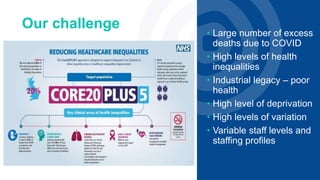
Our challenge
• Large number of excess
deaths due to COVID
• High levels of health
inequalities
• Industrial legacy – poor
health
• High level of deprivation
• High levels of variation
• Variable staff levels and
staffing profiles
UCLP
Proactive Care
Frameworks
• Conditions included
• CVD prevention
• Atrial Fibrillation
• Blood pressure
• Cholesterol
• Type 2 Diabetes
• Respiratory
• Asthma
• COPD
6
Copyright © UCLPartners 2021
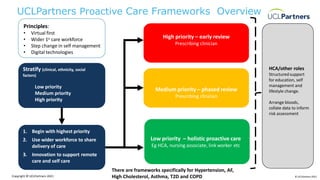
UCLPartners Proactive Care Frameworks Overview
February 2021
Principles:
• Virtual first
• Wider 1o care workforce
• Step change in self management
• Digital technologies
Stratify (clinical, ethnicity, social
factors)
Low priority
Medium priority
High priority
High priority – early review
Prescribing clinician
Medium priority – phased review
Prescribing clinician
Low priority – holistic proactive care
Eg HCA, nursing associate, link worker etc
1. Begin with highest priority
2. Use wider workforce to share
delivery of care
3. Innovation to support remote
care and self care
HCA/other roles
Structuredsupport
for education, self
management and
lifestyle change.
© UCLPartners 2021
Arrange bloods,
collate data to inform
risk assessment
There are frameworks specifically for Hypertension, AF,
High Cholesterol, Asthma, T2D and COPD
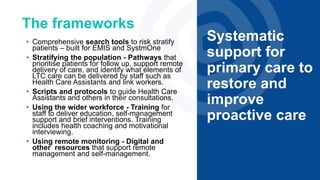
The frameworks
Systematic
support for
primary care to
restore and
improve
proactive care
• Comprehensive search tools to risk stratify
patients – built for EMIS and SystmOne
• Stratifying the population - Pathways that
prioritise patients for follow up, support remote
delivery of care, and identify what elements of
LTC care can be delivered by staff such as
Health Care Assistants and link workers.
• Scripts and protocols to guide Health Care
Assistants and others in their consultations.
• Using the wider workforce - Training for
staff to deliver education, self-management
support and brief interventions. Training
includes health coaching and motivational
interviewing.
• Using remote monitoring - Digital and
other resources that support remote
management and self-management.
Primary Care
Incentive
Opportunities
– CVD
Prevention
22/23
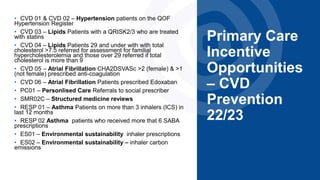
• CVD 01 & CVD 02 – Hypertension patients on the QOF
Hypertension Register
• CVD 03 – Lipids Patients with a QRISK2/3 who are treated
with statins
• CVD 04 – Lipids Patients 29 and under with with total
cholesterol >7.5 referred for assessment for familial
hypercholesterolemia and those over 29 referred if total
cholesterol is more than 9
• CVD 05 – Atrial Fibrillation CHA2DSVASc >2 (female) & >1
(not female) prescribed anti-coagulation
• CVD 06 – Atrial Fibrillation Patients prescribed Edoxaban
• PC01 – Personlised Care Referrals to social prescriber
• SMR02C – Structured medicine reviews
• RESP 01 – Asthma Patients on more than 3 inhalers (ICS) in
last 12 months
• RESP 02 Asthma patients who received more that 6 SABA
prescriptions
• ES01 – Environmental sustainability inhaler prescriptions
• ES02 – Environmental sustainability – inhaler carbon
emissions
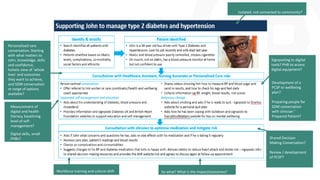
Personalised care
conversation: Starting
with what matters to
John, knowledge, skills
and confidence,
holistic view of ‘whole
lives’ and outcomes
they want to achieve,
and SDM conversation
re range of options
available?
Measurement of
digital and health
literacy, baselining
level of self-
management?
Digital skills, small
PHBs?
Signposting to digital
tools? PHB to access
digital equipment?
Development of a
PCSP or wellbeing
plan?
Preparing people for
SDM conversation
with clinician ‘
Prepared Patient?
Workforce training and culture shift
Shared Decision
Making
Conversation?
Review of PCSP?
Shared Decision
Making Conversation?
Review / development
of PCSP?
Isolated, not connected to community?
So what? What is the impact/outcomes?

Introduction to Supporting recovery in Primary Care using Proactive Frameworks for LTCs

  • 1.
    Supporting Recovery inPrimary Care UCLP Proactive Care Frameworks for Long Term Conditions Dr Julia Reynolds PhD Associate Director for Transformation Innovation Agency
  • 2.
    Welcome! HOUSEKEEPING Delegates are mutedfor this session. This session will be recorded and shared with delegates post event. QUESTIONS If you have any questions about the presentations you have seen, please enter them into the Q&A box. AGENDA 3 presentations – Case Studies • Blood Pressure (PCN) • Respiratory (GP Federation) • Multimorbidity (GP practice)
  • 3.
    COVID-19: Impact onProactive Care in Long Term Conditions Urgent challenge • Pandemic resulted in overnight transformation in primary care: universal shift to remote care and reduced face to face access • Disruption of routine, proactive care in long term conditions such as CVD, hypertension, diabetes, COPD, asthma • Risk of deterioration/exacerbation in long term conditions driving further waves of demand for urgent and acute care and worse outcomes for patients Opportunity • Restore and transform proactive care for people with long term conditions • Support a step change in Personalised Care • Mobilise wider primary care workforce to support remote care and self management • Optimise clinical care and reduce variation
  • 4.
    Our challenge • Largenumber of excess deaths due to COVID • High levels of health inequalities • Industrial legacy – poor health • High level of deprivation • High levels of variation • Variable staff levels and staffing profiles
  • 6.
    UCLP Proactive Care Frameworks • Conditionsincluded • CVD prevention • Atrial Fibrillation • Blood pressure • Cholesterol • Type 2 Diabetes • Respiratory • Asthma • COPD 6
  • 7.
    Copyright © UCLPartners2021 UCLPartners Proactive Care Frameworks Overview February 2021 Principles: • Virtual first • Wider 1o care workforce • Step change in self management • Digital technologies Stratify (clinical, ethnicity, social factors) Low priority Medium priority High priority High priority – early review Prescribing clinician Medium priority – phased review Prescribing clinician Low priority – holistic proactive care Eg HCA, nursing associate, link worker etc 1. Begin with highest priority 2. Use wider workforce to share delivery of care 3. Innovation to support remote care and self care HCA/other roles Structuredsupport for education, self management and lifestyle change. © UCLPartners 2021 Arrange bloods, collate data to inform risk assessment There are frameworks specifically for Hypertension, AF, High Cholesterol, Asthma, T2D and COPD
  • 8.
    The frameworks Systematic support for primarycare to restore and improve proactive care • Comprehensive search tools to risk stratify patients – built for EMIS and SystmOne • Stratifying the population - Pathways that prioritise patients for follow up, support remote delivery of care, and identify what elements of LTC care can be delivered by staff such as Health Care Assistants and link workers. • Scripts and protocols to guide Health Care Assistants and others in their consultations. • Using the wider workforce - Training for staff to deliver education, self-management support and brief interventions. Training includes health coaching and motivational interviewing. • Using remote monitoring - Digital and other resources that support remote management and self-management.
  • 9.
    Primary Care Incentive Opportunities – CVD Prevention 22/23 •CVD 01 & CVD 02 – Hypertension patients on the QOF Hypertension Register • CVD 03 – Lipids Patients with a QRISK2/3 who are treated with statins • CVD 04 – Lipids Patients 29 and under with with total cholesterol >7.5 referred for assessment for familial hypercholesterolemia and those over 29 referred if total cholesterol is more than 9 • CVD 05 – Atrial Fibrillation CHA2DSVASc >2 (female) & >1 (not female) prescribed anti-coagulation • CVD 06 – Atrial Fibrillation Patients prescribed Edoxaban • PC01 – Personlised Care Referrals to social prescriber • SMR02C – Structured medicine reviews • RESP 01 – Asthma Patients on more than 3 inhalers (ICS) in last 12 months • RESP 02 Asthma patients who received more that 6 SABA prescriptions • ES01 – Environmental sustainability inhaler prescriptions • ES02 – Environmental sustainability – inhaler carbon emissions
  • 10.
    Personalised care conversation: Starting withwhat matters to John, knowledge, skills and confidence, holistic view of ‘whole lives’ and outcomes they want to achieve, and SDM conversation re range of options available? Measurement of digital and health literacy, baselining level of self- management? Digital skills, small PHBs? Signposting to digital tools? PHB to access digital equipment? Development of a PCSP or wellbeing plan? Preparing people for SDM conversation with clinician ‘ Prepared Patient? Workforce training and culture shift Shared Decision Making Conversation? Review of PCSP? Shared Decision Making Conversation? Review / development of PCSP? Isolated, not connected to community? So what? What is the impact/outcomes?