In the Clinic®
Influenza Prevention
Diagnosis
Treatment
Practice Improvement
I
nfluenza is an acute viral respiratory disease
that affects persons of all ages and is associ-
ated with millions of medical visits, hundreds
of thousands of hospitalizations, and thousands
of deaths during annual winter epidemics of
variable severity in the United States. Elderly
persons have the highest influenza-associated
hospitalization and mortality rates. The primary
method of prevention is annual vaccination.
Early antiviral treatment has the greatest clinical
benefit; otherwise, management includes ad-
herence to recommended infection prevention
and control measures as well as supportive care
of complications.
CME/MOC activity available at Annals.org.
Physician Writer
Timothy M. Uyeki, MD,
MPH, MPP
From the Influenza Division,
Centers for Disease Control
and Prevention, Atlanta,
Georgia.
doi:10.7326/AITC201709050
CMEObjective:Toreviewcurrentevidenceforprevention,diagnosis,treatment,andpractice
improvementofinfluenza.
FundingSource:AmericanCollegeofPhysicians.
Acknowledgment:TheauthorthanksMargaretTrexlerHessen,MD,authoroftheprevious
versionofthisIntheClinic.
Disclaimer:Theviewsexpressedarethoseoftheauthoranddonotnecessarilyrepresentthe
officialpositionoftheCentersforDiseaseControlandPrevention.
Withtheassistanceofadditionalphysicianwriters,theeditorsofAnnalsofInternal
MedicinedevelopIntheClinicusingMKSAPandotherresourcesoftheAmericanCollege
ofPhysicians.
IntheClinicdoesnotnecessarilyrepresentofficialACPclinicalpolicy.ForACPclinical
guidelines,pleasegotohttps://www.acponline.org/clinical_information/guidelines/.
Disclosures: Dr. Uyeki, ACP Contributing Author, has disclosed no conflicts of interest.
His form can be viewed at www.acponline.org/authors/icmje/ConflictOfInterestForms
.do?msNum=M17-1783.
Annals of Internal Medicineᮋ
© 2017 American College of Physicians
Downloaded From: https://annals.org/ by a Univ of California San Francisco User on 09/04/2017
Annual epidemics caused by in-
fections with seasonal influenza A
or B viruses occur during the win-
ter months in temperate climates.
Influenza activity may occur year-
round in tropical and subtropical
climates, peaking during cooler or
rainy-season months. Influenza usu-
ally involves self-limited symptoms
of the upper respiratory tract, fatigue
and myalgia, with or without fever.
However, young children, elderly
persons, pregnant women, and
those with certain chronic medical
conditions are at higher risk for se-
vere disease.
Influenza A viruses are classified into
subtypes based on the 2 main sur-
face glycoprotein components:
hemagglutinin (referred to as “HA”
or “H”) and neuraminidase (referred
to as “NA” or “N”). Influenza viruses
bind to receptors on the surface of
respiratory epithelial cells (primarily
of the upper tract) through the HA
protein. Most humoral immunity
against the HA protein, acquired
through infection or vaccination, is
virus strain–specific.
Antigenic “drift” refers to HA
gene mutations causing anti-
genic changes in the HA protein
so that antibodies acquired by
prior infection or vaccination do
not bind to antigenically drifted
virus strains. Antigenic drift is the
unpredictable evolutionary pro-
cess that drives seasonal epidem-
ics and is why year-round influenza
surveillance and annual updating
of vaccine strains are needed.
Seasonal influenza viruses cur-
rently circulating among humans
worldwide include influenza
A(H1N1)pdm09 and A(H3N2) vi-
ruses and 2 main groups (or lin-
eages) of influenza B viruses.
Antigenic “shift” refers to human
infection with a novel influenza A
virus that is antigenically and ge-
netically distinct from influenza A
viruses circulating in humans.
Novel influenza A viruses have
public health importance be-
cause they can cause sporadic
human infections resulting from
exposure to infected animals
(usually poultry or pigs) as well as
pandemics in which most of the
population lacks immunity to the
novel virus strain.
Prevention
Who is at greatest risk for
complications and
hospitalization?
High-risk persons include young
children younger than 5 years
and particularly those under 2;
adults aged 65 years and older;
pregnant women; residents of
nursing homes and other long-
term care facilities; American In-
dians and Alaska Natives; per-
sons of any age with certain
underlying medical conditions,
such as chronic lung disease, car-
diac disease (but not isolated hy-
pertension), neurologic and neu-
rodevelopmental conditions,
hematologic disorders, kidney or
liver disorders, metabolic diseases,
or immunosuppression; persons
younger than 19 years receiving
long-term aspirin therapy; and ex-
tremely obese persons (body mass
index ≥40 kg/m2
) (see the Box)
(1).
In the United States, persons
aged 65 years and older have the
highest rate of influenza-
associated hospitalization, fol-
lowed by those aged 50–64
years and then young children.
Mortality rates are highest in per-
sons aged 65 years and older.
Who should receive vaccination,
and when should it be given?
All persons aged 6 months and
older in the United States should
be vaccinated annually, ideally
before influenza activity begins in
the community and by the end of
October, if possible (1). Recent
studies have reported evidence
of waning vaccine effectiveness
1. Grohskopf LA, Sokolow LZ,
Broder KR, Walter EB,
Bresee JS, Fry AM, et al.
Prevention and Control of
Seasonal Influenza with
Vaccines: Recommenda-
tions of the Advisory Com-
mittee on Immunization
Practices (ACIP)—United
States, 2017–18 Influenza
Season. MMWR Recomm
Rep. 2017. [Forthcoming]
2. Ferdinands JM, Fry AM,
Reynolds S, Petrie J, Flan-
nery B, Jackson ML, et al.
Intraseason waning of
influenza vaccine protec-
tion: evidence from the
US Influenza Vaccine
Effectiveness Network,
2011–12 through 2014–
15. Clin Infect Dis. 2017;
64:544-550. [PMID:
28039340]
3. Belongia EA, Sundaram
ME, McClure DL, Meece
JK, Ferdinands J, Van-
Wormer JJ. Waning vac-
cine protection against
influenza A (H3N2) illness
in children and older
adults during a single
season. Vaccine. 2015;33:
246-51. [PMID:
24962752]
4. Madhi SA, Cutland CL,
Kuwanda L, Weinberg A,
Hugo A, Jones S, et al;
Maternal Flu Trial (Matflu)
Team. Influenza vaccina-
tion of pregnant women
and protection of their
infants. N Engl J Med.
2014;371:918-31. [PMID:
25184864]
5. Tapia MD, Sow SO, Tam-
boura B, Te´guete´ I, Pasetti
MF, Kodio M, et al. Mater-
nal immunisation with
trivalent inactivated influ-
enza vaccine for preven-
tion of influenza in infants
in Mali: a prospective,
active-controlled, observer-
blind, randomised phase
4 trial. Lancet Infect Dis.
2016;16:1026-35. [PMID:
27261067]
6. Steinhoff MC, Katz J, En-
glund JA, Khatry SK,
Shrestha L, Kuypers J,
et al. Year-round influenza
immunisation during
pregnancy in Nepal: a
phase 4, randomised,
placebo-controlled trial.
Lancet Infect Dis. 2017.
[PMID: 28522338]
஽ 2017 American College of Physicians ITC34 In the Clinic Annals of Internal Medicine 5 September 2017
Downloaded From: https://annals.org/ by a Univ of California San Francisco User on 09/04/2017
during the influenza season (2,
3), suggesting that summertime
vaccination might be too early;
however, more studies are
needed. Clinicians need to keep
abreast of possible changes in
recommended timing of influ-
enza vaccination. The Centers for
Disease Control and Prevention
(CDC) maintains updated recom-
mendations on its Web site (see
Tool Kit for links).
Previously unvaccinated children
aged 6 months up to 9 years
should receive 2 doses at least
4 weeks apart in the first year of
vaccination; for all other groups,
revaccination is not recom-
mended during influenza season.
Although vaccination is not ap-
proved for infants younger than
6 months, strategies to prevent
influenza in this group include
vaccination of pregnant women,
household contacts aged 6
months and older, and caregiv-
ers. Randomized controlled stud-
ies have established that mater-
nal vaccination can prevent
influenza in infants (through
transplacentally transferred anti-
bodies) up to 6 months after
birth (4–6).
Although influenza activity in the
United States usually peaks dur-
ing December to March, it varies
widely and may continue into
April or May in some communi-
ties. Influenza B viruses often
peak later and circulate longer
than influenza A viruses. As long
as influenza viruses are circulat-
ing in a community, influenza
vaccination can be beneficial.
Persons with significant febrile
illness generally should not be
vaccinated, based on clinical
judgment; minor acute illness
without significant fever is not a
contraindication.
If difficulties in vaccine produc-
tion or distribution result in short-
ages or delays, priority should be
given to persons at high risk for
severe disease or complications
and to their close contacts, in-
cluding health care workers (1).
The CDC has provided recom-
mendations on its Web site for
prioritizing influenza vaccination
under these circumstances.
How effective is the vaccine?
Effectiveness of influenza vaccine
varies from season to season and
is influenced by such factors as
age, baseline health, and im-
mune function as well as the de-
gree of antigenic match between
vaccine strains and circulating
influenza viruses. If vaccine anti-
gens and virus strains are well-
matched, effectiveness is moder-
ate; however, it is lower during
seasons when they are mis-
matched. Effectiveness can also
vary by virus type and influenza A
virus subtype. In a systematic re-
view and meta-analysis of 10 ran-
domized controlled trials, effi-
cacy of the trivalent inactivated
vaccine was found in 8 of 12 sea-
sons, with a pooled efficacy of
59% (95% CI, 51%–67%) in adults
aged 18–65 years (7).
A recent systematic review and meta-analysis of
studies of vaccine effectiveness in outpatients re-
ported that the overall pooled effectiveness was
33% for A(H3N2), 54% for influenza B, and 61%
for A(H1N1)pdm09. Effectiveness was 33% when
the H3N2 vaccine antigen was well-matched to
the circulating A(H3N2) viruses but only 23%
when antigenic drift was present (8). For adults
older than 60 years, pooled effectiveness was
24% for A(H3N2), 62% for A(H1N1)pdm09, and
63% for influenza B.
Vaccination is moderately effec-
tive in preventing hospitalization
(9–12) and influenza-associated
death in children (13) but is gen-
erally less effective in elderly than
in nonelderly persons. However,
few clinical trials have focused on
elderly persons, and selection
bias may lead to vaccination of
healthier persons.
A meta-analysis of individual-participant data in-
volving case–control studies of nearly 5000
community-dwelling older adults worldwide re-
Groups at Greatest Risk for
Influenza-Related
Complications and
Hospitalization
Children aged <5 y, especially
<2 y
Adults aged ≥65 y
Residents of nursing homes and
long-term care facilities
Pregnant women
Persons aged <19 y receiving
long-term aspirin therapy
American Indians and Alaska
Natives
Persons of any age with the
following chronic medical
conditions:
• Pulmonary disease
(including asthma, chronic
obstructive pulmonary
disease, cystic fibrosis)
• Cardiac disease (excluding
isolated hypertension)
• Neurologic and
neurodevelopmental
conditions
• Hematologic disorders
• Endocrine disorders
• Renal disorders
• Hepatic disease
• Metabolic disease
• Immunosuppression (due to
disease or medication)
• Extreme obesity (body mass
index ≥40 kg/m2
)
7. Osterholm MT, Kelley NS,
Sommer A et al. Efficacy
and effectiveness of influ-
enza vaccines: a system-
atic review and meta-
analysis. Lancet Infect Dis.
2012 Jan;12(1):36-44.
[PMID: 22032844]
8. Belongia EA, Simpson
MD, King JP, Sundaram
ME, Kelley NS, Osterholm
MT, et al. Variable influ-
enza vaccine effectiveness
by subtype: a systematic
review and meta-analysis
of test-negative design
studies. Lancet Infect Dis.
2016;16:942-51. [PMID:
27061888]
9. Havers F, Sokolow L, Shay
DK, Farley MM, Monroe
M, Meek J, et al. Case-
control study of vaccine
effectiveness in preventing
laboratory-confirmed
influenza hospitalizations
in older adults, United
States, 2010–2011. Clin
Infect Dis. 2016;63:1304-
1311. [PMID: 27486114]
5 September 2017 Annals of Internal Medicine In the Clinic ITC35 ஽ 2017 American College of Physicians
Downloaded From: https://annals.org/ by a Univ of California San Francisco User on 09/04/2017
ported that vaccination was moderately effective
(adjusted effectiveness was 44.4% during well-
matched seasons and 20% during mismatched
seasons) in preventing laboratory-confirmed in-
fluenza (14). This study also found that vaccina-
tion was effective in older adults with cardiovas-
cular disease (adjusted effectiveness, 31%) or
respiratory disease (adjusted effectiveness, 31%)
and those aged 75 years or younger (adjusted ef-
fectiveness, 33%).
Recently, data have become
available for vaccines with higher
antigen content than standard-
dose (SD) vaccine. One random-
ized controlled trial that included
more than 8500 adults aged 50
years or older reported that a
recombinant vaccine with 3 times
the HA antigen content for each
strain provided greater protec-
tion against laboratory-confirmed
influenza than SD vaccine (15). A
cluster randomized trial of high-
dose (HD) inactivated influenza
vaccine containing 4 times the
antigen content for each strain ver-
sus SD inactivated influenza vac-
cine in elderly nursing home resi-
dents reported that HD vaccine
significantly reduced respiratory-
related hospitalizations compared
with SD vaccine (16).
What vaccines are available?
The composition of influenza vac-
cines is updated annually. A wide
variety of vaccines are approved
and available in the United States
(Table 1), including inactivated
trivalent (IIV3) or quadrivalent
Table 1. Approved Influenza Vaccines for U.S. Adults, 2017–2018 Season*
Description Approved Ages Dose/Route Recommendation/Notes†
Inactivated, standard dose,
egg-grown, trivalent (IIV3s)‡
≥18 y 0.5 mL/intramuscular Contains 15 mcg of each HA antigen per 0.5-mL
dose (45 mcg total); one manufacturer's
syringe tip cap on prefilled syringes might
contain natural rubber latex (potential issue for
persons with latex allergy)
Inactivated, standard dose,
egg-grown, quadrivalent
(IIV4s)‡
≥18 y 0.5 mL/intramuscular Contains 15 mcg of each HA antigen per 0.5-mL
dose (60 mcg total)
Inactivated, standard dose, cell
culture–grown, quadrivalent
(ccIIV4)‡
≥18 y 0.5 mL/intramuscular Contains 15 mcg of each HA antigen per 0.5-mL
dose (60 mcg total)
Inactivated, standard dose,
egg-grown, quadrivalent,
intradermal (IIV4s)‡
18–64 y 0.1 mL/intradermal Contains 9 mcg of each HA antigen per 0.1-mL
dose (36 mcg total); preferred injection site is
over the deltoid muscle using the prefilled
microinjection device
Inactivated, high dose,
egg-grown, trivalent (IIV3)‡
≥65 y 0.5 mL/intramuscular Contains 60 mcg of each HA antigen per 0.5-mL
dose (180 mcg total)
Adjuvanted inactivated,
standard dose, cell
culture–grown, trivalent
(aIIV3)‡
≥65 y 0.5 mL/intramuscular Contains 15 mcg of each HA antigen per 0.5-mL
dose (45 mcg total) with an oil-in-water
emulsion adjuvant; manufacturer's syringe tip
cap on prefilled syringes might contain natural
rubber latex (potential issue for persons with
latex allergy)
Recombinant trivalent (RIV3) ≥18 y 0.5 mL/intramuscular Contains 45 mcg of each HA antigen per 0.5-mL
dose (135 mcg total)
Recombinant quadrivalent
(RIV4)
≥18 y 0.5 mL/intramuscular Contains 45 mcg of each HA antigen per 0.5-mL
dose (180 mcg total)
Live attenuated, egg-grown,
quadrivalent (LAIV4)
2–49 y Intranasal Not recommended for the 2017–2018 season
HA = hemagglutinin.
* Contraindicated in persons with prior severe allergic reaction (e.g., anaphylaxis) to any vaccine component. Updated infor-
mation and recommendations on use of influenza vaccines are available on the Web site of the Centers for Disease Control
and Prevention (CDC) (www.cdc.gov/flu/professionals/vaccination/index.htm).
† Caution in persons with moderate to severe acute illness (with or without fever) and in those with a history of Guillain-Barr´e
syndrome within 6 weeks of receipt of influenza vaccine.
‡ Contraindicated in persons with prior severe allergic reactions (e.g., anaphylaxis) to any vaccine component or after
previous influenza vaccination. The Advisory Committee on Immunization Practices and the CDC state that any licensed,
recommended, and appropriate inactivated influenza vaccine or recombinant influenza vaccine can be administered to
persons with egg allergy of any severity.
10. Grijalva CG, Zhu Y, Wil-
liams DJ, Self WH, Am-
pofo K, Pavia AT, et al.
Association between
hospitalization with
community-acquired
laboratory-confirmed
influenza pneumonia
and prior receipt of influ-
enza vaccination. JAMA.
2015;314:1488-97.
[PMID: 26436611]
11. Ferdinands JM, Olsho LE,
Agan AA, Bhat N, Sulli-
van RM, Hall M, et al;
Pediatric Acute Lung
Injury and Sepsis Investi-
gators (PALISI) Network.
Effectiveness of influenza
vaccine against life-
threatening RT-PCR-
confirmed influenza
illness in US children,
2010–2012. J Infect Dis.
2014;210:674-83.
[PMID: 24676207]
஽ 2017 American College of Physicians ITC36 In the Clinic Annals of Internal Medicine 5 September 2017
Downloaded From: https://annals.org/ by a Univ of California San Francisco User on 09/04/2017
(IIV4) vaccines; the vaccine given
depends on the age of the recipi-
ent (1). Vaccines typically be-
come available in the late sum-
mer and expire on 30 June after
the end of each influenza season.
IIV3 vaccines contain 2 influenza
A virus antigens—an A(H3N2) and
an A(H1N1)pdm09 virus—and 1
influenza B virus antigen. IIV4
vaccines contain A(H3N2) and
A(H1N1)pdm09 virus antigens
and 2 influenza B virus
antigens—1 each of the 2 main
circulating lineages (B/Yamagata
and B/Victoria). Most IIV3 and
IIV4 vaccines are given by intra-
muscular injection; however, an
intradermal IIV4s vaccine is avail-
able for adults aged 18–64
years.
Most viruses are grown in embry-
onated chicken eggs and then
inactivated; however, 2 approved
vaccines use antigens that are
not grown in eggs, including 1
quadrivalent vaccine comprising
viruses that are grown in tissue
cell culture (ccIIV4) and then inac-
tivated. One vaccine approved
for adults that is not based on
cultured viruses is a recombinant
HA vaccine (RIV3 or RIV4) pro-
duced in insect cells.
For persons aged 65 years and
older, SD vaccines have de-
creased immunogenicity and ef-
fectiveness. Two vaccines are
now available that may improve
protection in this group: an adju-
vanted IIV, and an HD IIV with 4
times the antigen concentration
of SD vaccines.
Live attenuated influenza virus
vaccine is approved by the U.S.
Food and Drug Administration
for intranasal administration for
nonpregnant healthy persons
(without underlying medical condi-
tions) aged 2–49 years. However,
due to poor effectiveness over
multiple seasons, particularly for
the influenza A(H1N1)pdm09 virus
strain, the Advisory Committee on
Immunization Practices and the
CDC recommended that this vac-
cine not be used for the 2016–
2017 or 2017–2018 seasons (1).
What adverse effects are
associated with vaccination?
The most common adverse effect
from injectable inactivated influ-
enza vaccines is soreness at the
injection site for about 2 days (1).
Pain, low-grade fever, myalgia,
headache, and fatigue are less
common and may last 1–2 days.
Erythema, induration, swelling,
and pruritus may be more com-
mon with intradermal vaccines.
Studies of influenza vaccination in
pregnant women have not identi-
fied any significant adverse
pregnancy or fetal outcomes
(17–21).
Whether influenza vaccination
increases the risk for Guillain-
Barre´ syndrome (GBS) is un-
known. One systematic review
and meta-analysis of observa-
tional studies reported a slight
association between influenza
vaccination and GBS (22). In gen-
eral, persons who previously had
GBS within 6 weeks after being
vaccinated and are not at risk for
severe influenza complications
should not be vaccinated. For
persons who are more likely to
have influenza complications, the
small risk for GBS is probably
outweighed by the benefit of
vaccination, which can also re-
duce the small risk for GBS that
can be triggered by influenza
virus infection (23, 24). For non-
pregnant adults, some studies
have reported a low risk for GBS
(approximately 1 case per 1 mil-
lion vaccinated persons) (1).
How should clinicians
approach vaccination in
persons with severe allergies?
Anaphylaxis after influenza vacci-
nation is rare. Although most in-
fluenza vaccines are grown in
embryonated chicken eggs
12. Petrie JG, Ohmit SE,
Cheng CK, Martin ET,
Malosh RE, Lauring AS,
et al. Influenza vaccine
effectiveness against
antigenically drifted
influenza higher than
expected in hospitalized
adults: 2014–2015. Clin
Infect Dis. 2016;63:
1017-25. [PMID:
27369320]
13. Flannery B, Reynolds SB,
Blanton L, Santibanez TA,
O’Halloran A, Lu PJ, et al.
Influenza vaccine effec-
tiveness against pediatric
deaths: 2010–2014.
Pediatrics. 2017;139.
[PMID: 28557757]
14. Darvishian M, van den
Heuvel ER, Bissielo A,
Castilla J, Cohen C, En-
glund H, et al. Effective-
ness of seasonal influ-
enza vaccination in
community-dwelling
elderly people: an indi-
vidual participant data
meta-analysis of test-
negative design case-
control studies. Lancet
Respir Med. 2017;5:
200-211. [PMID:
28189522]
15. Dunkle LM, Izikson R,
Patriarca P, Goldenthal
KL, Muse D, Callahan J,
et al; PSC12 Study Team.
Efficacy of recombinant
influenza vaccine in
adults 50 years of age or
older. N Engl J Med.
2017;376:2427-2436.
[PMID: 28636855]
16. Gravenstein S, Davidson
HE, Taljaard M, Ogarek J,
Gozalo P, Han L, et al.
Comparative effective-
ness of high-dose versus
standard-dose influenza
vaccination on numbers
of US nursing home
residents admitted to
hospital: a cluster-
randomised trial. Lancet
Respir Med. 2017.
[PMID: 28736045]
17. Polyzos KA, Konstantelias
AA, Pitsa CE, Falagas ME.
Maternal influenza vacci-
nation and risk for con-
genital malformations: a
systematic review and
meta-analysis. Obstet
Gynecol. 2015;126:
1075-84. [PMID:
26444106]
18. McMillan M, Porritt K,
Kralik D, Costi L, Marshall
H. Influenza vaccination
during pregnancy: a
systematic review of fetal
death, spontaneous
abortion, and congenital
malformation safety
outcomes. Vaccine.
2015;33:2108-17.
[PMID: 25758932]
19. Bratton KN, Wardle MT,
Orenstein WA, Omer SB.
Maternal influenza im-
munization and birth
outcomes of stillbirth
and spontaneous abor-
tion: a systematic review
and meta-analysis. Clin
Infect Dis. 2015;60:
e11-9. [PMID:
25409473]
5 September 2017 Annals of Internal Medicine In the Clinic ITC37 ஽ 2017 American College of Physicians
Downloaded From: https://annals.org/ by a Univ of California San Francisco User on 09/04/2017
(except RIV3, RIV4, and ccIIV4
vaccines), severe reactions—even
in persons with egg allergies—are
uncommon. Influenza vaccine
can be given to persons with a
history of egg allergy who have
had only hives after exposure to
eggs. Persons who report other
allergic symptoms, such as an-
gioedema, respiratory distress,
lightheadedness, or recurrent
vomiting, or those who required
epinephrine or other emergency
medical intervention for anaphy-
laxis can still be vaccinated, but it
should be done in an inpatient or
outpatient medical setting super-
vised by a health care provider
who can recognize and manage
severe allergic reactions (1).
However, anyone who has had a
more severe allergic reaction
should not be vaccinated.
What is the role of behavioral
strategies to prevent
transmission?
Immunocompetent persons who
are symptomatic from uncompli-
cated influenza virus infection
can shed viruses from the upper
respiratory tract for approxi-
mately 4–7 days, although shed-
ding and transmissibility gener-
ally decrease substantially after
3 days. Influenza viruses are be-
lieved to be transmitted primarily
by large and small particle drop-
lets that are expelled by cough-
ing or sneezing by an infected
person to susceptible close con-
tacts. Contact transmission has
been suggested indirectly
through hand hygiene studies.
The role of asymptomatically in-
fected or presymptomatic per-
sons in transmitting the viruses is
unknown, but this is believed to
be uncommon.
A systematic review and meta-analysis ex-
amined randomized clinical trials studying
the efficacy of hand hygiene (with or with-
out facemasks) in reducing influenza virus
transmission in community settings (house-
holds). It reported that hand hygiene com-
bined with facemasks resulted in a statisti-
cally significant reduction in laboratory-
confirmed transmission (relative risk, 0.73
[CI, 0.53–0.99]; P = 0.05), but hand hygiene
alonedidnot(25).Anotherreviewconcludedthat
evidence of the efficacy of nonpharmaceutical in-
terventions, such as facemasks and hand hy-
giene, to reduce transmission was lacking, with
most studies being significantly flawed (26).
Community nonpharmaceutical
interventions, such as school clo-
sures, have been implemented to
control seasonal and pandemic in-
fluenza; effectiveness has varied
(27).
What is the role of antiviral
agents in prevention?
The neuraminidase inhibitors oral
oseltamivir and inhaled zanamivir
are approved for antiviral treat-
ment and chemoprophylaxis of
influenza. Antiviral chemoprophy-
laxis (before or after exposure) of
individuals or in households has
moderate to high effectiveness for
influenza prevention (28) but is not
routinely recommended. Antiviral
chemoprophylaxis can be consid-
ered for persons in whom vaccina-
tion is contraindicated or who are
not expected to benefit, such as
severely immunosuppressed
patients.
Antiviral chemoprophylaxis is an
important component of a bundle
of interventions to control institu-
tional influenza outbreaks, and
oseltamivir chemoprophylaxis has
been shown to be effective in con-
trolling established outbreaks in
nursing homes (29–31). When an
institutional outbreak is recog-
nized, some exposed residents or
patients may already be incubat-
ing influenza virus when antiviral
chemoprophylaxis is imple-
mented. Therefore, consideration
can be given to twice-daily (i.e.,
treatment dosing) versus once-
daily chemoprophylaxis dosing in
long-term care facilities or health
care facilities, including in immu-
nosuppressed persons (32, 33).
A cluster randomized trial compared oseltami-
vir treatment of symptomatic persons with os-
20. Fell DB, Platt RW, Lanes
A, Wilson K, Kaufman JS,
Basso O, et al. Fetal
death and preterm birth
associated with maternal
influenza vaccination:
systematic review. BJOG.
2015;122:17-26. [PMID:
25040307]
21. Kharbanda EO, Vazquez-
Benitez G, Romitti PA,
Naleway AL, Cheetham
TC, Lipkind HS, et al;
Vaccine Safety Datalink.
First trimester influenza
vaccination and risks for
major structural birth
defects in offspring. J
Pediatr. 2017. [PMID:
28550954]
22. Martı´n Arias LH, Sanz R,
Sa´inz M et al. Guillain-
Barre´ syndrome and
influenza vaccines: a
meta-analysis. Vaccine.
2015 Jul 17;33(31):
3773-8. [PMID:
25749247]
23. Sivadon-Tardy V, Or-
likowski D, Porcher R,
Sharshar T, Durand MC,
Enouf V, et al. Guillain-
Barre´ syndrome and
influenza virus infection.
Clin Infect Dis. 2009;48:
48-56. [PMID:
19025491]
24. Lehmann HC, Hartung
HP, Kieseier BC, Hughes
RA. Guillain-Barre´ syn-
drome after exposure to
influenza virus. Lancet
Infect Dis. 2010;10:643-
51. [PMID: 20797646]
25. Wong VW, Cowling BJ,
Aiello AE. Hand hygiene
and risk of influenza
virus infections in the
community: a systematic
review and meta-
analysis. Epidemiol In-
fect. 2014;142:922-32.
[PMID: 24572643]
26. Smith SM, Sonego S,
Wallen GR, Waterer G,
Cheng AC, Thompson
P. Use of non-
pharmaceutical inter-
ventions to reduce the
transmission of influ-
enza in adults: a sys-
tematic review. Respi-
rology. 2015;20:896-
903. [PMID:
25873071]
27. Jackson C, Vynnycky E,
Hawker J, Olowokure B,
Mangtani P. School
closures and influenza:
systematic review of
epidemiological studies.
BMJ Open. 2013;3.
[PMID: 23447463]
28. Okoli GN, Otete HE, Beck
CR, Nguyen-Van-Tam JS.
Use of neuraminidase
inhibitors for rapid con-
tainment of influenza: a
systematic review and
meta-analysis of individ-
ual and household trans-
mission studies. PLoS
One. 2014;9:e113633.
[PMID: 25490762]
஽ 2017 American College of Physicians ITC38 In the Clinic Annals of Internal Medicine 5 September 2017
Downloaded From: https://annals.org/ by a Univ of California San Francisco User on 09/04/2017
eltamivir chemoprophylaxis for elderly long-
term care residents over 3 seasons. It found
that postexposure chemoprophylaxis reduced
the influenza attack rate among residents
compared with treating symptomatic per-
sons (34). One multicountry randomized
controlled trial of oseltamivir chemoprophy-
laxis versus placebo for 6 weeks in vacci-
nated nursing home residents reported
high efficacy in preventing outbreaks (35).
During an institutional outbreak,
unvaccinated staff members and
residents should receive influ-
enza vaccine if it is available. In
nursing homes, the potential for
high-intensity virus exposure and
possible suboptimal immune re-
sponse to vaccine by debilitated
residents suggests that all resi-
dents, regardless of previous
vaccination, should receive che-
moprophylaxis in an outbreak.
Antiviral medications should be
continued for at least 2 weeks,
and then for 1 week longer than
the duration of the outbreak.
Antiviral chemoprophylaxis may
also be considered for high-risk
persons and close contacts (in-
cluding health care workers)
when vaccine is unavailable or
contraindicated, when a major
difference exists between the
predominant virus antigens and
the vaccine strains such that ef-
fectiveness is expected to be
very low, or when severe immu-
nosuppression makes response
to the vaccine unlikely.
What measures should
clinicians take to prevent
influenza among patients and
staff in health care institutions?
All health care personnel should
be vaccinated annually unless it
is contraindicated or the vaccine
is unavailable. In outpatient set-
tings, persons with suspected or
confirmed influenza should be
encouraged to adhere to respira-
tory hygiene, cough etiquette
(use facemasks or tissues to
cover the nose and mouth when
coughing, and dispose of con-
taminated materials), and hand
hygiene recommendations. For
inpatient settings, patients with
suspected or confirmed influenza
should be isolated or cohorted
(co-located) if isolation is not
possible. Standard and droplet
precautions are recommended,
and for aerosol-generating pro-
cedures a fit-tested N95 respira-
tor or respirator equivalent is rec-
ommended (36).
The use of standing orders, which
allow trained health care profes-
sionals other than physicians to
identify and vaccinate high-risk
patients, improves influenza vac-
cine coverage of hospitalized pa-
tients at discharge and nursing
home residents, especially if struc-
tured in an “opt-out” format. Like-
wise, providing free vaccination at
convenient times and places may
increase coverage among hospital
and nursing home staff.
During outbreaks, infection pre-
vention and control measures,
such as limiting visitors, using
droplet precautions, isolating or
cohorting symptomatic patients,
and performing active daily sur-
veillance for new cases, should
also be implemented.
29. Bowles SK, Lee W, Simor
AE, Vearncombe M, Loeb
M, Tamblyn S, et al;
Oseltamivir Compassion-
ate Use Program Group.
Use of oseltamivir during
influenza outbreaks in
Ontario nursing homes,
1999–2000. J Am Geri-
atr Soc. 2002;50:608-16.
[PMID: 11982659]
30. Gorisˇek Miksic N, Ursˇic T,
Simonovic Z, Lusa L,
Lobnik Rojko P, Petrovec
M, et al. Oseltamivir
prophylaxis in controlling
influenza outbreak in
nursing homes: a com-
parison between three
different approaches.
Infection. 2015;43:73-
81. [PMID: 25403263]
31. Ye M, Jacobs A, Khan
MN, Jaipaul J, Oda J,
Johnson M, et al. Evalua-
tion of the use of oselta-
mivir prophylaxis in the
control of influenza out-
breaks in long-term care
facilities in Alberta, Can-
ada: a retrospective pro-
vincial database analysis.
BMJ Open. 2016;6:
e011686. [PMID:
27381211]
32. Shijubo N, Yamada G,
Takahashi M, Tokunoh T,
Suzuki T, Abe S. Experi-
ence with oseltamivir in
the control of nursing
home influenza A out-
break. Intern Med. 2002;
41:366-70. [PMID:
12058885]
33. Buchbinder N, Dumesnil
C, Pinquier D, Merle V,
Filhon B, Schneider P,
et al. Pandemic A/H1N1/
2009 influenza in a
paediatric haematology
and oncology unit: suc-
cessful management of a
sudden outbreak. J Hosp
Infect. 2011;79:155-60.
[PMID: 21783276]
34. Booy R, Lindley RI, Dw-
yer DE, Yin JK, Heron LG,
Moffatt CR, et al. Treating
and preventing influenza
in aged care facilities: a
cluster randomised con-
trolled trial. PLoS One.
2012;7:e46509. [PMID:
23082123]
35. Peters PH Jr, Gravenstein
S, Norwood P, De Bock
V, Van Couter A, Gibbens
M, et al. Long-term use
of oseltamivir for the
prophylaxis of influenza
in a vaccinated frail older
population. J Am Geriatr
Soc. 2001;49:1025-31.
[PMID: 11555062]
36. Centers for Disease Con-
trol and Prevention.
Prevention Strategies for
Seasonal Influenza in
Healthcare Settings.
Accessed at www.cd-
c.gov/flu/professionals/
infectioncontrol/healthca-
resettings.htm on 17
July 2017.
Prevention... Annual influenza vaccination is recommended for all per-
sons aged 6 months and older in the United States, including health
care personnel. Vaccination is moderately effective in preventing influ-
enza. Recent studies have suggested that it may also help to reduce the
risk for some complications associated with influenza, including hospi-
talization and death. Antiviral chemoprophylaxis can be an adjunct to
influenza vaccination under some circumstances.
CLINICAL BOTTOM LINE
5 September 2017 Annals of Internal Medicine In the Clinic ITC39 ஽ 2017 American College of Physicians
Downloaded From: https://annals.org/ by a Univ of California San Francisco User on 09/04/2017
Diagnosis
What signs and symptoms
should prompt clinicians to
suspect influenza?
Signs and symptoms of uncom-
plicated influenza frequently
overlap with those of other respi-
ratory viral infections, but abrupt
onset of fever, especially high
fever or feverishness, and cough
can help in differentiation, espe-
cially if influenza activity is pres-
ent in the community (37–39).
Although weakness, myalgia,
sore throat, nausea, rhinorrhea,
and headache are common in
patients with influenza, they oc-
cur with similar frequency in
other viral illnesses. Not all per-
sons with influenza manifest fe-
ver, including immunosup-
pressed and elderly persons (40).
Young children with respiratory
symptoms may have diarrhea,
and adults with respiratory symp-
toms may have vomiting. The
presence of crackles or de-
creased breath sounds on chest
examination may suggest such
pulmonary complications as viral
pneumonia, secondary bacterial
pneumonia, or heart failure.
When should clinicians suspect
novel influenza A virus infection?
The key to diagnosing novel in-
fluenza A virus infection is to elicit
a history of recent exposure to
poultry or pigs where novel influ-
enza A viruses are circulating
among animal hosts, or expo-
sure to an ill person with novel
influenza A virus infection. Dis-
ease severity in infected animals
does not necessarily correlate
with severity in infected
humans.
Similar to seasonal influenza, a
wide clinical spectrum of human
infection with novel influenza A
viruses has been reported, in-
cluding asymptomatic infection,
conjunctivitis only, upper respira-
tory tract illness, pneumonia, en-
cephalopathy and encephalitis,
and multiorgan failure with fatal
outcomes (41, 42). Therefore,
novel influenza A virus infection
cannot be distinguished from
seasonal influenza A virus infection
by clinical findings or by commer-
cially available tests and must be
diagnosed by specific influenza
molecular assays at public health
laboratories (43, 44).
When should clinicians test to
confirm a clinical diagnosis?
Influenza testing (Table 2) is not
needed to confirm the clinical
diagnosis or to decide whether
to prescribe antiviral medications
to a patient when influenza vi-
ruses are circulating in the com-
munity (45). Testing should be
considered when the results will
influence individual clinical man-
agement decisions. In an institu-
tional (long-term care facility or
hospital ward) outbreak of respi-
ratory illness, diagnostic testing
can help establish influenza as
the cause, supporting prompt
implementation of prevention
and control measures.
Respiratory specimens should be
collected as close to illness onset
as possible. In critically ill patients,
the diagnosis may be missed if
only upper respiratory tract speci-
mens are tested, even with molec-
ular assays. Viral replication may
be prolonged in the lower respira-
tory tract, and testing endotracheal
aspirate or bronchoalveolar fluid
specimens may thus yield a diag-
nosis of influenza (46, 47).
Clinicians must understand the
limitations of influenza tests and
interpretation of their results (48,
49). Sensitivity of virus detection
is generally higher in children
than in adults, higher with naso-
pharyngeal or nasal specimens
than with throat samples, and
higher during the first few days of
illness. The positive predictive
37. Monto AS, Gravenstein S,
Elliott M, Colopy M,
Schweinle J. Clinical
signs and symptoms
predicting influenza
infection. Arch Intern
Med. 2000;160:3243-7.
[PMID: 11088084]
38. Shah SC, Rumoro DP,
Hallock MM, Trenholme
GM, Gibbs GS, Silva JC,
et al. Clinical predictors
for laboratory-confirmed
influenza infections:
exploring case defini-
tions for influenza-like
illness. Infect Control
Hosp Epidemiol. 2015;
36:241-8. [PMID:
25695163]
39. Lam PP, Coleman BL,
Green K, Powis J, Rich-
ardson D, Katz K, et al.
Predictors of influenza
among older adults in
the emergency depart-
ment. BMC Infect Dis.
2016;16:615. [PMID:
27793117]
40. Falsey AR, Baran A,
Walsh EE. Should clinical
case definitions of influ-
enza in hospitalized
older adults include
fever? Influenza Other
Respir Viruses. 2015;9
Suppl 1:23-9. [PMID:
26256292]
41. Freidl GS, Meijer A, de
Bruin E, de Nardi M,
Munoz O, Capua I, et al;
FLURISK Consortium.
Influenza at the animal-
human interface: a re-
view of the literature for
virological evidence of
human infection with
swine or avian influenza
viruses other than
A(H5N1). Euro Surveill.
2014;19. [PMID:
24832117]
42. Uyeki TM, Katz JM, Jerni-
gan DB. Novel influenza
A viruses and pandemic
threats. Lancet. 2017;
389:2172-2174. [PMID:
28589883]
43. Centers for Disease Con-
trol and Prevention.
Interim Guidance for
Specimen Collection,
Processing, and Testing
for Patients with Sus-
pected Infection with
Novel Influenza A Viruses
Associated with Severe
Disease in Humans.
Accessed at
www.cdc.gov/flu/
avianflu/h7n9/specimen-
collection.htm on 17 July
2017.
44. Centers for Disease Con-
trol and Prevention.
Interim Guidance for
Clinicians on Human
Infections with Variant
Influenza Viruses. Ac-
cessed at www.cdc.gov
/flu/swineflu/interim
-guidance-variant-flu.htm
on 17 July 2017.
஽ 2017 American College of Physicians ITC40 In the Clinic Annals of Internal Medicine 5 September 2017
Downloaded From: https://annals.org/ by a Univ of California San Francisco User on 09/04/2017
value of the tests is highest dur-
ing high influenza activity, and
the negative predictive value is
highest during low influenza ac-
tivity or outside the season. Clini-
cians who are evaluating travel-
ers returning from overseas
should understand that during
periods of low influenza activity
in the United States, activity may
be high in temperate climates in
the Southern Hemisphere and
that influenza activity occurs year-
round in countries with tropical
and subtropical climates.
Different influenza tests (Table 2)
are available for respiratory spec-
imens (50). The most accurate
tests with the highest sensitivity
and specificity are molecular as-
says, including reverse transcrip-
tion polymerase chain reaction
(RT-PCR) assays (51). Most molec-
ular assays take about 60–80
minutes to produce results, but
some require only 20 minutes,
with moderately high sensitivity
compared with other molecular
assays. Antigen detection assays,
including rapid influenza tests
that yield results in approxi-
mately 10 minutes, and immuno-
fluorescence assays have low to
moderate sensitivity in detecting
influenza viruses in respiratory
specimens; therefore, false-
negative results with these tests
are common during peak influ-
enza activity. For hospitalized
patients with suspected influ-
enza, molecular assays are rec-
ommended (51). Isolation and
implementation of infection pre-
vention and control measures
and initiation of empirical antivi-
ral treatment should not be de-
layed pending test results.
Viral culture is important for influ-
enza virus surveillance and public
health but does not yield timely
results to inform clinical manage-
ment. Serologic testing should not
be routinely done to diagnose in-
fluenza because of the need for
collection of acute and convales-
cent serum specimens. Serologic
testing of a single serum specimen
is not interpretable and has no role
in diagnosis or clinical manage-
ment of seasonal influenza.
Diagnosing influenza through test-
ing can preclude unnecessary anti-
biotic use and additional labora-
tory tests and facilitate antiviral use
and patient isolation (52, 53).
Table 2. Influenza Diagnostic Tests*
Name Method Time to Results Performance Notes
Rapid diagnostic test Antigen detection 10 min Low to moderate
sensitivity; high
specificity
Negative results may not rule out
influenza; most assays are
approved for point-of-care use
Rapid molecular
assay
Viral RNA
detection
15–20 min Moderate to high
sensitivity; high
specificity
Negative results may not rule out
influenza; some assays are
approved for point-of-care use
Immunofluorescence
assay
Antigen detection 2–4 h Moderate sensitivity;
high specificity
Negative results may not rule out
influenza; requires trained
laboratory personnel with
fluorescent microscope in a
moderately sophisticated
clinical laboratory
Molecular assay Viral RNA
detection
60–80 min for some
assays; up to 4–6 h
for others
High sensitivity; high
specificity
Negative results may not always
rule out influenza, especially in
critically ill patients
Tissue cell viral
culture
Virus isolation 3–10 d High sensitivity; high
specificity
Negative results may not always
rule out influenza; molecular
assays have higher sensitivity
* Respiratory tract specimens should be collected as close to illness onset as possible for testing. Serologic testing is not recom-
mended. Updated information and guidance on the use of influenza diagnostic tests and interpretation of results are available on the
Web site of the Centers for Disease Control and Prevention (www.cdc.gov/flu/professionals/diagnosis/index.htm).
45. Centers for Disease Con-
trol and Prevention.
Guide for considering
influenza testing when
influenza viruses are
circulating in the com-
munity. Accessed at
www.cdc.gov/flu/
professionals/diagnosis/
consider-influenza-
testing.htm on 17 July
2017.
46. Rice TW, Rubinson L,
Uyeki TM, Vaughn FL,
John BB, Miller RR 3rd,
et al; NHLBI ARDS Net-
work. Critical illness from
2009 pandemic influ-
enza A virus and bacte-
rial coinfection in the
United States. Crit Care
Med. 2012;40:1487-98.
[PMID: 22511131]
47. Rello J, Rodrı´guez A,
Iban˜ez P, Socias L, Ce-
brian J, Marques A, et al;
H1N1 SEMICYUC Work-
ing Group. Intensive care
adult patients with se-
vere respiratory failure
caused by influenza A
(H1N1)v in Spain. Crit
Care. 2009;13:R148.
[PMID: 19747383]
48. Centers for Disease Con-
trol and Prevention.
Algorithm to assist in the
interpretation of influ-
enza testing results and
clinical decision-making
during periods when
influenza viruses are
circulating in the com-
munity. Accessed at
www.cdc.gov/flu/
professionals/diagnosis/
algorithm-results-
circulating.htm on 17
July 2017.
5 September 2017 Annals of Internal Medicine In the Clinic ITC41 ஽ 2017 American College of Physicians
Downloaded From: https://annals.org/ by a Univ of California San Francisco User on 09/04/2017
What complications are
associated with influenza?
Complications vary by age, im-
mune function, and underlying
medical conditions. Influenza
may exacerbate underlying
chronic disease (e.g., chronic ob-
structive pulmonary disease or
heart failure). Persons with chronic
obstructive pulmonary disease or
severe immunosuppression and
elderly persons may be at greater
risk for pneumonia with influenza.
Other complications include
otitis media, bronchiolitis, and
croup in young children and
sinusitis in older children and
adults. Bronchospasm, bronchi-
tis, and pneumonia can occur at
any age. Pneumonia can be di-
rectly due to influenza virus or
bacterial co-infection; can occur
with or without pleural effusion;
and can progress rapidly to re-
spiratory failure, acute respiratory
distress syndrome, and refractory
hypoxemia. Cardiac complica-
tions include myocarditis, peri-
carditis, heart failure, and myo-
cardial infarction. A wide range
of neurologic complications in-
cludes seizures, transient en-
cephalopathy to acute necrotiz-
ing encephalopathy and
encephalitis, cerebrovascular ac-
cident, acute disseminated en-
cephalomyelitis, and GBS. Mus-
culoskeletal complications
include severe myositis and rhab-
domyolysis. Levels of hepatic
aminotransferases can be ele-
vated, but liver failure is rare.
Bacterial co-infection can result
in pneumonia, bacteremia, and
meningitis. Acute kidney injury
and renal failure can occur in
some patients. Critically ill pa-
tients may manifest with multior-
gan failure (respiratory and re-
nal), shock, and sepsis.
When should clinicians suspect
bacterial co-infection in patients
believed to have influenza?
Clinicians should consider bacte-
rial co-infection in patients with
suspected or confirmed influenza
who present with severe disease,
remain ill, worsen, or have acute
onset of high fever or respiratory
distress after initial improvement.
Adults with uncomplicated influ-
enza typically have fever and
symptoms for about 3 days, by
which time most show signs of im-
provement. Although it may take
10–14 days for complete recovery,
and longer in older adults, lack of
improvement or worsening symp-
toms suggest either a complica-
tion or an alternative diagnosis.
The bacteria most commonly im-
plicated in community-acquired
pneumonia with influenza are
Streptococcus pneumoniae, Staph-
ylococcus aureus (both methicillin-
sensitive and methicillin-resistant),
and group A Streptococcus (54).
An association between bacterial
meningitis due to Neisseria menin-
gitides and influenza has been
reported (55).
Patients who remain febrile for
more than 3–5 days or who de-
velop fever, worsening symp-
toms, or progressive disease re-
quire evaluation. Symptoms and
clinical findings should guide
blood tests, cultures, and imag-
ing studies. Consultation with an
infectious disease specialist
should be considered, especially
if the patient is severely ill or im-
munosuppressed. The differen-
tial diagnosis should be ex-
panded to include bacterial
infection in patients whose condi-
tion deteriorates rapidly, and
work-up and treatment should be
adjusted accordingly.
49. Centers for Disease Con-
trol and Prevention.
Algorithm to assist in the
interpretation of influ-
enza testing results and
clinical decision-making
during periods when
influenza viruses are NOT
circulating in the com-
munity. Accessed at
www.cdc.gov/flu/
professionals/diagnosis/
algorithm-results-not-
circulating.htm on 17
July 2017.
50. Centers for Disease Con-
trol and Prevention.
Influenza Virus Testing
Methods. Accessed at
www.cdc.gov/flu/
professionals/diagnosis/
table-testing-
methods.htm on 17 July
2017.
51. Centers for Disease Con-
trol and Prevention.
Guidance for Clinicians
on the Use of RT-PCR
and Other Molecular
Assays for Diagnosis of
Influenza Virus Infection.
Accessed at
www.cdc.gov/flu/
professionals/diagnosis/
molecular-assays.htm on
17 July 2017.
52. Blaschke AJ, Shapiro DJ,
Pavia AT, Byington CL,
Ampofo K, Stockmann C,
et al. A national study of
the impact of rapid influ-
enza testing on clinical
care in the emergency
department. J Pediatric
Infect Dis Soc. 2014;3:
112-8. [PMID:
24872879]
53. Busson L, Mahadeb B,
De Foor M, Vandenberg
O, Hallin M. Contribution
of a rapid influenza diag-
nostic test to manage
hospitalized patients
with suspected influenza.
Diagn Microbiol Infect
Dis. 2017;87:238-242.
[PMID: 27939284]
54. Shieh WJ, Blau DM,
Denison AM, Deleon-
Carnes M, Adem P, Bhat-
nagar J, et al. 2009
pandemic influenza A
(H1N1): pathology and
pathogenesis of 100
fatal cases in the United
States. Am J Pathol.
2010;177:166-75.
[PMID: 20508031]
55. Jacobs JH, Viboud C,
Tchetgen ET, Schwartz J,
Steiner C, Simonsen L,
et al. The association of
meningococcal disease
with influenza in the
United States, 1989–
2009. PLoS One. 2014;
9:e107486. [PMID:
25265409]
஽ 2017 American College of Physicians ITC42 In the Clinic Annals of Internal Medicine 5 September 2017
Downloaded From: https://annals.org/ by a Univ of California San Francisco User on 09/04/2017
Treatment
What is the role of hydration
and antipyretics?
Hydration is important to replace
insensible water loss that occurs
with fever. Antipyretics, such as
acetaminophen or ibuprofen, can
help reduce fever and prevent
further insensible water loss. Re-
duction of fever can prevent
other consequences of increased
metabolic rate, such as tachycar-
dia, and relieve such symptoms
as chills and myalgia. There is no
convincing evidence that anti-
pyretic therapy prolongs or
shortens the disease course. As-
pirin and aspirin-containing med-
ication must be avoided in pa-
tients with suspected or
confirmed influenza, particularly
in adolescents and children, be-
cause of the association between
salicylates and Reye syndrome in
persons with influenza (56, 57).
What is the role of antiviral
medications?
Neuraminidase inhibitors (oral
oseltamivir, inhaled zanamivir,
and intravenous peramivir) are
recommended antiviral treat-
ments for influenza. Treatment
duration in outpatients is typically
5 days. These drugs have activity
against influenza A and B viruses
but differ by approved age
groups, routes of administration,
and adverse effects (Table 3).
Dual neuraminidase inhibitor
treatment is not recommended
because of reports of antago-
nism with this therapy compared
with monotherapy (58). Inhaled
zanamivir is generally not recom-
mended for hospitalized pa-
tients. In critically ill patients, os-
eltamivir can be given enterally
by orogastric or nasogastric ad-
ministration. The adamantane
drugs (amantadine and rimanta-
dine) have no activity against in-
fluenza B viruses and are not rec-
ommended for treatment of
influenza A virus infection be-
cause currently circulating influ-
enza A viruses (A[H1N1]pdm09
and A[H3N2]) are resistant to
these drugs.
Randomized placebo-controlled
trials of antiviral treatment of in-
fluenza in hospitalized patients
are lacking. However, the CDC
recommends prescribing neur-
aminidase inhibitor antiviral treat-
ment to all hospitalized patients
with confirmed or suspected in-
fluenza as soon as possible, with-
out waiting for test results. Abun-
dant observational data from
Diagnosis... Clinical diagnosis of uncomplicated influenza based on
abrupt onset of fever, cough, and myalgia is usually reliable when influ-
enza activity is present in the community. Complications of influenza
should be considered in high-risk persons, including those with certain
chronic comorbidities, young children, pregnant women, elderly per-
sons, extremely obese persons, residents of long-term care facilities,
and American Indians and Alaska Natives. In outpatients, influenza test-
ing can be considered if the results will change clinical management
decisions. Molecular assays with high sensitivity and specificity can help
guide management decisions in individual patients, including those
with severe disease. Clinical decisions and management, especially re-
lated to initiation of antiviral treatment and implementation of infection
prevention and control measures, should not be delayed pending test
results. Proper interpretation of test results, especially negative results,
is important to successful clinical management.
CLINICAL BOTTOM LINE
56. Belay ED, Bresee JS,
Holman RC, Khan AS,
Shahriari A, Schonberger
LB. Reye's syndrome in
the United States from
1981 through 1997. N
Engl J Med. 1999;340:
1377-82. [PMID:
10228187]
57. Monto AS. The disap-
pearance of Reye's syn-
drome—a public health
triumph [Editorial]. N
Engl J Med. 1999;340:
1423-4. [PMID:
10228195]
58. Duval X, van der Werf S,
Blanchon T, Mosnier A,
Bouscambert-Duchamp
M, Tibi A, et al; Bivir
Study Group. Efficacy of
oseltamivir-zanamivir
combination compared
to each monotherapy for
seasonal influenza: a
randomized placebo-
controlled trial. PLoS
Med. 2010;7:e1000362.
[PMID: 21072246]
5 September 2017 Annals of Internal Medicine In the Clinic ITC43 ஽ 2017 American College of Physicians
Downloaded From: https://annals.org/ by a Univ of California San Francisco User on 09/04/2017
hospitalized patients with influ-
enza indicate that the greatest
clinical benefit is achieved when
antiviral treatment is started as
close to illness onset as possible,
although benefit is still possible
when it is started 48 or more
hours after onset compared with
no treatment (59). For outpa-
tients with suspected or con-
firmed influenza in a group at
high risk for complications, and
for those with progressive disease
who do not require hospitalization,
antiviral treatment is recom-
mended even if more than 2 days
have passed since illness onset.
For otherwise healthy persons with
suspected or confirmed uncompli-
cated influenza who are not at
high risk for complications and
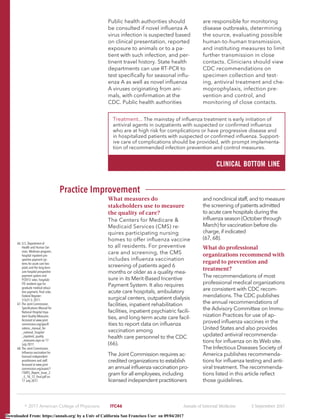
who present within 2 days of ill-
Table 3. Recommended Antiviral Drugs for Treatment and Chemoprophylaxis of Influenza in Adults*
Agent Mechanism of
Action
Dosage Benefits Adverse Effects and Notes
Zanamivir Inhibits influenza
virus
neuraminidase
to block
release of virus
particles from
infected
respiratory
tract cells
Treatment: 2 inhalations
(10 mg) twice daily for
5 d
Chemoprophylaxis: 2
inhalations (10 mg)
once daily; duration
based on ongoing
exposure
Early treatment shortens
duration of symptoms
by 1 d; chemopro-
phylaxis is
approximately
70%–90% effective in
preventing illness from
influenza; activity
against influenza A and
B viruses; activity
against some influenza
A viruses resistant to
other neuraminidase
inhibitors
Postmarketing reports suggest rare
bronchospasm; other adverse
effects include oropharyngeal or
facial edema, diarrhea, nausea,
sinusitis, nasal signs and
symptoms, bronchitis, cough,
headache, and dizziness as well
as ear, nose, and throat infections;
contraindicated in persons with
underlying airway disease;
pregnancy category C; approved
for early treatment of
uncomplicated disease in
outpatients; not recommended
for hospitalized patients due to
lack of data
Oseltamivir Inhibits influenza
virus
neuraminidase
to block
release of virus
particles from
infected
respiratory
tract cells
Treatment: 75 mg orally
twice daily for 5 d;
longer duration may
be indicated in
severely ill patients
Chemoprophylaxis: 75
mg orally once daily;
duration based on
ongoing exposure
Early treatment shortens
duration of symptoms
by 1 d
Chemoprophylaxis:
approximately
70%–90% effective in
preventing illness from
influenza; activity
against influenza A and
B viruses
Nausea and vomiting may occur
infrequently; postmarketing
reports of serious skin reactions
and sporadic, transient
neuropsychiatric events
(self-injury or delirium, mainly
among Japanese adolescents and
adults); dosage reduction for
creatinine clearance ≤60 mL/min;
pregnancy category C; approved
for early treatment of
uncomplicated disease in
outpatients; recommended by
the Centers for Disease Control
and Prevention for treatment of
hospitalized patients with
influenza; resistance may emerge,
especially in severely
immunosuppressed persons;
reduced effectiveness reported
for some influenza B virus
infections
Peramivir Inhibits influenza
virus
neuraminidase
to block
release of virus
particles from
infected
respiratory
tract cells
Treatment: One 600-mg
dose, via intravenous
infusion for 15–30 min
Single dose equivalent
to 5 d of oseltamivir;
activity against
influenza A and B
viruses; not for
chemoprophylaxis
Diarrhea; postmarketing reports of
serious skin reactions and
sporadic, transient
neuropsychiatric events
(self-injury or delirium, mainly
among Japanese adolescents and
adults); approved for early
treatment of uncomplicated
disease in outpatients; insufficient
data on efficacy for hospitalized
patients
* Updated information and guidance on use of antiviral medications for treatment and chemoprophylaxis of influenza are available
on the Web site of the Centers for Disease Control and Prevention (www.cdc.gov/flu/professionals/antivirals/index.htm).
஽ 2017 American College of Physicians ITC44 In the Clinic Annals of Internal Medicine 5 September 2017
Downloaded From: https://annals.org/ by a Univ of California San Francisco User on 09/04/2017
ness onset, clinical judgment can
be used to decide whether to pre-
scribe antiviral treatment.
Randomized clinical trials in out-
patients with uncomplicated
influenza have established the
efficacy of early (≤2 days after
illness onset) neuraminidase
inhibitor treatment to reduce
the duration of illness by ap-
proximately 0.6–1 day (60, 61).
A meta-analysis of randomized
controlled trials of oseltamivir
treatment versus placebo in
adult outpatients reported that
oseltamivir significantly re-
duced the risk for lower respira-
tory tract complications requir-
ing antibiotic treatment as well
as the risk for hospitalization for
any cause but increased the risk
for nausea and vomiting (60).
A meta-analysis of individual observational data
from3376patientsofallagesathighriskforhos-
pitalization with suspected or confirmed influ-
enza A(H1N1)pdm09 virus infection reported
that outpatient neuraminidase inhibitor treat-
ment was associated with a significantly reduced
likelihood of hospitalization compared with no
antiviral treatment (62).
Although oseltamivir and zanami-
vir are pregnancy category C
drugs, the CDC advises that preg-
nancy should not be considered a
contraindication. Oseltamivir is
recommended over inhaled zana-
mivir because of concerns about
lower lung volumes in pregnancy
causing reduced zanamivir distri-
bution and potential bronchos-
pasm (63). Cohort studies have
concluded that oseltamivir treat-
ment is safe and that there is no
evidence that treatment of preg-
nant women with this drug is asso-
ciated with any adverse pregnancy
or birth outcomes (64, 65).
An individual-patient–level meta-analysis (78
observational studies with >29 000 hospital-
ized patients with suspected or laboratory-
confirmed influenza A[H1N1]pdm09 virus in-
fection) reported that neuraminidase inhibitor
treatment of adults was associated with re-
duced risk for death compared with no antivi-
ral treatment. Treatment initiation within 2
days of illness onset was associated with re-
duced risk for death compared with starting
treatment more than 2 days after onset (59).
Similarly, when the analysis was limited to preg-
nant women, early initiation was associated with
reduced risk for death compared with no treat-
ment or later initiation of treatment, and neur-
aminidase inhibitor treatment at any time after
illness onset was associated with reduced risk for
death versus no treatment.
When should patients be
hospitalized?
Hospitalization should be consid-
ered for patients with significant
dehydration and severely ill per-
sons who have complications of
suspected or laboratory-confirmed
illness, especially those with respi-
ratory distress, hypoxemia, im-
paired cardiopulmonary function,
or altered mental status. Likewise,
patients who have an uncertain
clinical course or are frail at base-
line might require admission for
close observation.
When should clinicians consult
an infectious disease specialist
or public health authority?
Diagnostic consultation may be
useful in seriously ill patients in
whom influenza is suspected but
unproven, in patients with atypi-
cal presentations, when severe
complications are suspected, and
when the differential diagnosis is
broad (e.g., immunosuppressed
patients with pneumonia).
Infectious disease specialists can
guide the use of antiviral agents
and help determine the need for
antimicrobial agents and should
also be consulted if antiviral resis-
tance is suspected. They can help
manage severely immunosup-
pressed patients with influenza
and guide use of investigational
antivirals, either through a clinical
trial or for compassionate use.
Pulmonary or critical care special-
ists can help with procedures for
maintaining oxygenation in criti-
cally ill patients and obtaining
specimens for testing.
59. Muthuri SG, Venkatesan S,
MylesPR,Leonardi-BeeJ,
AlKhuwaitirTS,AlMamun
A,etal;PRIDEConsortium
Investigators.Effectiveness
ofneuraminidaseinhibi-
torsinreducingmortality
inpatientsadmittedto
hospitalwithinfluenzaA
H1N1pdm09virusinfec-
tion:ameta-analysisof
individualparticipantdata.
LancetRespirMed.2014;
2:395-404.[PMID:
24815805]
60. Dobson J, Whitley RJ,
Pocock S, Monto AS.
Oseltamivir treatment for
influenza in adults: a
meta-analysis of ran-
domised controlled trials.
Lancet. 2015;385:1729-
37. [PMID: 25640810]
61. Jefferson T, Jones MA,
Doshi P, Del Mar CB,
Hama R, Thompson MJ,
et al. Neuraminidase
inhibitors for preventing
and treating influenza in
healthy adults and chil-
dren. Cochrane Database
Syst Rev. 2014:
CD008965. [PMID:
24718923]
62. Venkatesan S, Myles PR,
Leonardi-Bee J, Muthuri
SG, Al Masri M, Andrews
N, et al. Impact of
outpatient neuramini-
dase inhibitor treatment
in patients infected with
influenza
A(H1N1)pdm09 at high
risk of hospitalization: an
individual participant
data metaanalysis. Clin
Infect Dis. 2017;64:
1328-1334. [PMID:
28199524]
63. Rasmussen SA, Kissin
DM, Yeung LF, MacFar-
lane K, Chu SY, Turcios-
Ruiz RM, et al; Pandemic
Influenza and Pregnancy
Working Group. Prepar-
ing for influenza after
2009 H1N1: special
considerations for preg-
nant women and new-
borns. Am J Obstet Gy-
necol. 2011;204:S13-20.
[PMID: 21333967]
64. Beau AB, Hurault-
Delarue C, Vial T, Mon-
tastruc JL, Damase-
Michel C, Lacroix I. Safety
of oseltamivir during
pregnancy: a compara-
tive study using the
EFEMERIS database.
BJOG. 2014;121:895-
900. [PMID: 24512604]
65. Graner S, Svensson T,
Beau AB, Damase-Michel
C, Engeland A, Furu K,
et al. Neuraminidase
inhibitors during preg-
nancy and risk of adverse
neonatal outcomes and
congenital malforma-
tions: population based
European register study.
BMJ. 2017;356:j629.
[PMID: 28246106]
5 September 2017 Annals of Internal Medicine In the Clinic ITC45 ஽ 2017 American College of Physicians
Downloaded From: https://annals.org/ by a Univ of California San Francisco User on 09/04/2017
Public health authorities should
be consulted if novel influenza A
virus infection is suspected based
on clinical presentation, reported
exposure to animals or to a pa-
tient with such infection, and per-
tinent travel history. State health
departments can use RT-PCR to
test specifically for seasonal influ-
enza A as well as novel influenza
A viruses originating from ani-
mals, with confirmation at the
CDC. Public health authorities
are responsible for monitoring
disease outbreaks, determining
the source, evaluating possible
human-to-human transmission,
and instituting measures to limit
further transmission in close
contacts. Clinicians should view
CDC recommendations on
specimen collection and test-
ing, antiviral treatment and che-
moprophylaxis, infection pre-
vention and control, and
monitoring of close contacts.
Practice Improvement
What measures do
stakeholders use to measure
the quality of care?
The Centers for Medicare &
Medicaid Services (CMS) re-
quires participating nursing
homes to offer influenza vaccine
to all residents. For preventive
care and screening, the CMS
includes influenza vaccination
screening of patients aged 6
months or older as a quality mea-
sure in its Merit-Based Incentive
Payment System. It also requires
acute care hospitals, ambulatory
surgical centers, outpatient dialysis
facilities, inpatient rehabilitation
facilities, inpatient psychiatric facili-
ties, and long-term acute care facil-
ities to report data on influenza
vaccination among
health care personnel to the CDC
(66).
The Joint Commission requires ac-
credited organizations to establish
an annual influenza vaccination pro-
gram for all employees, including
licensed independent practitioners
and nonclinical staff, and to measure
the screening of patients admitted
to acute care hospitals during the
influenza season (October through
March) for vaccination before dis-
charge, if indicated
(67, 68).
What do professional
organizations recommend with
regard to prevention and
treatment?
The recommendations of most
professional medical organizations
are consistent with CDC recom-
mendations. The CDC publishes
the annual recommendations of
the Advisory Committee on Immu-
nization Practices for use of ap-
proved influenza vaccines in the
United States and also provides
updated antiviral recommenda-
tions for influenza on its Web site.
The Infectious Diseases Society of
America publishes recommenda-
tions for influenza testing and anti-
viral treatment. The recommenda-
tions listed in this article reflect
those guidelines.
66. U.S. Department of
Health and Human Ser-
vices. Medicare program;
hospital inpatient pro-
spective payment sys-
tems for acute care hos-
pitals and the long-term
care hospital prospective
payment system and
FY2012 rates; hospitals'
FTE resident caps for
graduate medical educa-
tion payment; final rules.
Federal Register:
51631-3; 2011.
67. The Joint Commission.
Specifications Manual for
National Hospital Inpa-
tient Quality Measures.
Accessed at www.joint
commission.org/specifi
cations_manual_for
_national_hospital
_inpatient_quality
_measures.aspx on 17
July 2017.
68. The Joint Commission.
Influenza vaccination for
licensed independent
practitioners and staff.
Accessed at www.joint-
commission.org/assets/1
/18/R3_Report_Issue_3
_5_18_12_final.pdf on
17 July 2017.
Treatment... The mainstay of influenza treatment is early initiation of
antiviral agents in outpatients with suspected or confirmed influenza
who are at high risk for complications or have progressive disease and
in hospitalized patients with suspected or confirmed influenza. Support-
ive care of complications should be provided, with prompt implementa-
tion of recommended infection prevention and control measures.
CLINICAL BOTTOM LINE
஽ 2017 American College of Physicians ITC46 Annals of Internal Medicine 5 September 2017
Downloaded From: https://annals.org/ by a Univ of California San Francisco User on 09/04/2017
In the Clinic
Tool Kit
Influenza
Clinical Guidelines
www.idsociety.org/Guidelines/Patient_Care/IDSA
_Practice_Guidelines/Infections_By_Organism
-28143/Viruses/Influenza
Guidelines from the Infectious Diseases Society of
America.
www.idsociety.org/Guidelines/Patient_Care/IDSA
_Practice_Guidelines/Vaccination_of_the
_Immunocompromised_Host
Guidelines from the Infectious Diseases Society of America
for immunization in immunosuppressed patients.
www.who.int/csr/resources/publications/swineflu
/h1n1_guidelines_pharmaceutical_mngt.pdf
Guidelines from the World Health Organization for
pandemic influenza.
Patient Information
www.cdc.gov/flu/freeresources/print.htm
Information for patients and health care workers from
the Centers for Disease Control and Prevention (CDC)
(available in English and Spanish).
www.immunize.org/catg.d/p4208.pdf
Information for parents and patients.
www.acog.org/Patients/FAQs/The-Flu-Vaccine-and
-Pregnancy
Information for pregnant women on influenza and
influenza vaccination.
Information for Health Professionals From the
CDC
www.cdc.gov/flu/index.htm
www.cdc.gov/flu/weekly/fluactivitysurv.htm
Surveillance.
www.cdc.gov/flu/professionals/acip/index.htm
Vaccine recommendations.
www.cdc.gov/flu/professionals/diagnosis/index.htm
Testing information, including information on
interpretation of test results.
www.cdc.gov/flu/professionals/antivirals/index.htm
Antiviral information and current recommendations.
www.cdc.gov/flu/professionals/antivirals/summary
-clinicians.htm
Summary on antivirals.
www.cdc.gov/flu/avianflu/index.htm
Novel influenza A virus infections.
IntheClinic
5 September 2017 Annals of Internal Medicine ITC47 ஽ 2017 American College of Physicians
Downloaded From: https://annals.org/ by a Univ of California San Francisco User on 09/04/2017
WHAT YOU SHOULD
KNOW ABOUT INFLUENZA
What Is Influenza?
Influenza is a virus that makes you feel sick and can
cause serious health problems. It's often called
“the flu.” The flu is spread when an infected per-
son coughs or sneezes close to you. It is usually
spread during the winter or cooler months but
can be spread all year long.
What Are the Signs and
Symptoms?
• High fever
• Feeling tired and weak
• Feeling sore and achy
• Sore throat
• Cough
• Headache
How Is It Diagnosed?
Your doctor will ask you questions about your
symptoms. This is generally all the information
your doctor needs to diagnose the flu; however,
in some cases, you may need a physical exami-
nation or tests.
Can It Cause Health
Complications?
Usually the flu is not serious, and you will start to
feel better after 3 to 5 days and fully recover
within 1 to 2 weeks. However, in some persons it
can cause serious health complications resulting
in a hospital stay or even death. You are at
higher risk for flu complications if you are:
• Aged 65 years and older
• Pregnant
• Living in a nursing home
• American Indian or Alaska Native
• Obese
You are also at higher risk if you have certain
health problems. These include:
• Lung disease
• Heart disease
• Weakened immune system
How Is It Treated?
Your doctor may prescribe antiviral treatment for
the flu. All of the following are ways to feel
better:
• Rest.
• Stay hydrated by drinking lots of clear fluids.
• Use over-the-counter medicines, like
acetaminophen or ibuprofen, to help bring
your fever down. These medicines can also
help aches.
• Avoid taking aspirin.
If you are at risk for complications, your doctor
may prescribe medicines called antivirals that
help your body fight the flu virus. They may work
best if they are started within 2 days of getting
flu symptoms, but may still be helpful if they are
started after that time.
Should I Get a Flu Shot?
Everyone 6 months and older should get a flu
shot, preferably by the end of October each
year. There are different types of vaccines avail-
able. Ask your health care provider which is best
for you. If you have severe allergies to eggs, you
may get a flu shot but you should be watched by
a health care provider afterwards to make sure
you do not develop a bad reaction. You should
not get the flu shot if you ever had a serious al-
lergic reaction to it in the past.
How Can I Prevent Spreading
the Flu?
• If you think you have the flu, stay home from
work or school.
• Use a facemask or tissue to cover your mouth
and nose when coughing.
• Wash your hands often.
• Stay away from others until your fever is gone
and your cough is better.
For More Information
Centers for Disease Control and Prevention
https://www.cdc.gov/flu/index.htm
World Health Organization
www.who.int/mediacentre/factsheets/fs211/en/
In the Clinic
Annals of Internal Medicine
PatientInformation
Downloaded From: https://annals.org/ by a Univ of California San Francisco User on 09/04/2017

Influenza

  • 1.
    In the Clinic® InfluenzaPrevention Diagnosis Treatment Practice Improvement I nfluenza is an acute viral respiratory disease that affects persons of all ages and is associ- ated with millions of medical visits, hundreds of thousands of hospitalizations, and thousands of deaths during annual winter epidemics of variable severity in the United States. Elderly persons have the highest influenza-associated hospitalization and mortality rates. The primary method of prevention is annual vaccination. Early antiviral treatment has the greatest clinical benefit; otherwise, management includes ad- herence to recommended infection prevention and control measures as well as supportive care of complications. CME/MOC activity available at Annals.org. Physician Writer Timothy M. Uyeki, MD, MPH, MPP From the Influenza Division, Centers for Disease Control and Prevention, Atlanta, Georgia. doi:10.7326/AITC201709050 CMEObjective:Toreviewcurrentevidenceforprevention,diagnosis,treatment,andpractice improvementofinfluenza. FundingSource:AmericanCollegeofPhysicians. Acknowledgment:TheauthorthanksMargaretTrexlerHessen,MD,authoroftheprevious versionofthisIntheClinic. Disclaimer:Theviewsexpressedarethoseoftheauthoranddonotnecessarilyrepresentthe officialpositionoftheCentersforDiseaseControlandPrevention. Withtheassistanceofadditionalphysicianwriters,theeditorsofAnnalsofInternal MedicinedevelopIntheClinicusingMKSAPandotherresourcesoftheAmericanCollege ofPhysicians. IntheClinicdoesnotnecessarilyrepresentofficialACPclinicalpolicy.ForACPclinical guidelines,pleasegotohttps://www.acponline.org/clinical_information/guidelines/. Disclosures: Dr. Uyeki, ACP Contributing Author, has disclosed no conflicts of interest. His form can be viewed at www.acponline.org/authors/icmje/ConflictOfInterestForms .do?msNum=M17-1783. Annals of Internal Medicineᮋ © 2017 American College of Physicians Downloaded From: https://annals.org/ by a Univ of California San Francisco User on 09/04/2017
  • 2.
    Annual epidemics causedby in- fections with seasonal influenza A or B viruses occur during the win- ter months in temperate climates. Influenza activity may occur year- round in tropical and subtropical climates, peaking during cooler or rainy-season months. Influenza usu- ally involves self-limited symptoms of the upper respiratory tract, fatigue and myalgia, with or without fever. However, young children, elderly persons, pregnant women, and those with certain chronic medical conditions are at higher risk for se- vere disease. Influenza A viruses are classified into subtypes based on the 2 main sur- face glycoprotein components: hemagglutinin (referred to as “HA” or “H”) and neuraminidase (referred to as “NA” or “N”). Influenza viruses bind to receptors on the surface of respiratory epithelial cells (primarily of the upper tract) through the HA protein. Most humoral immunity against the HA protein, acquired through infection or vaccination, is virus strain–specific. Antigenic “drift” refers to HA gene mutations causing anti- genic changes in the HA protein so that antibodies acquired by prior infection or vaccination do not bind to antigenically drifted virus strains. Antigenic drift is the unpredictable evolutionary pro- cess that drives seasonal epidem- ics and is why year-round influenza surveillance and annual updating of vaccine strains are needed. Seasonal influenza viruses cur- rently circulating among humans worldwide include influenza A(H1N1)pdm09 and A(H3N2) vi- ruses and 2 main groups (or lin- eages) of influenza B viruses. Antigenic “shift” refers to human infection with a novel influenza A virus that is antigenically and ge- netically distinct from influenza A viruses circulating in humans. Novel influenza A viruses have public health importance be- cause they can cause sporadic human infections resulting from exposure to infected animals (usually poultry or pigs) as well as pandemics in which most of the population lacks immunity to the novel virus strain. Prevention Who is at greatest risk for complications and hospitalization? High-risk persons include young children younger than 5 years and particularly those under 2; adults aged 65 years and older; pregnant women; residents of nursing homes and other long- term care facilities; American In- dians and Alaska Natives; per- sons of any age with certain underlying medical conditions, such as chronic lung disease, car- diac disease (but not isolated hy- pertension), neurologic and neu- rodevelopmental conditions, hematologic disorders, kidney or liver disorders, metabolic diseases, or immunosuppression; persons younger than 19 years receiving long-term aspirin therapy; and ex- tremely obese persons (body mass index ≥40 kg/m2 ) (see the Box) (1). In the United States, persons aged 65 years and older have the highest rate of influenza- associated hospitalization, fol- lowed by those aged 50–64 years and then young children. Mortality rates are highest in per- sons aged 65 years and older. Who should receive vaccination, and when should it be given? All persons aged 6 months and older in the United States should be vaccinated annually, ideally before influenza activity begins in the community and by the end of October, if possible (1). Recent studies have reported evidence of waning vaccine effectiveness 1. Grohskopf LA, Sokolow LZ, Broder KR, Walter EB, Bresee JS, Fry AM, et al. Prevention and Control of Seasonal Influenza with Vaccines: Recommenda- tions of the Advisory Com- mittee on Immunization Practices (ACIP)—United States, 2017–18 Influenza Season. MMWR Recomm Rep. 2017. [Forthcoming] 2. Ferdinands JM, Fry AM, Reynolds S, Petrie J, Flan- nery B, Jackson ML, et al. Intraseason waning of influenza vaccine protec- tion: evidence from the US Influenza Vaccine Effectiveness Network, 2011–12 through 2014– 15. Clin Infect Dis. 2017; 64:544-550. [PMID: 28039340] 3. Belongia EA, Sundaram ME, McClure DL, Meece JK, Ferdinands J, Van- Wormer JJ. Waning vac- cine protection against influenza A (H3N2) illness in children and older adults during a single season. Vaccine. 2015;33: 246-51. [PMID: 24962752] 4. Madhi SA, Cutland CL, Kuwanda L, Weinberg A, Hugo A, Jones S, et al; Maternal Flu Trial (Matflu) Team. Influenza vaccina- tion of pregnant women and protection of their infants. N Engl J Med. 2014;371:918-31. [PMID: 25184864] 5. Tapia MD, Sow SO, Tam- boura B, Te´guete´ I, Pasetti MF, Kodio M, et al. Mater- nal immunisation with trivalent inactivated influ- enza vaccine for preven- tion of influenza in infants in Mali: a prospective, active-controlled, observer- blind, randomised phase 4 trial. Lancet Infect Dis. 2016;16:1026-35. [PMID: 27261067] 6. Steinhoff MC, Katz J, En- glund JA, Khatry SK, Shrestha L, Kuypers J, et al. Year-round influenza immunisation during pregnancy in Nepal: a phase 4, randomised, placebo-controlled trial. Lancet Infect Dis. 2017. [PMID: 28522338] ஽ 2017 American College of Physicians ITC34 In the Clinic Annals of Internal Medicine 5 September 2017 Downloaded From: https://annals.org/ by a Univ of California San Francisco User on 09/04/2017
  • 3.
    during the influenzaseason (2, 3), suggesting that summertime vaccination might be too early; however, more studies are needed. Clinicians need to keep abreast of possible changes in recommended timing of influ- enza vaccination. The Centers for Disease Control and Prevention (CDC) maintains updated recom- mendations on its Web site (see Tool Kit for links). Previously unvaccinated children aged 6 months up to 9 years should receive 2 doses at least 4 weeks apart in the first year of vaccination; for all other groups, revaccination is not recom- mended during influenza season. Although vaccination is not ap- proved for infants younger than 6 months, strategies to prevent influenza in this group include vaccination of pregnant women, household contacts aged 6 months and older, and caregiv- ers. Randomized controlled stud- ies have established that mater- nal vaccination can prevent influenza in infants (through transplacentally transferred anti- bodies) up to 6 months after birth (4–6). Although influenza activity in the United States usually peaks dur- ing December to March, it varies widely and may continue into April or May in some communi- ties. Influenza B viruses often peak later and circulate longer than influenza A viruses. As long as influenza viruses are circulat- ing in a community, influenza vaccination can be beneficial. Persons with significant febrile illness generally should not be vaccinated, based on clinical judgment; minor acute illness without significant fever is not a contraindication. If difficulties in vaccine produc- tion or distribution result in short- ages or delays, priority should be given to persons at high risk for severe disease or complications and to their close contacts, in- cluding health care workers (1). The CDC has provided recom- mendations on its Web site for prioritizing influenza vaccination under these circumstances. How effective is the vaccine? Effectiveness of influenza vaccine varies from season to season and is influenced by such factors as age, baseline health, and im- mune function as well as the de- gree of antigenic match between vaccine strains and circulating influenza viruses. If vaccine anti- gens and virus strains are well- matched, effectiveness is moder- ate; however, it is lower during seasons when they are mis- matched. Effectiveness can also vary by virus type and influenza A virus subtype. In a systematic re- view and meta-analysis of 10 ran- domized controlled trials, effi- cacy of the trivalent inactivated vaccine was found in 8 of 12 sea- sons, with a pooled efficacy of 59% (95% CI, 51%–67%) in adults aged 18–65 years (7). A recent systematic review and meta-analysis of studies of vaccine effectiveness in outpatients re- ported that the overall pooled effectiveness was 33% for A(H3N2), 54% for influenza B, and 61% for A(H1N1)pdm09. Effectiveness was 33% when the H3N2 vaccine antigen was well-matched to the circulating A(H3N2) viruses but only 23% when antigenic drift was present (8). For adults older than 60 years, pooled effectiveness was 24% for A(H3N2), 62% for A(H1N1)pdm09, and 63% for influenza B. Vaccination is moderately effec- tive in preventing hospitalization (9–12) and influenza-associated death in children (13) but is gen- erally less effective in elderly than in nonelderly persons. However, few clinical trials have focused on elderly persons, and selection bias may lead to vaccination of healthier persons. A meta-analysis of individual-participant data in- volving case–control studies of nearly 5000 community-dwelling older adults worldwide re- Groups at Greatest Risk for Influenza-Related Complications and Hospitalization Children aged <5 y, especially <2 y Adults aged ≥65 y Residents of nursing homes and long-term care facilities Pregnant women Persons aged <19 y receiving long-term aspirin therapy American Indians and Alaska Natives Persons of any age with the following chronic medical conditions: • Pulmonary disease (including asthma, chronic obstructive pulmonary disease, cystic fibrosis) • Cardiac disease (excluding isolated hypertension) • Neurologic and neurodevelopmental conditions • Hematologic disorders • Endocrine disorders • Renal disorders • Hepatic disease • Metabolic disease • Immunosuppression (due to disease or medication) • Extreme obesity (body mass index ≥40 kg/m2 ) 7. Osterholm MT, Kelley NS, Sommer A et al. Efficacy and effectiveness of influ- enza vaccines: a system- atic review and meta- analysis. Lancet Infect Dis. 2012 Jan;12(1):36-44. [PMID: 22032844] 8. Belongia EA, Simpson MD, King JP, Sundaram ME, Kelley NS, Osterholm MT, et al. Variable influ- enza vaccine effectiveness by subtype: a systematic review and meta-analysis of test-negative design studies. Lancet Infect Dis. 2016;16:942-51. [PMID: 27061888] 9. Havers F, Sokolow L, Shay DK, Farley MM, Monroe M, Meek J, et al. Case- control study of vaccine effectiveness in preventing laboratory-confirmed influenza hospitalizations in older adults, United States, 2010–2011. Clin Infect Dis. 2016;63:1304- 1311. [PMID: 27486114] 5 September 2017 Annals of Internal Medicine In the Clinic ITC35 ஽ 2017 American College of Physicians Downloaded From: https://annals.org/ by a Univ of California San Francisco User on 09/04/2017
  • 4.
    ported that vaccinationwas moderately effective (adjusted effectiveness was 44.4% during well- matched seasons and 20% during mismatched seasons) in preventing laboratory-confirmed in- fluenza (14). This study also found that vaccina- tion was effective in older adults with cardiovas- cular disease (adjusted effectiveness, 31%) or respiratory disease (adjusted effectiveness, 31%) and those aged 75 years or younger (adjusted ef- fectiveness, 33%). Recently, data have become available for vaccines with higher antigen content than standard- dose (SD) vaccine. One random- ized controlled trial that included more than 8500 adults aged 50 years or older reported that a recombinant vaccine with 3 times the HA antigen content for each strain provided greater protec- tion against laboratory-confirmed influenza than SD vaccine (15). A cluster randomized trial of high- dose (HD) inactivated influenza vaccine containing 4 times the antigen content for each strain ver- sus SD inactivated influenza vac- cine in elderly nursing home resi- dents reported that HD vaccine significantly reduced respiratory- related hospitalizations compared with SD vaccine (16). What vaccines are available? The composition of influenza vac- cines is updated annually. A wide variety of vaccines are approved and available in the United States (Table 1), including inactivated trivalent (IIV3) or quadrivalent Table 1. Approved Influenza Vaccines for U.S. Adults, 2017–2018 Season* Description Approved Ages Dose/Route Recommendation/Notes† Inactivated, standard dose, egg-grown, trivalent (IIV3s)‡ ≥18 y 0.5 mL/intramuscular Contains 15 mcg of each HA antigen per 0.5-mL dose (45 mcg total); one manufacturer's syringe tip cap on prefilled syringes might contain natural rubber latex (potential issue for persons with latex allergy) Inactivated, standard dose, egg-grown, quadrivalent (IIV4s)‡ ≥18 y 0.5 mL/intramuscular Contains 15 mcg of each HA antigen per 0.5-mL dose (60 mcg total) Inactivated, standard dose, cell culture–grown, quadrivalent (ccIIV4)‡ ≥18 y 0.5 mL/intramuscular Contains 15 mcg of each HA antigen per 0.5-mL dose (60 mcg total) Inactivated, standard dose, egg-grown, quadrivalent, intradermal (IIV4s)‡ 18–64 y 0.1 mL/intradermal Contains 9 mcg of each HA antigen per 0.1-mL dose (36 mcg total); preferred injection site is over the deltoid muscle using the prefilled microinjection device Inactivated, high dose, egg-grown, trivalent (IIV3)‡ ≥65 y 0.5 mL/intramuscular Contains 60 mcg of each HA antigen per 0.5-mL dose (180 mcg total) Adjuvanted inactivated, standard dose, cell culture–grown, trivalent (aIIV3)‡ ≥65 y 0.5 mL/intramuscular Contains 15 mcg of each HA antigen per 0.5-mL dose (45 mcg total) with an oil-in-water emulsion adjuvant; manufacturer's syringe tip cap on prefilled syringes might contain natural rubber latex (potential issue for persons with latex allergy) Recombinant trivalent (RIV3) ≥18 y 0.5 mL/intramuscular Contains 45 mcg of each HA antigen per 0.5-mL dose (135 mcg total) Recombinant quadrivalent (RIV4) ≥18 y 0.5 mL/intramuscular Contains 45 mcg of each HA antigen per 0.5-mL dose (180 mcg total) Live attenuated, egg-grown, quadrivalent (LAIV4) 2–49 y Intranasal Not recommended for the 2017–2018 season HA = hemagglutinin. * Contraindicated in persons with prior severe allergic reaction (e.g., anaphylaxis) to any vaccine component. Updated infor- mation and recommendations on use of influenza vaccines are available on the Web site of the Centers for Disease Control and Prevention (CDC) (www.cdc.gov/flu/professionals/vaccination/index.htm). † Caution in persons with moderate to severe acute illness (with or without fever) and in those with a history of Guillain-Barr´e syndrome within 6 weeks of receipt of influenza vaccine. ‡ Contraindicated in persons with prior severe allergic reactions (e.g., anaphylaxis) to any vaccine component or after previous influenza vaccination. The Advisory Committee on Immunization Practices and the CDC state that any licensed, recommended, and appropriate inactivated influenza vaccine or recombinant influenza vaccine can be administered to persons with egg allergy of any severity. 10. Grijalva CG, Zhu Y, Wil- liams DJ, Self WH, Am- pofo K, Pavia AT, et al. Association between hospitalization with community-acquired laboratory-confirmed influenza pneumonia and prior receipt of influ- enza vaccination. JAMA. 2015;314:1488-97. [PMID: 26436611] 11. Ferdinands JM, Olsho LE, Agan AA, Bhat N, Sulli- van RM, Hall M, et al; Pediatric Acute Lung Injury and Sepsis Investi- gators (PALISI) Network. Effectiveness of influenza vaccine against life- threatening RT-PCR- confirmed influenza illness in US children, 2010–2012. J Infect Dis. 2014;210:674-83. [PMID: 24676207] ஽ 2017 American College of Physicians ITC36 In the Clinic Annals of Internal Medicine 5 September 2017 Downloaded From: https://annals.org/ by a Univ of California San Francisco User on 09/04/2017
  • 5.
    (IIV4) vaccines; thevaccine given depends on the age of the recipi- ent (1). Vaccines typically be- come available in the late sum- mer and expire on 30 June after the end of each influenza season. IIV3 vaccines contain 2 influenza A virus antigens—an A(H3N2) and an A(H1N1)pdm09 virus—and 1 influenza B virus antigen. IIV4 vaccines contain A(H3N2) and A(H1N1)pdm09 virus antigens and 2 influenza B virus antigens—1 each of the 2 main circulating lineages (B/Yamagata and B/Victoria). Most IIV3 and IIV4 vaccines are given by intra- muscular injection; however, an intradermal IIV4s vaccine is avail- able for adults aged 18–64 years. Most viruses are grown in embry- onated chicken eggs and then inactivated; however, 2 approved vaccines use antigens that are not grown in eggs, including 1 quadrivalent vaccine comprising viruses that are grown in tissue cell culture (ccIIV4) and then inac- tivated. One vaccine approved for adults that is not based on cultured viruses is a recombinant HA vaccine (RIV3 or RIV4) pro- duced in insect cells. For persons aged 65 years and older, SD vaccines have de- creased immunogenicity and ef- fectiveness. Two vaccines are now available that may improve protection in this group: an adju- vanted IIV, and an HD IIV with 4 times the antigen concentration of SD vaccines. Live attenuated influenza virus vaccine is approved by the U.S. Food and Drug Administration for intranasal administration for nonpregnant healthy persons (without underlying medical condi- tions) aged 2–49 years. However, due to poor effectiveness over multiple seasons, particularly for the influenza A(H1N1)pdm09 virus strain, the Advisory Committee on Immunization Practices and the CDC recommended that this vac- cine not be used for the 2016– 2017 or 2017–2018 seasons (1). What adverse effects are associated with vaccination? The most common adverse effect from injectable inactivated influ- enza vaccines is soreness at the injection site for about 2 days (1). Pain, low-grade fever, myalgia, headache, and fatigue are less common and may last 1–2 days. Erythema, induration, swelling, and pruritus may be more com- mon with intradermal vaccines. Studies of influenza vaccination in pregnant women have not identi- fied any significant adverse pregnancy or fetal outcomes (17–21). Whether influenza vaccination increases the risk for Guillain- Barre´ syndrome (GBS) is un- known. One systematic review and meta-analysis of observa- tional studies reported a slight association between influenza vaccination and GBS (22). In gen- eral, persons who previously had GBS within 6 weeks after being vaccinated and are not at risk for severe influenza complications should not be vaccinated. For persons who are more likely to have influenza complications, the small risk for GBS is probably outweighed by the benefit of vaccination, which can also re- duce the small risk for GBS that can be triggered by influenza virus infection (23, 24). For non- pregnant adults, some studies have reported a low risk for GBS (approximately 1 case per 1 mil- lion vaccinated persons) (1). How should clinicians approach vaccination in persons with severe allergies? Anaphylaxis after influenza vacci- nation is rare. Although most in- fluenza vaccines are grown in embryonated chicken eggs 12. Petrie JG, Ohmit SE, Cheng CK, Martin ET, Malosh RE, Lauring AS, et al. Influenza vaccine effectiveness against antigenically drifted influenza higher than expected in hospitalized adults: 2014–2015. Clin Infect Dis. 2016;63: 1017-25. [PMID: 27369320] 13. Flannery B, Reynolds SB, Blanton L, Santibanez TA, O’Halloran A, Lu PJ, et al. Influenza vaccine effec- tiveness against pediatric deaths: 2010–2014. Pediatrics. 2017;139. [PMID: 28557757] 14. Darvishian M, van den Heuvel ER, Bissielo A, Castilla J, Cohen C, En- glund H, et al. Effective- ness of seasonal influ- enza vaccination in community-dwelling elderly people: an indi- vidual participant data meta-analysis of test- negative design case- control studies. Lancet Respir Med. 2017;5: 200-211. [PMID: 28189522] 15. Dunkle LM, Izikson R, Patriarca P, Goldenthal KL, Muse D, Callahan J, et al; PSC12 Study Team. Efficacy of recombinant influenza vaccine in adults 50 years of age or older. N Engl J Med. 2017;376:2427-2436. [PMID: 28636855] 16. Gravenstein S, Davidson HE, Taljaard M, Ogarek J, Gozalo P, Han L, et al. Comparative effective- ness of high-dose versus standard-dose influenza vaccination on numbers of US nursing home residents admitted to hospital: a cluster- randomised trial. Lancet Respir Med. 2017. [PMID: 28736045] 17. Polyzos KA, Konstantelias AA, Pitsa CE, Falagas ME. Maternal influenza vacci- nation and risk for con- genital malformations: a systematic review and meta-analysis. Obstet Gynecol. 2015;126: 1075-84. [PMID: 26444106] 18. McMillan M, Porritt K, Kralik D, Costi L, Marshall H. Influenza vaccination during pregnancy: a systematic review of fetal death, spontaneous abortion, and congenital malformation safety outcomes. Vaccine. 2015;33:2108-17. [PMID: 25758932] 19. Bratton KN, Wardle MT, Orenstein WA, Omer SB. Maternal influenza im- munization and birth outcomes of stillbirth and spontaneous abor- tion: a systematic review and meta-analysis. Clin Infect Dis. 2015;60: e11-9. [PMID: 25409473] 5 September 2017 Annals of Internal Medicine In the Clinic ITC37 ஽ 2017 American College of Physicians Downloaded From: https://annals.org/ by a Univ of California San Francisco User on 09/04/2017
  • 6.
    (except RIV3, RIV4,and ccIIV4 vaccines), severe reactions—even in persons with egg allergies—are uncommon. Influenza vaccine can be given to persons with a history of egg allergy who have had only hives after exposure to eggs. Persons who report other allergic symptoms, such as an- gioedema, respiratory distress, lightheadedness, or recurrent vomiting, or those who required epinephrine or other emergency medical intervention for anaphy- laxis can still be vaccinated, but it should be done in an inpatient or outpatient medical setting super- vised by a health care provider who can recognize and manage severe allergic reactions (1). However, anyone who has had a more severe allergic reaction should not be vaccinated. What is the role of behavioral strategies to prevent transmission? Immunocompetent persons who are symptomatic from uncompli- cated influenza virus infection can shed viruses from the upper respiratory tract for approxi- mately 4–7 days, although shed- ding and transmissibility gener- ally decrease substantially after 3 days. Influenza viruses are be- lieved to be transmitted primarily by large and small particle drop- lets that are expelled by cough- ing or sneezing by an infected person to susceptible close con- tacts. Contact transmission has been suggested indirectly through hand hygiene studies. The role of asymptomatically in- fected or presymptomatic per- sons in transmitting the viruses is unknown, but this is believed to be uncommon. A systematic review and meta-analysis ex- amined randomized clinical trials studying the efficacy of hand hygiene (with or with- out facemasks) in reducing influenza virus transmission in community settings (house- holds). It reported that hand hygiene com- bined with facemasks resulted in a statisti- cally significant reduction in laboratory- confirmed transmission (relative risk, 0.73 [CI, 0.53–0.99]; P = 0.05), but hand hygiene alonedidnot(25).Anotherreviewconcludedthat evidence of the efficacy of nonpharmaceutical in- terventions, such as facemasks and hand hy- giene, to reduce transmission was lacking, with most studies being significantly flawed (26). Community nonpharmaceutical interventions, such as school clo- sures, have been implemented to control seasonal and pandemic in- fluenza; effectiveness has varied (27). What is the role of antiviral agents in prevention? The neuraminidase inhibitors oral oseltamivir and inhaled zanamivir are approved for antiviral treat- ment and chemoprophylaxis of influenza. Antiviral chemoprophy- laxis (before or after exposure) of individuals or in households has moderate to high effectiveness for influenza prevention (28) but is not routinely recommended. Antiviral chemoprophylaxis can be consid- ered for persons in whom vaccina- tion is contraindicated or who are not expected to benefit, such as severely immunosuppressed patients. Antiviral chemoprophylaxis is an important component of a bundle of interventions to control institu- tional influenza outbreaks, and oseltamivir chemoprophylaxis has been shown to be effective in con- trolling established outbreaks in nursing homes (29–31). When an institutional outbreak is recog- nized, some exposed residents or patients may already be incubat- ing influenza virus when antiviral chemoprophylaxis is imple- mented. Therefore, consideration can be given to twice-daily (i.e., treatment dosing) versus once- daily chemoprophylaxis dosing in long-term care facilities or health care facilities, including in immu- nosuppressed persons (32, 33). A cluster randomized trial compared oseltami- vir treatment of symptomatic persons with os- 20. Fell DB, Platt RW, Lanes A, Wilson K, Kaufman JS, Basso O, et al. Fetal death and preterm birth associated with maternal influenza vaccination: systematic review. BJOG. 2015;122:17-26. [PMID: 25040307] 21. Kharbanda EO, Vazquez- Benitez G, Romitti PA, Naleway AL, Cheetham TC, Lipkind HS, et al; Vaccine Safety Datalink. First trimester influenza vaccination and risks for major structural birth defects in offspring. J Pediatr. 2017. [PMID: 28550954] 22. Martı´n Arias LH, Sanz R, Sa´inz M et al. Guillain- Barre´ syndrome and influenza vaccines: a meta-analysis. Vaccine. 2015 Jul 17;33(31): 3773-8. [PMID: 25749247] 23. Sivadon-Tardy V, Or- likowski D, Porcher R, Sharshar T, Durand MC, Enouf V, et al. Guillain- Barre´ syndrome and influenza virus infection. Clin Infect Dis. 2009;48: 48-56. [PMID: 19025491] 24. Lehmann HC, Hartung HP, Kieseier BC, Hughes RA. Guillain-Barre´ syn- drome after exposure to influenza virus. Lancet Infect Dis. 2010;10:643- 51. [PMID: 20797646] 25. Wong VW, Cowling BJ, Aiello AE. Hand hygiene and risk of influenza virus infections in the community: a systematic review and meta- analysis. Epidemiol In- fect. 2014;142:922-32. [PMID: 24572643] 26. Smith SM, Sonego S, Wallen GR, Waterer G, Cheng AC, Thompson P. Use of non- pharmaceutical inter- ventions to reduce the transmission of influ- enza in adults: a sys- tematic review. Respi- rology. 2015;20:896- 903. [PMID: 25873071] 27. Jackson C, Vynnycky E, Hawker J, Olowokure B, Mangtani P. School closures and influenza: systematic review of epidemiological studies. BMJ Open. 2013;3. [PMID: 23447463] 28. Okoli GN, Otete HE, Beck CR, Nguyen-Van-Tam JS. Use of neuraminidase inhibitors for rapid con- tainment of influenza: a systematic review and meta-analysis of individ- ual and household trans- mission studies. PLoS One. 2014;9:e113633. [PMID: 25490762] ஽ 2017 American College of Physicians ITC38 In the Clinic Annals of Internal Medicine 5 September 2017 Downloaded From: https://annals.org/ by a Univ of California San Francisco User on 09/04/2017
  • 7.
    eltamivir chemoprophylaxis forelderly long- term care residents over 3 seasons. It found that postexposure chemoprophylaxis reduced the influenza attack rate among residents compared with treating symptomatic per- sons (34). One multicountry randomized controlled trial of oseltamivir chemoprophy- laxis versus placebo for 6 weeks in vacci- nated nursing home residents reported high efficacy in preventing outbreaks (35). During an institutional outbreak, unvaccinated staff members and residents should receive influ- enza vaccine if it is available. In nursing homes, the potential for high-intensity virus exposure and possible suboptimal immune re- sponse to vaccine by debilitated residents suggests that all resi- dents, regardless of previous vaccination, should receive che- moprophylaxis in an outbreak. Antiviral medications should be continued for at least 2 weeks, and then for 1 week longer than the duration of the outbreak. Antiviral chemoprophylaxis may also be considered for high-risk persons and close contacts (in- cluding health care workers) when vaccine is unavailable or contraindicated, when a major difference exists between the predominant virus antigens and the vaccine strains such that ef- fectiveness is expected to be very low, or when severe immu- nosuppression makes response to the vaccine unlikely. What measures should clinicians take to prevent influenza among patients and staff in health care institutions? All health care personnel should be vaccinated annually unless it is contraindicated or the vaccine is unavailable. In outpatient set- tings, persons with suspected or confirmed influenza should be encouraged to adhere to respira- tory hygiene, cough etiquette (use facemasks or tissues to cover the nose and mouth when coughing, and dispose of con- taminated materials), and hand hygiene recommendations. For inpatient settings, patients with suspected or confirmed influenza should be isolated or cohorted (co-located) if isolation is not possible. Standard and droplet precautions are recommended, and for aerosol-generating pro- cedures a fit-tested N95 respira- tor or respirator equivalent is rec- ommended (36). The use of standing orders, which allow trained health care profes- sionals other than physicians to identify and vaccinate high-risk patients, improves influenza vac- cine coverage of hospitalized pa- tients at discharge and nursing home residents, especially if struc- tured in an “opt-out” format. Like- wise, providing free vaccination at convenient times and places may increase coverage among hospital and nursing home staff. During outbreaks, infection pre- vention and control measures, such as limiting visitors, using droplet precautions, isolating or cohorting symptomatic patients, and performing active daily sur- veillance for new cases, should also be implemented. 29. Bowles SK, Lee W, Simor AE, Vearncombe M, Loeb M, Tamblyn S, et al; Oseltamivir Compassion- ate Use Program Group. Use of oseltamivir during influenza outbreaks in Ontario nursing homes, 1999–2000. J Am Geri- atr Soc. 2002;50:608-16. [PMID: 11982659] 30. Gorisˇek Miksic N, Ursˇic T, Simonovic Z, Lusa L, Lobnik Rojko P, Petrovec M, et al. Oseltamivir prophylaxis in controlling influenza outbreak in nursing homes: a com- parison between three different approaches. Infection. 2015;43:73- 81. [PMID: 25403263] 31. Ye M, Jacobs A, Khan MN, Jaipaul J, Oda J, Johnson M, et al. Evalua- tion of the use of oselta- mivir prophylaxis in the control of influenza out- breaks in long-term care facilities in Alberta, Can- ada: a retrospective pro- vincial database analysis. BMJ Open. 2016;6: e011686. [PMID: 27381211] 32. Shijubo N, Yamada G, Takahashi M, Tokunoh T, Suzuki T, Abe S. Experi- ence with oseltamivir in the control of nursing home influenza A out- break. Intern Med. 2002; 41:366-70. [PMID: 12058885] 33. Buchbinder N, Dumesnil C, Pinquier D, Merle V, Filhon B, Schneider P, et al. Pandemic A/H1N1/ 2009 influenza in a paediatric haematology and oncology unit: suc- cessful management of a sudden outbreak. J Hosp Infect. 2011;79:155-60. [PMID: 21783276] 34. Booy R, Lindley RI, Dw- yer DE, Yin JK, Heron LG, Moffatt CR, et al. Treating and preventing influenza in aged care facilities: a cluster randomised con- trolled trial. PLoS One. 2012;7:e46509. [PMID: 23082123] 35. Peters PH Jr, Gravenstein S, Norwood P, De Bock V, Van Couter A, Gibbens M, et al. Long-term use of oseltamivir for the prophylaxis of influenza in a vaccinated frail older population. J Am Geriatr Soc. 2001;49:1025-31. [PMID: 11555062] 36. Centers for Disease Con- trol and Prevention. Prevention Strategies for Seasonal Influenza in Healthcare Settings. Accessed at www.cd- c.gov/flu/professionals/ infectioncontrol/healthca- resettings.htm on 17 July 2017. Prevention... Annual influenza vaccination is recommended for all per- sons aged 6 months and older in the United States, including health care personnel. Vaccination is moderately effective in preventing influ- enza. Recent studies have suggested that it may also help to reduce the risk for some complications associated with influenza, including hospi- talization and death. Antiviral chemoprophylaxis can be an adjunct to influenza vaccination under some circumstances. CLINICAL BOTTOM LINE 5 September 2017 Annals of Internal Medicine In the Clinic ITC39 ஽ 2017 American College of Physicians Downloaded From: https://annals.org/ by a Univ of California San Francisco User on 09/04/2017
  • 8.
    Diagnosis What signs andsymptoms should prompt clinicians to suspect influenza? Signs and symptoms of uncom- plicated influenza frequently overlap with those of other respi- ratory viral infections, but abrupt onset of fever, especially high fever or feverishness, and cough can help in differentiation, espe- cially if influenza activity is pres- ent in the community (37–39). Although weakness, myalgia, sore throat, nausea, rhinorrhea, and headache are common in patients with influenza, they oc- cur with similar frequency in other viral illnesses. Not all per- sons with influenza manifest fe- ver, including immunosup- pressed and elderly persons (40). Young children with respiratory symptoms may have diarrhea, and adults with respiratory symp- toms may have vomiting. The presence of crackles or de- creased breath sounds on chest examination may suggest such pulmonary complications as viral pneumonia, secondary bacterial pneumonia, or heart failure. When should clinicians suspect novel influenza A virus infection? The key to diagnosing novel in- fluenza A virus infection is to elicit a history of recent exposure to poultry or pigs where novel influ- enza A viruses are circulating among animal hosts, or expo- sure to an ill person with novel influenza A virus infection. Dis- ease severity in infected animals does not necessarily correlate with severity in infected humans. Similar to seasonal influenza, a wide clinical spectrum of human infection with novel influenza A viruses has been reported, in- cluding asymptomatic infection, conjunctivitis only, upper respira- tory tract illness, pneumonia, en- cephalopathy and encephalitis, and multiorgan failure with fatal outcomes (41, 42). Therefore, novel influenza A virus infection cannot be distinguished from seasonal influenza A virus infection by clinical findings or by commer- cially available tests and must be diagnosed by specific influenza molecular assays at public health laboratories (43, 44). When should clinicians test to confirm a clinical diagnosis? Influenza testing (Table 2) is not needed to confirm the clinical diagnosis or to decide whether to prescribe antiviral medications to a patient when influenza vi- ruses are circulating in the com- munity (45). Testing should be considered when the results will influence individual clinical man- agement decisions. In an institu- tional (long-term care facility or hospital ward) outbreak of respi- ratory illness, diagnostic testing can help establish influenza as the cause, supporting prompt implementation of prevention and control measures. Respiratory specimens should be collected as close to illness onset as possible. In critically ill patients, the diagnosis may be missed if only upper respiratory tract speci- mens are tested, even with molec- ular assays. Viral replication may be prolonged in the lower respira- tory tract, and testing endotracheal aspirate or bronchoalveolar fluid specimens may thus yield a diag- nosis of influenza (46, 47). Clinicians must understand the limitations of influenza tests and interpretation of their results (48, 49). Sensitivity of virus detection is generally higher in children than in adults, higher with naso- pharyngeal or nasal specimens than with throat samples, and higher during the first few days of illness. The positive predictive 37. Monto AS, Gravenstein S, Elliott M, Colopy M, Schweinle J. Clinical signs and symptoms predicting influenza infection. Arch Intern Med. 2000;160:3243-7. [PMID: 11088084] 38. Shah SC, Rumoro DP, Hallock MM, Trenholme GM, Gibbs GS, Silva JC, et al. Clinical predictors for laboratory-confirmed influenza infections: exploring case defini- tions for influenza-like illness. Infect Control Hosp Epidemiol. 2015; 36:241-8. [PMID: 25695163] 39. Lam PP, Coleman BL, Green K, Powis J, Rich- ardson D, Katz K, et al. Predictors of influenza among older adults in the emergency depart- ment. BMC Infect Dis. 2016;16:615. [PMID: 27793117] 40. Falsey AR, Baran A, Walsh EE. Should clinical case definitions of influ- enza in hospitalized older adults include fever? Influenza Other Respir Viruses. 2015;9 Suppl 1:23-9. [PMID: 26256292] 41. Freidl GS, Meijer A, de Bruin E, de Nardi M, Munoz O, Capua I, et al; FLURISK Consortium. Influenza at the animal- human interface: a re- view of the literature for virological evidence of human infection with swine or avian influenza viruses other than A(H5N1). Euro Surveill. 2014;19. [PMID: 24832117] 42. Uyeki TM, Katz JM, Jerni- gan DB. Novel influenza A viruses and pandemic threats. Lancet. 2017; 389:2172-2174. [PMID: 28589883] 43. Centers for Disease Con- trol and Prevention. Interim Guidance for Specimen Collection, Processing, and Testing for Patients with Sus- pected Infection with Novel Influenza A Viruses Associated with Severe Disease in Humans. Accessed at www.cdc.gov/flu/ avianflu/h7n9/specimen- collection.htm on 17 July 2017. 44. Centers for Disease Con- trol and Prevention. Interim Guidance for Clinicians on Human Infections with Variant Influenza Viruses. Ac- cessed at www.cdc.gov /flu/swineflu/interim -guidance-variant-flu.htm on 17 July 2017. ஽ 2017 American College of Physicians ITC40 In the Clinic Annals of Internal Medicine 5 September 2017 Downloaded From: https://annals.org/ by a Univ of California San Francisco User on 09/04/2017
  • 9.
    value of thetests is highest dur- ing high influenza activity, and the negative predictive value is highest during low influenza ac- tivity or outside the season. Clini- cians who are evaluating travel- ers returning from overseas should understand that during periods of low influenza activity in the United States, activity may be high in temperate climates in the Southern Hemisphere and that influenza activity occurs year- round in countries with tropical and subtropical climates. Different influenza tests (Table 2) are available for respiratory spec- imens (50). The most accurate tests with the highest sensitivity and specificity are molecular as- says, including reverse transcrip- tion polymerase chain reaction (RT-PCR) assays (51). Most molec- ular assays take about 60–80 minutes to produce results, but some require only 20 minutes, with moderately high sensitivity compared with other molecular assays. Antigen detection assays, including rapid influenza tests that yield results in approxi- mately 10 minutes, and immuno- fluorescence assays have low to moderate sensitivity in detecting influenza viruses in respiratory specimens; therefore, false- negative results with these tests are common during peak influ- enza activity. For hospitalized patients with suspected influ- enza, molecular assays are rec- ommended (51). Isolation and implementation of infection pre- vention and control measures and initiation of empirical antivi- ral treatment should not be de- layed pending test results. Viral culture is important for influ- enza virus surveillance and public health but does not yield timely results to inform clinical manage- ment. Serologic testing should not be routinely done to diagnose in- fluenza because of the need for collection of acute and convales- cent serum specimens. Serologic testing of a single serum specimen is not interpretable and has no role in diagnosis or clinical manage- ment of seasonal influenza. Diagnosing influenza through test- ing can preclude unnecessary anti- biotic use and additional labora- tory tests and facilitate antiviral use and patient isolation (52, 53). Table 2. Influenza Diagnostic Tests* Name Method Time to Results Performance Notes Rapid diagnostic test Antigen detection 10 min Low to moderate sensitivity; high specificity Negative results may not rule out influenza; most assays are approved for point-of-care use Rapid molecular assay Viral RNA detection 15–20 min Moderate to high sensitivity; high specificity Negative results may not rule out influenza; some assays are approved for point-of-care use Immunofluorescence assay Antigen detection 2–4 h Moderate sensitivity; high specificity Negative results may not rule out influenza; requires trained laboratory personnel with fluorescent microscope in a moderately sophisticated clinical laboratory Molecular assay Viral RNA detection 60–80 min for some assays; up to 4–6 h for others High sensitivity; high specificity Negative results may not always rule out influenza, especially in critically ill patients Tissue cell viral culture Virus isolation 3–10 d High sensitivity; high specificity Negative results may not always rule out influenza; molecular assays have higher sensitivity * Respiratory tract specimens should be collected as close to illness onset as possible for testing. Serologic testing is not recom- mended. Updated information and guidance on the use of influenza diagnostic tests and interpretation of results are available on the Web site of the Centers for Disease Control and Prevention (www.cdc.gov/flu/professionals/diagnosis/index.htm). 45. Centers for Disease Con- trol and Prevention. Guide for considering influenza testing when influenza viruses are circulating in the com- munity. Accessed at www.cdc.gov/flu/ professionals/diagnosis/ consider-influenza- testing.htm on 17 July 2017. 46. Rice TW, Rubinson L, Uyeki TM, Vaughn FL, John BB, Miller RR 3rd, et al; NHLBI ARDS Net- work. Critical illness from 2009 pandemic influ- enza A virus and bacte- rial coinfection in the United States. Crit Care Med. 2012;40:1487-98. [PMID: 22511131] 47. Rello J, Rodrı´guez A, Iban˜ez P, Socias L, Ce- brian J, Marques A, et al; H1N1 SEMICYUC Work- ing Group. Intensive care adult patients with se- vere respiratory failure caused by influenza A (H1N1)v in Spain. Crit Care. 2009;13:R148. [PMID: 19747383] 48. Centers for Disease Con- trol and Prevention. Algorithm to assist in the interpretation of influ- enza testing results and clinical decision-making during periods when influenza viruses are circulating in the com- munity. Accessed at www.cdc.gov/flu/ professionals/diagnosis/ algorithm-results- circulating.htm on 17 July 2017. 5 September 2017 Annals of Internal Medicine In the Clinic ITC41 ஽ 2017 American College of Physicians Downloaded From: https://annals.org/ by a Univ of California San Francisco User on 09/04/2017
  • 10.
    What complications are associatedwith influenza? Complications vary by age, im- mune function, and underlying medical conditions. Influenza may exacerbate underlying chronic disease (e.g., chronic ob- structive pulmonary disease or heart failure). Persons with chronic obstructive pulmonary disease or severe immunosuppression and elderly persons may be at greater risk for pneumonia with influenza. Other complications include otitis media, bronchiolitis, and croup in young children and sinusitis in older children and adults. Bronchospasm, bronchi- tis, and pneumonia can occur at any age. Pneumonia can be di- rectly due to influenza virus or bacterial co-infection; can occur with or without pleural effusion; and can progress rapidly to re- spiratory failure, acute respiratory distress syndrome, and refractory hypoxemia. Cardiac complica- tions include myocarditis, peri- carditis, heart failure, and myo- cardial infarction. A wide range of neurologic complications in- cludes seizures, transient en- cephalopathy to acute necrotiz- ing encephalopathy and encephalitis, cerebrovascular ac- cident, acute disseminated en- cephalomyelitis, and GBS. Mus- culoskeletal complications include severe myositis and rhab- domyolysis. Levels of hepatic aminotransferases can be ele- vated, but liver failure is rare. Bacterial co-infection can result in pneumonia, bacteremia, and meningitis. Acute kidney injury and renal failure can occur in some patients. Critically ill pa- tients may manifest with multior- gan failure (respiratory and re- nal), shock, and sepsis. When should clinicians suspect bacterial co-infection in patients believed to have influenza? Clinicians should consider bacte- rial co-infection in patients with suspected or confirmed influenza who present with severe disease, remain ill, worsen, or have acute onset of high fever or respiratory distress after initial improvement. Adults with uncomplicated influ- enza typically have fever and symptoms for about 3 days, by which time most show signs of im- provement. Although it may take 10–14 days for complete recovery, and longer in older adults, lack of improvement or worsening symp- toms suggest either a complica- tion or an alternative diagnosis. The bacteria most commonly im- plicated in community-acquired pneumonia with influenza are Streptococcus pneumoniae, Staph- ylococcus aureus (both methicillin- sensitive and methicillin-resistant), and group A Streptococcus (54). An association between bacterial meningitis due to Neisseria menin- gitides and influenza has been reported (55). Patients who remain febrile for more than 3–5 days or who de- velop fever, worsening symp- toms, or progressive disease re- quire evaluation. Symptoms and clinical findings should guide blood tests, cultures, and imag- ing studies. Consultation with an infectious disease specialist should be considered, especially if the patient is severely ill or im- munosuppressed. The differen- tial diagnosis should be ex- panded to include bacterial infection in patients whose condi- tion deteriorates rapidly, and work-up and treatment should be adjusted accordingly. 49. Centers for Disease Con- trol and Prevention. Algorithm to assist in the interpretation of influ- enza testing results and clinical decision-making during periods when influenza viruses are NOT circulating in the com- munity. Accessed at www.cdc.gov/flu/ professionals/diagnosis/ algorithm-results-not- circulating.htm on 17 July 2017. 50. Centers for Disease Con- trol and Prevention. Influenza Virus Testing Methods. Accessed at www.cdc.gov/flu/ professionals/diagnosis/ table-testing- methods.htm on 17 July 2017. 51. Centers for Disease Con- trol and Prevention. Guidance for Clinicians on the Use of RT-PCR and Other Molecular Assays for Diagnosis of Influenza Virus Infection. Accessed at www.cdc.gov/flu/ professionals/diagnosis/ molecular-assays.htm on 17 July 2017. 52. Blaschke AJ, Shapiro DJ, Pavia AT, Byington CL, Ampofo K, Stockmann C, et al. A national study of the impact of rapid influ- enza testing on clinical care in the emergency department. J Pediatric Infect Dis Soc. 2014;3: 112-8. [PMID: 24872879] 53. Busson L, Mahadeb B, De Foor M, Vandenberg O, Hallin M. Contribution of a rapid influenza diag- nostic test to manage hospitalized patients with suspected influenza. Diagn Microbiol Infect Dis. 2017;87:238-242. [PMID: 27939284] 54. Shieh WJ, Blau DM, Denison AM, Deleon- Carnes M, Adem P, Bhat- nagar J, et al. 2009 pandemic influenza A (H1N1): pathology and pathogenesis of 100 fatal cases in the United States. Am J Pathol. 2010;177:166-75. [PMID: 20508031] 55. Jacobs JH, Viboud C, Tchetgen ET, Schwartz J, Steiner C, Simonsen L, et al. The association of meningococcal disease with influenza in the United States, 1989– 2009. PLoS One. 2014; 9:e107486. [PMID: 25265409] ஽ 2017 American College of Physicians ITC42 In the Clinic Annals of Internal Medicine 5 September 2017 Downloaded From: https://annals.org/ by a Univ of California San Francisco User on 09/04/2017
  • 11.
    Treatment What is therole of hydration and antipyretics? Hydration is important to replace insensible water loss that occurs with fever. Antipyretics, such as acetaminophen or ibuprofen, can help reduce fever and prevent further insensible water loss. Re- duction of fever can prevent other consequences of increased metabolic rate, such as tachycar- dia, and relieve such symptoms as chills and myalgia. There is no convincing evidence that anti- pyretic therapy prolongs or shortens the disease course. As- pirin and aspirin-containing med- ication must be avoided in pa- tients with suspected or confirmed influenza, particularly in adolescents and children, be- cause of the association between salicylates and Reye syndrome in persons with influenza (56, 57). What is the role of antiviral medications? Neuraminidase inhibitors (oral oseltamivir, inhaled zanamivir, and intravenous peramivir) are recommended antiviral treat- ments for influenza. Treatment duration in outpatients is typically 5 days. These drugs have activity against influenza A and B viruses but differ by approved age groups, routes of administration, and adverse effects (Table 3). Dual neuraminidase inhibitor treatment is not recommended because of reports of antago- nism with this therapy compared with monotherapy (58). Inhaled zanamivir is generally not recom- mended for hospitalized pa- tients. In critically ill patients, os- eltamivir can be given enterally by orogastric or nasogastric ad- ministration. The adamantane drugs (amantadine and rimanta- dine) have no activity against in- fluenza B viruses and are not rec- ommended for treatment of influenza A virus infection be- cause currently circulating influ- enza A viruses (A[H1N1]pdm09 and A[H3N2]) are resistant to these drugs. Randomized placebo-controlled trials of antiviral treatment of in- fluenza in hospitalized patients are lacking. However, the CDC recommends prescribing neur- aminidase inhibitor antiviral treat- ment to all hospitalized patients with confirmed or suspected in- fluenza as soon as possible, with- out waiting for test results. Abun- dant observational data from Diagnosis... Clinical diagnosis of uncomplicated influenza based on abrupt onset of fever, cough, and myalgia is usually reliable when influ- enza activity is present in the community. Complications of influenza should be considered in high-risk persons, including those with certain chronic comorbidities, young children, pregnant women, elderly per- sons, extremely obese persons, residents of long-term care facilities, and American Indians and Alaska Natives. In outpatients, influenza test- ing can be considered if the results will change clinical management decisions. Molecular assays with high sensitivity and specificity can help guide management decisions in individual patients, including those with severe disease. Clinical decisions and management, especially re- lated to initiation of antiviral treatment and implementation of infection prevention and control measures, should not be delayed pending test results. Proper interpretation of test results, especially negative results, is important to successful clinical management. CLINICAL BOTTOM LINE 56. Belay ED, Bresee JS, Holman RC, Khan AS, Shahriari A, Schonberger LB. Reye's syndrome in the United States from 1981 through 1997. N Engl J Med. 1999;340: 1377-82. [PMID: 10228187] 57. Monto AS. The disap- pearance of Reye's syn- drome—a public health triumph [Editorial]. N Engl J Med. 1999;340: 1423-4. [PMID: 10228195] 58. Duval X, van der Werf S, Blanchon T, Mosnier A, Bouscambert-Duchamp M, Tibi A, et al; Bivir Study Group. Efficacy of oseltamivir-zanamivir combination compared to each monotherapy for seasonal influenza: a randomized placebo- controlled trial. PLoS Med. 2010;7:e1000362. [PMID: 21072246] 5 September 2017 Annals of Internal Medicine In the Clinic ITC43 ஽ 2017 American College of Physicians Downloaded From: https://annals.org/ by a Univ of California San Francisco User on 09/04/2017
  • 12.
    hospitalized patients withinflu- enza indicate that the greatest clinical benefit is achieved when antiviral treatment is started as close to illness onset as possible, although benefit is still possible when it is started 48 or more hours after onset compared with no treatment (59). For outpa- tients with suspected or con- firmed influenza in a group at high risk for complications, and for those with progressive disease who do not require hospitalization, antiviral treatment is recom- mended even if more than 2 days have passed since illness onset. For otherwise healthy persons with suspected or confirmed uncompli- cated influenza who are not at high risk for complications and who present within 2 days of ill- Table 3. Recommended Antiviral Drugs for Treatment and Chemoprophylaxis of Influenza in Adults* Agent Mechanism of Action Dosage Benefits Adverse Effects and Notes Zanamivir Inhibits influenza virus neuraminidase to block release of virus particles from infected respiratory tract cells Treatment: 2 inhalations (10 mg) twice daily for 5 d Chemoprophylaxis: 2 inhalations (10 mg) once daily; duration based on ongoing exposure Early treatment shortens duration of symptoms by 1 d; chemopro- phylaxis is approximately 70%–90% effective in preventing illness from influenza; activity against influenza A and B viruses; activity against some influenza A viruses resistant to other neuraminidase inhibitors Postmarketing reports suggest rare bronchospasm; other adverse effects include oropharyngeal or facial edema, diarrhea, nausea, sinusitis, nasal signs and symptoms, bronchitis, cough, headache, and dizziness as well as ear, nose, and throat infections; contraindicated in persons with underlying airway disease; pregnancy category C; approved for early treatment of uncomplicated disease in outpatients; not recommended for hospitalized patients due to lack of data Oseltamivir Inhibits influenza virus neuraminidase to block release of virus particles from infected respiratory tract cells Treatment: 75 mg orally twice daily for 5 d; longer duration may be indicated in severely ill patients Chemoprophylaxis: 75 mg orally once daily; duration based on ongoing exposure Early treatment shortens duration of symptoms by 1 d Chemoprophylaxis: approximately 70%–90% effective in preventing illness from influenza; activity against influenza A and B viruses Nausea and vomiting may occur infrequently; postmarketing reports of serious skin reactions and sporadic, transient neuropsychiatric events (self-injury or delirium, mainly among Japanese adolescents and adults); dosage reduction for creatinine clearance ≤60 mL/min; pregnancy category C; approved for early treatment of uncomplicated disease in outpatients; recommended by the Centers for Disease Control and Prevention for treatment of hospitalized patients with influenza; resistance may emerge, especially in severely immunosuppressed persons; reduced effectiveness reported for some influenza B virus infections Peramivir Inhibits influenza virus neuraminidase to block release of virus particles from infected respiratory tract cells Treatment: One 600-mg dose, via intravenous infusion for 15–30 min Single dose equivalent to 5 d of oseltamivir; activity against influenza A and B viruses; not for chemoprophylaxis Diarrhea; postmarketing reports of serious skin reactions and sporadic, transient neuropsychiatric events (self-injury or delirium, mainly among Japanese adolescents and adults); approved for early treatment of uncomplicated disease in outpatients; insufficient data on efficacy for hospitalized patients * Updated information and guidance on use of antiviral medications for treatment and chemoprophylaxis of influenza are available on the Web site of the Centers for Disease Control and Prevention (www.cdc.gov/flu/professionals/antivirals/index.htm). ஽ 2017 American College of Physicians ITC44 In the Clinic Annals of Internal Medicine 5 September 2017 Downloaded From: https://annals.org/ by a Univ of California San Francisco User on 09/04/2017
  • 13.
    ness onset, clinicaljudgment can be used to decide whether to pre- scribe antiviral treatment. Randomized clinical trials in out- patients with uncomplicated influenza have established the efficacy of early (≤2 days after illness onset) neuraminidase inhibitor treatment to reduce the duration of illness by ap- proximately 0.6–1 day (60, 61). A meta-analysis of randomized controlled trials of oseltamivir treatment versus placebo in adult outpatients reported that oseltamivir significantly re- duced the risk for lower respira- tory tract complications requir- ing antibiotic treatment as well as the risk for hospitalization for any cause but increased the risk for nausea and vomiting (60). A meta-analysis of individual observational data from3376patientsofallagesathighriskforhos- pitalization with suspected or confirmed influ- enza A(H1N1)pdm09 virus infection reported that outpatient neuraminidase inhibitor treat- ment was associated with a significantly reduced likelihood of hospitalization compared with no antiviral treatment (62). Although oseltamivir and zanami- vir are pregnancy category C drugs, the CDC advises that preg- nancy should not be considered a contraindication. Oseltamivir is recommended over inhaled zana- mivir because of concerns about lower lung volumes in pregnancy causing reduced zanamivir distri- bution and potential bronchos- pasm (63). Cohort studies have concluded that oseltamivir treat- ment is safe and that there is no evidence that treatment of preg- nant women with this drug is asso- ciated with any adverse pregnancy or birth outcomes (64, 65). An individual-patient–level meta-analysis (78 observational studies with >29 000 hospital- ized patients with suspected or laboratory- confirmed influenza A[H1N1]pdm09 virus in- fection) reported that neuraminidase inhibitor treatment of adults was associated with re- duced risk for death compared with no antivi- ral treatment. Treatment initiation within 2 days of illness onset was associated with re- duced risk for death compared with starting treatment more than 2 days after onset (59). Similarly, when the analysis was limited to preg- nant women, early initiation was associated with reduced risk for death compared with no treat- ment or later initiation of treatment, and neur- aminidase inhibitor treatment at any time after illness onset was associated with reduced risk for death versus no treatment. When should patients be hospitalized? Hospitalization should be consid- ered for patients with significant dehydration and severely ill per- sons who have complications of suspected or laboratory-confirmed illness, especially those with respi- ratory distress, hypoxemia, im- paired cardiopulmonary function, or altered mental status. Likewise, patients who have an uncertain clinical course or are frail at base- line might require admission for close observation. When should clinicians consult an infectious disease specialist or public health authority? Diagnostic consultation may be useful in seriously ill patients in whom influenza is suspected but unproven, in patients with atypi- cal presentations, when severe complications are suspected, and when the differential diagnosis is broad (e.g., immunosuppressed patients with pneumonia). Infectious disease specialists can guide the use of antiviral agents and help determine the need for antimicrobial agents and should also be consulted if antiviral resis- tance is suspected. They can help manage severely immunosup- pressed patients with influenza and guide use of investigational antivirals, either through a clinical trial or for compassionate use. Pulmonary or critical care special- ists can help with procedures for maintaining oxygenation in criti- cally ill patients and obtaining specimens for testing. 59. Muthuri SG, Venkatesan S, MylesPR,Leonardi-BeeJ, AlKhuwaitirTS,AlMamun A,etal;PRIDEConsortium Investigators.Effectiveness ofneuraminidaseinhibi- torsinreducingmortality inpatientsadmittedto hospitalwithinfluenzaA H1N1pdm09virusinfec- tion:ameta-analysisof individualparticipantdata. LancetRespirMed.2014; 2:395-404.[PMID: 24815805] 60. Dobson J, Whitley RJ, Pocock S, Monto AS. Oseltamivir treatment for influenza in adults: a meta-analysis of ran- domised controlled trials. Lancet. 2015;385:1729- 37. [PMID: 25640810] 61. Jefferson T, Jones MA, Doshi P, Del Mar CB, Hama R, Thompson MJ, et al. Neuraminidase inhibitors for preventing and treating influenza in healthy adults and chil- dren. Cochrane Database Syst Rev. 2014: CD008965. [PMID: 24718923] 62. Venkatesan S, Myles PR, Leonardi-Bee J, Muthuri SG, Al Masri M, Andrews N, et al. Impact of outpatient neuramini- dase inhibitor treatment in patients infected with influenza A(H1N1)pdm09 at high risk of hospitalization: an individual participant data metaanalysis. Clin Infect Dis. 2017;64: 1328-1334. [PMID: 28199524] 63. Rasmussen SA, Kissin DM, Yeung LF, MacFar- lane K, Chu SY, Turcios- Ruiz RM, et al; Pandemic Influenza and Pregnancy Working Group. Prepar- ing for influenza after 2009 H1N1: special considerations for preg- nant women and new- borns. Am J Obstet Gy- necol. 2011;204:S13-20. [PMID: 21333967] 64. Beau AB, Hurault- Delarue C, Vial T, Mon- tastruc JL, Damase- Michel C, Lacroix I. Safety of oseltamivir during pregnancy: a compara- tive study using the EFEMERIS database. BJOG. 2014;121:895- 900. [PMID: 24512604] 65. Graner S, Svensson T, Beau AB, Damase-Michel C, Engeland A, Furu K, et al. Neuraminidase inhibitors during preg- nancy and risk of adverse neonatal outcomes and congenital malforma- tions: population based European register study. BMJ. 2017;356:j629. [PMID: 28246106] 5 September 2017 Annals of Internal Medicine In the Clinic ITC45 ஽ 2017 American College of Physicians Downloaded From: https://annals.org/ by a Univ of California San Francisco User on 09/04/2017
  • 14.
    Public health authoritiesshould be consulted if novel influenza A virus infection is suspected based on clinical presentation, reported exposure to animals or to a pa- tient with such infection, and per- tinent travel history. State health departments can use RT-PCR to test specifically for seasonal influ- enza A as well as novel influenza A viruses originating from ani- mals, with confirmation at the CDC. Public health authorities are responsible for monitoring disease outbreaks, determining the source, evaluating possible human-to-human transmission, and instituting measures to limit further transmission in close contacts. Clinicians should view CDC recommendations on specimen collection and test- ing, antiviral treatment and che- moprophylaxis, infection pre- vention and control, and monitoring of close contacts. Practice Improvement What measures do stakeholders use to measure the quality of care? The Centers for Medicare & Medicaid Services (CMS) re- quires participating nursing homes to offer influenza vaccine to all residents. For preventive care and screening, the CMS includes influenza vaccination screening of patients aged 6 months or older as a quality mea- sure in its Merit-Based Incentive Payment System. It also requires acute care hospitals, ambulatory surgical centers, outpatient dialysis facilities, inpatient rehabilitation facilities, inpatient psychiatric facili- ties, and long-term acute care facil- ities to report data on influenza vaccination among health care personnel to the CDC (66). The Joint Commission requires ac- credited organizations to establish an annual influenza vaccination pro- gram for all employees, including licensed independent practitioners and nonclinical staff, and to measure the screening of patients admitted to acute care hospitals during the influenza season (October through March) for vaccination before dis- charge, if indicated (67, 68). What do professional organizations recommend with regard to prevention and treatment? The recommendations of most professional medical organizations are consistent with CDC recom- mendations. The CDC publishes the annual recommendations of the Advisory Committee on Immu- nization Practices for use of ap- proved influenza vaccines in the United States and also provides updated antiviral recommenda- tions for influenza on its Web site. The Infectious Diseases Society of America publishes recommenda- tions for influenza testing and anti- viral treatment. The recommenda- tions listed in this article reflect those guidelines. 66. U.S. Department of Health and Human Ser- vices. Medicare program; hospital inpatient pro- spective payment sys- tems for acute care hos- pitals and the long-term care hospital prospective payment system and FY2012 rates; hospitals' FTE resident caps for graduate medical educa- tion payment; final rules. Federal Register: 51631-3; 2011. 67. The Joint Commission. Specifications Manual for National Hospital Inpa- tient Quality Measures. Accessed at www.joint commission.org/specifi cations_manual_for _national_hospital _inpatient_quality _measures.aspx on 17 July 2017. 68. The Joint Commission. Influenza vaccination for licensed independent practitioners and staff. Accessed at www.joint- commission.org/assets/1 /18/R3_Report_Issue_3 _5_18_12_final.pdf on 17 July 2017. Treatment... The mainstay of influenza treatment is early initiation of antiviral agents in outpatients with suspected or confirmed influenza who are at high risk for complications or have progressive disease and in hospitalized patients with suspected or confirmed influenza. Support- ive care of complications should be provided, with prompt implementa- tion of recommended infection prevention and control measures. CLINICAL BOTTOM LINE ஽ 2017 American College of Physicians ITC46 Annals of Internal Medicine 5 September 2017 Downloaded From: https://annals.org/ by a Univ of California San Francisco User on 09/04/2017
  • 15.
    In the Clinic ToolKit Influenza Clinical Guidelines www.idsociety.org/Guidelines/Patient_Care/IDSA _Practice_Guidelines/Infections_By_Organism -28143/Viruses/Influenza Guidelines from the Infectious Diseases Society of America. www.idsociety.org/Guidelines/Patient_Care/IDSA _Practice_Guidelines/Vaccination_of_the _Immunocompromised_Host Guidelines from the Infectious Diseases Society of America for immunization in immunosuppressed patients. www.who.int/csr/resources/publications/swineflu /h1n1_guidelines_pharmaceutical_mngt.pdf Guidelines from the World Health Organization for pandemic influenza. Patient Information www.cdc.gov/flu/freeresources/print.htm Information for patients and health care workers from the Centers for Disease Control and Prevention (CDC) (available in English and Spanish). www.immunize.org/catg.d/p4208.pdf Information for parents and patients. www.acog.org/Patients/FAQs/The-Flu-Vaccine-and -Pregnancy Information for pregnant women on influenza and influenza vaccination. Information for Health Professionals From the CDC www.cdc.gov/flu/index.htm www.cdc.gov/flu/weekly/fluactivitysurv.htm Surveillance. www.cdc.gov/flu/professionals/acip/index.htm Vaccine recommendations. www.cdc.gov/flu/professionals/diagnosis/index.htm Testing information, including information on interpretation of test results. www.cdc.gov/flu/professionals/antivirals/index.htm Antiviral information and current recommendations. www.cdc.gov/flu/professionals/antivirals/summary -clinicians.htm Summary on antivirals. www.cdc.gov/flu/avianflu/index.htm Novel influenza A virus infections. IntheClinic 5 September 2017 Annals of Internal Medicine ITC47 ஽ 2017 American College of Physicians Downloaded From: https://annals.org/ by a Univ of California San Francisco User on 09/04/2017
  • 16.
    WHAT YOU SHOULD KNOWABOUT INFLUENZA What Is Influenza? Influenza is a virus that makes you feel sick and can cause serious health problems. It's often called “the flu.” The flu is spread when an infected per- son coughs or sneezes close to you. It is usually spread during the winter or cooler months but can be spread all year long. What Are the Signs and Symptoms? • High fever • Feeling tired and weak • Feeling sore and achy • Sore throat • Cough • Headache How Is It Diagnosed? Your doctor will ask you questions about your symptoms. This is generally all the information your doctor needs to diagnose the flu; however, in some cases, you may need a physical exami- nation or tests. Can It Cause Health Complications? Usually the flu is not serious, and you will start to feel better after 3 to 5 days and fully recover within 1 to 2 weeks. However, in some persons it can cause serious health complications resulting in a hospital stay or even death. You are at higher risk for flu complications if you are: • Aged 65 years and older • Pregnant • Living in a nursing home • American Indian or Alaska Native • Obese You are also at higher risk if you have certain health problems. These include: • Lung disease • Heart disease • Weakened immune system How Is It Treated? Your doctor may prescribe antiviral treatment for the flu. All of the following are ways to feel better: • Rest. • Stay hydrated by drinking lots of clear fluids. • Use over-the-counter medicines, like acetaminophen or ibuprofen, to help bring your fever down. These medicines can also help aches. • Avoid taking aspirin. If you are at risk for complications, your doctor may prescribe medicines called antivirals that help your body fight the flu virus. They may work best if they are started within 2 days of getting flu symptoms, but may still be helpful if they are started after that time. Should I Get a Flu Shot? Everyone 6 months and older should get a flu shot, preferably by the end of October each year. There are different types of vaccines avail- able. Ask your health care provider which is best for you. If you have severe allergies to eggs, you may get a flu shot but you should be watched by a health care provider afterwards to make sure you do not develop a bad reaction. You should not get the flu shot if you ever had a serious al- lergic reaction to it in the past. How Can I Prevent Spreading the Flu? • If you think you have the flu, stay home from work or school. • Use a facemask or tissue to cover your mouth and nose when coughing. • Wash your hands often. • Stay away from others until your fever is gone and your cough is better. For More Information Centers for Disease Control and Prevention https://www.cdc.gov/flu/index.htm World Health Organization www.who.int/mediacentre/factsheets/fs211/en/ In the Clinic Annals of Internal Medicine PatientInformation Downloaded From: https://annals.org/ by a Univ of California San Francisco User on 09/04/2017