Team-Based Care Within the Setting of
COVID-19 – Review & Reintroduction
October 6th, 2021
Continuing Education Credits
In support of improving patient care, Community
Health Center, Inc. / Weitzman Institute is jointly
accredited by the Accreditation Council for
Continuing Medical Education (ACCME), the
Accreditation Council for Pharmacy Education
(ACPE), and the American Nurses Credentialing
Center (ANCC), to provide continuing education for
the healthcare team.
A comprehensive certificate will be sent after the
end of the series, December 2021.
Disclosures & Disclaimers
With respect to the following presentation, there has been no relevant (direct or indirect)
financial relationship between the faculty listed above or other activity planners (or spouse/partner)
and any for-profit company in the past 12 months which would be considered a conflict of interest.
The views expressed in this presentation are those of the faculty and may not reflect official
policy of Community Health Center, Inc. and its Weitzman Institute.
We are obligated to disclose any products which are off-label, unlabeled, experimental, and/or
under investigation (not FDA approved) and any limitations on the information that are presented,
such as data that are preliminary or that represent ongoing research, interim analyses, and/or
unsupported opinion.
This project is supported by the Health Resources and Services Administration (HRSA) of the
U.S. Department of Health and Human Services (HHS) as part of an award totaling $137,500 with 0%
financed with non-governmental sources. The contents are those of the author(s) and do not
necessarily represent the official views of, nor an endorsement, by HRSA, HHS, or the U.S.
Government. For more information, please visit HRSA.gov.
At the Weitzman Institute, we
value a culture of equity,
inclusiveness, diversity, and mutually
respectful dialogue. We want to
ensure that all feel welcome. If there
is anything said in our program that
makes you feel uncomfortable,
please let us know.
med.stanford.edu
6 Oct 2021
COVID-19
Pandemic of the Century
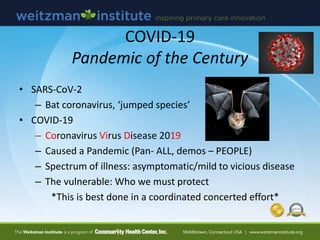
• SARS-CoV-2
– Bat coronavirus, ‘jumped species’
• COVID-19
– Coronavirus Virus Disease 2019
– Caused a Pandemic (Pan- ALL, demos – PEOPLE)
– Spectrum of illness: asymptomatic/mild to vicious disease
– The vulnerable: Who we must protect
*This is best done in a coordinated concerted effort*
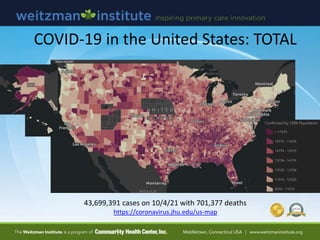
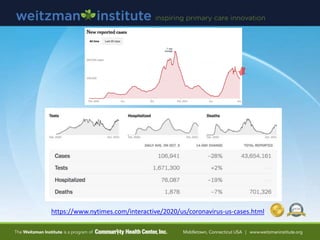
43,699,391 cases on 10/4/21 with 701,377 deaths
https://coronavirus.jhu.edu/us-map
COVID-19 in the United States: TOTAL
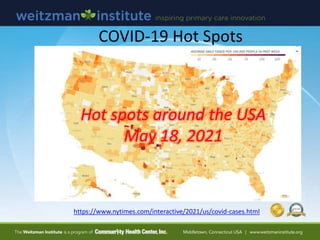
COVID-19 Hot Spots
https://www.nytimes.com/interactive/2021/us/covid-cases.html
Hot spots around the USA
May 18, 2021
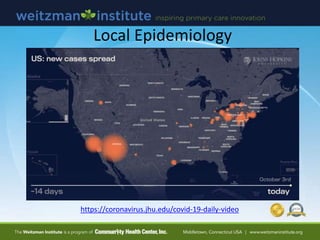
Local Epidemiology
https://coronavirus.jhu.edu/covid-19-daily-video
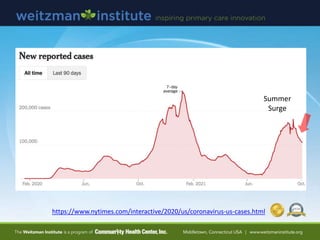
https://www.nytimes.com/interactive/2020/us/coronavirus-us-cases.html
Summer
Surge
https://www.nytimes.com/interactive/2020/us/coronavirus-us-cases.html
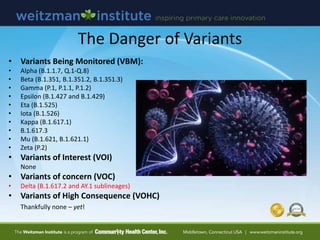
The Danger of Variants
• Variants Being Monitored (VBM):
• Alpha (B.1.1.7, Q.1-Q.8)
• Beta (B.1.351, B.1.351.2, B.1.351.3)
• Gamma (P.1, P.1.1, P.1.2)
• Epsilon (B.1.427 and B.1.429)
• Eta (B.1.525)
• Iota (B.1.526)
• Kappa (B.1.617.1)
• B.1.617.3
• Mu (B.1.621, B.1.621.1)
• Zeta (P.2)
• Variants of Interest (VOI)
None
• Variants of concern (VOC)
• Delta (B.1.617.2 and AY.1 sublineages)
• Variants of High Consequence (VOHC)
Thankfully none – yet!
Delta Variant
https://www.axios.com/coronavirus-variant-tracker-where-different-strains-are-spreading-
ffd71934-1596-43e6-923d-32c4698e2f8b.html
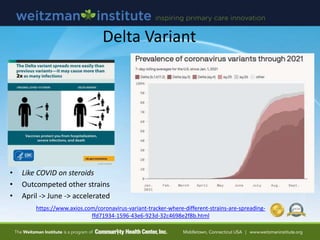
• Like COVID on steroids
• Outcompeted other strains
• April -> June -> accelerated
Breakthrough Infections
• Immunocompromised
– What exactly does that mean?
– Who are the weak, who are the vulnerable, who will the
virus attack?
– Very important to recognize this, and take action!
• Body follows the principle: ‘Use it or lose it’
Immunity 101
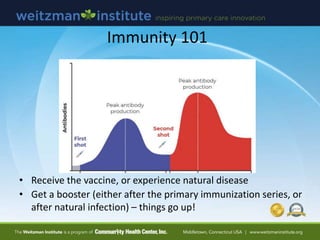
• Receive the vaccine, or experience natural disease
• Get a booster (either after the primary immunization series, or
after natural infection) – things go up!
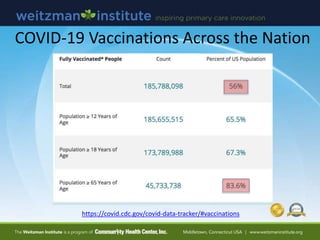
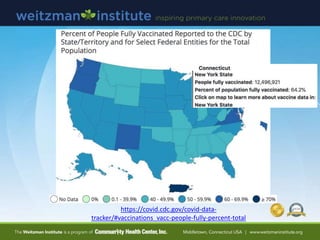
COVID-19 Vaccinations Across the Nation
https://covid.cdc.gov/covid-data-tracker/#vaccinations
https://covid.cdc.gov/covid-data-
tracker/#vaccinations_vacc-people-fully-percent-total
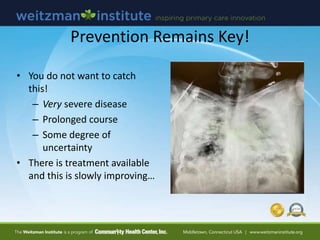
Prevention Remains Key!
• You do not want to catch
this!
– Very severe disease
– Prolonged course
– Some degree of
uncertainty
• There is treatment available
and this is slowly improving…
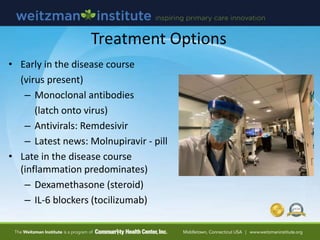
Treatment Options
• Early in the disease course
(virus present)
– Monoclonal antibodies
(latch onto virus)
– Antivirals: Remdesivir
– Latest news: Molnupiravir - pill
• Late in the disease course
(inflammation predominates)
– Dexamethasone (steroid)
– IL-6 blockers (tocilizumab)
Treatment Options
• Non-hospitalized patients with mild to moderate COVID-19
who are at high risk of clinical progression:
– Bamlanivimab plus etesevimab; or
– Casirivimab plus imdevimab; or
– Sotrovimab intravenous (IV) infusion
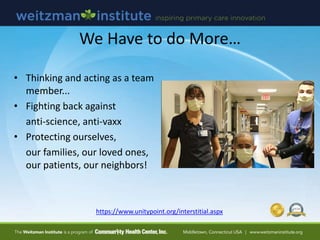
We Have to do More…
• Thinking and acting as a team
member...
• Fighting back against
anti-science, anti-vaxx
• Protecting ourselves,
our families, our loved ones,
our patients, our neighbors!
https://www.unitypoint.org/interstitial.aspx
Special Focus: Prevention in Pregnancy
• CDC strong recommendation for those who are pregnant,
recently pregnant (i.e. lactating), trying or planning to become
pregnant - should be immunized
• Only 31% currently immunized
– 15.6% for pregnant non-Hispanic
Black women = health inequities
• Pregnancy carries an increased risk for severe illness
(including hospitalization, ICU admission, mechanical
ventilation, and death)
• Increased risk of preterm birth
Vaccination in Pregnancy
• Pregnant people have not reported different side effects from
non-pregnant people after vaccination with mRNA vaccines
(Moderna and Pfizer-BioNTech)
– Fever following vaccination? Recommended to take
acetaminophen (Tylenol®) because fever can be associated
with adverse pregnancy outcomes
• Johnson & Johnson’s Janssen (J&J/Janssen) Vaccine: Women
younger than 50 years old - rare risk of blood clots with low
platelets after vaccination
• Discuss with your healthcare provider!
Trusted Resources
• Johns Hopkins
https://coronavirus.jhu.edu/map.html
• CDC
https://www.cdc.gov/coronavirus/2019-ncov/index.html
https://emergency.cdc.gov/coca/calls/2020/
• WHO:
https://www.who.int/emergencies/diseases/novel-coronavirus-
2019
• Others
https://www.nytimes.com/interactive/2021/us/covid-cases.html
https://www.thelancet.com/coronavirus
https://covidactnow.org/
Care Delivery in the COVID-19 Landscape
Veena Channamsetty, MD
Mary Blankson, DNP, APRN
Care Delivery in the COVID-19 Landscape
• Balancing In-person care with Telehealth
o Clinical need
o Patient and staff safety
o Discipline and role specific
• Team Based Care and the Virtual Team
o On-site care team
o Virtual care team
o Extended care team
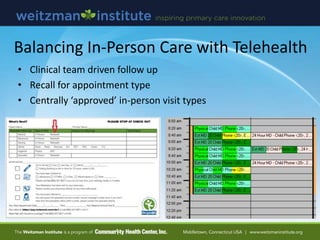
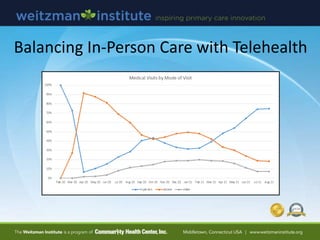
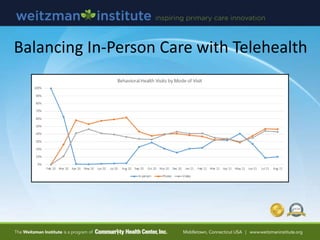
Balancing In-Person Care with Telehealth
• Clinical team driven follow up
• Recall for appointment type
• Centrally ‘approved’ in-person visit types
Balancing In-Person Care with Telehealth
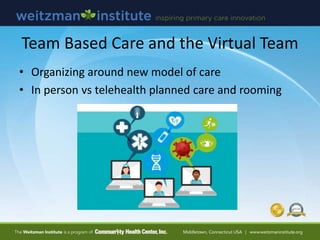
Team Based Care and the Virtual Team
• Organizing around new model of care
• In person vs telehealth planned care and rooming
Team Based Care and the Virtual Team
• Incident-to-care for
telehealth providers
• COVID-19 related care
and immunizations
• Staff recruitment and
retention efforts
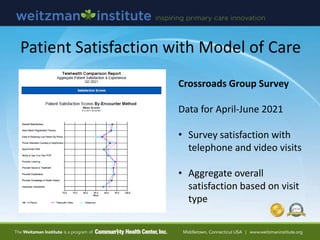
Patient Satisfaction with Model of Care
Crossroads Group Survey
Data for April-June 2021
• Survey satisfaction with
telephone and video visits
• Aggregate overall
satisfaction based on visit
type
Upcoming Dates & Topics
• 10/20 – Boosters for Immunocompromised
and Patients at High Risk
• 11/3 – Pediatric Vaccines in the Team-Based
Care Model
• 11/17 – Community Engagement Pathways
• 12/1 – Supporting Staff & Sharing Best
Practices in Navigating COVID-19

Weitzman Echo on COVID-19 Team Based Care

  • 1.
    Team-Based Care Withinthe Setting of COVID-19 – Review & Reintroduction October 6th, 2021
  • 2.
    Continuing Education Credits Insupport of improving patient care, Community Health Center, Inc. / Weitzman Institute is jointly accredited by the Accreditation Council for Continuing Medical Education (ACCME), the Accreditation Council for Pharmacy Education (ACPE), and the American Nurses Credentialing Center (ANCC), to provide continuing education for the healthcare team. A comprehensive certificate will be sent after the end of the series, December 2021.
  • 3.
    Disclosures & Disclaimers Withrespect to the following presentation, there has been no relevant (direct or indirect) financial relationship between the faculty listed above or other activity planners (or spouse/partner) and any for-profit company in the past 12 months which would be considered a conflict of interest. The views expressed in this presentation are those of the faculty and may not reflect official policy of Community Health Center, Inc. and its Weitzman Institute. We are obligated to disclose any products which are off-label, unlabeled, experimental, and/or under investigation (not FDA approved) and any limitations on the information that are presented, such as data that are preliminary or that represent ongoing research, interim analyses, and/or unsupported opinion. This project is supported by the Health Resources and Services Administration (HRSA) of the U.S. Department of Health and Human Services (HHS) as part of an award totaling $137,500 with 0% financed with non-governmental sources. The contents are those of the author(s) and do not necessarily represent the official views of, nor an endorsement, by HRSA, HHS, or the U.S. Government. For more information, please visit HRSA.gov.
  • 4.
    At the WeitzmanInstitute, we value a culture of equity, inclusiveness, diversity, and mutually respectful dialogue. We want to ensure that all feel welcome. If there is anything said in our program that makes you feel uncomfortable, please let us know.
  • 5.
  • 6.
    COVID-19 Pandemic of theCentury • SARS-CoV-2 – Bat coronavirus, ‘jumped species’ • COVID-19 – Coronavirus Virus Disease 2019 – Caused a Pandemic (Pan- ALL, demos – PEOPLE) – Spectrum of illness: asymptomatic/mild to vicious disease – The vulnerable: Who we must protect *This is best done in a coordinated concerted effort*
  • 7.
    43,699,391 cases on10/4/21 with 701,377 deaths https://coronavirus.jhu.edu/us-map COVID-19 in the United States: TOTAL
  • 8.
  • 9.
  • 10.
  • 11.
  • 12.
    The Danger ofVariants • Variants Being Monitored (VBM): • Alpha (B.1.1.7, Q.1-Q.8) • Beta (B.1.351, B.1.351.2, B.1.351.3) • Gamma (P.1, P.1.1, P.1.2) • Epsilon (B.1.427 and B.1.429) • Eta (B.1.525) • Iota (B.1.526) • Kappa (B.1.617.1) • B.1.617.3 • Mu (B.1.621, B.1.621.1) • Zeta (P.2) • Variants of Interest (VOI) None • Variants of concern (VOC) • Delta (B.1.617.2 and AY.1 sublineages) • Variants of High Consequence (VOHC) Thankfully none – yet!
  • 13.
  • 14.
    Breakthrough Infections • Immunocompromised –What exactly does that mean? – Who are the weak, who are the vulnerable, who will the virus attack? – Very important to recognize this, and take action! • Body follows the principle: ‘Use it or lose it’
  • 15.
    Immunity 101 • Receivethe vaccine, or experience natural disease • Get a booster (either after the primary immunization series, or after natural infection) – things go up!
  • 16.
    COVID-19 Vaccinations Acrossthe Nation https://covid.cdc.gov/covid-data-tracker/#vaccinations
  • 17.
  • 18.
    Prevention Remains Key! •You do not want to catch this! – Very severe disease – Prolonged course – Some degree of uncertainty • There is treatment available and this is slowly improving…
  • 19.
    Treatment Options • Earlyin the disease course (virus present) – Monoclonal antibodies (latch onto virus) – Antivirals: Remdesivir – Latest news: Molnupiravir - pill • Late in the disease course (inflammation predominates) – Dexamethasone (steroid) – IL-6 blockers (tocilizumab)
  • 20.
    Treatment Options • Non-hospitalizedpatients with mild to moderate COVID-19 who are at high risk of clinical progression: – Bamlanivimab plus etesevimab; or – Casirivimab plus imdevimab; or – Sotrovimab intravenous (IV) infusion
  • 21.
    We Have todo More… • Thinking and acting as a team member... • Fighting back against anti-science, anti-vaxx • Protecting ourselves, our families, our loved ones, our patients, our neighbors! https://www.unitypoint.org/interstitial.aspx
  • 22.
    Special Focus: Preventionin Pregnancy • CDC strong recommendation for those who are pregnant, recently pregnant (i.e. lactating), trying or planning to become pregnant - should be immunized • Only 31% currently immunized – 15.6% for pregnant non-Hispanic Black women = health inequities • Pregnancy carries an increased risk for severe illness (including hospitalization, ICU admission, mechanical ventilation, and death) • Increased risk of preterm birth
  • 23.
    Vaccination in Pregnancy •Pregnant people have not reported different side effects from non-pregnant people after vaccination with mRNA vaccines (Moderna and Pfizer-BioNTech) – Fever following vaccination? Recommended to take acetaminophen (Tylenol®) because fever can be associated with adverse pregnancy outcomes • Johnson & Johnson’s Janssen (J&J/Janssen) Vaccine: Women younger than 50 years old - rare risk of blood clots with low platelets after vaccination • Discuss with your healthcare provider!
  • 24.
    Trusted Resources • JohnsHopkins https://coronavirus.jhu.edu/map.html • CDC https://www.cdc.gov/coronavirus/2019-ncov/index.html https://emergency.cdc.gov/coca/calls/2020/ • WHO: https://www.who.int/emergencies/diseases/novel-coronavirus- 2019 • Others https://www.nytimes.com/interactive/2021/us/covid-cases.html https://www.thelancet.com/coronavirus https://covidactnow.org/
  • 25.
    Care Delivery inthe COVID-19 Landscape Veena Channamsetty, MD Mary Blankson, DNP, APRN
  • 26.
    Care Delivery inthe COVID-19 Landscape • Balancing In-person care with Telehealth o Clinical need o Patient and staff safety o Discipline and role specific • Team Based Care and the Virtual Team o On-site care team o Virtual care team o Extended care team
  • 27.
    Balancing In-Person Carewith Telehealth • Clinical team driven follow up • Recall for appointment type • Centrally ‘approved’ in-person visit types
  • 28.
    Balancing In-Person Carewith Telehealth
  • 29.
    Balancing In-Person Carewith Telehealth
  • 30.
    Team Based Careand the Virtual Team • Organizing around new model of care • In person vs telehealth planned care and rooming
  • 31.
    Team Based Careand the Virtual Team • Incident-to-care for telehealth providers • COVID-19 related care and immunizations • Staff recruitment and retention efforts
  • 32.
    Patient Satisfaction withModel of Care Crossroads Group Survey Data for April-June 2021 • Survey satisfaction with telephone and video visits • Aggregate overall satisfaction based on visit type
  • 33.
    Upcoming Dates &Topics • 10/20 – Boosters for Immunocompromised and Patients at High Risk • 11/3 – Pediatric Vaccines in the Team-Based Care Model • 11/17 – Community Engagement Pathways • 12/1 – Supporting Staff & Sharing Best Practices in Navigating COVID-19

Editor's Notes

  • #6 Welcome everyone – I just wanted review some of the latest information on COVID-19 in the framework of a Teams-based approach to care. We’ve all be continuing on in this Pandemic, and we’re still not out of it yet. Hopefully this background info is a useful refresher – please stop and interrupt or send a message to the chat where I can respond as necessary to help you get up to speed.
  • #7 Humans: We don’t like to think of ourselves as animals – but we are, and we are somewhat related to bats – since they are mammals, and therefore could acquire infections. What we’re seeing in “real time”- is how a new disease takes hold… Many human diseases actually come from animals in the first place… then, they find out that these germs can do well in our large human populations.
  • #8 10/4/21: 43,699,391 cases, deaths - 701,377
  • #9 10/4/21: Here you can see from the map the ‘hot spots’ occurring around the country. The Darker colors mean more active infections: Alaska, the “Mountain West”, some parts of the midwest – Coal mining areas (W Virginia). Looking at Alaska as an example of what’s going on: this week they’ve had an average of over 1100 cases/day, with a rate of 156 per 100000 population - this is thee highest rate in the whole USA (Wyoming, N Dakota, Montana coming in 2, 3 and 4). Partly this is because only 51% of the population of alaska is fully vaccinated. For the Mountain West – those populations are in the 40% range for ‘vaccinated’… in some ways, their spread out geography helps – if it was an urban center, it would probably be much worse.
  • #10 Important to know locally what’s going on – This daily JHU video helps give a localized assessment of disease outbreaks across the US. You can view your local Health Dept website probably for the more localized data.
  • #11 10/4/21: Here you can see with the red arrow where we are with ‘new’ reported cases… the Summer Surge is waning – probably because of A) Natural Immunity + B) vaccination efforts = combining to a relative ‘herd’ immunity, the Holy Grail of immunity we’ve hoped for…
  • #12 10/4/21: Here you can see with the red arrow where we are with ‘new’ reported cases… the Summer Surge is waning – probably because of A) Natural Immunity + B) vaccination efforts = combining to a relative ‘herd’ immunity, the Holy Grail of immunity we’ve hoped for…
  • #13 10/4/21: Newer nomenclature to categorize the variants (these categories are rather descriptive I think!): 1 – Variants being monitored… Alpha (B.1.1.7, Q.1-Q.8), Beta (B.1.351, B.1.351.2, B.1.351.3), and Gamma (P.1, P.1.1, P.1.2) have been downgraded from Variants of Concern to Variants Being Monitored based on significant and sustained reduction in national and regional proportions. Eta (B.1.525), Iota (B.1.526), Kappa (B.1.617.1), and B.1.617.3 have been downgraded from Variants of Interest to Variants Being Monitored based on significant and sustained reduction in national and regional proportions. Additional Variants Being Monitored include Epsilon (B.1.427 and B.1.429) and Zeta (P.2) based on their previous classification as Variants of Concern or Variants of Interest. 2 - variant of interest: changes to receptor binding, reduced neutralization by antibodies generated against previous infection or vaccination, reduced efficacy of treatments, potential diagnostic impact, or predicted increase in transmissibility or disease severity. 3 - Variants of concern: evidence of an increase in transmissibility, more severe disease (increased hospitalizations or deaths), significant reduction in neutralization by antibodies generated during previous infection or vaccination, reduced effectiveness of treatments or vaccines, or diagnostic detection failures. 4 - Variants of high consequence: clear evidence that prevention measures or medical countermeasures (MCMs) have significantly reduced effectiveness relative to previously circulating variants.
  • #14 B.1.617.2 (India) – DELTA variant -"like Covid on steroids," Andy Slavitt, former White House senior adviser for Covid-19 response -is “outcompeting all other strains” -thee dominant strain: 99% of all new infections (in the middle of June – just 20%) CDC -Researchers: 1260x more virus in nasopharynx than wild type -shorter onset: 4 days rather than 6
  • #15 Of course those who were never immunized: Now at higher risk of contracting it The vaccines work – up to a point, in the face of this new threat. Who are those most at risk? The most important diseases as risk factors: Cancer Cerebrovascular disease Chronic kidney disease* COPD (chronic obstructive pulmonary disease) Diabetes mellitus, type 1 and type 2* Heart conditions (such as heart failure, coronary artery disease, or cardiomyopathies) Obesity (BMI ≥30 kg/m2)* Pregnancy and recent pregnancy Smoking, current and former
  • #16 Should be getting 3rd shots – booster shots as of now…
  • #18 10/4: Puerto Rico – doing very well: 70.7% immunized
  • #20 Plus whatever we can do in the hospital…
  • #21 Plus whatever we can do in the hospital…
  • #27 VEENA
  • #28 VEENA
  • #29 VEENA
  • #30 VEENA
  • #31 MARY
  • #32 MARY
  • #33 VEENA