The Scientific Method refers to the basic steps 
scientists use to solve problems… 
D • (D)etermine the Problem 
R • Gather (R)esearch 
H • Form a (H)ypothesis 
E • Carry Out an (E)xperiment 
R • Record and Analyze the (R)esults 
C • Draw a (C)onclusion
 A good science problem is written 
as a question, and is one that you 
can test to find the answer 
 *This is the purpose of your 
investigation
 Gather data to help you form your 
hypothesis 
 Research what others have already discovered about your 
problem (books, magazines, reports, experts, etc.) 
 Observation – using one or more of your senses to collect 
data 
 Inference – an interpretation of an observation based on 
evidence or prior knowledge
 A hypothesis is a possible explanation of, or 
answer to your scientific question 
 Worded as an “If…then…because…” statement 
 MUST be testable 
 MUST be based on research 
 Will be supported or disproved by 
experimentation
 Materials List 
 Detailed list of all supplies needed to carry out your 
experiment 
 Include amounts needed of each supply 
 Procedures List 
 Step-by-step instructions for how to carry out 
experiment 
 Must be detailed enough so your experiment could be 
repeated by someone else
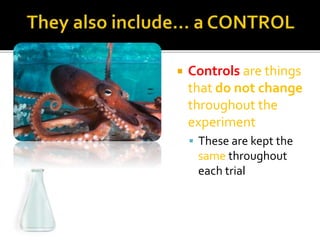
 Controls are things 
that do not change 
throughout the 
experiment 
 These are kept the 
same throughout 
each trial
 A variable is a factor that can 
change in an experiment 
 You may only change one at a time! 
 An independent variable is the one and only 
variable you’re allowed to change in your 
experiment this is the variable being tested (x-axis 
on a graph) 
 A dependent variable is the factor that changes 
because of your independent variable this is the 
observed variable (y-axis on a graph)
 Now you may design and carry out 
an experiment to test your 
hypothesis 
 Determine controls 
 Consider all possible variables 
 Must include at least two trials 
???
 Recording accurate observations and 
measurements are necessary to carrying out 
a valid experiment 
 Once recorded, you can organize your data 
 Perform any necessary calculations 
 Create charts/graphs/data tables to organize data 
 Consider sources of error
 Interpret your charts, tables, or graphs to 
help you draw your conclusions 
 Answer your question using data as evidence 
Based on the data you have gathered, were 
you able to find the answer to your question? 
If so, was your hypothesis correct? 
If no, what other experiment(s) could help 
you retest your theory? 
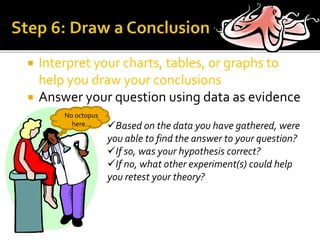
No octopus 
here…
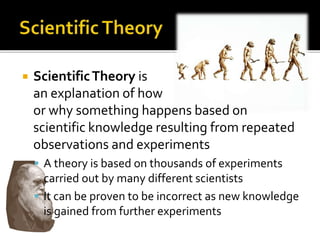
 Scientific Theory is 
an explanation of how 
or why something happens based on 
scientific knowledge resulting from repeated 
observations and experiments 
 A theory is based on thousands of experiments 
carried out by many different scientists 
 It can be proven to be incorrect as new knowledge 
is gained from further experiments
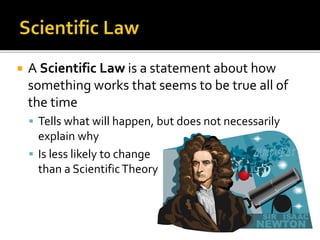
 A Scientific Law is a statement about how 
something works that seems to be true all of 
the time 
 Tells what will happen, but does not necessarily 
explain why 
 Is less likely to change 
than a Scientific Theory