Scientific Method Unit One
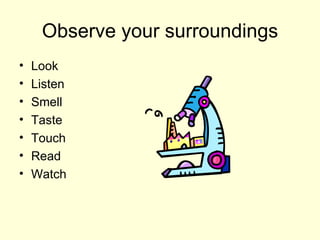
Observe your surroundings Look Listen Smell Taste Touch Read Watch
Ask a question What interests you?  What do you want to understand about the world around you?
Form a hypothesis This is an educated guess or explanation for a scientific problem. It MUST be testable. Hypotheses are always changing and there may be many for one idea.
Design and perform an experiment You need a well designed experiment that will test your hypothesis. A good experiment has only one factor that changes. That factor is called a  variable .
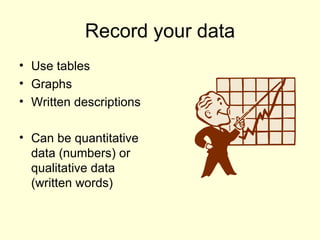
Record your data Use tables Graphs Written descriptions Can be quantitative data (numbers) or qualitative data (written words)
Analyze and draw conclusions Study your data and compare it to your hypothesis. Does it support your prediction or not? What conclusions can you make?
Report results to others Scientists share information so that others may learn from experiments that have already been performed.

Scientific method

  • 1.
  • 2.
    Observe your surroundingsLook Listen Smell Taste Touch Read Watch
  • 3.
    Ask a questionWhat interests you? What do you want to understand about the world around you?
  • 4.
    Form a hypothesisThis is an educated guess or explanation for a scientific problem. It MUST be testable. Hypotheses are always changing and there may be many for one idea.
  • 5.
    Design and performan experiment You need a well designed experiment that will test your hypothesis. A good experiment has only one factor that changes. That factor is called a variable .
  • 6.
    Record your dataUse tables Graphs Written descriptions Can be quantitative data (numbers) or qualitative data (written words)
  • 7.
    Analyze and drawconclusions Study your data and compare it to your hypothesis. Does it support your prediction or not? What conclusions can you make?
  • 8.
    Report results toothers Scientists share information so that others may learn from experiments that have already been performed.