OCEAN
THERMAL
ENERGY
CONVERSION
Presented by:
B.A.T.M.Thilakarathne
SC/2016/9691
CONTENT
• Introduction
• Ocean
• Temperature of Ocean Water
• OTEC
• Sea water system
• Classification
• Cycle types
• Plant types
• Applications
• Advantages
• Disadvantages
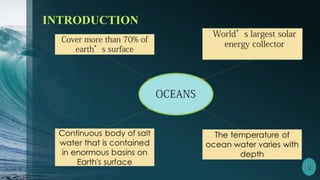
INTRODUCTION
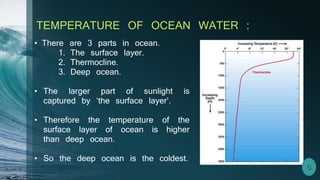
TEMPERATURE OF OCEAN WATER :
• There are 3 parts in ocean.
1. The surface layer.
2. Thermocline.
3. Deep ocean.
• The larger part of sunlight is
captured by ‘the surface layer’.
• Therefore the temperature of the
surface layer of ocean is higher
than deep ocean.
• So the deep ocean is the coldest.
• The stored solar energy in the ocean could be
converted into electrical power.
• The technology is called as Ocean Thermal
Energy Conversion(OTEC).
• The idea of tapping OTEC was first proposed by
French physicist ,Jacques Arsene d`Arsonal in
1881.
• The recent growth in interest in renewable energy,
development of OTEC has increased in the world.
OTEC(Ocean Thermal Energy Conversion)
OTEC is a renewable energy
technology that uses the natural
temperature difference in oceans to
produce electricity ,day and night
(OTEC is firm power (24/7)), year
around .
• With current technology, an annual temperature
difference of 20℃ or more is needed for OTEC.
• In order to produce power with the low temperature
range, a working fluid with low boiling point is used.
• Several countries are actively pursuing large-scale
deployment of OTEC.
• For example, companies and governments in France, Japan,
the Philippines and South Korea have developed roadmaps
for OTEC development.
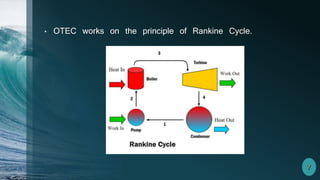
• OTEC works on the principle of Rankine Cycle.
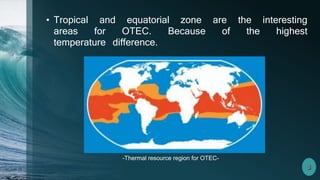
-Thermal resource region for OTEC-
• Tropical and equatorial zone are the interesting
areas for OTEC. Because of the highest
temperature difference.
Sea Water System
Warm water intake:-
• Depth - *For pilot plants will be about 10 m deep.
*For larger commercial plants will be about 20 m
deep.
• Shape and orientation - The intake structure is
constructed to produce
horizontal flows external to the
structure.
Cold water intake:-
• Depth -
• Shape and orientation - An open-ended pipe with
bar screens placed to
keep out relatively
large objects.
For most OTEC designs will be at a
depth of 750-1000m.
Used to vaporize a
working fluid with a low
boiling point (ammonia or
halocarbon Refrigerants).
Used to condense the
vapor and ensure the
vapor pressure difference
drives the turbine.
The warm
water
The cold water
CLASSIFICATION
According to cycle
type :-
• Open Cycle.
• Close Cycle.
• Hybrid Cycle.
According to location:-
• Land based plant.
• Off-Shore plant.
CYCLE TYPES
1.Close Cycle
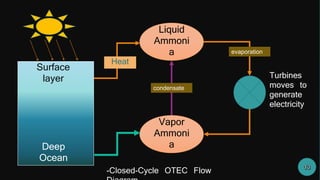
• Low boiling point working fluid is used (e.g. ammonia).
• The working fluid is evaporated by warm seawater.
• The expanding gas drives a gas turbine, is then re-condensed by
cold seawater, and the process is repeated.
Surface
layer
Deep
Ocean
Liquid
Ammoni
a
Vapor
Ammoni
a
Heat
Turbines
moves to
generate
electricity
condensate
evaporation
-Closed-Cycle OTEC Flow
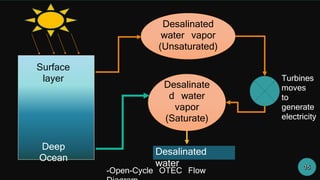
• Open-Cycle systems use vaporized sea water as
the working fluid.
• Warm sea water pumped into a vacuum chamber
where a small amount is evaporated into low
density stream that drives a low pressure turbine.
• The steam is condensed by cold water.
• Desalinated water is a byproduct.
2.Open Cycle
Surface
layer
Deep
Ocean
Desalinate
d water
vapor
(Saturate)
Turbines
moves
to
generate
electricity
Desalinated
water vapor
(Unsaturated)
Desalinated
water
-Open-Cycle OTEC Flow
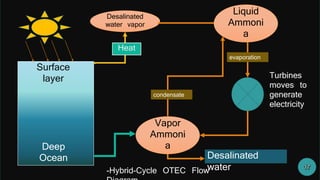
• This system used both open and close cycle
systems methods.
• The warm water enters to the vacuum chamber
where it is evaporated into steam.(Similar to the
open cycle)
• The steam vaporizes the working fluid .(Similar to
the close cycle)
• The steam drives a turbine that produces electricity.
• The steam condenses within the heat exchange to
produce desalinated water.
3.Hybrid Cycle
Surface
layer
Deep
Ocean
Desalinated
water vapor
Vapor
Ammoni
a
Turbines
moves to
generate
electricity
evaporation
-Hybrid-Cycle OTEC Flow
Liquid
Ammoni
a
condensate
Desalinated
water
Heat
PLANT TYPES
• Basic considerations for plant design and location
include
• A stable environment for the system operation
• A constant source of both warm and cold
water with a minimum temperature difference
20℃.
• A cost –effective way to deliver power and
complementary products.
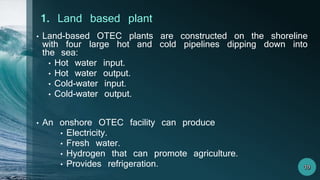
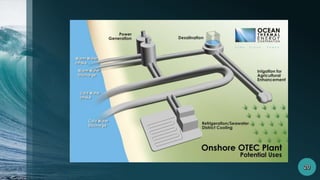
• Land-based OTEC plants are constructed on the shoreline
with four large hot and cold pipelines dipping down into
the sea:
• Hot water input.
• Hot water output.
• Cold-water input.
• Cold-water output.
• An onshore OTEC facility can produce
• Electricity.
• Fresh water.
• Hydrogen that can promote agriculture.
• Provides refrigeration.
1. Land based plant
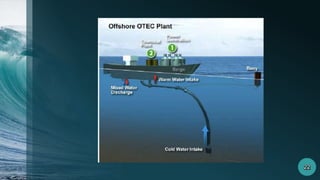
• The offshore platform installation has
comparatively lower land use and impact.
• but requires grid cables to be installed to
land.
• has higher construction and maintenance
costs.
2. Offshore plant
• Electricity Production.
• Desalinated Water.
• Refrigeration and Air-Conditioning.
• Mineral Extraction.
Applications
• Helps in producing fuels such as hydrogen,
ammonia, and methanol.
• Produces base load electrical energy .
• Produces desalinated water for industrial,
agricultural, and residential uses .
• Is a resource for on-shore and near-shore Mari-
culture operations .
Advantages
• Provides air-conditioning for buildings .
• Food Aquaculture products can be cultivated in
discharge water.
• Eco- friendly .
• Minimal maintenance costs compared to other
power production plants.
• High installation cost.
• It only had been tested in a very small scale.
• OTEC plant construction and operation may affect commercial
and recreational fishing.
• Other risks associated with the OTEC power system are the
safety issues associated with steam electric power generation
plants. Such as : -
Electrical hazards,
Rotating machinery,
Use of compressed gases,
Heavy material-handling equipment.
Disadvantages
• Irena.org, 2021. [Online]. Available: https://www.irena.org/-
/media/Files/IRENA/Agency/Publication/2014/Ocean_Thermal_Energy_V4_web.pdf.
References
Thank You!

Ocean thermal energy conversion

  • 1.
  • 2.
    CONTENT • Introduction • Ocean •Temperature of Ocean Water • OTEC • Sea water system • Classification • Cycle types • Plant types • Applications • Advantages • Disadvantages
  • 3.
  • 4.
    TEMPERATURE OF OCEANWATER : • There are 3 parts in ocean. 1. The surface layer. 2. Thermocline. 3. Deep ocean. • The larger part of sunlight is captured by ‘the surface layer’. • Therefore the temperature of the surface layer of ocean is higher than deep ocean. • So the deep ocean is the coldest.
  • 5.
    • The storedsolar energy in the ocean could be converted into electrical power. • The technology is called as Ocean Thermal Energy Conversion(OTEC). • The idea of tapping OTEC was first proposed by French physicist ,Jacques Arsene d`Arsonal in 1881. • The recent growth in interest in renewable energy, development of OTEC has increased in the world.
  • 6.
    OTEC(Ocean Thermal EnergyConversion) OTEC is a renewable energy technology that uses the natural temperature difference in oceans to produce electricity ,day and night (OTEC is firm power (24/7)), year around .
  • 7.
    • With currenttechnology, an annual temperature difference of 20℃ or more is needed for OTEC. • In order to produce power with the low temperature range, a working fluid with low boiling point is used. • Several countries are actively pursuing large-scale deployment of OTEC. • For example, companies and governments in France, Japan, the Philippines and South Korea have developed roadmaps for OTEC development.
  • 8.
    • OTEC workson the principle of Rankine Cycle.
  • 9.
    -Thermal resource regionfor OTEC- • Tropical and equatorial zone are the interesting areas for OTEC. Because of the highest temperature difference.
  • 10.
    Sea Water System Warmwater intake:- • Depth - *For pilot plants will be about 10 m deep. *For larger commercial plants will be about 20 m deep. • Shape and orientation - The intake structure is constructed to produce horizontal flows external to the structure.
  • 11.
    Cold water intake:- •Depth - • Shape and orientation - An open-ended pipe with bar screens placed to keep out relatively large objects. For most OTEC designs will be at a depth of 750-1000m.
  • 12.
    Used to vaporizea working fluid with a low boiling point (ammonia or halocarbon Refrigerants). Used to condense the vapor and ensure the vapor pressure difference drives the turbine. The warm water The cold water
  • 13.
    CLASSIFICATION According to cycle type:- • Open Cycle. • Close Cycle. • Hybrid Cycle. According to location:- • Land based plant. • Off-Shore plant.
  • 14.
  • 15.
    1.Close Cycle • Lowboiling point working fluid is used (e.g. ammonia). • The working fluid is evaporated by warm seawater. • The expanding gas drives a gas turbine, is then re-condensed by cold seawater, and the process is repeated.
  • 16.
  • 17.
    • Open-Cycle systemsuse vaporized sea water as the working fluid. • Warm sea water pumped into a vacuum chamber where a small amount is evaporated into low density stream that drives a low pressure turbine. • The steam is condensed by cold water. • Desalinated water is a byproduct. 2.Open Cycle
  • 18.
  • 19.
    • This systemused both open and close cycle systems methods. • The warm water enters to the vacuum chamber where it is evaporated into steam.(Similar to the open cycle) • The steam vaporizes the working fluid .(Similar to the close cycle) • The steam drives a turbine that produces electricity. • The steam condenses within the heat exchange to produce desalinated water. 3.Hybrid Cycle
  • 20.
  • 21.
  • 22.
    • Basic considerationsfor plant design and location include • A stable environment for the system operation • A constant source of both warm and cold water with a minimum temperature difference 20℃. • A cost –effective way to deliver power and complementary products.
  • 23.
    • Land-based OTECplants are constructed on the shoreline with four large hot and cold pipelines dipping down into the sea: • Hot water input. • Hot water output. • Cold-water input. • Cold-water output. • An onshore OTEC facility can produce • Electricity. • Fresh water. • Hydrogen that can promote agriculture. • Provides refrigeration. 1. Land based plant
  • 25.
    • The offshoreplatform installation has comparatively lower land use and impact. • but requires grid cables to be installed to land. • has higher construction and maintenance costs. 2. Offshore plant
  • 27.
    • Electricity Production. •Desalinated Water. • Refrigeration and Air-Conditioning. • Mineral Extraction. Applications
  • 28.
    • Helps inproducing fuels such as hydrogen, ammonia, and methanol. • Produces base load electrical energy . • Produces desalinated water for industrial, agricultural, and residential uses . • Is a resource for on-shore and near-shore Mari- culture operations . Advantages
  • 29.
    • Provides air-conditioningfor buildings . • Food Aquaculture products can be cultivated in discharge water. • Eco- friendly . • Minimal maintenance costs compared to other power production plants.
  • 30.
    • High installationcost. • It only had been tested in a very small scale. • OTEC plant construction and operation may affect commercial and recreational fishing. • Other risks associated with the OTEC power system are the safety issues associated with steam electric power generation plants. Such as : - Electrical hazards, Rotating machinery, Use of compressed gases, Heavy material-handling equipment. Disadvantages
  • 31.
    • Irena.org, 2021.[Online]. Available: https://www.irena.org/- /media/Files/IRENA/Agency/Publication/2014/Ocean_Thermal_Energy_V4_web.pdf. References
  • 32.

Editor's Notes

  • #9 1.The working fluid is pumped from low to high pressure. As the fluid is a liquid at this stage, the pump requires little input energy. 2. The high-pressure liquid enters a boiler 3. The dry saturated vapour expands through a turbine, generating power. 4. The wet vapour then enters a condenser, where it is condensed at a constant pressure to become a saturated liquid.
  • #10 The tropics are the region of Earth surrounding the Equator Equatorial regions are located in a band around the Equator and cover about 6% of the Earth's surface.
  • #11 Because it appears that fish can sense and avoid horizontal flows better than vertical flows