PLANT
ATHUL
ruathul@gmail.com
HISTORY
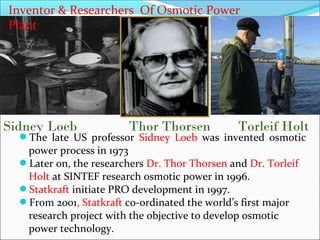
Sidney Loeb Thor Thorsen Torleif Holt
Inventor & Researchers Of Osmotic Power
Plant
The late US professor Sidney Loeb was invented osmotic
power process in 1973
Later on, the researchers Dr. Thor Thorsen and Dr. Torleif
Holt at SINTEF research osmotic power in 1996.
Statkraft initiate PRO development in 1997.
From 2001, Statkraft co-ordinated the world’s first major
research project with the objective to develop osmotic
power technology.
Power consumption has been increased enormously across the world so the power
generation should be increased. There are many ways of power generation.
Some of them leads to environmental pollution. So, non conventional power plants
must be encouraged.
The main thing with osmotic energy is transportation
of solution.
It separated by a special filter called semi permeable
membrane.
It is an organic filter.
Membrane will be allow pass small molecules, like
water molecules.
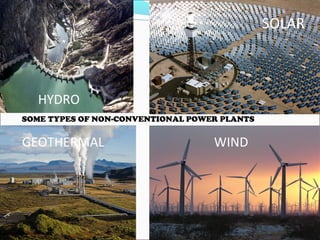
SOME TYPES OF NON-CONVENTIONAL POWER PLANTS
HYDRO
SOLAR
GEOTHERMAL WIND
WHY THIS TECHNOLOGY?
All power plants shown above are effected by the climatic conditions
Cannot be operated through out year
a new type of power plant which is non conventional and can be operated 24/7
is
OSMOTIC POWER PLANT
 Osmotic power stands as one of the most promising and yet unexploited
new, renewable energy sources for the near future.
Osmotic power plant is literally WORLD CHANGING
TECHNOLOGY.
The power plants are both noise and pollutant free.
 Osmotic power is a relatively new energy conversion concept even though
WORKING
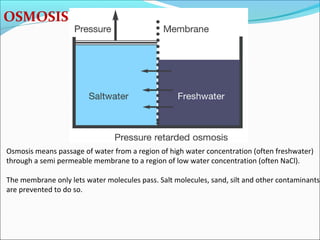
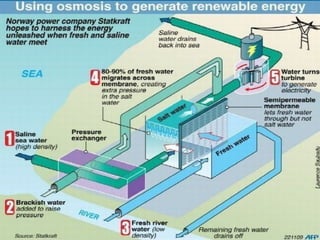
Osmosis means passage of water from a region of high water concentration (often freshwater)
through a semi permeable membrane to a region of low water concentration (often NaCl).
The membrane only lets water molecules pass. Salt molecules, sand, silt and other contaminants
are prevented to do so.
OSMOSIS:
IMPORTANT PARTS IN OSMOTIC POWER PLANT:
The membrane is the heart of the technology.
Turbine is needed to generate electricity.
Pumps and pipes to transport water throughout the plant.
Water cleaning unit (to prevent clogged/damaged membranes).
Cleaning unit for the membranes (which must be washed regularly)
MEMBRANE DEVELOPMENT:
Membrane producing at least 4 W/m2 to produce power at a competitive price
level
The best prototype membranes are equivalent to 4 W/m2, although this has to be
verified in PRO operation.
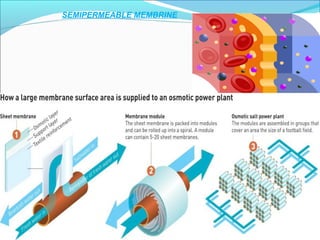
SEMIPERMEABLE MEMBRINE
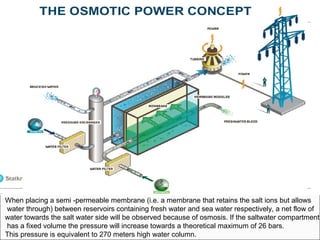
When placing a semi -permeable membrane (i.e. a membrane that retains the salt ions but allows
water through) between reservoirs containing fresh water and sea water respectively, a net flow of
water towards the salt water side will be observed because of osmosis. If the saltwater compartment
has a fixed volume the pressure will increase towards a theoretical maximum of 26 bars.
This pressure is equivalent to 270 meters high water column.
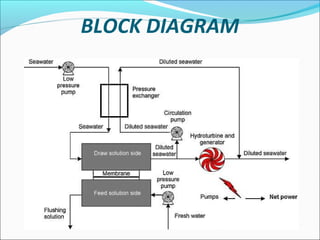
BLOCK DIAGRAM
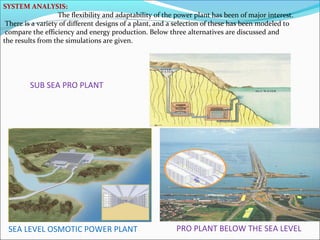
SEA LEVEL OSMOTIC POWER PLANT
SYSTEM ANALYSIS:
The flexibility and adaptability of the power plant has been of major interest.
There is a variety of different designs of a plant, and a selection of these has been modeled to
compare the efficiency and energy production. Below three alternatives are discussed and
the results from the simulations are given.
SUB SEA PRO PLANT
PRO PLANT BELOW THE SEA LEVEL
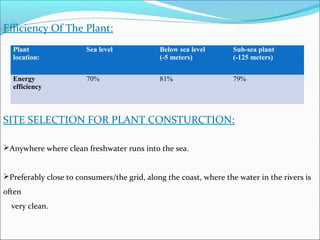
Efficiency Of The Plant:
SITE SELECTION FOR PLANT CONSTURCTION:
Anywhere where clean freshwater runs into the sea.
Preferably close to consumers/the grid, along the coast, where the water in the rivers is
often
very clean.
Plant
location:
Sea level Below sea level
(-5 meters)
Sub-sea plant
(-125 meters)
Energy
efficiency
70% 81% 79%
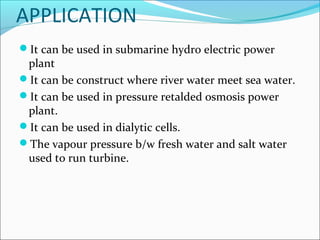
APPLICATION
It can be used in submarine hydro electric power
plant
It can be construct where river water meet sea water.
It can be used in pressure retalded osmosis power
plant.
It can be used in dialytic cells.
The vapour pressure b/w fresh water and salt water
used to run turbine.
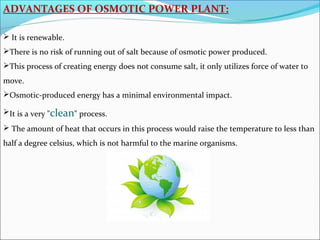
ADVANTAGES OF OSMOTIC POWER PLANT:
 It is renewable.
There is no risk of running out of salt because of osmotic power produced.
This process of creating energy does not consume salt, it only utilizes force of water to
move.
Osmotic-produced energy has a minimal environmental impact.
It is a very "clean" process.
 The amount of heat that occurs in this process would raise the temperature to less than
half a degree celsius, which is not harmful to the marine organisms.
DISADVANTAGES:
Osmotic energy is extremely expensive.
 About 36 times as expensive as a conventional power plant.
Protection of the marine organisms from the turbine and other
machinery.
Engineering and design problems.
SCOPE FOR FUTURESCOPE FOR FUTURE
It is very scopefull technology for future.
The semi permeable membrane which is used in this
technology have high cost. In future, the cost of the
membrane will be decrease and the whole system cost
will decrease.
If we could develop the membrane to use salt water
as fresh water, then it would be more feasible to use
salinity or the vapour pressure technique could be
further developed.
CONCLUSION:
This paper has given a broad introduction to the concept of osmotic
power and the latest development on the way to Commercialization.
Statkraft will continue the effort in developing osmotic power into an available
source of new, renewable and environmental friendly energy source for the
near future.
REFFERENCE
www.Authorstream.com
www.Pptsforece.blogspot.com
www.Wikipedia.com
www.osmoticenergy.htm
www.worldwidewater.com
www.seas.ucla.edu.htl
Posted in electrical engineering papers
tags: osmotic power.
Any Questions ?
Thank YouThank You

Osmotic powerplant

  • 2.
  • 3.
  • 4.
    Sidney Loeb ThorThorsen Torleif Holt Inventor & Researchers Of Osmotic Power Plant The late US professor Sidney Loeb was invented osmotic power process in 1973 Later on, the researchers Dr. Thor Thorsen and Dr. Torleif Holt at SINTEF research osmotic power in 1996. Statkraft initiate PRO development in 1997. From 2001, Statkraft co-ordinated the world’s first major research project with the objective to develop osmotic power technology.
  • 7.
    Power consumption hasbeen increased enormously across the world so the power generation should be increased. There are many ways of power generation. Some of them leads to environmental pollution. So, non conventional power plants must be encouraged.
  • 8.
    The main thingwith osmotic energy is transportation of solution. It separated by a special filter called semi permeable membrane. It is an organic filter. Membrane will be allow pass small molecules, like water molecules.
  • 9.
    SOME TYPES OFNON-CONVENTIONAL POWER PLANTS HYDRO SOLAR GEOTHERMAL WIND
  • 10.
  • 11.
    All power plantsshown above are effected by the climatic conditions Cannot be operated through out year a new type of power plant which is non conventional and can be operated 24/7 is OSMOTIC POWER PLANT  Osmotic power stands as one of the most promising and yet unexploited new, renewable energy sources for the near future. Osmotic power plant is literally WORLD CHANGING TECHNOLOGY. The power plants are both noise and pollutant free.  Osmotic power is a relatively new energy conversion concept even though
  • 12.
  • 13.
    Osmosis means passageof water from a region of high water concentration (often freshwater) through a semi permeable membrane to a region of low water concentration (often NaCl). The membrane only lets water molecules pass. Salt molecules, sand, silt and other contaminants are prevented to do so. OSMOSIS:
  • 14.
    IMPORTANT PARTS INOSMOTIC POWER PLANT: The membrane is the heart of the technology. Turbine is needed to generate electricity. Pumps and pipes to transport water throughout the plant. Water cleaning unit (to prevent clogged/damaged membranes). Cleaning unit for the membranes (which must be washed regularly) MEMBRANE DEVELOPMENT: Membrane producing at least 4 W/m2 to produce power at a competitive price level The best prototype membranes are equivalent to 4 W/m2, although this has to be verified in PRO operation.
  • 15.
  • 16.
    When placing asemi -permeable membrane (i.e. a membrane that retains the salt ions but allows water through) between reservoirs containing fresh water and sea water respectively, a net flow of water towards the salt water side will be observed because of osmosis. If the saltwater compartment has a fixed volume the pressure will increase towards a theoretical maximum of 26 bars. This pressure is equivalent to 270 meters high water column.
  • 17.
  • 19.
    SEA LEVEL OSMOTICPOWER PLANT SYSTEM ANALYSIS: The flexibility and adaptability of the power plant has been of major interest. There is a variety of different designs of a plant, and a selection of these has been modeled to compare the efficiency and energy production. Below three alternatives are discussed and the results from the simulations are given. SUB SEA PRO PLANT PRO PLANT BELOW THE SEA LEVEL
  • 20.
    Efficiency Of ThePlant: SITE SELECTION FOR PLANT CONSTURCTION: Anywhere where clean freshwater runs into the sea. Preferably close to consumers/the grid, along the coast, where the water in the rivers is often very clean. Plant location: Sea level Below sea level (-5 meters) Sub-sea plant (-125 meters) Energy efficiency 70% 81% 79%
  • 21.
    APPLICATION It can beused in submarine hydro electric power plant It can be construct where river water meet sea water. It can be used in pressure retalded osmosis power plant. It can be used in dialytic cells. The vapour pressure b/w fresh water and salt water used to run turbine.
  • 22.
    ADVANTAGES OF OSMOTICPOWER PLANT:  It is renewable. There is no risk of running out of salt because of osmotic power produced. This process of creating energy does not consume salt, it only utilizes force of water to move. Osmotic-produced energy has a minimal environmental impact. It is a very "clean" process.  The amount of heat that occurs in this process would raise the temperature to less than half a degree celsius, which is not harmful to the marine organisms.
  • 23.
    DISADVANTAGES: Osmotic energy isextremely expensive.  About 36 times as expensive as a conventional power plant. Protection of the marine organisms from the turbine and other machinery. Engineering and design problems.
  • 24.
    SCOPE FOR FUTURESCOPEFOR FUTURE It is very scopefull technology for future. The semi permeable membrane which is used in this technology have high cost. In future, the cost of the membrane will be decrease and the whole system cost will decrease. If we could develop the membrane to use salt water as fresh water, then it would be more feasible to use salinity or the vapour pressure technique could be further developed.
  • 25.
    CONCLUSION: This paper hasgiven a broad introduction to the concept of osmotic power and the latest development on the way to Commercialization. Statkraft will continue the effort in developing osmotic power into an available source of new, renewable and environmental friendly energy source for the near future.
  • 26.
  • 27.
  • 28.