By:
Zeel Shah
Masters of Regulatory Affairs
Brief about dossier
ICH
Guidelines
Dossier registration
Regulatory guidelines for dossier
Format of dossier (Module 1-5)
FLOW OF PRESENTATION
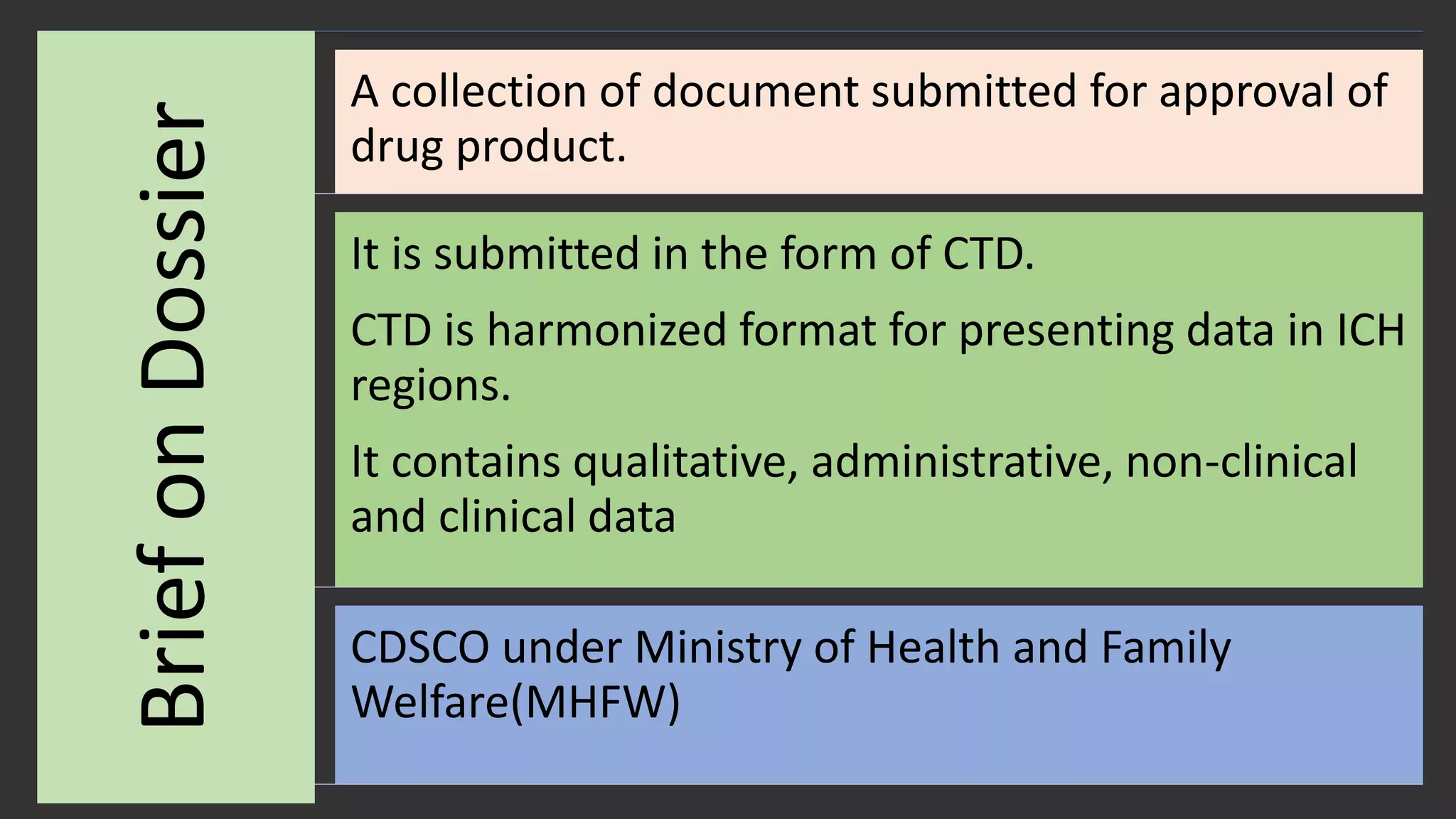
Brief
on
Dossier
A collection of document submitted for approval of
drug product.
It is submitted in the form of CTD.
CTD is harmonized format for presenting data in ICH
regions.
It contains qualitative, administrative, non-clinical
and clinical data
CDSCO under Ministry of Health and Family
Welfare(MHFW)
ICH (INTERNATIONAL CONFERENCE OF
HARMONIZATION)
CDSCO adopts
CTD format for
technical
requirements for
registration of
pharmaceutical
products for
human use (Feb
2009)
Based on ICH
Tripartite
Guideline
Issued the CTD
quality (IMH-4Q)
CTD format has
widely accepted
by regulatory
authority within
and beyond the
ICH regions
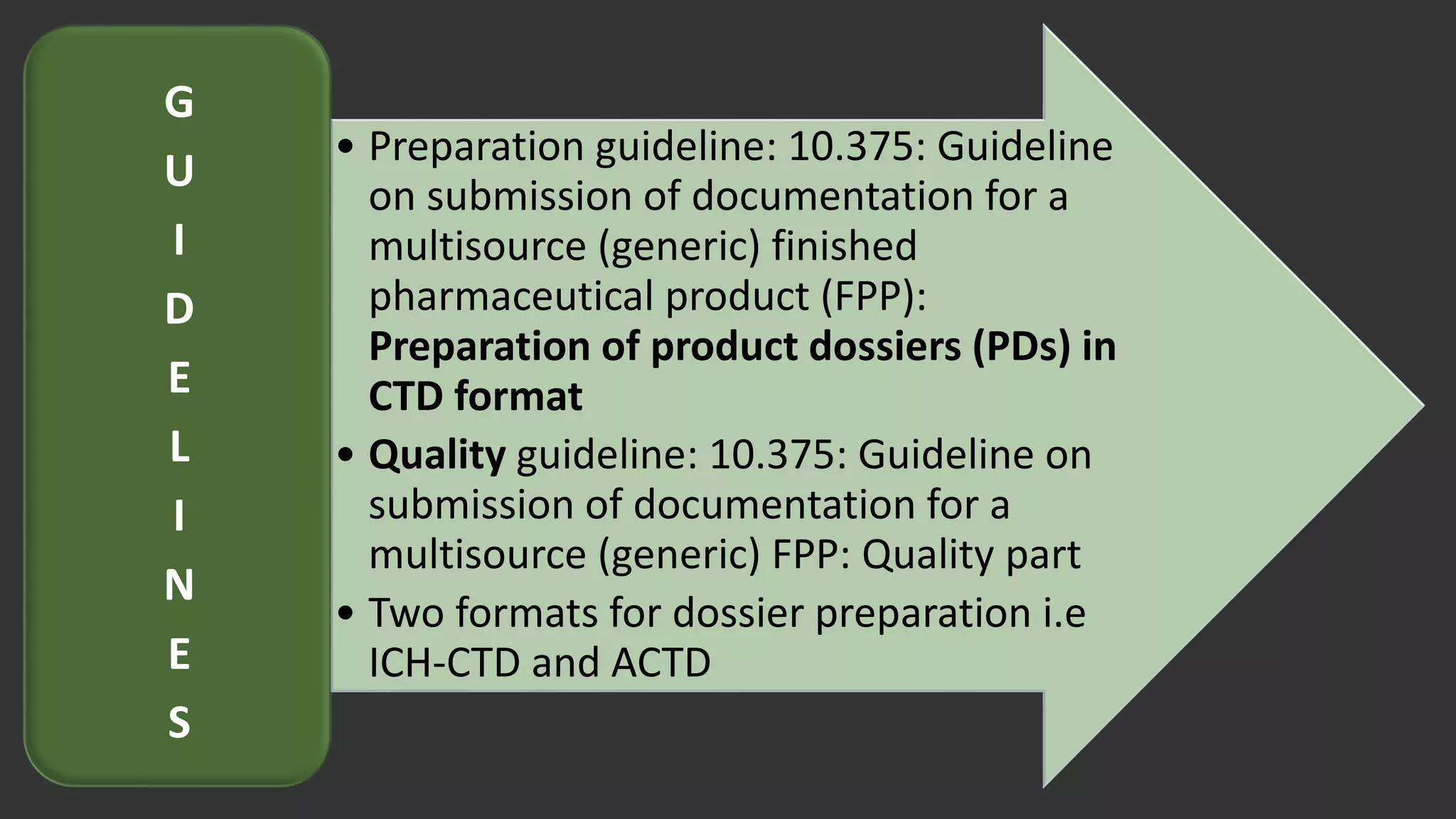
• Preparation guideline: 10.375: Guideline
on submission of documentation for a
multisource (generic) finished
pharmaceutical product (FPP):
Preparation of product dossiers (PDs) in
CTD format
• Quality guideline: 10.375: Guideline on
submission of documentation for a
multisource (generic) FPP: Quality part
• Two formats for dossier preparation i.e
ICH-CTD and ACTD
G
U
I
D
E
L
I
N
E
S
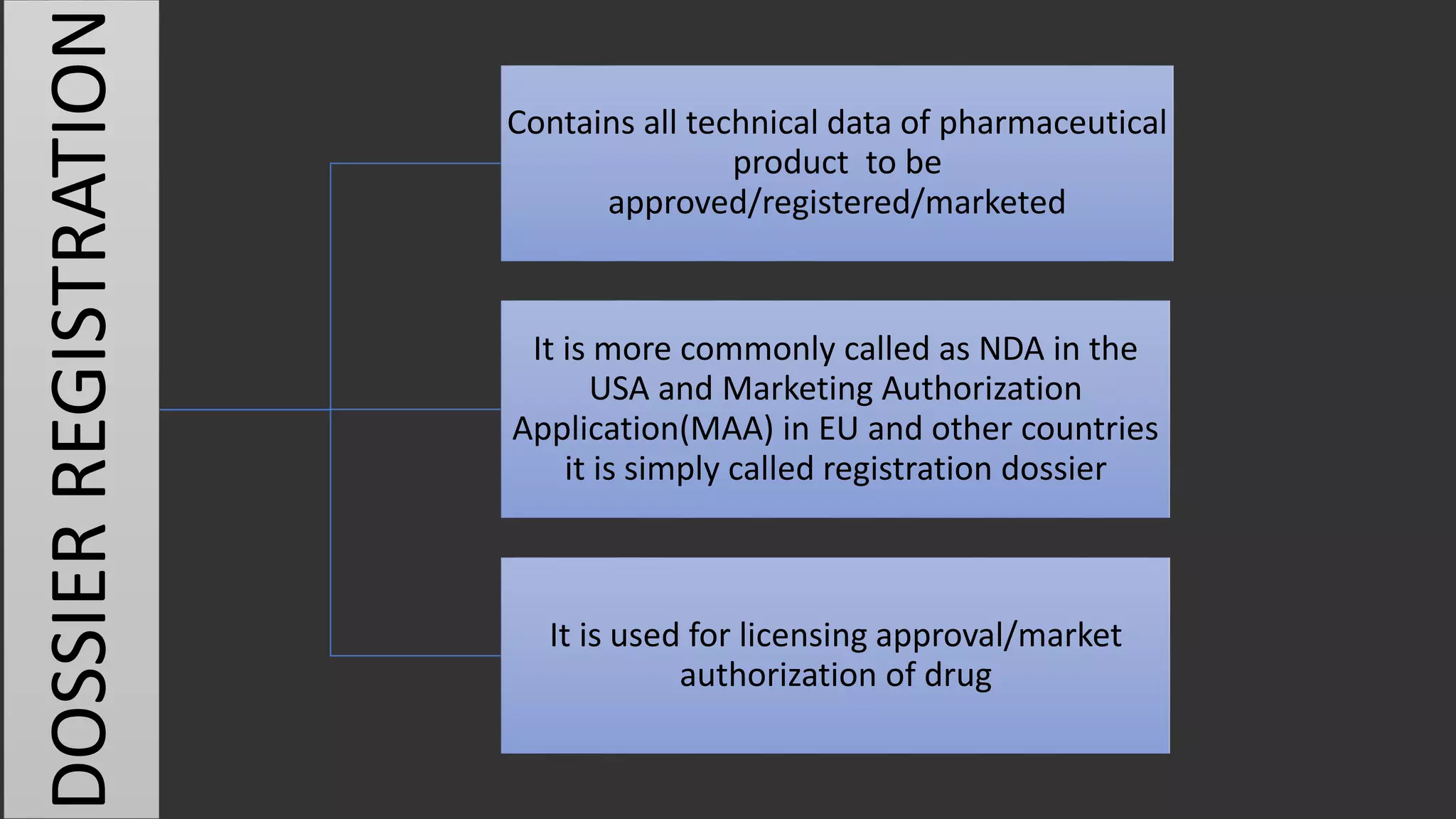
DOSSIER
REGISTRATION Contains all technical data of pharmaceutical
product to be
approved/registered/marketed
It is more commonly called as NDA in the
USA and Marketing Authorization
Application(MAA) in EU and other countries
it is simply called registration dossier
It is used for licensing approval/market
authorization of drug
D & C Act 1940 & 1945
Regulates the import manufacture, distribution and sale.
Schedule Y: provides guidelines and requirements for clinical trials
CDSCO: A licensing authority for approval of new drugs
DCGI: responsible for approval of new drugs & CT to be conducted in India.
Appointed by Central Government of India
Regulatory Guideline for Dossier Submission in India
1995
Concept of
CTD
proposed by
industry
November
2000
ICH-CTD
guidelines
finalized
September
2002
Re-editing of
guidelines by
changing
number of
section 2
header
Prior to July
2003
Voluntary
submission
phase in 3
ICH regions
1 July 2003
Mandatory
requirement
in 3 ICH
regions
2009
In India: CDSCO
adopt CTD format
for technical
requirement for
registration of
biological products
October 28, 2010
In India: CDSCO give
guideline for feedback
purpose for industry on
preparation of CTD for
import/marketing
approval new drug for
Human use and ask
comments and
suggestions within 60
days
Structure of CTD
Administrative
Documents:
Application form,
Labels, package inserts
Chemistry,
Manufacturing and
Characterization(CMC)
data of drug substance
and drug product
Pre-clinical data (animal
study data)
Clinical data (Human
study data)
Information to be Submitted
FORMAT OF DOSSIER - CTD
Module 1: Administrative Information and Prescribing Information
1.1 Comprehensive Table of Contents of the Submission Including all Modules
1.2 Documents Specific to Each Region (for example, cover letter, application forms, product information, prescribing
information, information about experts, pharmacovigilance, orphan drug status, etc.)
Module 2 – CTD Summaries
2.1 Common Technical Document TOC (Modules 2-5)
2.2 CTD Introduction
2.3 Quality Overall Summary
2.4 Nonclinical Overview
2.4.1 General Aspects
2.4.2 Content and Structural Format
2.5 Clinical Overview
2.5.1 Product Development of Content Rationale
2.5.2 Overview of Biop’ceutics
2.5.3 Overview of Clinical Pharmacology
2.5.4 Overview of Efficacy
2.5.5 Overview of Safety
2.5.6 Benefits and Risks Conclusions
2.5.7 Literature References
2.6 Non-clinical Written and Tabulated Summaries
2.6.1 Pharmacology
2.6.2 Pharmacokinetics
2.6.3 Toxicology
2.7 Clinical summary
2.7.1 Biop’ceutic Studies & Associated Analytical
Methods
2.7.2 Clinical Pharmacology Studies
2.7.3 Clinical Efficacy
2.7.4 Clinical Safety
2.7.5 Literature References
2.7.6 Synopses of Individual Studies
FORMAT OF DOSSIER - CTD
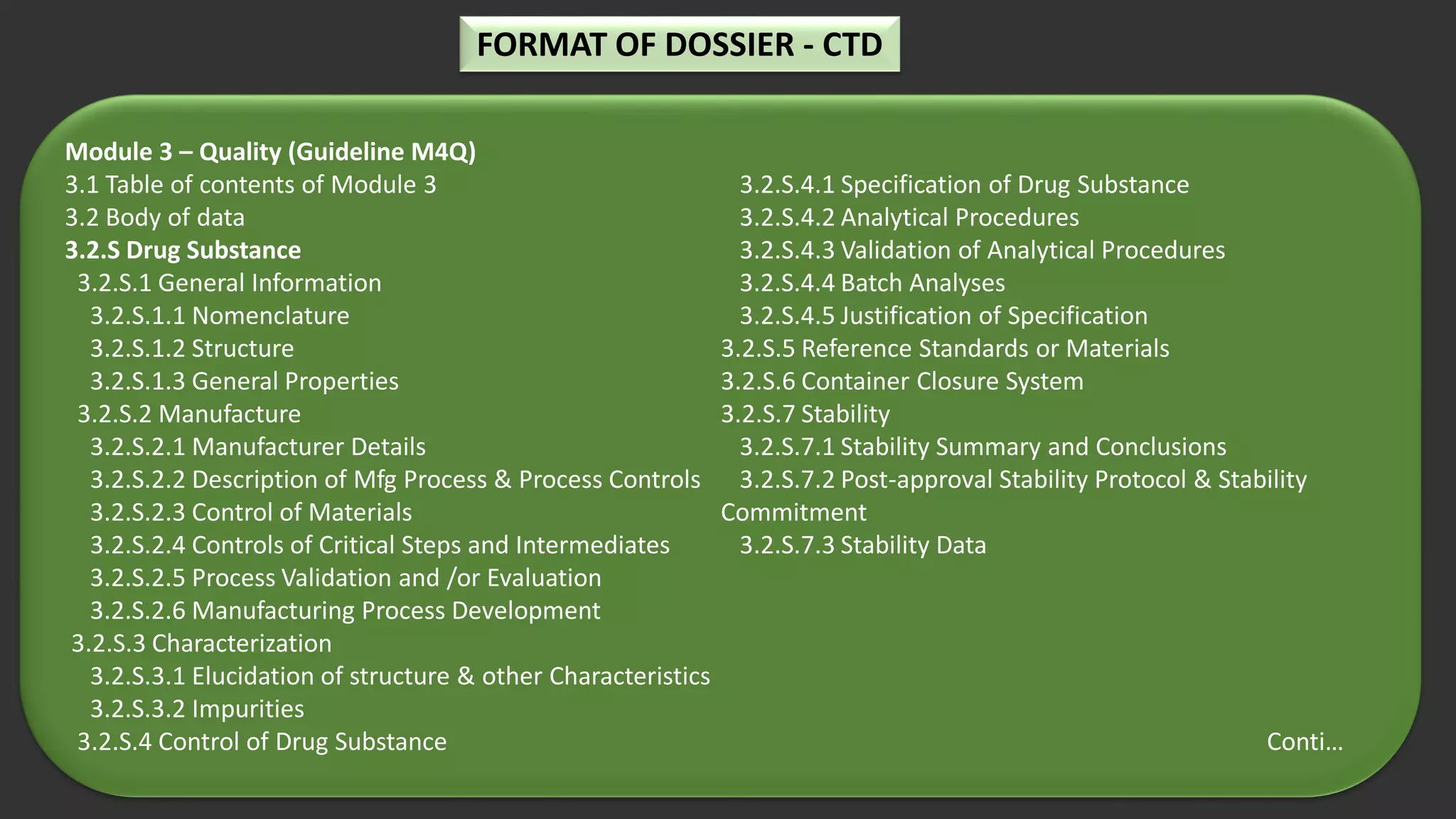
Module 3 – Quality (Guideline M4Q)
3.1 Table of contents of Module 3
3.2 Body of data
3.2.S Drug Substance
3.2.S.1 General Information
3.2.S.1.1 Nomenclature
3.2.S.1.2 Structure
3.2.S.1.3 General Properties
3.2.S.2 Manufacture
3.2.S.2.1 Manufacturer Details
3.2.S.2.2 Description of Mfg Process & Process Controls
3.2.S.2.3 Control of Materials
3.2.S.2.4 Controls of Critical Steps and Intermediates
3.2.S.2.5 Process Validation and /or Evaluation
3.2.S.2.6 Manufacturing Process Development
3.2.S.3 Characterization
3.2.S.3.1 Elucidation of structure & other Characteristics
3.2.S.3.2 Impurities
3.2.S.4 Control of Drug Substance
3.2.S.4.1 Specification of Drug Substance
3.2.S.4.2 Analytical Procedures
3.2.S.4.3 Validation of Analytical Procedures
3.2.S.4.4 Batch Analyses
3.2.S.4.5 Justification of Specification
3.2.S.5 Reference Standards or Materials
3.2.S.6 Container Closure System
3.2.S.7 Stability
3.2.S.7.1 Stability Summary and Conclusions
3.2.S.7.2 Post-approval Stability Protocol & Stability
Commitment
3.2.S.7.3 Stability Data
Conti…
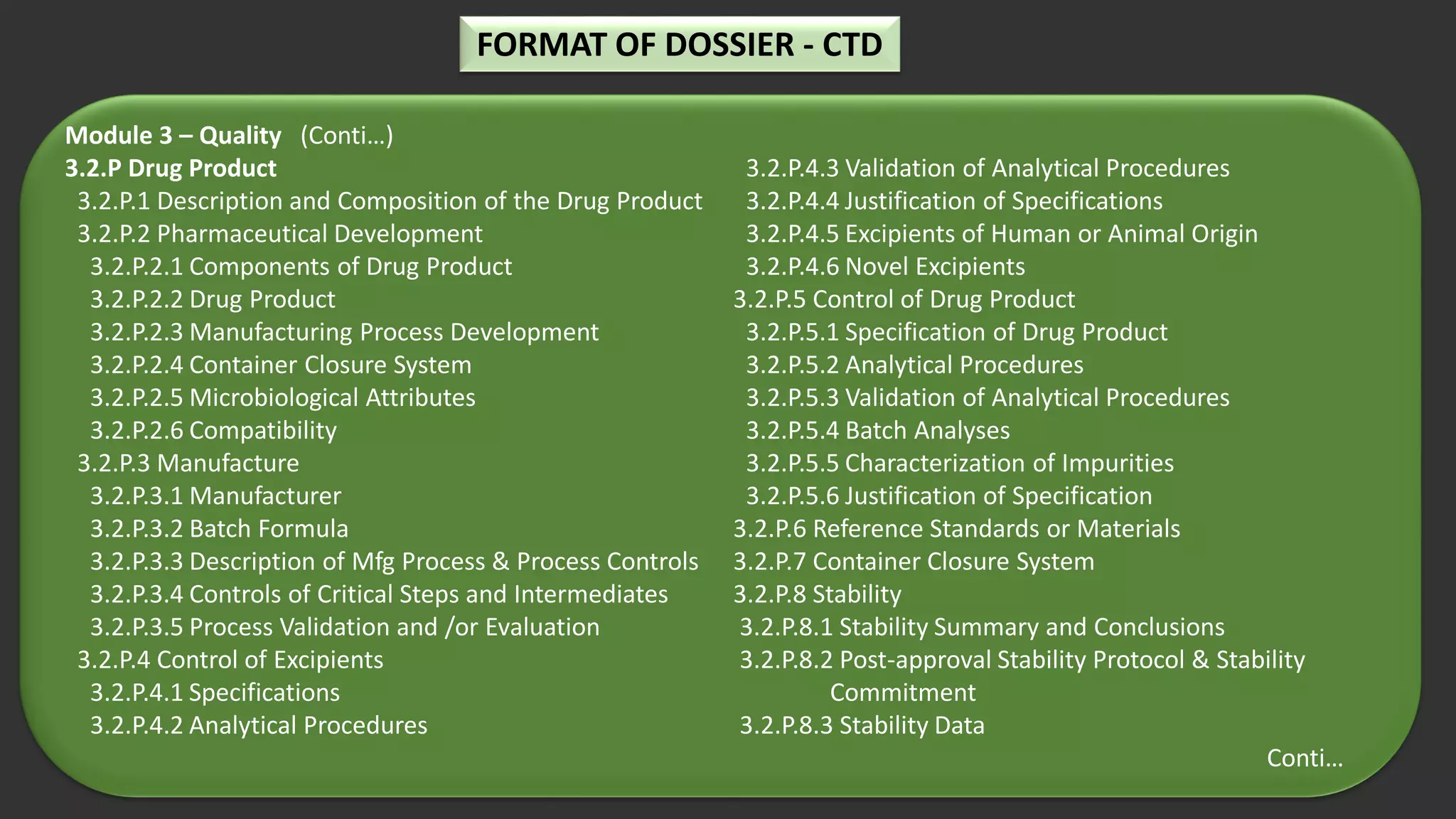
Module 3 – Quality (Conti…)
3.2.P Drug Product
3.2.P.1 Description and Composition of the Drug Product
3.2.P.2 Pharmaceutical Development
3.2.P.2.1 Components of Drug Product
3.2.P.2.2 Drug Product
3.2.P.2.3 Manufacturing Process Development
3.2.P.2.4 Container Closure System
3.2.P.2.5 Microbiological Attributes
3.2.P.2.6 Compatibility
3.2.P.3 Manufacture
3.2.P.3.1 Manufacturer
3.2.P.3.2 Batch Formula
3.2.P.3.3 Description of Mfg Process & Process Controls
3.2.P.3.4 Controls of Critical Steps and Intermediates
3.2.P.3.5 Process Validation and /or Evaluation
3.2.P.4 Control of Excipients
3.2.P.4.1 Specifications
3.2.P.4.2 Analytical Procedures
3.2.P.4.3 Validation of Analytical Procedures
3.2.P.4.4 Justification of Specifications
3.2.P.4.5 Excipients of Human or Animal Origin
3.2.P.4.6 Novel Excipients
3.2.P.5 Control of Drug Product
3.2.P.5.1 Specification of Drug Product
3.2.P.5.2 Analytical Procedures
3.2.P.5.3 Validation of Analytical Procedures
3.2.P.5.4 Batch Analyses
3.2.P.5.5 Characterization of Impurities
3.2.P.5.6 Justification of Specification
3.2.P.6 Reference Standards or Materials
3.2.P.7 Container Closure System
3.2.P.8 Stability
3.2.P.8.1 Stability Summary and Conclusions
3.2.P.8.2 Post-approval Stability Protocol & Stability
Commitment
3.2.P.8.3 Stability Data
Conti…
FORMAT OF DOSSIER - CTD
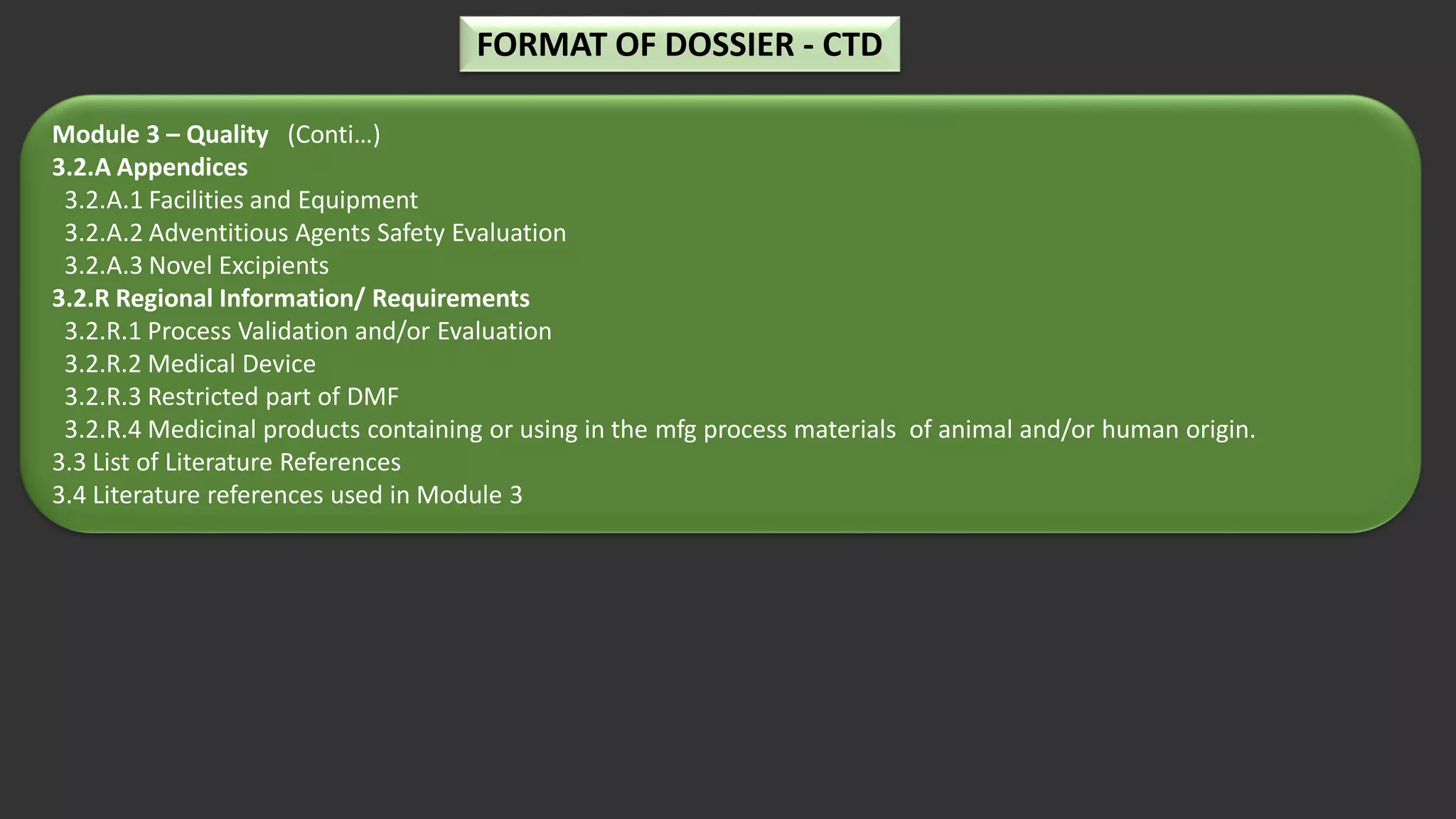
Module 3 – Quality (Conti…)
3.2.A Appendices
3.2.A.1 Facilities and Equipment
3.2.A.2 Adventitious Agents Safety Evaluation
3.2.A.3 Novel Excipients
3.2.R Regional Information/ Requirements
3.2.R.1 Process Validation and/or Evaluation
3.2.R.2 Medical Device
3.2.R.3 Restricted part of DMF
3.2.R.4 Medicinal products containing or using in the mfg process materials of animal and/or human origin.
3.3 List of Literature References
3.4 Literature references used in Module 3
FORMAT OF DOSSIER - CTD
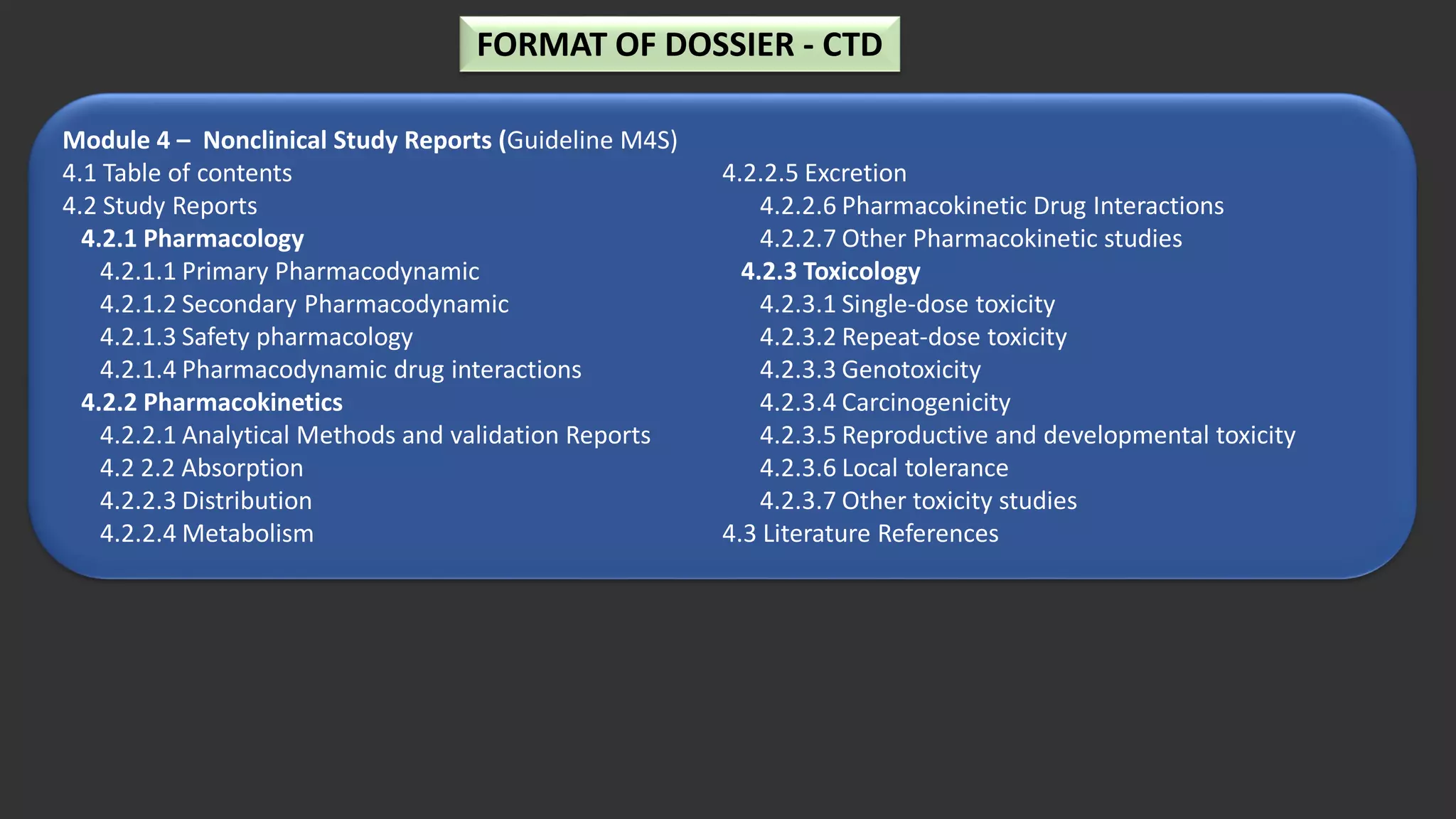
Module 4 – Nonclinical Study Reports (Guideline M4S)
4.1 Table of contents
4.2 Study Reports
4.2.1 Pharmacology
4.2.1.1 Primary Pharmacodynamic
4.2.1.2 Secondary Pharmacodynamic
4.2.1.3 Safety pharmacology
4.2.1.4 Pharmacodynamic drug interactions
4.2.2 Pharmacokinetics
4.2.2.1 Analytical Methods and validation Reports
4.2 2.2 Absorption
4.2.2.3 Distribution
4.2.2.4 Metabolism
4.2.2.5 Excretion
4.2.2.6 Pharmacokinetic Drug Interactions
4.2.2.7 Other Pharmacokinetic studies
4.2.3 Toxicology
4.2.3.1 Single-dose toxicity
4.2.3.2 Repeat-dose toxicity
4.2.3.3 Genotoxicity
4.2.3.4 Carcinogenicity
4.2.3.5 Reproductive and developmental toxicity
4.2.3.6 Local tolerance
4.2.3.7 Other toxicity studies
4.3 Literature References
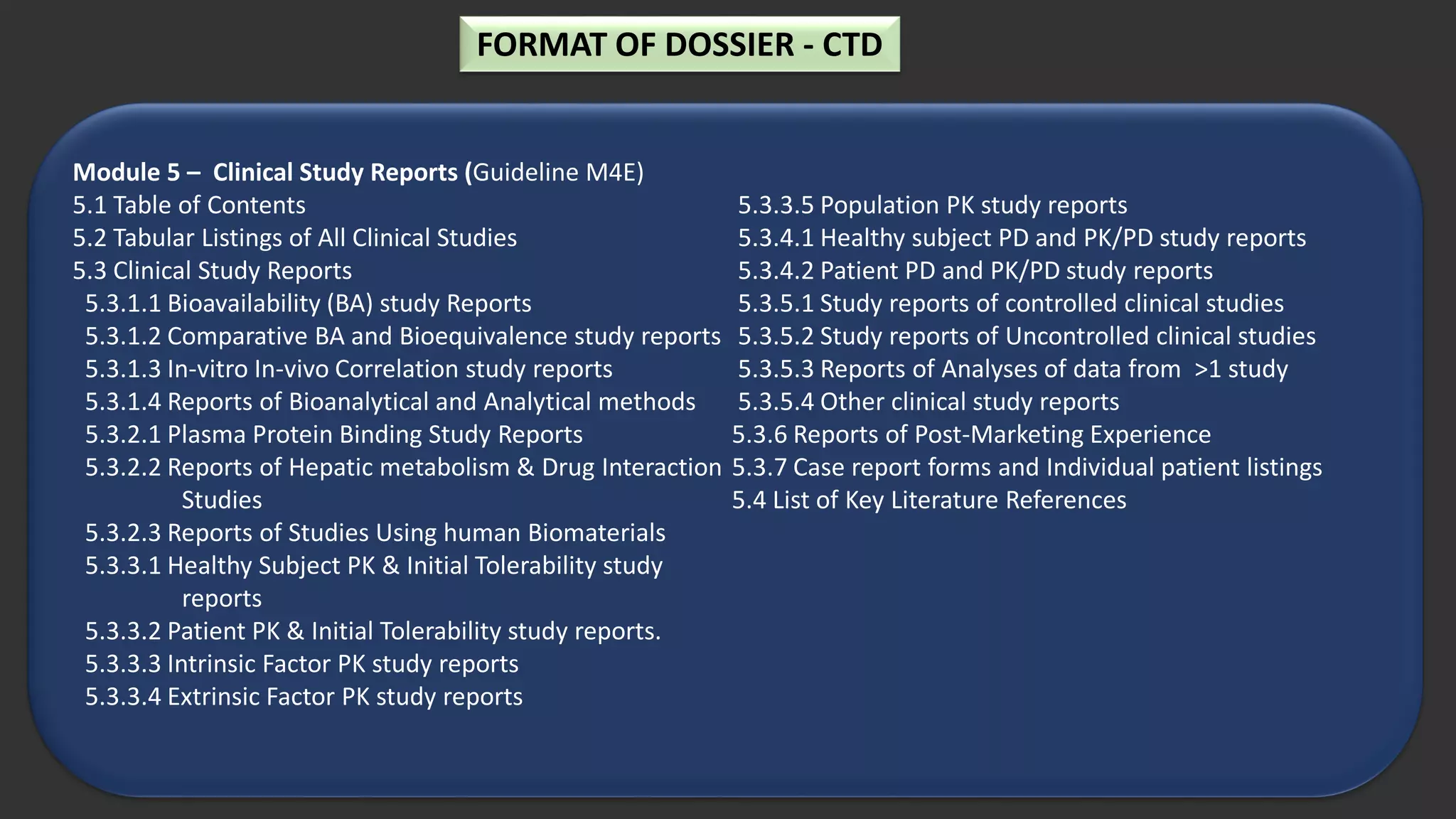
FORMAT OF DOSSIER - CTD
Module 5 – Clinical Study Reports (Guideline M4E)
5.1 Table of Contents
5.2 Tabular Listings of All Clinical Studies
5.3 Clinical Study Reports
5.3.1.1 Bioavailability (BA) study Reports
5.3.1.2 Comparative BA and Bioequivalence study reports
5.3.1.3 In-vitro In-vivo Correlation study reports
5.3.1.4 Reports of Bioanalytical and Analytical methods
5.3.2.1 Plasma Protein Binding Study Reports
5.3.2.2 Reports of Hepatic metabolism & Drug Interaction
Studies
5.3.2.3 Reports of Studies Using human Biomaterials
5.3.3.1 Healthy Subject PK & Initial Tolerability study
reports
5.3.3.2 Patient PK & Initial Tolerability study reports.
5.3.3.3 Intrinsic Factor PK study reports
5.3.3.4 Extrinsic Factor PK study reports
5.3.3.5 Population PK study reports
5.3.4.1 Healthy subject PD and PK/PD study reports
5.3.4.2 Patient PD and PK/PD study reports
5.3.5.1 Study reports of controlled clinical studies
5.3.5.2 Study reports of Uncontrolled clinical studies
5.3.5.3 Reports of Analyses of data from >1 study
5.3.5.4 Other clinical study reports
5.3.6 Reports of Post-Marketing Experience
5.3.7 Case report forms and Individual patient listings
5.4 List of Key Literature References
THANK YOU 

dossier.pdf

  • 1.
    By: Zeel Shah Masters ofRegulatory Affairs
  • 2.
    Brief about dossier ICH Guidelines Dossierregistration Regulatory guidelines for dossier Format of dossier (Module 1-5) FLOW OF PRESENTATION
  • 3.
    Brief on Dossier A collection ofdocument submitted for approval of drug product. It is submitted in the form of CTD. CTD is harmonized format for presenting data in ICH regions. It contains qualitative, administrative, non-clinical and clinical data CDSCO under Ministry of Health and Family Welfare(MHFW)
  • 4.
    ICH (INTERNATIONAL CONFERENCEOF HARMONIZATION) CDSCO adopts CTD format for technical requirements for registration of pharmaceutical products for human use (Feb 2009) Based on ICH Tripartite Guideline Issued the CTD quality (IMH-4Q) CTD format has widely accepted by regulatory authority within and beyond the ICH regions
  • 5.
    • Preparation guideline:10.375: Guideline on submission of documentation for a multisource (generic) finished pharmaceutical product (FPP): Preparation of product dossiers (PDs) in CTD format • Quality guideline: 10.375: Guideline on submission of documentation for a multisource (generic) FPP: Quality part • Two formats for dossier preparation i.e ICH-CTD and ACTD G U I D E L I N E S
  • 6.
    DOSSIER REGISTRATION Contains alltechnical data of pharmaceutical product to be approved/registered/marketed It is more commonly called as NDA in the USA and Marketing Authorization Application(MAA) in EU and other countries it is simply called registration dossier It is used for licensing approval/market authorization of drug
  • 7.
    D & CAct 1940 & 1945 Regulates the import manufacture, distribution and sale. Schedule Y: provides guidelines and requirements for clinical trials CDSCO: A licensing authority for approval of new drugs DCGI: responsible for approval of new drugs & CT to be conducted in India. Appointed by Central Government of India Regulatory Guideline for Dossier Submission in India
  • 8.
    1995 Concept of CTD proposed by industry November 2000 ICH-CTD guidelines finalized September 2002 Re-editingof guidelines by changing number of section 2 header Prior to July 2003 Voluntary submission phase in 3 ICH regions 1 July 2003 Mandatory requirement in 3 ICH regions 2009 In India: CDSCO adopt CTD format for technical requirement for registration of biological products October 28, 2010 In India: CDSCO give guideline for feedback purpose for industry on preparation of CTD for import/marketing approval new drug for Human use and ask comments and suggestions within 60 days Structure of CTD
  • 9.
    Administrative Documents: Application form, Labels, packageinserts Chemistry, Manufacturing and Characterization(CMC) data of drug substance and drug product Pre-clinical data (animal study data) Clinical data (Human study data) Information to be Submitted
  • 10.
  • 11.
    FORMAT OF DOSSIER- CTD Module 1: Administrative Information and Prescribing Information 1.1 Comprehensive Table of Contents of the Submission Including all Modules 1.2 Documents Specific to Each Region (for example, cover letter, application forms, product information, prescribing information, information about experts, pharmacovigilance, orphan drug status, etc.) Module 2 – CTD Summaries 2.1 Common Technical Document TOC (Modules 2-5) 2.2 CTD Introduction 2.3 Quality Overall Summary 2.4 Nonclinical Overview 2.4.1 General Aspects 2.4.2 Content and Structural Format 2.5 Clinical Overview 2.5.1 Product Development of Content Rationale 2.5.2 Overview of Biop’ceutics 2.5.3 Overview of Clinical Pharmacology 2.5.4 Overview of Efficacy 2.5.5 Overview of Safety 2.5.6 Benefits and Risks Conclusions 2.5.7 Literature References 2.6 Non-clinical Written and Tabulated Summaries 2.6.1 Pharmacology 2.6.2 Pharmacokinetics 2.6.3 Toxicology 2.7 Clinical summary 2.7.1 Biop’ceutic Studies & Associated Analytical Methods 2.7.2 Clinical Pharmacology Studies 2.7.3 Clinical Efficacy 2.7.4 Clinical Safety 2.7.5 Literature References 2.7.6 Synopses of Individual Studies
  • 12.
    FORMAT OF DOSSIER- CTD Module 3 – Quality (Guideline M4Q) 3.1 Table of contents of Module 3 3.2 Body of data 3.2.S Drug Substance 3.2.S.1 General Information 3.2.S.1.1 Nomenclature 3.2.S.1.2 Structure 3.2.S.1.3 General Properties 3.2.S.2 Manufacture 3.2.S.2.1 Manufacturer Details 3.2.S.2.2 Description of Mfg Process & Process Controls 3.2.S.2.3 Control of Materials 3.2.S.2.4 Controls of Critical Steps and Intermediates 3.2.S.2.5 Process Validation and /or Evaluation 3.2.S.2.6 Manufacturing Process Development 3.2.S.3 Characterization 3.2.S.3.1 Elucidation of structure & other Characteristics 3.2.S.3.2 Impurities 3.2.S.4 Control of Drug Substance 3.2.S.4.1 Specification of Drug Substance 3.2.S.4.2 Analytical Procedures 3.2.S.4.3 Validation of Analytical Procedures 3.2.S.4.4 Batch Analyses 3.2.S.4.5 Justification of Specification 3.2.S.5 Reference Standards or Materials 3.2.S.6 Container Closure System 3.2.S.7 Stability 3.2.S.7.1 Stability Summary and Conclusions 3.2.S.7.2 Post-approval Stability Protocol & Stability Commitment 3.2.S.7.3 Stability Data Conti…
  • 13.
    Module 3 –Quality (Conti…) 3.2.P Drug Product 3.2.P.1 Description and Composition of the Drug Product 3.2.P.2 Pharmaceutical Development 3.2.P.2.1 Components of Drug Product 3.2.P.2.2 Drug Product 3.2.P.2.3 Manufacturing Process Development 3.2.P.2.4 Container Closure System 3.2.P.2.5 Microbiological Attributes 3.2.P.2.6 Compatibility 3.2.P.3 Manufacture 3.2.P.3.1 Manufacturer 3.2.P.3.2 Batch Formula 3.2.P.3.3 Description of Mfg Process & Process Controls 3.2.P.3.4 Controls of Critical Steps and Intermediates 3.2.P.3.5 Process Validation and /or Evaluation 3.2.P.4 Control of Excipients 3.2.P.4.1 Specifications 3.2.P.4.2 Analytical Procedures 3.2.P.4.3 Validation of Analytical Procedures 3.2.P.4.4 Justification of Specifications 3.2.P.4.5 Excipients of Human or Animal Origin 3.2.P.4.6 Novel Excipients 3.2.P.5 Control of Drug Product 3.2.P.5.1 Specification of Drug Product 3.2.P.5.2 Analytical Procedures 3.2.P.5.3 Validation of Analytical Procedures 3.2.P.5.4 Batch Analyses 3.2.P.5.5 Characterization of Impurities 3.2.P.5.6 Justification of Specification 3.2.P.6 Reference Standards or Materials 3.2.P.7 Container Closure System 3.2.P.8 Stability 3.2.P.8.1 Stability Summary and Conclusions 3.2.P.8.2 Post-approval Stability Protocol & Stability Commitment 3.2.P.8.3 Stability Data Conti… FORMAT OF DOSSIER - CTD
  • 14.
    Module 3 –Quality (Conti…) 3.2.A Appendices 3.2.A.1 Facilities and Equipment 3.2.A.2 Adventitious Agents Safety Evaluation 3.2.A.3 Novel Excipients 3.2.R Regional Information/ Requirements 3.2.R.1 Process Validation and/or Evaluation 3.2.R.2 Medical Device 3.2.R.3 Restricted part of DMF 3.2.R.4 Medicinal products containing or using in the mfg process materials of animal and/or human origin. 3.3 List of Literature References 3.4 Literature references used in Module 3 FORMAT OF DOSSIER - CTD
  • 15.
    Module 4 –Nonclinical Study Reports (Guideline M4S) 4.1 Table of contents 4.2 Study Reports 4.2.1 Pharmacology 4.2.1.1 Primary Pharmacodynamic 4.2.1.2 Secondary Pharmacodynamic 4.2.1.3 Safety pharmacology 4.2.1.4 Pharmacodynamic drug interactions 4.2.2 Pharmacokinetics 4.2.2.1 Analytical Methods and validation Reports 4.2 2.2 Absorption 4.2.2.3 Distribution 4.2.2.4 Metabolism 4.2.2.5 Excretion 4.2.2.6 Pharmacokinetic Drug Interactions 4.2.2.7 Other Pharmacokinetic studies 4.2.3 Toxicology 4.2.3.1 Single-dose toxicity 4.2.3.2 Repeat-dose toxicity 4.2.3.3 Genotoxicity 4.2.3.4 Carcinogenicity 4.2.3.5 Reproductive and developmental toxicity 4.2.3.6 Local tolerance 4.2.3.7 Other toxicity studies 4.3 Literature References FORMAT OF DOSSIER - CTD
  • 16.
    FORMAT OF DOSSIER- CTD Module 5 – Clinical Study Reports (Guideline M4E) 5.1 Table of Contents 5.2 Tabular Listings of All Clinical Studies 5.3 Clinical Study Reports 5.3.1.1 Bioavailability (BA) study Reports 5.3.1.2 Comparative BA and Bioequivalence study reports 5.3.1.3 In-vitro In-vivo Correlation study reports 5.3.1.4 Reports of Bioanalytical and Analytical methods 5.3.2.1 Plasma Protein Binding Study Reports 5.3.2.2 Reports of Hepatic metabolism & Drug Interaction Studies 5.3.2.3 Reports of Studies Using human Biomaterials 5.3.3.1 Healthy Subject PK & Initial Tolerability study reports 5.3.3.2 Patient PK & Initial Tolerability study reports. 5.3.3.3 Intrinsic Factor PK study reports 5.3.3.4 Extrinsic Factor PK study reports 5.3.3.5 Population PK study reports 5.3.4.1 Healthy subject PD and PK/PD study reports 5.3.4.2 Patient PD and PK/PD study reports 5.3.5.1 Study reports of controlled clinical studies 5.3.5.2 Study reports of Uncontrolled clinical studies 5.3.5.3 Reports of Analyses of data from >1 study 5.3.5.4 Other clinical study reports 5.3.6 Reports of Post-Marketing Experience 5.3.7 Case report forms and Individual patient listings 5.4 List of Key Literature References
  • 17.