ICH – INTERNATIONAL COUNCIL
FOR HARMONIZATION & IT’S
GUIDELINES
By: Zeel Shah
Masters of Regulatory Affairs
Semester: 1
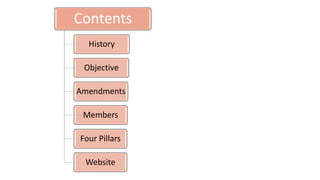
Contents
History
Objective
Amendments
Members
Four Pillars
Website
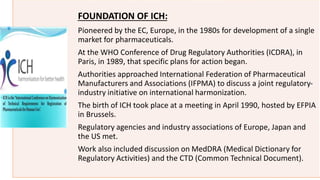
FOUNDATION OF ICH:
Pioneered by the EC, Europe, in the 1980s for development of a single
market for pharmaceuticals.
At the WHO Conference of Drug Regulatory Authorities (ICDRA), in
Paris, in 1989, that specific plans for action began.
Authorities approached International Federation of Pharmaceutical
Manufacturers and Associations (IFPMA) to discuss a joint regulatory-
industry initiative on international harmonization.
The birth of ICH took place at a meeting in April 1990, hosted by EFPIA
in Brussels.
Regulatory agencies and industry associations of Europe, Japan and
the US met.
Work also included discussion on MedDRA (Medical Dictionary for
Regulatory Activities) and the CTD (Common Technical Document).
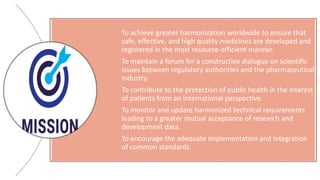
To achieve greater harmonization worldwide to ensure that
safe, effective, and high quality medicines are developed and
registered in the most resource-efficient manner.
To maintain a forum for a constructive dialogue on scientific
issues between regulatory authorities and the pharmaceutical
industry.
To contribute to the protection of public health in the interest
of patients from an international perspective.
To monitor and update harmonized technical requirements
leading to a greater mutual acceptance of research and
development data.
To encourage the adequate implementation and integration
of common standards.
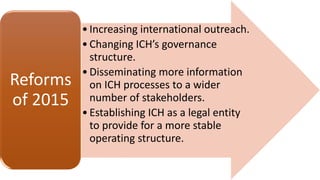
•Increasing international outreach.
•Changing ICH’s governance
structure.
•Disseminating more information
on ICH processes to a wider
number of stakeholders.
•Establishing ICH as a legal entity
to provide for a more stable
operating structure.
Reforms
of 2015
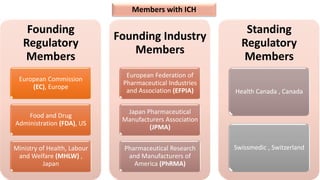
Founding
Regulatory
Members
European Commission
(EC), Europe
Food and Drug
Administration (FDA), US
Ministry of Health, Labour
and Welfare (MHLW) ,
Japan
Founding Industry
Members
European Federation of
Pharmaceutical Industries
and Association (EFPIA)
Japan Pharmaceutical
Manufacturers Association
(JPMA)
Pharmaceutical Research
and Manufacturers of
America (PhRMA)
Standing
Regulatory
Members
Health Canada , Canada
Swissmedic , Switzerland
Members with ICH
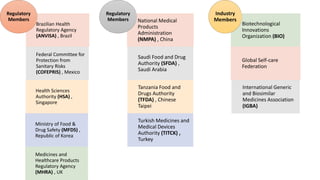
Brazilian Health
Regulatory Agency
(ANVISA) , Brazil
Federal Committee for
Protection from
Sanitary Risks
(COFEPRIS) , Mexico
Health Sciences
Authority (HSA) ,
Singapore
Ministry of Food &
Drug Safety (MFDS) ,
Republic of Korea
Medicines and
Healthcare Products
Regulatory Agency
(MHRA) , UK
Regulatory
Members National Medical
Products
Administration
(NMPA) , China
Saudi Food and Drug
Authority (SFDA) ,
Saudi Arabia
Tanzania Food and
Drugs Authority
(TFDA) , Chinese
Taipei
Turkish Medicines and
Medical Devices
Authority (TITCK) ,
Turkey
Regulatory
Members
Biotechnological
Innovations
Organization (BIO)
Global Self-care
Federation
International Generic
and Biosimilar
Medicines Association
(IGBA)
Industry
Members
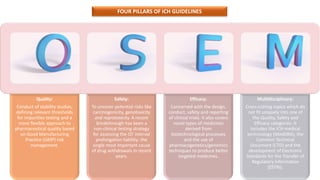
Quality:
Conduct of stability studies,
defining relevant thresholds
for impurities testing and a
more flexible approach to
pharmaceutical quality based
on Good Manufacturing
Practice (GMP) risk
management.
Safety:
To uncover potential risks like
carcinogenicity, genotoxicity
and reprotoxicity. A recent
breakthrough has been a
non-clinical testing strategy
for assessing the QT interval
prolongation liability: the
single most important cause
of drug withdrawals in recent
years.
Efficacy:
Concerned with the design,
conduct, safety and reporting
of clinical trials. It also covers
novel types of medicines
derived from
biotechnological processes
and the use of
pharmacogenetics/genomics
techniques to produce better
targeted medicines.
Multidisciplinary:
Cross-cutting topics which do
not fit uniquely into one of
the Quality, Safety and
Efficacy categories. It
includes the ICH medical
terminology (MedDRA), the
Common Technical
Document (CTD) and the
development of Electronic
Standards for the Transfer of
Regulatory Information
(ESTRI).
FOUR PILLARS OF ICH GUIDELINES
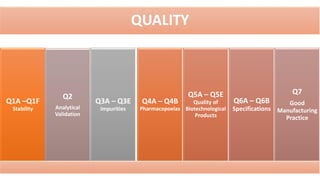
QUALITY
Q1A –Q1F
Stability
Q4A – Q4B
Pharmacopoeias
Q5A – Q5E
Quality of
Biotechnological
Products
Q6A – Q6B
Specifications
Q7
Good
Manufacturing
Practice
Q2
Analytical
Validation
Q3A – Q3E
Impurities
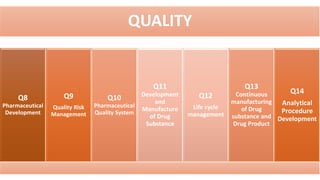
QUALITY
Q8
Pharmaceutical
Development
Q9
Quality Risk
Management
Q10
Pharmaceutical
Quality System
Q11
Development
and
Manufacture
of Drug
Substance
Q12
Life cycle
management
Q13
Continuous
manufacturing
of Drug
substance and
Drug Product
Q14
Analytical
Procedure
Development
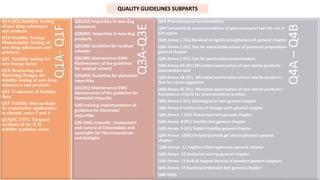
Q4A
–
Q4B
Q3A-Q3E
Q1A-
Q1F
Q1A (R2) Stability Testing
of new drug substances
and products
Q1B Stability Testing:
Photostability Testing of
new drug substances and
products.
Q1C Stability testing for
new dosage forms
Q1D Bracketing and
Matrixing Designs for
stability testing of new drug
substances and products
Q1E Evaluation of Stability
Data
Q1F Stability data package
for registration applications
in climatic zones 3 and 4
Q1/Q5C EWG Targeted
revisions of the ICH
stability guideline series
Q3A(R2) Impurities in new dug
substances
Q3B(R2) Impurities in new dug
products
Q3C(R8) Guideline for residual
solvents
Q3C(R9) Maintenance EWG
Maintenance of the guideline
for residual solvent
Q3D(R2) Guideline for elemental
impurities
Q3C(R3) Maintenance EWG
Maintenance of the guideline for
Elemental impurity
Q3D training Implementation of
guideline for Elemental
impurities
Q3E EWG Impurity : Assessment
and control of Extractables and
Leachable for Pharmaceuticals
and biologics
Q4A Pharmacopeial harmonization
Q4B Evaluation & recommendation of pharmacopeial text for use in
ICH region
Q4B Annex 1 (R1) Residual on ignition/sulphated ash general chapter
Q4B Annex 2 (R1) Test for extractable values of parentral preparation
general chapter
Q4B Annex 3 (R1) Test for particulate contamination
Q4B Annex 4A (R1) Microbial examination of non-sterile products :
enumeration test
Q4B Annex 4B (R1) Microbial examination of non-sterile products :
Test for micro-organisms
Q4B Annex 4C (R1) Microbial examination of non-sterile products :
Acceptance criteria for pharmaceutical product
Q4B Annex 5 (R1) Disintegration test general chapter
Q4B Annex 6 Uniformity of dosage units general chapter
Q4B Annex 7 (R2) Dissolution test general chapter
Q4B Annex 8 (R1) Sterility test general chapter
Q4B Annex 9 (R1) Tablet friability general chapter
Q4B Annex 10(R1) Polyacrylamide gel electrophoresis general
chapter
Q4B Annex 11 Capillary Electrophoresis general chapter
Q4B Annex 12 Analytical sieving general chapter
Q4B Annex 13 Bulk & tapped density of powders general chapters
Q4B Annex 14 Bacterial Endotoxin test general chapter
Q4B FAQs
QUALITY GUIDELINES SUBPARTS
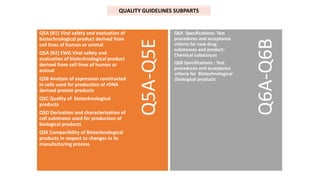
Q6A-Q6B
Q5A-Q5E
Q5A (R1) Viral safety and evaluation of
biotechnological product derived from
cell lines of human or animal
Q5A (R2) EWG Viral safety and
evaluation of biotechnological product
derived from cell lines of human or
animal
Q5B Analysis of expression constructed
in cells used for production of rDNA
derived protein products
Q5C Quality of biotechnological
products
Q5D Derivation and characterization of
cell substrates used for production of
biological products
Q5E Comparibility of Biotechnological
products in respect to changes in its
manufacturing process
Q6A Specifications: Test
procedures and acceptance
criteria for new drug
substances and product:
Chemical substances
Q6B Specifications : Test
procedures and acceptance
criteria for Biotechnological
/biological products
QUALITY GUIDELINES SUBPARTS
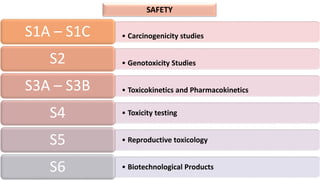
• Carcinogenicity studies
S1A – S1C
• Genotoxicity Studies
S2
• Toxicokinetics and Pharmacokinetics
S3A – S3B
• Toxicity testing
S4
• Reproductive toxicology
S5
• Biotechnological Products
S6
SAFETY
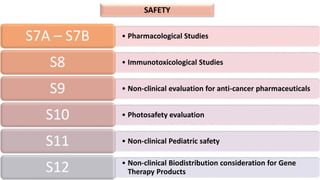
SAFETY
• Pharmacological Studies
S7A – S7B
• Immunotoxicological Studies
S8
• Non-clinical evaluation for anti-cancer pharmaceuticals
S9
• Photosafety evaluation
S10
• Non-clinical Pediatric safety
S11
• Non-clinical Biodistribution consideration for Gene
Therapy Products
S12
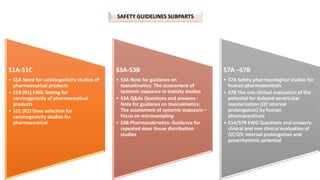
S1A-S1C
• S1A Need for carcinogenicity studies of
pharmaceutical products
• S1B (R1) EWG Testing for
carcinogenicity of pharmaceutical
products
• S1C (R2) Dose selection for
carcinogenicity studies for
pharmaceutical
S3A-S3B
• S3A Note for guidance on
toxicokinetics: The assessment of
systemic exposure in toxicity studies
• S3A Q&As Questions and answers -
Note for guidance on toxicokinetics:
The assessment of systemic exposure –
Focus on microsampling
• S3B Pharmacokinetics: Guidance for
repeated dose tissue distribution
studies
S7A –S7B
• S7A Safety pharmacological studies for
human pharmaceuticals
• S7B The non clinical evaluation of the
potential for delayed ventricular
repolarization (QT interval
prolongation) by human
pharmaceuticals
• E14/S7B EWG Questions and answers:
clinical and non clinical evaluation of
QT/QTc interval prolongation and
proarrhythmic potential
SAFETY GUIDELINES SUBPARTS
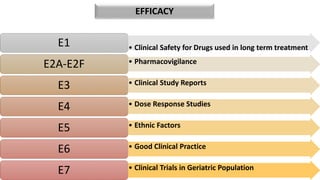
• Clinical Safety for Drugs used in long term treatment
E1
• Pharmacovigilance
E2A-E2F
• Clinical Study Reports
E3
• Dose Response Studies
E4
• Ethnic Factors
E5
• Good Clinical Practice
E6
• Clinical Trials in Geriatric Population
E7
EFFICACY
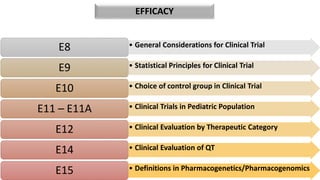
EFFICACY
• General Considerations for Clinical Trial
E8
• Statistical Principles for Clinical Trial
E9
• Choice of control group in Clinical Trial
E10
• Clinical Trials in Pediatric Population
E11 – E11A
• Clinical Evaluation by Therapeutic Category
E12
• Clinical Evaluation of QT
E14
• Definitions in Pharmacogenetics/Pharmacogenomics
E15
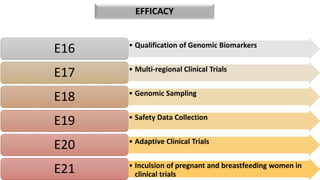
EFFICACY
• Qualification of Genomic Biomarkers
E16
• Multi-regional Clinical Trials
E17
• Genomic Sampling
E18
• Safety Data Collection
E19
• Adaptive Clinical Trials
E20
• Inculsion of pregnant and breastfeeding women in
clinical trials
E21
E2A – E2F
• E2A Clinical safety data management: definitions and
standards for reporting
• E2B (R2) Clinical safety data management: Data element
for transmission of Individual Case Safety Reports(ICSRs)
• E2B (R3) Q&As Clinical safety data management: Data
element for transmission of Individual Case Safety Reports
• E2B (R3) EWG/IWG Element for transmission of Individual
Case Safety Reports
• E2C (R2) Periodic benefit risk evaluation reports
• E2C (R2) Q&As Question and answers: Periodic benefit risk
evaluation reports
• E2D Post approval safety data management : Definitions
and standards for expediting reportings
• E2D (R1) EWG Post approval safety data management :
Definitions and standards for expediting reportings
• E2E Pharmacovigilance planning
• E2F Development safety update
E11-E11A
• E11 (R1) Addendum: Clinical invstigation of
medicinal products in the pediatric population
• E11A EWG Pediatric extrapolation
EFFICACY GUIDELINE SUBPARTS
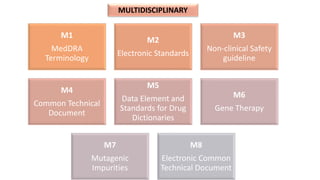
M1
MedDRA
Terminology
M2
Electronic Standards
M3
Non-clinical Safety
guideline
M4
Common Technical
Document
M5
Data Element and
Standards for Drug
Dictionaries
M6
Gene Therapy
M7
Mutagenic
Impurities
M8
Electronic Common
Technical Document
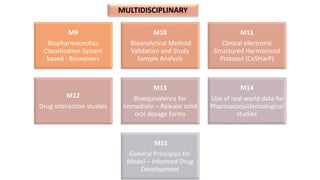
MULTIDISCIPLINARY
MULTIDISCIPLINARY
M9
Biopharmaceutics
Classification System
based - Biowaivers
M10
Bioanalytical Method
Validation and Study
Sample Analysis
M11
Clinical electronic
Structured Harmonised
Protocol (CeSHarP)
M12
Drug interaction studies
M13
Bioequivalence for
Immediate – Release solid
oral dosage forms
M14
Use of real world data for
Pharmacoepidemiological
studies
M15
General Principles for
Model – Informed Drug
Development
Website
ich.org
THANK YOU 

ICH guideline.pdf

  • 1.
    ICH – INTERNATIONALCOUNCIL FOR HARMONIZATION & IT’S GUIDELINES By: Zeel Shah Masters of Regulatory Affairs Semester: 1
  • 2.
  • 3.
    FOUNDATION OF ICH: Pioneeredby the EC, Europe, in the 1980s for development of a single market for pharmaceuticals. At the WHO Conference of Drug Regulatory Authorities (ICDRA), in Paris, in 1989, that specific plans for action began. Authorities approached International Federation of Pharmaceutical Manufacturers and Associations (IFPMA) to discuss a joint regulatory- industry initiative on international harmonization. The birth of ICH took place at a meeting in April 1990, hosted by EFPIA in Brussels. Regulatory agencies and industry associations of Europe, Japan and the US met. Work also included discussion on MedDRA (Medical Dictionary for Regulatory Activities) and the CTD (Common Technical Document).
  • 4.
    To achieve greaterharmonization worldwide to ensure that safe, effective, and high quality medicines are developed and registered in the most resource-efficient manner. To maintain a forum for a constructive dialogue on scientific issues between regulatory authorities and the pharmaceutical industry. To contribute to the protection of public health in the interest of patients from an international perspective. To monitor and update harmonized technical requirements leading to a greater mutual acceptance of research and development data. To encourage the adequate implementation and integration of common standards.
  • 5.
    •Increasing international outreach. •ChangingICH’s governance structure. •Disseminating more information on ICH processes to a wider number of stakeholders. •Establishing ICH as a legal entity to provide for a more stable operating structure. Reforms of 2015
  • 6.
    Founding Regulatory Members European Commission (EC), Europe Foodand Drug Administration (FDA), US Ministry of Health, Labour and Welfare (MHLW) , Japan Founding Industry Members European Federation of Pharmaceutical Industries and Association (EFPIA) Japan Pharmaceutical Manufacturers Association (JPMA) Pharmaceutical Research and Manufacturers of America (PhRMA) Standing Regulatory Members Health Canada , Canada Swissmedic , Switzerland Members with ICH
  • 7.
    Brazilian Health Regulatory Agency (ANVISA), Brazil Federal Committee for Protection from Sanitary Risks (COFEPRIS) , Mexico Health Sciences Authority (HSA) , Singapore Ministry of Food & Drug Safety (MFDS) , Republic of Korea Medicines and Healthcare Products Regulatory Agency (MHRA) , UK Regulatory Members National Medical Products Administration (NMPA) , China Saudi Food and Drug Authority (SFDA) , Saudi Arabia Tanzania Food and Drugs Authority (TFDA) , Chinese Taipei Turkish Medicines and Medical Devices Authority (TITCK) , Turkey Regulatory Members Biotechnological Innovations Organization (BIO) Global Self-care Federation International Generic and Biosimilar Medicines Association (IGBA) Industry Members
  • 8.
    Quality: Conduct of stabilitystudies, defining relevant thresholds for impurities testing and a more flexible approach to pharmaceutical quality based on Good Manufacturing Practice (GMP) risk management. Safety: To uncover potential risks like carcinogenicity, genotoxicity and reprotoxicity. A recent breakthrough has been a non-clinical testing strategy for assessing the QT interval prolongation liability: the single most important cause of drug withdrawals in recent years. Efficacy: Concerned with the design, conduct, safety and reporting of clinical trials. It also covers novel types of medicines derived from biotechnological processes and the use of pharmacogenetics/genomics techniques to produce better targeted medicines. Multidisciplinary: Cross-cutting topics which do not fit uniquely into one of the Quality, Safety and Efficacy categories. It includes the ICH medical terminology (MedDRA), the Common Technical Document (CTD) and the development of Electronic Standards for the Transfer of Regulatory Information (ESTRI). FOUR PILLARS OF ICH GUIDELINES
  • 9.
    QUALITY Q1A –Q1F Stability Q4A –Q4B Pharmacopoeias Q5A – Q5E Quality of Biotechnological Products Q6A – Q6B Specifications Q7 Good Manufacturing Practice Q2 Analytical Validation Q3A – Q3E Impurities
  • 10.
    QUALITY Q8 Pharmaceutical Development Q9 Quality Risk Management Q10 Pharmaceutical Quality System Q11 Development and Manufacture ofDrug Substance Q12 Life cycle management Q13 Continuous manufacturing of Drug substance and Drug Product Q14 Analytical Procedure Development
  • 11.
    Q4A – Q4B Q3A-Q3E Q1A- Q1F Q1A (R2) StabilityTesting of new drug substances and products Q1B Stability Testing: Photostability Testing of new drug substances and products. Q1C Stability testing for new dosage forms Q1D Bracketing and Matrixing Designs for stability testing of new drug substances and products Q1E Evaluation of Stability Data Q1F Stability data package for registration applications in climatic zones 3 and 4 Q1/Q5C EWG Targeted revisions of the ICH stability guideline series Q3A(R2) Impurities in new dug substances Q3B(R2) Impurities in new dug products Q3C(R8) Guideline for residual solvents Q3C(R9) Maintenance EWG Maintenance of the guideline for residual solvent Q3D(R2) Guideline for elemental impurities Q3C(R3) Maintenance EWG Maintenance of the guideline for Elemental impurity Q3D training Implementation of guideline for Elemental impurities Q3E EWG Impurity : Assessment and control of Extractables and Leachable for Pharmaceuticals and biologics Q4A Pharmacopeial harmonization Q4B Evaluation & recommendation of pharmacopeial text for use in ICH region Q4B Annex 1 (R1) Residual on ignition/sulphated ash general chapter Q4B Annex 2 (R1) Test for extractable values of parentral preparation general chapter Q4B Annex 3 (R1) Test for particulate contamination Q4B Annex 4A (R1) Microbial examination of non-sterile products : enumeration test Q4B Annex 4B (R1) Microbial examination of non-sterile products : Test for micro-organisms Q4B Annex 4C (R1) Microbial examination of non-sterile products : Acceptance criteria for pharmaceutical product Q4B Annex 5 (R1) Disintegration test general chapter Q4B Annex 6 Uniformity of dosage units general chapter Q4B Annex 7 (R2) Dissolution test general chapter Q4B Annex 8 (R1) Sterility test general chapter Q4B Annex 9 (R1) Tablet friability general chapter Q4B Annex 10(R1) Polyacrylamide gel electrophoresis general chapter Q4B Annex 11 Capillary Electrophoresis general chapter Q4B Annex 12 Analytical sieving general chapter Q4B Annex 13 Bulk & tapped density of powders general chapters Q4B Annex 14 Bacterial Endotoxin test general chapter Q4B FAQs QUALITY GUIDELINES SUBPARTS
  • 12.
    Q6A-Q6B Q5A-Q5E Q5A (R1) Viralsafety and evaluation of biotechnological product derived from cell lines of human or animal Q5A (R2) EWG Viral safety and evaluation of biotechnological product derived from cell lines of human or animal Q5B Analysis of expression constructed in cells used for production of rDNA derived protein products Q5C Quality of biotechnological products Q5D Derivation and characterization of cell substrates used for production of biological products Q5E Comparibility of Biotechnological products in respect to changes in its manufacturing process Q6A Specifications: Test procedures and acceptance criteria for new drug substances and product: Chemical substances Q6B Specifications : Test procedures and acceptance criteria for Biotechnological /biological products QUALITY GUIDELINES SUBPARTS
  • 13.
    • Carcinogenicity studies S1A– S1C • Genotoxicity Studies S2 • Toxicokinetics and Pharmacokinetics S3A – S3B • Toxicity testing S4 • Reproductive toxicology S5 • Biotechnological Products S6 SAFETY
  • 14.
    SAFETY • Pharmacological Studies S7A– S7B • Immunotoxicological Studies S8 • Non-clinical evaluation for anti-cancer pharmaceuticals S9 • Photosafety evaluation S10 • Non-clinical Pediatric safety S11 • Non-clinical Biodistribution consideration for Gene Therapy Products S12
  • 15.
    S1A-S1C • S1A Needfor carcinogenicity studies of pharmaceutical products • S1B (R1) EWG Testing for carcinogenicity of pharmaceutical products • S1C (R2) Dose selection for carcinogenicity studies for pharmaceutical S3A-S3B • S3A Note for guidance on toxicokinetics: The assessment of systemic exposure in toxicity studies • S3A Q&As Questions and answers - Note for guidance on toxicokinetics: The assessment of systemic exposure – Focus on microsampling • S3B Pharmacokinetics: Guidance for repeated dose tissue distribution studies S7A –S7B • S7A Safety pharmacological studies for human pharmaceuticals • S7B The non clinical evaluation of the potential for delayed ventricular repolarization (QT interval prolongation) by human pharmaceuticals • E14/S7B EWG Questions and answers: clinical and non clinical evaluation of QT/QTc interval prolongation and proarrhythmic potential SAFETY GUIDELINES SUBPARTS
  • 16.
    • Clinical Safetyfor Drugs used in long term treatment E1 • Pharmacovigilance E2A-E2F • Clinical Study Reports E3 • Dose Response Studies E4 • Ethnic Factors E5 • Good Clinical Practice E6 • Clinical Trials in Geriatric Population E7 EFFICACY
  • 17.
    EFFICACY • General Considerationsfor Clinical Trial E8 • Statistical Principles for Clinical Trial E9 • Choice of control group in Clinical Trial E10 • Clinical Trials in Pediatric Population E11 – E11A • Clinical Evaluation by Therapeutic Category E12 • Clinical Evaluation of QT E14 • Definitions in Pharmacogenetics/Pharmacogenomics E15
  • 18.
    EFFICACY • Qualification ofGenomic Biomarkers E16 • Multi-regional Clinical Trials E17 • Genomic Sampling E18 • Safety Data Collection E19 • Adaptive Clinical Trials E20 • Inculsion of pregnant and breastfeeding women in clinical trials E21
  • 19.
    E2A – E2F •E2A Clinical safety data management: definitions and standards for reporting • E2B (R2) Clinical safety data management: Data element for transmission of Individual Case Safety Reports(ICSRs) • E2B (R3) Q&As Clinical safety data management: Data element for transmission of Individual Case Safety Reports • E2B (R3) EWG/IWG Element for transmission of Individual Case Safety Reports • E2C (R2) Periodic benefit risk evaluation reports • E2C (R2) Q&As Question and answers: Periodic benefit risk evaluation reports • E2D Post approval safety data management : Definitions and standards for expediting reportings • E2D (R1) EWG Post approval safety data management : Definitions and standards for expediting reportings • E2E Pharmacovigilance planning • E2F Development safety update E11-E11A • E11 (R1) Addendum: Clinical invstigation of medicinal products in the pediatric population • E11A EWG Pediatric extrapolation EFFICACY GUIDELINE SUBPARTS
  • 20.
    M1 MedDRA Terminology M2 Electronic Standards M3 Non-clinical Safety guideline M4 CommonTechnical Document M5 Data Element and Standards for Drug Dictionaries M6 Gene Therapy M7 Mutagenic Impurities M8 Electronic Common Technical Document MULTIDISCIPLINARY
  • 21.
    MULTIDISCIPLINARY M9 Biopharmaceutics Classification System based -Biowaivers M10 Bioanalytical Method Validation and Study Sample Analysis M11 Clinical electronic Structured Harmonised Protocol (CeSHarP) M12 Drug interaction studies M13 Bioequivalence for Immediate – Release solid oral dosage forms M14 Use of real world data for Pharmacoepidemiological studies M15 General Principles for Model – Informed Drug Development
  • 22.
  • 23.