Dossier Preparation / CTD
(Common Technical Document)
1. Mr. Pramod Kewat
Manager , R&D Department
pramod.spl512@gmail.com
26 July 2020 1
2. Mr. Prakash Ghimire
Senior Officer , QA Department
ghimireprakash1234@gmail.com
PRESENTED BY
Biogain Remedies Pvt. Ltd.
Patthardanda, Tilottame-16, Rupandehi, Nepal
It is collection or file of documents that contains all the
technical data of pharmaceutical product to be approved/
registered/ marketed in country.
It is commonly called as registration dossier.
In US : New Drug Application (NDA)
In EU : Marketing Authorization Application (MAA)
A registration dossier for a Marketing Authorization
Application (MAA)
MAA is an application submitted by a drug manufacturer
seeking permission to bring a new medicine to the market.
26 July 2020
Biogain Remedies Pvt. Ltd.; Patthardanda,
Tilottama-16, Rupandehi, Nepal
2
What is Dossier ?
Process of reviewing and assessing the dossier to support a medicinal
product in view of its marketing (also called licensing, registration,
approval, etc.), finalized by granting of a document also called marketing
authorization (MA) (equivalent: product license).
This process is performed within a legislative framework which defines
the requirements necessary for application to the concerned regulatory
authority, details on the assessment procedure (based on quality, efficacy and
safety criteria) and the grounds for approval or rejection of the application,
and also the circumstances where a marketing authorization already granted
may be withdrawn, suspended or revoked.
26 July 2020
Biogain Remedies Pvt. Ltd.; Patthardanda,
Tilottama-16, Rupandehi, Nepal
3
Dossier…
The application dossier for marketing authorization is
called a New Drug Application in the USA or Marketing
Authorization Application in the European Union and other
countries, or simply registration dossier.
Basically, this consists of a dossier with data proving that
the drug has quality, efficacy and safety properties suitable
for the intended use, additional administrative documents,
samples of finished product or related substances and
reagents necessary to perform analyses of finished product
as described in that dossier.
The content and format of the dossier must follow rules
as defined by the competent authorities.
26 July 2020
Biogain Remedies Pvt. Ltd.; Patthardanda,
Tilottama-16, Rupandehi, Nepal
4
Dossier…
In accordance with local legislation, the
resulting document allowing to the applicant to
market the product may be more detailed (in
addition to data identifying the product and its
marketing authorization holder) it may contain
addresses of all manufacturing sites, appended
labeling, artwork of packaging components,
etc.) until a one-page document called
certificate of registration (and containing
minimal data identifying the product and its
source).
26 July 2020
Biogain Remedies Pvt. Ltd.; Patthardanda,
Tilottama-16, Rupandehi, Nepal
5
Dossier…
What is CTD ?
The Common Technical Document (CTD) is a set
of specification for application dossier for the
registration of Medicines and designed to be used
across Europe, Japan and the United States.
It is an internationally agreed format for the
preparation of applications regarding new drugs
intended to be submitted to regional regulatory
authorities in participating countries.
Its electronic version called as Electronic Common
Technical Document (eCTD)
26 July 2020 6Biogain Remedies Pvt. Ltd.; Patthardanda, Tilottama-16, Rupandehi, Nepal
 It was developed by the European Medicines Agency (EMA, Europe),
the Food and Drug Administration (FDA, US) and the Ministry of Health,
Labour and Welfare(Japan).
 The CTD is maintained by the International Conference on Harmonisation
of Technical Requirements for Registration of Pharmaceuticals for Human
Use (ICH).
 The Paper CTD is destined to be replaced by its electronic counterpart,
the eCTD.
 Technical document—data necessary for proving safety, efficacy and
quality of a drug product.
 CTD—initiative to formalise the technical data.
 The CTD is only a format for submission of information to Central Drugs
Standard Control Organization (CDSCO) or National Authorties.
It does not define the content.
26 July 2020 7
Biogain Remedies Pvt. Ltd.; Patthardanda,
Tilottama-16, Rupandehi, Nepal
CTD Contd...
The CTD was agreed upon in November 2000, in San
Diego,USA.
The purpose of this CTD is to provide a harmonised structure
and format for new product applications (marketing
authorization).
The use of the CTD format is mandatory as from 1 July
2003 in the European Union.
Detailed subheadings for each Module are specified for all
jurisdictions.
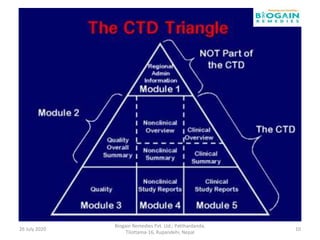
The CTD is organized into five modules. Module 1 is region
specific and Modules 2, 3, 4 and 5 are intended to be common
for all regions.
26 July 2020
Biogain Remedies Pvt. Ltd.; Patthardanda,
Tilottama-16, Rupandehi, Nepal
8
CTD
26 July 2020
Biogain Remedies Pvt. Ltd.; Patthardanda,
Tilottama-16, Rupandehi, Nepal
9
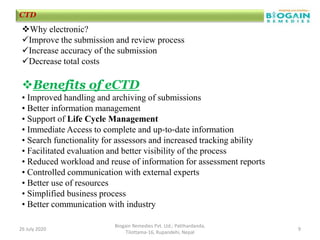
Why electronic?
Improve the submission and review process
Increase accuracy of the submission
Decrease total costs
Benefits of eCTD
• Improved handling and archiving of submissions
• Better information management
• Support of Life Cycle Management
• Immediate Access to complete and up‐to‐date information
• Search functionality for assessors and increased tracking ability
• Facilitated evaluation and better visibility of the process
• Reduced workload and reuse of information for assessment reports
• Controlled communication with external experts
• Better use of resources
• Simplified business process
• Better communication with industry
CTD
26 July 2020
Biogain Remedies Pvt. Ltd.; Patthardanda,
Tilottama-16, Rupandehi, Nepal
10
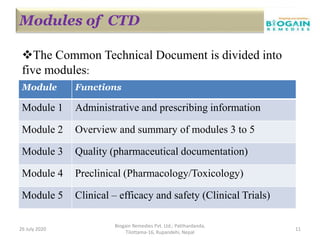
The Common Technical Document is divided into
five modules:
26 July 2020 11
Biogain Remedies Pvt. Ltd.; Patthardanda,
Tilottama-16, Rupandehi, Nepal
Module Functions
Module 1 Administrative and prescribing information
Module 2 Overview and summary of modules 3 to 5
Module 3 Quality (pharmaceutical documentation)
Module 4 Preclinical (Pharmacology/Toxicology)
Module 5 Clinical – efficacy and safety (Clinical Trials)
Modules of CTD
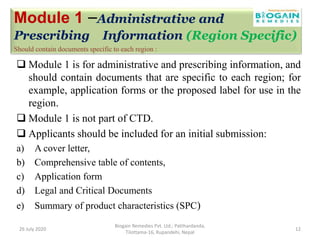
Module 1 –Administrative and
Prescribing Information (Region Specific)
Should containdocumentsspecific to each region :
 Module 1 is for administrative and prescribing information, and
should contain documents that are specific to each region; for
example, application forms or the proposed label for use in the
region.
 Module 1 is not part of CTD.
 Applicants should be included for an initial submission:
a) A cover letter,
b) Comprehensive table of contents,
c) Application form
d) Legal and Critical Documents
e) Summary of product characteristics (SPC)
26 July 2020
Biogain Remedies Pvt. Ltd.; Patthardanda,
Tilottama-16, Rupandehi, Nepal
12
f) Labeling text and mock-ups
g) Information about the experts
h) Specific requirements for different types of applications (if
required),
i) Information relating to orphan market exclusivity (if required),
j) Information relating to clinical trials (if required).
k) Environmental risk assessments (if required),
l) Description of the pharmacovigilance system
m) Risk management plan
26 July 2020
Biogain Remedies Pvt. Ltd.; Patthardanda,
Tilottama-16, Rupandehi, Nepal
13
Module 1 –Administrative and Prescribing Information
 Site master plan of plant.

 Company profile in short.
 Attested copy of manufacturing licence.
 Attested copy of product permission from FDA.
 Attested copy of CoPP (Certificate of Pharmaceutical Product).
 Attested copy of WHO/ GMP certificate.
 Attested copy of wholesale licence.
 COA of sample.
 Letter of authorization.
26 July 2020
Biogain Remedies Pvt. Ltd.; Patthardanda,
Tilottama-16, Rupandehi, Nepal
14
Module 1 –Administrative and Prescribing Information
The Quality Overall Summary (QOS) is a summary that follows the scope
and the outline of the Body of Data in Module 3.
The QOS should also emphasise critical key parameters of the product and
provide, for instance, justification in cases where guidelines were not
followed.
This module should begin with a general introduction to the
pharmaceutical, including its pharmacologic class, mode of action, and
proposed clinical use, not exceeding one page.
 It should also provide the overall summary of the ‘quality’ information
provided, the non-clinical overview and the clinical overview, as well as the
non-clinical written summaries and the tabulated summaries, and the clinical
summary.
26 July 2020
Biogain Remedies Pvt. Ltd.; Patthardanda,
Tilottama-16, Rupandehi, Nepal
15
Module 2 – CTD Summaries (QOS)
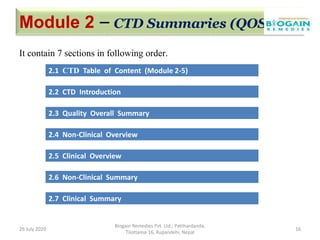
It contain 7 sections in following order.
26 July 2020
Biogain Remedies Pvt. Ltd.; Patthardanda,
Tilottama-16, Rupandehi, Nepal
16
2.1 CTD Table of Content (Module 2-5)
2.3 Quality Overall Summary
2.2 CTD Introduction
2.7 Clinical Summary
2.6 Non-Clinical Summary
2.5 Clinical Overview
2.4 Non-Clinical Overview
Module 2 – CTD Summaries (QOS)
2.1) CTD Table of Contents
2.2) CTD Introduction – a general introduction to the
drug, including its pharmacological class, mode of
action and proposed clinical use
2.3) Quality Overall Summary (QOS) - This is the CMC
summary, intended to give the quality reviewer
sufficient information from each section to provide an
overview of Module 3. The QOS follows the scope
and the outline of the “Body of Data” in Module 3.
26 July 2020
Biogain Remedies Pvt. Ltd.; Patthardanda,
Tilottama-16, Rupandehi, Nepal
17
Module 2 – CTD Summaries (QOS)
2.4) Nonclinical Overview – this section should present
an integrated and critical assessment of the
pharmacologic, pharmacokinetic, and toxicologic
evaluation of the pharmaceutical, and generally should
not exceed 30 pages.
2.5) Clinical Overview - a short document that provides a
critical assessment of the clinical data.
26 July 2020
Biogain Remedies Pvt. Ltd.; Patthardanda,
Tilottama-16, Rupandehi, Nepal
18
Module 2 – CTD Summaries (QOS)
2.6) Nonclinical Written and Tabulated Summaries – are expected to
be 100-150 pages. These should provide more extensive summaries
and discussion of the nonclinical information on pharmacology,
pharmacokinetics and toxicology.
2.7) Clinical Summary - a longer document than the Clinical
Overview, this focuses on data summarization and integration. Clinical
Study Reports and raw data (where applicable) are not set out in this
section but are to be included in Module 5 of the CTD.
26 July 2020
Biogain Remedies Pvt. Ltd.; Patthardanda,
Tilottama-16, Rupandehi, Nepal
19
Module 2 – CTD Summaries (QOS)
3.1 Table of Content (Module 3)
26 July 2020
Biogain Remedies Pvt. Ltd.; Patthardanda,
Tilottama-16, Rupandehi, Nepal
20
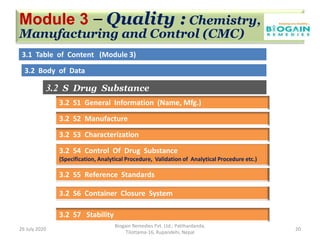
3.2 S1 General Information (Name, Mfg.)
3.2 S Drug Substance
3.2 Body of Data
3.2 S7 Stability
3.2 S5 Reference Standards
3.2 S4 Control Of Drug Substance
(Specification, Analytical Procedure, Validation of Analytical Procedure etc.)
3.2 S3 Characterization
3.2 S2 Manufacture
Module 3 – Quality : Chemistry,
Manufacturing and Control (CMC)
3.2 S6 Container Closure System
General information : Name, Manufacturer
Nomenclature:
i. Chemical Abstracts Service (CAS) registry Number,
ii. Recommended International Nonproprietary Name (INN),
iii. Chemical name (s)
Structure : The structural formula, including relative and absolute
stereochemistry, the molecular formula, the relative molecular mass and
chirality should all be provided.
General Properties : list should be provided of physicochemical and other
relevant properties of the drug substance: pH / pKa, melting point, solubility,
Hygroscopicity, physical form, crystalline form, etc. List the polymorphic
form(s) present in the proposed active.
26 July 2020
Biogain Remedies Pvt. Ltd.; Patthardanda,
Tilottama-16, Rupandehi, Nepal
21
3.2 S1 General Information (Name, Mfg.)
The name, address, and responsibility of each manufacturer,
including contractors, and each proposed production site or facility
involved in manufacturing and testing should be provided.
A flow diagram of the synthetic process and sequential procedural
narrative of the manufacturing process should be submitted.
Information on the quality and control of materials used in the
manufacture of the drug substance (e.g., raw materials, starting
materials, solvents, reagents, catalysts) should be listed identifying
where each material is used in the process.
Process validation and/or evaluation studies for aseptic processing
and sterilization should be included. The aseptic process may be
recorded through a comprehensive documentation :
26 July 2020
Biogain Remedies Pvt. Ltd.; Patthardanda,
Tilottama-16, Rupandehi, Nepal
22
3.2 S2 Manufacture
Elucidation of Structure and other Characteristics :
Confirmation of structure based on synthetic route and
spectral analyses should be provided.
Impurities : Information on impurities should be provided
include classification and identification of impurities, report
generation, listing of impurities in specifications, and a brief
discussion of analytical procedures.
i. Organic impurities (Process and drug related)
ii. Inorganic impurities
iii. Residual solvents.
26 July 2020
Biogain Remedies Pvt. Ltd.; Patthardanda,
Tilottama-16, Rupandehi, Nepal
23
3.2 S3 Characterization
Specification : A specification is defined as a list of tests, references to
analytical procedures, and appropriate acceptance criteria, which are
numerical limits, ranges, or other criteria for the tests described.
Analytical Procedures : The discussion of the validation of analytical
procedures is directed to the four most common, types of analytical
procedures:
i. Identification tests;
ii. Quantitative tests for impurities' content;
iii. Limit tests for the control of impurities;
iv. Quantitative tests of the active moiety in samples of drug substance
Validation of Analytical Procedures
Batch Analyses
Justification of Specification
26 July 2020
Biogain Remedies Pvt. Ltd.; Patthardanda,
Tilottama-16, Rupandehi, Nepal
24
3.2 S4 Control Of Drug Substance
(Specification, Analytical Procedure, Validation of Analytical Procedure etc.)
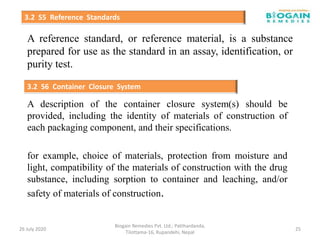
A reference standard, or reference material, is a substance
prepared for use as the standard in an assay, identification, or
purity test.
A description of the container closure system(s) should be
provided, including the identity of materials of construction of
each packaging component, and their specifications.
for example, choice of materials, protection from moisture and
light, compatibility of the materials of construction with the drug
substance, including sorption to container and leaching, and/or
safety of materials of construction.
26 July 2020
Biogain Remedies Pvt. Ltd.; Patthardanda,
Tilottama-16, Rupandehi, Nepal
25
3.2 S5 Reference Standards
3.2 S6 Container Closure System
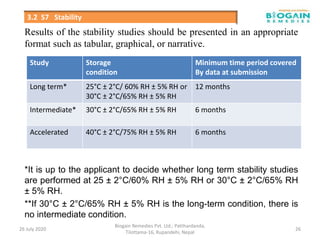
Results of the stability studies should be presented in an appropriate
format such as tabular, graphical, or narrative.
*It is up to the applicant to decide whether long term stability studies
are performed at 25 ± 2°C/60% RH ± 5% RH or 30°C ± 2°C/65% RH
± 5% RH.
**If 30°C ± 2°C/65% RH ± 5% RH is the long-term condition, there is
no intermediate condition.
26 July 2020
Biogain Remedies Pvt. Ltd.; Patthardanda,
Tilottama-16, Rupandehi, Nepal
26
3.2 S7 Stability
Study Storage
condition
Minimum time period covered
By data at submission
Long term* 25°C ± 2°C/ 60% RH ± 5% RH or
30°C ± 2°C/65% RH ± 5% RH
12 months
Intermediate* 30°C ± 2°C/65% RH ± 5% RH 6 months
Accelerated 40°C ± 2°C/75% RH ± 5% RH 6 months
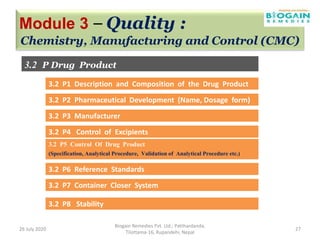
3.2 P4 Control of Excipients
26 July 2020
Biogain Remedies Pvt. Ltd.; Patthardanda,
Tilottama-16, Rupandehi, Nepal
27
3.2 P1 Description and Composition of the Drug Product
3.2 P Drug Product
3.2 P8 Stability
3.2 P6 Reference Standards
3.2 P5 Control Of Drug Product
(Specification, Analytical Procedure, Validation of Analytical Procedure etc.)
3.2 P3 Manufacturer
3.2 P2 Pharmaceutical Development (Name, Dosage form)
Module 3 – Quality :
Chemistry, Manufacturing and Control (CMC)
3.2 P7 Container Closer System
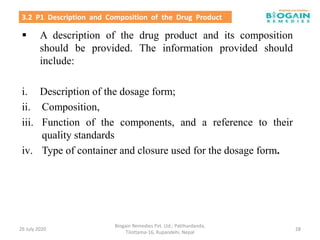
 A description of the drug product and its composition
should be provided. The information provided should
include:
i. Description of the dosage form;
ii. Composition,
iii. Function of the components, and a reference to their
quality standards
iv. Type of container and closure used for the dosage form.
26 July 2020
Biogain Remedies Pvt. Ltd.; Patthardanda,
Tilottama-16, Rupandehi, Nepal
28
3.2 P1 Description and Composition of the Drug Product
 Components of the Drug Product
 Drug Substance (The compatibility of the drug
substance with excipients)
 Overages : Any overages in the formulation
 Physiochemical & biological properties.
 Microbiological attributes.
26 July 2020
Biogain Remedies Pvt. Ltd.; Patthardanda,
Tilottama-16, Rupandehi, Nepal
29
3.2 P2 Pharmaceutical Development (Name, Dosage form)
The name, address, and responsibility of each
manufacturer, including contractors, and each
proposed.
Batch Formula.
Description of Manufacturing Process and Process
Controls.
Control of Critical steps & intermediates.
Process validation
26 July 2020
Biogain Remedies Pvt. Ltd.; Patthardanda,
Tilottama-16, Rupandehi, Nepal
30
3.2 P3 Manufacturer
The specifications for excipients should be provided.
The analytical procedures used for testing the
excipients should be provided, where appropriate.
Validation of Analytical Procedures
Justification of specifications.
Novel Excipients : For excipient(s) used for the first
time in a drug product or by a new route of
administration,
26 July 2020
Biogain Remedies Pvt. Ltd.; Patthardanda,
Tilottama-16, Rupandehi, Nepal
31
3.2 P4 Control of Excipients
The specification(s) for the drug product should be provided.
Analytical Procedures.
Validation of Analytical Procedures.
Batch Analyses
Characterization of Impurities.
Justification of specification.
26 July 2020
Biogain Remedies Pvt. Ltd.; Patthardanda,
Tilottama-16, Rupandehi, Nepal
32
3.2 P5 Control Of Drug Product
(Specification, Analytical Procedure, Validation of Analytical Procedure etc.)
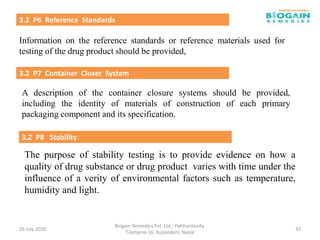
Information on the reference standards or reference materials used for
testing of the drug product should be provided,
The purpose of stability testing is to provide evidence on how a
quality of drug substance or drug product varies with time under the
influence of a verity of environmental factors such as temperature,
humidity and light.
26 July 2020
Biogain Remedies Pvt. Ltd.; Patthardanda,
Tilottama-16, Rupandehi, Nepal
33
3.2 P8 Stability
3.2 P6 Reference Standards
3.2 P7 Container Closer System
A description of the container closure systems should be provided,
including the identity of materials of construction of each primary
packaging component and its specification.
26 July 2020
Biogain Remedies Pvt. Ltd.; Patthardanda,
Tilottama-16, Rupandehi, Nepal
34
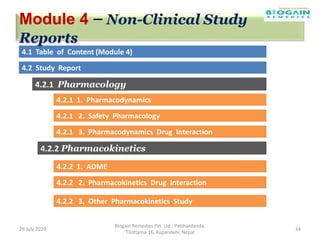
4.2.1 2. Safety Pharmacology
4.2 Study Report
4.1 Table of Content (Module 4)
4.2.1 3. Pharmacodynamics Drug Interaction
4.2.1 1. Pharmacodynamics
4.2.1 Pharmacology
4.2.2 2. Pharmacokinetics Drug Interaction
4.2.2 3. Other Pharmacokinetics Study
4.2.2 1. ADME
4.2.2 Pharmacokinetics
Module 4 – Non-Clinical Study
Reports
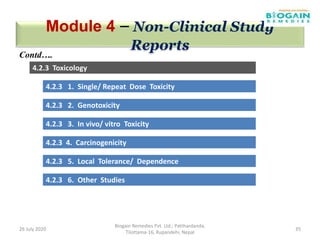
Contd….
26 July 2020
Biogain Remedies Pvt. Ltd.; Patthardanda,
Tilottama-16, Rupandehi, Nepal
35
4.2.3 4. Carcinogenicity
4.2.3 1. Single/ Repeat Dose Toxicity
4.2.3 Toxicology
4.2.3 5. Local Tolerance/ Dependence
4.2.3 3. In vivo/ vitro Toxicity
4.2.3 2. Genotoxicity
4.2.3 6. Other Studies
Module 4 – Non-Clinical Study
Reports
26 July 2020
Biogain Remedies Pvt. Ltd.; Patthardanda,
Tilottama-16, Rupandehi, Nepal
36
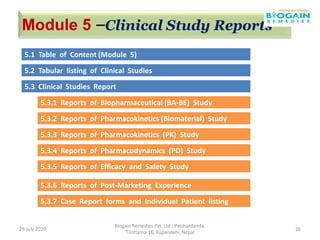
Module 5 –Clinical Study Reports
5.2 Tabular listing of Clinical Studies
5.1 Table of Content (Module 5)
5.3 Clinical Studies Report
5.3.2 Reports of Pharmacokinetics (Biomaterial) Study
5.3.3 Reports of Pharmacokinetics (PK) Study
5.3.1 Reports of Biopharmaceutical (BA-BE) Study
5.3.6 Reports of Post-Marketing Experience
5.3.7 Case Report forms and Individual Patient listing
5.3.5 Reports of Efficacy and Safety Study
5.3.4 Reports of Pharmacodynamics (PD) Study
26 July 2020
Biogain Remedies Pvt. Ltd.; Patthardanda,
Tilottama-16, Rupandehi, Nepal
37

Dossier Preparation/ CTD (Common Technical Document)

  • 1.
    Dossier Preparation /CTD (Common Technical Document) 1. Mr. Pramod Kewat Manager , R&D Department pramod.spl512@gmail.com 26 July 2020 1 2. Mr. Prakash Ghimire Senior Officer , QA Department ghimireprakash1234@gmail.com PRESENTED BY Biogain Remedies Pvt. Ltd. Patthardanda, Tilottame-16, Rupandehi, Nepal
  • 2.
    It is collectionor file of documents that contains all the technical data of pharmaceutical product to be approved/ registered/ marketed in country. It is commonly called as registration dossier. In US : New Drug Application (NDA) In EU : Marketing Authorization Application (MAA) A registration dossier for a Marketing Authorization Application (MAA) MAA is an application submitted by a drug manufacturer seeking permission to bring a new medicine to the market. 26 July 2020 Biogain Remedies Pvt. Ltd.; Patthardanda, Tilottama-16, Rupandehi, Nepal 2 What is Dossier ?
  • 3.
    Process of reviewingand assessing the dossier to support a medicinal product in view of its marketing (also called licensing, registration, approval, etc.), finalized by granting of a document also called marketing authorization (MA) (equivalent: product license). This process is performed within a legislative framework which defines the requirements necessary for application to the concerned regulatory authority, details on the assessment procedure (based on quality, efficacy and safety criteria) and the grounds for approval or rejection of the application, and also the circumstances where a marketing authorization already granted may be withdrawn, suspended or revoked. 26 July 2020 Biogain Remedies Pvt. Ltd.; Patthardanda, Tilottama-16, Rupandehi, Nepal 3 Dossier…
  • 4.
    The application dossierfor marketing authorization is called a New Drug Application in the USA or Marketing Authorization Application in the European Union and other countries, or simply registration dossier. Basically, this consists of a dossier with data proving that the drug has quality, efficacy and safety properties suitable for the intended use, additional administrative documents, samples of finished product or related substances and reagents necessary to perform analyses of finished product as described in that dossier. The content and format of the dossier must follow rules as defined by the competent authorities. 26 July 2020 Biogain Remedies Pvt. Ltd.; Patthardanda, Tilottama-16, Rupandehi, Nepal 4 Dossier…
  • 5.
    In accordance withlocal legislation, the resulting document allowing to the applicant to market the product may be more detailed (in addition to data identifying the product and its marketing authorization holder) it may contain addresses of all manufacturing sites, appended labeling, artwork of packaging components, etc.) until a one-page document called certificate of registration (and containing minimal data identifying the product and its source). 26 July 2020 Biogain Remedies Pvt. Ltd.; Patthardanda, Tilottama-16, Rupandehi, Nepal 5 Dossier…
  • 6.
    What is CTD? The Common Technical Document (CTD) is a set of specification for application dossier for the registration of Medicines and designed to be used across Europe, Japan and the United States. It is an internationally agreed format for the preparation of applications regarding new drugs intended to be submitted to regional regulatory authorities in participating countries. Its electronic version called as Electronic Common Technical Document (eCTD) 26 July 2020 6Biogain Remedies Pvt. Ltd.; Patthardanda, Tilottama-16, Rupandehi, Nepal
  • 7.
     It wasdeveloped by the European Medicines Agency (EMA, Europe), the Food and Drug Administration (FDA, US) and the Ministry of Health, Labour and Welfare(Japan).  The CTD is maintained by the International Conference on Harmonisation of Technical Requirements for Registration of Pharmaceuticals for Human Use (ICH).  The Paper CTD is destined to be replaced by its electronic counterpart, the eCTD.  Technical document—data necessary for proving safety, efficacy and quality of a drug product.  CTD—initiative to formalise the technical data.  The CTD is only a format for submission of information to Central Drugs Standard Control Organization (CDSCO) or National Authorties. It does not define the content. 26 July 2020 7 Biogain Remedies Pvt. Ltd.; Patthardanda, Tilottama-16, Rupandehi, Nepal CTD Contd...
  • 8.
    The CTD wasagreed upon in November 2000, in San Diego,USA. The purpose of this CTD is to provide a harmonised structure and format for new product applications (marketing authorization). The use of the CTD format is mandatory as from 1 July 2003 in the European Union. Detailed subheadings for each Module are specified for all jurisdictions. The CTD is organized into five modules. Module 1 is region specific and Modules 2, 3, 4 and 5 are intended to be common for all regions. 26 July 2020 Biogain Remedies Pvt. Ltd.; Patthardanda, Tilottama-16, Rupandehi, Nepal 8 CTD
  • 9.
    26 July 2020 BiogainRemedies Pvt. Ltd.; Patthardanda, Tilottama-16, Rupandehi, Nepal 9 Why electronic? Improve the submission and review process Increase accuracy of the submission Decrease total costs Benefits of eCTD • Improved handling and archiving of submissions • Better information management • Support of Life Cycle Management • Immediate Access to complete and up‐to‐date information • Search functionality for assessors and increased tracking ability • Facilitated evaluation and better visibility of the process • Reduced workload and reuse of information for assessment reports • Controlled communication with external experts • Better use of resources • Simplified business process • Better communication with industry CTD
  • 10.
    26 July 2020 BiogainRemedies Pvt. Ltd.; Patthardanda, Tilottama-16, Rupandehi, Nepal 10
  • 11.
    The Common TechnicalDocument is divided into five modules: 26 July 2020 11 Biogain Remedies Pvt. Ltd.; Patthardanda, Tilottama-16, Rupandehi, Nepal Module Functions Module 1 Administrative and prescribing information Module 2 Overview and summary of modules 3 to 5 Module 3 Quality (pharmaceutical documentation) Module 4 Preclinical (Pharmacology/Toxicology) Module 5 Clinical – efficacy and safety (Clinical Trials) Modules of CTD
  • 12.
    Module 1 –Administrativeand Prescribing Information (Region Specific) Should containdocumentsspecific to each region :  Module 1 is for administrative and prescribing information, and should contain documents that are specific to each region; for example, application forms or the proposed label for use in the region.  Module 1 is not part of CTD.  Applicants should be included for an initial submission: a) A cover letter, b) Comprehensive table of contents, c) Application form d) Legal and Critical Documents e) Summary of product characteristics (SPC) 26 July 2020 Biogain Remedies Pvt. Ltd.; Patthardanda, Tilottama-16, Rupandehi, Nepal 12
  • 13.
    f) Labeling textand mock-ups g) Information about the experts h) Specific requirements for different types of applications (if required), i) Information relating to orphan market exclusivity (if required), j) Information relating to clinical trials (if required). k) Environmental risk assessments (if required), l) Description of the pharmacovigilance system m) Risk management plan 26 July 2020 Biogain Remedies Pvt. Ltd.; Patthardanda, Tilottama-16, Rupandehi, Nepal 13 Module 1 –Administrative and Prescribing Information
  • 14.
     Site masterplan of plant.  Company profile in short.  Attested copy of manufacturing licence.  Attested copy of product permission from FDA.  Attested copy of CoPP (Certificate of Pharmaceutical Product).  Attested copy of WHO/ GMP certificate.  Attested copy of wholesale licence.  COA of sample.  Letter of authorization. 26 July 2020 Biogain Remedies Pvt. Ltd.; Patthardanda, Tilottama-16, Rupandehi, Nepal 14 Module 1 –Administrative and Prescribing Information
  • 15.
    The Quality OverallSummary (QOS) is a summary that follows the scope and the outline of the Body of Data in Module 3. The QOS should also emphasise critical key parameters of the product and provide, for instance, justification in cases where guidelines were not followed. This module should begin with a general introduction to the pharmaceutical, including its pharmacologic class, mode of action, and proposed clinical use, not exceeding one page.  It should also provide the overall summary of the ‘quality’ information provided, the non-clinical overview and the clinical overview, as well as the non-clinical written summaries and the tabulated summaries, and the clinical summary. 26 July 2020 Biogain Remedies Pvt. Ltd.; Patthardanda, Tilottama-16, Rupandehi, Nepal 15 Module 2 – CTD Summaries (QOS)
  • 16.
    It contain 7sections in following order. 26 July 2020 Biogain Remedies Pvt. Ltd.; Patthardanda, Tilottama-16, Rupandehi, Nepal 16 2.1 CTD Table of Content (Module 2-5) 2.3 Quality Overall Summary 2.2 CTD Introduction 2.7 Clinical Summary 2.6 Non-Clinical Summary 2.5 Clinical Overview 2.4 Non-Clinical Overview Module 2 – CTD Summaries (QOS)
  • 17.
    2.1) CTD Tableof Contents 2.2) CTD Introduction – a general introduction to the drug, including its pharmacological class, mode of action and proposed clinical use 2.3) Quality Overall Summary (QOS) - This is the CMC summary, intended to give the quality reviewer sufficient information from each section to provide an overview of Module 3. The QOS follows the scope and the outline of the “Body of Data” in Module 3. 26 July 2020 Biogain Remedies Pvt. Ltd.; Patthardanda, Tilottama-16, Rupandehi, Nepal 17 Module 2 – CTD Summaries (QOS)
  • 18.
    2.4) Nonclinical Overview– this section should present an integrated and critical assessment of the pharmacologic, pharmacokinetic, and toxicologic evaluation of the pharmaceutical, and generally should not exceed 30 pages. 2.5) Clinical Overview - a short document that provides a critical assessment of the clinical data. 26 July 2020 Biogain Remedies Pvt. Ltd.; Patthardanda, Tilottama-16, Rupandehi, Nepal 18 Module 2 – CTD Summaries (QOS)
  • 19.
    2.6) Nonclinical Writtenand Tabulated Summaries – are expected to be 100-150 pages. These should provide more extensive summaries and discussion of the nonclinical information on pharmacology, pharmacokinetics and toxicology. 2.7) Clinical Summary - a longer document than the Clinical Overview, this focuses on data summarization and integration. Clinical Study Reports and raw data (where applicable) are not set out in this section but are to be included in Module 5 of the CTD. 26 July 2020 Biogain Remedies Pvt. Ltd.; Patthardanda, Tilottama-16, Rupandehi, Nepal 19 Module 2 – CTD Summaries (QOS)
  • 20.
    3.1 Table ofContent (Module 3) 26 July 2020 Biogain Remedies Pvt. Ltd.; Patthardanda, Tilottama-16, Rupandehi, Nepal 20 3.2 S1 General Information (Name, Mfg.) 3.2 S Drug Substance 3.2 Body of Data 3.2 S7 Stability 3.2 S5 Reference Standards 3.2 S4 Control Of Drug Substance (Specification, Analytical Procedure, Validation of Analytical Procedure etc.) 3.2 S3 Characterization 3.2 S2 Manufacture Module 3 – Quality : Chemistry, Manufacturing and Control (CMC) 3.2 S6 Container Closure System
  • 21.
    General information :Name, Manufacturer Nomenclature: i. Chemical Abstracts Service (CAS) registry Number, ii. Recommended International Nonproprietary Name (INN), iii. Chemical name (s) Structure : The structural formula, including relative and absolute stereochemistry, the molecular formula, the relative molecular mass and chirality should all be provided. General Properties : list should be provided of physicochemical and other relevant properties of the drug substance: pH / pKa, melting point, solubility, Hygroscopicity, physical form, crystalline form, etc. List the polymorphic form(s) present in the proposed active. 26 July 2020 Biogain Remedies Pvt. Ltd.; Patthardanda, Tilottama-16, Rupandehi, Nepal 21 3.2 S1 General Information (Name, Mfg.)
  • 22.
    The name, address,and responsibility of each manufacturer, including contractors, and each proposed production site or facility involved in manufacturing and testing should be provided. A flow diagram of the synthetic process and sequential procedural narrative of the manufacturing process should be submitted. Information on the quality and control of materials used in the manufacture of the drug substance (e.g., raw materials, starting materials, solvents, reagents, catalysts) should be listed identifying where each material is used in the process. Process validation and/or evaluation studies for aseptic processing and sterilization should be included. The aseptic process may be recorded through a comprehensive documentation : 26 July 2020 Biogain Remedies Pvt. Ltd.; Patthardanda, Tilottama-16, Rupandehi, Nepal 22 3.2 S2 Manufacture
  • 23.
    Elucidation of Structureand other Characteristics : Confirmation of structure based on synthetic route and spectral analyses should be provided. Impurities : Information on impurities should be provided include classification and identification of impurities, report generation, listing of impurities in specifications, and a brief discussion of analytical procedures. i. Organic impurities (Process and drug related) ii. Inorganic impurities iii. Residual solvents. 26 July 2020 Biogain Remedies Pvt. Ltd.; Patthardanda, Tilottama-16, Rupandehi, Nepal 23 3.2 S3 Characterization
  • 24.
    Specification : Aspecification is defined as a list of tests, references to analytical procedures, and appropriate acceptance criteria, which are numerical limits, ranges, or other criteria for the tests described. Analytical Procedures : The discussion of the validation of analytical procedures is directed to the four most common, types of analytical procedures: i. Identification tests; ii. Quantitative tests for impurities' content; iii. Limit tests for the control of impurities; iv. Quantitative tests of the active moiety in samples of drug substance Validation of Analytical Procedures Batch Analyses Justification of Specification 26 July 2020 Biogain Remedies Pvt. Ltd.; Patthardanda, Tilottama-16, Rupandehi, Nepal 24 3.2 S4 Control Of Drug Substance (Specification, Analytical Procedure, Validation of Analytical Procedure etc.)
  • 25.
    A reference standard,or reference material, is a substance prepared for use as the standard in an assay, identification, or purity test. A description of the container closure system(s) should be provided, including the identity of materials of construction of each packaging component, and their specifications. for example, choice of materials, protection from moisture and light, compatibility of the materials of construction with the drug substance, including sorption to container and leaching, and/or safety of materials of construction. 26 July 2020 Biogain Remedies Pvt. Ltd.; Patthardanda, Tilottama-16, Rupandehi, Nepal 25 3.2 S5 Reference Standards 3.2 S6 Container Closure System
  • 26.
    Results of thestability studies should be presented in an appropriate format such as tabular, graphical, or narrative. *It is up to the applicant to decide whether long term stability studies are performed at 25 ± 2°C/60% RH ± 5% RH or 30°C ± 2°C/65% RH ± 5% RH. **If 30°C ± 2°C/65% RH ± 5% RH is the long-term condition, there is no intermediate condition. 26 July 2020 Biogain Remedies Pvt. Ltd.; Patthardanda, Tilottama-16, Rupandehi, Nepal 26 3.2 S7 Stability Study Storage condition Minimum time period covered By data at submission Long term* 25°C ± 2°C/ 60% RH ± 5% RH or 30°C ± 2°C/65% RH ± 5% RH 12 months Intermediate* 30°C ± 2°C/65% RH ± 5% RH 6 months Accelerated 40°C ± 2°C/75% RH ± 5% RH 6 months
  • 27.
    3.2 P4 Controlof Excipients 26 July 2020 Biogain Remedies Pvt. Ltd.; Patthardanda, Tilottama-16, Rupandehi, Nepal 27 3.2 P1 Description and Composition of the Drug Product 3.2 P Drug Product 3.2 P8 Stability 3.2 P6 Reference Standards 3.2 P5 Control Of Drug Product (Specification, Analytical Procedure, Validation of Analytical Procedure etc.) 3.2 P3 Manufacturer 3.2 P2 Pharmaceutical Development (Name, Dosage form) Module 3 – Quality : Chemistry, Manufacturing and Control (CMC) 3.2 P7 Container Closer System
  • 28.
     A descriptionof the drug product and its composition should be provided. The information provided should include: i. Description of the dosage form; ii. Composition, iii. Function of the components, and a reference to their quality standards iv. Type of container and closure used for the dosage form. 26 July 2020 Biogain Remedies Pvt. Ltd.; Patthardanda, Tilottama-16, Rupandehi, Nepal 28 3.2 P1 Description and Composition of the Drug Product
  • 29.
     Components ofthe Drug Product  Drug Substance (The compatibility of the drug substance with excipients)  Overages : Any overages in the formulation  Physiochemical & biological properties.  Microbiological attributes. 26 July 2020 Biogain Remedies Pvt. Ltd.; Patthardanda, Tilottama-16, Rupandehi, Nepal 29 3.2 P2 Pharmaceutical Development (Name, Dosage form)
  • 30.
    The name, address,and responsibility of each manufacturer, including contractors, and each proposed. Batch Formula. Description of Manufacturing Process and Process Controls. Control of Critical steps & intermediates. Process validation 26 July 2020 Biogain Remedies Pvt. Ltd.; Patthardanda, Tilottama-16, Rupandehi, Nepal 30 3.2 P3 Manufacturer
  • 31.
    The specifications forexcipients should be provided. The analytical procedures used for testing the excipients should be provided, where appropriate. Validation of Analytical Procedures Justification of specifications. Novel Excipients : For excipient(s) used for the first time in a drug product or by a new route of administration, 26 July 2020 Biogain Remedies Pvt. Ltd.; Patthardanda, Tilottama-16, Rupandehi, Nepal 31 3.2 P4 Control of Excipients
  • 32.
    The specification(s) forthe drug product should be provided. Analytical Procedures. Validation of Analytical Procedures. Batch Analyses Characterization of Impurities. Justification of specification. 26 July 2020 Biogain Remedies Pvt. Ltd.; Patthardanda, Tilottama-16, Rupandehi, Nepal 32 3.2 P5 Control Of Drug Product (Specification, Analytical Procedure, Validation of Analytical Procedure etc.)
  • 33.
    Information on thereference standards or reference materials used for testing of the drug product should be provided, The purpose of stability testing is to provide evidence on how a quality of drug substance or drug product varies with time under the influence of a verity of environmental factors such as temperature, humidity and light. 26 July 2020 Biogain Remedies Pvt. Ltd.; Patthardanda, Tilottama-16, Rupandehi, Nepal 33 3.2 P8 Stability 3.2 P6 Reference Standards 3.2 P7 Container Closer System A description of the container closure systems should be provided, including the identity of materials of construction of each primary packaging component and its specification.
  • 34.
    26 July 2020 BiogainRemedies Pvt. Ltd.; Patthardanda, Tilottama-16, Rupandehi, Nepal 34 4.2.1 2. Safety Pharmacology 4.2 Study Report 4.1 Table of Content (Module 4) 4.2.1 3. Pharmacodynamics Drug Interaction 4.2.1 1. Pharmacodynamics 4.2.1 Pharmacology 4.2.2 2. Pharmacokinetics Drug Interaction 4.2.2 3. Other Pharmacokinetics Study 4.2.2 1. ADME 4.2.2 Pharmacokinetics Module 4 – Non-Clinical Study Reports
  • 35.
    Contd…. 26 July 2020 BiogainRemedies Pvt. Ltd.; Patthardanda, Tilottama-16, Rupandehi, Nepal 35 4.2.3 4. Carcinogenicity 4.2.3 1. Single/ Repeat Dose Toxicity 4.2.3 Toxicology 4.2.3 5. Local Tolerance/ Dependence 4.2.3 3. In vivo/ vitro Toxicity 4.2.3 2. Genotoxicity 4.2.3 6. Other Studies Module 4 – Non-Clinical Study Reports
  • 36.
    26 July 2020 BiogainRemedies Pvt. Ltd.; Patthardanda, Tilottama-16, Rupandehi, Nepal 36 Module 5 –Clinical Study Reports 5.2 Tabular listing of Clinical Studies 5.1 Table of Content (Module 5) 5.3 Clinical Studies Report 5.3.2 Reports of Pharmacokinetics (Biomaterial) Study 5.3.3 Reports of Pharmacokinetics (PK) Study 5.3.1 Reports of Biopharmaceutical (BA-BE) Study 5.3.6 Reports of Post-Marketing Experience 5.3.7 Case Report forms and Individual Patient listing 5.3.5 Reports of Efficacy and Safety Study 5.3.4 Reports of Pharmacodynamics (PD) Study
  • 37.
    26 July 2020 BiogainRemedies Pvt. Ltd.; Patthardanda, Tilottama-16, Rupandehi, Nepal 37