SCHEDULE M-III
QUALITY MANAGEMENT SYSTEM
FOR
NOTIFIED MEDICAL DEVICES
AND
IN-VITRO DIAGNOSTICS
(12.06.2015)
(Prepared by Sub-Committee of DTAB)
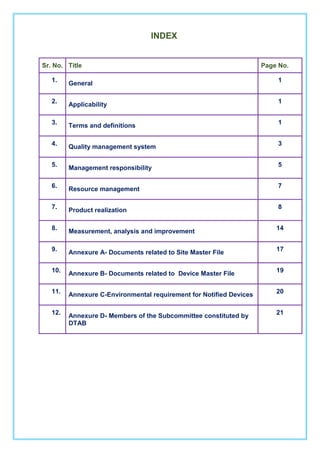
INDEX
Sr. No. Title Page No.
1.
General
1
2.
Applicability
1
3.
Terms and definitions
1
4.
Quality management system
3
5.
Management responsibility
5
6.
Resource management
7
7.
Product realization
8
8.
Measurement, analysis and improvement
14
9.
Annexure A- Documents related to Site Master File
17
10. Annexure B- Documents related to Device Master File 19
11.
Annexure C-Environmental requirement for Notified Devices
20
12. Annexure D- Members of the Subcommittee constituted by
DTAB
21
SCHEDULE M-III
[See Rule 76]
QUALITY MANAGEMENT SYSTEM –FOR NOTIFIED MEDICAL DEVICES AND IN-VITRO
DIAGNOSTICS
1. General
This schedule specifies requirements for a quality management system that shall be used by
the manufacturer for the design and development, manufacture, packaging, labeling, testing,
installation and servicing of medical devices and in-vitro diagnostics. If the manufacturer does
not carry out design and development activity, the same shall be recorded in the quality
management system and shall exclude the provisions of relevant clauses of this schedule.
The manufacturer shall ensure the claims of conformity with this schedule to reflect the
exclusions.
If any requirement(s) in Clause 7(product realization) of this schedule is(are) not applicable
due to the nature of the medical device(s) and in-vitro diagnostics(s) for which the quality
management system is applied, the manufacturer does not need to include such a
requirement(s) in its quality management system.
The processes required by this schedule, which are applicable to the medical device(s)and
in-vitro diagnostic devices, but which are not performed by the manufacturer are the
responsibility of the manufacturer and are accounted for in the manufacturer’s quality
management system.
If a manufacturer engages in only some operations subject to the requirements in this part,
and not in others, that manufacturer need only comply with those requirements applicable to
the operations in which it is engaged.
It is emphasized that the quality management system requirements specified in this schedule
are complementary to technical requirements for products.
Manufacturers of components or parts of finished devices and in-vitro diagnostics are
encouraged to use appropriate provisions of this regulation as guidance.
2. Applicability
The provisions of this Schedule shall be applicable to manufacturers of finished devices, In-
Vitro Diagnostics, mechanical contraceptives (Condoms, intrauterine Devices, Tubal Rings),
surgical dressings, surgical bandages, surgical staplers, surgical sutures and ligatures, Blood
and Blood Components Collection bags, intended for human or animal use that is
manufactured in India.
3. Terms and definitions
3.1 Active implantable medical device
Active medical device which is intended to be totally or partially introduced, surgically or
medically, into the human or animal body or by medical intervention into a natural orifice, and
which is intended to remain after the procedure
3.2 Active medical device
Medical device relying for its functioning on a source of electrical energy or any source of
power other than that directly generated by the human or animal body or gravity
1 | P a g e
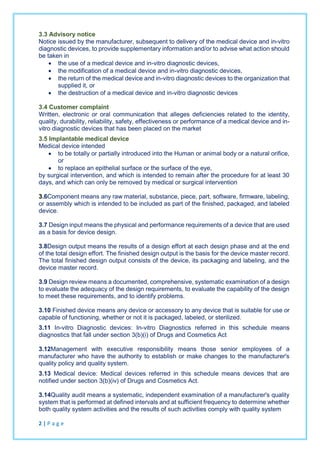
3.3 Advisory notice
Notice issued by the manufacturer, subsequent to delivery of the medical device and in-vitro
diagnostic devices, to provide supplementary information and/or to advise what action should
be taken in
 the use of a medical device and in-vitro diagnostic devices,
 the modification of a medical device and in-vitro diagnostic devices,
 the return of the medical device and in-vitro diagnostic devices to the organization that
supplied it, or
 the destruction of a medical device and in-vitro diagnostic devices
3.4 Customer complaint
Written, electronic or oral communication that alleges deficiencies related to the identity,
quality, durability, reliability, safety, effectiveness or performance of a medical device and in-
vitro diagnostic devices that has been placed on the market
3.5 Implantable medical device
Medical device intended
 to be totally or partially introduced into the Human or animal body or a natural orifice,
or
 to replace an epithelial surface or the surface of the eye,
by surgical intervention, and which is intended to remain after the procedure for at least 30
days, and which can only be removed by medical or surgical intervention
3.6Component means any raw material, substance, piece, part, software, firmware, labeling,
or assembly which is intended to be included as part of the finished, packaged, and labeled
device.
3.7 Design input means the physical and performance requirements of a device that are used
as a basis for device design.
3.8Design output means the results of a design effort at each design phase and at the end
of the total design effort. The finished design output is the basis for the device master record.
The total finished design output consists of the device, its packaging and labeling, and the
device master record.
3.9 Design review means a documented, comprehensive, systematic examination of a design
to evaluate the adequacy of the design requirements, to evaluate the capability of the design
to meet these requirements, and to identify problems.
3.10 Finished device means any device or accessory to any device that is suitable for use or
capable of functioning, whether or not it is packaged, labeled, or sterilized.
3.11 In-vitro Diagnostic devices: In-vitro Diagnostics referred in this schedule means
diagnostics that fall under section 3(b)(i) of Drugs and Cosmetics Act
3.12Management with executive responsibility means those senior employees of a
manufacturer who have the authority to establish or make changes to the manufacturer's
quality policy and quality system.
3.13 Medical device: Medical devices referred in this schedule means devices that are
notified under section 3(b)(iv) of Drugs and Cosmetics Act.
3.14Quality audit means a systematic, independent examination of a manufacturer's quality
system that is performed at defined intervals and at sufficient frequency to determine whether
both quality system activities and the results of such activities comply with quality system
2 | P a g e
procedures, that these procedures are implemented effectively, and that these procedures
are suitable to achieve quality system objectives.
3.15Quality policy means the overall intentions and direction of an organization with respect
to quality, as established by management with executive responsibility.
3.16Quality system means the organizational structure, responsibilities, procedures,
processes, and resources for implementing quality management.
3.17Rework means action taken on a nonconforming product so that it will fulfill the specified
DMR requirements before it is released for distribution.
3.18Specification means any requirement with which a product, process, service, or other
activity must conform.
3.19Validation means confirmation by examination and provision of objective evidence that
the particular requirements for a specific intended use can be consistently fulfilled.
(1)Process validation means establishing by objective evidence that a process
consistently produces a result or product meeting its predetermined specifications.
(2)Design validation means establishing by objective evidence that device
specifications conform with user needs and intended use(s).
3.20Verification means confirmation by examination and provision of objective evidence that
specified requirements have been fulfilled.
4 Quality Management System
4.1 General requirements
The manufacturer shall establish, document, implement and maintain a quality management
system and maintain its effectiveness in accordance with the requirements of this schedule.
The manufacturer shall
a) identify the processes needed for the quality management system and their application
throughout the organization,
b) determine the sequence and interaction of these processes,
c) determine criteria and methods needed to ensure that both the operation and control of
these processes are effective,
d) ensure the availability of resources and information necessary to support the operation
and monitoring of these processes,
e) monitor, measure and analyse these processes, and
f) implement actions necessary to achieve planned results and maintain the effectiveness of
these processes.
These processes shall be managed by the manufacturer in accordance with the requirements
of this schedule.
Where a Manufacturer chooses to outsource any process that affects product conformity with
requirements, the Manufacturer shall ensure control over such processes. Control of such
outsourced processes shall be identified within the quality management system.
NOTE Processes needed for the quality management system referred to above should
include processes for management activities, provision of resources, product realization and
measurement.
4.2 Documentation requirements
3| P a g e
4.2.1 General
The quality management system documentation shall include
a) documented statements of a quality policy and quality objectives,
b) a quality manual,
c) documented procedures required by this schedule,
d) documents needed by the manufacturer to ensure the effective planning, operation and
control of its processes,
e) records required by this schedule, and
Where this schedule specifies that a requirement, procedure, activity or special arrangement
be
“documented”, it shall, in addition, be implemented and maintained.
For each type or model of medical device/ In-vitro Diagnostics, the manufacturer shall
establish and maintain a file either containing or identifying documents defining product
specifications and quality management system requirements. These documents shall define
the complete manufacturing process and, if applicable, installation.
Data may be recorded by electronic data processing systems or other reliable means, but
documents and record relating to the system in use shall also be available in a hard copy to
facilitate checking of the accuracy of the records. Wherever documentation is handled by
electronic data processing methods, authorized persons shall enter or modify data in the
computer. There shall be record of changes and deletions. Access shall be restricted by
‘passwords’ or other means and the result of entry of critical data shall be independently
checked. Batch records electronically stored shall be protected by a suitable back-up. During
the period of retention, all relevant data shall be readily available.
4.2.2 Quality manual
The manufacturer shall establish and maintain a quality manual that includes
a) the scope of the quality management system, including details of and justification
for any exclusion and/or non-application,
b) the documented procedures established for the quality management system, or
reference to them, and
c) a description of the interaction between the processes of the quality management
system.
The quality manual shall outline the structure of the documentation used in the quality
management system.
The manufacturer shall prepare documentation in a form of a Site Master File containing
specific information about the facilities, personnel and other details as prescribed in
Annexure A.
4.2.3 Control of documents
Documents required by the quality management system shall be controlled. Records are a
special type of document and shall be controlled according to the requirements given in the
control of records. Documents shall be approved, signed and dated by the appropriate and
the authorized person
A documented procedure shall be established to define the controls needed
a) to review and approve documents for adequacy prior to issue,
b) to review and update as necessary and re-approve documents,
c) to ensure that changes and the current revision status of documents are
identified,
d) to ensure that relevant versions of applicable documents are available at
points of use,
4 | P a g e
e) to ensure that documents remain legible and readily identifiable,
f) to ensure that documents of external origin are identified and their distribution
controlled, and
g) to prevent the unintended use of obsolete documents, and to apply suitable
identification to them if they are retained for any purpose.
Changes to document shall be reviewed, approved and maintained. Change records shall
include a description of the change, identification of the affected documents, the signature of
the approving individual(s), the approval date, and when the change becomes effective.
The manufacturer shall ensure that changes to documents are reviewed and approved either
by the original approving function or another designated function which has access to
pertinent background information upon which to base its decisions.
The manufacturer shall define the period for which at least one copy of obsolete controlled
documents shall be retained. This period shall ensure that documents to which medical
devices/In-vitro Diagnostics have been manufactured and tested are retained for at least one
year after the date of expiry of the medical device/In-vitro Diagnostic as defined by the
manufacturer.
4.2.4 Control of records
Records shall be established and maintained to provide evidence of conformity to
requirements and of the effective operation of the quality management system. Records shall
remain legible, readily identifiable and retrievable. A documented procedure shall be
established to define the controls needed for the identification, storage, protection, retrieval,
retention time and disposition of records.
The manufacturer shall retain the records for a period of time at least one year after the date
of expiry of the medical device/In-vitro Diagnostics as defined by the manufacturer, but not
less than two years from the date of product release by the manufacturer.
5 Management responsibility
5.1 Management commitment
Top management of the manufacturer shall provide evidence of its commitment to the
development and implementation of the quality management system and maintaining its
effectiveness by
a) communicating to the employees the importance of meeting customer as well as statutory
and regulatory requirements,
b) establishing the quality policy,
c) ensuring that quality objectives are established,
d) conducting management reviews, and
e) ensuring the availability of resources.
5.2 Customer focus
Top management of the manufacturer shall ensure that customer requirements are
determined and are met.
5.3 Quality policy
Top management of the manufacturer shall ensure that the quality policy
a) is appropriate to the purpose of the manufacturing facility,
b) includes a commitment to comply with requirements and to maintain the effectiveness of
the quality management system,
c) provides a framework for establishing and reviewing quality objectives,
d) is communicated and understood within the manufacturers organization, and
e) is reviewed for continuing suitability.
5.4 Planning
5| P a g e
5.4.1 Quality objectives
Top management of the manufacturer shall ensure that quality objectives, including those
needed to meet requirements for product, are established at relevant functions and levels
within the manufacturing organization. The quality objectives shall be measurable and
consistent with the quality policy.
5.4.2 Quality management system planning
Top management of the manufacturer shall ensure that
a) the planning of the quality management system is carried out in order to meet the specified
requirements, as well as the quality objectives, and
b) the integrity of the quality management system is maintained when changes to the quality
management system are planned and implemented.
5.5 Responsibility, authority and communication
5.5.1 Responsibility and authority
Top management of the manufacturer shall ensure that responsibilities and authorities are
defined, documented and communicated within the manufacturing organization.
Top management of the manufacturer shall establish the interrelation of all personnel who
manage, perform and verify work affecting quality, and shall ensure the independence and
authority necessary to perform these tasks.
5.5.2 Management representative
Top management shall appoint a member of management who, irrespective of other
responsibilities, shall have responsibility and authority that includes
a) ensuring that processes needed for the quality management system are established,
implemented and maintained,
b) reporting to top management on the performance of the quality management system and
any need for improvement, and
c) ensuring the promotion of awareness of regulatory and customer requirements throughout
the manufacturing organization.
5.5.3 Internal communication
Top management shall ensure that appropriate communication processes are established
within the Manufacturing organization and that communication takes place regarding the
effectiveness of the quality management system.
5.6 Management review
5.6.1 General
Top management shall review the organization’s quality management system, at planned
intervals, to ensure its continuing suitability, adequacy and effectiveness. This review shall
include assessing opportunities for improvement and the need for changes to the quality
management system, including the quality policy and quality objectives. Records from
management reviews shall be maintained.
5.6.2 Review input
The input to management review shall include information on
a) results of audits,
b) customer feedback,
c) process performance and product conformity,
d) status of preventive and corrective actions,
e) follow-up actions from previous management reviews,
f) changes that could affect the quality management system,
g) recommendations for improvement, and
h) new or revised regulatory requirements as and when issued.
6| P a g e
5.6.3 Review output
The output from the management review shall include any decisions and actions related to
a) improvements needed to maintain the effectiveness of the quality management system
and its processes,
b) improvement of product related to customer requirements, and
c) resource needs.
6 Resource Management
6.1 Provision of resources
The manufacturing organization shall determine and provide the resources needed
a) to implement the quality management system and to maintain its effectiveness, and
b) to meet regulatory and customer requirements.
6.2 Human resources
6.2.1 General
Personnel performing work affecting product quality shall be competent on the basis of
appropriate education, training, skills and experience. Number of personnel employed shall
be adequate and in direct proportion to the workload. Prior to employment, all personnel,
shall undergo medical examination including eye examination, and shall be free from
communicable or contagious diseases. Thereafter, they should be medically examined
periodically, at least once a year. Records shall be maintained thereof. All personnel shall
bear clean body covering appropriate to their duties. Smoking, Eating, Drinking, Chewing or
keeping food and drink shall not be permitted in production, laboratory and storage areas.
6.2.2 Competence, awareness and training
The manufacturer shall
a) determine the necessary competence for personnel performing work affecting product
quality,
b) provide training or take other actions to satisfy these needs,
c) evaluate the effectiveness of the actions taken,
d) ensure that its personnel are aware of the relevance and importance of their activities and
how they contribute to the achievement of the quality objectives, and
e) maintain appropriate records of education, training, skills and experience.
f) establish documented procedures for identifying training needs and ensure that all
personnel are trained to adequately perform their assigned responsibilities.
6.3 Infrastructure
The organization shall determine, provide and maintain the infrastructure needed to achieve
conformity to product requirements. Infrastructure includes, as applicable
a) buildings, workspace and associated utilities.
b) process equipment (both hardware and software), and
c) supporting services (such as transport or communication).
The manufacturer shall establish documented requirements for maintenance activities,
including their frequency, when such activities or lack thereof can affect product quality.
Records of such maintenance shall be maintained.
6.4 Work environment
The organization shall determine and manage the work environment needed to achieve
conformity to product requirements. The following requirements shall apply.
a) The manufacturer shall establish documented requirements for health, cleanliness and
clothing of personnel if contact between such personnel and the product or work environment
could adversely affect the quality of the product.
b) If work environment conditions can have an adverse effect on product quality, the
manufacturer shall establish documented requirements as per annexure-C of this schedule
for the work environment conditions and documented procedures or work instructions to
7 | P a g e
monitor and control these work environment conditions.
c) The manufacturer shall ensure that all personnel who are required to work temporarily
under special environmental conditions within the work environment are appropriately trained
and supervised by a trained person.
d) If appropriate, special arrangements shall be established and documented for the control
of contaminated or potentially contaminated product in order to prevent contamination of
other product, the work environment or personnel.
7 Product realization
7.1 Planning of product realization
The manufacturer shall plan and develop the processes needed for product realization.
Planning of product realization shall be consistent with the requirements of the other
processes of the quality management system. In planning product realization, the
manufacturer shall determine the following, as appropriate:
a) quality objectives and requirements for the product;
b) the need to establish processes, documents, and provide resources specific to the product;
c) required verification, validation, monitoring, inspection and test activities specific to the
product and the criteria for product acceptance;
d) records needed to provide evidence that the realization processes and resulting product
meet requirements.
The output of this planning shall be in a form suitable for the manufacturer’s method of
operations.
The manufacturer organization shall establish documented requirements for risk
management (as per the IS/ISO 14971) throughout product realization. Records arising from
risk management shall be maintained.
7.2 Customer-related processes
7.2.1 Determination of requirements related to the product
The manufacturer shall determine
a) requirements specified by the customer, including the requirements for delivery and post-
delivery activities,
b) requirements not stated by the customer but necessary for specified or intended use,
where known,
c) statutory requirements related to the product, and
d) any additional requirements determined by the manufacturer.
7.2.2 Review of requirements related to the product
The manufacturer shall review the requirements related to the product. This review shall be
conducted prior to the manufacturer's commitment to supply a product to the customer and
shall ensure that
a) product requirements are defined and documented,
b) contract or order requirements differing from those previously expressed are resolved, and
c) the manufacturer has the ability to meet the defined requirements.
Records of the results of the review and actions arising from the review shall be maintained.
Where the customer provides no documented statement of requirement, the customer
requirements shall be confirmed by the manufacturer before acceptance.
Where product requirements are changed, the manufacturer shall ensure that relevant
documents are amended and that relevant personnel are made aware of the changed
requirements.
The manufacturer shall prepare documentation on Device(s) in a form of a Device Master
File containing specific information as prescribed in Annexure B.
8 | P a g e
7.2.3 Customer communication
The manufacturer shall determine and implement effective arrangements for communicating
with customers in relation to
a) product information,
b) enquiries, contracts or order handling, including amendments,
c) customer feedback, including customer complaints, and
d) advisory notices.
7.3 Design and development
7.3.1 Design and development planning
The manufacturer shall establish documented procedures for design and development. The
manufacturer shall plan and control the design and development of product. During the
design and development planning, the manufacturer shall determine
a) the design and development stages,
b) the review, verification, validation and design transfer activities (see Note) that are
appropriate at each design and development stage, and
c) the responsibilities and authorities for design and development.
The manufacturer shall manage the interfaces between different groups involved in design
and development to ensure effective communication and clear assignment of responsibility.
Planning output shall be documented, and updated as appropriate, as the design and
development progresses.
NOTE Design transfer activities during the design and development process ensure that design and
development outputs are verified as suitable for manufacturing before becoming final production
specifications.
7.3.2 Design and development inputs
Inputs relating to product requirements shall be determined and records maintained. The
design requirements relating to a device are appropriate and address the intended use of the
device, including the needs of the user and patients.
These inputs shall include
a) functional, performance and safety requirements, according to the intended use,
b) applicable statutory and regulatory requirements,
c) where applicable, information derived from previous similar designs,
d) other requirements essential for design and development, and
e) output(s) of risk management.
These inputs shall be reviewed for adequacy and approved by designated individual(s)
Requirements shall be complete, unambiguous and not in conflict with each other.
7.3.3 Design and development outputs
The outputs of design and development shall be provided in a form that enables verification
against the design and development input and shall be documented, reviewed, and approved
prior to release.
Design and development outputs shall
a) meet the input requirements for design and development,
b) provide appropriate information for purchasing, production and for service provision,
c) contain or reference product acceptance criteria, and
d) specify the characteristics of the product that are essential for its safe and proper use.
Records of the design and development outputs shall be maintained.
Records of design and development outputs can include specifications, manufacturing
procedures, engineering drawings, and engineering or research logbooks.
7.3.4 Design and development review
At suitable stages, systematic reviews of design and development shall be performed in
accordance with planned arrangements
9 | P a g e
a) to evaluate the ability of the results of design and development to meet requirements, and
b) to identify any problems and propose necessary actions.
Participants in such reviews shall include representatives of functions concerned with the
design and development stage(s) being reviewed, as well as other specialist personnel
Records of the results of the reviews and any necessary actions shall be maintained (see
4.2.4).
7.3.5 Design and development verification
Verification shall be performed in accordance with planned arrangements to ensure that the
design and development outputs have met the design and development input requirements.
Records of the results of the verification and any necessary actions shall be maintained.
7.3.6 Design and development validation
Design and development validation shall be performed in accordance with planned
arrangements to ensure that the resulting product is capable of meeting the requirements for
the specified application or intended use. Design validation shall be performed under defined
operating conditions on initial production units, lots, or batches or their equivalence. Design
validation shall include software validation and risk analysis, where appropriate Validation
shall be completed prior to the delivery or implementation of the product.
Records of the results of validation and any necessary actions shall be maintained.
As part of design and development validation, the manufacturer shall perform clinical
evaluations and/or evaluation of performance of the medical device/In-vitro Diagnostics.
NOTE 1 If a medical device /In-vitro Diagnostics can only be validated following assembly
and installation at point of use, delivery is not considered to be complete until the product has
been formally transferred to the customer.
NOTE 2 Provision of the medical device for purposes of clinical evaluations and/or evaluation
of performance is not considered to be delivery.
7.3.7 Control of design and development changes
Design and development changes shall be identified and records maintained. The changes
shall be reviewed, verified and validated, as appropriate, and approved before
implementation. The review of design and development changes shall include evaluation of
the effect of the changes on constituent parts and product already delivered. Records of the
results of the review of changes and any necessary actions shall be maintained.
Note: -Each manufacturer shall establish and maintain a Design History File for each type of
device. The Design History File shall contain or reference the records necessary to
demonstrate that the design was developed in accordance with the approved design plan
and the requirements of design and development.
7.4 Purchasing
7.4.1 Purchasing process
The manufacturer organization shall establish documented procedures to ensure that
purchased product conforms to specified purchase requirements. The type and extent of
control applied to the supplier and the purchased product shall be dependent upon the effect
of the purchased product on subsequent product realization or the final product.
The manufacturer shall evaluate and select suppliers based on their ability to supply product
in accordance with the manufacturer’s requirements. Criteria for selection, evaluation and re-
evaluation shall be established.
Records of the results of evaluations and any necessary actions arising from the evaluation
shall be maintained.
10 | P a g e
7.4.2 Purchasing information
Purchasing information shall describe the product to be purchased, including where
appropriate
a) requirements for approval of product, procedures, processes and equipment,
b) requirements for qualification of personnel, and
c) quality management system requirements.
The manufacturer shall ensure the adequacy of specified purchase requirements prior to their
communication to the supplier.
To the extent required for traceability, the manufacturer shall maintain relevant purchasing
information, i.e. documents and records.
7.4.3 Verification of purchased product
The manufacturer shall establish and implement the inspection or other activities necessary
for ensuring that purchased product meets specified purchase requirements. Where the
manufacturer intends to perform verification at the supplier’s premises, the manufacturer
shall state the intended verification arrangements and method of product release in the
purchasing information. Records of the verification shall be maintained.
7.5 Production and service provision
7.5.1 Control of production and service provision
7.5.1.1 General requirements
The manufacturer shall plan and carry out production and service provision under controlled
conditions. Controlled conditions shall include, as applicable
a) the availability of information that describes the characteristics of the product,
b) the availability of documented procedures, documented requirements, work instructions,
and reference materials and reference measurement procedures as necessary,
c) the use of suitable equipment,
d) the availability and use of monitoring and measuring devices,
e) the implementation of monitoring and measurement,
f) the implementation of release, delivery and post-delivery activities, and
g) the implementation of defined operations for labeling and packaging.
The manufacturer shall establish and maintain a record for each batch of medical devices/In-
vitro Diagnostic devices that provides traceability and identifies the amount manufactured
and amount approved for distribution. The batch record shall be verified and approved.
7.5.1.2 Control of production and service provision — Specific requirements
7.5.1.2.1 Cleanliness of product and contamination control
The manufacturer shall establish documented requirements for cleanliness of product if
a) product is cleaned by the manufacturer prior to sterilization and/or its use, or
b) product is supplied non-sterile to be subjected to a cleaning process prior to sterilization
and/or its use, or
c) product is supplied to be used non-sterile and its cleanliness is of significance in use, or
d) process agents are to be removed from product during manufacture.
If the product is cleaned in accordance with a) or b) above, the requirements content in 6.4
(a) & (b) do not apply prior to the cleaning process
7.5.1.2.2 Installation activities
If appropriate, the manufacturer shall establish documented requirements which contain
acceptance criteria for installing and verifying the installation of the medical device/In-vitro
Diagnostic devices.
11 | P a g e
If the agreed customer requirements allow installation to be performed other than by
manufacturer or its authorized agent, the manufacturer shall provide documented
requirements for installation and verification. Records of installation and verification
performed by the manufacturer or its authorized agent shall be maintained.
7.5.1.3 Particular requirements for sterile medical devices
The manufacturer shall maintain records of the process parameters for the sterilization
process which was used for each sterilization batch. Sterilization records shall be traceable
to each production batch of medical devices.
7.5.2 Validation of processes for production and service provision
7.5.2.1 General requirements
The manufacturer shall validate any processes for production and service provision where
the resulting output cannot be verified by subsequent monitoring or measurement. This
includes any processes where deficiencies become apparent only after the product is in use.
Validation shall demonstrate the ability of these processes to achieve planned results.
The manufacturer shall establish arrangements for these processes including, as applicable
a) defined criteria for review and approval of the processes,
b) approval of equipment and qualification of personnel,
c) use of specific methods and procedures,
d) requirements for records, and
e) revalidation.
The manufacturer shall establish documented procedures for the validation of the
application of computer software (and changes to such software and/or its application)
for production and service provision that affect the ability of the product to confirm to
specified requirements. Such software applications shall be validated prior to initial use.
Records of validation shall be maintained.
7.5.2.2 Particular requirements for sterile medical devices
The manufacturer shall establish documented procedures for the validation of sterilization
processes. Sterilization processes shall be validated prior to initial use. The records of
validation of each sterilization process shall be maintained.
7.5.3 Identification and traceability
7.5.3.1 Identification
The manufacturer shall identify the product by suitable means throughout product realization,
and shall establish documented procedures for such product identification. The manufacturer
shall establish documented procedures to ensure that medical devices and In-vitro
Diagnostics returned to the Manufacturer are identified and distinguished from conforming
product.
7.5.3.2 Traceability
7.5.3.2.1 General
The manufacturer shall establish documented procedures for traceability. Such procedures
shall define the extent of product traceability and the records required.
Where traceability is a requirement, the manufacturer shall control and record the unique
identification of the product.
NOTE Configuration management is a means by which identification and traceability can be
maintained.
12 | P a g e
7.5.3.2.2 Particular requirements for active implantable medical devices and
implantable medical devices
In defining the records required for traceability, the manufacturer shall include records of all
components, materials and work environment conditions, if these could cause the medical
device not to satisfy its specified requirements.
The manufacturer shall require that its agents or distributors maintain records of the
distribution of medical devices/In-vitro Diagnostics to allow traceability and that such records
are available for inspection. Records of the name and address of the shipping package
consignee shall be maintained.
7.5.3.3 Status identification
The manufacturer shall identify the product status with respect to monitoring and
measurement requirements. The identification of product status shall be maintained
throughout production, storage, implant, usage and installation of the product to ensure that
only product that has passed the required inspections and tests (or released under an
authorized concession) is dispatched, used or installed.
7.5.4 Customer property
The manufacturer shall exercise care with customer property while it is under the
manufacturer’s control or being used by the manufacturer. The manufacturer shall identify,
verify, protect and safeguard customer property provided for use or incorporation into the
product. If any customer property is lost, damaged or otherwise found to be unsuitable for
use, this shall be reported to the customer and records maintained.
NOTE Customer property can include intellectual property or confidential health information.
7.5.5 Preservation of product
The manufacturer shall establish documented procedures or documented work instructions
for preserving the conformity of product during internal processing and delivery to the
intended destination. This preservation shall include identification, handling, packaging,
storage and protection. Preservation shall also apply to the constituent parts of a product.
The manufacturer shall establish documented procedures or documented work instructions
for the control of product with a limited shelf-life or requiring special storage conditions. Such
special storage conditions shall be controlled and recorded.
7.6 Control of monitoring and measuring devices
The manufacturer shall determine the monitoring and measurement to be undertaken and
the monitoring and measuring devices needed to provide evidence of conformity of product
to determined requirements.
The manufacturer shall establish documented procedures to ensure that monitoring and
measurement can be carried out and are carried out in a manner that is consistent with the
monitoring and measurement requirements.
Where necessary to ensure valid results, measuring equipment shall
a) be calibrated or verified at specified intervals, or prior to use, against measurement
standards traceable to Bureau of Indian Standards wherever available ; where no such
standards exist, the basis used for calibration or verification shall be recorded;
b) be adjusted or re-adjusted as necessary;
c) be identified to enable the calibration status to be determined;
d) be safeguarded from adjustments that would invalidate the measurement result;
e) be protected from damage and deterioration during handling, maintenance and storage.
In addition, the manufacturer shall assess and record the validity of the previous measuring
results when the equipment is found not to conform to requirements. The manufacturer shall
13| P a g e
take appropriate action on the equipment and any product affected. Records of the results of
calibration and verification shall be maintained.
When used in the monitoring and measurement of specified requirements, the ability of
computer software to satisfy the intended application shall be confirmed. This shall be
undertaken prior to initial use and reconfirmed as necessary.
8 Measurement, analysis and improvement
8.1 General
The manufacturer shall plan and implement the monitoring, measurement, analysis and
improvement processes needed
a) to demonstrate conformity of the product,
b) to ensure conformity of the quality management system, and
c) to maintain the effectiveness of the quality management system.
This shall include determination of applicable methods, including statistical techniques, and
the extent of their use.
Note: If relevant Indian standards are not available, International standards are applicable.
In case no Indian/International standards are available, validated testing process of the
manufacturer is applicable
8.2 Monitoring and measurement
8.2.1 Feedback
As one of the measurements of the performance of the quality management system, the
manufacturer shall monitor information relating to whether the manufacturer has met
customer / Regulatory requirements. The methods for obtaining and using this information
shall be determined.
The manufacturer shall establish a documented procedure for a feedback system to provide
early warning of quality problems and for input into the corrective and preventive action
processes.
8.2.2 Internal audit
The manufacturer shall conduct internal audits at planned intervals to determine whether the
quality management system
a) conforms to the planned arrangements, to the requirements of this schedule and to the
quality management system requirements established by the manufacturer, and
b) is effectively implemented and maintained.
An audit programme shall be planned, taking into consideration the status and importance of
the processes and areas to be audited, as well as the results of previous audits. The audit
criteria, scope, frequency and methods shall be defined. Selection of auditors and conduct
of audits shall ensure objectivity and impartiality of the audit process. Auditors shall not audit
their own work.
The responsibilities and requirements for planning and conducting audits, and for reporting
results and maintaining records shall be defined in a documented procedure.
The management responsible for the area being audited shall ensure that actions are taken
without undue delay to eliminate detected nonconformities and their causes. Follow-up
activities shall include the verification of the actions taken and the reporting of verification
results.
8.2.3 Monitoring and measurement of processes
The manufacturer shall apply suitable methods for monitoring and, where applicable,
measurement of the quality management system processes. These methods shall
demonstrate the ability of the processes to achieve planned results. When planned results
14 | P a g e
are not achieved, correction and corrective action shall be taken, as appropriate, to ensure
conformity of the product.
8.2.4 Monitoring and measurement of product
8.2.4.1 General requirements
The manufacturer shall monitor and measure the characteristics of the product to verify that
product requirements have been met. This shall be carried out at appropriate stages of the
product realization process in accordance with the planned arrangements and documented
procedures.
Evidence of conformity with the acceptance criteria shall be maintained. Records shall
indicate the person(s) authorizing release of product. Product release shall not proceed until
the planned arrangements have been satisfactorily completed.
8.2.4.2 Particular requirement for active implantable medical devices and implantable
medical Devices wherever applicable
The manufacturer shall record the identity of personnel performing any inspection or testing.
8.3 Control of nonconforming product
The manufacturer shall ensure that product which does not conform to product requirements
is identified and controlled to prevent its unintended use or delivery. The controls and related
responsibilities and authorities for dealing with nonconforming product shall be defined in a
documented procedure.
The manufacturer shall deal with nonconforming product by one or more of the following
ways:
a) by taking action to eliminate the detected nonconformity;
b) by authorizing its use, release or acceptance under concession;
c) by taking action to preclude its original intended use or application.
The manufacturer shall ensure that nonconforming product is accepted by concession only
if regulatory requirements are met. Records of the identity of the person(s) authorizing the
concession shall be maintained. Records of the nature of nonconformities and any
subsequent actions taken, including concessions obtained, shall be maintained.
When nonconforming product is corrected it shall be subject to re-verification to demonstrate
conformity to the requirements. When nonconforming product is detected after delivery or
use has started, the manufacturer shall take action appropriate to the effects, or potential
effects, of the nonconformity.
If product needs to be reworked (one or more times), the manufacturer shall document the
rework process in a work instruction that has undergone the same authorization and approval
procedure as the original work instruction. Prior to authorization and approval of the work
instruction, a determination of any adverse effect of the rework upon product shall be made
and documented.
8.4 Analysis of data
The manufacturer shall establish documented procedures to determine collect and analyze
appropriate data to demonstrate the suitability and effectiveness of the quality management
system and to evaluate if improvement of the effectiveness of the quality management
system can be made.
This shall include data generated as a result of monitoring and measurement and from other
relevant sources. The analysis of data shall provide information relating to
a) feedback,
b) conformity to product requirements,
c) characteristics and trends of processes and products including opportunities for preventive
action, and
d) suppliers.
15 | P a g e
Records of the results of the analysis of data shall be maintained.
8.5 Improvement
8.5.1 General
The manufacturer shall identify and implement any changes necessary to ensure and
maintain the continued suitability and effectiveness of the quality management system
through the use of the quality policy, quality objectives, audit results, analysis of data,
corrective and preventive actions and management review.
The manufacturer shall establish documented procedures for the issue and implementation
of advisory notices. These procedures shall be capable of being implemented at any time.
Records of all customer complaint investigations shall be maintained. If investigation
determines that the activities outside the manufacturer’s organization contributed to the
customer complaint, relevant information shall be exchanged between the organizations
involved.
If any customer complaint is not followed by corrective and/or preventive action, the reason
shall be authorized and recorded. Manufacturer require to notify adverse events and the
manufacturer shall establish documented procedures to such notification to regulatory
authorities.
8.5.2 Corrective action
The manufacturer shall take action to eliminate the cause of nonconformities in order to
prevent recurrence. Corrective actions shall be appropriate to the effects of the
nonconformities encountered. A documented procedure shall be established to define
requirements for
a) reviewing nonconformities (including customer complaints),
b) determining the causes of nonconformities,
c) evaluating the need for action to ensure that nonconformities do not recur,
d) determining and implementing action needed, including, if appropriate, updating
documentation,
e) recording of the results of any investigation and of action taken, and
f) reviewing the corrective action taken and its effectiveness.
8.5.3 Preventive action
The manufacturer shall determine action to eliminate the causes of potential nonconformities
in order to prevent their occurrence. Preventive actions shall be appropriate to the effects of
the potential problems. A documented procedure shall be established to define requirements
for
a) determining potential nonconformities and their causes,
b) evaluating the need for action to prevent occurrence of nonconformities,
c) determining and implementing action needed,
d) recording of the results of any investigations and of action taken, and
e) reviewing preventive action taken and its effectiveness.
16 | P a g e
Annexure A
The manufacturer shall prepare a succinct document in the form of Site Master File containing
specific information about the production and/or control of device manufacturing carried out
at the premises. It shall contain the following information:
A GENERAL INFORMATION
I Brief information on the site (including name and address), relation to other sites
II Manufacturing activities
III Any other operations carried out on the site
IV Name and exact address of the site, including telephone, fax numbers, web site URL
and e-mail address
V Type of medical devices handled on the site and information about specifically toxic or
hazardous substances handled, mentioning the way they are handled and precautions
taken
VI Short description of the site (size, location and immediate environment and other
activities on the site)
VII Number of employees engaged in Production, Quality Control, warehousing, and
distribution
VIII Use of outside scientific, analytical or other technical assistance in relation to the
design, manufacture and testing
IX Short description of the quality management system of the company
X Devices details registered with foreign countries
B PERSONNEL
I Organisation chart showing the arrangements for key personnel
II Qualifications, experience and responsibilities of key personnel
III Outline of arrangements for basic and in-service training and how records are
maintained
IV Health requirements for personnel engaged in production
V Personnel hygiene requirements, including clothing
C PREMISES AND FACILITIES
I Layout of premises with indication of scale
II Nature of construction, finishes/fixtures and fittings
III Brief description of ventilation systems. More details should be given for critical areas
with potential risks of airborne contamination (including schematic drawings of the
systems). Classification of the rooms used for the manufacture of sterile products
should be mentioned
IV Special areas for the handling of highly toxic, hazardous and sensitizing materials
V Brief description of water systems (schematic drawings of the systems are desirable)
including sanitation
VI Maintenance (description of planned preventive maintenance programmes for premises
and recording system)
D EQUIPMENT
I Brief description of major production and quality control laboratories equipment (a list of
the equipment is required)
II Maintenance (description of planned preventive maintenance programmes and
recording system).
III Qualification and calibration, including the recording system. Arrangements for
computerized systems validation.
E SANITATION
I Availability of written specifications and procedures for cleaning the manufacturing
areas and equipments
17 | P a g e
F PRODUCTION
I Brief description of production operations using, wherever possible, flow sheets and
charts specifying important parameters
II Arrangements for the handling of starting materials, packaging materials, bulk and
finished products, including sampling, quarantine, release and storage.
III Arrangements for reprocessing or rework
IV Arrangements for the handling of rejected materials and products
V Brief description of general policy for process validation
G QUALITY CONTROLS
I Description of the Quality Control system and of the activities of the Quality Control
Department. Procedures for the release of finished products
H STORAGE
I Policy on the storage of medical device
E DOCUMENTATION
I Arrangements for the preparation, revision and distribution of necessary documentation,
including storage of master documents
F MEDICAL DEVICE COMPLAINTS AND FIELD SAFETY CORRECTIVE ACTION
I Arrangements for the handling of complaints
II Arrangements for the handling of field safety corrective action
G SELF INSPECTION
I Short Description of the internal audit system
H CONTRACT ACTIVITIES
I Description of the way in which the compliance of the contract acceptor is assessed
18 | P a g e
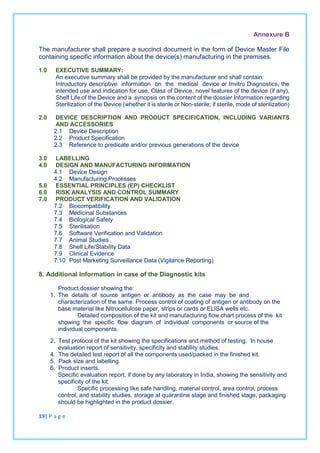
Annexure B
The manufacturer shall prepare a succinct document in the form of Device Master File
containing specific information about the device(s) manufacturing in the premises.
1.0 EXECUTIVE SUMMARY:
An executive summary shall be provided by the manufacturer and shall contain:
Introductory descriptive information on the medical device or Invitro Diagnostics, the
intended use and indication for use, Class of Device, novel features of the device (if any),
Shelf Life of the Device and a synopsis on the content of the dossier Information regarding
Sterilization of the Device (whether it is sterile or Non-sterile; if sterile, mode of sterilization)
2.0 DEVICE DESCRIPTION AND PRODUCT SPECIFICATION, INCLUDING VARIANTS
AND ACCESSORIES
2.1 Device Description
2.2 Product Specification
2.3 Reference to predicate and/or previous generations of the device
3.0 LABELLING
4.0 DESIGN AND MANUFACTURING INFORMATION
4.1 Device Design
4.2 Manufacturing Processes
5.0 ESSENTIAL PRINCIPLES (EP) CHECKLIST
6.0 RISK ANALYSIS AND CONTROL SUMMARY
7.0 PRODUCT VERIFICATION AND VALIDATION
7.2 Biocompatibility
7.3 Medicinal Substances
7.4 Biological Safety
7.5 Sterilisation
7.6 Software Verification and Validation
7.7 Animal Studies
7.8 Shelf Life/Stability Data
7.9 Clinical Evidence
7.10 Post Marketing Surveillance Data (Vigilance Reporting)
8. Additional Information in case of the Diagnostic kits
Product dossier showing the:
1. The details of source antigen or antibody as the case may be and
characterization of the same. Process control of coating of antigen or antibody on the
base material like Nitrocellulose paper, strips or cards or ELISA wells etc.
Detailed composition of the kit and manufacturing flow chart process of the kit
showing the specific flow diagram of individual components or source of the
individual components.
2. Test protocol of the kit showing the specifications and method of testing. In house
evaluation report of sensitivity, specificity and stability studies.
4. The detailed test report of all the components used/packed in the finished kit.
5. Pack size and labelling.
6. Product inserts.
Specific evaluation report, if done by any laboratory in India, showing the sensitivity and
specificity of the kit.
Specific processing like safe handling, material control, area control, process
control, and stability studies, storage at quarantine stage and finished stage, packaging
should be highlighted in the product dossier.
19| P a g e
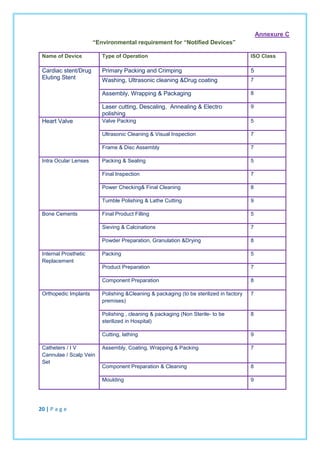
Annexure C
“Environmental requirement for “Notified Devices”
20 | P a g e
Name of Device Type of Operation ISO Class
Cardiac stent/Drug
Eluting Stent
Primary Packing and Crimping 5
Washing, Ultrasonic cleaning &Drug coating 7
Assembly, Wrapping & Packaging 8
Laser cutting, Descaling, Annealing & Electro
polishing
9
Heart Valve Valve Packing 5
Ultrasonic Cleaning & Visual Inspection 7
Frame & Disc Assembly 7
Intra Ocular Lenses Packing & Sealing 5
Final Inspection 7
Power Checking& Final Cleaning 8
Tumble Polishing & Lathe Cutting 9
Bone Cements Final Product Filling 5
Sieving & Calcinations 7
Powder Preparation, Granulation &Drying 8
Internal Prosthetic
Replacement
Packing 5
Product Preparation 7
Component Preparation 8
Orthopedic Implants Polishing &Cleaning & packaging (to be sterilized in factory
premises)
7
Polishing , cleaning & packaging (Non Sterile- to be
sterilized in Hospital)
8
Cutting, lathing 9
Catheters / I V
Cannulae / Scalp Vein
Set
Assembly, Coating, Wrapping & Packing 7
Component Preparation & Cleaning 8
Moulding 9
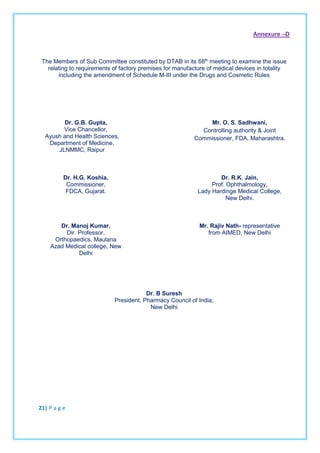
Annexure –D
The Members of Sub Committee constituted by DTAB in its 68th
meeting to examine the issue
relating to requirements of factory premises for manufacture of medical devices in totality
including the amendment of Schedule M-III under the Drugs and Cosmetic Rules
Dr. G.B. Gupta,
Vice Chancellor,
Ayush and Health Sciences,
Department of Medicine,
JLNMMC, Raipur
Mr. O. S. Sadhwani,
Controlling authority & Joint
Commissioner, FDA, Maharashtra.
Dr. H.G. Koshia,
Commissioner,
FDCA, Gujarat.
Dr. R.K. Jain,
Prof. Ophthalmology,
Lady Hardinge Medical College,
New Delhi.
Dr. Manoj Kumar,
Dir. Professor,
Orthopaedics, Maulana
Azad Medical college, New
Delhi
Mr. Rajiv Nath- representative
from AIMED, New Delhi
New
Dr. B Suresh
President, Pharmacy Council of India,
New Delhi
21| P a g e

Final_Schedule M2.pdf

  • 1.
    SCHEDULE M-III QUALITY MANAGEMENTSYSTEM FOR NOTIFIED MEDICAL DEVICES AND IN-VITRO DIAGNOSTICS (12.06.2015) (Prepared by Sub-Committee of DTAB)
  • 2.
    INDEX Sr. No. TitlePage No. 1. General 1 2. Applicability 1 3. Terms and definitions 1 4. Quality management system 3 5. Management responsibility 5 6. Resource management 7 7. Product realization 8 8. Measurement, analysis and improvement 14 9. Annexure A- Documents related to Site Master File 17 10. Annexure B- Documents related to Device Master File 19 11. Annexure C-Environmental requirement for Notified Devices 20 12. Annexure D- Members of the Subcommittee constituted by DTAB 21
  • 3.
    SCHEDULE M-III [See Rule76] QUALITY MANAGEMENT SYSTEM –FOR NOTIFIED MEDICAL DEVICES AND IN-VITRO DIAGNOSTICS 1. General This schedule specifies requirements for a quality management system that shall be used by the manufacturer for the design and development, manufacture, packaging, labeling, testing, installation and servicing of medical devices and in-vitro diagnostics. If the manufacturer does not carry out design and development activity, the same shall be recorded in the quality management system and shall exclude the provisions of relevant clauses of this schedule. The manufacturer shall ensure the claims of conformity with this schedule to reflect the exclusions. If any requirement(s) in Clause 7(product realization) of this schedule is(are) not applicable due to the nature of the medical device(s) and in-vitro diagnostics(s) for which the quality management system is applied, the manufacturer does not need to include such a requirement(s) in its quality management system. The processes required by this schedule, which are applicable to the medical device(s)and in-vitro diagnostic devices, but which are not performed by the manufacturer are the responsibility of the manufacturer and are accounted for in the manufacturer’s quality management system. If a manufacturer engages in only some operations subject to the requirements in this part, and not in others, that manufacturer need only comply with those requirements applicable to the operations in which it is engaged. It is emphasized that the quality management system requirements specified in this schedule are complementary to technical requirements for products. Manufacturers of components or parts of finished devices and in-vitro diagnostics are encouraged to use appropriate provisions of this regulation as guidance. 2. Applicability The provisions of this Schedule shall be applicable to manufacturers of finished devices, In- Vitro Diagnostics, mechanical contraceptives (Condoms, intrauterine Devices, Tubal Rings), surgical dressings, surgical bandages, surgical staplers, surgical sutures and ligatures, Blood and Blood Components Collection bags, intended for human or animal use that is manufactured in India. 3. Terms and definitions 3.1 Active implantable medical device Active medical device which is intended to be totally or partially introduced, surgically or medically, into the human or animal body or by medical intervention into a natural orifice, and which is intended to remain after the procedure 3.2 Active medical device Medical device relying for its functioning on a source of electrical energy or any source of power other than that directly generated by the human or animal body or gravity 1 | P a g e
  • 4.
    3.3 Advisory notice Noticeissued by the manufacturer, subsequent to delivery of the medical device and in-vitro diagnostic devices, to provide supplementary information and/or to advise what action should be taken in  the use of a medical device and in-vitro diagnostic devices,  the modification of a medical device and in-vitro diagnostic devices,  the return of the medical device and in-vitro diagnostic devices to the organization that supplied it, or  the destruction of a medical device and in-vitro diagnostic devices 3.4 Customer complaint Written, electronic or oral communication that alleges deficiencies related to the identity, quality, durability, reliability, safety, effectiveness or performance of a medical device and in- vitro diagnostic devices that has been placed on the market 3.5 Implantable medical device Medical device intended  to be totally or partially introduced into the Human or animal body or a natural orifice, or  to replace an epithelial surface or the surface of the eye, by surgical intervention, and which is intended to remain after the procedure for at least 30 days, and which can only be removed by medical or surgical intervention 3.6Component means any raw material, substance, piece, part, software, firmware, labeling, or assembly which is intended to be included as part of the finished, packaged, and labeled device. 3.7 Design input means the physical and performance requirements of a device that are used as a basis for device design. 3.8Design output means the results of a design effort at each design phase and at the end of the total design effort. The finished design output is the basis for the device master record. The total finished design output consists of the device, its packaging and labeling, and the device master record. 3.9 Design review means a documented, comprehensive, systematic examination of a design to evaluate the adequacy of the design requirements, to evaluate the capability of the design to meet these requirements, and to identify problems. 3.10 Finished device means any device or accessory to any device that is suitable for use or capable of functioning, whether or not it is packaged, labeled, or sterilized. 3.11 In-vitro Diagnostic devices: In-vitro Diagnostics referred in this schedule means diagnostics that fall under section 3(b)(i) of Drugs and Cosmetics Act 3.12Management with executive responsibility means those senior employees of a manufacturer who have the authority to establish or make changes to the manufacturer's quality policy and quality system. 3.13 Medical device: Medical devices referred in this schedule means devices that are notified under section 3(b)(iv) of Drugs and Cosmetics Act. 3.14Quality audit means a systematic, independent examination of a manufacturer's quality system that is performed at defined intervals and at sufficient frequency to determine whether both quality system activities and the results of such activities comply with quality system 2 | P a g e
  • 5.
    procedures, that theseprocedures are implemented effectively, and that these procedures are suitable to achieve quality system objectives. 3.15Quality policy means the overall intentions and direction of an organization with respect to quality, as established by management with executive responsibility. 3.16Quality system means the organizational structure, responsibilities, procedures, processes, and resources for implementing quality management. 3.17Rework means action taken on a nonconforming product so that it will fulfill the specified DMR requirements before it is released for distribution. 3.18Specification means any requirement with which a product, process, service, or other activity must conform. 3.19Validation means confirmation by examination and provision of objective evidence that the particular requirements for a specific intended use can be consistently fulfilled. (1)Process validation means establishing by objective evidence that a process consistently produces a result or product meeting its predetermined specifications. (2)Design validation means establishing by objective evidence that device specifications conform with user needs and intended use(s). 3.20Verification means confirmation by examination and provision of objective evidence that specified requirements have been fulfilled. 4 Quality Management System 4.1 General requirements The manufacturer shall establish, document, implement and maintain a quality management system and maintain its effectiveness in accordance with the requirements of this schedule. The manufacturer shall a) identify the processes needed for the quality management system and their application throughout the organization, b) determine the sequence and interaction of these processes, c) determine criteria and methods needed to ensure that both the operation and control of these processes are effective, d) ensure the availability of resources and information necessary to support the operation and monitoring of these processes, e) monitor, measure and analyse these processes, and f) implement actions necessary to achieve planned results and maintain the effectiveness of these processes. These processes shall be managed by the manufacturer in accordance with the requirements of this schedule. Where a Manufacturer chooses to outsource any process that affects product conformity with requirements, the Manufacturer shall ensure control over such processes. Control of such outsourced processes shall be identified within the quality management system. NOTE Processes needed for the quality management system referred to above should include processes for management activities, provision of resources, product realization and measurement. 4.2 Documentation requirements 3| P a g e
  • 6.
    4.2.1 General The qualitymanagement system documentation shall include a) documented statements of a quality policy and quality objectives, b) a quality manual, c) documented procedures required by this schedule, d) documents needed by the manufacturer to ensure the effective planning, operation and control of its processes, e) records required by this schedule, and Where this schedule specifies that a requirement, procedure, activity or special arrangement be “documented”, it shall, in addition, be implemented and maintained. For each type or model of medical device/ In-vitro Diagnostics, the manufacturer shall establish and maintain a file either containing or identifying documents defining product specifications and quality management system requirements. These documents shall define the complete manufacturing process and, if applicable, installation. Data may be recorded by electronic data processing systems or other reliable means, but documents and record relating to the system in use shall also be available in a hard copy to facilitate checking of the accuracy of the records. Wherever documentation is handled by electronic data processing methods, authorized persons shall enter or modify data in the computer. There shall be record of changes and deletions. Access shall be restricted by ‘passwords’ or other means and the result of entry of critical data shall be independently checked. Batch records electronically stored shall be protected by a suitable back-up. During the period of retention, all relevant data shall be readily available. 4.2.2 Quality manual The manufacturer shall establish and maintain a quality manual that includes a) the scope of the quality management system, including details of and justification for any exclusion and/or non-application, b) the documented procedures established for the quality management system, or reference to them, and c) a description of the interaction between the processes of the quality management system. The quality manual shall outline the structure of the documentation used in the quality management system. The manufacturer shall prepare documentation in a form of a Site Master File containing specific information about the facilities, personnel and other details as prescribed in Annexure A. 4.2.3 Control of documents Documents required by the quality management system shall be controlled. Records are a special type of document and shall be controlled according to the requirements given in the control of records. Documents shall be approved, signed and dated by the appropriate and the authorized person A documented procedure shall be established to define the controls needed a) to review and approve documents for adequacy prior to issue, b) to review and update as necessary and re-approve documents, c) to ensure that changes and the current revision status of documents are identified, d) to ensure that relevant versions of applicable documents are available at points of use, 4 | P a g e
  • 7.
    e) to ensurethat documents remain legible and readily identifiable, f) to ensure that documents of external origin are identified and their distribution controlled, and g) to prevent the unintended use of obsolete documents, and to apply suitable identification to them if they are retained for any purpose. Changes to document shall be reviewed, approved and maintained. Change records shall include a description of the change, identification of the affected documents, the signature of the approving individual(s), the approval date, and when the change becomes effective. The manufacturer shall ensure that changes to documents are reviewed and approved either by the original approving function or another designated function which has access to pertinent background information upon which to base its decisions. The manufacturer shall define the period for which at least one copy of obsolete controlled documents shall be retained. This period shall ensure that documents to which medical devices/In-vitro Diagnostics have been manufactured and tested are retained for at least one year after the date of expiry of the medical device/In-vitro Diagnostic as defined by the manufacturer. 4.2.4 Control of records Records shall be established and maintained to provide evidence of conformity to requirements and of the effective operation of the quality management system. Records shall remain legible, readily identifiable and retrievable. A documented procedure shall be established to define the controls needed for the identification, storage, protection, retrieval, retention time and disposition of records. The manufacturer shall retain the records for a period of time at least one year after the date of expiry of the medical device/In-vitro Diagnostics as defined by the manufacturer, but not less than two years from the date of product release by the manufacturer. 5 Management responsibility 5.1 Management commitment Top management of the manufacturer shall provide evidence of its commitment to the development and implementation of the quality management system and maintaining its effectiveness by a) communicating to the employees the importance of meeting customer as well as statutory and regulatory requirements, b) establishing the quality policy, c) ensuring that quality objectives are established, d) conducting management reviews, and e) ensuring the availability of resources. 5.2 Customer focus Top management of the manufacturer shall ensure that customer requirements are determined and are met. 5.3 Quality policy Top management of the manufacturer shall ensure that the quality policy a) is appropriate to the purpose of the manufacturing facility, b) includes a commitment to comply with requirements and to maintain the effectiveness of the quality management system, c) provides a framework for establishing and reviewing quality objectives, d) is communicated and understood within the manufacturers organization, and e) is reviewed for continuing suitability. 5.4 Planning 5| P a g e
  • 8.
    5.4.1 Quality objectives Topmanagement of the manufacturer shall ensure that quality objectives, including those needed to meet requirements for product, are established at relevant functions and levels within the manufacturing organization. The quality objectives shall be measurable and consistent with the quality policy. 5.4.2 Quality management system planning Top management of the manufacturer shall ensure that a) the planning of the quality management system is carried out in order to meet the specified requirements, as well as the quality objectives, and b) the integrity of the quality management system is maintained when changes to the quality management system are planned and implemented. 5.5 Responsibility, authority and communication 5.5.1 Responsibility and authority Top management of the manufacturer shall ensure that responsibilities and authorities are defined, documented and communicated within the manufacturing organization. Top management of the manufacturer shall establish the interrelation of all personnel who manage, perform and verify work affecting quality, and shall ensure the independence and authority necessary to perform these tasks. 5.5.2 Management representative Top management shall appoint a member of management who, irrespective of other responsibilities, shall have responsibility and authority that includes a) ensuring that processes needed for the quality management system are established, implemented and maintained, b) reporting to top management on the performance of the quality management system and any need for improvement, and c) ensuring the promotion of awareness of regulatory and customer requirements throughout the manufacturing organization. 5.5.3 Internal communication Top management shall ensure that appropriate communication processes are established within the Manufacturing organization and that communication takes place regarding the effectiveness of the quality management system. 5.6 Management review 5.6.1 General Top management shall review the organization’s quality management system, at planned intervals, to ensure its continuing suitability, adequacy and effectiveness. This review shall include assessing opportunities for improvement and the need for changes to the quality management system, including the quality policy and quality objectives. Records from management reviews shall be maintained. 5.6.2 Review input The input to management review shall include information on a) results of audits, b) customer feedback, c) process performance and product conformity, d) status of preventive and corrective actions, e) follow-up actions from previous management reviews, f) changes that could affect the quality management system, g) recommendations for improvement, and h) new or revised regulatory requirements as and when issued. 6| P a g e
  • 9.
    5.6.3 Review output Theoutput from the management review shall include any decisions and actions related to a) improvements needed to maintain the effectiveness of the quality management system and its processes, b) improvement of product related to customer requirements, and c) resource needs. 6 Resource Management 6.1 Provision of resources The manufacturing organization shall determine and provide the resources needed a) to implement the quality management system and to maintain its effectiveness, and b) to meet regulatory and customer requirements. 6.2 Human resources 6.2.1 General Personnel performing work affecting product quality shall be competent on the basis of appropriate education, training, skills and experience. Number of personnel employed shall be adequate and in direct proportion to the workload. Prior to employment, all personnel, shall undergo medical examination including eye examination, and shall be free from communicable or contagious diseases. Thereafter, they should be medically examined periodically, at least once a year. Records shall be maintained thereof. All personnel shall bear clean body covering appropriate to their duties. Smoking, Eating, Drinking, Chewing or keeping food and drink shall not be permitted in production, laboratory and storage areas. 6.2.2 Competence, awareness and training The manufacturer shall a) determine the necessary competence for personnel performing work affecting product quality, b) provide training or take other actions to satisfy these needs, c) evaluate the effectiveness of the actions taken, d) ensure that its personnel are aware of the relevance and importance of their activities and how they contribute to the achievement of the quality objectives, and e) maintain appropriate records of education, training, skills and experience. f) establish documented procedures for identifying training needs and ensure that all personnel are trained to adequately perform their assigned responsibilities. 6.3 Infrastructure The organization shall determine, provide and maintain the infrastructure needed to achieve conformity to product requirements. Infrastructure includes, as applicable a) buildings, workspace and associated utilities. b) process equipment (both hardware and software), and c) supporting services (such as transport or communication). The manufacturer shall establish documented requirements for maintenance activities, including their frequency, when such activities or lack thereof can affect product quality. Records of such maintenance shall be maintained. 6.4 Work environment The organization shall determine and manage the work environment needed to achieve conformity to product requirements. The following requirements shall apply. a) The manufacturer shall establish documented requirements for health, cleanliness and clothing of personnel if contact between such personnel and the product or work environment could adversely affect the quality of the product. b) If work environment conditions can have an adverse effect on product quality, the manufacturer shall establish documented requirements as per annexure-C of this schedule for the work environment conditions and documented procedures or work instructions to 7 | P a g e
  • 10.
    monitor and controlthese work environment conditions. c) The manufacturer shall ensure that all personnel who are required to work temporarily under special environmental conditions within the work environment are appropriately trained and supervised by a trained person. d) If appropriate, special arrangements shall be established and documented for the control of contaminated or potentially contaminated product in order to prevent contamination of other product, the work environment or personnel. 7 Product realization 7.1 Planning of product realization The manufacturer shall plan and develop the processes needed for product realization. Planning of product realization shall be consistent with the requirements of the other processes of the quality management system. In planning product realization, the manufacturer shall determine the following, as appropriate: a) quality objectives and requirements for the product; b) the need to establish processes, documents, and provide resources specific to the product; c) required verification, validation, monitoring, inspection and test activities specific to the product and the criteria for product acceptance; d) records needed to provide evidence that the realization processes and resulting product meet requirements. The output of this planning shall be in a form suitable for the manufacturer’s method of operations. The manufacturer organization shall establish documented requirements for risk management (as per the IS/ISO 14971) throughout product realization. Records arising from risk management shall be maintained. 7.2 Customer-related processes 7.2.1 Determination of requirements related to the product The manufacturer shall determine a) requirements specified by the customer, including the requirements for delivery and post- delivery activities, b) requirements not stated by the customer but necessary for specified or intended use, where known, c) statutory requirements related to the product, and d) any additional requirements determined by the manufacturer. 7.2.2 Review of requirements related to the product The manufacturer shall review the requirements related to the product. This review shall be conducted prior to the manufacturer's commitment to supply a product to the customer and shall ensure that a) product requirements are defined and documented, b) contract or order requirements differing from those previously expressed are resolved, and c) the manufacturer has the ability to meet the defined requirements. Records of the results of the review and actions arising from the review shall be maintained. Where the customer provides no documented statement of requirement, the customer requirements shall be confirmed by the manufacturer before acceptance. Where product requirements are changed, the manufacturer shall ensure that relevant documents are amended and that relevant personnel are made aware of the changed requirements. The manufacturer shall prepare documentation on Device(s) in a form of a Device Master File containing specific information as prescribed in Annexure B. 8 | P a g e
  • 11.
    7.2.3 Customer communication Themanufacturer shall determine and implement effective arrangements for communicating with customers in relation to a) product information, b) enquiries, contracts or order handling, including amendments, c) customer feedback, including customer complaints, and d) advisory notices. 7.3 Design and development 7.3.1 Design and development planning The manufacturer shall establish documented procedures for design and development. The manufacturer shall plan and control the design and development of product. During the design and development planning, the manufacturer shall determine a) the design and development stages, b) the review, verification, validation and design transfer activities (see Note) that are appropriate at each design and development stage, and c) the responsibilities and authorities for design and development. The manufacturer shall manage the interfaces between different groups involved in design and development to ensure effective communication and clear assignment of responsibility. Planning output shall be documented, and updated as appropriate, as the design and development progresses. NOTE Design transfer activities during the design and development process ensure that design and development outputs are verified as suitable for manufacturing before becoming final production specifications. 7.3.2 Design and development inputs Inputs relating to product requirements shall be determined and records maintained. The design requirements relating to a device are appropriate and address the intended use of the device, including the needs of the user and patients. These inputs shall include a) functional, performance and safety requirements, according to the intended use, b) applicable statutory and regulatory requirements, c) where applicable, information derived from previous similar designs, d) other requirements essential for design and development, and e) output(s) of risk management. These inputs shall be reviewed for adequacy and approved by designated individual(s) Requirements shall be complete, unambiguous and not in conflict with each other. 7.3.3 Design and development outputs The outputs of design and development shall be provided in a form that enables verification against the design and development input and shall be documented, reviewed, and approved prior to release. Design and development outputs shall a) meet the input requirements for design and development, b) provide appropriate information for purchasing, production and for service provision, c) contain or reference product acceptance criteria, and d) specify the characteristics of the product that are essential for its safe and proper use. Records of the design and development outputs shall be maintained. Records of design and development outputs can include specifications, manufacturing procedures, engineering drawings, and engineering or research logbooks. 7.3.4 Design and development review At suitable stages, systematic reviews of design and development shall be performed in accordance with planned arrangements 9 | P a g e
  • 12.
    a) to evaluatethe ability of the results of design and development to meet requirements, and b) to identify any problems and propose necessary actions. Participants in such reviews shall include representatives of functions concerned with the design and development stage(s) being reviewed, as well as other specialist personnel Records of the results of the reviews and any necessary actions shall be maintained (see 4.2.4). 7.3.5 Design and development verification Verification shall be performed in accordance with planned arrangements to ensure that the design and development outputs have met the design and development input requirements. Records of the results of the verification and any necessary actions shall be maintained. 7.3.6 Design and development validation Design and development validation shall be performed in accordance with planned arrangements to ensure that the resulting product is capable of meeting the requirements for the specified application or intended use. Design validation shall be performed under defined operating conditions on initial production units, lots, or batches or their equivalence. Design validation shall include software validation and risk analysis, where appropriate Validation shall be completed prior to the delivery or implementation of the product. Records of the results of validation and any necessary actions shall be maintained. As part of design and development validation, the manufacturer shall perform clinical evaluations and/or evaluation of performance of the medical device/In-vitro Diagnostics. NOTE 1 If a medical device /In-vitro Diagnostics can only be validated following assembly and installation at point of use, delivery is not considered to be complete until the product has been formally transferred to the customer. NOTE 2 Provision of the medical device for purposes of clinical evaluations and/or evaluation of performance is not considered to be delivery. 7.3.7 Control of design and development changes Design and development changes shall be identified and records maintained. The changes shall be reviewed, verified and validated, as appropriate, and approved before implementation. The review of design and development changes shall include evaluation of the effect of the changes on constituent parts and product already delivered. Records of the results of the review of changes and any necessary actions shall be maintained. Note: -Each manufacturer shall establish and maintain a Design History File for each type of device. The Design History File shall contain or reference the records necessary to demonstrate that the design was developed in accordance with the approved design plan and the requirements of design and development. 7.4 Purchasing 7.4.1 Purchasing process The manufacturer organization shall establish documented procedures to ensure that purchased product conforms to specified purchase requirements. The type and extent of control applied to the supplier and the purchased product shall be dependent upon the effect of the purchased product on subsequent product realization or the final product. The manufacturer shall evaluate and select suppliers based on their ability to supply product in accordance with the manufacturer’s requirements. Criteria for selection, evaluation and re- evaluation shall be established. Records of the results of evaluations and any necessary actions arising from the evaluation shall be maintained. 10 | P a g e
  • 13.
    7.4.2 Purchasing information Purchasinginformation shall describe the product to be purchased, including where appropriate a) requirements for approval of product, procedures, processes and equipment, b) requirements for qualification of personnel, and c) quality management system requirements. The manufacturer shall ensure the adequacy of specified purchase requirements prior to their communication to the supplier. To the extent required for traceability, the manufacturer shall maintain relevant purchasing information, i.e. documents and records. 7.4.3 Verification of purchased product The manufacturer shall establish and implement the inspection or other activities necessary for ensuring that purchased product meets specified purchase requirements. Where the manufacturer intends to perform verification at the supplier’s premises, the manufacturer shall state the intended verification arrangements and method of product release in the purchasing information. Records of the verification shall be maintained. 7.5 Production and service provision 7.5.1 Control of production and service provision 7.5.1.1 General requirements The manufacturer shall plan and carry out production and service provision under controlled conditions. Controlled conditions shall include, as applicable a) the availability of information that describes the characteristics of the product, b) the availability of documented procedures, documented requirements, work instructions, and reference materials and reference measurement procedures as necessary, c) the use of suitable equipment, d) the availability and use of monitoring and measuring devices, e) the implementation of monitoring and measurement, f) the implementation of release, delivery and post-delivery activities, and g) the implementation of defined operations for labeling and packaging. The manufacturer shall establish and maintain a record for each batch of medical devices/In- vitro Diagnostic devices that provides traceability and identifies the amount manufactured and amount approved for distribution. The batch record shall be verified and approved. 7.5.1.2 Control of production and service provision — Specific requirements 7.5.1.2.1 Cleanliness of product and contamination control The manufacturer shall establish documented requirements for cleanliness of product if a) product is cleaned by the manufacturer prior to sterilization and/or its use, or b) product is supplied non-sterile to be subjected to a cleaning process prior to sterilization and/or its use, or c) product is supplied to be used non-sterile and its cleanliness is of significance in use, or d) process agents are to be removed from product during manufacture. If the product is cleaned in accordance with a) or b) above, the requirements content in 6.4 (a) & (b) do not apply prior to the cleaning process 7.5.1.2.2 Installation activities If appropriate, the manufacturer shall establish documented requirements which contain acceptance criteria for installing and verifying the installation of the medical device/In-vitro Diagnostic devices. 11 | P a g e
  • 14.
    If the agreedcustomer requirements allow installation to be performed other than by manufacturer or its authorized agent, the manufacturer shall provide documented requirements for installation and verification. Records of installation and verification performed by the manufacturer or its authorized agent shall be maintained. 7.5.1.3 Particular requirements for sterile medical devices The manufacturer shall maintain records of the process parameters for the sterilization process which was used for each sterilization batch. Sterilization records shall be traceable to each production batch of medical devices. 7.5.2 Validation of processes for production and service provision 7.5.2.1 General requirements The manufacturer shall validate any processes for production and service provision where the resulting output cannot be verified by subsequent monitoring or measurement. This includes any processes where deficiencies become apparent only after the product is in use. Validation shall demonstrate the ability of these processes to achieve planned results. The manufacturer shall establish arrangements for these processes including, as applicable a) defined criteria for review and approval of the processes, b) approval of equipment and qualification of personnel, c) use of specific methods and procedures, d) requirements for records, and e) revalidation. The manufacturer shall establish documented procedures for the validation of the application of computer software (and changes to such software and/or its application) for production and service provision that affect the ability of the product to confirm to specified requirements. Such software applications shall be validated prior to initial use. Records of validation shall be maintained. 7.5.2.2 Particular requirements for sterile medical devices The manufacturer shall establish documented procedures for the validation of sterilization processes. Sterilization processes shall be validated prior to initial use. The records of validation of each sterilization process shall be maintained. 7.5.3 Identification and traceability 7.5.3.1 Identification The manufacturer shall identify the product by suitable means throughout product realization, and shall establish documented procedures for such product identification. The manufacturer shall establish documented procedures to ensure that medical devices and In-vitro Diagnostics returned to the Manufacturer are identified and distinguished from conforming product. 7.5.3.2 Traceability 7.5.3.2.1 General The manufacturer shall establish documented procedures for traceability. Such procedures shall define the extent of product traceability and the records required. Where traceability is a requirement, the manufacturer shall control and record the unique identification of the product. NOTE Configuration management is a means by which identification and traceability can be maintained. 12 | P a g e
  • 15.
    7.5.3.2.2 Particular requirementsfor active implantable medical devices and implantable medical devices In defining the records required for traceability, the manufacturer shall include records of all components, materials and work environment conditions, if these could cause the medical device not to satisfy its specified requirements. The manufacturer shall require that its agents or distributors maintain records of the distribution of medical devices/In-vitro Diagnostics to allow traceability and that such records are available for inspection. Records of the name and address of the shipping package consignee shall be maintained. 7.5.3.3 Status identification The manufacturer shall identify the product status with respect to monitoring and measurement requirements. The identification of product status shall be maintained throughout production, storage, implant, usage and installation of the product to ensure that only product that has passed the required inspections and tests (or released under an authorized concession) is dispatched, used or installed. 7.5.4 Customer property The manufacturer shall exercise care with customer property while it is under the manufacturer’s control or being used by the manufacturer. The manufacturer shall identify, verify, protect and safeguard customer property provided for use or incorporation into the product. If any customer property is lost, damaged or otherwise found to be unsuitable for use, this shall be reported to the customer and records maintained. NOTE Customer property can include intellectual property or confidential health information. 7.5.5 Preservation of product The manufacturer shall establish documented procedures or documented work instructions for preserving the conformity of product during internal processing and delivery to the intended destination. This preservation shall include identification, handling, packaging, storage and protection. Preservation shall also apply to the constituent parts of a product. The manufacturer shall establish documented procedures or documented work instructions for the control of product with a limited shelf-life or requiring special storage conditions. Such special storage conditions shall be controlled and recorded. 7.6 Control of monitoring and measuring devices The manufacturer shall determine the monitoring and measurement to be undertaken and the monitoring and measuring devices needed to provide evidence of conformity of product to determined requirements. The manufacturer shall establish documented procedures to ensure that monitoring and measurement can be carried out and are carried out in a manner that is consistent with the monitoring and measurement requirements. Where necessary to ensure valid results, measuring equipment shall a) be calibrated or verified at specified intervals, or prior to use, against measurement standards traceable to Bureau of Indian Standards wherever available ; where no such standards exist, the basis used for calibration or verification shall be recorded; b) be adjusted or re-adjusted as necessary; c) be identified to enable the calibration status to be determined; d) be safeguarded from adjustments that would invalidate the measurement result; e) be protected from damage and deterioration during handling, maintenance and storage. In addition, the manufacturer shall assess and record the validity of the previous measuring results when the equipment is found not to conform to requirements. The manufacturer shall 13| P a g e
  • 16.
    take appropriate actionon the equipment and any product affected. Records of the results of calibration and verification shall be maintained. When used in the monitoring and measurement of specified requirements, the ability of computer software to satisfy the intended application shall be confirmed. This shall be undertaken prior to initial use and reconfirmed as necessary. 8 Measurement, analysis and improvement 8.1 General The manufacturer shall plan and implement the monitoring, measurement, analysis and improvement processes needed a) to demonstrate conformity of the product, b) to ensure conformity of the quality management system, and c) to maintain the effectiveness of the quality management system. This shall include determination of applicable methods, including statistical techniques, and the extent of their use. Note: If relevant Indian standards are not available, International standards are applicable. In case no Indian/International standards are available, validated testing process of the manufacturer is applicable 8.2 Monitoring and measurement 8.2.1 Feedback As one of the measurements of the performance of the quality management system, the manufacturer shall monitor information relating to whether the manufacturer has met customer / Regulatory requirements. The methods for obtaining and using this information shall be determined. The manufacturer shall establish a documented procedure for a feedback system to provide early warning of quality problems and for input into the corrective and preventive action processes. 8.2.2 Internal audit The manufacturer shall conduct internal audits at planned intervals to determine whether the quality management system a) conforms to the planned arrangements, to the requirements of this schedule and to the quality management system requirements established by the manufacturer, and b) is effectively implemented and maintained. An audit programme shall be planned, taking into consideration the status and importance of the processes and areas to be audited, as well as the results of previous audits. The audit criteria, scope, frequency and methods shall be defined. Selection of auditors and conduct of audits shall ensure objectivity and impartiality of the audit process. Auditors shall not audit their own work. The responsibilities and requirements for planning and conducting audits, and for reporting results and maintaining records shall be defined in a documented procedure. The management responsible for the area being audited shall ensure that actions are taken without undue delay to eliminate detected nonconformities and their causes. Follow-up activities shall include the verification of the actions taken and the reporting of verification results. 8.2.3 Monitoring and measurement of processes The manufacturer shall apply suitable methods for monitoring and, where applicable, measurement of the quality management system processes. These methods shall demonstrate the ability of the processes to achieve planned results. When planned results 14 | P a g e
  • 17.
    are not achieved,correction and corrective action shall be taken, as appropriate, to ensure conformity of the product. 8.2.4 Monitoring and measurement of product 8.2.4.1 General requirements The manufacturer shall monitor and measure the characteristics of the product to verify that product requirements have been met. This shall be carried out at appropriate stages of the product realization process in accordance with the planned arrangements and documented procedures. Evidence of conformity with the acceptance criteria shall be maintained. Records shall indicate the person(s) authorizing release of product. Product release shall not proceed until the planned arrangements have been satisfactorily completed. 8.2.4.2 Particular requirement for active implantable medical devices and implantable medical Devices wherever applicable The manufacturer shall record the identity of personnel performing any inspection or testing. 8.3 Control of nonconforming product The manufacturer shall ensure that product which does not conform to product requirements is identified and controlled to prevent its unintended use or delivery. The controls and related responsibilities and authorities for dealing with nonconforming product shall be defined in a documented procedure. The manufacturer shall deal with nonconforming product by one or more of the following ways: a) by taking action to eliminate the detected nonconformity; b) by authorizing its use, release or acceptance under concession; c) by taking action to preclude its original intended use or application. The manufacturer shall ensure that nonconforming product is accepted by concession only if regulatory requirements are met. Records of the identity of the person(s) authorizing the concession shall be maintained. Records of the nature of nonconformities and any subsequent actions taken, including concessions obtained, shall be maintained. When nonconforming product is corrected it shall be subject to re-verification to demonstrate conformity to the requirements. When nonconforming product is detected after delivery or use has started, the manufacturer shall take action appropriate to the effects, or potential effects, of the nonconformity. If product needs to be reworked (one or more times), the manufacturer shall document the rework process in a work instruction that has undergone the same authorization and approval procedure as the original work instruction. Prior to authorization and approval of the work instruction, a determination of any adverse effect of the rework upon product shall be made and documented. 8.4 Analysis of data The manufacturer shall establish documented procedures to determine collect and analyze appropriate data to demonstrate the suitability and effectiveness of the quality management system and to evaluate if improvement of the effectiveness of the quality management system can be made. This shall include data generated as a result of monitoring and measurement and from other relevant sources. The analysis of data shall provide information relating to a) feedback, b) conformity to product requirements, c) characteristics and trends of processes and products including opportunities for preventive action, and d) suppliers. 15 | P a g e
  • 18.
    Records of theresults of the analysis of data shall be maintained. 8.5 Improvement 8.5.1 General The manufacturer shall identify and implement any changes necessary to ensure and maintain the continued suitability and effectiveness of the quality management system through the use of the quality policy, quality objectives, audit results, analysis of data, corrective and preventive actions and management review. The manufacturer shall establish documented procedures for the issue and implementation of advisory notices. These procedures shall be capable of being implemented at any time. Records of all customer complaint investigations shall be maintained. If investigation determines that the activities outside the manufacturer’s organization contributed to the customer complaint, relevant information shall be exchanged between the organizations involved. If any customer complaint is not followed by corrective and/or preventive action, the reason shall be authorized and recorded. Manufacturer require to notify adverse events and the manufacturer shall establish documented procedures to such notification to regulatory authorities. 8.5.2 Corrective action The manufacturer shall take action to eliminate the cause of nonconformities in order to prevent recurrence. Corrective actions shall be appropriate to the effects of the nonconformities encountered. A documented procedure shall be established to define requirements for a) reviewing nonconformities (including customer complaints), b) determining the causes of nonconformities, c) evaluating the need for action to ensure that nonconformities do not recur, d) determining and implementing action needed, including, if appropriate, updating documentation, e) recording of the results of any investigation and of action taken, and f) reviewing the corrective action taken and its effectiveness. 8.5.3 Preventive action The manufacturer shall determine action to eliminate the causes of potential nonconformities in order to prevent their occurrence. Preventive actions shall be appropriate to the effects of the potential problems. A documented procedure shall be established to define requirements for a) determining potential nonconformities and their causes, b) evaluating the need for action to prevent occurrence of nonconformities, c) determining and implementing action needed, d) recording of the results of any investigations and of action taken, and e) reviewing preventive action taken and its effectiveness. 16 | P a g e
  • 19.
    Annexure A The manufacturershall prepare a succinct document in the form of Site Master File containing specific information about the production and/or control of device manufacturing carried out at the premises. It shall contain the following information: A GENERAL INFORMATION I Brief information on the site (including name and address), relation to other sites II Manufacturing activities III Any other operations carried out on the site IV Name and exact address of the site, including telephone, fax numbers, web site URL and e-mail address V Type of medical devices handled on the site and information about specifically toxic or hazardous substances handled, mentioning the way they are handled and precautions taken VI Short description of the site (size, location and immediate environment and other activities on the site) VII Number of employees engaged in Production, Quality Control, warehousing, and distribution VIII Use of outside scientific, analytical or other technical assistance in relation to the design, manufacture and testing IX Short description of the quality management system of the company X Devices details registered with foreign countries B PERSONNEL I Organisation chart showing the arrangements for key personnel II Qualifications, experience and responsibilities of key personnel III Outline of arrangements for basic and in-service training and how records are maintained IV Health requirements for personnel engaged in production V Personnel hygiene requirements, including clothing C PREMISES AND FACILITIES I Layout of premises with indication of scale II Nature of construction, finishes/fixtures and fittings III Brief description of ventilation systems. More details should be given for critical areas with potential risks of airborne contamination (including schematic drawings of the systems). Classification of the rooms used for the manufacture of sterile products should be mentioned IV Special areas for the handling of highly toxic, hazardous and sensitizing materials V Brief description of water systems (schematic drawings of the systems are desirable) including sanitation VI Maintenance (description of planned preventive maintenance programmes for premises and recording system) D EQUIPMENT I Brief description of major production and quality control laboratories equipment (a list of the equipment is required) II Maintenance (description of planned preventive maintenance programmes and recording system). III Qualification and calibration, including the recording system. Arrangements for computerized systems validation. E SANITATION I Availability of written specifications and procedures for cleaning the manufacturing areas and equipments 17 | P a g e
  • 20.
    F PRODUCTION I Briefdescription of production operations using, wherever possible, flow sheets and charts specifying important parameters II Arrangements for the handling of starting materials, packaging materials, bulk and finished products, including sampling, quarantine, release and storage. III Arrangements for reprocessing or rework IV Arrangements for the handling of rejected materials and products V Brief description of general policy for process validation G QUALITY CONTROLS I Description of the Quality Control system and of the activities of the Quality Control Department. Procedures for the release of finished products H STORAGE I Policy on the storage of medical device E DOCUMENTATION I Arrangements for the preparation, revision and distribution of necessary documentation, including storage of master documents F MEDICAL DEVICE COMPLAINTS AND FIELD SAFETY CORRECTIVE ACTION I Arrangements for the handling of complaints II Arrangements for the handling of field safety corrective action G SELF INSPECTION I Short Description of the internal audit system H CONTRACT ACTIVITIES I Description of the way in which the compliance of the contract acceptor is assessed 18 | P a g e
  • 21.
    Annexure B The manufacturershall prepare a succinct document in the form of Device Master File containing specific information about the device(s) manufacturing in the premises. 1.0 EXECUTIVE SUMMARY: An executive summary shall be provided by the manufacturer and shall contain: Introductory descriptive information on the medical device or Invitro Diagnostics, the intended use and indication for use, Class of Device, novel features of the device (if any), Shelf Life of the Device and a synopsis on the content of the dossier Information regarding Sterilization of the Device (whether it is sterile or Non-sterile; if sterile, mode of sterilization) 2.0 DEVICE DESCRIPTION AND PRODUCT SPECIFICATION, INCLUDING VARIANTS AND ACCESSORIES 2.1 Device Description 2.2 Product Specification 2.3 Reference to predicate and/or previous generations of the device 3.0 LABELLING 4.0 DESIGN AND MANUFACTURING INFORMATION 4.1 Device Design 4.2 Manufacturing Processes 5.0 ESSENTIAL PRINCIPLES (EP) CHECKLIST 6.0 RISK ANALYSIS AND CONTROL SUMMARY 7.0 PRODUCT VERIFICATION AND VALIDATION 7.2 Biocompatibility 7.3 Medicinal Substances 7.4 Biological Safety 7.5 Sterilisation 7.6 Software Verification and Validation 7.7 Animal Studies 7.8 Shelf Life/Stability Data 7.9 Clinical Evidence 7.10 Post Marketing Surveillance Data (Vigilance Reporting) 8. Additional Information in case of the Diagnostic kits Product dossier showing the: 1. The details of source antigen or antibody as the case may be and characterization of the same. Process control of coating of antigen or antibody on the base material like Nitrocellulose paper, strips or cards or ELISA wells etc. Detailed composition of the kit and manufacturing flow chart process of the kit showing the specific flow diagram of individual components or source of the individual components. 2. Test protocol of the kit showing the specifications and method of testing. In house evaluation report of sensitivity, specificity and stability studies. 4. The detailed test report of all the components used/packed in the finished kit. 5. Pack size and labelling. 6. Product inserts. Specific evaluation report, if done by any laboratory in India, showing the sensitivity and specificity of the kit. Specific processing like safe handling, material control, area control, process control, and stability studies, storage at quarantine stage and finished stage, packaging should be highlighted in the product dossier. 19| P a g e
  • 22.
    Annexure C “Environmental requirementfor “Notified Devices” 20 | P a g e Name of Device Type of Operation ISO Class Cardiac stent/Drug Eluting Stent Primary Packing and Crimping 5 Washing, Ultrasonic cleaning &Drug coating 7 Assembly, Wrapping & Packaging 8 Laser cutting, Descaling, Annealing & Electro polishing 9 Heart Valve Valve Packing 5 Ultrasonic Cleaning & Visual Inspection 7 Frame & Disc Assembly 7 Intra Ocular Lenses Packing & Sealing 5 Final Inspection 7 Power Checking& Final Cleaning 8 Tumble Polishing & Lathe Cutting 9 Bone Cements Final Product Filling 5 Sieving & Calcinations 7 Powder Preparation, Granulation &Drying 8 Internal Prosthetic Replacement Packing 5 Product Preparation 7 Component Preparation 8 Orthopedic Implants Polishing &Cleaning & packaging (to be sterilized in factory premises) 7 Polishing , cleaning & packaging (Non Sterile- to be sterilized in Hospital) 8 Cutting, lathing 9 Catheters / I V Cannulae / Scalp Vein Set Assembly, Coating, Wrapping & Packing 7 Component Preparation & Cleaning 8 Moulding 9
  • 23.
    Annexure –D The Membersof Sub Committee constituted by DTAB in its 68th meeting to examine the issue relating to requirements of factory premises for manufacture of medical devices in totality including the amendment of Schedule M-III under the Drugs and Cosmetic Rules Dr. G.B. Gupta, Vice Chancellor, Ayush and Health Sciences, Department of Medicine, JLNMMC, Raipur Mr. O. S. Sadhwani, Controlling authority & Joint Commissioner, FDA, Maharashtra. Dr. H.G. Koshia, Commissioner, FDCA, Gujarat. Dr. R.K. Jain, Prof. Ophthalmology, Lady Hardinge Medical College, New Delhi. Dr. Manoj Kumar, Dir. Professor, Orthopaedics, Maulana Azad Medical college, New Delhi Mr. Rajiv Nath- representative from AIMED, New Delhi New Dr. B Suresh President, Pharmacy Council of India, New Delhi 21| P a g e