DOCUMENTATION:
SPECIFICATIONS &
CERTIFICATE OF
ANALYSIS (COA)
HARSHAVARDHAN V
KONDHARE
SEM II
DEPT. OF DRUG REGULATORY
AFFAIRS
GUIDED BY : Mrs PREETI K TAMANE
POONA COLLEGE OF PHARMACY
15-2-2015
SEM II
DRA III UNIT III DOCUMENTATION
2
3
SPECIFICATIONS
Specifications
A document describing in detail the requirements with which the
product obtained during manufacture have to conform.
– A document specification contains several parts:
 A description of the audience(s) for the document;
 A detailed outline giving the structure and contents of the
document;
 A work plan showing who is responsible for each part of the
document;
 What the deadlines are for completing each task.
4
Specifications: Purpose
– Three purposes for document specifications:
– In the workplace, formal document specifications serve three
important functions:
 Economy of effort,
 Work planning,
 Writing organization.
5
Specifications: Scope
They should be included for-
– raw materials and packaging materials
– product containers and closures.
– in-process and bulk products
– finished products
– preparation of containers and closures
– For raw materials and packaging materials – should include
a) Designated name and internal code reference;
b) Reference, if any, to a pharmacopoeial monograph;
c) Qualitative and quantitative requirements with acceptance limits;
6
Specifications: Scope
d) Name and address of manufacturer or supplier and original manufacturer of
the material;
e) Specimen of printed material;
f) Directions for sampling and testing or reference to procedures;
g) Storage conditions;
h) Maximum period of storage before re-testing.
– For product containers and closures
a) Comply with the pharmacopoeial requirements.
b) Validated specifications and procedures should be strictly followed to avoid any
effect on quality of product.
7
Specifications: Scope
c) Written schedule of cleaning shall be laid down and followed for bottles.
– For in-process and bulk products
a) Authenticated specification must be present.
– For finished products – should include
a) Designated name of the product and the code reference;
b) Formula or a reference to the formula and the pharmacopoeial reference;
c) Directions for sampling and testing or a reference to procedures;
d) Dosage form and package details;
e) Qualitative and quantitative requirements, with the acceptance limits for
release;
8
Specifications: Scope
f) Storage conditions and precautions,
g) Shelf-life.
– For preparation of containers and closures
a) Schedule ×include requirements of machinery, equipment and premises
required for preparation of containers and closures.
b) Specifications can be as per the requirement of the manufacturer.
9
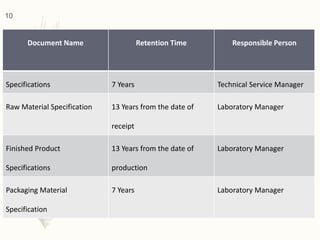
Document Name Retention Time Responsible Person
Specifications 7 Years Technical Service Manager
Raw Material Specification 13 Years from the date of
receipt
Laboratory Manager
Finished Product
Specifications
13 Years from the date of
production
Laboratory Manager
Packaging Material
Specification
7 Years Laboratory Manager
10
11
CERTIFICATE OF
ANALYSIS
(COA)
Certificate of Analysis
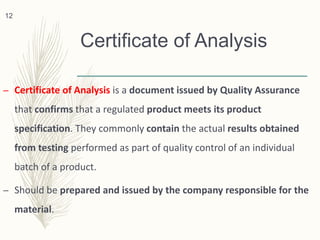
– Certificate of Analysis is a document issued by Quality Assurance
that confirms that a regulated product meets its product
specification. They commonly contain the actual results obtained
from testing performed as part of quality control of an individual
batch of a product.
– Should be prepared and issued by the company responsible for the
material.
12
Certificate of Analysis:
Purpose and Scope
– Purpose is to report analytical results for a specific batch of-
 Raw materials
 Component
 API
 Finished product
 Other similar item.
13
Certificate of Analysis:
Contents
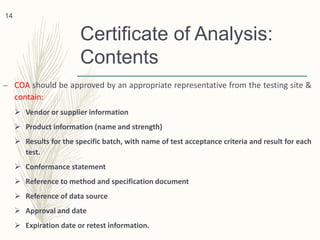
– COA should be approved by an appropriate representative from the testing site &
contain:
 Vendor or supplier information
 Product information (name and strength)
 Results for the specific batch, with name of test acceptance criteria and result for each
test.
 Conformance statement
 Reference to method and specification document
 Reference of data source
 Approval and date
 Expiration date or retest information.
14
Certificate of Analysis:
Contents
– Information needed for COA :
 Name and unique batch number
 Manufacturer
 Manufacturing date
 Retest date
 Expiry date
 Transport instruction
 Storage condition
 Content of reference substance
 Note on calculation of the contents
 Special remark on handling requirement if any
 All the required tests with their specifications and results.
15
Certificate of Analysis:
eCOA
– Certificates of Analysis issued from computer systems without a handwritten
signature are common and are acceptable provided the appropriate controls are
in-place. The following considerations should be met:
 Access to the computer system, entering and editing of data should be limited to
authorized personnel. Authentication by username and password. Confirmation of the
integrity and accuracy should be completed during implementation and then
periodically checked thereafter.
 Data entered into a computer system from which information is extracted for a COA and
changes made thereafter should be accompanied by time- and date-stamped audit
trails.
– With these criteria met, the issuance of electronically generated COAs is
acceptable provided the COA includes contact information.
16
Certificate of Analysis:
Some Examples
17
18
REFERENCES
19
1. THE DRUGS AND COSMETICS ACT, 1940 (As amended up to the 30th June, 2005)
and THE DRUGS AND COSMETICS RULES, 1945 (As amended up to the 30th June,
2005), SCHEDULE M, 17. Specification, 22.5 Records of Analysis.
2. Dan Creinin, Certificates of Analysis Confirm Control, February 1, 2005
3. www.pharmout.net
White Paper, How to Implement Good Documentation Practices, Version 01, 2013.
4. www.drugregulations.org/ documentation in pharmaceutical industry.
5. http://www.sigmaaldrich.com/united-kingdom/technical-services/c-of-
a.html#sthash.vFEeMLDB.dpuf
6. www.csv-qa.com/ computer system validation/audit trials
20

DOCUMENTATION -- CoA & SPECIFICATIONS

  • 1.
    DOCUMENTATION: SPECIFICATIONS & CERTIFICATE OF ANALYSIS(COA) HARSHAVARDHAN V KONDHARE SEM II DEPT. OF DRUG REGULATORY AFFAIRS GUIDED BY : Mrs PREETI K TAMANE POONA COLLEGE OF PHARMACY 15-2-2015 SEM II DRA III UNIT III DOCUMENTATION
  • 2.
  • 3.
  • 4.
    Specifications A document describingin detail the requirements with which the product obtained during manufacture have to conform. – A document specification contains several parts:  A description of the audience(s) for the document;  A detailed outline giving the structure and contents of the document;  A work plan showing who is responsible for each part of the document;  What the deadlines are for completing each task. 4
  • 5.
    Specifications: Purpose – Threepurposes for document specifications: – In the workplace, formal document specifications serve three important functions:  Economy of effort,  Work planning,  Writing organization. 5
  • 6.
    Specifications: Scope They shouldbe included for- – raw materials and packaging materials – product containers and closures. – in-process and bulk products – finished products – preparation of containers and closures – For raw materials and packaging materials – should include a) Designated name and internal code reference; b) Reference, if any, to a pharmacopoeial monograph; c) Qualitative and quantitative requirements with acceptance limits; 6
  • 7.
    Specifications: Scope d) Nameand address of manufacturer or supplier and original manufacturer of the material; e) Specimen of printed material; f) Directions for sampling and testing or reference to procedures; g) Storage conditions; h) Maximum period of storage before re-testing. – For product containers and closures a) Comply with the pharmacopoeial requirements. b) Validated specifications and procedures should be strictly followed to avoid any effect on quality of product. 7
  • 8.
    Specifications: Scope c) Writtenschedule of cleaning shall be laid down and followed for bottles. – For in-process and bulk products a) Authenticated specification must be present. – For finished products – should include a) Designated name of the product and the code reference; b) Formula or a reference to the formula and the pharmacopoeial reference; c) Directions for sampling and testing or a reference to procedures; d) Dosage form and package details; e) Qualitative and quantitative requirements, with the acceptance limits for release; 8
  • 9.
    Specifications: Scope f) Storageconditions and precautions, g) Shelf-life. – For preparation of containers and closures a) Schedule ×include requirements of machinery, equipment and premises required for preparation of containers and closures. b) Specifications can be as per the requirement of the manufacturer. 9
  • 10.
    Document Name RetentionTime Responsible Person Specifications 7 Years Technical Service Manager Raw Material Specification 13 Years from the date of receipt Laboratory Manager Finished Product Specifications 13 Years from the date of production Laboratory Manager Packaging Material Specification 7 Years Laboratory Manager 10
  • 11.
  • 12.
    Certificate of Analysis –Certificate of Analysis is a document issued by Quality Assurance that confirms that a regulated product meets its product specification. They commonly contain the actual results obtained from testing performed as part of quality control of an individual batch of a product. – Should be prepared and issued by the company responsible for the material. 12
  • 13.
    Certificate of Analysis: Purposeand Scope – Purpose is to report analytical results for a specific batch of-  Raw materials  Component  API  Finished product  Other similar item. 13
  • 14.
    Certificate of Analysis: Contents –COA should be approved by an appropriate representative from the testing site & contain:  Vendor or supplier information  Product information (name and strength)  Results for the specific batch, with name of test acceptance criteria and result for each test.  Conformance statement  Reference to method and specification document  Reference of data source  Approval and date  Expiration date or retest information. 14
  • 15.
    Certificate of Analysis: Contents –Information needed for COA :  Name and unique batch number  Manufacturer  Manufacturing date  Retest date  Expiry date  Transport instruction  Storage condition  Content of reference substance  Note on calculation of the contents  Special remark on handling requirement if any  All the required tests with their specifications and results. 15
  • 16.
    Certificate of Analysis: eCOA –Certificates of Analysis issued from computer systems without a handwritten signature are common and are acceptable provided the appropriate controls are in-place. The following considerations should be met:  Access to the computer system, entering and editing of data should be limited to authorized personnel. Authentication by username and password. Confirmation of the integrity and accuracy should be completed during implementation and then periodically checked thereafter.  Data entered into a computer system from which information is extracted for a COA and changes made thereafter should be accompanied by time- and date-stamped audit trails. – With these criteria met, the issuance of electronically generated COAs is acceptable provided the COA includes contact information. 16
  • 17.
  • 18.
  • 19.
    19 1. THE DRUGSAND COSMETICS ACT, 1940 (As amended up to the 30th June, 2005) and THE DRUGS AND COSMETICS RULES, 1945 (As amended up to the 30th June, 2005), SCHEDULE M, 17. Specification, 22.5 Records of Analysis. 2. Dan Creinin, Certificates of Analysis Confirm Control, February 1, 2005 3. www.pharmout.net White Paper, How to Implement Good Documentation Practices, Version 01, 2013. 4. www.drugregulations.org/ documentation in pharmaceutical industry. 5. http://www.sigmaaldrich.com/united-kingdom/technical-services/c-of- a.html#sthash.vFEeMLDB.dpuf 6. www.csv-qa.com/ computer system validation/audit trials
  • 20.

Editor's Notes

  • #4 Types of documents Commitment documents – relationship between industry and the regulatory authorities. E.g NDA, DMFs etc. Directive documents – relationship between the management and employees. E.g specifications, SOPs, etc. Record documents – relationship between the employees and the work they perform. E.g protocols, BPRs, log books, calibration records.
  • #5 Meaning of specification – a detailed description of the design and materials used to make something. - a set of documented requirements to be satisfied by a material, design, product, or service.
  • #13 RECORDS OF ANALYSIS IN SCH. M POINT 22.5
  • #17 Purpose for an audit trial for Electronic Record systems is to provide assurance of the integrity of the Electronic Record and the associated Raw Data.