QUALIFICATION OF HVAC SYSTEM
Presented by :
MAYUR UNDE
Master of Pharmacy
Quality Assurance Techniques
GMP MANUFACTURING ENVIRONMENTS
Air Handling Systems
HVAC Systems
Heating
Ventilation
Air Conditioning
Qualification & Maintenance
I
N
D
E
X
1. DEFINITION
2. QUALIFICATION OF HVAC SYSTEM
3. MAINTENANCE OF HVAC SYSTEM
4. INSPECTION OF HVAC SYSTEM
5. CLEANROOM MONITORING PROGRAM
6. HVAC AND QUALITY RISK MANAGEMENT
7. CONCLUSION
8. REFERENCES
The documented act of proving that any
procedure, process, equipment, material, activity
or system, actually leads to the expected results.
Validation :
DEFINITION
Qualification :
The action of proving that any equipment
works correctly and actually leads to the
expected results.
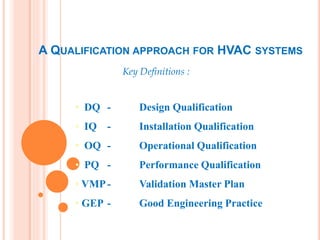
A QUALIFICATION APPROACH FOR HVAC SYSTEMS
Key Definitions :
• DQ - Design Qualification
• IQ - Installation Qualification
• OQ - Operational Qualification
• PQ - Performance Qualification
• VMP- Validation Master Plan
• GEP - Good Engineering Practice
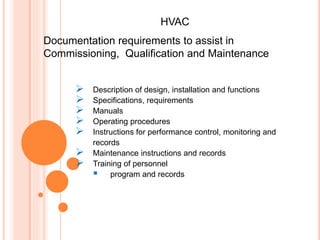
 Description of design, installation and functions
 Specifications, requirements
 Manuals
 Operating procedures
 Instructions for performance control, monitoring and
records
 Maintenance instructions and records
 Training of personnel
 program and records
Documentation requirements to assist in
Commissioning, Qualification and Maintenance
HVAC
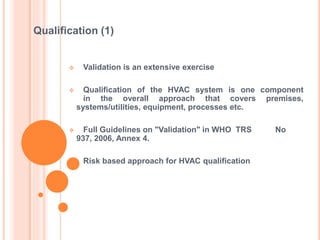
Qualification (1)
 Validation is an extensive exercise
 Qualification of the HVAC system is one component
in the overall approach that covers premises,
systems/utilities, equipment, processes etc.
 Full Guidelines on "Validation" in WHO TRS No
937, 2006, Annex 4.
 Risk based approach for HVAC qualification
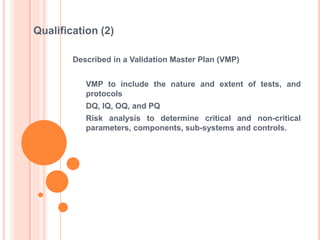
Described in a Validation Master Plan (VMP)
VMP to include the nature and extent of tests, and
protocols
DQ, IQ, OQ, and PQ
Risk analysis to determine critical and non-critical
parameters, components, sub-systems and controls.
Qualification (2)
Direct impact components and critical parameters
should be included :
Non-critical systems and components are subjected
to Good Engineering Practices (GEP)
Acceptance criteria and limits defined in design stage
Design conditions, normal operating ranges,
operating ranges, alert and action limits.
Qualification (3)
Typical parameters to be included in qualification (based
on risk assessment):
o Temperature
o Relative humidity
o Supply, return and exhaust air quantities
o Room air change rates
o Room pressures (pressure differentials)
Qualification (4)
Typical parameters to be included in qualification (based on
risk assessment) (2):
 Room clean up rate
 Particulate matter
 Microbial matter (viable and non-viable)
 HEPA filter penetration tests
 Containment system velocity
 Warning/alarm systems
Qualification (5)
Conduct of the tests:
 Time intervals and procedure to be defined by the
manufacturer.
 Influenced by the type of facility and level of protection .
 ISO 14644 for methods of testing.
 Re-qualification, and change control.
Qualification (6)
 Tests performed according to protocols and
procedures for the tests
 Results recorded and presented in report (source
data kept)
 Traceability e.g. devices and standards used,
calibration records; and conditions specified
Qualification (7)
Qualification – examples of aspects to consider
DQ – Design of the system, URS
(e.g. components, type of air treatment needed, materials
of construction)
IQ – Verify installation
E.g. relevant components, ducting, filters, controls,
monitors, sensors etc
Includes calibration where relevant
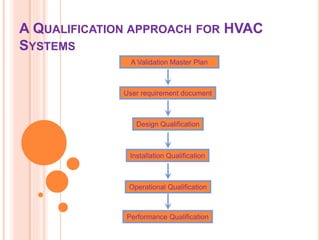
A QUALIFICATION APPROACH FOR HVAC
SYSTEMS
A Validation Master Plan
Design Qualification
User requirement document
Installation Qualification
Operational Qualification
Performance Qualification
A QUALIFICATION APPROACH FOR HVAC SYSTEMS
 Validation policy
 Organizational structure of validation activities
 Summary of facilities, systems, equipment and processes
to be validated
 Documentation format to be used for protocols and
reports
 Planning and scheduling
 Change control
 References to existing documents
The Validation Master Plan
This document should contain :
17
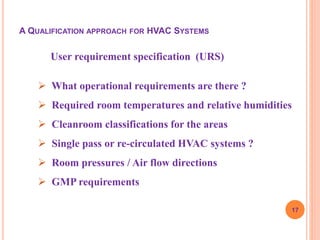
User requirement specification (URS)
 What operational requirements are there ?
 Required room temperatures and relative humidities
 Cleanroom classifications for the areas
 Single pass or re-circulated HVAC systems ?
 Room pressures / Air flow directions
 GMP requirements
A QUALIFICATION APPROACH FOR HVAC SYSTEMS
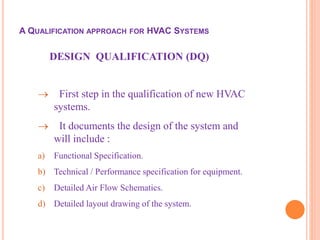
DESIGN QUALIFICATION (DQ)
 First step in the qualification of new HVAC
systems.
 It documents the design of the system and
will include :
a) Functional Specification.
b) Technical / Performance specification for equipment.
c) Detailed Air Flow Schematics.
d) Detailed layout drawing of the system.
A QUALIFICATION APPROACH FOR HVAC SYSTEMS
A QUALIFICATION APPROACH FOR HVAC
SYSTEMS
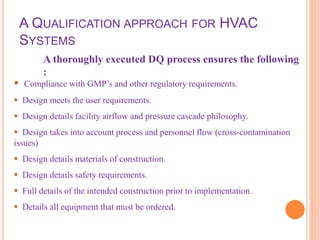
A thoroughly executed DQ process ensures the following
:
 Compliance with GMP’s and other regulatory requirements.
 Design meets the user requirements.
 Design details facility airflow and pressure cascade philosophy.
 Design takes into account process and personnel flow (cross-contamination
issues)
 Design details materials of construction.
 Design details safety requirements.
 Full details of the intended construction prior to implementation.
 Details all equipment that must be ordered.
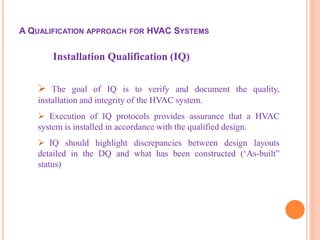
Installation Qualification (IQ)
 The goal of IQ is to verify and document the quality,
installation and integrity of the HVAC system.
 Execution of IQ protocols provides assurance that a HVAC
system is installed in accordance with the qualified design.
 IQ should highlight discrepancies between design layouts
detailed in the DQ and what has been constructed (‘As-built”
status)
A QUALIFICATION APPROACH FOR HVAC SYSTEMS
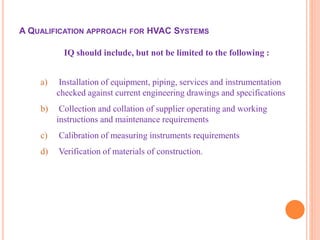
IQ should include, but not be limited to the following :
a) Installation of equipment, piping, services and instrumentation
checked against current engineering drawings and specifications
b) Collection and collation of supplier operating and working
instructions and maintenance requirements
c) Calibration of measuring instruments requirements
d) Verification of materials of construction.
A QUALIFICATION APPROACH FOR HVAC SYSTEMS
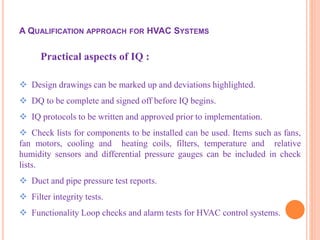
Practical aspects of IQ :
 Design drawings can be marked up and deviations highlighted.
 DQ to be complete and signed off before IQ begins.
 IQ protocols to be written and approved prior to implementation.
 Check lists for components to be installed can be used. Items such as fans,
fan motors, cooling and heating coils, filters, temperature and relative
humidity sensors and differential pressure gauges can be included in check
lists.
 Duct and pipe pressure test reports.
 Filter integrity tests.
 Functionality Loop checks and alarm tests for HVAC control systems.
A QUALIFICATION APPROACH FOR HVAC SYSTEMS
23
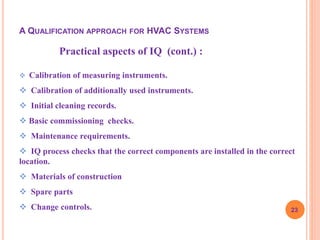
Practical aspects of IQ (cont.) :
 Calibration of measuring instruments.
 Calibration of additionally used instruments.
 Initial cleaning records.
 Basic commissioning checks.
 Maintenance requirements.
 IQ process checks that the correct components are installed in the correct
location.
 Materials of construction
 Spare parts
 Change controls.
A QUALIFICATION APPROACH FOR HVAC SYSTEMS
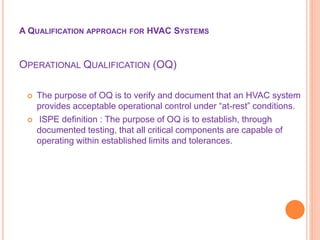
OPERATIONAL QUALIFICATION (OQ)
 The purpose of OQ is to verify and document that an HVAC system
provides acceptable operational control under “at-rest” conditions.
 ISPE definition : The purpose of OQ is to establish, through
documented testing, that all critical components are capable of
operating within established limits and tolerances.
A QUALIFICATION APPROACH FOR HVAC SYSTEMS
OPERATIONAL CONTROL / OPERATION WITHIN ESTABLISHED
LIMITS AND TOLERANCES CAN BE DEMONSTRATED BY ANY OF THE
FOLLOWING :
 Ability to maintain temperature, relative humidity and pressure set
points.
 Ability to provide air of sufficient quality and quantity to ensure
achievement of specified clean room conditions.
 Ability to maintain any critical parameters stated in the DQ
consistently.
PRACTICAL ASPECTS OF OQ :
 IQ reports must be completed and signed off.
 OQ protocols to be written and approved prior to completion.
 Measurement reports are required to demonstrate achievement
of critical parameters as detailed in DQ.
Eg: * Temperature measurement report
* Humidity measurement report
* Differential pressure measurement report
* Air flow direction measurement report
* Room particle count measurement report
* All drawings etc. – done in ‘as-built’ status
* All maintenance/ cleaning instructions available
* All staff to be trained to use and maintain the HVAC system.
A QUALIFICATION APPROACH FOR HVAC SYSTEMS
 The purpose of PQ is to verify and document that an HVAC
system provides acceptable operational control under ‘ full
operational ‘ conditions.
 PQ verifies that over time, the critical parameters , as defined
in the DQ are being achieved.
 PQ should follow successful completion of IQ and OQ.
PERFORMANCE QUALIFICATION ( PQ)
A QUALIFICATION APPROACH FOR HVAC SYSTEMS
 Tests, using production materials, qualified substitutes or simulated
product, that have been developed from knowledge of the process and
facilities, systems or equipment.
 Test to include a condition or set of conditions encompassing upper and
lower operating limits.
PQ should include , but not be limited to the following:-
A QUALIFICATION APPROACH FOR HVAC SYSTEMS
 PQ is used to demonstrate consistent achievement of critical
parameters over time. ( under manufacturing conditions)
 PQ is ongoing.
 PQ and OQ tests are sometimes performed in conjunction
with one another.
Practical aspects of PQ:
A QUALIFICATION APPROACH FOR HVAC SYSTEMS
 PQ tests can consist of the following :-
 Air flow direction tests
 Room pressure tests
 Room temperature monitoring
 Room relative humidity monitoring
 Room particle monitoring
 Microbiological monitoring
Practical aspects of PQ (cont.) :
A QUALIFICATION APPROACH FOR HVAC SYSTEMS
 Procedure, program and records for planned,
preventative maintenance
E.g. Cleaning of filters, calibration of devices
 Appropriate training for personnel
 Change of HEPA filters by suitably trained persons
 Impact of maintenance on:
Product quality
Qualification
MAINTENANCE OF HVAC SYSTEMS
32
 The validation process should ensure that all maintenance
information is obtained prior to the handover and use of the
system.
 The validation process should ensure that preventative and
planned maintenance are put into practice.
MAINTENANCE OF HVAC SYSTEMS
33
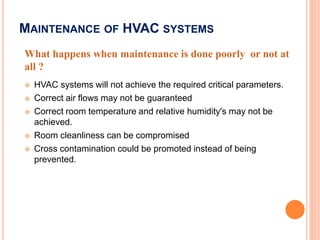
 HVAC systems will not achieve the required critical parameters.
 Correct air flows may not be guaranteed
 Correct room temperature and relative humidity's may not be
achieved.
 Room cleanliness can be compromised
 Cross contamination could be promoted instead of being
prevented.
What happens when maintenance is done poorly or not at
all ?
MAINTENANCE OF HVAC SYSTEMS
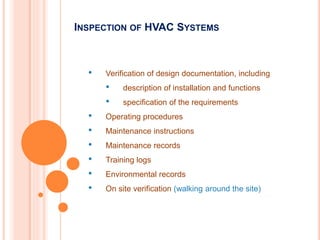
• Verification of design documentation, including
• description of installation and functions
• specification of the requirements
• Operating procedures
• Maintenance instructions
• Maintenance records
• Training logs
• Environmental records
• On site verification (walking around the site)
INSPECTION OF HVAC SYSTEMS
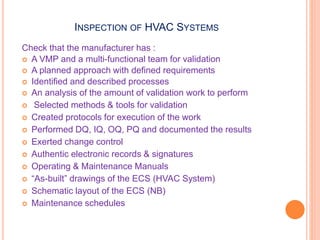
Check that the manufacturer has :
 A VMP and a multi-functional team for validation
 A planned approach with defined requirements
 Identified and described processes
 An analysis of the amount of validation work to perform
 Selected methods & tools for validation
 Created protocols for execution of the work
 Performed DQ, IQ, OQ, PQ and documented the results
 Exerted change control
 Authentic electronic records & signatures
 Operating & Maintenance Manuals
 “As-built” drawings of the ECS (HVAC System)
 Schematic layout of the ECS (NB)
 Maintenance schedules
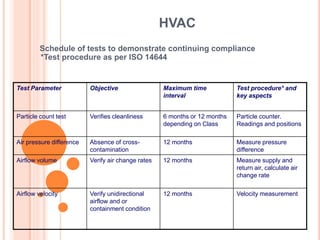
HVAC
Schedule of tests to demonstrate continuing compliance
*Test procedure as per ISO 14644
Test procedure* and
key aspects
Maximum time
interval
ObjectiveTest Parameter
Particle counter.
Readings and positions
6 months or 12 months
depending on Class
Verifies cleanlinessParticle count test
Measure pressure
difference
12 monthsAbsence of cross-
contamination
Air pressure difference
Measure supply and
return air, calculate air
change rate
12 monthsVerify air change ratesAirflow volume
Velocity measurement12 monthsVerify unidirectional
airflow and or
containment condition
Airflow velocity
HVAC
Recommended optional strategic tests
*Test procedure as per ISO 14644
Test procedure*
and key aspects
Maximum time
interval
ObjectiveTest Parameter
Filter media and
filter seal integrity
12 monthsVerify filter integrityFilter leakage
Airflow direction and
pressure differential
12 monthsVerify absence of
cross-contamination
Containment
leakage
Time taken
maximum 15
minutes
12 monthsVerify clean-up timeRecovery (time)
Airflow direction,
documented
evidence
12 monthsVerify required
airflow patterns
Airflow visualization
CLEANROOM MONITORING PROGRAM
Routine monitoring program as part of quality assurance
Additional monitoring and triggers e.g.
 Shutdown
 Replacement of filter elements
 Maintenance of air handling systems
 Exceeding of established limits
PARTICLES AND MICROBIOLOGICAL CONTAMINANTS
 Number of points/locations for monitoring determined, specified,
documented in procedure and or protocol
 Sufficient time for exposure, and suitable sample size
 Identification and marking of sampling points
 Definition of transport, storage, and incubation conditions
 Results to reflect the procedure/protocol followed
 Define alert and action limits as a function of cleanliness
zone/class
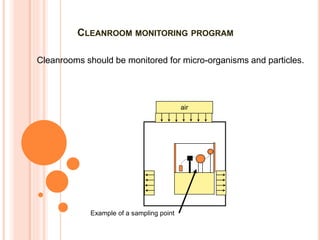
CLEANROOM MONITORING PROGRAM
air
Cleanrooms should be monitored for micro-organisms and particles.
Example of a sampling point
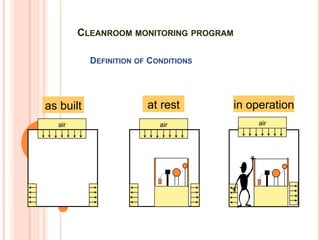
CLEANROOM MONITORING PROGRAM
DEFINITION OF CONDITIONS
air
as built
air air
at rest in operation
CLEANROOM MONITORING PROGRAM
HVAC & QUALITY RISK MANAGEMENT
What about risk assessment/risk management in HAVC
systems?
Recommended risk assessment prior to qualification
Design requirements
Qualification (GMP) vs GEP
Ongoing performance
Ongoing maintenance
Type of products and materials
Product range
Campaign
Cleaning
Design, age, changes
Monitoring results
Air handling systems:
 Play a major role in the quality of pharmaceuticals
 Should be designed properly, by professionals
 Should be treated as a critical system
Conclusion
VALIDATION, QUALIFICATION AND MAINTENANCE
 Qualification is a quality tool
 A planned risk assessment based activity consisting
of DQ, IQ, OQ and PQ.
 Expensive and time consuming
 Requires the manufacturer to assess which
systems are critical and which are less critical.
 Used to demonstrate that the systems are under
control.
Summary
REFERENCES
.
Quality Assurance of Pharmaceuticals. A compendium of guidelines and related
materials, Volume 2, Updated edition. Good manufacturing practices and inspection.
Geneva, World Health Organization, 2004.
Quality Assurance of Pharmaceuticals. A compendium of guidelines and related
materials, Volume 1. Geneva, World Health Organization, 1997.
ASHRAE Handbook 1999, HVAC Applications, SI Edition. ASHRAE Handbook 2000.
HVAC Systems and Equipment.
ISPE Baseline Pharmaceutical Engineering Guides for New and Renovated Facilities,
Volume 5. Commissioning and Qualification, First Edition, March 2001.
Luwa “Introduction to High Efficiency Filtration”, Bulletin 50.10.10, Sheet 020.
International Cleanroom Standards, ISO 14644, Parts 1 to 6.
Heating Ventilation and Air Conditioner HVAC Qualification

Heating Ventilation and Air Conditioner HVAC Qualification

  • 1.
    QUALIFICATION OF HVACSYSTEM Presented by : MAYUR UNDE Master of Pharmacy Quality Assurance Techniques
  • 2.
    GMP MANUFACTURING ENVIRONMENTS AirHandling Systems HVAC Systems Heating Ventilation Air Conditioning Qualification & Maintenance
  • 3.
    I N D E X 1. DEFINITION 2. QUALIFICATIONOF HVAC SYSTEM 3. MAINTENANCE OF HVAC SYSTEM 4. INSPECTION OF HVAC SYSTEM 5. CLEANROOM MONITORING PROGRAM 6. HVAC AND QUALITY RISK MANAGEMENT 7. CONCLUSION 8. REFERENCES
  • 4.
    The documented actof proving that any procedure, process, equipment, material, activity or system, actually leads to the expected results. Validation : DEFINITION Qualification : The action of proving that any equipment works correctly and actually leads to the expected results.
  • 5.
    A QUALIFICATION APPROACHFOR HVAC SYSTEMS Key Definitions : • DQ - Design Qualification • IQ - Installation Qualification • OQ - Operational Qualification • PQ - Performance Qualification • VMP- Validation Master Plan • GEP - Good Engineering Practice
  • 6.
     Description ofdesign, installation and functions  Specifications, requirements  Manuals  Operating procedures  Instructions for performance control, monitoring and records  Maintenance instructions and records  Training of personnel  program and records Documentation requirements to assist in Commissioning, Qualification and Maintenance HVAC
  • 7.
    Qualification (1)  Validationis an extensive exercise  Qualification of the HVAC system is one component in the overall approach that covers premises, systems/utilities, equipment, processes etc.  Full Guidelines on "Validation" in WHO TRS No 937, 2006, Annex 4.  Risk based approach for HVAC qualification
  • 8.
    Described in aValidation Master Plan (VMP) VMP to include the nature and extent of tests, and protocols DQ, IQ, OQ, and PQ Risk analysis to determine critical and non-critical parameters, components, sub-systems and controls. Qualification (2)
  • 9.
    Direct impact componentsand critical parameters should be included : Non-critical systems and components are subjected to Good Engineering Practices (GEP) Acceptance criteria and limits defined in design stage Design conditions, normal operating ranges, operating ranges, alert and action limits. Qualification (3)
  • 10.
    Typical parameters tobe included in qualification (based on risk assessment): o Temperature o Relative humidity o Supply, return and exhaust air quantities o Room air change rates o Room pressures (pressure differentials) Qualification (4)
  • 11.
    Typical parameters tobe included in qualification (based on risk assessment) (2):  Room clean up rate  Particulate matter  Microbial matter (viable and non-viable)  HEPA filter penetration tests  Containment system velocity  Warning/alarm systems Qualification (5)
  • 12.
    Conduct of thetests:  Time intervals and procedure to be defined by the manufacturer.  Influenced by the type of facility and level of protection .  ISO 14644 for methods of testing.  Re-qualification, and change control. Qualification (6)
  • 13.
     Tests performedaccording to protocols and procedures for the tests  Results recorded and presented in report (source data kept)  Traceability e.g. devices and standards used, calibration records; and conditions specified Qualification (7)
  • 14.
    Qualification – examplesof aspects to consider DQ – Design of the system, URS (e.g. components, type of air treatment needed, materials of construction) IQ – Verify installation E.g. relevant components, ducting, filters, controls, monitors, sensors etc Includes calibration where relevant
  • 15.
    A QUALIFICATION APPROACHFOR HVAC SYSTEMS A Validation Master Plan Design Qualification User requirement document Installation Qualification Operational Qualification Performance Qualification
  • 16.
    A QUALIFICATION APPROACHFOR HVAC SYSTEMS  Validation policy  Organizational structure of validation activities  Summary of facilities, systems, equipment and processes to be validated  Documentation format to be used for protocols and reports  Planning and scheduling  Change control  References to existing documents The Validation Master Plan This document should contain :
  • 17.
    17 User requirement specification(URS)  What operational requirements are there ?  Required room temperatures and relative humidities  Cleanroom classifications for the areas  Single pass or re-circulated HVAC systems ?  Room pressures / Air flow directions  GMP requirements A QUALIFICATION APPROACH FOR HVAC SYSTEMS
  • 18.
    DESIGN QUALIFICATION (DQ) First step in the qualification of new HVAC systems.  It documents the design of the system and will include : a) Functional Specification. b) Technical / Performance specification for equipment. c) Detailed Air Flow Schematics. d) Detailed layout drawing of the system. A QUALIFICATION APPROACH FOR HVAC SYSTEMS
  • 19.
    A QUALIFICATION APPROACHFOR HVAC SYSTEMS A thoroughly executed DQ process ensures the following :  Compliance with GMP’s and other regulatory requirements.  Design meets the user requirements.  Design details facility airflow and pressure cascade philosophy.  Design takes into account process and personnel flow (cross-contamination issues)  Design details materials of construction.  Design details safety requirements.  Full details of the intended construction prior to implementation.  Details all equipment that must be ordered.
  • 20.
    Installation Qualification (IQ) The goal of IQ is to verify and document the quality, installation and integrity of the HVAC system.  Execution of IQ protocols provides assurance that a HVAC system is installed in accordance with the qualified design.  IQ should highlight discrepancies between design layouts detailed in the DQ and what has been constructed (‘As-built” status) A QUALIFICATION APPROACH FOR HVAC SYSTEMS
  • 21.
    IQ should include,but not be limited to the following : a) Installation of equipment, piping, services and instrumentation checked against current engineering drawings and specifications b) Collection and collation of supplier operating and working instructions and maintenance requirements c) Calibration of measuring instruments requirements d) Verification of materials of construction. A QUALIFICATION APPROACH FOR HVAC SYSTEMS
  • 22.
    Practical aspects ofIQ :  Design drawings can be marked up and deviations highlighted.  DQ to be complete and signed off before IQ begins.  IQ protocols to be written and approved prior to implementation.  Check lists for components to be installed can be used. Items such as fans, fan motors, cooling and heating coils, filters, temperature and relative humidity sensors and differential pressure gauges can be included in check lists.  Duct and pipe pressure test reports.  Filter integrity tests.  Functionality Loop checks and alarm tests for HVAC control systems. A QUALIFICATION APPROACH FOR HVAC SYSTEMS
  • 23.
    23 Practical aspects ofIQ (cont.) :  Calibration of measuring instruments.  Calibration of additionally used instruments.  Initial cleaning records.  Basic commissioning checks.  Maintenance requirements.  IQ process checks that the correct components are installed in the correct location.  Materials of construction  Spare parts  Change controls. A QUALIFICATION APPROACH FOR HVAC SYSTEMS
  • 24.
    OPERATIONAL QUALIFICATION (OQ) The purpose of OQ is to verify and document that an HVAC system provides acceptable operational control under “at-rest” conditions.  ISPE definition : The purpose of OQ is to establish, through documented testing, that all critical components are capable of operating within established limits and tolerances. A QUALIFICATION APPROACH FOR HVAC SYSTEMS
  • 25.
    OPERATIONAL CONTROL /OPERATION WITHIN ESTABLISHED LIMITS AND TOLERANCES CAN BE DEMONSTRATED BY ANY OF THE FOLLOWING :  Ability to maintain temperature, relative humidity and pressure set points.  Ability to provide air of sufficient quality and quantity to ensure achievement of specified clean room conditions.  Ability to maintain any critical parameters stated in the DQ consistently.
  • 26.
    PRACTICAL ASPECTS OFOQ :  IQ reports must be completed and signed off.  OQ protocols to be written and approved prior to completion.  Measurement reports are required to demonstrate achievement of critical parameters as detailed in DQ. Eg: * Temperature measurement report * Humidity measurement report * Differential pressure measurement report * Air flow direction measurement report * Room particle count measurement report * All drawings etc. – done in ‘as-built’ status * All maintenance/ cleaning instructions available * All staff to be trained to use and maintain the HVAC system. A QUALIFICATION APPROACH FOR HVAC SYSTEMS
  • 27.
     The purposeof PQ is to verify and document that an HVAC system provides acceptable operational control under ‘ full operational ‘ conditions.  PQ verifies that over time, the critical parameters , as defined in the DQ are being achieved.  PQ should follow successful completion of IQ and OQ. PERFORMANCE QUALIFICATION ( PQ) A QUALIFICATION APPROACH FOR HVAC SYSTEMS
  • 28.
     Tests, usingproduction materials, qualified substitutes or simulated product, that have been developed from knowledge of the process and facilities, systems or equipment.  Test to include a condition or set of conditions encompassing upper and lower operating limits. PQ should include , but not be limited to the following:- A QUALIFICATION APPROACH FOR HVAC SYSTEMS
  • 29.
     PQ isused to demonstrate consistent achievement of critical parameters over time. ( under manufacturing conditions)  PQ is ongoing.  PQ and OQ tests are sometimes performed in conjunction with one another. Practical aspects of PQ: A QUALIFICATION APPROACH FOR HVAC SYSTEMS
  • 30.
     PQ testscan consist of the following :-  Air flow direction tests  Room pressure tests  Room temperature monitoring  Room relative humidity monitoring  Room particle monitoring  Microbiological monitoring Practical aspects of PQ (cont.) : A QUALIFICATION APPROACH FOR HVAC SYSTEMS
  • 31.
     Procedure, programand records for planned, preventative maintenance E.g. Cleaning of filters, calibration of devices  Appropriate training for personnel  Change of HEPA filters by suitably trained persons  Impact of maintenance on: Product quality Qualification MAINTENANCE OF HVAC SYSTEMS
  • 32.
    32  The validationprocess should ensure that all maintenance information is obtained prior to the handover and use of the system.  The validation process should ensure that preventative and planned maintenance are put into practice. MAINTENANCE OF HVAC SYSTEMS
  • 33.
    33  HVAC systemswill not achieve the required critical parameters.  Correct air flows may not be guaranteed  Correct room temperature and relative humidity's may not be achieved.  Room cleanliness can be compromised  Cross contamination could be promoted instead of being prevented. What happens when maintenance is done poorly or not at all ? MAINTENANCE OF HVAC SYSTEMS
  • 34.
    • Verification ofdesign documentation, including • description of installation and functions • specification of the requirements • Operating procedures • Maintenance instructions • Maintenance records • Training logs • Environmental records • On site verification (walking around the site) INSPECTION OF HVAC SYSTEMS
  • 35.
    INSPECTION OF HVACSYSTEMS Check that the manufacturer has :  A VMP and a multi-functional team for validation  A planned approach with defined requirements  Identified and described processes  An analysis of the amount of validation work to perform  Selected methods & tools for validation  Created protocols for execution of the work  Performed DQ, IQ, OQ, PQ and documented the results  Exerted change control  Authentic electronic records & signatures  Operating & Maintenance Manuals  “As-built” drawings of the ECS (HVAC System)  Schematic layout of the ECS (NB)  Maintenance schedules
  • 36.
    HVAC Schedule of teststo demonstrate continuing compliance *Test procedure as per ISO 14644 Test procedure* and key aspects Maximum time interval ObjectiveTest Parameter Particle counter. Readings and positions 6 months or 12 months depending on Class Verifies cleanlinessParticle count test Measure pressure difference 12 monthsAbsence of cross- contamination Air pressure difference Measure supply and return air, calculate air change rate 12 monthsVerify air change ratesAirflow volume Velocity measurement12 monthsVerify unidirectional airflow and or containment condition Airflow velocity
  • 37.
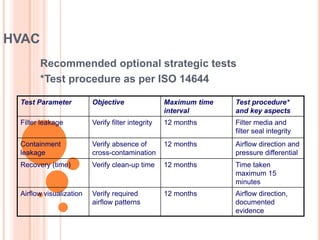
    HVAC Recommended optional strategictests *Test procedure as per ISO 14644 Test procedure* and key aspects Maximum time interval ObjectiveTest Parameter Filter media and filter seal integrity 12 monthsVerify filter integrityFilter leakage Airflow direction and pressure differential 12 monthsVerify absence of cross-contamination Containment leakage Time taken maximum 15 minutes 12 monthsVerify clean-up timeRecovery (time) Airflow direction, documented evidence 12 monthsVerify required airflow patterns Airflow visualization
  • 38.
    CLEANROOM MONITORING PROGRAM Routinemonitoring program as part of quality assurance Additional monitoring and triggers e.g.  Shutdown  Replacement of filter elements  Maintenance of air handling systems  Exceeding of established limits
  • 39.
    PARTICLES AND MICROBIOLOGICALCONTAMINANTS  Number of points/locations for monitoring determined, specified, documented in procedure and or protocol  Sufficient time for exposure, and suitable sample size  Identification and marking of sampling points  Definition of transport, storage, and incubation conditions  Results to reflect the procedure/protocol followed  Define alert and action limits as a function of cleanliness zone/class CLEANROOM MONITORING PROGRAM
  • 40.
    air Cleanrooms should bemonitored for micro-organisms and particles. Example of a sampling point CLEANROOM MONITORING PROGRAM
  • 41.
    DEFINITION OF CONDITIONS air asbuilt air air at rest in operation CLEANROOM MONITORING PROGRAM
  • 42.
    HVAC & QUALITYRISK MANAGEMENT What about risk assessment/risk management in HAVC systems? Recommended risk assessment prior to qualification Design requirements Qualification (GMP) vs GEP Ongoing performance Ongoing maintenance Type of products and materials Product range Campaign Cleaning Design, age, changes Monitoring results
  • 43.
    Air handling systems: Play a major role in the quality of pharmaceuticals  Should be designed properly, by professionals  Should be treated as a critical system Conclusion
  • 44.
    VALIDATION, QUALIFICATION ANDMAINTENANCE  Qualification is a quality tool  A planned risk assessment based activity consisting of DQ, IQ, OQ and PQ.  Expensive and time consuming  Requires the manufacturer to assess which systems are critical and which are less critical.  Used to demonstrate that the systems are under control. Summary
  • 45.
    REFERENCES . Quality Assurance ofPharmaceuticals. A compendium of guidelines and related materials, Volume 2, Updated edition. Good manufacturing practices and inspection. Geneva, World Health Organization, 2004. Quality Assurance of Pharmaceuticals. A compendium of guidelines and related materials, Volume 1. Geneva, World Health Organization, 1997. ASHRAE Handbook 1999, HVAC Applications, SI Edition. ASHRAE Handbook 2000. HVAC Systems and Equipment. ISPE Baseline Pharmaceutical Engineering Guides for New and Renovated Facilities, Volume 5. Commissioning and Qualification, First Edition, March 2001. Luwa “Introduction to High Efficiency Filtration”, Bulletin 50.10.10, Sheet 020. International Cleanroom Standards, ISO 14644, Parts 1 to 6.