KARTHIK REDDY C A
Reg No. NP20AL61
I MSC.MICROBIOLOGY
NRUPATHUNGA UNIVERSITY BANGALORE - 01
KKR1116 1
INTRODUCTION :
Nuclic acids are the inorganic materials Present in all organisms in the foam of
DNA or RNA.
Nuclic acids are formed by the combination of Nitrogenous bases, pentose Sugar
molecules and the Phosphate groups.
DNA is known as Deoxyribonucleic acid.
“ DNA is a group of molecules that is responsible for carrying and transmitting
the hereditary materials from parents to offsprings “.
 DNA is the genetic materials of all organisms which is present in chromosome
bind with histone protein.
DNA and RNA are Nucleic acids are reported by Friedrich Miescher in the
pusscells and also he reported DNA are acidic substance in the Nucleus.
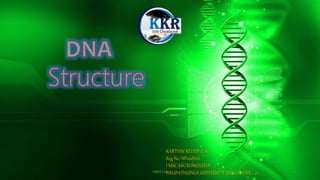
In 1953, James Watson and Francis Crick discovered the structure of DNA. The
structure of Dna is a double helix structure .
DNA is polymer of Nucleotides. KKR1116 2
STRUCTURE OF NUCLEOTIDE
KKR1116 3
 PHOSPHORICACID
 It may occur also phosphate and forms the backbone of DNA molecule
along with sugar molecule.
 It links the Nucleotide by joining the deoxyribose sugar of two adjacent
nucleotide with an ester phosphate bond.
 This bond connect 3 prime carbon in one Nucleotide with 5 prime
carbon in next.
 PENTOSESUGAR
 DNA IS the pentose sugar bearing C5H10O4 chemical formula.
 The structure of pentose sugar is pentagonal ring where 3 prime and
5 prime carbon atom attached to phosphoric acid and in 1st Carbon
atom to the Nitrogenous base.
 NITROGENOUSBASE  Nitrogenous base are attached at C1 of the pentose sugar
by glycosidic bond.
 The bond formation between 9th position of purines and 1st
position of pyrimidine.
 Each Nucleotide bind with OH group of 3rd Carbon sugar
with phosphodiester bond to form Nucleotide chain.
KKR1116 4
STRUCTURE OF DNA
( Watson and Crick’s Model of DNA )
 The DNA structure is described as a double helix like twisted
ladder.
 DNA is a double stranded helix they are antiparallel, one strand
runs in a 5 prime to 3 prime direction, while other strand runs
opposite direction.
 Two strands are called polynucleotides, as they are made of
simpler monomer units called Nucleotides.
 Each strand has a 5 prime end with phosphate group and a 3
prime end with a hydroxyl group.
 The two strands are held together by hydrogen bonds and are
complimentary to each other.
 DNA is composed of deoxyribonucleotides, they are linked
together by 3 prime – 5 prime phosphodiester bond.
 The sugar and phosphate groups link the nucleotides together
to form each strand of DNA.
 Four Nitrogenous bases pair together in the following ways : A
with T by 2 hydrogen bonds and C with G by three hydrogen
bonds.
KKR1116 5
Cont.…
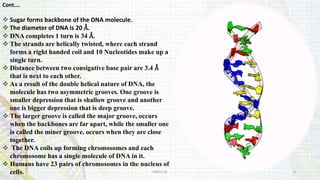
 Sugar forms backbone of the DNA molecule.
 The diameter of DNA is 20 Å.
 DNA completes 1 turn is 34 Å.
 The strands are helically twisted, where each strand
forms a right handed coil and 10 Nucleotides make up a
single turn.
 Distance between two consigative base pair are 3.4 Å
that is next to each other.
 As a result of the double helical nature of DNA, the
molecule has two asymmetric grooves. One groove is
smaller depression that is shallow groove and another
one is bigger depression that is deep groove.
 The larger groove is called the major groove, occurs
when the backbones are far apart, while the smaller one
is called the miner groove, occurs when they are close
together.
 The DNA coils up forming chromosomes and each
chromosome has a single molecule of DNA in it.
 Humans have 23 pairs of chromosomes in the nucleus of
cells. KKR1116 6
o BASEPAIR RULE
 This rule tells us purines pair with pyrimidine.
Purines are A & G, Pyrimidines are C & T.
 Two strands are complimentary to each other.
o CHARGAFF’S RULE
Erwin Chargaff, a biochemist discovered
that the number of Nitrogenous bases
in the DNA was present in equal
quantities. The amount of A is equal to
T, whereas the amount of C is equal to
G.
KKR1116 7
TYPES OF DNA
 Based on the location DNA may be.
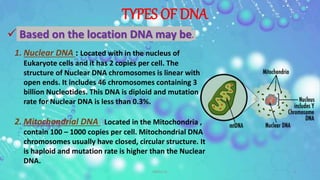
1. Nuclear DNA : Located with in the nucleus of
Eukaryote cells and it has 2 copies per cell. The
structure of Nuclear DNA chromosomes is linear with
open ends. It includes 46 chromosomes containing 3
billion Nucleotides. This DNA is diploid and mutation
rate for Nuclear DNA is less than 0.3%.
2. Mitochondrial DNA : Located in the Mitochondria ,
contain 100 – 1000 copies per cell. Mitochondrial DNA
chromosomes usually have closed, circular structure. It
is haploid and mutation rate is higher than the Nuclear
DNA.
KKR1116 8
 On the basis of Role / Function
1.Tropic DNA : This DNA is responsible for all activities
except Reproduction.
2. Genetic DNA : Responsible for only reproduction.
Example for these two types of DNA can be observed in
paramecium.
KKR1116 9
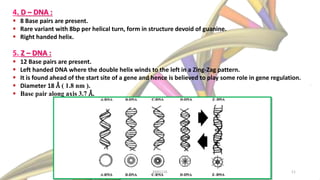
 On the basis of Number of base pairs per turn and coiling.
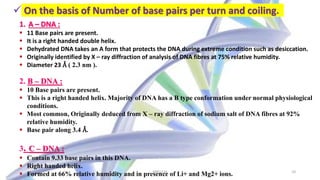
1. A – DNA :
 11 Base pairs are present.
 It is a right handed double helix.
 Dehydrated DNA takes an A form that protects the DNA during extreme condition such as desiccation.
 Originally identified by X – ray diffraction of analysis of DNA fibres at 75% relative humidity.
 Diameter 23 Å ( 2.3 nm ).
2. B – DNA :
 10 Base pairs are present.
 This is a right handed helix. Majority of DNA has a B type conformation under normal physiological
conditions.
 Most common, Originally deduced from X – ray diffraction of sodium salt of DNA fibres at 92%
relative humidity.
 Base pair along 3.4 Å.
3. C – DNA :
 Contain 9.33 base pairs in this DNA.
 Right handed helix.
 Formed at 66% relative humidity and in presence of Li+ and Mg2+ ions.
KKR1116 10
4. D – DNA :
 8 Base pairs are present.
 Rare variant with 8bp per helical turn, form in structure devoid of guanine.
 Right handed helix.
5. Z – DNA :
 12 Base pairs are present.
 Left handed DNA where the double helix winds to the left in a Zing-Zag pattern.
 It is found ahead of the start site of a gene and hence is believed to play some role in gene regulation.
 Diameter 18 Å ( 1.8 nm ).
 Base pair along axis 3.7 Å.
KKR1116 11
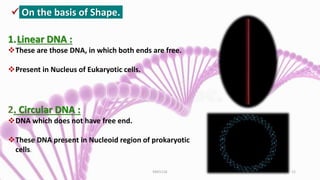
 On the basis of Shape.
1.Linear DNA :
These are those DNA, in which both ends are free.
Present in Nucleus of Eukaryotic cells.
2. Circular DNA :
DNA which does not have free end.
These DNA present in Nucleoid region of prokaryotic
cells.
KKR1116 12
IMPORTANAT THINGS ABOUT DNA
Palindrome : Palindrome are segments of
DNA in which the Nitrogen base sequence is
same on both the strands, when they are read
in the same direction.
Denaturation and Renaturation :
o DNA are heated higher temperature, the bond
between the two strands are break to form
separate strands is called Denaturation.
o If cool this single strands to form hydrogen
bonds between strands to bring back is called
Renaturation. KKR1116 13
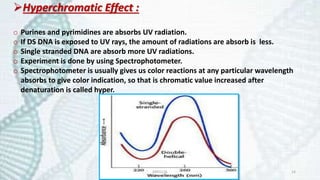
Hyperchromatic Effect :
o Purines and pyrimidines are absorbs UV radiation.
o If DS DNA is exposed to UV rays, the amount of radiations are absorb is less.
o Single stranded DNA are absorb more UV radiations.
o Experiment is done by using Spectrophotometer.
o Spectrophotometer is usually gives us color reactions at any particular wavelength
absorbs to give color indication, so that is chromatic value increased after
denaturation is called hyper.
KKR1116 14
FUNCTIONS OF DNA
DNA is a genetic material which carries all the hereditary information.
Replication process – Transferring the genetic information from one cell to
its daughters and from one generation to the next .
Mutations – The changes which occur in the DNA sequences.
Transcription.
Cellular Metabolism.
DNA Fingerprinting.
Gene therapy.
Storing genetic information.
Directing protein information.
Directly responsible for metabolic activities, Evolution, Heredity and
Differention.
KKR1116 15
REFERENCES
• https://microbenotes.com.
• https://www.genome.gov.
• Cell biology, Genetics, Molecular biology, Evolution and
Ecology – S. CHAND.
• Cell Biology – P S VERMA.
KKR1116 16

DNA structure

  • 1.
    KARTHIK REDDY CA Reg No. NP20AL61 I MSC.MICROBIOLOGY NRUPATHUNGA UNIVERSITY BANGALORE - 01 KKR1116 1
  • 2.
    INTRODUCTION : Nuclic acidsare the inorganic materials Present in all organisms in the foam of DNA or RNA. Nuclic acids are formed by the combination of Nitrogenous bases, pentose Sugar molecules and the Phosphate groups. DNA is known as Deoxyribonucleic acid. “ DNA is a group of molecules that is responsible for carrying and transmitting the hereditary materials from parents to offsprings “.  DNA is the genetic materials of all organisms which is present in chromosome bind with histone protein. DNA and RNA are Nucleic acids are reported by Friedrich Miescher in the pusscells and also he reported DNA are acidic substance in the Nucleus. In 1953, James Watson and Francis Crick discovered the structure of DNA. The structure of Dna is a double helix structure . DNA is polymer of Nucleotides. KKR1116 2
  • 3.
  • 4.
     PHOSPHORICACID  Itmay occur also phosphate and forms the backbone of DNA molecule along with sugar molecule.  It links the Nucleotide by joining the deoxyribose sugar of two adjacent nucleotide with an ester phosphate bond.  This bond connect 3 prime carbon in one Nucleotide with 5 prime carbon in next.  PENTOSESUGAR  DNA IS the pentose sugar bearing C5H10O4 chemical formula.  The structure of pentose sugar is pentagonal ring where 3 prime and 5 prime carbon atom attached to phosphoric acid and in 1st Carbon atom to the Nitrogenous base.  NITROGENOUSBASE  Nitrogenous base are attached at C1 of the pentose sugar by glycosidic bond.  The bond formation between 9th position of purines and 1st position of pyrimidine.  Each Nucleotide bind with OH group of 3rd Carbon sugar with phosphodiester bond to form Nucleotide chain. KKR1116 4
  • 5.
    STRUCTURE OF DNA (Watson and Crick’s Model of DNA )  The DNA structure is described as a double helix like twisted ladder.  DNA is a double stranded helix they are antiparallel, one strand runs in a 5 prime to 3 prime direction, while other strand runs opposite direction.  Two strands are called polynucleotides, as they are made of simpler monomer units called Nucleotides.  Each strand has a 5 prime end with phosphate group and a 3 prime end with a hydroxyl group.  The two strands are held together by hydrogen bonds and are complimentary to each other.  DNA is composed of deoxyribonucleotides, they are linked together by 3 prime – 5 prime phosphodiester bond.  The sugar and phosphate groups link the nucleotides together to form each strand of DNA.  Four Nitrogenous bases pair together in the following ways : A with T by 2 hydrogen bonds and C with G by three hydrogen bonds. KKR1116 5
  • 6.
    Cont.…  Sugar formsbackbone of the DNA molecule.  The diameter of DNA is 20 Å.  DNA completes 1 turn is 34 Å.  The strands are helically twisted, where each strand forms a right handed coil and 10 Nucleotides make up a single turn.  Distance between two consigative base pair are 3.4 Å that is next to each other.  As a result of the double helical nature of DNA, the molecule has two asymmetric grooves. One groove is smaller depression that is shallow groove and another one is bigger depression that is deep groove.  The larger groove is called the major groove, occurs when the backbones are far apart, while the smaller one is called the miner groove, occurs when they are close together.  The DNA coils up forming chromosomes and each chromosome has a single molecule of DNA in it.  Humans have 23 pairs of chromosomes in the nucleus of cells. KKR1116 6
  • 7.
    o BASEPAIR RULE This rule tells us purines pair with pyrimidine. Purines are A & G, Pyrimidines are C & T.  Two strands are complimentary to each other. o CHARGAFF’S RULE Erwin Chargaff, a biochemist discovered that the number of Nitrogenous bases in the DNA was present in equal quantities. The amount of A is equal to T, whereas the amount of C is equal to G. KKR1116 7
  • 8.
    TYPES OF DNA Based on the location DNA may be. 1. Nuclear DNA : Located with in the nucleus of Eukaryote cells and it has 2 copies per cell. The structure of Nuclear DNA chromosomes is linear with open ends. It includes 46 chromosomes containing 3 billion Nucleotides. This DNA is diploid and mutation rate for Nuclear DNA is less than 0.3%. 2. Mitochondrial DNA : Located in the Mitochondria , contain 100 – 1000 copies per cell. Mitochondrial DNA chromosomes usually have closed, circular structure. It is haploid and mutation rate is higher than the Nuclear DNA. KKR1116 8
  • 9.
     On thebasis of Role / Function 1.Tropic DNA : This DNA is responsible for all activities except Reproduction. 2. Genetic DNA : Responsible for only reproduction. Example for these two types of DNA can be observed in paramecium. KKR1116 9
  • 10.
     On thebasis of Number of base pairs per turn and coiling. 1. A – DNA :  11 Base pairs are present.  It is a right handed double helix.  Dehydrated DNA takes an A form that protects the DNA during extreme condition such as desiccation.  Originally identified by X – ray diffraction of analysis of DNA fibres at 75% relative humidity.  Diameter 23 Å ( 2.3 nm ). 2. B – DNA :  10 Base pairs are present.  This is a right handed helix. Majority of DNA has a B type conformation under normal physiological conditions.  Most common, Originally deduced from X – ray diffraction of sodium salt of DNA fibres at 92% relative humidity.  Base pair along 3.4 Å. 3. C – DNA :  Contain 9.33 base pairs in this DNA.  Right handed helix.  Formed at 66% relative humidity and in presence of Li+ and Mg2+ ions. KKR1116 10
  • 11.
    4. D –DNA :  8 Base pairs are present.  Rare variant with 8bp per helical turn, form in structure devoid of guanine.  Right handed helix. 5. Z – DNA :  12 Base pairs are present.  Left handed DNA where the double helix winds to the left in a Zing-Zag pattern.  It is found ahead of the start site of a gene and hence is believed to play some role in gene regulation.  Diameter 18 Å ( 1.8 nm ).  Base pair along axis 3.7 Å. KKR1116 11
  • 12.
     On thebasis of Shape. 1.Linear DNA : These are those DNA, in which both ends are free. Present in Nucleus of Eukaryotic cells. 2. Circular DNA : DNA which does not have free end. These DNA present in Nucleoid region of prokaryotic cells. KKR1116 12
  • 13.
    IMPORTANAT THINGS ABOUTDNA Palindrome : Palindrome are segments of DNA in which the Nitrogen base sequence is same on both the strands, when they are read in the same direction. Denaturation and Renaturation : o DNA are heated higher temperature, the bond between the two strands are break to form separate strands is called Denaturation. o If cool this single strands to form hydrogen bonds between strands to bring back is called Renaturation. KKR1116 13
  • 14.
    Hyperchromatic Effect : oPurines and pyrimidines are absorbs UV radiation. o If DS DNA is exposed to UV rays, the amount of radiations are absorb is less. o Single stranded DNA are absorb more UV radiations. o Experiment is done by using Spectrophotometer. o Spectrophotometer is usually gives us color reactions at any particular wavelength absorbs to give color indication, so that is chromatic value increased after denaturation is called hyper. KKR1116 14
  • 15.
    FUNCTIONS OF DNA DNAis a genetic material which carries all the hereditary information. Replication process – Transferring the genetic information from one cell to its daughters and from one generation to the next . Mutations – The changes which occur in the DNA sequences. Transcription. Cellular Metabolism. DNA Fingerprinting. Gene therapy. Storing genetic information. Directing protein information. Directly responsible for metabolic activities, Evolution, Heredity and Differention. KKR1116 15
  • 16.
    REFERENCES • https://microbenotes.com. • https://www.genome.gov. •Cell biology, Genetics, Molecular biology, Evolution and Ecology – S. CHAND. • Cell Biology – P S VERMA. KKR1116 16