P re p are d B y
           ZAHIDA UMAR
D e p t of E nvironm e ntal S cie nce s   DNA structure   1
      G C , U nive rsity, Lahore
D N A s tru ctu re


                     Wh at D N A is ?


                                        2
D N A s tru ctu re


                                   Wh at D N A is ?
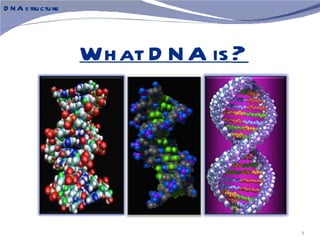
    •    A polymer of deoxyribonucleotides i.e. DNA
    •    Double-stranded
    •    A “double helical” structure
              •      common axis for both helices
              •      antiparallel relationship between 2 DNA strands
    •    Structural purposes, or are involved in regulating the use of this
         genetic information.
    •    Individual deoxynucleoside triphosphates are coupled by
         phosphodiester bonds
              •      Esterification
              •      terminal ends : 5’ and 3’
                                                                              3
D N A D is cove ry


                D is cove ring th e s tru ctu re of D N A


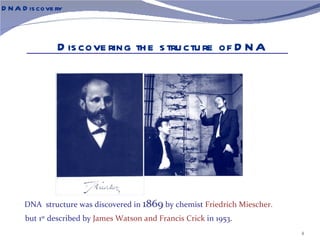
      DNA structure was discovered in 1869 by chemist Friedrich Miescher.
      but 1st described by James Watson and Francis Crick in 1953.
                                                                            4
D N A s tru ctu re


                         D N A O rganization


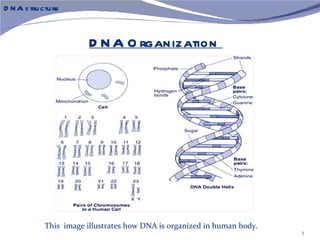
             This image illustrates how DNA is organized in human body.
                                                                          5
D N A Top ology


                   C h e m ical s tru ctu re of D N A


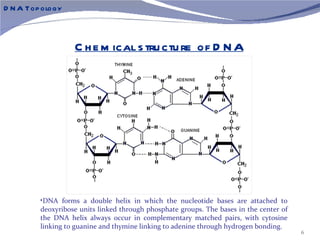
         •DNA forms a double helix in which the nucleotide bases are attached to
         deoxyribose units linked through phosphate groups. The bases in the center of
         the DNA helix always occur in complementary matched pairs, with cytosine
         linking to guanine and thymine linking to adenine through hydrogen bonding.
                                                                                         6
E s te rification


                     S u gar P h os p h ate Backb one


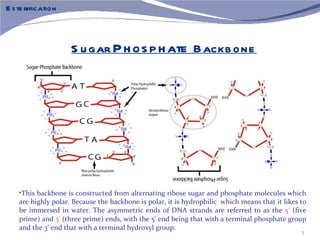
    •This backbone is constructed from alternating ribose sugar and phosphate molecules which
    are highly polar. Because the backbone is polar, it is hydrophilic which means that it likes to
    be immersed in water. The asymmetric ends of DNA strands are referred to as the 5′ (five
    prime) and 3′ (three prime) ends, with the 5' end being that with a terminal phosphate group
    and the 3' end that with a terminal hydroxyl group.
                                                                                                 7
D N A Bas e s


                              N itroge nou s Bas e s


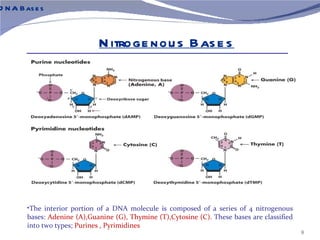
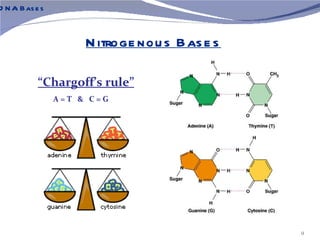
        •The interior portion of a DNA molecule is composed of a series of 4 nitrogenous
        bases: Adenine (A),Guanine (G), Thymine (T),Cytosine (C). These bases are classified
        into two types; Purines , Pyrimidines
                                                                                               8
D N A Bas e s


                     N itroge nou s Bas e s

           “Chargoff’s rule”
                A=T & C=G


                                              9
D N A s tru ctu re


                                D N A G roove s


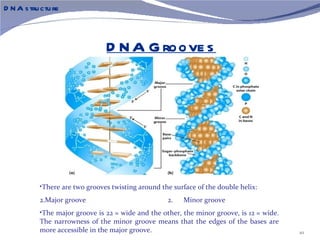
           •There are two grooves twisting around the surface of the double helix:
           2.Major groove                           2.   Minor groove
           •The major groove is 22 Å wide and the other, the minor groove, is 12 Å wide.
           The narrowness of the minor groove means that the edges of the bases are
           more accessible in the major groove.                                            10
N A S TR AN D S


                             S e ns e & Antis e ns e
                                 D N A s trand s


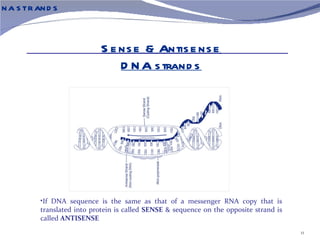
          •If DNA sequence is the same as that of a messenger RNA copy that is
          translated into protein is called SENSE & sequence on the opposite strand is
          called ANTISENSE
                                                                                         11
D N A S u p e rcoiling


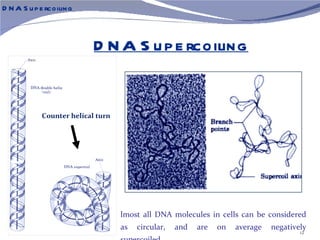
                           D N A S u p e rcoiling


            Counter helical turn


                                   lmost all DNA molecules in cells can be considered
                                   as   circular,   and   are   on   average   negatively
                                                                                       12
D N A s tru ctu re


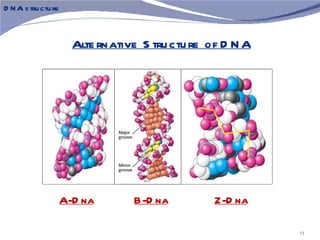
                       Alte rnative S tru ctu re of D N A


                     A-D na       B-D na         Z-D na

                                                            13
D N A s tru ctu re


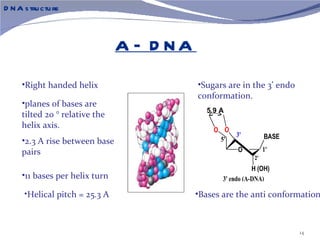
                                A – D NA
     •Right handed helix                                 •Sugars are in the 3’ endo
                                                         conformation.
     •planes of bases are
                                                           5.9 A
     tilted 20 ° relative the O
     helix axis.                5'        2' BASE            O O
                                    O                               3'          BASE
     •2.3 A rise between base                 1'              5'
                                   3'       H (OH)                   O          1'
     pairs
                                  O                                        2'
                                                                           H (OH)
     •11 bases per helix turn                                   3' endo (A-DNA)
                                2' endo (3' exo) B-DNA
      •Helical pitch = 25.3 A                            •Bases are the anti conformation


                                                                                       14
D N A s tru ctu re


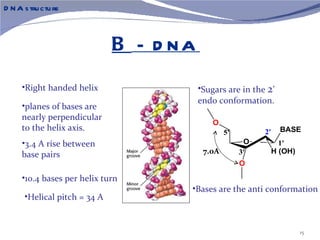
                              B – D NA

     •Right handed helix                 •Sugars are in the 2’
                                         endo conformation.
     •planes of bases are
     nearly perpendicular
                                             O
     to the helix axis.                          5'        2'     BASE
     •3.4 A rise between                               O          1'
     base pairs                           7.0A        3'        H (OH)
                                                      O

     •10.4 bases per helix turn
                                     •Bases are2' endo (3' conformation
                                                the anti exo) B-DNA
      •Helical pitch = 34 A


                                                                         15
D N A s tru ctu re


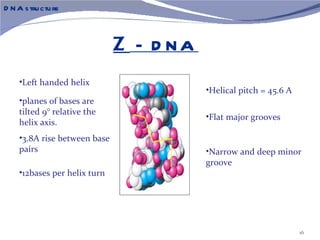
                              Z – D NA
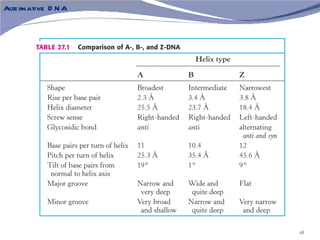
    •Left handed helix
                                         •Helical pitch = 45.6 A
    •planes of bases are
    tilted 9° relative the
                                         •Flat major grooves
    helix axis.
    •3.8A rise between base
    pairs                                •Narrow and deep minor
                                         groove
    •12bases per helix turn


                                                                   16
D N A s tru ctu re


                             Z – D NA
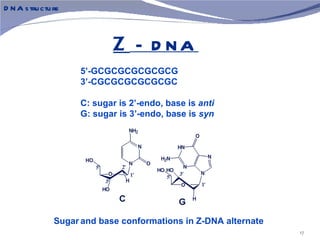
                     5’-GCGCGCGCGCGCG
                     3’-CGCGCGCGCGCGC

                     C: sugar is 2’-endo, base is anti
                     G: sugar is 3’-endo, base is syn


                Sugar and base conformations in Z-DNA alternate
                                                                  17
Alte rnative D N A


                     18
P re p are d B y
           ZAH ID A U MAR
              B .S c H ons,
D e p t of E nvironm e ntal S cie nce s
                                   19

DNA structure

  • 1.
    P re pare d B y ZAHIDA UMAR D e p t of E nvironm e ntal S cie nce s DNA structure 1 G C , U nive rsity, Lahore
  • 2.
    D N As tru ctu re Wh at D N A is ? 2
  • 3.
    D N As tru ctu re Wh at D N A is ? • A polymer of deoxyribonucleotides i.e. DNA • Double-stranded • A “double helical” structure • common axis for both helices • antiparallel relationship between 2 DNA strands • Structural purposes, or are involved in regulating the use of this genetic information. • Individual deoxynucleoside triphosphates are coupled by phosphodiester bonds • Esterification • terminal ends : 5’ and 3’ 3
  • 4.
    D N AD is cove ry D is cove ring th e s tru ctu re of D N A DNA structure was discovered in 1869 by chemist Friedrich Miescher. but 1st described by James Watson and Francis Crick in 1953. 4
  • 5.
    D N As tru ctu re D N A O rganization This image illustrates how DNA is organized in human body. 5
  • 6.
    D N ATop ology C h e m ical s tru ctu re of D N A •DNA forms a double helix in which the nucleotide bases are attached to deoxyribose units linked through phosphate groups. The bases in the center of the DNA helix always occur in complementary matched pairs, with cytosine linking to guanine and thymine linking to adenine through hydrogen bonding. 6
  • 7.
    E s terification S u gar P h os p h ate Backb one •This backbone is constructed from alternating ribose sugar and phosphate molecules which are highly polar. Because the backbone is polar, it is hydrophilic which means that it likes to be immersed in water. The asymmetric ends of DNA strands are referred to as the 5′ (five prime) and 3′ (three prime) ends, with the 5' end being that with a terminal phosphate group and the 3' end that with a terminal hydroxyl group. 7
  • 8.
    D N ABas e s N itroge nou s Bas e s •The interior portion of a DNA molecule is composed of a series of 4 nitrogenous bases: Adenine (A),Guanine (G), Thymine (T),Cytosine (C). These bases are classified into two types; Purines , Pyrimidines 8
  • 9.
    D N ABas e s N itroge nou s Bas e s “Chargoff’s rule” A=T & C=G 9
  • 10.
    D N As tru ctu re D N A G roove s •There are two grooves twisting around the surface of the double helix: 2.Major groove 2. Minor groove •The major groove is 22 Å wide and the other, the minor groove, is 12 Å wide. The narrowness of the minor groove means that the edges of the bases are more accessible in the major groove. 10
  • 11.
    N A STR AN D S S e ns e & Antis e ns e D N A s trand s •If DNA sequence is the same as that of a messenger RNA copy that is translated into protein is called SENSE & sequence on the opposite strand is called ANTISENSE 11
  • 12.
    D N AS u p e rcoiling D N A S u p e rcoiling Counter helical turn lmost all DNA molecules in cells can be considered as circular, and are on average negatively 12
  • 13.
    D N As tru ctu re Alte rnative S tru ctu re of D N A A-D na B-D na Z-D na 13
  • 14.
    D N As tru ctu re A – D NA •Right handed helix •Sugars are in the 3’ endo conformation. •planes of bases are 5.9 A tilted 20 ° relative the O helix axis. 5' 2' BASE O O O 3' BASE •2.3 A rise between base 1' 5' 3' H (OH) O 1' pairs O 2' H (OH) •11 bases per helix turn 3' endo (A-DNA) 2' endo (3' exo) B-DNA •Helical pitch = 25.3 A •Bases are the anti conformation 14
  • 15.
    D N As tru ctu re B – D NA •Right handed helix •Sugars are in the 2’ endo conformation. •planes of bases are nearly perpendicular O to the helix axis. 5' 2' BASE •3.4 A rise between O 1' base pairs 7.0A 3' H (OH) O •10.4 bases per helix turn •Bases are2' endo (3' conformation the anti exo) B-DNA •Helical pitch = 34 A 15
  • 16.
    D N As tru ctu re Z – D NA •Left handed helix •Helical pitch = 45.6 A •planes of bases are tilted 9° relative the •Flat major grooves helix axis. •3.8A rise between base pairs •Narrow and deep minor groove •12bases per helix turn 16
  • 17.
    D N As tru ctu re Z – D NA 5’-GCGCGCGCGCGCG 3’-CGCGCGCGCGCGC C: sugar is 2’-endo, base is anti G: sugar is 3’-endo, base is syn Sugar and base conformations in Z-DNA alternate 17
  • 18.
  • 19.
    P re pare d B y ZAH ID A U MAR B .S c H ons, D e p t of E nvironm e ntal S cie nce s 19