Extraction kits – reagents and functions
             How do kits work on DNA
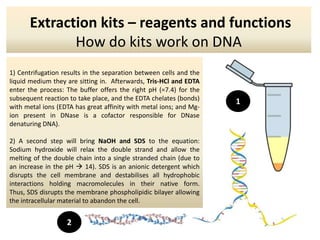
1) Centrifugation results in the separation between cells and the
liquid medium they are sitting in. Afterwards, Tris-HCl and EDTA
enter the process: The buffer offers the right pH (=7.4) for the
subsequent reaction to take place, and the EDTA chelates (bonds)
                                                                    1
with metal ions (EDTA has great affinity with metal ions; and Mg-
ion present in DNase is a cofactor responsible for DNase
denaturing DNA).

2) A second step will bring NaOH and SDS to the equation:
Sodium hydroxide will relax the double strand and allow the
melting of the double chain into a single stranded chain (due to
an increase in the pH  14). SDS is an anionic detergent which
disrupts the cell membrane and destabilises all hydrophobic
interactions holding macromolecules in their native form.
Thus, SDS disrupts the membrane phospholipidic bilayer allowing
the intracellular material to abandon the cell.


                   2
Extraction kits – reagents and functions
                   How do kits work on DNA
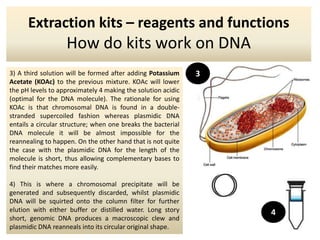
3) A third solution will be formed after adding Potassium     3
Acetate (KOAc) to the previous mixture. KOAc will lower
the pH levels to approximately 4 making the solution acidic
(optimal for the DNA molecule). The rationale for using
KOAc is that chromosomal DNA is found in a double-
stranded supercoiled fashion whereas plasmidic DNA
entails a circular structure; when one breaks the bacterial
DNA molecule it will be almost impossible for the
reannealing to happen. On the other hand that is not quite
the case with the plasmidic DNA for the length of the
molecule is short, thus allowing complementary bases to
find their matches more easily.

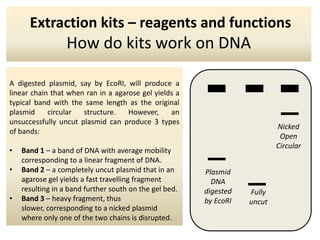
4) This is where a chromosomal precipitate will be
generated and subsequently discarded, whilst plasmidic
DNA will be squirted onto the column filter for further
elution with either buffer or distilled water. Long story         4
short, genomic DNA produces a macroscopic clew and
plasmidic DNA reanneals into its circular original shape.
Extraction kits – reagents and functions
                  How do kits work on DNA

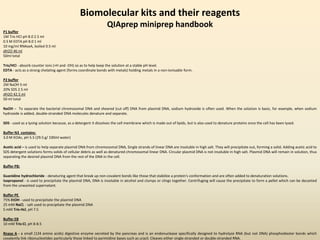
A digested plasmid, say by EcoRI, will produce a
linear chain that when ran in a agarose gel yields a
typical band with the same length as the original
plasmid     circular  structure.    However,     an
unsuccessfully uncut plasmid can produce 3 types
                                                                           Nicked
of bands:
                                                                            Open
                                                                           Circular
•   Band 1 – a band of DNA with average mobility
    corresponding to a linear fragment of DNA.
•   Band 2 – a completely uncut plasmid that in an      Plasmid
    agarose gel yields a fast travelling fragment         DNA
    resulting in a band further south on the gel bed.   digested   Fully
•   Band 3 – heavy fragment, thus                       by EcoRI   uncut
    slower, corresponding to a nicked plasmid
    where only one of the two chains is disrupted.
Biomolecular kits and their reagents
                                                                 QIAprep miniprep handbook
P1 buffer
1M Tris HCl pH 8.0 2.5 ml
0.5 M EDTA pH 8.0 1 ml
10 mg/ml RNAseA, boiled 0.5 ml
dH2O 46 ml
50ml total

Tris/HCl - absorb counter ions (+H and -OH) so as to help keep the solution at a stable pH level.
EDTA - acts as a strong chelating agent (forms coordinate bonds with metals) holding metals in a non-ionisable form.

P2 buffer
2M NaOH 5 ml
20% SDS 2.5 ml
dH2O 42.5 ml
50 ml total

NaOH – To separate the bacterial chromosomal DNA and sheared (cut off) DNA from plasmid DNA, sodium hydroxide is often used. When the solution is basic, for example, when sodium
hydroxide is added, double-stranded DNA molecules denature and separate.

SDS - used as a lysing solution because, as a detergent it dissolves the cell membrane which is made out of lipids, but is also used to denature proteins once the cell has been lysed.

Buffer N3 contains:
3.0 M KOAc, pH 5.5 (29.5 g/ 100ml water)

Acetic acid – is used to help separate plasmid DNA from chromosomal DNA, Single strands of linear DNA are insoluble in high salt. They will precipitate out, forming a solid. Adding acetic acid to
SDS detergent solutions forms solids of cellular debris as well as denatured chromosomal linear DNA. Circular plasmid DNA is not insoluble in high salt. Plasmid DNA will remain in solution, thus
separating the desired plasmid DNA from the rest of the DNA in the cell.

Buffer PB:

Guanidine hydrochloride - denaturing agent that break up non-covalent bonds like those that stabilize a protein's conformation and are often added to denaturation solutions.
Isopropanol - is used to precipitate the plasmid DNA, DNA is insoluble in alcohol and clumps or clings together. Centrifuging will cause the precipitate to form a pellet which can be decanted
from the unwanted supernatant.

Buffer PE
75% EtOH - used to precipitate the plasmid DNA
25 mM NaCl, - salt used to precipitate the plasmid DNA
5 mM Tris-Hcl, pH 7.5

Buffer EB
10 mM Tris·Cl, pH 8-8.5

Rnase A - a small (124 amino acids) digestive enzyme secreted by the pancreas and is an endonuclease specifically designed to hydrolyze RNA (but not DNA) phosphodiester bonds which
covalently link ribonucleotides particularly those linked to pyrimidine bases such as uracil. Cleaves either single-stranded or double-stranded RNA.

Extraction kits – how do kits work on dna

  • 1.
    Extraction kits –reagents and functions How do kits work on DNA 1) Centrifugation results in the separation between cells and the liquid medium they are sitting in. Afterwards, Tris-HCl and EDTA enter the process: The buffer offers the right pH (=7.4) for the subsequent reaction to take place, and the EDTA chelates (bonds) 1 with metal ions (EDTA has great affinity with metal ions; and Mg- ion present in DNase is a cofactor responsible for DNase denaturing DNA). 2) A second step will bring NaOH and SDS to the equation: Sodium hydroxide will relax the double strand and allow the melting of the double chain into a single stranded chain (due to an increase in the pH  14). SDS is an anionic detergent which disrupts the cell membrane and destabilises all hydrophobic interactions holding macromolecules in their native form. Thus, SDS disrupts the membrane phospholipidic bilayer allowing the intracellular material to abandon the cell. 2
  • 2.
    Extraction kits –reagents and functions How do kits work on DNA 3) A third solution will be formed after adding Potassium 3 Acetate (KOAc) to the previous mixture. KOAc will lower the pH levels to approximately 4 making the solution acidic (optimal for the DNA molecule). The rationale for using KOAc is that chromosomal DNA is found in a double- stranded supercoiled fashion whereas plasmidic DNA entails a circular structure; when one breaks the bacterial DNA molecule it will be almost impossible for the reannealing to happen. On the other hand that is not quite the case with the plasmidic DNA for the length of the molecule is short, thus allowing complementary bases to find their matches more easily. 4) This is where a chromosomal precipitate will be generated and subsequently discarded, whilst plasmidic DNA will be squirted onto the column filter for further elution with either buffer or distilled water. Long story 4 short, genomic DNA produces a macroscopic clew and plasmidic DNA reanneals into its circular original shape.
  • 3.
    Extraction kits –reagents and functions How do kits work on DNA A digested plasmid, say by EcoRI, will produce a linear chain that when ran in a agarose gel yields a typical band with the same length as the original plasmid circular structure. However, an unsuccessfully uncut plasmid can produce 3 types Nicked of bands: Open Circular • Band 1 – a band of DNA with average mobility corresponding to a linear fragment of DNA. • Band 2 – a completely uncut plasmid that in an Plasmid agarose gel yields a fast travelling fragment DNA resulting in a band further south on the gel bed. digested Fully • Band 3 – heavy fragment, thus by EcoRI uncut slower, corresponding to a nicked plasmid where only one of the two chains is disrupted.
  • 4.
    Biomolecular kits andtheir reagents QIAprep miniprep handbook P1 buffer 1M Tris HCl pH 8.0 2.5 ml 0.5 M EDTA pH 8.0 1 ml 10 mg/ml RNAseA, boiled 0.5 ml dH2O 46 ml 50ml total Tris/HCl - absorb counter ions (+H and -OH) so as to help keep the solution at a stable pH level. EDTA - acts as a strong chelating agent (forms coordinate bonds with metals) holding metals in a non-ionisable form. P2 buffer 2M NaOH 5 ml 20% SDS 2.5 ml dH2O 42.5 ml 50 ml total NaOH – To separate the bacterial chromosomal DNA and sheared (cut off) DNA from plasmid DNA, sodium hydroxide is often used. When the solution is basic, for example, when sodium hydroxide is added, double-stranded DNA molecules denature and separate. SDS - used as a lysing solution because, as a detergent it dissolves the cell membrane which is made out of lipids, but is also used to denature proteins once the cell has been lysed. Buffer N3 contains: 3.0 M KOAc, pH 5.5 (29.5 g/ 100ml water) Acetic acid – is used to help separate plasmid DNA from chromosomal DNA, Single strands of linear DNA are insoluble in high salt. They will precipitate out, forming a solid. Adding acetic acid to SDS detergent solutions forms solids of cellular debris as well as denatured chromosomal linear DNA. Circular plasmid DNA is not insoluble in high salt. Plasmid DNA will remain in solution, thus separating the desired plasmid DNA from the rest of the DNA in the cell. Buffer PB: Guanidine hydrochloride - denaturing agent that break up non-covalent bonds like those that stabilize a protein's conformation and are often added to denaturation solutions. Isopropanol - is used to precipitate the plasmid DNA, DNA is insoluble in alcohol and clumps or clings together. Centrifuging will cause the precipitate to form a pellet which can be decanted from the unwanted supernatant. Buffer PE 75% EtOH - used to precipitate the plasmid DNA 25 mM NaCl, - salt used to precipitate the plasmid DNA 5 mM Tris-Hcl, pH 7.5 Buffer EB 10 mM Tris·Cl, pH 8-8.5 Rnase A - a small (124 amino acids) digestive enzyme secreted by the pancreas and is an endonuclease specifically designed to hydrolyze RNA (but not DNA) phosphodiester bonds which covalently link ribonucleotides particularly those linked to pyrimidine bases such as uracil. Cleaves either single-stranded or double-stranded RNA.