Forensic Serology & DNA Typing…
M.PHOOL BADSHAH
Lecture-5
DNA extraction & types and
quantification in forensic serology
Introduction
• DNA extraction is an essential stage in the forensic serology
study of biological materials taken from crime scenes.
• The objective is to separate and purify DNA from other
environmental and cellular elements in order to produce a
high-quality sample for further examination.
• An overview of the types and methods of DNA extraction and
quantification employed in forensic serology is provided
below:
DNA Extraction Methods
 Organic Extraction Methods:
1- Phenol-Chloroform Extraction:
 In this conventional technique, DNA is separated from proteins and other
cellular constituents using phenol and chloroform. Although it is safe to
use, it has certain risks and should be handled carefully.
2- Chelex Extraction:
 This process facilitates the release of DNA by binding and removing metal
ions using a chelating resin known as Chelex. Comparing this procedure to
phenol-chloroform extraction, it is safer and simpler.
 Solid-Phase Extraction (SPE):
1- Silica-Based Methods:
 When chaotropic salts are present, DNA attaches to silica membranes, and
further washing processes eliminate impurities. This method is widely used
in commercial kits due to its ease of use and effectiveness.
2- Magnetic Bead-Based Methods:
 For DNA extraction, magnetic beads coated with a DNA-binding material
are utilized. A magnetic field makes it simple to separate these beads,
expediting the procedure.
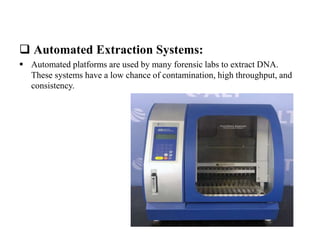
 Automated Extraction Systems:
 Automated platforms are used by many forensic labs to extract DNA.
These systems have a low chance of contamination, high throughput, and
consistency.
Types of DNA for Analysis
1- Nuclear DNA:
 Nuclear DNA, which is found in cell nuclei, is the main subject of forensic
DNA analysis. A person's unique genetic makeup is inherited from both
parents, with the exception of identical twins.
2- Mitochondrial DNA (mtDNA):
 Mothers pass on their mtDNA, which is found in the mitochondria outside
of the cell nucleus.
 MtDNA analysis is helpful when nuclear DNA is damaged or unavailable
in large enough amounts, even though it is not as uniquely distinctive as
nuclear DNA.
DNA Quantification Techniques
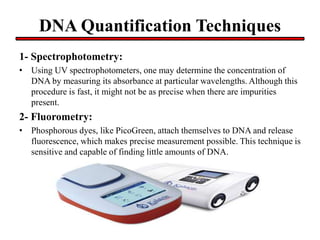
1- Spectrophotometry:
• Using UV spectrophotometers, one may determine the concentration of
DNA by measuring its absorbance at particular wavelengths. Although this
procedure is fast, it might not be as precise when there are impurities
present.
2- Fluorometry:
• Phosphorous dyes, like PicoGreen, attach themselves to DNA and release
fluorescence, which makes precise measurement possible. This technique is
sensitive and capable of finding little amounts of DNA.
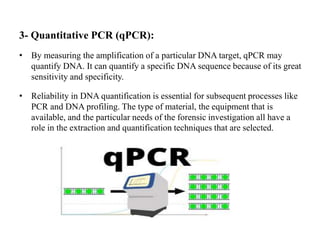
3- Quantitative PCR (qPCR):
• By measuring the amplification of a particular DNA target, qPCR may
quantify DNA. It can quantify a specific DNA sequence because of its great
sensitivity and specificity.
• Reliability in DNA quantification is essential for subsequent processes like
PCR and DNA profiling. The type of material, the equipment that is
available, and the particular needs of the forensic investigation all have a
role in the extraction and quantification techniques that are selected.

DNA Extraction & Quantification in Forensic Science.pptx

  • 1.
    Forensic Serology &DNA Typing… M.PHOOL BADSHAH
  • 2.
    Lecture-5 DNA extraction &types and quantification in forensic serology
  • 3.
    Introduction • DNA extractionis an essential stage in the forensic serology study of biological materials taken from crime scenes. • The objective is to separate and purify DNA from other environmental and cellular elements in order to produce a high-quality sample for further examination. • An overview of the types and methods of DNA extraction and quantification employed in forensic serology is provided below:
  • 4.
    DNA Extraction Methods Organic Extraction Methods: 1- Phenol-Chloroform Extraction:  In this conventional technique, DNA is separated from proteins and other cellular constituents using phenol and chloroform. Although it is safe to use, it has certain risks and should be handled carefully. 2- Chelex Extraction:  This process facilitates the release of DNA by binding and removing metal ions using a chelating resin known as Chelex. Comparing this procedure to phenol-chloroform extraction, it is safer and simpler.
  • 5.
     Solid-Phase Extraction(SPE): 1- Silica-Based Methods:  When chaotropic salts are present, DNA attaches to silica membranes, and further washing processes eliminate impurities. This method is widely used in commercial kits due to its ease of use and effectiveness. 2- Magnetic Bead-Based Methods:  For DNA extraction, magnetic beads coated with a DNA-binding material are utilized. A magnetic field makes it simple to separate these beads, expediting the procedure.
  • 6.
     Automated ExtractionSystems:  Automated platforms are used by many forensic labs to extract DNA. These systems have a low chance of contamination, high throughput, and consistency.
  • 7.
    Types of DNAfor Analysis 1- Nuclear DNA:  Nuclear DNA, which is found in cell nuclei, is the main subject of forensic DNA analysis. A person's unique genetic makeup is inherited from both parents, with the exception of identical twins. 2- Mitochondrial DNA (mtDNA):  Mothers pass on their mtDNA, which is found in the mitochondria outside of the cell nucleus.  MtDNA analysis is helpful when nuclear DNA is damaged or unavailable in large enough amounts, even though it is not as uniquely distinctive as nuclear DNA.
  • 8.
    DNA Quantification Techniques 1-Spectrophotometry: • Using UV spectrophotometers, one may determine the concentration of DNA by measuring its absorbance at particular wavelengths. Although this procedure is fast, it might not be as precise when there are impurities present. 2- Fluorometry: • Phosphorous dyes, like PicoGreen, attach themselves to DNA and release fluorescence, which makes precise measurement possible. This technique is sensitive and capable of finding little amounts of DNA.
  • 9.
    3- Quantitative PCR(qPCR): • By measuring the amplification of a particular DNA target, qPCR may quantify DNA. It can quantify a specific DNA sequence because of its great sensitivity and specificity. • Reliability in DNA quantification is essential for subsequent processes like PCR and DNA profiling. The type of material, the equipment that is available, and the particular needs of the forensic investigation all have a role in the extraction and quantification techniques that are selected.