AIM: How are amino acids formed into proteins? PEPTIDE BOND: Joins Two AMINO ACIDS together JANUARY 16 th , 2009
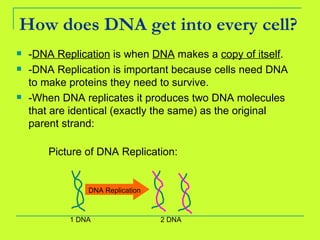
How does DNA get into every cell? - DNA Replication  is when  DNA  makes a  copy of itself .  -DNA Replication is important because cells need DNA to make proteins they need to survive. -When DNA replicates it produces two DNA molecules that are identical (exactly the same) as the original parent strand: Picture of DNA Replication: 1 DNA 2 DNA DNA Replication
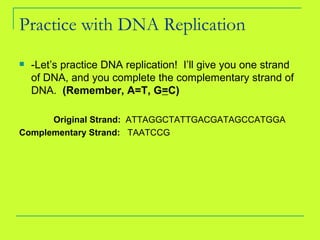
Practice with DNA Replication -Let’s practice DNA replication!  I’ll give you one strand of DNA, and you complete the complementary strand of DNA.  (Remember, A=T, G = C) Original Strand:  ATTAGGCTATTGACGATAGCCATGGA Complementary Strand:  TAATCCG
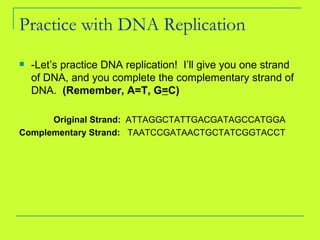
Practice with DNA Replication -Let’s practice DNA replication!  I’ll give you one strand of DNA, and you complete the complementary strand of DNA.  (Remember, A=T, G = C) Original Strand:  ATTAGGCTATTGACGATAGCCATGGA Complementary Strand:  TAATCCGATAACTGCTATCGGTACCT
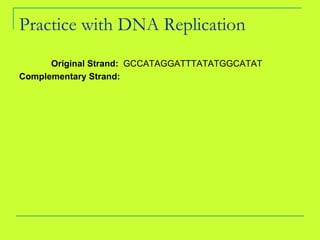
Practice with DNA Replication Original Strand:  GCCATAGGATTTATATGGCATAT Complementary Strand:
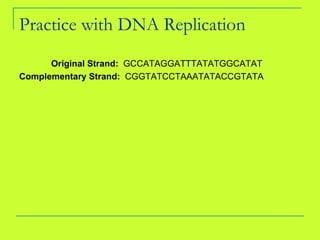
Practice with DNA Replication Original Strand:  GCCATAGGATTTATATGGCATAT Complementary Strand:   CGGTATCCTAAATATACCGTATA
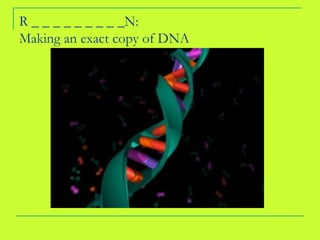
R _ _ _ _ _ _ _ _ _N: Making an exact copy of DNA
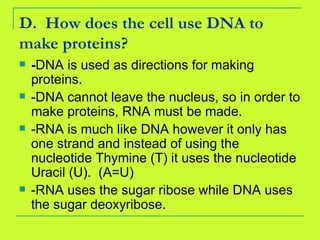
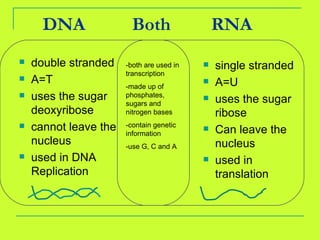
D.  How does the cell use DNA to make proteins? - DNA is used as directions for making proteins. -DNA cannot leave the nucleus, so in order to make proteins, RNA must be made. -RNA is much like DNA however it only has one strand and instead of using the nucleotide Thymine (T) it uses the nucleotide Uracil (U).  (A=U) -RNA uses the sugar ribose while DNA uses the sugar deoxyribose.
DNA  Both RNA double stranded A=T uses the sugar deoxyribose cannot leave the nucleus used in DNA Replication single stranded A=U uses the sugar ribose Can leave the nucleus used in translation -both are used in transcription -made up of phosphates, sugars and nitrogen bases -contain genetic information -use G, C and A
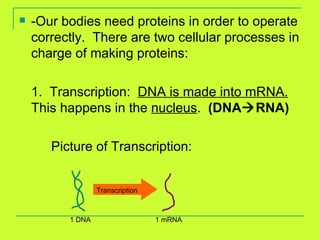
-Our bodies need proteins in order to operate correctly.  There are two cellular processes in charge of making proteins: 1.  Transcription:  DNA is made into mRNA.   This happens in the  nucleus .  (DNA  RNA) Picture of Transcription: 1 DNA 1 mRNA Transcription
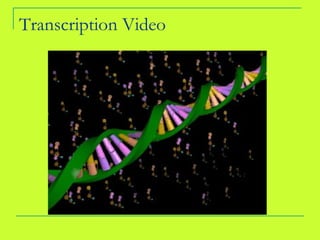
Transcription Video
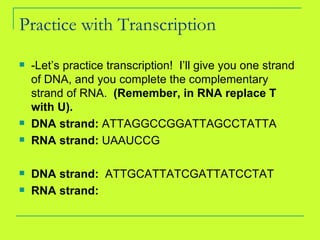
Practice with Transcription -Let’s practice transcription!  I’ll give you one strand of DNA, and you complete the complementary strand of RNA.  (Remember, in RNA replace T with U). DNA strand:  ATTAGGCCGGATTAGCCTATTA RNA strand:  UAAUCCG DNA strand:   ATTGCATTATCGATTATCCTAT RNA strand:
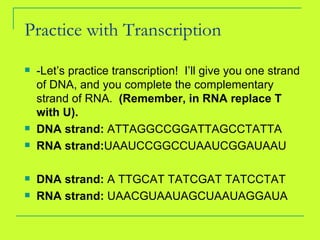
Practice with Transcription -Let’s practice transcription!  I’ll give you one strand of DNA, and you complete the complementary strand of RNA.  (Remember, in RNA replace T with U). DNA strand:  ATTAGGCCGGATTAGCCTATTA RNA strand: UAAUCCGGCCUAAUCGGAUAAU DNA strand:  A TTGCAT TATCGAT TATCCTAT RNA strand:  UAACGUAAUAGCUAAUAGGAUA
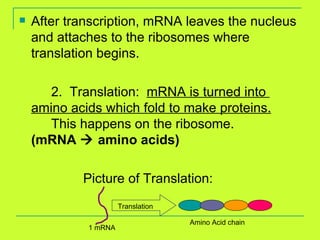
After transcription, mRNA leaves the nucleus and attaches to the ribosomes where translation begins. 2.  Translation:  mRNA is turned into  amino acids which fold to make proteins.   This happens on the ribosome.  (mRNA    amino acids) Picture of Translation: 1 mRNA Translation Amino Acid chain
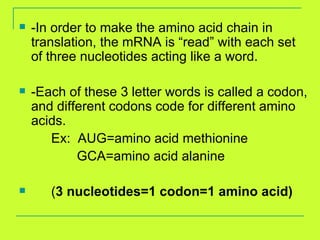
-In order to make the amino acid chain in translation, the mRNA is “read” with each set of three nucleotides acting like a word. -Each of these 3 letter words is called a codon, and different codons code for different amino acids. Ex:  AUG=amino acid methionine    GCA=amino acid alanine ( 3 nucleotides=1 codon=1 amino acid)
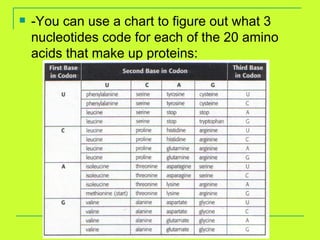
-You can use a chart to figure out what 3 nucleotides code for each of the 20 amino acids that make up proteins:
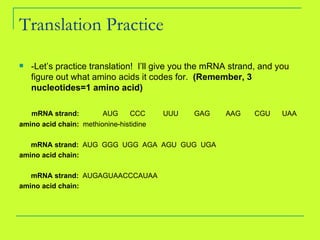
Translation Practice -Let’s practice translation!  I’ll give you the mRNA strand, and you figure out what amino acids it codes for.  (Remember, 3 nucleotides=1 amino acid) mRNA strand:  AUG  CCC  UUU  GAG  AAG  CGU  UAA amino acid chain:  methionine-histidine mRNA strand:  AUG  GGG  UGG  AGA  AGU  GUG  UGA amino acid chain: mRNA strand:  AUGAGUAACCCAUAA amino acid chain:
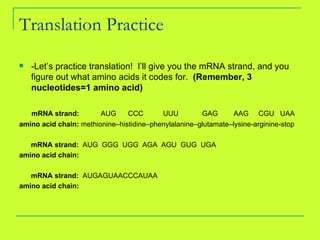
Translation Practice -Let’s practice translation!  I’ll give you the mRNA strand, and you figure out what amino acids it codes for.  (Remember, 3 nucleotides=1 amino acid) mRNA strand:  AUG  CCC  UUU  GAG  AAG  CGU  UAA amino acid chain:  methionine–histidine–phenylalanine–glutamate–lysine-arginine-stop mRNA strand:  AUG  GGG  UGG  AGA  AGU  GUG  UGA amino acid chain: mRNA strand:  AUGAGUAACCCAUAA amino acid chain:
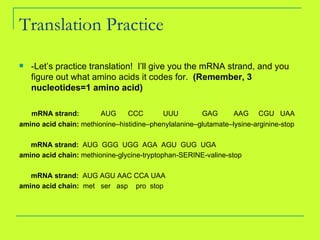
Translation Practice -Let’s practice translation!  I’ll give you the mRNA strand, and you figure out what amino acids it codes for.  (Remember, 3 nucleotides=1 amino acid) mRNA strand:  AUG  CCC  UUU  GAG  AAG  CGU  UAA amino acid chain:  methionine–histidine–phenylalanine–glutamate–lysine-arginine-stop mRNA strand:  AUG  GGG  UGG  AGA  AGU  GUG  UGA amino acid chain:  methionine-glycine-tryptophan-SERINE-valine-stop mRNA strand:  AUG AGU AAC CCA UAA amino acid chain:  met  ser  asp  pro  stop
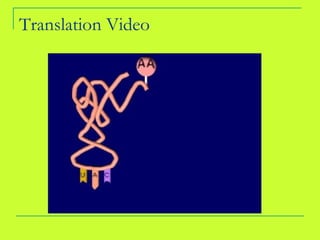
Translation Video
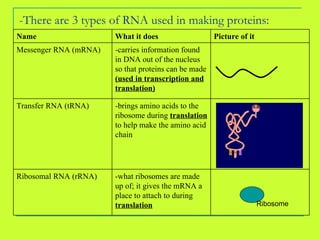
-There are 3 types of RNA used in making proteins: -what ribosomes are made up of; it gives the mRNA a place to attach to during  translation Ribosomal RNA (rRNA) -brings amino acids to the ribosome during  translation  to help make the amino acid chain Transfer RNA (tRNA) -carries information found in DNA out of the nucleus so that proteins can be made  (used in transcription and translation) Messenger RNA (mRNA) Picture of it What it does Name Ribosome
I don’t care what you heard about me But my RNA can make all of my proteins All my As and Us and Cs and Gs My RNA is coding for Proteins!

Dna Rna Protein Review

  • 1.
    AIM: How areamino acids formed into proteins? PEPTIDE BOND: Joins Two AMINO ACIDS together JANUARY 16 th , 2009
  • 2.
    How does DNAget into every cell? - DNA Replication is when DNA makes a copy of itself . -DNA Replication is important because cells need DNA to make proteins they need to survive. -When DNA replicates it produces two DNA molecules that are identical (exactly the same) as the original parent strand: Picture of DNA Replication: 1 DNA 2 DNA DNA Replication
  • 3.
    Practice with DNAReplication -Let’s practice DNA replication! I’ll give you one strand of DNA, and you complete the complementary strand of DNA. (Remember, A=T, G = C) Original Strand: ATTAGGCTATTGACGATAGCCATGGA Complementary Strand: TAATCCG
  • 4.
    Practice with DNAReplication -Let’s practice DNA replication! I’ll give you one strand of DNA, and you complete the complementary strand of DNA. (Remember, A=T, G = C) Original Strand: ATTAGGCTATTGACGATAGCCATGGA Complementary Strand: TAATCCGATAACTGCTATCGGTACCT
  • 5.
    Practice with DNAReplication Original Strand: GCCATAGGATTTATATGGCATAT Complementary Strand:
  • 6.
    Practice with DNAReplication Original Strand: GCCATAGGATTTATATGGCATAT Complementary Strand: CGGTATCCTAAATATACCGTATA
  • 7.
    R _ __ _ _ _ _ _ _N: Making an exact copy of DNA
  • 8.
    D. Howdoes the cell use DNA to make proteins? - DNA is used as directions for making proteins. -DNA cannot leave the nucleus, so in order to make proteins, RNA must be made. -RNA is much like DNA however it only has one strand and instead of using the nucleotide Thymine (T) it uses the nucleotide Uracil (U). (A=U) -RNA uses the sugar ribose while DNA uses the sugar deoxyribose.
  • 9.
    DNA BothRNA double stranded A=T uses the sugar deoxyribose cannot leave the nucleus used in DNA Replication single stranded A=U uses the sugar ribose Can leave the nucleus used in translation -both are used in transcription -made up of phosphates, sugars and nitrogen bases -contain genetic information -use G, C and A
  • 10.
    -Our bodies needproteins in order to operate correctly. There are two cellular processes in charge of making proteins: 1. Transcription: DNA is made into mRNA. This happens in the nucleus . (DNA  RNA) Picture of Transcription: 1 DNA 1 mRNA Transcription
  • 11.
  • 12.
    Practice with Transcription-Let’s practice transcription! I’ll give you one strand of DNA, and you complete the complementary strand of RNA. (Remember, in RNA replace T with U). DNA strand: ATTAGGCCGGATTAGCCTATTA RNA strand: UAAUCCG DNA strand: ATTGCATTATCGATTATCCTAT RNA strand:
  • 13.
    Practice with Transcription-Let’s practice transcription! I’ll give you one strand of DNA, and you complete the complementary strand of RNA. (Remember, in RNA replace T with U). DNA strand: ATTAGGCCGGATTAGCCTATTA RNA strand: UAAUCCGGCCUAAUCGGAUAAU DNA strand: A TTGCAT TATCGAT TATCCTAT RNA strand: UAACGUAAUAGCUAAUAGGAUA
  • 14.
    After transcription, mRNAleaves the nucleus and attaches to the ribosomes where translation begins. 2. Translation: mRNA is turned into amino acids which fold to make proteins. This happens on the ribosome. (mRNA  amino acids) Picture of Translation: 1 mRNA Translation Amino Acid chain
  • 15.
    -In order tomake the amino acid chain in translation, the mRNA is “read” with each set of three nucleotides acting like a word. -Each of these 3 letter words is called a codon, and different codons code for different amino acids. Ex: AUG=amino acid methionine GCA=amino acid alanine ( 3 nucleotides=1 codon=1 amino acid)
  • 16.
    -You can usea chart to figure out what 3 nucleotides code for each of the 20 amino acids that make up proteins:
  • 17.
    Translation Practice -Let’spractice translation! I’ll give you the mRNA strand, and you figure out what amino acids it codes for. (Remember, 3 nucleotides=1 amino acid) mRNA strand: AUG CCC UUU GAG AAG CGU UAA amino acid chain: methionine-histidine mRNA strand: AUG GGG UGG AGA AGU GUG UGA amino acid chain: mRNA strand: AUGAGUAACCCAUAA amino acid chain:
  • 18.
    Translation Practice -Let’spractice translation! I’ll give you the mRNA strand, and you figure out what amino acids it codes for. (Remember, 3 nucleotides=1 amino acid) mRNA strand: AUG CCC UUU GAG AAG CGU UAA amino acid chain: methionine–histidine–phenylalanine–glutamate–lysine-arginine-stop mRNA strand: AUG GGG UGG AGA AGU GUG UGA amino acid chain: mRNA strand: AUGAGUAACCCAUAA amino acid chain:
  • 19.
    Translation Practice -Let’spractice translation! I’ll give you the mRNA strand, and you figure out what amino acids it codes for. (Remember, 3 nucleotides=1 amino acid) mRNA strand: AUG CCC UUU GAG AAG CGU UAA amino acid chain: methionine–histidine–phenylalanine–glutamate–lysine-arginine-stop mRNA strand: AUG GGG UGG AGA AGU GUG UGA amino acid chain: methionine-glycine-tryptophan-SERINE-valine-stop mRNA strand: AUG AGU AAC CCA UAA amino acid chain: met ser asp pro stop
  • 20.
  • 21.
    -There are 3types of RNA used in making proteins: -what ribosomes are made up of; it gives the mRNA a place to attach to during translation Ribosomal RNA (rRNA) -brings amino acids to the ribosome during translation to help make the amino acid chain Transfer RNA (tRNA) -carries information found in DNA out of the nucleus so that proteins can be made (used in transcription and translation) Messenger RNA (mRNA) Picture of it What it does Name Ribosome
  • 22.
    I don’t carewhat you heard about me But my RNA can make all of my proteins All my As and Us and Cs and Gs My RNA is coding for Proteins!