ESCUELAS PÍAS ALBACETE
BIOLOGY WORK Teacher:  González Montero, Jose María Realized by: Daniela Nicoletta Trinc María Espinosa García de la Serrana 2010
DNA
 
CONTENTS History
Structure
Replication
Gene expression
Mutations
Video
Bibliography
History In 1869 biologist Johann Friedrich Miesscher separated the cell membrane and cytoplasm of the cell to isolate the cell nucleus and identified a new group of cellular substances which he called nuclein.
Subsequently,Richard
Altmann identified the
acids and gave them
the name  nucleic
acids.
Robert Feulgen, in 1914, described a method to reveal by staining the DNA, based on the dye fuchsin. Using this method, the presence of DNA in the nucleus of all eukaryotic cells, specifically in chromosomes.
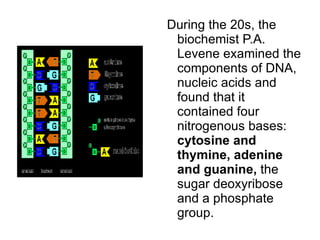
During the 20s, the biochemist P.A. Levene examined the components of DNA, nucleic acids and found that it contained four nitrogenous bases:  cytosine and thymine,   adenine and guanine,  the sugar deoxyribose and a phosphate group.
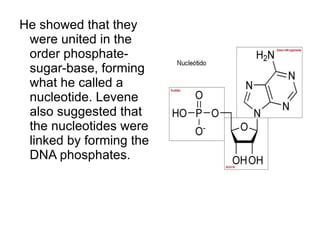
He showed that they were united in the order phosphate-sugar-base, forming what he called a nucleotide. Levene also suggested that the nucleotides were linked by forming the DNA phosphates.
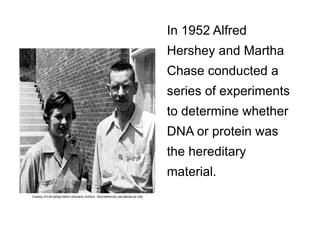
In 1952 Alfred
Hershey and Martha
Chase conducted a
series of experiments
to determine whether
DNA or protein was
the hereditary
material.
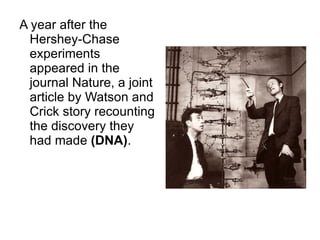
A year after the Hershey-Chase experiments appeared in the journal Nature, a joint article by Watson and Crick story recounting the discovery they had made  (DNA) .
STRUCTURE Each DNA molecule  consists of two chains  formed by a large  number of chemical  compounds called  nucleotides .
Each nucleotide consists of three units: a sugar molecule (desoxyribose), a phosphate group and one of four possible nitrogen compounds called bases: adenine (A), guanine (G), thymine (T) and cytosine (C).
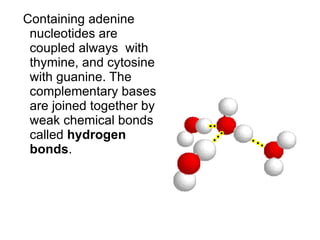
Containing adenine nucleotides are coupled always  with thymine, and cytosine with guanine. The complementary bases are joined together by weak chemical bonds called  hydrogen bonds .
Deoxyribonucleic acid  is a polymer of two  antiparallel strands  (orientation 5 '3'y3'5').
REPLICATION The DNA replication  process allows the DNA  to double, ie, synthesize  an identical copy.
This duplication of  genetic material occurs according to a  semiconservative  mechanism(the chain of the DNA  is previous ).
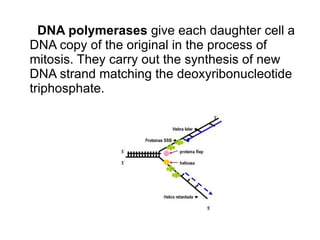
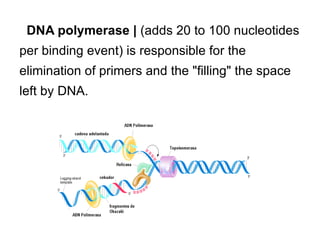
The process of Replication begins  with the  helicase , an  vital enzyme . (The  human being have got 24 enzymes). Its mission is to break the hydrogen bonds.
DNA polymerases  give each daughter cell a DNA copy of the original in the process of mitosis. They carry out the synthesis of new DNA strand matching the deoxyribonucleotide triphosphate.
Primer is a iniciator of the creation of the chain delayed (so called because its direction is 3-5).
DNA polymerase III  is the principal responsible enzyme for DNA elongation (polymerase activity 5 '-> 3'). It also performs tasks of correction (exonuclease activity 3 '-> 5').
DNA polymerase |  (adds 20 to 100 nucleotides  per binding event) is responsible for the  elimination of primers and the "filling" the space  left by DNA.
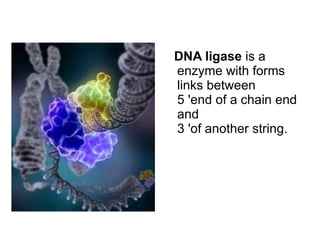
DNA ligase  is a enzyme with forms links between 5 'end of a chain end and 3 'of another string.
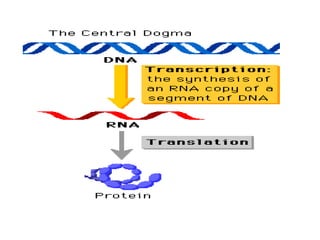
Gene expression DNA -> RNA -> protein:  gene expression. To express the genetic information contained in DNA, first the nucleotide sequence of a gene is transcribed into RNA. The transcript is catalyzed by the enzyme RNA polymerase.
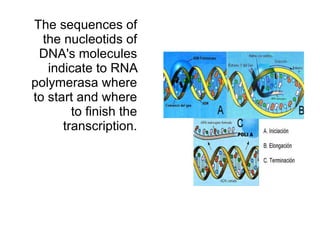
The sequences of the nucleotids of DNA's molecules indicate to RNA polymerasa where to start and where to finish the transcription.
The difference between DNA and RNA: It contains the sugar ribose instead of deoxyribose. It contains the base uracil (U) instead of thymine (T)
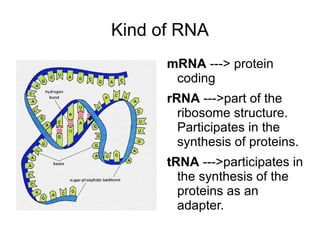
Kind of RNA mRNA  ---> protein coding rRNA  --->part of the ribosome structure. Participates in the synthesis of proteins. tRNA  --->participates in the synthesis of the proteins as an adapter.
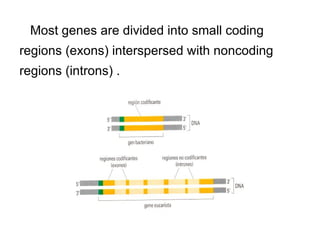
Most genes are divided into small coding  regions (exons) interspersed with noncoding  regions (introns) .
At the core, the introns are removed from the primary RNA transcript through a process of maturation of RNA. By a reaction catalyzed by small ribonucleoprotein complexes known as snRNPs, the introns are excised from the primary transcript and exons are joined together directly. Then the mRNA moves to cytoplasm.
The nucleotide  sequence of the mRNA  is read in groups of  three nucleotides  ( codons ), so that each  codon corresponds to  an  aminoacid.
The possible combinations of four different nucleotides in the RNA produced 64 different codons in the genetic code. Most amino acids are specified by more than one codon.
 
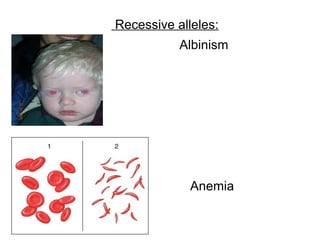
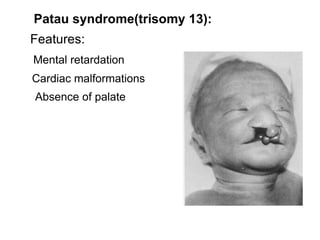
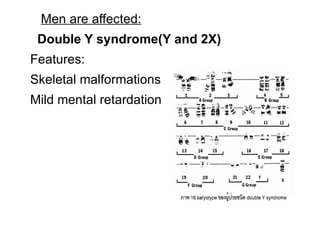
The replication must be exactly the same,if it´s not, a lot of illnesses can be developed. ILLNESSES
Alterations of genetic material.

Dna

  • 1.
  • 2.
    BIOLOGY WORK Teacher: González Montero, Jose María Realized by: Daniela Nicoletta Trinc María Espinosa García de la Serrana 2010
  • 3.
  • 4.
  • 5.
  • 6.
  • 7.
  • 8.
  • 9.
  • 10.
  • 11.
  • 12.
    History In 1869biologist Johann Friedrich Miesscher separated the cell membrane and cytoplasm of the cell to isolate the cell nucleus and identified a new group of cellular substances which he called nuclein.
  • 13.
  • 14.
  • 15.
  • 16.
    the name nucleic
  • 17.
  • 18.
    Robert Feulgen, in1914, described a method to reveal by staining the DNA, based on the dye fuchsin. Using this method, the presence of DNA in the nucleus of all eukaryotic cells, specifically in chromosomes.
  • 19.
    During the 20s,the biochemist P.A. Levene examined the components of DNA, nucleic acids and found that it contained four nitrogenous bases: cytosine and thymine, adenine and guanine, the sugar deoxyribose and a phosphate group.
  • 20.
    He showed thatthey were united in the order phosphate-sugar-base, forming what he called a nucleotide. Levene also suggested that the nucleotides were linked by forming the DNA phosphates.
  • 21.
  • 22.
  • 23.
  • 24.
  • 25.
  • 26.
  • 27.
  • 28.
  • 29.
    A year afterthe Hershey-Chase experiments appeared in the journal Nature, a joint article by Watson and Crick story recounting the discovery they had made (DNA) .
  • 30.
    STRUCTURE Each DNAmolecule consists of two chains formed by a large number of chemical compounds called nucleotides .
  • 31.
    Each nucleotide consistsof three units: a sugar molecule (desoxyribose), a phosphate group and one of four possible nitrogen compounds called bases: adenine (A), guanine (G), thymine (T) and cytosine (C).
  • 32.
    Containing adenine nucleotidesare coupled always with thymine, and cytosine with guanine. The complementary bases are joined together by weak chemical bonds called hydrogen bonds .
  • 33.
    Deoxyribonucleic acid is a polymer of two antiparallel strands (orientation 5 '3'y3'5').
  • 34.
    REPLICATION The DNAreplication process allows the DNA to double, ie, synthesize an identical copy.
  • 35.
    This duplication of genetic material occurs according to a semiconservative mechanism(the chain of the DNA is previous ).
  • 36.
    The process ofReplication begins with the helicase , an vital enzyme . (The human being have got 24 enzymes). Its mission is to break the hydrogen bonds.
  • 37.
    DNA polymerases give each daughter cell a DNA copy of the original in the process of mitosis. They carry out the synthesis of new DNA strand matching the deoxyribonucleotide triphosphate.
  • 38.
    Primer is ainiciator of the creation of the chain delayed (so called because its direction is 3-5).
  • 39.
    DNA polymerase III is the principal responsible enzyme for DNA elongation (polymerase activity 5 '-> 3'). It also performs tasks of correction (exonuclease activity 3 '-> 5').
  • 40.
    DNA polymerase | (adds 20 to 100 nucleotides per binding event) is responsible for the elimination of primers and the "filling" the space left by DNA.
  • 41.
    DNA ligase is a enzyme with forms links between 5 'end of a chain end and 3 'of another string.
  • 42.
    Gene expression DNA-> RNA -> protein: gene expression. To express the genetic information contained in DNA, first the nucleotide sequence of a gene is transcribed into RNA. The transcript is catalyzed by the enzyme RNA polymerase.
  • 43.
    The sequences ofthe nucleotids of DNA's molecules indicate to RNA polymerasa where to start and where to finish the transcription.
  • 44.
    The difference betweenDNA and RNA: It contains the sugar ribose instead of deoxyribose. It contains the base uracil (U) instead of thymine (T)
  • 45.
    Kind of RNAmRNA ---> protein coding rRNA --->part of the ribosome structure. Participates in the synthesis of proteins. tRNA --->participates in the synthesis of the proteins as an adapter.
  • 46.
    Most genes aredivided into small coding regions (exons) interspersed with noncoding regions (introns) .
  • 47.
    At the core,the introns are removed from the primary RNA transcript through a process of maturation of RNA. By a reaction catalyzed by small ribonucleoprotein complexes known as snRNPs, the introns are excised from the primary transcript and exons are joined together directly. Then the mRNA moves to cytoplasm.
  • 48.
    The nucleotide sequence of the mRNA is read in groups of three nucleotides ( codons ), so that each codon corresponds to an aminoacid.
  • 49.
    The possible combinationsof four different nucleotides in the RNA produced 64 different codons in the genetic code. Most amino acids are specified by more than one codon.
  • 50.
  • 51.
    The replication mustbe exactly the same,if it´s not, a lot of illnesses can be developed. ILLNESSES
  • 52.