 DNA    (deoxyribonucleic acid).
 All living things contain DNA.
 Source of genetic traits.
 DNA is a nucleic acid.
 Nucleic acids are made of
  nucleotides.
Nucleotides
    Made of three
     things:
    1. Phosphate
     (PO4)
    2. Sugar
     (deoxyribose).
    3. Nitrogen base.
Nitrogen Bases
Four nitrogen bases
 makes four different
 nucleotides:
 –Guanine
 –Cytosine
 –Adenine
 –Thymine
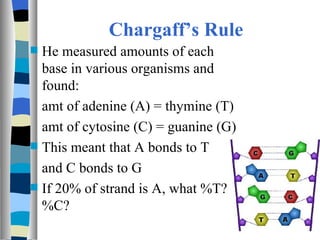
Chargaff’s Rule
 He measured amounts of each
  base in various organisms and
  found:
  amt of adenine (A) = thymine (T)
  amt of cytosine (C) = guanine (G)
 This meant that A bonds to T
  and C bonds to G
 If 20% of strand is A, what %T?
  %C?
Structure of DNA
   Discovered by Watson and Crick
   Double helix- “spiral staircase”, 2
    strands of nucleotides
   Siderails-sugar and phosphate
   Rungs-nitrogen bases
    – A----T
    – C----G


Hydrogen bonds (glue)
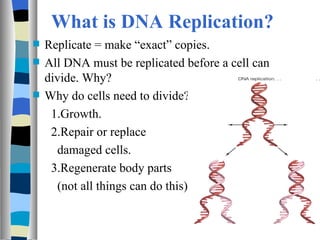
What is DNA Replication?
   Replicate = make “exact” copies.
   All DNA must be replicated before a cell can
    divide. Why?
   Why do cells need to divide?
     1.Growth.
     2.Repair or replace
      damaged cells.
     3.Regenerate body parts
      (not all things can do this).
Enzymes and Replication
 Helicase- unwinds DNA
 DNA polymerase-moves along each strand
  and brings in bases for new strand copy
DNA Replication
 Can be a mistake in replication
 Mutations-change in DNA
 Caused by mutagens, such as X-rays,
  toxins, drugs, UV light, etc.
 Can cause disease, such as cancer,
  cystic fibrosis, etc.
 Can be:
    – insertions of extra bases
    – deletions of bases
    – substitutions of the wrong bases.
Mutations


   Substitution
How Much DNA Is In Our Cells?

 Chromosome-strands of DNA coiled tightly
 Human cell has 46 (23 pair 2 sets of 23)
   23 from Mom
   23 from Dad
 If all body cells contain the same # of
  chromosomes, why are all cells so
  different?
 Different cells make different proteins.
 Different “active” segments of DNA.
 During early stages of development, cells
  become “specialized.”
   The first few cells that develop from
    the zygote are called stem cells.
   Stem cells differentiate into other
    cells.
2 Types of Cells
 Body cells somatic
   diploidchromosomes are in pairs (23 pairs)
 Reproductive cellsgametes
   egg & sperm
   haploid no pairs (23)
What is the Purpose of DNA?

 The cell “factory” makes proteins.
 Gene- a segment of DNA that codes for a
  protein.
 DNA has 1000’s of genes to make many
  different types of proteins.
    – Fingernails, hair, enzymes, hemoglobin, etc.
   Protein - polymer of amino acids
What is the Purpose of DNA?
RNA (Ribonucleic acid)
   _____RNA____vs._____DNA___
     single strand           double strand
    sugar= ribose            sugar= deoxyribose
      A, C, G, U (uracil)   A, C, G, T
      mRNA, rRNA, tRNA      “DNA is DNA”
     all over               nucleus only
Structure RNA
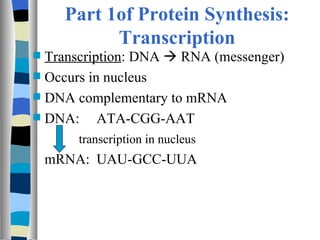
Part 1of Protein Synthesis:
            Transcription
 Transcription: DNA  RNA (messenger)
 Occurs in nucleus
 DNA complementary to mRNA
 DNA:     ATA-CGG-AAT
       transcription in nucleus
    mRNA: UAU-GCC-UUA
Part 2 of Protein Synthesis:
          Translation:
 Translation: mRNA  protein
 Occurs at ribosomes in cytoplasm
 Codon-Three bases on mRNA that code for
  an amino acid
 mRNA: UAU-GCC-UUA              (3 codons)
        translation in cytoplasm
  protein: a.a.---a.a---a.a.
 mRNA needs the help of tRNA to bring in
  the amino acids
Whole Process
  DNA:      ATA-CGG-AAT
            transcription in nucleus
 mRNA: UAU-GCC-UUA(3 codons)
            translation in cytoplasm
 protein:       a.a.-a.a-a.a.

How do we know what amino acid results?
         The Codon chart or wheel!!!
The Codon Wheel

Cp dna 2012

  • 2.
     DNA (deoxyribonucleic acid).  All living things contain DNA.  Source of genetic traits.  DNA is a nucleic acid.  Nucleic acids are made of nucleotides.
  • 3.
    Nucleotides  Made of three things: 1. Phosphate (PO4) 2. Sugar (deoxyribose). 3. Nitrogen base.
  • 4.
    Nitrogen Bases Four nitrogenbases makes four different nucleotides: –Guanine –Cytosine –Adenine –Thymine
  • 5.
    Chargaff’s Rule  Hemeasured amounts of each base in various organisms and found: amt of adenine (A) = thymine (T) amt of cytosine (C) = guanine (G)  This meant that A bonds to T and C bonds to G  If 20% of strand is A, what %T? %C?
  • 6.
    Structure of DNA  Discovered by Watson and Crick  Double helix- “spiral staircase”, 2 strands of nucleotides  Siderails-sugar and phosphate  Rungs-nitrogen bases – A----T – C----G Hydrogen bonds (glue)
  • 7.
    What is DNAReplication?  Replicate = make “exact” copies.  All DNA must be replicated before a cell can divide. Why?  Why do cells need to divide? 1.Growth. 2.Repair or replace damaged cells. 3.Regenerate body parts (not all things can do this).
  • 8.
    Enzymes and Replication Helicase- unwinds DNA  DNA polymerase-moves along each strand and brings in bases for new strand copy
  • 9.
    DNA Replication  Canbe a mistake in replication  Mutations-change in DNA  Caused by mutagens, such as X-rays, toxins, drugs, UV light, etc.  Can cause disease, such as cancer, cystic fibrosis, etc.  Can be: – insertions of extra bases – deletions of bases – substitutions of the wrong bases.
  • 10.
    Mutations Substitution
  • 11.
    How Much DNAIs In Our Cells?  Chromosome-strands of DNA coiled tightly  Human cell has 46 (23 pair 2 sets of 23)  23 from Mom  23 from Dad
  • 13.
     If allbody cells contain the same # of chromosomes, why are all cells so different?  Different cells make different proteins.  Different “active” segments of DNA.  During early stages of development, cells become “specialized.”
  • 14.
    The first few cells that develop from the zygote are called stem cells.  Stem cells differentiate into other cells.
  • 15.
    2 Types ofCells  Body cells somatic  diploidchromosomes are in pairs (23 pairs)  Reproductive cellsgametes  egg & sperm  haploid no pairs (23)
  • 16.
    What is thePurpose of DNA?  The cell “factory” makes proteins.  Gene- a segment of DNA that codes for a protein.  DNA has 1000’s of genes to make many different types of proteins. – Fingernails, hair, enzymes, hemoglobin, etc.  Protein - polymer of amino acids
  • 17.
    What is thePurpose of DNA?
  • 18.
    RNA (Ribonucleic acid)  _____RNA____vs._____DNA___ single strand double strand sugar= ribose sugar= deoxyribose A, C, G, U (uracil) A, C, G, T mRNA, rRNA, tRNA “DNA is DNA” all over nucleus only
  • 19.
  • 20.
    Part 1of ProteinSynthesis: Transcription  Transcription: DNA  RNA (messenger)  Occurs in nucleus  DNA complementary to mRNA  DNA: ATA-CGG-AAT transcription in nucleus mRNA: UAU-GCC-UUA
  • 22.
    Part 2 ofProtein Synthesis: Translation:  Translation: mRNA  protein  Occurs at ribosomes in cytoplasm  Codon-Three bases on mRNA that code for an amino acid  mRNA: UAU-GCC-UUA (3 codons) translation in cytoplasm protein: a.a.---a.a---a.a.  mRNA needs the help of tRNA to bring in the amino acids
  • 23.
    Whole Process DNA: ATA-CGG-AAT transcription in nucleus mRNA: UAU-GCC-UUA(3 codons) translation in cytoplasm protein: a.a.-a.a-a.a. How do we know what amino acid results? The Codon chart or wheel!!!
  • 25.