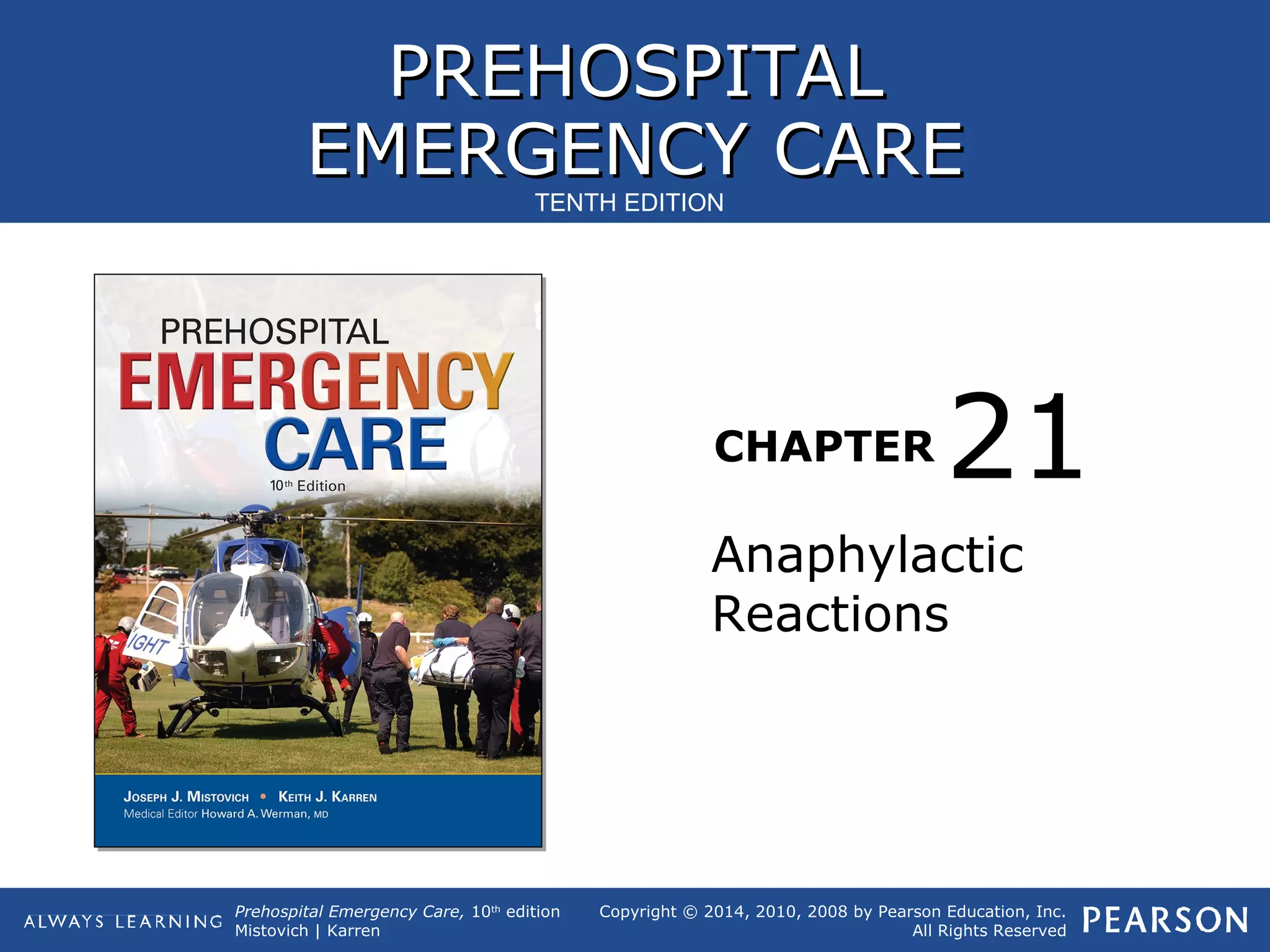
PREHOSPITALPREHOSPITAL
EMERGENCY CAREEMERGENCY CARE
CHAPTER
Copyright © 2014, 2010, 2008 by Pearson Education, Inc.
All Rights Reserved
Prehospital Emergency Care, 10th
edition
Mistovich | Karren
TENTH EDITION
Anaphylactic
Reactions
21
Prehospital Emergency Care, 10th
edition
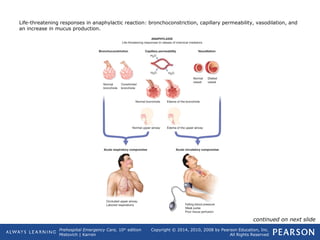
Mistovich | Karren
Copyright © 2014, 2010, 2008 by Pearson Education, Inc.
All Rights Reserved
Learning ReadinessLearning Readiness
• EMS Education Standards, text p. 585
Prehospital Emergency Care, 10th
edition
Mistovich | Karren
Copyright © 2014, 2010, 2008 by Pearson Education, Inc.
All Rights Reserved
Learning ReadinessLearning Readiness
ObjectivesObjectives
• Please refer to page 585 of your text to
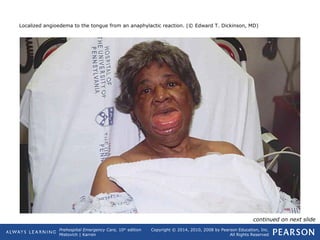
view the objectives for this chapter.
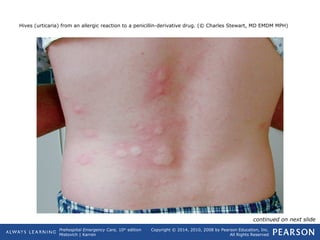
Prehospital Emergency Care, 10th
edition
Mistovich | Karren
Copyright © 2014, 2010, 2008 by Pearson Education, Inc.
All Rights Reserved
Learning ReadinessLearning Readiness
Key TermsKey Terms
• Please refer to page 585 of your text to
view the key terms for this chapter.
Prehospital Emergency Care, 10th
edition
Mistovich | Karren
Copyright © 2014, 2010, 2008 by Pearson Education, Inc.
All Rights Reserved
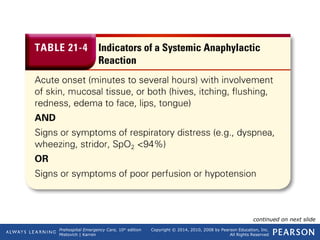
Setting the StageSetting the Stage
• Overview of Lesson Topics
 Anaphylactic Reactions
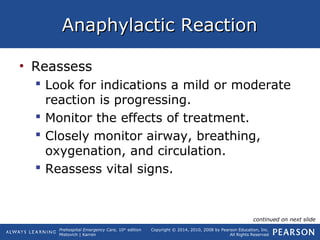
Prehospital Emergency Care, 10th
edition
Mistovich | Karren
Copyright © 2014, 2010, 2008 by Pearson Education, Inc.
All Rights Reserved
Case Study IntroductionCase Study Introduction
EMTs Luke Boyce and Joy Dunn arrive at
Armstrong Elementary School for a report of an
allergic reaction. Six-year-old Jesse Mendoza
began having difficulty breathing, with
weakness and a rash, within a few minutes of
accidentally being exposed to peanuts, to which
he has a known allergy.
The EMTs see a young boy sitting in the nurse's
office with swelling of his lips, and they can
hear wheezing without a stethoscope.
Prehospital Emergency Care, 10th
edition
Mistovich | Karren
Copyright © 2014, 2010, 2008 by Pearson Education, Inc.
All Rights Reserved
Case StudyCase Study
• What level of concern should the EMTs
have, based on their general
impression?
• What is going on in the patient's body
to cause his signs and symptoms?
• What steps should be considered in
formulating a treatment plan for this
patient?
Prehospital Emergency Care, 10th
edition
Mistovich | Karren
Copyright © 2014, 2010, 2008 by Pearson Education, Inc.
All Rights Reserved
IntroductionIntroduction
• An anaphylactic reaction is a severe,
life-threatening allergic reaction.
• Problems include airway swelling,
constriction of the bronchioles, fluid
leaking from the capillaries, and
vasodilation.
• Administering epinephrine can be life
saving.
Prehospital Emergency Care, 10th
edition
Mistovich | Karren
Copyright © 2014, 2010, 2008 by Pearson Education, Inc.
All Rights Reserved
Anaphylactic ReactionAnaphylactic Reaction
• The immune system responds to
foreign substances called antigens.
• Allergens are a type of antigen that can
provoke a reaction in some people.
• The response of the immune system
upon exposure to an antigen is to
produce antibodies.
continued on next slide
Prehospital Emergency Care, 10th
edition
Mistovich | Karren
Copyright © 2014, 2010, 2008 by Pearson Education, Inc.
All Rights Reserved
Anaphylactic ReactionAnaphylactic Reaction
• The body can produce immunoglobulin
E (IgE) in response to allergens.
• When IgE encounters an allergen, it
triggers an immune system response.
• An excessive immune system response
to an allergen is called an allergic
reaction.
continued on next slide
Prehospital Emergency Care, 10th
edition
Mistovich | Karren
Copyright © 2014, 2010, 2008 by Pearson Education, Inc.
All Rights Reserved
Anaphylactic ReactionAnaphylactic Reaction
• A severe, systemic immune response to
an allergen is called an anaphylactic
reaction.
• Chemicals released by the body in
anaphylaxis cause airway swelling,
bronchoconstriction, and vasodilation.
continued on next slide
Prehospital Emergency Care, 10th
edition
Mistovich | Karren
Copyright © 2014, 2010, 2008 by Pearson Education, Inc.
All Rights Reserved
Anaphylactic ReactionAnaphylactic Reaction
• On first exposure to an allergen,
sensitization occurs, and IgE is
produced.
• After sensitization, IgE antibodies
attach to two types of immune cells.
 Mast cells (in the tissues)
 Basophils (in the blood)
continued on next slide
Prehospital Emergency Care, 10th
edition
Mistovich | Karren
Copyright © 2014, 2010, 2008 by Pearson Education, Inc.
All Rights Reserved
Anaphylactic ReactionAnaphylactic Reaction
• On subsequent exposure to an allergen,
the allergen attaches to IgE.
• Mast cells and basophils release
chemicals that mediate the events of
anaphylaxis.
• The primary chemical mediator is
histamine.
continued on next slide
Prehospital Emergency Care, 10th
edition
Mistovich | Karren
Copyright © 2014, 2010, 2008 by Pearson Education, Inc.
All Rights Reserved
Life-threatening responses in anaphylactic reaction: bronchoconstriction, capillary permeability, vasodilation, and
an increase in mucus production.
continued on next slide
Prehospital Emergency Care, 10th
edition
Mistovich | Karren
Copyright © 2014, 2010, 2008 by Pearson Education, Inc.
All Rights Reserved
Anaphylactic ReactionAnaphylactic Reaction
• An anaphylactoid reaction does not
involve IgE, but the signs, symptoms,
and treatment are the same as for
anaphylaxis.
continued on next slide
Prehospital Emergency Care, 10th
edition
Mistovich | Karren
Copyright © 2014, 2010, 2008 by Pearson Education, Inc.
All Rights Reserved
Anaphylactic ReactionAnaphylactic Reaction
• Allergens may enter the body through:
 Injection
 Ingestion
 Inhalation
 Contact
continued on next slide
Prehospital Emergency Care, 10th
edition
Mistovich | Karren
Copyright © 2014, 2010, 2008 by Pearson Education, Inc.
All Rights Reserved
Anaphylactic ReactionAnaphylactic Reaction
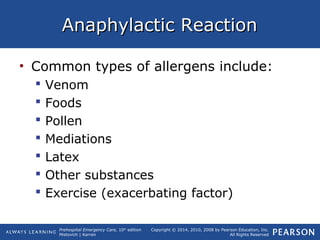
• Common types of allergens include:
 Venom
 Foods
 Pollen
 Mediations
 Latex
 Other substances
 Exercise (exacerbating factor)
Prehospital Emergency Care, 10th
edition
Mistovich | Karren
Copyright © 2014, 2010, 2008 by Pearson Education, Inc.
All Rights Reserved
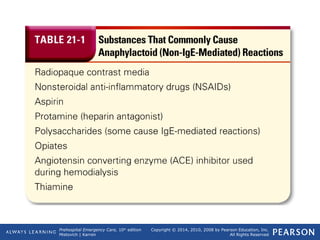
Table 21-1 Substances That Commonly Cause
Anaphylactoid (Non-IgE-Mediated) Reactions
Prehospital Emergency Care, 10th
edition
Mistovich | Karren
Copyright © 2014, 2010, 2008 by Pearson Education, Inc.
All Rights Reserved
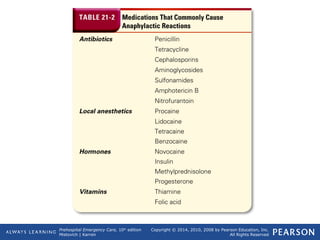
Table 21-2 Medications That Commonly Cause
Anaphylactic Reactions
Prehospital Emergency Care, 10th
edition
Mistovich | Karren
Copyright © 2014, 2010, 2008 by Pearson Education, Inc.
All Rights Reserved
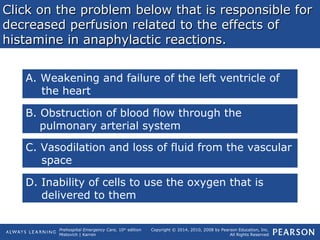
Click on the problem below that is responsible forClick on the problem below that is responsible for
decreased perfusion related to the effects ofdecreased perfusion related to the effects of
histamine in anaphylactic reactions.histamine in anaphylactic reactions.
A. Weakening and failure of the left ventricle of
the heart
B. Obstruction of blood flow through the
pulmonary arterial system
C. Vasodilation and loss of fluid from the vascular
space
D. Inability of cells to use the oxygen that is
delivered to them
Prehospital Emergency Care, 10th
edition
Mistovich | Karren
Copyright © 2014, 2010, 2008 by Pearson Education, Inc.
All Rights Reserved
Anaphylactic ReactionAnaphylactic Reaction
• Assessment-based approach
 Anaphylactic reaction is often apparent
because of the characteristic signs and
symptoms.
 In the scene size-up, be aware of
dangers, such as wasps and bees.
 The type of setting and medications at
the scene can provide clues.
continued on next slide
Prehospital Emergency Care, 10th
edition
Mistovich | Karren
Copyright © 2014, 2010, 2008 by Pearson Education, Inc.
All Rights Reserved
Anaphylactic ReactionAnaphylactic Reaction
• Primary assessment
 The general impression may be a
patient with malaise, general
discomfort, or a sense of impending
doom.
 Mental status varies from alert to
unresponsive.
continued on next slide
Prehospital Emergency Care, 10th
edition
Mistovich | Karren
Copyright © 2014, 2010, 2008 by Pearson Education, Inc.
All Rights Reserved
Anaphylactic ReactionAnaphylactic Reaction
• Primary assessment
 There is a high risk of airway
obstruction.
 Stridor or crowing indicate upper airway
swelling.
 Airway adjuncts will not help with
laryngeal edema.
continued on next slide
Prehospital Emergency Care, 10th
edition
Mistovich | Karren
Copyright © 2014, 2010, 2008 by Pearson Education, Inc.
All Rights Reserved
Anaphylactic ReactionAnaphylactic Reaction
• Primary assessment
 Wheezing may be prominent.
 Positive pressure ventilation may be
necessary.
continued on next slide
Prehospital Emergency Care, 10th
edition
Mistovich | Karren
Copyright © 2014, 2010, 2008 by Pearson Education, Inc.
All Rights Reserved
Anaphylactic ReactionAnaphylactic Reaction
• Primary assessment
 Maintain SpO2 at 94% or greater.
 Ventilations may be difficult from
increased airway resistance.
 Consider requesting ALS for airway
management.
continued on next slide
Prehospital Emergency Care, 10th
edition
Mistovich | Karren
Copyright © 2014, 2010, 2008 by Pearson Education, Inc.
All Rights Reserved
Anaphylactic ReactionAnaphylactic Reaction
• Primary assessment
 The pulse may be weak and rapid.
 There may be edema, and the skin may
be red and warm or cyanotic.
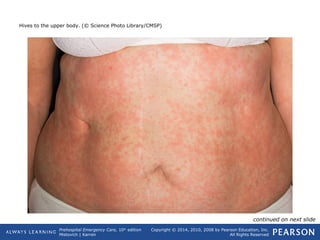
 Hives and itching are characteristic.
continued on next slide
Prehospital Emergency Care, 10th
edition
Mistovich | Karren
Copyright © 2014, 2010, 2008 by Pearson Education, Inc.
All Rights Reserved
Localized angioedema to the tongue from an anaphylactic reaction. (© Edward T. Dickinson, MD)
continued on next slide
Prehospital Emergency Care, 10th
edition
Mistovich | Karren
Copyright © 2014, 2010, 2008 by Pearson Education, Inc.
All Rights Reserved
Hives (urticaria) from an allergic reaction to a penicillin-derivative drug. (© Charles Stewart, MD EMDM MPH)
continued on next slide
Prehospital Emergency Care, 10th
edition
Mistovich | Karren
Copyright © 2014, 2010, 2008 by Pearson Education, Inc.
All Rights Reserved
Hives to the upper body. (© Science Photo Library/CMSP)
continued on next slide
Prehospital Emergency Care, 10th
edition
Mistovich | Karren
Copyright © 2014, 2010, 2008 by Pearson Education, Inc.
All Rights Reserved
Anaphylactic ReactionAnaphylactic Reaction
• Signs and symptoms include:
 Rhinitis
 Tachycardia
 Pruritus
 Faintness
continued on next slide
Prehospital Emergency Care, 10th
edition
Mistovich | Karren
Copyright © 2014, 2010, 2008 by Pearson Education, Inc.
All Rights Reserved
Anaphylactic ReactionAnaphylactic Reaction
• Signs and symptoms include:
 Warm, flushed skin (may be pale)
 Agitation, anxiety
 Urticaria
 Edema
continued on next slide
Prehospital Emergency Care, 10th
edition
Mistovich | Karren
Copyright © 2014, 2010, 2008 by Pearson Education, Inc.
All Rights Reserved
Anaphylactic ReactionAnaphylactic Reaction
• Be prepared for immediate intervention
and transport.
• Determine whether the patient has an
epinephrine auto-injector.
continued on next slide
Prehospital Emergency Care, 10th
edition
Mistovich | Karren
Copyright © 2014, 2010, 2008 by Pearson Education, Inc.
All Rights Reserved
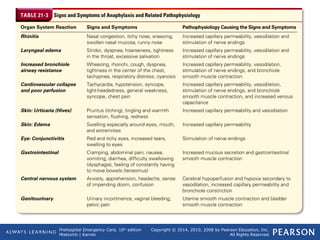
Table 21-3 Signs and Symptoms of Anaphylaxis and
Related Pathophysiology
Prehospital Emergency Care, 10th
edition
Mistovich | Karren
Copyright © 2014, 2010, 2008 by Pearson Education, Inc.
All Rights Reserved
Anaphylactic ReactionAnaphylactic Reaction
• Secondary assessment
 For the history of the present illness,
use OPQRST.
 Time is critical—generally, the more
quickly the reaction develops, the more
severe it will be.
continued on next slide
Prehospital Emergency Care, 10th
edition
Mistovich | Karren
Copyright © 2014, 2010, 2008 by Pearson Education, Inc.
All Rights Reserved
Anaphylactic ReactionAnaphylactic Reaction
• Determine the following:
 Are signs and symptoms consistent with
anaphylaxis?
 Are signs and symptoms mild,
moderate, or severe?
 Are signs and symptoms getting worse
or better?
continued on next slide
Prehospital Emergency Care, 10th
edition
Mistovich | Karren
Copyright © 2014, 2010, 2008 by Pearson Education, Inc.
All Rights Reserved
Anaphylactic ReactionAnaphylactic Reaction
• Determine the following:
 Does the patient have a history of
allergies or anaphylactic reaction?
 Does the patient have an epinephrine
auto-injector?
 Has the patient taken any other
medications?
 What medications is the patient taking?
Any new medications?
continued on next slide
Prehospital Emergency Care, 10th
edition
Mistovich | Karren
Copyright © 2014, 2010, 2008 by Pearson Education, Inc.
All Rights Reserved
Anaphylactic ReactionAnaphylactic Reaction
• Determine the following:
 Has the patient had an anaphylactic
reaction in the past?
 How severe was the last reaction?
 Does the patient have other illnesses?
continued on next slide
Prehospital Emergency Care, 10th
edition
Mistovich | Karren
Copyright © 2014, 2010, 2008 by Pearson Education, Inc.
All Rights Reserved
Anaphylactic ReactionAnaphylactic Reaction
• Determine the following:
 When did the patient last eat or drink?
What did he recently eat or drink?
 What was the patient doing before the
onset of the reaction?
 Was the patient exposed to anything
that could have caused the reaction,
and by what route?
continued on next slide
Prehospital Emergency Care, 10th
edition
Mistovich | Karren
Copyright © 2014, 2010, 2008 by Pearson Education, Inc.
All Rights Reserved
Anaphylactic ReactionAnaphylactic Reaction
• Obtain baseline vital signs.
 Hypotension may be present.
 Respirations may be fast and labored.
 Wheezing may be heard without a
stethoscope.
 The pulse may be rapid and weak.
continued on next slide
Prehospital Emergency Care, 10th
edition
Mistovich | Karren
Copyright © 2014, 2010, 2008 by Pearson Education, Inc.
All Rights Reserved
Anaphylactic ReactionAnaphylactic Reaction
• Emergency medical care
 Distinguish between a systemic and a
local reaction.
 Treatment depends on this distinction.
continued on next slide
Prehospital Emergency Care, 10th
edition
Mistovich | Karren
Copyright © 2014, 2010, 2008 by Pearson Education, Inc.
All Rights Reserved
Anaphylactic ReactionAnaphylactic Reaction
• Two key categories of signs and
symptoms
 Airway and respiratory compromise
 Shock
continued on next slide
Prehospital Emergency Care, 10th
edition
Mistovich | Karren
Copyright © 2014, 2010, 2008 by Pearson Education, Inc.
All Rights Reserved
Table 21-4 Indicators of a Systemic Anaphylactic
Reaction
continued on next slide
Prehospital Emergency Care, 10th
edition
Mistovich | Karren
Copyright © 2014, 2010, 2008 by Pearson Education, Inc.
All Rights Reserved
Anaphylactic ReactionAnaphylactic Reaction
• Maintain a patent airway; airway
adjuncts may not be effective.
• Suction secretions.
• Maintain an SpO2 of 94% or greater.
continued on next slide
Prehospital Emergency Care, 10th
edition
Mistovich | Karren
Copyright © 2014, 2010, 2008 by Pearson Education, Inc.
All Rights Reserved
Anaphylactic ReactionAnaphylactic Reaction
• Be prepared to provide positive
pressure ventilation.
• Administer epinephrine by prescribed
auto-injector, according to protocol.
• Consider requesting ALS.
• Initiate transport early.
continued on next slide
Prehospital Emergency Care, 10th
edition
Mistovich | Karren
Copyright © 2014, 2010, 2008 by Pearson Education, Inc.
All Rights Reserved
Anaphylactic ReactionAnaphylactic Reaction
• Reassess
 Look for indications a mild or moderate
reaction is progressing.
 Monitor the effects of treatment.
 Closely monitor airway, breathing,
oxygenation, and circulation.
 Reassess vital signs.
continued on next slide
Prehospital Emergency Care, 10th
edition
Mistovich | Karren
Copyright © 2014, 2010, 2008 by Pearson Education, Inc.
All Rights Reserved
Anaphylactic ReactionAnaphylactic Reaction
• Epinephrine auto-injector
 Epinephrine mimics the effects of the
sympathetic nervous system to treat the
signs and symptoms of anaphylaxis.
 Alpha1 effects cause vasoconstriction.
 Beta2 effects cause bronchodilation.
 Beta1 effects result in side effects.
continued on next slide
Prehospital Emergency Care, 10th
edition
Mistovich | Karren
Copyright © 2014, 2010, 2008 by Pearson Education, Inc.
All Rights Reserved
Anaphylactic ReactionAnaphylactic Reaction
• Epinephrine auto-injector
 The effects of epinephrine are rapid, but
short-lived.
 Auto-injectors may be packed singly or
in pairs.
 There are two dosages.
• 0.3 mg for patients 66 lb. or greater
• 0.15 mg for patients less than 66 lb.
continued on next slide
Prehospital Emergency Care, 10th
edition
Mistovich | Karren
Copyright © 2014, 2010, 2008 by Pearson Education, Inc.
All Rights Reserved
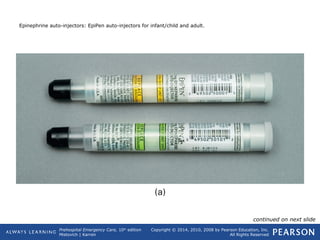
Epinephrine auto-injectors: EpiPen auto-injectors for infant/child and adult.
continued on next slide
Prehospital Emergency Care, 10th
edition
Mistovich | Karren
Copyright © 2014, 2010, 2008 by Pearson Education, Inc.
All Rights Reserved
Anaphylactic ReactionAnaphylactic Reaction
• Epinephrine auto-injector
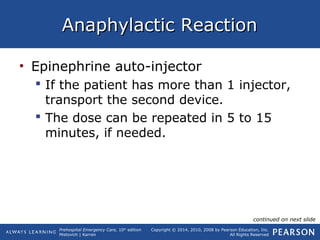
 If the patient has more than 1 injector,
transport the second device.
 The dose can be repeated in 5 to 15
minutes, if needed.
continued on next slide
Prehospital Emergency Care, 10th
edition
Mistovich | Karren
Copyright © 2014, 2010, 2008 by Pearson Education, Inc.
All Rights Reserved
Anaphylactic ReactionAnaphylactic Reaction
• Epinephrine auto-injector side effects
 Increased heart rate
 Pale skin
 Dizziness
 Chest pain
 Headache
 Nausea and vomiting
 Excitability and anxiousness
Prehospital Emergency Care, 10th
edition
Mistovich | Karren
Copyright © 2014, 2010, 2008 by Pearson Education, Inc.
All Rights Reserved
EMT SKILLS 21-1
Administering an EpiPen Epinephrine
Auto-Injector
Prehospital Emergency Care, 10th
edition
Mistovich | Karren
Copyright © 2014, 2010, 2008 by Pearson Education, Inc.
All Rights Reserved
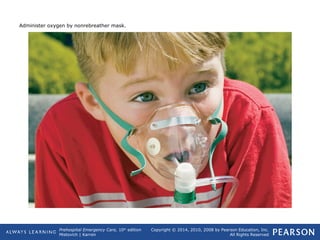
Administer oxygen by nonrebreather mask.
Prehospital Emergency Care, 10th
edition
Mistovich | Karren
Copyright © 2014, 2010, 2008 by Pearson Education, Inc.
All Rights Reserved
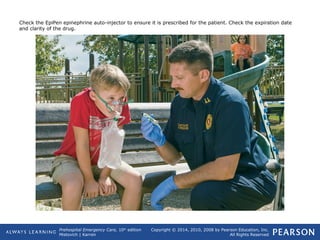
Check the EpiPen epinephrine auto-injector to ensure it is prescribed for the patient. Check the expiration date
and clarity of the drug.
Prehospital Emergency Care, 10th
edition
Mistovich | Karren
Copyright © 2014, 2010, 2008 by Pearson Education, Inc.
All Rights Reserved
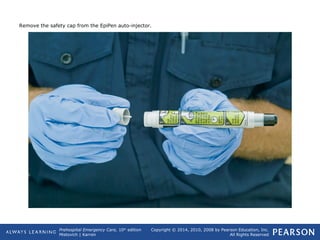
Remove the safety cap from the EpiPen auto-injector.
Prehospital Emergency Care, 10th
edition
Mistovich | Karren
Copyright © 2014, 2010, 2008 by Pearson Education, Inc.
All Rights Reserved
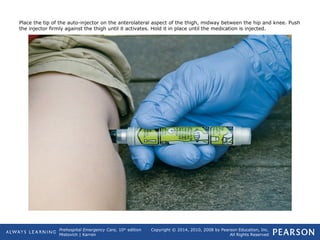
Place the tip of the auto-injector on the anterolateral aspect of the thigh, midway between the hip and knee. Push
the injector firmly against the thigh until it activates. Hold it in place until the medication is injected.
Prehospital Emergency Care, 10th
edition
Mistovich | Karren
Copyright © 2014, 2010, 2008 by Pearson Education, Inc.
All Rights Reserved
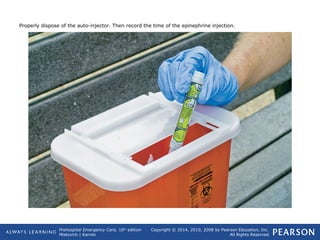
Properly dispose of the auto-injector. Then record the time of the epinephrine injection.
Prehospital Emergency Care, 10th
edition
Mistovich | Karren
Copyright © 2014, 2010, 2008 by Pearson Education, Inc.
All Rights Reserved
Case Study ConclusionCase Study Conclusion
Luke and Joy quickly gather information to
confirm their initial impression of
anaphylaxis. Jesse has an epinephrine auto-
injector in the nurse's office, but the nurse is
not currently at the school.
As Joy reassures Jesse and completes a
rapid secondary assessment, including vital
signs, Luke confirms that the auto-injector is
prescribed to Jesse and administers it.
continued on next slide
Prehospital Emergency Care, 10th
edition
Mistovich | Karren
Copyright © 2014, 2010, 2008 by Pearson Education, Inc.
All Rights Reserved
Case Study ConclusionCase Study Conclusion
Recognizing the short duration of action of
epinephrine, the EMTs do not spend further
time at the scene, but transport
immediately.
Jesse's wheezing decreases en route, and
there is no worsening of his swelling or rash.
His blood pressure remains normal, as well
as his SpO2, although is heart rate has
increased from an initial 104 to 116.
continued on next slide
Prehospital Emergency Care, 10th
edition
Mistovich | Karren
Copyright © 2014, 2010, 2008 by Pearson Education, Inc.
All Rights Reserved
Case Study ConclusionCase Study Conclusion
At the emergency department, Jesse
receives additional epinephrine, as well as
an antihistamine. After being observed and
monitored for several hours, Jesse's parents
are grateful to be able to take him home.
Prehospital Emergency Care, 10th
edition
Mistovich | Karren
Copyright © 2014, 2010, 2008 by Pearson Education, Inc.
All Rights Reserved
Lesson SummaryLesson Summary
• An anaphylactic reaction is a severe
allergic reaction.
• The pathophysiology includes airway
edema, bronchoconstriction, and
vasodilation.
• Care includes airway management,
ventilation and oxygenation, and
administration of epinephrine.
continued on next slide
Prehospital Emergency Care, 10th
edition
Mistovich | Karren
Copyright © 2014, 2010, 2008 by Pearson Education, Inc.
All Rights Reserved
Lesson SummaryLesson Summary
• Anaphylaxis can progress rapidly;
reassess the patient frequently.

DMACC EMT Chapter 21

  • 1.
    PREHOSPITALPREHOSPITAL EMERGENCY CAREEMERGENCY CARE CHAPTER Copyright© 2014, 2010, 2008 by Pearson Education, Inc. All Rights Reserved Prehospital Emergency Care, 10th edition Mistovich | Karren TENTH EDITION Anaphylactic Reactions 21
  • 2.
    Prehospital Emergency Care,10th edition Mistovich | Karren Copyright © 2014, 2010, 2008 by Pearson Education, Inc. All Rights Reserved Learning ReadinessLearning Readiness • EMS Education Standards, text p. 585
  • 3.
    Prehospital Emergency Care,10th edition Mistovich | Karren Copyright © 2014, 2010, 2008 by Pearson Education, Inc. All Rights Reserved Learning ReadinessLearning Readiness ObjectivesObjectives • Please refer to page 585 of your text to view the objectives for this chapter.
  • 4.
    Prehospital Emergency Care,10th edition Mistovich | Karren Copyright © 2014, 2010, 2008 by Pearson Education, Inc. All Rights Reserved Learning ReadinessLearning Readiness Key TermsKey Terms • Please refer to page 585 of your text to view the key terms for this chapter.
  • 5.
    Prehospital Emergency Care,10th edition Mistovich | Karren Copyright © 2014, 2010, 2008 by Pearson Education, Inc. All Rights Reserved Setting the StageSetting the Stage • Overview of Lesson Topics  Anaphylactic Reactions
  • 6.
    Prehospital Emergency Care,10th edition Mistovich | Karren Copyright © 2014, 2010, 2008 by Pearson Education, Inc. All Rights Reserved Case Study IntroductionCase Study Introduction EMTs Luke Boyce and Joy Dunn arrive at Armstrong Elementary School for a report of an allergic reaction. Six-year-old Jesse Mendoza began having difficulty breathing, with weakness and a rash, within a few minutes of accidentally being exposed to peanuts, to which he has a known allergy. The EMTs see a young boy sitting in the nurse's office with swelling of his lips, and they can hear wheezing without a stethoscope.
  • 7.
    Prehospital Emergency Care,10th edition Mistovich | Karren Copyright © 2014, 2010, 2008 by Pearson Education, Inc. All Rights Reserved Case StudyCase Study • What level of concern should the EMTs have, based on their general impression? • What is going on in the patient's body to cause his signs and symptoms? • What steps should be considered in formulating a treatment plan for this patient?
  • 8.
    Prehospital Emergency Care,10th edition Mistovich | Karren Copyright © 2014, 2010, 2008 by Pearson Education, Inc. All Rights Reserved IntroductionIntroduction • An anaphylactic reaction is a severe, life-threatening allergic reaction. • Problems include airway swelling, constriction of the bronchioles, fluid leaking from the capillaries, and vasodilation. • Administering epinephrine can be life saving.
  • 9.
    Prehospital Emergency Care,10th edition Mistovich | Karren Copyright © 2014, 2010, 2008 by Pearson Education, Inc. All Rights Reserved Anaphylactic ReactionAnaphylactic Reaction • The immune system responds to foreign substances called antigens. • Allergens are a type of antigen that can provoke a reaction in some people. • The response of the immune system upon exposure to an antigen is to produce antibodies. continued on next slide
  • 10.
    Prehospital Emergency Care,10th edition Mistovich | Karren Copyright © 2014, 2010, 2008 by Pearson Education, Inc. All Rights Reserved Anaphylactic ReactionAnaphylactic Reaction • The body can produce immunoglobulin E (IgE) in response to allergens. • When IgE encounters an allergen, it triggers an immune system response. • An excessive immune system response to an allergen is called an allergic reaction. continued on next slide
  • 11.
    Prehospital Emergency Care,10th edition Mistovich | Karren Copyright © 2014, 2010, 2008 by Pearson Education, Inc. All Rights Reserved Anaphylactic ReactionAnaphylactic Reaction • A severe, systemic immune response to an allergen is called an anaphylactic reaction. • Chemicals released by the body in anaphylaxis cause airway swelling, bronchoconstriction, and vasodilation. continued on next slide
  • 12.
    Prehospital Emergency Care,10th edition Mistovich | Karren Copyright © 2014, 2010, 2008 by Pearson Education, Inc. All Rights Reserved Anaphylactic ReactionAnaphylactic Reaction • On first exposure to an allergen, sensitization occurs, and IgE is produced. • After sensitization, IgE antibodies attach to two types of immune cells.  Mast cells (in the tissues)  Basophils (in the blood) continued on next slide
  • 13.
    Prehospital Emergency Care,10th edition Mistovich | Karren Copyright © 2014, 2010, 2008 by Pearson Education, Inc. All Rights Reserved Anaphylactic ReactionAnaphylactic Reaction • On subsequent exposure to an allergen, the allergen attaches to IgE. • Mast cells and basophils release chemicals that mediate the events of anaphylaxis. • The primary chemical mediator is histamine. continued on next slide
  • 14.
    Prehospital Emergency Care,10th edition Mistovich | Karren Copyright © 2014, 2010, 2008 by Pearson Education, Inc. All Rights Reserved Life-threatening responses in anaphylactic reaction: bronchoconstriction, capillary permeability, vasodilation, and an increase in mucus production. continued on next slide
  • 15.
    Prehospital Emergency Care,10th edition Mistovich | Karren Copyright © 2014, 2010, 2008 by Pearson Education, Inc. All Rights Reserved Anaphylactic ReactionAnaphylactic Reaction • An anaphylactoid reaction does not involve IgE, but the signs, symptoms, and treatment are the same as for anaphylaxis. continued on next slide
  • 16.
    Prehospital Emergency Care,10th edition Mistovich | Karren Copyright © 2014, 2010, 2008 by Pearson Education, Inc. All Rights Reserved Anaphylactic ReactionAnaphylactic Reaction • Allergens may enter the body through:  Injection  Ingestion  Inhalation  Contact continued on next slide
  • 17.
    Prehospital Emergency Care,10th edition Mistovich | Karren Copyright © 2014, 2010, 2008 by Pearson Education, Inc. All Rights Reserved Anaphylactic ReactionAnaphylactic Reaction • Common types of allergens include:  Venom  Foods  Pollen  Mediations  Latex  Other substances  Exercise (exacerbating factor)
  • 18.
    Prehospital Emergency Care,10th edition Mistovich | Karren Copyright © 2014, 2010, 2008 by Pearson Education, Inc. All Rights Reserved Table 21-1 Substances That Commonly Cause Anaphylactoid (Non-IgE-Mediated) Reactions
  • 19.
    Prehospital Emergency Care,10th edition Mistovich | Karren Copyright © 2014, 2010, 2008 by Pearson Education, Inc. All Rights Reserved Table 21-2 Medications That Commonly Cause Anaphylactic Reactions
  • 20.
    Prehospital Emergency Care,10th edition Mistovich | Karren Copyright © 2014, 2010, 2008 by Pearson Education, Inc. All Rights Reserved Click on the problem below that is responsible forClick on the problem below that is responsible for decreased perfusion related to the effects ofdecreased perfusion related to the effects of histamine in anaphylactic reactions.histamine in anaphylactic reactions. A. Weakening and failure of the left ventricle of the heart B. Obstruction of blood flow through the pulmonary arterial system C. Vasodilation and loss of fluid from the vascular space D. Inability of cells to use the oxygen that is delivered to them
  • 21.
    Prehospital Emergency Care,10th edition Mistovich | Karren Copyright © 2014, 2010, 2008 by Pearson Education, Inc. All Rights Reserved Anaphylactic ReactionAnaphylactic Reaction • Assessment-based approach  Anaphylactic reaction is often apparent because of the characteristic signs and symptoms.  In the scene size-up, be aware of dangers, such as wasps and bees.  The type of setting and medications at the scene can provide clues. continued on next slide
  • 22.
    Prehospital Emergency Care,10th edition Mistovich | Karren Copyright © 2014, 2010, 2008 by Pearson Education, Inc. All Rights Reserved Anaphylactic ReactionAnaphylactic Reaction • Primary assessment  The general impression may be a patient with malaise, general discomfort, or a sense of impending doom.  Mental status varies from alert to unresponsive. continued on next slide
  • 23.
    Prehospital Emergency Care,10th edition Mistovich | Karren Copyright © 2014, 2010, 2008 by Pearson Education, Inc. All Rights Reserved Anaphylactic ReactionAnaphylactic Reaction • Primary assessment  There is a high risk of airway obstruction.  Stridor or crowing indicate upper airway swelling.  Airway adjuncts will not help with laryngeal edema. continued on next slide
  • 24.
    Prehospital Emergency Care,10th edition Mistovich | Karren Copyright © 2014, 2010, 2008 by Pearson Education, Inc. All Rights Reserved Anaphylactic ReactionAnaphylactic Reaction • Primary assessment  Wheezing may be prominent.  Positive pressure ventilation may be necessary. continued on next slide
  • 25.
    Prehospital Emergency Care,10th edition Mistovich | Karren Copyright © 2014, 2010, 2008 by Pearson Education, Inc. All Rights Reserved Anaphylactic ReactionAnaphylactic Reaction • Primary assessment  Maintain SpO2 at 94% or greater.  Ventilations may be difficult from increased airway resistance.  Consider requesting ALS for airway management. continued on next slide
  • 26.
    Prehospital Emergency Care,10th edition Mistovich | Karren Copyright © 2014, 2010, 2008 by Pearson Education, Inc. All Rights Reserved Anaphylactic ReactionAnaphylactic Reaction • Primary assessment  The pulse may be weak and rapid.  There may be edema, and the skin may be red and warm or cyanotic.  Hives and itching are characteristic. continued on next slide
  • 27.
    Prehospital Emergency Care,10th edition Mistovich | Karren Copyright © 2014, 2010, 2008 by Pearson Education, Inc. All Rights Reserved Localized angioedema to the tongue from an anaphylactic reaction. (© Edward T. Dickinson, MD) continued on next slide
  • 28.
    Prehospital Emergency Care,10th edition Mistovich | Karren Copyright © 2014, 2010, 2008 by Pearson Education, Inc. All Rights Reserved Hives (urticaria) from an allergic reaction to a penicillin-derivative drug. (© Charles Stewart, MD EMDM MPH) continued on next slide
  • 29.
    Prehospital Emergency Care,10th edition Mistovich | Karren Copyright © 2014, 2010, 2008 by Pearson Education, Inc. All Rights Reserved Hives to the upper body. (© Science Photo Library/CMSP) continued on next slide
  • 30.
    Prehospital Emergency Care,10th edition Mistovich | Karren Copyright © 2014, 2010, 2008 by Pearson Education, Inc. All Rights Reserved Anaphylactic ReactionAnaphylactic Reaction • Signs and symptoms include:  Rhinitis  Tachycardia  Pruritus  Faintness continued on next slide
  • 31.
    Prehospital Emergency Care,10th edition Mistovich | Karren Copyright © 2014, 2010, 2008 by Pearson Education, Inc. All Rights Reserved Anaphylactic ReactionAnaphylactic Reaction • Signs and symptoms include:  Warm, flushed skin (may be pale)  Agitation, anxiety  Urticaria  Edema continued on next slide
  • 32.
    Prehospital Emergency Care,10th edition Mistovich | Karren Copyright © 2014, 2010, 2008 by Pearson Education, Inc. All Rights Reserved Anaphylactic ReactionAnaphylactic Reaction • Be prepared for immediate intervention and transport. • Determine whether the patient has an epinephrine auto-injector. continued on next slide
  • 33.
    Prehospital Emergency Care,10th edition Mistovich | Karren Copyright © 2014, 2010, 2008 by Pearson Education, Inc. All Rights Reserved Table 21-3 Signs and Symptoms of Anaphylaxis and Related Pathophysiology
  • 34.
    Prehospital Emergency Care,10th edition Mistovich | Karren Copyright © 2014, 2010, 2008 by Pearson Education, Inc. All Rights Reserved Anaphylactic ReactionAnaphylactic Reaction • Secondary assessment  For the history of the present illness, use OPQRST.  Time is critical—generally, the more quickly the reaction develops, the more severe it will be. continued on next slide
  • 35.
    Prehospital Emergency Care,10th edition Mistovich | Karren Copyright © 2014, 2010, 2008 by Pearson Education, Inc. All Rights Reserved Anaphylactic ReactionAnaphylactic Reaction • Determine the following:  Are signs and symptoms consistent with anaphylaxis?  Are signs and symptoms mild, moderate, or severe?  Are signs and symptoms getting worse or better? continued on next slide
  • 36.
    Prehospital Emergency Care,10th edition Mistovich | Karren Copyright © 2014, 2010, 2008 by Pearson Education, Inc. All Rights Reserved Anaphylactic ReactionAnaphylactic Reaction • Determine the following:  Does the patient have a history of allergies or anaphylactic reaction?  Does the patient have an epinephrine auto-injector?  Has the patient taken any other medications?  What medications is the patient taking? Any new medications? continued on next slide
  • 37.
    Prehospital Emergency Care,10th edition Mistovich | Karren Copyright © 2014, 2010, 2008 by Pearson Education, Inc. All Rights Reserved Anaphylactic ReactionAnaphylactic Reaction • Determine the following:  Has the patient had an anaphylactic reaction in the past?  How severe was the last reaction?  Does the patient have other illnesses? continued on next slide
  • 38.
    Prehospital Emergency Care,10th edition Mistovich | Karren Copyright © 2014, 2010, 2008 by Pearson Education, Inc. All Rights Reserved Anaphylactic ReactionAnaphylactic Reaction • Determine the following:  When did the patient last eat or drink? What did he recently eat or drink?  What was the patient doing before the onset of the reaction?  Was the patient exposed to anything that could have caused the reaction, and by what route? continued on next slide
  • 39.
    Prehospital Emergency Care,10th edition Mistovich | Karren Copyright © 2014, 2010, 2008 by Pearson Education, Inc. All Rights Reserved Anaphylactic ReactionAnaphylactic Reaction • Obtain baseline vital signs.  Hypotension may be present.  Respirations may be fast and labored.  Wheezing may be heard without a stethoscope.  The pulse may be rapid and weak. continued on next slide
  • 40.
    Prehospital Emergency Care,10th edition Mistovich | Karren Copyright © 2014, 2010, 2008 by Pearson Education, Inc. All Rights Reserved Anaphylactic ReactionAnaphylactic Reaction • Emergency medical care  Distinguish between a systemic and a local reaction.  Treatment depends on this distinction. continued on next slide
  • 41.
    Prehospital Emergency Care,10th edition Mistovich | Karren Copyright © 2014, 2010, 2008 by Pearson Education, Inc. All Rights Reserved Anaphylactic ReactionAnaphylactic Reaction • Two key categories of signs and symptoms  Airway and respiratory compromise  Shock continued on next slide
  • 42.
    Prehospital Emergency Care,10th edition Mistovich | Karren Copyright © 2014, 2010, 2008 by Pearson Education, Inc. All Rights Reserved Table 21-4 Indicators of a Systemic Anaphylactic Reaction continued on next slide
  • 43.
    Prehospital Emergency Care,10th edition Mistovich | Karren Copyright © 2014, 2010, 2008 by Pearson Education, Inc. All Rights Reserved Anaphylactic ReactionAnaphylactic Reaction • Maintain a patent airway; airway adjuncts may not be effective. • Suction secretions. • Maintain an SpO2 of 94% or greater. continued on next slide
  • 44.
    Prehospital Emergency Care,10th edition Mistovich | Karren Copyright © 2014, 2010, 2008 by Pearson Education, Inc. All Rights Reserved Anaphylactic ReactionAnaphylactic Reaction • Be prepared to provide positive pressure ventilation. • Administer epinephrine by prescribed auto-injector, according to protocol. • Consider requesting ALS. • Initiate transport early. continued on next slide
  • 45.
    Prehospital Emergency Care,10th edition Mistovich | Karren Copyright © 2014, 2010, 2008 by Pearson Education, Inc. All Rights Reserved Anaphylactic ReactionAnaphylactic Reaction • Reassess  Look for indications a mild or moderate reaction is progressing.  Monitor the effects of treatment.  Closely monitor airway, breathing, oxygenation, and circulation.  Reassess vital signs. continued on next slide
  • 46.
    Prehospital Emergency Care,10th edition Mistovich | Karren Copyright © 2014, 2010, 2008 by Pearson Education, Inc. All Rights Reserved Anaphylactic ReactionAnaphylactic Reaction • Epinephrine auto-injector  Epinephrine mimics the effects of the sympathetic nervous system to treat the signs and symptoms of anaphylaxis.  Alpha1 effects cause vasoconstriction.  Beta2 effects cause bronchodilation.  Beta1 effects result in side effects. continued on next slide
  • 47.
    Prehospital Emergency Care,10th edition Mistovich | Karren Copyright © 2014, 2010, 2008 by Pearson Education, Inc. All Rights Reserved Anaphylactic ReactionAnaphylactic Reaction • Epinephrine auto-injector  The effects of epinephrine are rapid, but short-lived.  Auto-injectors may be packed singly or in pairs.  There are two dosages. • 0.3 mg for patients 66 lb. or greater • 0.15 mg for patients less than 66 lb. continued on next slide
  • 48.
    Prehospital Emergency Care,10th edition Mistovich | Karren Copyright © 2014, 2010, 2008 by Pearson Education, Inc. All Rights Reserved Epinephrine auto-injectors: EpiPen auto-injectors for infant/child and adult. continued on next slide
  • 49.
    Prehospital Emergency Care,10th edition Mistovich | Karren Copyright © 2014, 2010, 2008 by Pearson Education, Inc. All Rights Reserved Anaphylactic ReactionAnaphylactic Reaction • Epinephrine auto-injector  If the patient has more than 1 injector, transport the second device.  The dose can be repeated in 5 to 15 minutes, if needed. continued on next slide
  • 50.
    Prehospital Emergency Care,10th edition Mistovich | Karren Copyright © 2014, 2010, 2008 by Pearson Education, Inc. All Rights Reserved Anaphylactic ReactionAnaphylactic Reaction • Epinephrine auto-injector side effects  Increased heart rate  Pale skin  Dizziness  Chest pain  Headache  Nausea and vomiting  Excitability and anxiousness
  • 51.
    Prehospital Emergency Care,10th edition Mistovich | Karren Copyright © 2014, 2010, 2008 by Pearson Education, Inc. All Rights Reserved EMT SKILLS 21-1 Administering an EpiPen Epinephrine Auto-Injector
  • 52.
    Prehospital Emergency Care,10th edition Mistovich | Karren Copyright © 2014, 2010, 2008 by Pearson Education, Inc. All Rights Reserved Administer oxygen by nonrebreather mask.
  • 53.
    Prehospital Emergency Care,10th edition Mistovich | Karren Copyright © 2014, 2010, 2008 by Pearson Education, Inc. All Rights Reserved Check the EpiPen epinephrine auto-injector to ensure it is prescribed for the patient. Check the expiration date and clarity of the drug.
  • 54.
    Prehospital Emergency Care,10th edition Mistovich | Karren Copyright © 2014, 2010, 2008 by Pearson Education, Inc. All Rights Reserved Remove the safety cap from the EpiPen auto-injector.
  • 55.
    Prehospital Emergency Care,10th edition Mistovich | Karren Copyright © 2014, 2010, 2008 by Pearson Education, Inc. All Rights Reserved Place the tip of the auto-injector on the anterolateral aspect of the thigh, midway between the hip and knee. Push the injector firmly against the thigh until it activates. Hold it in place until the medication is injected.
  • 56.
    Prehospital Emergency Care,10th edition Mistovich | Karren Copyright © 2014, 2010, 2008 by Pearson Education, Inc. All Rights Reserved Properly dispose of the auto-injector. Then record the time of the epinephrine injection.
  • 57.
    Prehospital Emergency Care,10th edition Mistovich | Karren Copyright © 2014, 2010, 2008 by Pearson Education, Inc. All Rights Reserved Case Study ConclusionCase Study Conclusion Luke and Joy quickly gather information to confirm their initial impression of anaphylaxis. Jesse has an epinephrine auto- injector in the nurse's office, but the nurse is not currently at the school. As Joy reassures Jesse and completes a rapid secondary assessment, including vital signs, Luke confirms that the auto-injector is prescribed to Jesse and administers it. continued on next slide
  • 58.
    Prehospital Emergency Care,10th edition Mistovich | Karren Copyright © 2014, 2010, 2008 by Pearson Education, Inc. All Rights Reserved Case Study ConclusionCase Study Conclusion Recognizing the short duration of action of epinephrine, the EMTs do not spend further time at the scene, but transport immediately. Jesse's wheezing decreases en route, and there is no worsening of his swelling or rash. His blood pressure remains normal, as well as his SpO2, although is heart rate has increased from an initial 104 to 116. continued on next slide
  • 59.
    Prehospital Emergency Care,10th edition Mistovich | Karren Copyright © 2014, 2010, 2008 by Pearson Education, Inc. All Rights Reserved Case Study ConclusionCase Study Conclusion At the emergency department, Jesse receives additional epinephrine, as well as an antihistamine. After being observed and monitored for several hours, Jesse's parents are grateful to be able to take him home.
  • 60.
    Prehospital Emergency Care,10th edition Mistovich | Karren Copyright © 2014, 2010, 2008 by Pearson Education, Inc. All Rights Reserved Lesson SummaryLesson Summary • An anaphylactic reaction is a severe allergic reaction. • The pathophysiology includes airway edema, bronchoconstriction, and vasodilation. • Care includes airway management, ventilation and oxygenation, and administration of epinephrine. continued on next slide
  • 61.
    Prehospital Emergency Care,10th edition Mistovich | Karren Copyright © 2014, 2010, 2008 by Pearson Education, Inc. All Rights Reserved Lesson SummaryLesson Summary • Anaphylaxis can progress rapidly; reassess the patient frequently.

Editor's Notes

  • #2 During this lesson, students will learn about the roles and responsibilities of an EMT. Advance Preparation Student Readiness Assign the associated section of MyBRADYLab and review student scores. Review the chapter material in the Instructor Resources, which includes Student Handouts, PowerPoint slides, and the MyTest Program. Prepare Make copies of course policies and procedures, the syllabus, handouts from the Instructor Resources, and other materials for distribution or post them in your learning management system. Preview the media resources and Master Teaching Notes in this lesson. Preview the case study presented in the PowerPoint slides. Invite the medical director to the first class session. Make arrangements to tour an emergency department or local PSAP. Obtain 911 recordings to play for the class. Arrange to have an ambulance present at the class location. Bring in a couple of current EMS research articles from a peer-reviewed publication. Ask a health department representative to speak on public health. Plan 100 to 120 minutes for this class as follows: The Emergency Medical Services System: 30 minutes Provides a brief history of EMS system development Describes the current state of EMS and where EMS should be in the future The EMT: 30 minutes Students learn about the characteristics of EMTs, the roles they will play, and the responsibilities of being a health care provider. Research and EMS Care: 20 minutes Describes the concept of evidence-based medicine and the use of research data to improve patient outcomes Public health: 20 minutes Public health is a recent focus for EMS. EMTs can make a difference in public health by participating in health education and illness and injury prevention activities in their communities. The total teaching time recommended is only a guideline. Take into consideration factors such as the pace at which students learn, the size of the class, breaks, and classroom activities. The actual time devoted to teaching objectives is the responsibility of the instructor.
  • #3 Explain to students what the National EMS Education Standards are. The National EMS Education Standards communicate the expectations of entry-level EMS providers. As EMTs, students will be expected to be competent in these areas. Acknowledge that the Standards are broad, general statements. Although this lesson addresses the listed competencies, the competencies are often complex and require completion of more than one lesson to accomplish.
  • #4 Objectives are more specific statements of what students should be able to do after completing all reading and activities related to a specific chapter. Remind students they are responsible for the learning objectives and key terms for this chapter.
  • #5 Assess and reinforce the objectives and key terms using quizzes, handouts from the electronic instructor resources, and workbook pages.
  • #7 Case Study Present the Case Study Introduction provided in the PowerPoint slide set. Lead a discussion using the case study questions provided on the subsequent slide(s). The Case Study with discussion questions continues throughout the PowerPoint presentation. Case Study Discussion Use the case study content and questions to foreshadow the upcoming lesson content
  • #9 During this lesson, students will learn about assessment and emergency care for patients suffering from allergic reaction.
  • #10 Discussion Question What is the relationship between an allergic reaction and anaphylaxis?   Critical Thinking Discussion How does the body's response to an allergen result in signs and symptoms of anaphylaxis?  
  • #11 An allergic reaction is an abnormal reaction of the immune system to a foreign substance. The reaction can range from mild to life-threatening. The chemicals released in anaphylaxis result in swelling of the airway, bronchoconstriction, and poor perfusion. Anaphylaxis requires a prior exposure to the antigen. An anaphylactoid reaction is similar, but does not require prior sensitization to the substance. Penicillin, bee venom, nuts, and berries are common causes of anaphylaxis.
  • #12 Discussion Question What are some common causes of anaphylaxis?    
  • #22 Points to Emphasize Assess the patient for signs of airway obstruction, impaired ventilation, and poor perfusion. Patients with a history of anaphylaxis may have a prescribed epinephrine auto-injector with them. Epinephrine helps the patient with anaphylaxis by causing vasoconstriction, bronchodilation, and improving cardiac output.   Class Activity Provide ample opportunity for students to practice skills.      
  • #23 Discussion Question What are signs and symptoms of anaphylaxis?   Discussion Question What are the treatment priorities for patients with anaphylaxis?  
  • #47 Teaching Tips Pass around examples of epinephrine auto-injectors for students to see and handle.   Critical Thinking Discussion What are the actions of epinephrine that are beneficial to the patient with anaphylaxis?  
  • #61 Follow-Up Answer student questions. Follow-Up Assignments Review Chapter 21 Summary. Complete Chapter 21 In Review questions. Complete Chapter 21 Critical Thinking questions. Assessments Handouts Chapter 21 quiz
  • #62 Class Activity As an alternative to assigning the follow-up exercises in the lesson plan as homework, assign each question to a small group of students for in-class discussion.   Teaching Tips Answers to In Review questions are in the appendix of the text. Advise students to review the questions again as they study the chapter.