PREHOSPITALPREHOSPITAL
EMERGENCY CAREEMERGENCY CARE
CHAPTER
Copyright © 2014, 2010, 2008 by Pearson Education, Inc.
All Rights Reserved
Prehospital Emergency Care, 10th
edition
Mistovich | Karren
TENTH EDITION
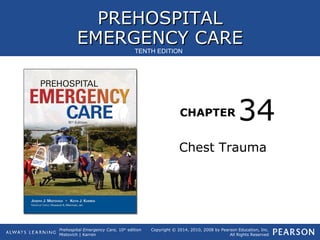
Chest Trauma
34
Prehospital Emergency Care, 10th
edition
Mistovich | Karren
Copyright © 2014, 2010, 2008 by Pearson Education, Inc.
All Rights Reserved
Learning ReadinessLearning Readiness
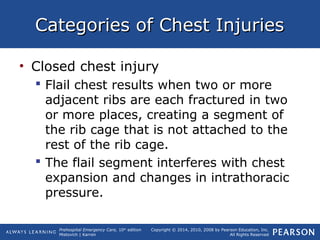
• EMS Education Standards, text p. 945
Prehospital Emergency Care, 10th
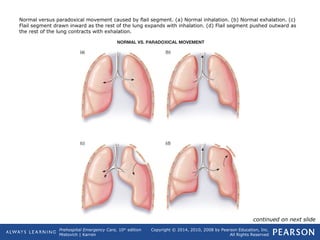
edition
Mistovich | Karren
Copyright © 2014, 2010, 2008 by Pearson Education, Inc.
All Rights Reserved
Learning ReadinessLearning Readiness
ObjectivesObjectives
• Please refer to page 945 of your text to
view the objectives for this chapter.
Prehospital Emergency Care, 10th
edition
Mistovich | Karren
Copyright © 2014, 2010, 2008 by Pearson Education, Inc.
All Rights Reserved
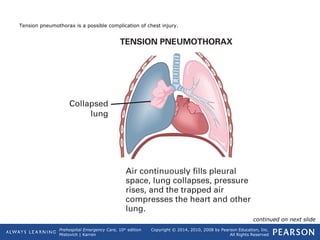
Learning ReadinessLearning Readiness
Key TermsKey Terms
• Please refer to page 945 of your text to
view the key terms for this chapter.
Prehospital Emergency Care, 10th
edition
Mistovich | Karren
Copyright © 2014, 2010, 2008 by Pearson Education, Inc.
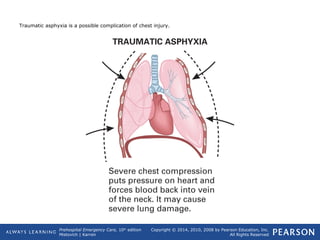
All Rights Reserved
Setting the StageSetting the Stage
• Overview of Lesson Topics
 Anatomy of the Chest
 Types of Chest Injuries
 Assessment-Based Management of
Chest Injuries
Prehospital Emergency Care, 10th
edition
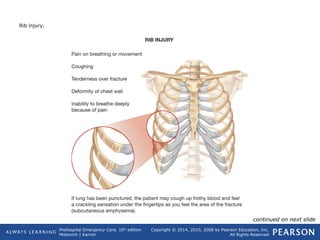
Mistovich | Karren
Copyright © 2014, 2010, 2008 by Pearson Education, Inc.
All Rights Reserved
Case Study IntroductionCase Study Introduction
EMTs Roxanne Freidman and Laura Cahill are
on the scene of a patient who was ejected from
the driver's seat of a vehicle that rolled multiple
times after leaving the roadway at high speed.
As Roxanne maintains in-line stabilization of the
spine while opening the airway with a jaw-
thrust maneuver, Laura quickly exposes the
chest and listens for breath sounds.
"No breath sounds on the right. There is jugular
vein distention," says Laura.
Prehospital Emergency Care, 10th
edition
Mistovich | Karren
Copyright © 2014, 2010, 2008 by Pearson Education, Inc.
All Rights Reserved
Case StudyCase Study
• What injuries are suggested by the
mechanism of injury and the EMTs'
findings so far?
• What immediate interventions are
required?
Prehospital Emergency Care, 10th
edition
Mistovich | Karren
Copyright © 2014, 2010, 2008 by Pearson Education, Inc.
All Rights Reserved
IntroductionIntroduction
• Chest injuries may not have a dramatic
appearance and can be overlooked.
• Chest injuries can be lethal.
• Maintain a high index of suspicion
based on mechanism of injury.
Prehospital Emergency Care, 10th
edition
Mistovich | Karren
Copyright © 2014, 2010, 2008 by Pearson Education, Inc.
All Rights Reserved
Anatomy of the ChestAnatomy of the Chest
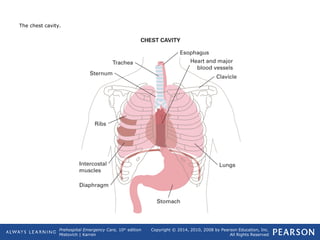
• The thoracic cavity
 Contains vital organs
 Vital organs are protected by the ribs.
 The thoracic cavity is lined by two layers
of pleura.
Prehospital Emergency Care, 10th
edition
Mistovich | Karren
Copyright © 2014, 2010, 2008 by Pearson Education, Inc.
All Rights Reserved
The chest cavity.
Prehospital Emergency Care, 10th
edition
Mistovich | Karren
Copyright © 2014, 2010, 2008 by Pearson Education, Inc.
All Rights Reserved
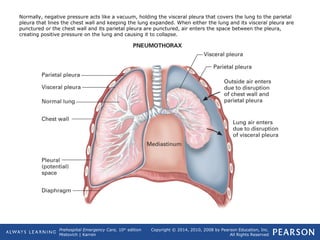
Normally, negative pressure acts like a vacuum, holding the visceral pleura that covers the lung to the parietal
pleura that lines the chest wall and keeping the lung expanded. When either the lung and its visceral pleura are
punctured or the chest wall and its parietal pleura are punctured, air enters the space between the pleura,
creating positive pressure on the lung and causing it to collapse.
Prehospital Emergency Care, 10th
edition
Mistovich | Karren
Copyright © 2014, 2010, 2008 by Pearson Education, Inc.
All Rights Reserved
Categories of Chest InjuriesCategories of Chest Injuries
• Open chest injury
 Caused by penetration injury
 Cavitation occurs with gunshot wounds.
continued on next slide
Prehospital Emergency Care, 10th
edition
Mistovich | Karren
Copyright © 2014, 2010, 2008 by Pearson Education, Inc.
All Rights Reserved
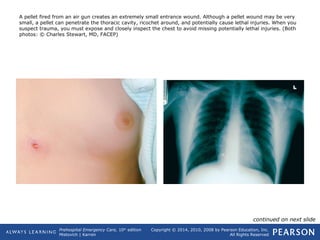
A pellet fired from an air gun creates an extremely small entrance wound. Although a pellet wound may be very
small, a pellet can penetrate the thoracic cavity, ricochet around, and potentially cause lethal injuries. When you
suspect trauma, you must expose and closely inspect the chest to avoid missing potentially lethal injuries. (Both
photos: © Charles Stewart, MD, FACEP)
continued on next slide
Prehospital Emergency Care, 10th
edition
Mistovich | Karren
Copyright © 2014, 2010, 2008 by Pearson Education, Inc.
All Rights Reserved
Categories of Chest InjuriesCategories of Chest Injuries
• Open chest injury
 May involve injury of the heart, major
blood vessels.
 Pneumothorax
• Penetrating trauma can interfere with the
negative pressure needed for inhalation
by allowing air to enter through the
wound.
continued on next slide
Prehospital Emergency Care, 10th
edition
Mistovich | Karren
Copyright © 2014, 2010, 2008 by Pearson Education, Inc.
All Rights Reserved
Categories of Chest InjuriesCategories of Chest Injuries
• Open chest injury
 Sucking chest wound
• Air enters through the wound with each
inhalation.
• Must be covered with an occlusive
dressing taped on three sides.
• Taping the dressing on four sides can
lead to tension pneumothorax.
continued on next slide
Prehospital Emergency Care, 10th
edition
Mistovich | Karren
Copyright © 2014, 2010, 2008 by Pearson Education, Inc.
All Rights Reserved
Categories of Chest InjuriesCategories of Chest Injuries
• Closed chest injury
 Results from blunt trauma
 Can injure the heart, lung, great
vessels, and other structures
continued on next slide
Prehospital Emergency Care, 10th
edition
Mistovich | Karren
Copyright © 2014, 2010, 2008 by Pearson Education, Inc.
All Rights Reserved
Categories of Chest InjuriesCategories of Chest Injuries
• Closed chest injury
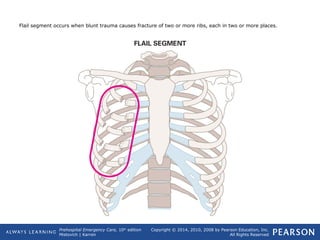
 Flail chest results when two or more
adjacent ribs are each fractured in two
or more places, creating a segment of
the rib cage that is not attached to the
rest of the rib cage.
 The flail segment interferes with chest
expansion and changes in intrathoracic
pressure.
Prehospital Emergency Care, 10th
edition
Mistovich | Karren
Copyright © 2014, 2010, 2008 by Pearson Education, Inc.
All Rights Reserved
Flail segment occurs when blunt trauma causes fracture of two or more ribs, each in two or more places.
Prehospital Emergency Care, 10th
edition
Mistovich | Karren
Copyright © 2014, 2010, 2008 by Pearson Education, Inc.
All Rights Reserved
Specific Injuries: Flail SegmentSpecific Injuries: Flail Segment
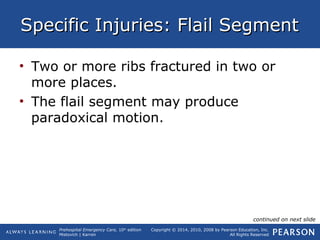
• Two or more ribs fractured in two or
more places.
• The flail segment may produce
paradoxical motion.
continued on next slide
Prehospital Emergency Care, 10th
edition
Mistovich | Karren
Copyright © 2014, 2010, 2008 by Pearson Education, Inc.
All Rights Reserved
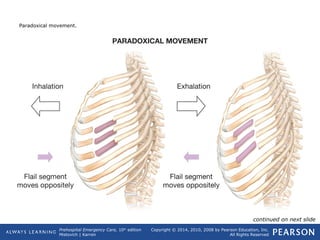
Paradoxical movement.
continued on next slide
Prehospital Emergency Care, 10th
edition
Mistovich | Karren
Copyright © 2014, 2010, 2008 by Pearson Education, Inc.
All Rights Reserved
Normal versus paradoxical movement caused by flail segment. (a) Normal inhalation. (b) Normal exhalation. (c)
Flail segment drawn inward as the rest of the lung expands with inhalation. (d) Flail segment pushed outward as
the rest of the lung contracts with exhalation.
continued on next slide
Prehospital Emergency Care, 10th
edition
Mistovich | Karren
Copyright © 2014, 2010, 2008 by Pearson Education, Inc.
All Rights Reserved
Specific Injuries: Flail SegmentSpecific Injuries: Flail Segment
• The flail segment interferes with
ventilation and must be stabilized.
• Also suspect underlying pulmonary
contusion, which interferes with gas
exchange.
continued on next slide
Prehospital Emergency Care, 10th
edition
Mistovich | Karren
Copyright © 2014, 2010, 2008 by Pearson Education, Inc.
All Rights Reserved
Specific Injuries: Flail SegmentSpecific Injuries: Flail Segment
• To avoid further compromise of chest
movement:
 Do not place the patient on the injured
side.
 Do not stabilize the chest wall with
objects that restrict chest wall motion.
continued on next slide
Prehospital Emergency Care, 10th
edition
Mistovich | Karren
Copyright © 2014, 2010, 2008 by Pearson Education, Inc.
All Rights Reserved
Specific Injuries: Flail SegmentSpecific Injuries: Flail Segment
• CPAP or positive pressure ventilation
may be indicated to improve ventilation
and oxygenation.
Prehospital Emergency Care, 10th
edition
Mistovich | Karren
Copyright © 2014, 2010, 2008 by Pearson Education, Inc.
All Rights Reserved
Specific Injuries: PulmonarySpecific Injuries: Pulmonary
ContusionContusion
• Bleeding occurs in the lung tissue in
and around the alveoli and in the
interstitial space.
• Gas exchange is severely impaired.
continued on next slide
Prehospital Emergency Care, 10th
edition
Mistovich | Karren
Copyright © 2014, 2010, 2008 by Pearson Education, Inc.
All Rights Reserved
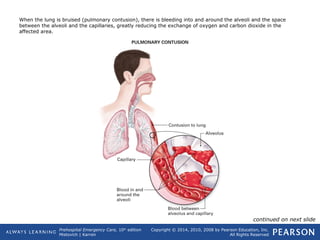
When the lung is bruised (pulmonary contusion), there is bleeding into and around the alveoli and the space
between the alveoli and the capillaries, greatly reducing the exchange of oxygen and carbon dioxide in the
affected area.
continued on next slide
Prehospital Emergency Care, 10th
edition
Mistovich | Karren
Copyright © 2014, 2010, 2008 by Pearson Education, Inc.
All Rights Reserved
Specific Injuries: PulmonarySpecific Injuries: Pulmonary
ContusionContusion
• Treatment is directed toward
supporting oxygenation and ventilation.
 Maintain an SpO2 greater than or equal
to 94%.
 CPAP or positive pressure ventilation
may be required.
Prehospital Emergency Care, 10th
edition
Mistovich | Karren
Copyright © 2014, 2010, 2008 by Pearson Education, Inc.
All Rights Reserved
Specific Injuries: PneumothoraxSpecific Injuries: Pneumothorax
• An accumulation of air in the pleural
space resulting in collapse of a portion
of the lung.
• Causes
 A "paper bag" effect may occur upon
sudden compression of the chest.
 Penetrating trauma
continued on next slide
Prehospital Emergency Care, 10th
edition
Mistovich | Karren
Copyright © 2014, 2010, 2008 by Pearson Education, Inc.
All Rights Reserved
Specific Injuries: PneumothoraxSpecific Injuries: Pneumothorax
• Signs and symptoms include:
 Chest pain, worse with inspiration
 Dyspnea
 Tachypnea
 Decreased or absent breath sounds on
affected side
Prehospital Emergency Care, 10th
edition
Mistovich | Karren
Copyright © 2014, 2010, 2008 by Pearson Education, Inc.
All Rights Reserved
Specific Injuries: OpenSpecific Injuries: Open
PneumothoraxPneumothorax
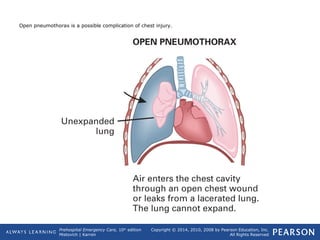
• Caused by an open chest wound that
allows air to enter the pleural space
with inspiration.
• The open wound must immediately be
occluded, first by your gloved hand,
and then by an occlusive dressing.
Prehospital Emergency Care, 10th
edition
Mistovich | Karren
Copyright © 2014, 2010, 2008 by Pearson Education, Inc.
All Rights Reserved
Open pneumothorax is a possible complication of chest injury.
Prehospital Emergency Care, 10th
edition
Mistovich | Karren
Copyright © 2014, 2010, 2008 by Pearson Education, Inc.
All Rights Reserved
Specific Injuries: TensionSpecific Injuries: Tension
PneumothoraxPneumothorax
• Immediately life threatening
• Air accumulates in the pleural space
with no route of escape, increasing
pressure in the thoracic cavity.
continued on next slide
Prehospital Emergency Care, 10th
edition
Mistovich | Karren
Copyright © 2014, 2010, 2008 by Pearson Education, Inc.
All Rights Reserved
Specific Injuries: TensionSpecific Injuries: Tension
PneumothoraxPneumothorax
• The pressure shifts the structures
within the chest and reduces blood
return to the heart.
• Death can occur rapidly from from
respiratory failure and hypotension.
continued on next slide
Prehospital Emergency Care, 10th
edition
Mistovich | Karren
Copyright © 2014, 2010, 2008 by Pearson Education, Inc.
All Rights Reserved
Tension pneumothorax is a possible complication of chest injury.
continued on next slide
Prehospital Emergency Care, 10th
edition
Mistovich | Karren
Copyright © 2014, 2010, 2008 by Pearson Education, Inc.
All Rights Reserved
Specific Injuries: TensionSpecific Injuries: Tension
PneumothoraxPneumothorax
• Signs and symptoms
 Rapid deterioration
 Severe respiratory distress
 Signs of shock
 Absent breath sounds on one side
continued on next slide
Prehospital Emergency Care, 10th
edition
Mistovich | Karren
Copyright © 2014, 2010, 2008 by Pearson Education, Inc.
All Rights Reserved
Specific Injuries: TensionSpecific Injuries: Tension
PneumothoraxPneumothorax
• Signs and symptoms
 Unequal chest movement
 Distended neck veins
 Diminishing breath sounds on the
opposite side
 Deviation of the trachea
continued on next slide
Prehospital Emergency Care, 10th
edition
Mistovich | Karren
Copyright © 2014, 2010, 2008 by Pearson Education, Inc.
All Rights Reserved
Specific Injuries: TensionSpecific Injuries: Tension
PneumothoraxPneumothorax
• If tension pneumothorax results from
application of an occlusive dressing, lift
the dressing on expiration.
• Immediate transport is critical.
Prehospital Emergency Care, 10th
edition
Mistovich | Karren
Copyright © 2014, 2010, 2008 by Pearson Education, Inc.
All Rights Reserved
Specific Injuries: HemothoraxSpecific Injuries: Hemothorax
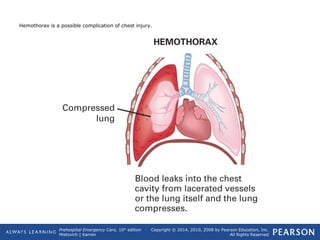
• A collection of blood in the pleural
space compresses the lung.
• May occur in open and closed injuries.
• The amount of blood loss can result in
shock.
Prehospital Emergency Care, 10th
edition
Mistovich | Karren
Copyright © 2014, 2010, 2008 by Pearson Education, Inc.
All Rights Reserved
Hemothorax is a possible complication of chest injury.
Prehospital Emergency Care, 10th
edition
Mistovich | Karren
Copyright © 2014, 2010, 2008 by Pearson Education, Inc.
All Rights Reserved
Specific Injuries: TraumaticSpecific Injuries: Traumatic
AsphyxiaAsphyxia
• Sudden, severe compression of the
thorax causes a rapid increase in
intrathoracic pressure.
• There is a backflow of blood out of the
right ventricle into the upper body.
continued on next slide
Prehospital Emergency Care, 10th
edition
Mistovich | Karren
Copyright © 2014, 2010, 2008 by Pearson Education, Inc.
All Rights Reserved
Traumatic asphyxia is a possible complication of chest injury.
Prehospital Emergency Care, 10th
edition
Mistovich | Karren
Copyright © 2014, 2010, 2008 by Pearson Education, Inc.
All Rights Reserved
Specific Injuries: TraumaticSpecific Injuries: Traumatic
AsphyxiaAsphyxia
• Signs and symptoms
 Bluish or purple discoloration of the
face, head, neck, and shoulders
 Jugular vein distention
 Bloodshot eyes that are protruding from
the socket
 Cyanotic and swollen tongue and lips
 Bleeding of the conjunctiva
Prehospital Emergency Care, 10th
edition
Mistovich | Karren
Copyright © 2014, 2010, 2008 by Pearson Education, Inc.
All Rights Reserved
Specific Injuries: CardiacSpecific Injuries: Cardiac
ContusionContusion
• Associated with blunt trauma from
violent compression of the chest.
• A bruise to the heart wall may form, or
the heart may ruptured; disruption in
electrical conduction may occur.
continued on next slide
Prehospital Emergency Care, 10th
edition
Mistovich | Karren
Copyright © 2014, 2010, 2008 by Pearson Education, Inc.
All Rights Reserved
Specific Injuries: CardiacSpecific Injuries: Cardiac
ContusionContusion
• Signs and symptoms
 Chest pain or discomfort
 Signs of blunt trauma to the chest,
including bruises, swelling, crepitation,
and deformity
 Tachycardia
 Irregular pulse
Prehospital Emergency Care, 10th
edition
Mistovich | Karren
Copyright © 2014, 2010, 2008 by Pearson Education, Inc.
All Rights Reserved
Specific Injuries: Commotio CordisSpecific Injuries: Commotio Cordis
• Sudden cardiac arrest from blunt force
to the precordial area
• A blow to the chest during a vulnerable
period of the cardiac cycle can lead to a
lethal dysrhythmia.
• Start CPR and apply the AED.
Prehospital Emergency Care, 10th
edition
Mistovich | Karren
Copyright © 2014, 2010, 2008 by Pearson Education, Inc.
All Rights Reserved
Specific Injuries: PericardialSpecific Injuries: Pericardial
TamponadeTamponade
• Bleeding into the fibrous sac around the
heart from blunt or penetrating trauma
• Compression of the ventricles results in
inadequate ventricular filling and
reduced cardiac output.
continued on next slide
Prehospital Emergency Care, 10th
edition
Mistovich | Karren
Copyright © 2014, 2010, 2008 by Pearson Education, Inc.
All Rights Reserved
Specific Injuries: PericardialSpecific Injuries: Pericardial
TamponadeTamponade
• Signs and symptoms
 Jugular vein distention
 Signs of shock
 Tachycardia
 Decreased blood pressure
 Narrow pulse pressure
 Weak pulses
 Radial pulse diminishes on inhalation
continued on next slide
Prehospital Emergency Care, 10th
edition
Mistovich | Karren
Copyright © 2014, 2010, 2008 by Pearson Education, Inc.
All Rights Reserved
Specific Injuries: PericardialSpecific Injuries: Pericardial
TamponadeTamponade
• Rapidly life threatening
• Early recognition and rapid transport
are critical.
• Manage the airway, breathing, and
oxygenation.
Prehospital Emergency Care, 10th
edition
Mistovich | Karren
Copyright © 2014, 2010, 2008 by Pearson Education, Inc.
All Rights Reserved
Specific Injuries: Rib InjurySpecific Injuries: Rib Injury
• The fractured rib may cause damage to
the lung or intercostal vessels.
• Rib fracture is less common in children.
Prehospital Emergency Care, 10th
edition
Mistovich | Karren
Copyright © 2014, 2010, 2008 by Pearson Education, Inc.
All Rights Reserved
Rib injury.
continued on next slide
Prehospital Emergency Care, 10th
edition
Mistovich | Karren
Copyright © 2014, 2010, 2008 by Pearson Education, Inc.
All Rights Reserved
Click on the injury that is characterized by air trapped in theClick on the injury that is characterized by air trapped in the
pleural space under pressure, resulting in compression of thepleural space under pressure, resulting in compression of the
structures of the affected side, mediastinum, and opposite sidestructures of the affected side, mediastinum, and opposite side
of the chest.of the chest.
A. Hemothorax
B. Tension pneumothorax
C. Pericardial tamponade
D. Sucking chest wound
Prehospital Emergency Care, 10th
edition
Mistovich | Karren
Copyright © 2014, 2010, 2008 by Pearson Education, Inc.
All Rights Reserved
Assessment-Based Approach:Assessment-Based Approach:
Chest TraumaChest Trauma
• Scene size-up
 If violence was involved, be especially
careful with the scene size-up.
 Do not enter a scene that is not safe to
enter.
 Use Standard Precautions.
continued on next slide
Prehospital Emergency Care, 10th
edition
Mistovich | Karren
Copyright © 2014, 2010, 2008 by Pearson Education, Inc.
All Rights Reserved
Assessment-Based Approach:Assessment-Based Approach:
Chest TraumaChest Trauma
• Mechanisms of injury
 Sports accidents
 Falls
 Fights
 Gunshot
 Vehicle collision
 Crushing injury
 Explosion
continued on next slide
Prehospital Emergency Care, 10th
edition
Mistovich | Karren
Copyright © 2014, 2010, 2008 by Pearson Education, Inc.
All Rights Reserved
Assessment-Based Approach:Assessment-Based Approach:
Chest TraumaChest Trauma
• Primary assessment
 Use spinal stabilization, if indicated.
 Form a general impression.
 Expose and examine the chest.
 Assess the mental status.
 Assess the airway.
 Look for signs of respiratory distress.
continued on next slide
Prehospital Emergency Care, 10th
edition
Mistovich | Karren
Copyright © 2014, 2010, 2008 by Pearson Education, Inc.
All Rights Reserved
Assessment-Based Approach:Assessment-Based Approach:
Chest TraumaChest Trauma
• Primary assessment
 If breathing is adequate, apply oxygen,
as needed, to maintain an SpO2 greater
than or equal to 94%.
 Consider CPAP for flail segment or
pulmonary contusion.
 Do not use CPAP if pneumothorax is
suspected.
continued on next slide
Prehospital Emergency Care, 10th
edition
Mistovich | Karren
Copyright © 2014, 2010, 2008 by Pearson Education, Inc.
All Rights Reserved
Assessment-Based Approach:Assessment-Based Approach:
Chest TraumaChest Trauma
• Primary assessment
 If breathing is inadequate, provide
positive pressure ventilation.
 Tension pneumothorax results in
increasing difficulty ventilating the
patient.
 Cyanosis is an indicator of poor
oxygenation and ventilation.
continued on next slide
Prehospital Emergency Care, 10th
edition
Mistovich | Karren
Copyright © 2014, 2010, 2008 by Pearson Education, Inc.
All Rights Reserved
Assessment-Based Approach:Assessment-Based Approach:
Chest TraumaChest Trauma
• Primary assessment
 Pallor can indicate early hypoxia, poor
pumping function of the heart, or blood
loss.
 A weak, rapid pulse can indicate
bleeding or compression of the heart.
 Chest injury patients are a high priority
for transport.
continued on next slide
Prehospital Emergency Care, 10th
edition
Mistovich | Karren
Copyright © 2014, 2010, 2008 by Pearson Education, Inc.
All Rights Reserved
Assessment-Based Approach:Assessment-Based Approach:
Chest TraumaChest Trauma
• Secondary assessment
 Perform a rapid secondary assessment.
 Assess the neck for subcutaneous
emphysema, jugular vein distention,
and tracheal deviation.
 If indicated, apply a cervical collar after
examination of the neck.
continued on next slide
Prehospital Emergency Care, 10th
edition
Mistovich | Karren
Copyright © 2014, 2010, 2008 by Pearson Education, Inc.
All Rights Reserved
Assessment-Based Approach:Assessment-Based Approach:
Chest TraumaChest Trauma
• Secondary assessment
 Expose the chest, if not already done.
 Include examination of the lateral and
posterior chest.
 Immediately seal any open wounds to
the chest.
 For signs of flail segment with
inadequate breathing, use positive
pressure ventilation.
continued on next slide
Prehospital Emergency Care, 10th
edition
Mistovich | Karren
Copyright © 2014, 2010, 2008 by Pearson Education, Inc.
All Rights Reserved
Assessment-Based Approach:Assessment-Based Approach:
Chest TraumaChest Trauma
• Secondary assessment
 Look for chest symmetry, paradoxical
movement, swelling, deformities,
crepitation, and guarding of injured ribs.
 Auscultate the lung sounds.
 Assess baseline vital signs.
 Obtain a history.
continued on next slide
Prehospital Emergency Care, 10th
edition
Mistovich | Karren
Copyright © 2014, 2010, 2008 by Pearson Education, Inc.
All Rights Reserved
Assessment-Based Approach:Assessment-Based Approach:
Chest TraumaChest Trauma
• Signs and symptoms
 Cyanosis
 Dyspnea
 Tachypnea or bradypnea
 Obvious signs of injury
 Hemoptysis
 Signs of shock
continued on next slide
Prehospital Emergency Care, 10th
edition
Mistovich | Karren
Copyright © 2014, 2010, 2008 by Pearson Education, Inc.
All Rights Reserved
Assessment-Based Approach:Assessment-Based Approach:
Chest TraumaChest Trauma
• Signs and symptoms
 Tracheal deviation
 Paradoxical movement
 Open wounds
 Subcutaneous emphysema
 Jugular vein distention
continued on next slide
Prehospital Emergency Care, 10th
edition
Mistovich | Karren
Copyright © 2014, 2010, 2008 by Pearson Education, Inc.
All Rights Reserved
Assessment-Based Approach:Assessment-Based Approach:
Chest TraumaChest Trauma
• Signs and symptoms
 Absent or decreased breath sounds
 Pain at the site of injury, especially with
inhalation
 Failure of the chest to expand normally
 Weak or absent peripheral pulses
 Drop in systolic BP of ≥10 mmHg on
inhalation
continued on next slide
Prehospital Emergency Care, 10th
edition
Mistovich | Karren
Copyright © 2014, 2010, 2008 by Pearson Education, Inc.
All Rights Reserved
Assessment-Based Approach:Assessment-Based Approach:
Chest TraumaChest Trauma
• General care
 Maintain an open airway, use in-line
spinal stabilization if indicated.
 Maintain adequate oxygenation.
 Re-evaluate breathing status; avoid
forceful ventilation.
continued on next slide
Prehospital Emergency Care, 10th
edition
Mistovich | Karren
Copyright © 2014, 2010, 2008 by Pearson Education, Inc.
All Rights Reserved
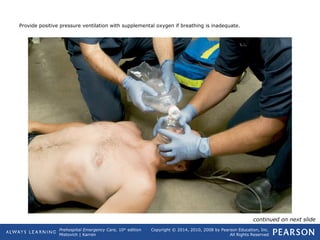
Provide positive pressure ventilation with supplemental oxygen if breathing is inadequate.
continued on next slide
Prehospital Emergency Care, 10th
edition
Mistovich | Karren
Copyright © 2014, 2010, 2008 by Pearson Education, Inc.
All Rights Reserved
Assessment-Based Approach:Assessment-Based Approach:
Chest TraumaChest Trauma
• General care
 Stabilize an impaled object in place.
 Completely immobilize the patient if
spinal injury is suspected.
 Treat for shock.
continued on next slide
Prehospital Emergency Care, 10th
edition
Mistovich | Karren
Copyright © 2014, 2010, 2008 by Pearson Education, Inc.
All Rights Reserved
Assessment-Based Approach:Assessment-Based Approach:
Chest TraumaChest Trauma
• Emergency medical care: open chest
wound
 Immediately seal the wound with a
gloved hand.
 Apply an occlusive dressing.
continued on next slide
Prehospital Emergency Care, 10th
edition
Mistovich | Karren
Copyright © 2014, 2010, 2008 by Pearson Education, Inc.
All Rights Reserved
Assessment-Based Approach:Assessment-Based Approach:
Chest TraumaChest Trauma
• Emergency medical care: open chest
wound
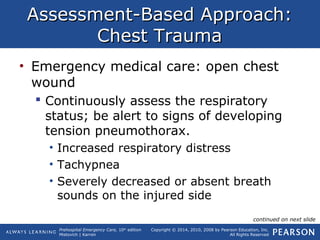
 Continuously assess the respiratory
status; be alert to signs of developing
tension pneumothorax.
• Increased respiratory distress
• Tachypnea
• Severely decreased or absent breath
sounds on the injured side
continued on next slide
Prehospital Emergency Care, 10th
edition
Mistovich | Karren
Copyright © 2014, 2010, 2008 by Pearson Education, Inc.
All Rights Reserved
Assessment-Based Approach:Assessment-Based Approach:
Chest TraumaChest Trauma
• Emergency medical care: open chest
wound
 If an occlusive dressing has been
applied and there are signs of
developing tension pneumothorax, lift
the dressing on exhalation.
continued on next slide
Prehospital Emergency Care, 10th
edition
Mistovich | Karren
Copyright © 2014, 2010, 2008 by Pearson Education, Inc.
All Rights Reserved
Assessment-Based Approach:Assessment-Based Approach:
Chest TraumaChest Trauma
• Emergency medical care: flail segment
 Do not splint the chest wall in any way
that interferes with chest movement.
 Maintain oxygenation.
 Consider CPAP.
 Positive pressure ventilation if breathing
is inadequate.
continued on next slide
Prehospital Emergency Care, 10th
edition
Mistovich | Karren
Copyright © 2014, 2010, 2008 by Pearson Education, Inc.
All Rights Reserved
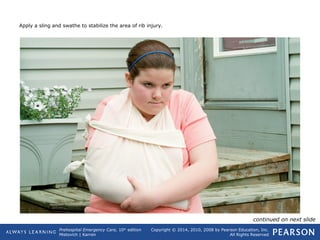
Apply a sling and swathe to stabilize the area of rib injury.
continued on next slide
Prehospital Emergency Care, 10th
edition
Mistovich | Karren
Copyright © 2014, 2010, 2008 by Pearson Education, Inc.
All Rights Reserved
Assessment-Based Approach:Assessment-Based Approach:
Chest TraumaChest Trauma
• Reassessment
 Be alert for signs of deterioration such
as increased difficulty breathing,
decreasing mental status, decreased
breath sounds, worsening cyanosis, and
shock.
continued on next slide
Prehospital Emergency Care, 10th
edition
Mistovich | Karren
Copyright © 2014, 2010, 2008 by Pearson Education, Inc.
All Rights Reserved
Assessment-Based Approach:Assessment-Based Approach:
Chest TraumaChest Trauma
• Reassessment
 Reassess for missed injuries
 Assess interventions
 Reassess vital signs
Prehospital Emergency Care, 10th
edition
Mistovich | Karren
Copyright © 2014, 2010, 2008 by Pearson Education, Inc.
All Rights Reserved
Case Study ConclusionCase Study Conclusion
In the primary assessment, the EMTs find
the patient responsive to pain, with rapid,
shallow respirations and a weak, rapid pulse
that disappears on inspiration.
Roxanne begins positive pressure ventilation
as Laura requests ALS backup. With the
assistance of other responders on the scene,
the EMTs perform a rapid secondary
assessment and package the patient for
transport.
continued on next slide
Prehospital Emergency Care, 10th
edition
Mistovich | Karren
Copyright © 2014, 2010, 2008 by Pearson Education, Inc.
All Rights Reserved
Case Study ConclusionCase Study Conclusion
The EMTs meet the ALS unit at the agreed-
upon point. Roxanne reports that
ventilations are very difficult. After a quick
assessment, the paramedic performs a
needle chest decompression, which
immediately improves the patient's
ventilatory status and circulation.
continued on next slide
Prehospital Emergency Care, 10th
edition
Mistovich | Karren
Copyright © 2014, 2010, 2008 by Pearson Education, Inc.
All Rights Reserved
Case Study ConclusionCase Study Conclusion
The crew transports the patient to a trauma
center, where she undergoes surgery for
chest and abdominal injuries, as well as for
multiple fractures.
Prehospital Emergency Care, 10th
edition
Mistovich | Karren
Copyright © 2014, 2010, 2008 by Pearson Education, Inc.
All Rights Reserved
Lesson SummaryLesson Summary
• Chest injuries can lead to respiratory
compromise, poor ventilation, and poor
oxygenation.
• An open wound to the chest can allow
air into the pleural space.
• A flail chest interferes with ventilation
and oxygenation.
continued on next slide
Prehospital Emergency Care, 10th
edition
Mistovich | Karren
Copyright © 2014, 2010, 2008 by Pearson Education, Inc.
All Rights Reserved
Lesson SummaryLesson Summary
• Immediately cover an open chest
wound with a gloved hand, followed by
an occlusive dressing.
• Patients with flail chest or pulmonary
contusion may require CPAP or positive
pressure ventilation.
• Do not use CPAP for patients with
pneumothorax.

DMACC EMT Chapter 34

  • 1.
    PREHOSPITALPREHOSPITAL EMERGENCY CAREEMERGENCY CARE CHAPTER Copyright© 2014, 2010, 2008 by Pearson Education, Inc. All Rights Reserved Prehospital Emergency Care, 10th edition Mistovich | Karren TENTH EDITION Chest Trauma 34
  • 2.
    Prehospital Emergency Care,10th edition Mistovich | Karren Copyright © 2014, 2010, 2008 by Pearson Education, Inc. All Rights Reserved Learning ReadinessLearning Readiness • EMS Education Standards, text p. 945
  • 3.
    Prehospital Emergency Care,10th edition Mistovich | Karren Copyright © 2014, 2010, 2008 by Pearson Education, Inc. All Rights Reserved Learning ReadinessLearning Readiness ObjectivesObjectives • Please refer to page 945 of your text to view the objectives for this chapter.
  • 4.
    Prehospital Emergency Care,10th edition Mistovich | Karren Copyright © 2014, 2010, 2008 by Pearson Education, Inc. All Rights Reserved Learning ReadinessLearning Readiness Key TermsKey Terms • Please refer to page 945 of your text to view the key terms for this chapter.
  • 5.
    Prehospital Emergency Care,10th edition Mistovich | Karren Copyright © 2014, 2010, 2008 by Pearson Education, Inc. All Rights Reserved Setting the StageSetting the Stage • Overview of Lesson Topics  Anatomy of the Chest  Types of Chest Injuries  Assessment-Based Management of Chest Injuries
  • 6.
    Prehospital Emergency Care,10th edition Mistovich | Karren Copyright © 2014, 2010, 2008 by Pearson Education, Inc. All Rights Reserved Case Study IntroductionCase Study Introduction EMTs Roxanne Freidman and Laura Cahill are on the scene of a patient who was ejected from the driver's seat of a vehicle that rolled multiple times after leaving the roadway at high speed. As Roxanne maintains in-line stabilization of the spine while opening the airway with a jaw- thrust maneuver, Laura quickly exposes the chest and listens for breath sounds. "No breath sounds on the right. There is jugular vein distention," says Laura.
  • 7.
    Prehospital Emergency Care,10th edition Mistovich | Karren Copyright © 2014, 2010, 2008 by Pearson Education, Inc. All Rights Reserved Case StudyCase Study • What injuries are suggested by the mechanism of injury and the EMTs' findings so far? • What immediate interventions are required?
  • 8.
    Prehospital Emergency Care,10th edition Mistovich | Karren Copyright © 2014, 2010, 2008 by Pearson Education, Inc. All Rights Reserved IntroductionIntroduction • Chest injuries may not have a dramatic appearance and can be overlooked. • Chest injuries can be lethal. • Maintain a high index of suspicion based on mechanism of injury.
  • 9.
    Prehospital Emergency Care,10th edition Mistovich | Karren Copyright © 2014, 2010, 2008 by Pearson Education, Inc. All Rights Reserved Anatomy of the ChestAnatomy of the Chest • The thoracic cavity  Contains vital organs  Vital organs are protected by the ribs.  The thoracic cavity is lined by two layers of pleura.
  • 10.
    Prehospital Emergency Care,10th edition Mistovich | Karren Copyright © 2014, 2010, 2008 by Pearson Education, Inc. All Rights Reserved The chest cavity.
  • 11.
    Prehospital Emergency Care,10th edition Mistovich | Karren Copyright © 2014, 2010, 2008 by Pearson Education, Inc. All Rights Reserved Normally, negative pressure acts like a vacuum, holding the visceral pleura that covers the lung to the parietal pleura that lines the chest wall and keeping the lung expanded. When either the lung and its visceral pleura are punctured or the chest wall and its parietal pleura are punctured, air enters the space between the pleura, creating positive pressure on the lung and causing it to collapse.
  • 12.
    Prehospital Emergency Care,10th edition Mistovich | Karren Copyright © 2014, 2010, 2008 by Pearson Education, Inc. All Rights Reserved Categories of Chest InjuriesCategories of Chest Injuries • Open chest injury  Caused by penetration injury  Cavitation occurs with gunshot wounds. continued on next slide
  • 13.
    Prehospital Emergency Care,10th edition Mistovich | Karren Copyright © 2014, 2010, 2008 by Pearson Education, Inc. All Rights Reserved A pellet fired from an air gun creates an extremely small entrance wound. Although a pellet wound may be very small, a pellet can penetrate the thoracic cavity, ricochet around, and potentially cause lethal injuries. When you suspect trauma, you must expose and closely inspect the chest to avoid missing potentially lethal injuries. (Both photos: © Charles Stewart, MD, FACEP) continued on next slide
  • 14.
    Prehospital Emergency Care,10th edition Mistovich | Karren Copyright © 2014, 2010, 2008 by Pearson Education, Inc. All Rights Reserved Categories of Chest InjuriesCategories of Chest Injuries • Open chest injury  May involve injury of the heart, major blood vessels.  Pneumothorax • Penetrating trauma can interfere with the negative pressure needed for inhalation by allowing air to enter through the wound. continued on next slide
  • 15.
    Prehospital Emergency Care,10th edition Mistovich | Karren Copyright © 2014, 2010, 2008 by Pearson Education, Inc. All Rights Reserved Categories of Chest InjuriesCategories of Chest Injuries • Open chest injury  Sucking chest wound • Air enters through the wound with each inhalation. • Must be covered with an occlusive dressing taped on three sides. • Taping the dressing on four sides can lead to tension pneumothorax. continued on next slide
  • 16.
    Prehospital Emergency Care,10th edition Mistovich | Karren Copyright © 2014, 2010, 2008 by Pearson Education, Inc. All Rights Reserved Categories of Chest InjuriesCategories of Chest Injuries • Closed chest injury  Results from blunt trauma  Can injure the heart, lung, great vessels, and other structures continued on next slide
  • 17.
    Prehospital Emergency Care,10th edition Mistovich | Karren Copyright © 2014, 2010, 2008 by Pearson Education, Inc. All Rights Reserved Categories of Chest InjuriesCategories of Chest Injuries • Closed chest injury  Flail chest results when two or more adjacent ribs are each fractured in two or more places, creating a segment of the rib cage that is not attached to the rest of the rib cage.  The flail segment interferes with chest expansion and changes in intrathoracic pressure.
  • 18.
    Prehospital Emergency Care,10th edition Mistovich | Karren Copyright © 2014, 2010, 2008 by Pearson Education, Inc. All Rights Reserved Flail segment occurs when blunt trauma causes fracture of two or more ribs, each in two or more places.
  • 19.
    Prehospital Emergency Care,10th edition Mistovich | Karren Copyright © 2014, 2010, 2008 by Pearson Education, Inc. All Rights Reserved Specific Injuries: Flail SegmentSpecific Injuries: Flail Segment • Two or more ribs fractured in two or more places. • The flail segment may produce paradoxical motion. continued on next slide
  • 20.
    Prehospital Emergency Care,10th edition Mistovich | Karren Copyright © 2014, 2010, 2008 by Pearson Education, Inc. All Rights Reserved Paradoxical movement. continued on next slide
  • 21.
    Prehospital Emergency Care,10th edition Mistovich | Karren Copyright © 2014, 2010, 2008 by Pearson Education, Inc. All Rights Reserved Normal versus paradoxical movement caused by flail segment. (a) Normal inhalation. (b) Normal exhalation. (c) Flail segment drawn inward as the rest of the lung expands with inhalation. (d) Flail segment pushed outward as the rest of the lung contracts with exhalation. continued on next slide
  • 22.
    Prehospital Emergency Care,10th edition Mistovich | Karren Copyright © 2014, 2010, 2008 by Pearson Education, Inc. All Rights Reserved Specific Injuries: Flail SegmentSpecific Injuries: Flail Segment • The flail segment interferes with ventilation and must be stabilized. • Also suspect underlying pulmonary contusion, which interferes with gas exchange. continued on next slide
  • 23.
    Prehospital Emergency Care,10th edition Mistovich | Karren Copyright © 2014, 2010, 2008 by Pearson Education, Inc. All Rights Reserved Specific Injuries: Flail SegmentSpecific Injuries: Flail Segment • To avoid further compromise of chest movement:  Do not place the patient on the injured side.  Do not stabilize the chest wall with objects that restrict chest wall motion. continued on next slide
  • 24.
    Prehospital Emergency Care,10th edition Mistovich | Karren Copyright © 2014, 2010, 2008 by Pearson Education, Inc. All Rights Reserved Specific Injuries: Flail SegmentSpecific Injuries: Flail Segment • CPAP or positive pressure ventilation may be indicated to improve ventilation and oxygenation.
  • 25.
    Prehospital Emergency Care,10th edition Mistovich | Karren Copyright © 2014, 2010, 2008 by Pearson Education, Inc. All Rights Reserved Specific Injuries: PulmonarySpecific Injuries: Pulmonary ContusionContusion • Bleeding occurs in the lung tissue in and around the alveoli and in the interstitial space. • Gas exchange is severely impaired. continued on next slide
  • 26.
    Prehospital Emergency Care,10th edition Mistovich | Karren Copyright © 2014, 2010, 2008 by Pearson Education, Inc. All Rights Reserved When the lung is bruised (pulmonary contusion), there is bleeding into and around the alveoli and the space between the alveoli and the capillaries, greatly reducing the exchange of oxygen and carbon dioxide in the affected area. continued on next slide
  • 27.
    Prehospital Emergency Care,10th edition Mistovich | Karren Copyright © 2014, 2010, 2008 by Pearson Education, Inc. All Rights Reserved Specific Injuries: PulmonarySpecific Injuries: Pulmonary ContusionContusion • Treatment is directed toward supporting oxygenation and ventilation.  Maintain an SpO2 greater than or equal to 94%.  CPAP or positive pressure ventilation may be required.
  • 28.
    Prehospital Emergency Care,10th edition Mistovich | Karren Copyright © 2014, 2010, 2008 by Pearson Education, Inc. All Rights Reserved Specific Injuries: PneumothoraxSpecific Injuries: Pneumothorax • An accumulation of air in the pleural space resulting in collapse of a portion of the lung. • Causes  A "paper bag" effect may occur upon sudden compression of the chest.  Penetrating trauma continued on next slide
  • 29.
    Prehospital Emergency Care,10th edition Mistovich | Karren Copyright © 2014, 2010, 2008 by Pearson Education, Inc. All Rights Reserved Specific Injuries: PneumothoraxSpecific Injuries: Pneumothorax • Signs and symptoms include:  Chest pain, worse with inspiration  Dyspnea  Tachypnea  Decreased or absent breath sounds on affected side
  • 30.
    Prehospital Emergency Care,10th edition Mistovich | Karren Copyright © 2014, 2010, 2008 by Pearson Education, Inc. All Rights Reserved Specific Injuries: OpenSpecific Injuries: Open PneumothoraxPneumothorax • Caused by an open chest wound that allows air to enter the pleural space with inspiration. • The open wound must immediately be occluded, first by your gloved hand, and then by an occlusive dressing.
  • 31.
    Prehospital Emergency Care,10th edition Mistovich | Karren Copyright © 2014, 2010, 2008 by Pearson Education, Inc. All Rights Reserved Open pneumothorax is a possible complication of chest injury.
  • 32.
    Prehospital Emergency Care,10th edition Mistovich | Karren Copyright © 2014, 2010, 2008 by Pearson Education, Inc. All Rights Reserved Specific Injuries: TensionSpecific Injuries: Tension PneumothoraxPneumothorax • Immediately life threatening • Air accumulates in the pleural space with no route of escape, increasing pressure in the thoracic cavity. continued on next slide
  • 33.
    Prehospital Emergency Care,10th edition Mistovich | Karren Copyright © 2014, 2010, 2008 by Pearson Education, Inc. All Rights Reserved Specific Injuries: TensionSpecific Injuries: Tension PneumothoraxPneumothorax • The pressure shifts the structures within the chest and reduces blood return to the heart. • Death can occur rapidly from from respiratory failure and hypotension. continued on next slide
  • 34.
    Prehospital Emergency Care,10th edition Mistovich | Karren Copyright © 2014, 2010, 2008 by Pearson Education, Inc. All Rights Reserved Tension pneumothorax is a possible complication of chest injury. continued on next slide
  • 35.
    Prehospital Emergency Care,10th edition Mistovich | Karren Copyright © 2014, 2010, 2008 by Pearson Education, Inc. All Rights Reserved Specific Injuries: TensionSpecific Injuries: Tension PneumothoraxPneumothorax • Signs and symptoms  Rapid deterioration  Severe respiratory distress  Signs of shock  Absent breath sounds on one side continued on next slide
  • 36.
    Prehospital Emergency Care,10th edition Mistovich | Karren Copyright © 2014, 2010, 2008 by Pearson Education, Inc. All Rights Reserved Specific Injuries: TensionSpecific Injuries: Tension PneumothoraxPneumothorax • Signs and symptoms  Unequal chest movement  Distended neck veins  Diminishing breath sounds on the opposite side  Deviation of the trachea continued on next slide
  • 37.
    Prehospital Emergency Care,10th edition Mistovich | Karren Copyright © 2014, 2010, 2008 by Pearson Education, Inc. All Rights Reserved Specific Injuries: TensionSpecific Injuries: Tension PneumothoraxPneumothorax • If tension pneumothorax results from application of an occlusive dressing, lift the dressing on expiration. • Immediate transport is critical.
  • 38.
    Prehospital Emergency Care,10th edition Mistovich | Karren Copyright © 2014, 2010, 2008 by Pearson Education, Inc. All Rights Reserved Specific Injuries: HemothoraxSpecific Injuries: Hemothorax • A collection of blood in the pleural space compresses the lung. • May occur in open and closed injuries. • The amount of blood loss can result in shock.
  • 39.
    Prehospital Emergency Care,10th edition Mistovich | Karren Copyright © 2014, 2010, 2008 by Pearson Education, Inc. All Rights Reserved Hemothorax is a possible complication of chest injury.
  • 40.
    Prehospital Emergency Care,10th edition Mistovich | Karren Copyright © 2014, 2010, 2008 by Pearson Education, Inc. All Rights Reserved Specific Injuries: TraumaticSpecific Injuries: Traumatic AsphyxiaAsphyxia • Sudden, severe compression of the thorax causes a rapid increase in intrathoracic pressure. • There is a backflow of blood out of the right ventricle into the upper body. continued on next slide
  • 41.
    Prehospital Emergency Care,10th edition Mistovich | Karren Copyright © 2014, 2010, 2008 by Pearson Education, Inc. All Rights Reserved Traumatic asphyxia is a possible complication of chest injury.
  • 42.
    Prehospital Emergency Care,10th edition Mistovich | Karren Copyright © 2014, 2010, 2008 by Pearson Education, Inc. All Rights Reserved Specific Injuries: TraumaticSpecific Injuries: Traumatic AsphyxiaAsphyxia • Signs and symptoms  Bluish or purple discoloration of the face, head, neck, and shoulders  Jugular vein distention  Bloodshot eyes that are protruding from the socket  Cyanotic and swollen tongue and lips  Bleeding of the conjunctiva
  • 43.
    Prehospital Emergency Care,10th edition Mistovich | Karren Copyright © 2014, 2010, 2008 by Pearson Education, Inc. All Rights Reserved Specific Injuries: CardiacSpecific Injuries: Cardiac ContusionContusion • Associated with blunt trauma from violent compression of the chest. • A bruise to the heart wall may form, or the heart may ruptured; disruption in electrical conduction may occur. continued on next slide
  • 44.
    Prehospital Emergency Care,10th edition Mistovich | Karren Copyright © 2014, 2010, 2008 by Pearson Education, Inc. All Rights Reserved Specific Injuries: CardiacSpecific Injuries: Cardiac ContusionContusion • Signs and symptoms  Chest pain or discomfort  Signs of blunt trauma to the chest, including bruises, swelling, crepitation, and deformity  Tachycardia  Irregular pulse
  • 45.
    Prehospital Emergency Care,10th edition Mistovich | Karren Copyright © 2014, 2010, 2008 by Pearson Education, Inc. All Rights Reserved Specific Injuries: Commotio CordisSpecific Injuries: Commotio Cordis • Sudden cardiac arrest from blunt force to the precordial area • A blow to the chest during a vulnerable period of the cardiac cycle can lead to a lethal dysrhythmia. • Start CPR and apply the AED.
  • 46.
    Prehospital Emergency Care,10th edition Mistovich | Karren Copyright © 2014, 2010, 2008 by Pearson Education, Inc. All Rights Reserved Specific Injuries: PericardialSpecific Injuries: Pericardial TamponadeTamponade • Bleeding into the fibrous sac around the heart from blunt or penetrating trauma • Compression of the ventricles results in inadequate ventricular filling and reduced cardiac output. continued on next slide
  • 47.
    Prehospital Emergency Care,10th edition Mistovich | Karren Copyright © 2014, 2010, 2008 by Pearson Education, Inc. All Rights Reserved Specific Injuries: PericardialSpecific Injuries: Pericardial TamponadeTamponade • Signs and symptoms  Jugular vein distention  Signs of shock  Tachycardia  Decreased blood pressure  Narrow pulse pressure  Weak pulses  Radial pulse diminishes on inhalation continued on next slide
  • 48.
    Prehospital Emergency Care,10th edition Mistovich | Karren Copyright © 2014, 2010, 2008 by Pearson Education, Inc. All Rights Reserved Specific Injuries: PericardialSpecific Injuries: Pericardial TamponadeTamponade • Rapidly life threatening • Early recognition and rapid transport are critical. • Manage the airway, breathing, and oxygenation.
  • 49.
    Prehospital Emergency Care,10th edition Mistovich | Karren Copyright © 2014, 2010, 2008 by Pearson Education, Inc. All Rights Reserved Specific Injuries: Rib InjurySpecific Injuries: Rib Injury • The fractured rib may cause damage to the lung or intercostal vessels. • Rib fracture is less common in children.
  • 50.
    Prehospital Emergency Care,10th edition Mistovich | Karren Copyright © 2014, 2010, 2008 by Pearson Education, Inc. All Rights Reserved Rib injury. continued on next slide
  • 51.
    Prehospital Emergency Care,10th edition Mistovich | Karren Copyright © 2014, 2010, 2008 by Pearson Education, Inc. All Rights Reserved Click on the injury that is characterized by air trapped in theClick on the injury that is characterized by air trapped in the pleural space under pressure, resulting in compression of thepleural space under pressure, resulting in compression of the structures of the affected side, mediastinum, and opposite sidestructures of the affected side, mediastinum, and opposite side of the chest.of the chest. A. Hemothorax B. Tension pneumothorax C. Pericardial tamponade D. Sucking chest wound
  • 52.
    Prehospital Emergency Care,10th edition Mistovich | Karren Copyright © 2014, 2010, 2008 by Pearson Education, Inc. All Rights Reserved Assessment-Based Approach:Assessment-Based Approach: Chest TraumaChest Trauma • Scene size-up  If violence was involved, be especially careful with the scene size-up.  Do not enter a scene that is not safe to enter.  Use Standard Precautions. continued on next slide
  • 53.
    Prehospital Emergency Care,10th edition Mistovich | Karren Copyright © 2014, 2010, 2008 by Pearson Education, Inc. All Rights Reserved Assessment-Based Approach:Assessment-Based Approach: Chest TraumaChest Trauma • Mechanisms of injury  Sports accidents  Falls  Fights  Gunshot  Vehicle collision  Crushing injury  Explosion continued on next slide
  • 54.
    Prehospital Emergency Care,10th edition Mistovich | Karren Copyright © 2014, 2010, 2008 by Pearson Education, Inc. All Rights Reserved Assessment-Based Approach:Assessment-Based Approach: Chest TraumaChest Trauma • Primary assessment  Use spinal stabilization, if indicated.  Form a general impression.  Expose and examine the chest.  Assess the mental status.  Assess the airway.  Look for signs of respiratory distress. continued on next slide
  • 55.
    Prehospital Emergency Care,10th edition Mistovich | Karren Copyright © 2014, 2010, 2008 by Pearson Education, Inc. All Rights Reserved Assessment-Based Approach:Assessment-Based Approach: Chest TraumaChest Trauma • Primary assessment  If breathing is adequate, apply oxygen, as needed, to maintain an SpO2 greater than or equal to 94%.  Consider CPAP for flail segment or pulmonary contusion.  Do not use CPAP if pneumothorax is suspected. continued on next slide
  • 56.
    Prehospital Emergency Care,10th edition Mistovich | Karren Copyright © 2014, 2010, 2008 by Pearson Education, Inc. All Rights Reserved Assessment-Based Approach:Assessment-Based Approach: Chest TraumaChest Trauma • Primary assessment  If breathing is inadequate, provide positive pressure ventilation.  Tension pneumothorax results in increasing difficulty ventilating the patient.  Cyanosis is an indicator of poor oxygenation and ventilation. continued on next slide
  • 57.
    Prehospital Emergency Care,10th edition Mistovich | Karren Copyright © 2014, 2010, 2008 by Pearson Education, Inc. All Rights Reserved Assessment-Based Approach:Assessment-Based Approach: Chest TraumaChest Trauma • Primary assessment  Pallor can indicate early hypoxia, poor pumping function of the heart, or blood loss.  A weak, rapid pulse can indicate bleeding or compression of the heart.  Chest injury patients are a high priority for transport. continued on next slide
  • 58.
    Prehospital Emergency Care,10th edition Mistovich | Karren Copyright © 2014, 2010, 2008 by Pearson Education, Inc. All Rights Reserved Assessment-Based Approach:Assessment-Based Approach: Chest TraumaChest Trauma • Secondary assessment  Perform a rapid secondary assessment.  Assess the neck for subcutaneous emphysema, jugular vein distention, and tracheal deviation.  If indicated, apply a cervical collar after examination of the neck. continued on next slide
  • 59.
    Prehospital Emergency Care,10th edition Mistovich | Karren Copyright © 2014, 2010, 2008 by Pearson Education, Inc. All Rights Reserved Assessment-Based Approach:Assessment-Based Approach: Chest TraumaChest Trauma • Secondary assessment  Expose the chest, if not already done.  Include examination of the lateral and posterior chest.  Immediately seal any open wounds to the chest.  For signs of flail segment with inadequate breathing, use positive pressure ventilation. continued on next slide
  • 60.
    Prehospital Emergency Care,10th edition Mistovich | Karren Copyright © 2014, 2010, 2008 by Pearson Education, Inc. All Rights Reserved Assessment-Based Approach:Assessment-Based Approach: Chest TraumaChest Trauma • Secondary assessment  Look for chest symmetry, paradoxical movement, swelling, deformities, crepitation, and guarding of injured ribs.  Auscultate the lung sounds.  Assess baseline vital signs.  Obtain a history. continued on next slide
  • 61.
    Prehospital Emergency Care,10th edition Mistovich | Karren Copyright © 2014, 2010, 2008 by Pearson Education, Inc. All Rights Reserved Assessment-Based Approach:Assessment-Based Approach: Chest TraumaChest Trauma • Signs and symptoms  Cyanosis  Dyspnea  Tachypnea or bradypnea  Obvious signs of injury  Hemoptysis  Signs of shock continued on next slide
  • 62.
    Prehospital Emergency Care,10th edition Mistovich | Karren Copyright © 2014, 2010, 2008 by Pearson Education, Inc. All Rights Reserved Assessment-Based Approach:Assessment-Based Approach: Chest TraumaChest Trauma • Signs and symptoms  Tracheal deviation  Paradoxical movement  Open wounds  Subcutaneous emphysema  Jugular vein distention continued on next slide
  • 63.
    Prehospital Emergency Care,10th edition Mistovich | Karren Copyright © 2014, 2010, 2008 by Pearson Education, Inc. All Rights Reserved Assessment-Based Approach:Assessment-Based Approach: Chest TraumaChest Trauma • Signs and symptoms  Absent or decreased breath sounds  Pain at the site of injury, especially with inhalation  Failure of the chest to expand normally  Weak or absent peripheral pulses  Drop in systolic BP of ≥10 mmHg on inhalation continued on next slide
  • 64.
    Prehospital Emergency Care,10th edition Mistovich | Karren Copyright © 2014, 2010, 2008 by Pearson Education, Inc. All Rights Reserved Assessment-Based Approach:Assessment-Based Approach: Chest TraumaChest Trauma • General care  Maintain an open airway, use in-line spinal stabilization if indicated.  Maintain adequate oxygenation.  Re-evaluate breathing status; avoid forceful ventilation. continued on next slide
  • 65.
    Prehospital Emergency Care,10th edition Mistovich | Karren Copyright © 2014, 2010, 2008 by Pearson Education, Inc. All Rights Reserved Provide positive pressure ventilation with supplemental oxygen if breathing is inadequate. continued on next slide
  • 66.
    Prehospital Emergency Care,10th edition Mistovich | Karren Copyright © 2014, 2010, 2008 by Pearson Education, Inc. All Rights Reserved Assessment-Based Approach:Assessment-Based Approach: Chest TraumaChest Trauma • General care  Stabilize an impaled object in place.  Completely immobilize the patient if spinal injury is suspected.  Treat for shock. continued on next slide
  • 67.
    Prehospital Emergency Care,10th edition Mistovich | Karren Copyright © 2014, 2010, 2008 by Pearson Education, Inc. All Rights Reserved Assessment-Based Approach:Assessment-Based Approach: Chest TraumaChest Trauma • Emergency medical care: open chest wound  Immediately seal the wound with a gloved hand.  Apply an occlusive dressing. continued on next slide
  • 68.
    Prehospital Emergency Care,10th edition Mistovich | Karren Copyright © 2014, 2010, 2008 by Pearson Education, Inc. All Rights Reserved Assessment-Based Approach:Assessment-Based Approach: Chest TraumaChest Trauma • Emergency medical care: open chest wound  Continuously assess the respiratory status; be alert to signs of developing tension pneumothorax. • Increased respiratory distress • Tachypnea • Severely decreased or absent breath sounds on the injured side continued on next slide
  • 69.
    Prehospital Emergency Care,10th edition Mistovich | Karren Copyright © 2014, 2010, 2008 by Pearson Education, Inc. All Rights Reserved Assessment-Based Approach:Assessment-Based Approach: Chest TraumaChest Trauma • Emergency medical care: open chest wound  If an occlusive dressing has been applied and there are signs of developing tension pneumothorax, lift the dressing on exhalation. continued on next slide
  • 70.
    Prehospital Emergency Care,10th edition Mistovich | Karren Copyright © 2014, 2010, 2008 by Pearson Education, Inc. All Rights Reserved Assessment-Based Approach:Assessment-Based Approach: Chest TraumaChest Trauma • Emergency medical care: flail segment  Do not splint the chest wall in any way that interferes with chest movement.  Maintain oxygenation.  Consider CPAP.  Positive pressure ventilation if breathing is inadequate. continued on next slide
  • 71.
    Prehospital Emergency Care,10th edition Mistovich | Karren Copyright © 2014, 2010, 2008 by Pearson Education, Inc. All Rights Reserved Apply a sling and swathe to stabilize the area of rib injury. continued on next slide
  • 72.
    Prehospital Emergency Care,10th edition Mistovich | Karren Copyright © 2014, 2010, 2008 by Pearson Education, Inc. All Rights Reserved Assessment-Based Approach:Assessment-Based Approach: Chest TraumaChest Trauma • Reassessment  Be alert for signs of deterioration such as increased difficulty breathing, decreasing mental status, decreased breath sounds, worsening cyanosis, and shock. continued on next slide
  • 73.
    Prehospital Emergency Care,10th edition Mistovich | Karren Copyright © 2014, 2010, 2008 by Pearson Education, Inc. All Rights Reserved Assessment-Based Approach:Assessment-Based Approach: Chest TraumaChest Trauma • Reassessment  Reassess for missed injuries  Assess interventions  Reassess vital signs
  • 74.
    Prehospital Emergency Care,10th edition Mistovich | Karren Copyright © 2014, 2010, 2008 by Pearson Education, Inc. All Rights Reserved Case Study ConclusionCase Study Conclusion In the primary assessment, the EMTs find the patient responsive to pain, with rapid, shallow respirations and a weak, rapid pulse that disappears on inspiration. Roxanne begins positive pressure ventilation as Laura requests ALS backup. With the assistance of other responders on the scene, the EMTs perform a rapid secondary assessment and package the patient for transport. continued on next slide
  • 75.
    Prehospital Emergency Care,10th edition Mistovich | Karren Copyright © 2014, 2010, 2008 by Pearson Education, Inc. All Rights Reserved Case Study ConclusionCase Study Conclusion The EMTs meet the ALS unit at the agreed- upon point. Roxanne reports that ventilations are very difficult. After a quick assessment, the paramedic performs a needle chest decompression, which immediately improves the patient's ventilatory status and circulation. continued on next slide
  • 76.
    Prehospital Emergency Care,10th edition Mistovich | Karren Copyright © 2014, 2010, 2008 by Pearson Education, Inc. All Rights Reserved Case Study ConclusionCase Study Conclusion The crew transports the patient to a trauma center, where she undergoes surgery for chest and abdominal injuries, as well as for multiple fractures.
  • 77.
    Prehospital Emergency Care,10th edition Mistovich | Karren Copyright © 2014, 2010, 2008 by Pearson Education, Inc. All Rights Reserved Lesson SummaryLesson Summary • Chest injuries can lead to respiratory compromise, poor ventilation, and poor oxygenation. • An open wound to the chest can allow air into the pleural space. • A flail chest interferes with ventilation and oxygenation. continued on next slide
  • 78.
    Prehospital Emergency Care,10th edition Mistovich | Karren Copyright © 2014, 2010, 2008 by Pearson Education, Inc. All Rights Reserved Lesson SummaryLesson Summary • Immediately cover an open chest wound with a gloved hand, followed by an occlusive dressing. • Patients with flail chest or pulmonary contusion may require CPAP or positive pressure ventilation. • Do not use CPAP for patients with pneumothorax.

Editor's Notes

  • #2 During this lesson, students will learn about the roles and responsibilities of an EMT. Advance Preparation Student Readiness Assign the associated section of MyBRADYLab and review student scores. Review the chapter material in the Instructor Resources, which includes Student Handouts, PowerPoint slides, and the MyTest Program. Prepare Make copies of course policies and procedures, the syllabus, handouts from the Instructor Resources, and other materials for distribution or post them in your learning management system. Preview the media resources and Master Teaching Notes in this lesson. Preview the case study presented in the PowerPoint slides. Invite the medical director to the first class session. Make arrangements to tour an emergency department or local PSAP. Obtain 911 recordings to play for the class. Arrange to have an ambulance present at the class location. Bring in a couple of current EMS research articles from a peer-reviewed publication. Ask a health department representative to speak on public health. Plan 100 to 120 minutes for this class as follows: The Emergency Medical Services System: 30 minutes Provides a brief history of EMS system development Describes the current state of EMS and where EMS should be in the future The EMT: 30 minutes Students learn about the characteristics of EMTs, the roles they will play, and the responsibilities of being a health care provider. Research and EMS Care: 20 minutes Describes the concept of evidence-based medicine and the use of research data to improve patient outcomes Public health: 20 minutes Public health is a recent focus for EMS. EMTs can make a difference in public health by participating in health education and illness and injury prevention activities in their communities. The total teaching time recommended is only a guideline. Take into consideration factors such as the pace at which students learn, the size of the class, breaks, and classroom activities. The actual time devoted to teaching objectives is the responsibility of the instructor.
  • #3 Explain to students what the National EMS Education Standards are. The National EMS Education Standards communicate the expectations of entry-level EMS providers. As EMTs, students will be expected to be competent in these areas. Acknowledge that the Standards are broad, general statements. Although this lesson addresses the listed competencies, the competencies are often complex and require completion of more than one lesson to accomplish.
  • #4 Objectives are more specific statements of what students should be able to do after completing all reading and activities related to a specific chapter. Remind students they are responsible for the learning objectives and key terms for this chapter.
  • #5 Assess and reinforce the objectives and key terms using quizzes, handouts from the electronic instructor resources, and workbook pages.
  • #7 Case Study Present the Case Study Introduction provided in the PowerPoint slide set. Lead a discussion using the case study questions provided on the subsequent slide(s). The Case Study with discussion questions continues throughout the PowerPoint presentation. Case Study Discussion Use the case study content and questions to foreshadow the upcoming lesson content.
  • #9 During this lesson, students will learn about assessment and emergency medical care for a patient suffering from chest trauma.
  • #10 Teaching Tips Use the anatomical models to review the structures of the chest.   Discussion Questions What structures are in the mediastinum? How is the contact between the pleural layers important to lung expansion and inhalation?
  • #13 Teaching Tips Draw a grid on the white board with types of chest injuries at the top and rows for signs, symptoms, pathophysiology, and treatment at the left. Give students time to review the chapter material and notes. Then have students come to the board and fill in the grid. When the grid is complete, review it with the class, comparing and contrasting the various injuries.
  • #20 Discussion Questions How does a flail segment interfere with ventilation? How does pulmonary contusion interfere with gas exchange? What are the signs and symptoms of a pneumothorax? Critical Thinking Discussion What could the sudden compression of the chest do to the heart valves? What signs and symptoms might you find in association with these consequences?  
  • #53 Knowledge Application Given a variety of chest injury scenarios, students should be able to identify patient's injuries and provide both general supportive and injury-specific management.
  • #78 Follow-Up Answer student questions. Follow-Up Assignments Review Chapter 34 Summary. Complete Chapter 34 In Review questions. Complete Chapter 34 Critical Thinking questions. Assessments Handouts Chapter 34 quiz
  • #79 Class Activity As an alternative to assigning the follow-up exercises in the lesson plan as homework, assign each question to a small group of students for in-class discussion.   Teaching Tips Answers to In Review questions are in the appendix of the text. Advise students to review the questions again as they study the chapter.