PREHOSPITALPREHOSPITAL
EMERGENCY CAREEMERGENCY CARE
CHAPTER
Copyright © 2014, 2010, 2008 by Pearson Education, Inc.
All Rights Reserved
Prehospital Emergency Care, 10th
edition
Mistovich | Karren
TENTH EDITION
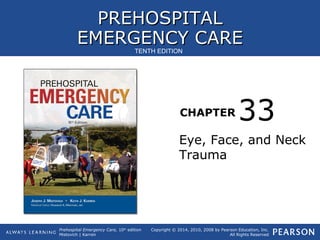
Eye, Face, and Neck
Trauma
33
Prehospital Emergency Care, 10th
edition
Mistovich | Karren
Copyright © 2014, 2010, 2008 by Pearson Education, Inc.
All Rights Reserved
Learning ReadinessLearning Readiness
• EMS Education Standards, text p. 924
Prehospital Emergency Care, 10th
edition
Mistovich | Karren
Copyright © 2014, 2010, 2008 by Pearson Education, Inc.
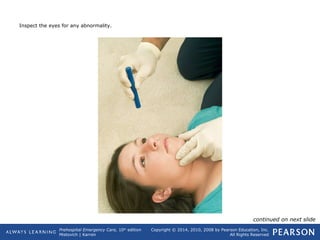
All Rights Reserved
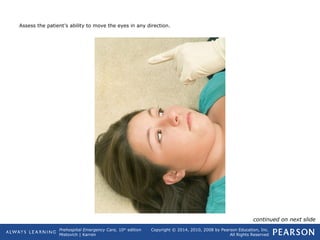
Learning ReadinessLearning Readiness
ObjectivesObjectives
• Please refer to page 924 of your text to
view the objectives for this chapter.
Prehospital Emergency Care, 10th
edition
Mistovich | Karren
Copyright © 2014, 2010, 2008 by Pearson Education, Inc.
All Rights Reserved
Learning ReadinessLearning Readiness
Key TermsKey Terms
• Please refer to page 924 of your text to
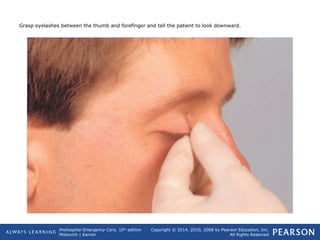
view the key terms for this chapter.
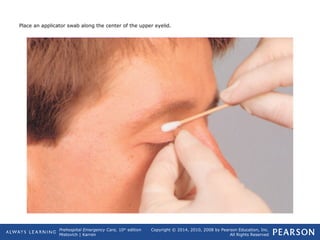
Prehospital Emergency Care, 10th
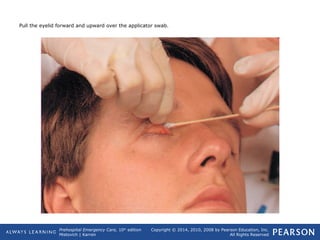
edition
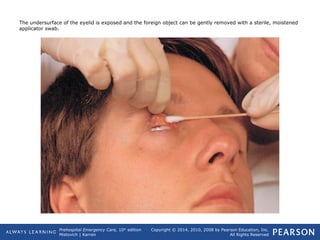
Mistovich | Karren
Copyright © 2014, 2010, 2008 by Pearson Education, Inc.
All Rights Reserved
Setting the StageSetting the Stage
• Overview of Lesson Topics
 Anatomy of the Eye, Face, and Neck
 Eye, Face, and Neck Injuries
Prehospital Emergency Care, 10th
edition
Mistovich | Karren
Copyright © 2014, 2010, 2008 by Pearson Education, Inc.
All Rights Reserved
Case Study IntroductionCase Study Introduction
EMTs Paul Ellis and Jeremy Dowling have
responded to a report of an injured person
at a tire shop. A technician was attempting
to take a tire off a rim when the tire
exploded and struck him in the face. The
scene is safe, and their general impression
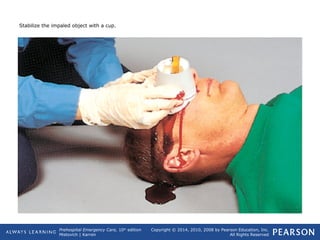
is that of a patient in his 20s with massive
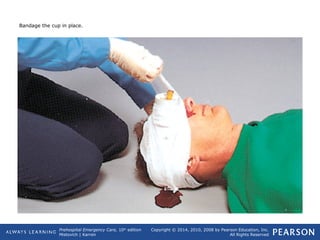
facial trauma, who is combative and seems
to have difficulty managing his airway.
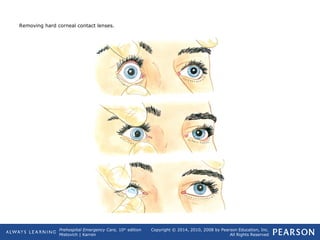
Prehospital Emergency Care, 10th
edition
Mistovich | Karren
Copyright © 2014, 2010, 2008 by Pearson Education, Inc.
All Rights Reserved
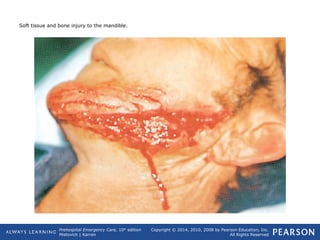
Case StudyCase Study
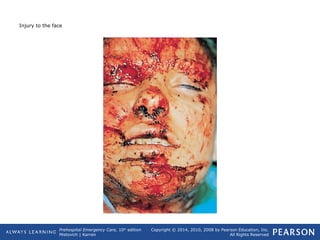
• What are the priorities of management
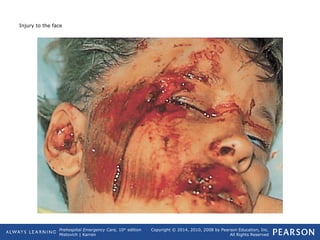
in this patient?
• What specific steps are required in the
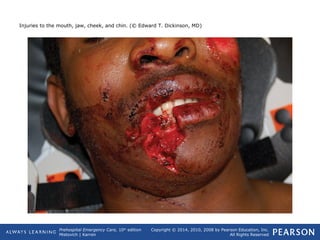
management of this patient?
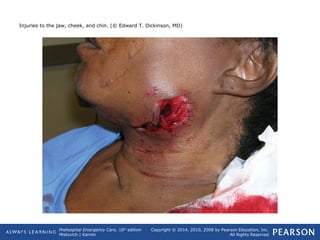
Prehospital Emergency Care, 10th
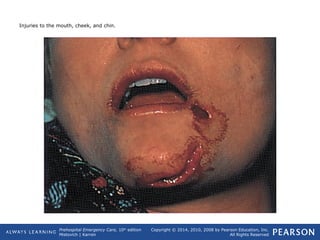
edition
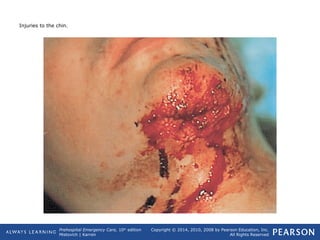
Mistovich | Karren
Copyright © 2014, 2010, 2008 by Pearson Education, Inc.
All Rights Reserved
IntroductionIntroduction
• Injuries to the eye and face can cause
emotional distress, as well as pain.
• Injuries to the face and neck carry risks
of airway compromise, bleeding, and
cervical spine injury.
• Management priorities are establishing
an airway and controlling bleeding.
Prehospital Emergency Care, 10th
edition
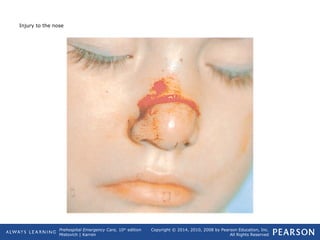
Mistovich | Karren
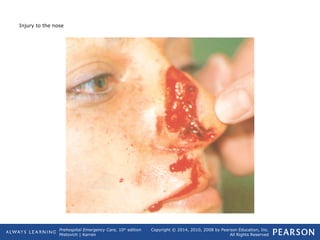
Copyright © 2014, 2010, 2008 by Pearson Education, Inc.
All Rights Reserved
Anatomy of the Eye, Face, andAnatomy of the Eye, Face, and
NeckNeck
• The eye
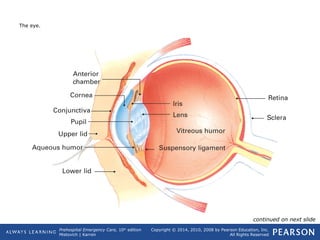
 The eye is a sphere about 1 inch in
diameter, surrounded by the bony orbit.
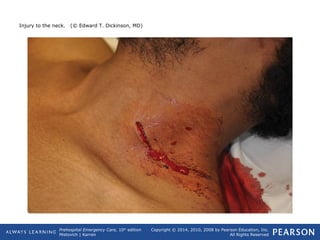
continued on next slide
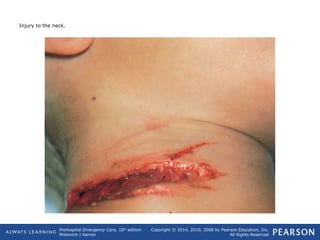
Prehospital Emergency Care, 10th
edition
Mistovich | Karren
Copyright © 2014, 2010, 2008 by Pearson Education, Inc.
All Rights Reserved
The eye.
continued on next slide
Prehospital Emergency Care, 10th
edition
Mistovich | Karren
Copyright © 2014, 2010, 2008 by Pearson Education, Inc.
All Rights Reserved
Anatomy of the Eye, Face, andAnatomy of the Eye, Face, and
NeckNeck
• The face
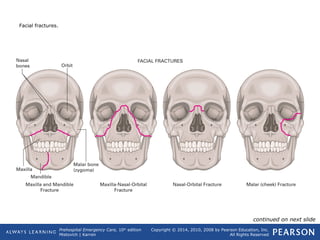
 There are 14 facial bones
 Only the mandible is movable
 The face is highly vascular
 Facial injury can lead to airway
compromise and may be associated with
brain and spine trauma.
continued on next slide
Prehospital Emergency Care, 10th
edition
Mistovich | Karren
Copyright © 2014, 2010, 2008 by Pearson Education, Inc.
All Rights Reserved
Facial fractures.
continued on next slide
Prehospital Emergency Care, 10th
edition
Mistovich | Karren
Copyright © 2014, 2010, 2008 by Pearson Education, Inc.
All Rights Reserved
Anatomy of the Eye, Face, andAnatomy of the Eye, Face, and
NeckNeck
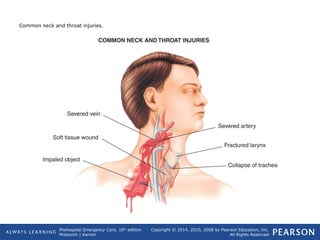
• The neck
 Contains vital vascular, airway, and
nervous system structures
 Damage to the vital structures is life
threatening.
Prehospital Emergency Care, 10th
edition
Mistovich | Karren
Copyright © 2014, 2010, 2008 by Pearson Education, Inc.
All Rights Reserved
Common neck and throat injuries.
Prehospital Emergency Care, 10th
edition
Mistovich | Karren
Copyright © 2014, 2010, 2008 by Pearson Education, Inc.
All Rights Reserved
Eye, Face, and Neck InjuriesEye, Face, and Neck Injuries
• Management challenges include:
 Profuse hemorrhage
 Many such injuries result from assault.
 There may be emotional, as well as
physical trauma.
continued on next slide
Prehospital Emergency Care, 10th
edition
Mistovich | Karren
Copyright © 2014, 2010, 2008 by Pearson Education, Inc.
All Rights Reserved
Eye, Face, and Neck InjuriesEye, Face, and Neck Injuries
• Assessment-based approach
 Scene size-up
• Motor vehicle crashes, assaults, and
sports injuries are common causes of
facial trauma.
• Assault may be involved; ensure your
safety.
continued on next slide
Prehospital Emergency Care, 10th
edition
Mistovich | Karren
Copyright © 2014, 2010, 2008 by Pearson Education, Inc.
All Rights Reserved
Eye, Face, and Neck InjuriesEye, Face, and Neck Injuries
• Assessment-based approach
 Primary assessment
• In-line spinal immobilization
• Jaw-thrust maneuver, if necessary
• Control major hemorrhage
• Suction as needed
• Consider ALS for airway management
continued on next slide
Prehospital Emergency Care, 10th
edition
Mistovich | Karren
Copyright © 2014, 2010, 2008 by Pearson Education, Inc.
All Rights Reserved
Eye, Face, and Neck InjuriesEye, Face, and Neck Injuries
• Assessment-based approach
 Primary assessment
• Maintain an SpO2 greater than or equal to
94%.
• Positive pressure ventilation for
inadequate breathing.
• Establish priority.
continued on next slide
Prehospital Emergency Care, 10th
edition
Mistovich | Karren
Copyright © 2014, 2010, 2008 by Pearson Education, Inc.
All Rights Reserved
Eye, Face, and Neck InjuriesEye, Face, and Neck Injuries
• Assessment-based approach
 High-priority conditions include:
• Chemical burns to the eye
• Impaled object in the eye
• Extruded eyeball
• Respiratory distress
• Severe face or neck injuries
• Spinal column or spinal cord injury
• Airway compromise
continued on next slide
Prehospital Emergency Care, 10th
edition
Mistovich | Karren
Copyright © 2014, 2010, 2008 by Pearson Education, Inc.
All Rights Reserved
Eye, Face, and Neck InjuriesEye, Face, and Neck Injuries
• Assessment-based approach
 Secondary assessment
• Inspect and palpate for signs of injury.
• Use a penlight to inspect the eyes.
• Do not push directly on the eye.
• Obtain vital signs.
• Obtain a history.
continued on next slide
Prehospital Emergency Care, 10th
edition
Mistovich | Karren
Copyright © 2014, 2010, 2008 by Pearson Education, Inc.
All Rights Reserved
Eye, Face, and Neck InjuriesEye, Face, and Neck Injuries
• Assessment-based approach
 Reassessment
• Every 5 minutes for unstable patients
• Every 15 minutes for stable patients
• Be alert to changes in the mental status,
airway, or breathing.
Prehospital Emergency Care, 10th
edition
Mistovich | Karren
Copyright © 2014, 2010, 2008 by Pearson Education, Inc.
All Rights Reserved
Eye InjuriesEye Injuries
• Assess the eyes separately and
together to evaluate the:
 Orbits
 Eyelids
 Conjunctivae
 Globes
 Pupils
continued on next slide
Prehospital Emergency Care, 10th
edition
Mistovich | Karren
Copyright © 2014, 2010, 2008 by Pearson Education, Inc.
All Rights Reserved
Inspect the eyes for any abnormality.
continued on next slide
Prehospital Emergency Care, 10th
edition
Mistovich | Karren
Copyright © 2014, 2010, 2008 by Pearson Education, Inc.
All Rights Reserved
Assess the patient’s ability to move the eyes in any direction.
continued on next slide
Prehospital Emergency Care, 10th
edition
Mistovich | Karren
Copyright © 2014, 2010, 2008 by Pearson Education, Inc.
All Rights Reserved
Eye InjuriesEye Injuries
• Suspect significant eye damage if the
patient:
 Has loss of vision that does not improve
with blinking
 Loses part of the visual field
 Has severe pain
 Has double vision
 Is unusually sensitive to light
continued on next slide
Prehospital Emergency Care, 10th
edition
Mistovich | Karren
Copyright © 2014, 2010, 2008 by Pearson Education, Inc.
All Rights Reserved
Eye InjuriesEye Injuries
• Basic guidelines for eye injuries
 If the eye is swollen shut, avoid
unnecessary manipulation in examining
the eye.
 Do not try to force the eyelid open
unless you have to wash out chemicals.
 Consult medical direction or protocol
before irrigating.
continued on next slide
Prehospital Emergency Care, 10th
edition
Mistovich | Karren
Copyright © 2014, 2010, 2008 by Pearson Education, Inc.
All Rights Reserved
Eye InjuriesEye Injuries
• Basic guidelines for eye injuries
 Do not put salve or medicine in an
injured eye.
 Do not remove blood or blood clots from
the eye.
 Have the patient lie down and keep
quiet; never let a patient with an eye
injury walk without help.
continued on next slide
Prehospital Emergency Care, 10th
edition
Mistovich | Karren
Copyright © 2014, 2010, 2008 by Pearson Education, Inc.
All Rights Reserved
Eye InjuriesEye Injuries
• Basic guidelines for eye injuries
 Limit use of the uninjured eye; cover it
along with the injured eye.
 Give the patient nothing by mouth in
case general anesthesia is required at
the hospital.
 Every patient with an eye injury must
be transported for evaluation by a
physician.
continued on next slide
Prehospital Emergency Care, 10th
edition
Mistovich | Karren
Copyright © 2014, 2010, 2008 by Pearson Education, Inc.
All Rights Reserved
Eye InjuriesEye Injuries
• Basic guidelines for eye injuries
 Never apply direct pressure to an
injured eye.
 If possible, bring the liquid or material
to which the eye was exposed with the
patient.
continued on next slide
Prehospital Emergency Care, 10th
edition
Mistovich | Karren
Copyright © 2014, 2010, 2008 by Pearson Education, Inc.
All Rights Reserved
Eye InjuriesEye Injuries
• Foreign object in the eye
 A variety of foreign particles can enter
the eye.
 It is safer to transport than to attempt
removal of the object in the field.
continued on next slide
Prehospital Emergency Care, 10th
edition
Mistovich | Karren
Copyright © 2014, 2010, 2008 by Pearson Education, Inc.
All Rights Reserved
Eye InjuriesEye Injuries
• Foreign object in the eye
 Some EMS systems allow irrigation or
manual technique to remove a foreign
object.
 Do not remove an embedded foreign
object; bandage both eyes and
transport.
continued on next slide
Prehospital Emergency Care, 10th
edition
Mistovich | Karren
Copyright © 2014, 2010, 2008 by Pearson Education, Inc.
All Rights Reserved
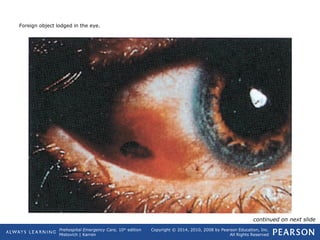
Foreign object lodged in the eye.
continued on next slide
Prehospital Emergency Care, 10th
edition
Mistovich | Karren
Copyright © 2014, 2010, 2008 by Pearson Education, Inc.
All Rights Reserved
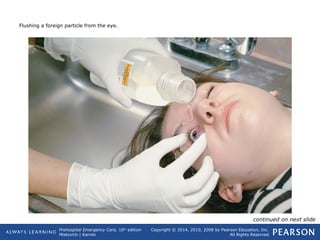
Flushing a foreign particle from the eye.
continued on next slide
Prehospital Emergency Care, 10th
edition
Mistovich | Karren
Copyright © 2014, 2010, 2008 by Pearson Education, Inc.
All Rights Reserved
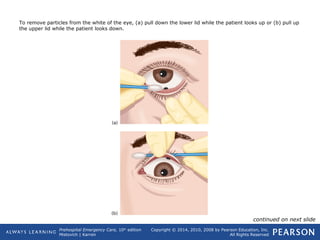
To remove particles from the white of the eye, (a) pull down the lower lid while the patient looks up or (b) pull up
the upper lid while the patient looks down.
continued on next slide
Prehospital Emergency Care, 10th
edition
Mistovich | Karren
Copyright © 2014, 2010, 2008 by Pearson Education, Inc.
All Rights Reserved
EMT SKILLS 33-1
Removal of Foreign Object—Upper Eyelid
Prehospital Emergency Care, 10th
edition
Mistovich | Karren
Copyright © 2014, 2010, 2008 by Pearson Education, Inc.
All Rights Reserved
Grasp eyelashes between the thumb and forefinger and tell the patient to look downward.
Prehospital Emergency Care, 10th
edition
Mistovich | Karren
Copyright © 2014, 2010, 2008 by Pearson Education, Inc.
All Rights Reserved
Place an applicator swab along the center of the upper eyelid.
Prehospital Emergency Care, 10th
edition
Mistovich | Karren
Copyright © 2014, 2010, 2008 by Pearson Education, Inc.
All Rights Reserved
Pull the eyelid forward and upward over the applicator swab.
Prehospital Emergency Care, 10th
edition
Mistovich | Karren
Copyright © 2014, 2010, 2008 by Pearson Education, Inc.
All Rights Reserved
The undersurface of the eyelid is exposed and the foreign object can be gently removed with a sterile, moistened
applicator swab.
Prehospital Emergency Care, 10th
edition
Mistovich | Karren
Copyright © 2014, 2010, 2008 by Pearson Education, Inc.
All Rights Reserved
Eye InjuriesEye Injuries
• Injury to the orbits
 Orbital fractures can be associated with
cervical spine injury.
continued on next slide
Prehospital Emergency Care, 10th
edition
Mistovich | Karren
Copyright © 2014, 2010, 2008 by Pearson Education, Inc.
All Rights Reserved
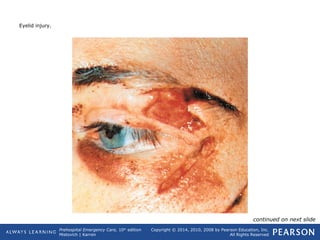
Eyelid injury.
continued on next slide
Prehospital Emergency Care, 10th
edition
Mistovich | Karren
Copyright © 2014, 2010, 2008 by Pearson Education, Inc.
All Rights Reserved
Eye InjuriesEye Injuries
• Signs of orbital injury include:
 Double vision
 Decrease in vision
 Loss of sensation above the eyebrow,
over the cheek, or in the upper lip
 Nasal discharge
continued on next slide
Prehospital Emergency Care, 10th
edition
Mistovich | Karren
Copyright © 2014, 2010, 2008 by Pearson Education, Inc.
All Rights Reserved
Eye InjuriesEye Injuries
• Signs of orbital injury include:
 Tenderness to palpation
 A bony deformity
 Paralysis of the upward gaze
continued on next slide
Prehospital Emergency Care, 10th
edition
Mistovich | Karren
Copyright © 2014, 2010, 2008 by Pearson Education, Inc.
All Rights Reserved
Eye InjuriesEye Injuries
• For suspected orbital injury:
 Apply a cold pack.
 Transport the patient in an upright
position.
 If injury to the eyeball is suspected, do
not use cold packs; transport in a supine
position.
continued on next slide
Prehospital Emergency Care, 10th
edition
Mistovich | Karren
Copyright © 2014, 2010, 2008 by Pearson Education, Inc.
All Rights Reserved
Eye InjuriesEye Injuries
• Eyelid injury
 Control bleeding with light direct
pressure.
 Do not apply pressure if eyeball injury is
suspected.
 Use a moist dressing for open wounds.
 Cover both eyes to decrease movement.
continued on next slide
Prehospital Emergency Care, 10th
edition
Mistovich | Karren
Copyright © 2014, 2010, 2008 by Pearson Education, Inc.
All Rights Reserved
Eye InjuriesEye Injuries
• Injuries to the globe
 Include lacerations, foreign objects,
abrasions
 There may be blood in the anterior
chamber of the eye.
 Avoid any pressure on the eye.
 Lightly bandage both eyes.
 Transport.
continued on next slide
Prehospital Emergency Care, 10th
edition
Mistovich | Karren
Copyright © 2014, 2010, 2008 by Pearson Education, Inc.
All Rights Reserved
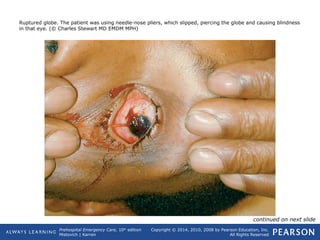
Ruptured globe. The patient was using needle-nose pliers, which slipped, piercing the globe and causing blindness
in that eye. (© Charles Stewart MD EMDM MPH)
continued on next slide
Prehospital Emergency Care, 10th
edition
Mistovich | Karren
Copyright © 2014, 2010, 2008 by Pearson Education, Inc.
All Rights Reserved
Eye InjuriesEye Injuries
• Chemical burn to the eye
 Burning continues as long as the
substance is in the eye.
 After the scene size-up and primary
assessment, begin treatment
immediately.
continued on next slide
Prehospital Emergency Care, 10th
edition
Mistovich | Karren
Copyright © 2014, 2010, 2008 by Pearson Education, Inc.
All Rights Reserved
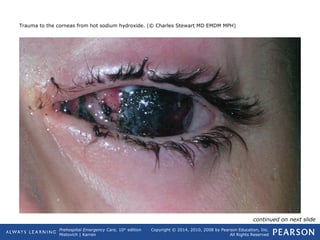
Trauma to the corneas from hot sodium hydroxide. (© Charles Stewart MD EMDM MPH)
continued on next slide
Prehospital Emergency Care, 10th
edition
Mistovich | Karren
Copyright © 2014, 2010, 2008 by Pearson Education, Inc.
All Rights Reserved
Eye InjuriesEye Injuries
• Chemical burns to the eye
 Hold the eyelids open.
 Continuously irrigate for 20 minutes;
one hour for alkali.
 Avoid contamination of the unaffected
eye.
 Use only plain water or saline.
 Flush out or remove contact lenses.
continued on next slide
Prehospital Emergency Care, 10th
edition
Mistovich | Karren
Copyright © 2014, 2010, 2008 by Pearson Education, Inc.
All Rights Reserved
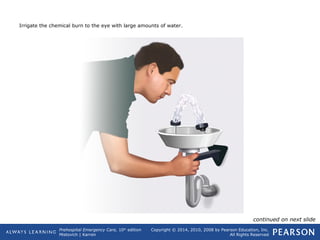
Irrigate the chemical burn to the eye with large amounts of water.
continued on next slide
Prehospital Emergency Care, 10th
edition
Mistovich | Karren
Copyright © 2014, 2010, 2008 by Pearson Education, Inc.
All Rights Reserved
Eye InjuriesEye Injuries
• Impaled object or extruded eyeball
 Do not remove an impaled object;
stabilize it in place.
 Do not manipulate the eye.
 Protect the injured eye with an eye
shield or cup.
 Bandage both eyes.
continued on next slide
Prehospital Emergency Care, 10th
edition
Mistovich | Karren
Copyright © 2014, 2010, 2008 by Pearson Education, Inc.
All Rights Reserved
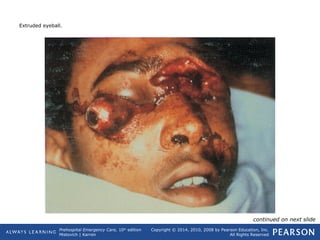
Extruded eyeball.
continued on next slide
Prehospital Emergency Care, 10th
edition
Mistovich | Karren
Copyright © 2014, 2010, 2008 by Pearson Education, Inc.
All Rights Reserved
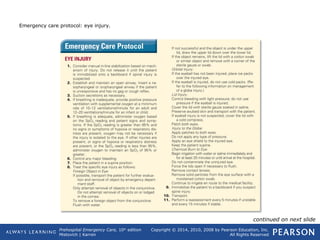
Emergency care protocol: eye injury.
continued on next slide
Prehospital Emergency Care, 10th
edition
Mistovich | Karren
Copyright © 2014, 2010, 2008 by Pearson Education, Inc.
All Rights Reserved
EMT SKILLS 33-2
Emergency Care—Impaled Object in the
Eye
Prehospital Emergency Care, 10th
edition
Mistovich | Karren
Copyright © 2014, 2010, 2008 by Pearson Education, Inc.
All Rights Reserved
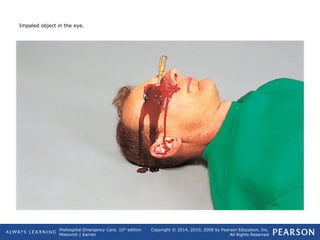
Impaled object in the eye.
Prehospital Emergency Care, 10th
edition
Mistovich | Karren
Copyright © 2014, 2010, 2008 by Pearson Education, Inc.
All Rights Reserved
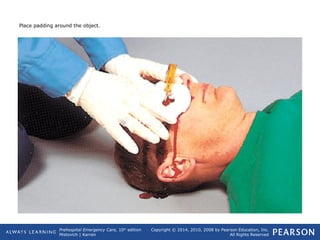
Place padding around the object.
Prehospital Emergency Care, 10th
edition
Mistovich | Karren
Copyright © 2014, 2010, 2008 by Pearson Education, Inc.
All Rights Reserved
Stabilize the impaled object with a cup.
Prehospital Emergency Care, 10th
edition
Mistovich | Karren
Copyright © 2014, 2010, 2008 by Pearson Education, Inc.
All Rights Reserved
Bandage the cup in place.
Prehospital Emergency Care, 10th
edition
Mistovich | Karren
Copyright © 2014, 2010, 2008 by Pearson Education, Inc.
All Rights Reserved
Eye InjuriesEye Injuries
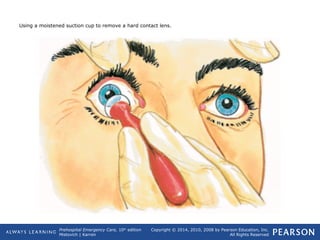
• Contact lenses may need to be
removed when there is an eye injury.
• Check both eyes; patients may wear
one contact lens or wear both contact
lenses and glasses.
• Consult medical direction about
removing contact lenses.
Prehospital Emergency Care, 10th
edition
Mistovich | Karren
Copyright © 2014, 2010, 2008 by Pearson Education, Inc.
All Rights Reserved
Removing hard corneal contact lenses.
Prehospital Emergency Care, 10th
edition
Mistovich | Karren
Copyright © 2014, 2010, 2008 by Pearson Education, Inc.
All Rights Reserved
Using a moistened suction cup to remove a hard contact lens.
Prehospital Emergency Care, 10th
edition
Mistovich | Karren
Copyright © 2014, 2010, 2008 by Pearson Education, Inc.
All Rights Reserved
An adult patient presents with a complaint of eye pain after being struck in the eye byAn adult patient presents with a complaint of eye pain after being struck in the eye by
debris from a metal grinder. His right eye is watery and red, and he has difficultydebris from a metal grinder. His right eye is watery and red, and he has difficulty
keeping it open. You are able to see a metal shaving that appears to be superficiallykeeping it open. You are able to see a metal shaving that appears to be superficially
embedded in the cornea. Click on the action that is most appropriate in the prehospitalembedded in the cornea. Click on the action that is most appropriate in the prehospital
management of this patient.management of this patient.
A. Use a cotton-tipped applicator to dislodge the
metal shaving.
B. Aggressively irrigate the eye with normal saline
to dislodge the metal shaving.
C. Bandage both eyes.
D. Cover the right eye with a metal eye shield
taped in place.
Prehospital Emergency Care, 10th
edition
Mistovich | Karren
Copyright © 2014, 2010, 2008 by Pearson Education, Inc.
All Rights Reserved
Injuries to the FaceInjuries to the Face
• Facial injuries pose a risk of airway
compromise.
 Pay particular attention to airway
management.
 Be prepared to suction.
• With significant facial trauma, suspect
cervical spine trauma and brain injury.
continued on next slide
Prehospital Emergency Care, 10th
edition
Mistovich | Karren
Copyright © 2014, 2010, 2008 by Pearson Education, Inc.
All Rights Reserved
EMT SKILLS 33-3
Injuries to the Face
Prehospital Emergency Care, 10th
edition
Mistovich | Karren
Copyright © 2014, 2010, 2008 by Pearson Education, Inc.
All Rights Reserved
Soft tissue and bone injury to the mandible.
Prehospital Emergency Care, 10th
edition
Mistovich | Karren
Copyright © 2014, 2010, 2008 by Pearson Education, Inc.
All Rights Reserved
Injury to the face
Prehospital Emergency Care, 10th
edition
Mistovich | Karren
Copyright © 2014, 2010, 2008 by Pearson Education, Inc.
All Rights Reserved
Injury to the face
Prehospital Emergency Care, 10th
edition
Mistovich | Karren
Copyright © 2014, 2010, 2008 by Pearson Education, Inc.
All Rights Reserved
EMT SKILLS 33-4
Injuries to the Mouth, Jaw, Cheek, and
Chin
Prehospital Emergency Care, 10th
edition
Mistovich | Karren
Copyright © 2014, 2010, 2008 by Pearson Education, Inc.
All Rights Reserved
Injuries to the mouth, jaw, cheek, and chin. (© Edward T. Dickinson, MD)
Prehospital Emergency Care, 10th
edition
Mistovich | Karren
Copyright © 2014, 2010, 2008 by Pearson Education, Inc.
All Rights Reserved
Injuries to the jaw, cheek, and chin. (© Edward T. Dickinson, MD)
Prehospital Emergency Care, 10th
edition
Mistovich | Karren
Copyright © 2014, 2010, 2008 by Pearson Education, Inc.
All Rights Reserved
Injuries to the mouth, cheek, and chin.
Prehospital Emergency Care, 10th
edition
Mistovich | Karren
Copyright © 2014, 2010, 2008 by Pearson Education, Inc.
All Rights Reserved
Injuries to the chin.
Prehospital Emergency Care, 10th
edition
Mistovich | Karren
Copyright © 2014, 2010, 2008 by Pearson Education, Inc.
All Rights Reserved
Injuries to the FaceInjuries to the Face
• Emergency care for injuries to the face
 Establish and maintain in-line spinal
stabilization.
 Establish and maintain a patent airway.
continued on next slide
Prehospital Emergency Care, 10th
edition
Mistovich | Karren
Copyright © 2014, 2010, 2008 by Pearson Education, Inc.
All Rights Reserved
Injuries to the FaceInjuries to the Face
• In establishing and maintaining an
airway:
 Inspect the mouth for fragments of
teeth, bone, soft tissue, or foreign
objects.
 Leave dentures in place if they are
secure and unbroken; remove broken or
loose dentures.
continued on next slide
Prehospital Emergency Care, 10th
edition
Mistovich | Karren
Copyright © 2014, 2010, 2008 by Pearson Education, Inc.
All Rights Reserved
Injuries to the FaceInjuries to the Face
• In establishing and maintaining an
airway:
 The tongue may need to be pulled
forward if it has lost its support
structure.
continued on next slide
Prehospital Emergency Care, 10th
edition
Mistovich | Karren
Copyright © 2014, 2010, 2008 by Pearson Education, Inc.
All Rights Reserved
Injuries to the FaceInjuries to the Face
• In establishing and maintaining an
airway:
 Suction the airway as needed.
 Request ALS, if needed, for advanced
airway management.
continued on next slide
Prehospital Emergency Care, 10th
edition
Mistovich | Karren
Copyright © 2014, 2010, 2008 by Pearson Education, Inc.
All Rights Reserved
Injuries to the FaceInjuries to the Face
• Emergency care for injuries to the face:
 Maintain an SpO2 greater than or equal
to 94%; provide positive pressure
ventilation if breathing is inadequate.
 Control severe bleeding.
 Cover exposed nerves, tendons, or
blood vessels with a moist, sterile
dressing.
 Treat for shock; transport.
continued on next slide
Prehospital Emergency Care, 10th
edition
Mistovich | Karren
Copyright © 2014, 2010, 2008 by Pearson Education, Inc.
All Rights Reserved
Injuries to the FaceInjuries to the Face
• Avulsed tooth
 Gently rinse the tooth with saline to
remove debris; transport the tooth in a
cup of saline or wrapped in saline-
soaked gauze.
 Do not handle the tooth by the root.
continued on next slide
Prehospital Emergency Care, 10th
edition
Mistovich | Karren
Copyright © 2014, 2010, 2008 by Pearson Education, Inc.
All Rights Reserved
Injuries to the FaceInjuries to the Face
• Avulsed tooth
 If you cannot find teeth that have been
knocked out, assume they have been
swallowed or aspirated.
 Control bleeding from the tooth socket
with a gauze pad.
continued on next slide
Prehospital Emergency Care, 10th
edition
Mistovich | Karren
Copyright © 2014, 2010, 2008 by Pearson Education, Inc.
All Rights Reserved
Injuries to the FaceInjuries to the Face
• Injury to the mid-face, or upper or
lower jaw
 Stabilize the spine.
 Manage the airway and support
breathing.
 Control bleeding.
 Request ALS for difficult-to-manage
airway or ventilation.
continued on next slide
Prehospital Emergency Care, 10th
edition
Mistovich | Karren
Copyright © 2014, 2010, 2008 by Pearson Education, Inc.
All Rights Reserved
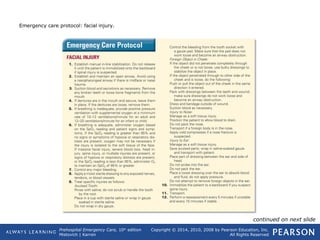
Emergency care protocol: facial injury.
continued on next slide
Prehospital Emergency Care, 10th
edition
Mistovich | Karren
Copyright © 2014, 2010, 2008 by Pearson Education, Inc.
All Rights Reserved
Injuries to the FaceInjuries to the Face
• Impaled object in the cheek
 Remove the object if it jeopardizes the
airway.
 Pack dressing material between the
teeth and the wound, but secure the
dressing to prevent airway compromise.
 Control bleeding.
 Suction frequently.
continued on next slide
Prehospital Emergency Care, 10th
edition
Mistovich | Karren
Copyright © 2014, 2010, 2008 by Pearson Education, Inc.
All Rights Reserved
Injuries to the FaceInjuries to the Face
• Injury to to the nose
 Monitor the airway.
 Position the patient to prevent blood
from being swallowed or draining into
the airway.
 Do not attempt to remove foreign
bodies in the nose.
continued on next slide
Prehospital Emergency Care, 10th
edition
Mistovich | Karren
Copyright © 2014, 2010, 2008 by Pearson Education, Inc.
All Rights Reserved
EMT SKILLS 33-5
Injuries to the Nose
Prehospital Emergency Care, 10th
edition
Mistovich | Karren
Copyright © 2014, 2010, 2008 by Pearson Education, Inc.
All Rights Reserved
Injury to the nose
Prehospital Emergency Care, 10th
edition
Mistovich | Karren
Copyright © 2014, 2010, 2008 by Pearson Education, Inc.
All Rights Reserved
Injury to the nose
Prehospital Emergency Care, 10th
edition
Mistovich | Karren
Copyright © 2014, 2010, 2008 by Pearson Education, Inc.
All Rights Reserved
Injuries to the FaceInjuries to the Face
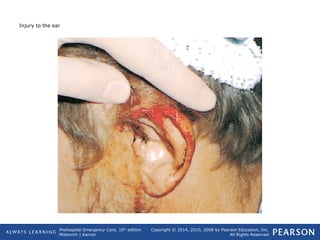
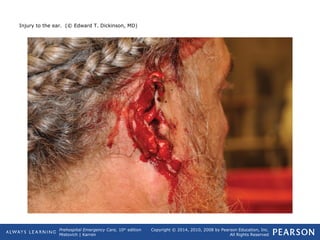
• Injury to the ear
 Treat for soft-tissue injury; transport
any avulsed tissue.
 Do not attempt to remove foreign
bodies in the ear.
Prehospital Emergency Care, 10th
edition
Mistovich | Karren
Copyright © 2014, 2010, 2008 by Pearson Education, Inc.
All Rights Reserved
EMT SKILLS 33-6
Injuries to the Ear
Prehospital Emergency Care, 10th
edition
Mistovich | Karren
Copyright © 2014, 2010, 2008 by Pearson Education, Inc.
All Rights Reserved
Injury to the ear
Prehospital Emergency Care, 10th
edition
Mistovich | Karren
Copyright © 2014, 2010, 2008 by Pearson Education, Inc.
All Rights Reserved
Injury to the ear. (© Edward T. Dickinson, MD)
Prehospital Emergency Care, 10th
edition
Mistovich | Karren
Copyright © 2014, 2010, 2008 by Pearson Education, Inc.
All Rights Reserved
Injuries to the NeckInjuries to the Neck
• May be caused by blunt or penetrating
trauma
• Complications include bleeding, air
embolism, airway compromise, and
cervical spine injury.
continued on next slide
Prehospital Emergency Care, 10th
edition
Mistovich | Karren
Copyright © 2014, 2010, 2008 by Pearson Education, Inc.
All Rights Reserved
EMT SKILLS 33-7
Injuries to the Neck
Prehospital Emergency Care, 10th
edition
Mistovich | Karren
Copyright © 2014, 2010, 2008 by Pearson Education, Inc.
All Rights Reserved
Injury to the neck. (© Edward T. Dickinson, MD)
Prehospital Emergency Care, 10th
edition
Mistovich | Karren
Copyright © 2014, 2010, 2008 by Pearson Education, Inc.
All Rights Reserved
Injury to the neck.
Prehospital Emergency Care, 10th
edition
Mistovich | Karren
Copyright © 2014, 2010, 2008 by Pearson Education, Inc.
All Rights Reserved
Injuries to the NeckInjuries to the Neck
• Signs and symptoms include:
 Swelling, bruising, hematoma formation
 Difficulty speaking
 Change in or loss of voice
 Subcutaneous emphysema
continued on next slide
Prehospital Emergency Care, 10th
edition
Mistovich | Karren
Copyright © 2014, 2010, 2008 by Pearson Education, Inc.
All Rights Reserved
Injuries to the NeckInjuries to the Neck
• Signs and symptoms include:
 Airway obstruction
 Crepitation while speaking
 Displacement of the trachea to one side
continued on next slide
Prehospital Emergency Care, 10th
edition
Mistovich | Karren
Copyright © 2014, 2010, 2008 by Pearson Education, Inc.
All Rights Reserved
Injuries to the NeckInjuries to the Neck
• Management
 Spinal stabilization
 Establish a patent airway.
 Maintain adequate oxygenation.
 Positive pressure ventilation for
inadequate breathing
 Control severe bleeding.
 Treat for shock.
continued on next slide
Prehospital Emergency Care, 10th
edition
Mistovich | Karren
Copyright © 2014, 2010, 2008 by Pearson Education, Inc.
All Rights Reserved
Injuries to the NeckInjuries to the Neck
• Jugular vein laceration
 Air may enter the injured vessel,
resulting in air embolism.
 Quickly apply an occlusive dressing.
Prehospital Emergency Care, 10th
edition
Mistovich | Karren
Copyright © 2014, 2010, 2008 by Pearson Education, Inc.
All Rights Reserved
EMT SKILLS 33-8
Emergency Care—Severed Blood Vessel of
the Neck
Prehospital Emergency Care, 10th
edition
Mistovich | Karren
Copyright © 2014, 2010, 2008 by Pearson Education, Inc.
All Rights Reserved
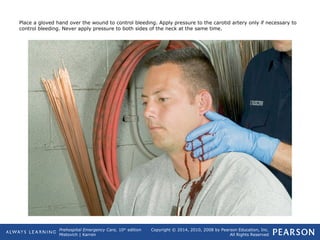
Place a gloved hand over the wound to control bleeding. Apply pressure to the carotid artery only if necessary to
control bleeding. Never apply pressure to both sides of the neck at the same time.
Prehospital Emergency Care, 10th
edition
Mistovich | Karren
Copyright © 2014, 2010, 2008 by Pearson Education, Inc.
All Rights Reserved
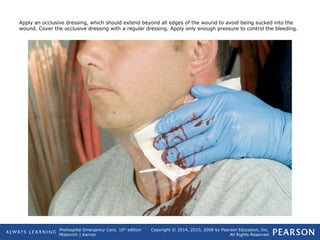
Apply an occlusive dressing, which should extend beyond all edges of the wound to avoid being sucked into the
wound. Cover the occlusive dressing with a regular dressing. Apply only enough pressure to control the bleeding.
Prehospital Emergency Care, 10th
edition
Mistovich | Karren
Copyright © 2014, 2010, 2008 by Pearson Education, Inc.
All Rights Reserved
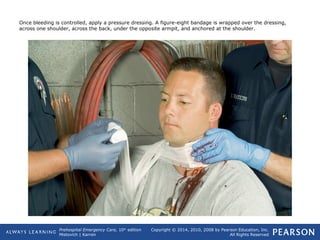
Once bleeding is controlled, apply a pressure dressing. A figure-eight bandage is wrapped over the dressing,
across one shoulder, across the back, under the opposite armpit, and anchored at the shoulder.
Prehospital Emergency Care, 10th
edition
Mistovich | Karren
Copyright © 2014, 2010, 2008 by Pearson Education, Inc.
All Rights Reserved
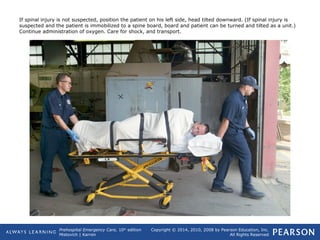
If spinal injury is not suspected, position the patient on his left side, head tilted downward. (If spinal injury is
suspected and the patient is immobilized to a spine board, board and patient can be turned and tilted as a unit.)
Continue administration of oxygen. Care for shock, and transport.
Prehospital Emergency Care, 10th
edition
Mistovich | Karren
Copyright © 2014, 2010, 2008 by Pearson Education, Inc.
All Rights Reserved
Case Study ConclusionCase Study Conclusion
Paul immediately provides in-line stabilization
of the spine and a jaw-thrust maneuver, as
Jeremy prepares suction. The patient is awake,
but is uncooperative and confused. A
nasopharyngeal airway is contraindicated
because of massive mid-facial trauma.
Instability of the mandible makes manual
positioning of the airway difficult. Jeremy
immediately requests ALS backup for advanced
airway management.
continued on next slide
Prehospital Emergency Care, 10th
edition
Mistovich | Karren
Copyright © 2014, 2010, 2008 by Pearson Education, Inc.
All Rights Reserved
Case Study ConclusionCase Study Conclusion
The patient's breathing is adequate, and he has
a strong, regular radial pulse.
The EMTs immobilize the patient to a long
backboard while continuing basic airway
management. ALS arrives; the paramedic
sedates and intubates the patient, and the crew
begins transport to a trauma center.
The patient is found to have complex facial
fractures that require surgery, as a well as a
cerebral contusion.
Prehospital Emergency Care, 10th
edition
Mistovich | Karren
Copyright © 2014, 2010, 2008 by Pearson Education, Inc.
All Rights Reserved
Lesson SummaryLesson Summary
• Severe facial or neck injuries can be
clinically challenging.
• Patients can require emotional support
as well as care of the injuries.
continued on next slide
Prehospital Emergency Care, 10th
edition
Mistovich | Karren
Copyright © 2014, 2010, 2008 by Pearson Education, Inc.
All Rights Reserved
Lesson SummaryLesson Summary
• Keep in mind the possibility of spinal
and traumatic brain injuries in
association with facial and neck
injuries.
• Airway management is critical and can
be complicated in patients with facial
and neck trauma.

DMACC EMT Chapter 33

  • 1.
    PREHOSPITALPREHOSPITAL EMERGENCY CAREEMERGENCY CARE CHAPTER Copyright© 2014, 2010, 2008 by Pearson Education, Inc. All Rights Reserved Prehospital Emergency Care, 10th edition Mistovich | Karren TENTH EDITION Eye, Face, and Neck Trauma 33
  • 2.
    Prehospital Emergency Care,10th edition Mistovich | Karren Copyright © 2014, 2010, 2008 by Pearson Education, Inc. All Rights Reserved Learning ReadinessLearning Readiness • EMS Education Standards, text p. 924
  • 3.
    Prehospital Emergency Care,10th edition Mistovich | Karren Copyright © 2014, 2010, 2008 by Pearson Education, Inc. All Rights Reserved Learning ReadinessLearning Readiness ObjectivesObjectives • Please refer to page 924 of your text to view the objectives for this chapter.
  • 4.
    Prehospital Emergency Care,10th edition Mistovich | Karren Copyright © 2014, 2010, 2008 by Pearson Education, Inc. All Rights Reserved Learning ReadinessLearning Readiness Key TermsKey Terms • Please refer to page 924 of your text to view the key terms for this chapter.
  • 5.
    Prehospital Emergency Care,10th edition Mistovich | Karren Copyright © 2014, 2010, 2008 by Pearson Education, Inc. All Rights Reserved Setting the StageSetting the Stage • Overview of Lesson Topics  Anatomy of the Eye, Face, and Neck  Eye, Face, and Neck Injuries
  • 6.
    Prehospital Emergency Care,10th edition Mistovich | Karren Copyright © 2014, 2010, 2008 by Pearson Education, Inc. All Rights Reserved Case Study IntroductionCase Study Introduction EMTs Paul Ellis and Jeremy Dowling have responded to a report of an injured person at a tire shop. A technician was attempting to take a tire off a rim when the tire exploded and struck him in the face. The scene is safe, and their general impression is that of a patient in his 20s with massive facial trauma, who is combative and seems to have difficulty managing his airway.
  • 7.
    Prehospital Emergency Care,10th edition Mistovich | Karren Copyright © 2014, 2010, 2008 by Pearson Education, Inc. All Rights Reserved Case StudyCase Study • What are the priorities of management in this patient? • What specific steps are required in the management of this patient?
  • 8.
    Prehospital Emergency Care,10th edition Mistovich | Karren Copyright © 2014, 2010, 2008 by Pearson Education, Inc. All Rights Reserved IntroductionIntroduction • Injuries to the eye and face can cause emotional distress, as well as pain. • Injuries to the face and neck carry risks of airway compromise, bleeding, and cervical spine injury. • Management priorities are establishing an airway and controlling bleeding.
  • 9.
    Prehospital Emergency Care,10th edition Mistovich | Karren Copyright © 2014, 2010, 2008 by Pearson Education, Inc. All Rights Reserved Anatomy of the Eye, Face, andAnatomy of the Eye, Face, and NeckNeck • The eye  The eye is a sphere about 1 inch in diameter, surrounded by the bony orbit. continued on next slide
  • 10.
    Prehospital Emergency Care,10th edition Mistovich | Karren Copyright © 2014, 2010, 2008 by Pearson Education, Inc. All Rights Reserved The eye. continued on next slide
  • 11.
    Prehospital Emergency Care,10th edition Mistovich | Karren Copyright © 2014, 2010, 2008 by Pearson Education, Inc. All Rights Reserved Anatomy of the Eye, Face, andAnatomy of the Eye, Face, and NeckNeck • The face  There are 14 facial bones  Only the mandible is movable  The face is highly vascular  Facial injury can lead to airway compromise and may be associated with brain and spine trauma. continued on next slide
  • 12.
    Prehospital Emergency Care,10th edition Mistovich | Karren Copyright © 2014, 2010, 2008 by Pearson Education, Inc. All Rights Reserved Facial fractures. continued on next slide
  • 13.
    Prehospital Emergency Care,10th edition Mistovich | Karren Copyright © 2014, 2010, 2008 by Pearson Education, Inc. All Rights Reserved Anatomy of the Eye, Face, andAnatomy of the Eye, Face, and NeckNeck • The neck  Contains vital vascular, airway, and nervous system structures  Damage to the vital structures is life threatening.
  • 14.
    Prehospital Emergency Care,10th edition Mistovich | Karren Copyright © 2014, 2010, 2008 by Pearson Education, Inc. All Rights Reserved Common neck and throat injuries.
  • 15.
    Prehospital Emergency Care,10th edition Mistovich | Karren Copyright © 2014, 2010, 2008 by Pearson Education, Inc. All Rights Reserved Eye, Face, and Neck InjuriesEye, Face, and Neck Injuries • Management challenges include:  Profuse hemorrhage  Many such injuries result from assault.  There may be emotional, as well as physical trauma. continued on next slide
  • 16.
    Prehospital Emergency Care,10th edition Mistovich | Karren Copyright © 2014, 2010, 2008 by Pearson Education, Inc. All Rights Reserved Eye, Face, and Neck InjuriesEye, Face, and Neck Injuries • Assessment-based approach  Scene size-up • Motor vehicle crashes, assaults, and sports injuries are common causes of facial trauma. • Assault may be involved; ensure your safety. continued on next slide
  • 17.
    Prehospital Emergency Care,10th edition Mistovich | Karren Copyright © 2014, 2010, 2008 by Pearson Education, Inc. All Rights Reserved Eye, Face, and Neck InjuriesEye, Face, and Neck Injuries • Assessment-based approach  Primary assessment • In-line spinal immobilization • Jaw-thrust maneuver, if necessary • Control major hemorrhage • Suction as needed • Consider ALS for airway management continued on next slide
  • 18.
    Prehospital Emergency Care,10th edition Mistovich | Karren Copyright © 2014, 2010, 2008 by Pearson Education, Inc. All Rights Reserved Eye, Face, and Neck InjuriesEye, Face, and Neck Injuries • Assessment-based approach  Primary assessment • Maintain an SpO2 greater than or equal to 94%. • Positive pressure ventilation for inadequate breathing. • Establish priority. continued on next slide
  • 19.
    Prehospital Emergency Care,10th edition Mistovich | Karren Copyright © 2014, 2010, 2008 by Pearson Education, Inc. All Rights Reserved Eye, Face, and Neck InjuriesEye, Face, and Neck Injuries • Assessment-based approach  High-priority conditions include: • Chemical burns to the eye • Impaled object in the eye • Extruded eyeball • Respiratory distress • Severe face or neck injuries • Spinal column or spinal cord injury • Airway compromise continued on next slide
  • 20.
    Prehospital Emergency Care,10th edition Mistovich | Karren Copyright © 2014, 2010, 2008 by Pearson Education, Inc. All Rights Reserved Eye, Face, and Neck InjuriesEye, Face, and Neck Injuries • Assessment-based approach  Secondary assessment • Inspect and palpate for signs of injury. • Use a penlight to inspect the eyes. • Do not push directly on the eye. • Obtain vital signs. • Obtain a history. continued on next slide
  • 21.
    Prehospital Emergency Care,10th edition Mistovich | Karren Copyright © 2014, 2010, 2008 by Pearson Education, Inc. All Rights Reserved Eye, Face, and Neck InjuriesEye, Face, and Neck Injuries • Assessment-based approach  Reassessment • Every 5 minutes for unstable patients • Every 15 minutes for stable patients • Be alert to changes in the mental status, airway, or breathing.
  • 22.
    Prehospital Emergency Care,10th edition Mistovich | Karren Copyright © 2014, 2010, 2008 by Pearson Education, Inc. All Rights Reserved Eye InjuriesEye Injuries • Assess the eyes separately and together to evaluate the:  Orbits  Eyelids  Conjunctivae  Globes  Pupils continued on next slide
  • 23.
    Prehospital Emergency Care,10th edition Mistovich | Karren Copyright © 2014, 2010, 2008 by Pearson Education, Inc. All Rights Reserved Inspect the eyes for any abnormality. continued on next slide
  • 24.
    Prehospital Emergency Care,10th edition Mistovich | Karren Copyright © 2014, 2010, 2008 by Pearson Education, Inc. All Rights Reserved Assess the patient’s ability to move the eyes in any direction. continued on next slide
  • 25.
    Prehospital Emergency Care,10th edition Mistovich | Karren Copyright © 2014, 2010, 2008 by Pearson Education, Inc. All Rights Reserved Eye InjuriesEye Injuries • Suspect significant eye damage if the patient:  Has loss of vision that does not improve with blinking  Loses part of the visual field  Has severe pain  Has double vision  Is unusually sensitive to light continued on next slide
  • 26.
    Prehospital Emergency Care,10th edition Mistovich | Karren Copyright © 2014, 2010, 2008 by Pearson Education, Inc. All Rights Reserved Eye InjuriesEye Injuries • Basic guidelines for eye injuries  If the eye is swollen shut, avoid unnecessary manipulation in examining the eye.  Do not try to force the eyelid open unless you have to wash out chemicals.  Consult medical direction or protocol before irrigating. continued on next slide
  • 27.
    Prehospital Emergency Care,10th edition Mistovich | Karren Copyright © 2014, 2010, 2008 by Pearson Education, Inc. All Rights Reserved Eye InjuriesEye Injuries • Basic guidelines for eye injuries  Do not put salve or medicine in an injured eye.  Do not remove blood or blood clots from the eye.  Have the patient lie down and keep quiet; never let a patient with an eye injury walk without help. continued on next slide
  • 28.
    Prehospital Emergency Care,10th edition Mistovich | Karren Copyright © 2014, 2010, 2008 by Pearson Education, Inc. All Rights Reserved Eye InjuriesEye Injuries • Basic guidelines for eye injuries  Limit use of the uninjured eye; cover it along with the injured eye.  Give the patient nothing by mouth in case general anesthesia is required at the hospital.  Every patient with an eye injury must be transported for evaluation by a physician. continued on next slide
  • 29.
    Prehospital Emergency Care,10th edition Mistovich | Karren Copyright © 2014, 2010, 2008 by Pearson Education, Inc. All Rights Reserved Eye InjuriesEye Injuries • Basic guidelines for eye injuries  Never apply direct pressure to an injured eye.  If possible, bring the liquid or material to which the eye was exposed with the patient. continued on next slide
  • 30.
    Prehospital Emergency Care,10th edition Mistovich | Karren Copyright © 2014, 2010, 2008 by Pearson Education, Inc. All Rights Reserved Eye InjuriesEye Injuries • Foreign object in the eye  A variety of foreign particles can enter the eye.  It is safer to transport than to attempt removal of the object in the field. continued on next slide
  • 31.
    Prehospital Emergency Care,10th edition Mistovich | Karren Copyright © 2014, 2010, 2008 by Pearson Education, Inc. All Rights Reserved Eye InjuriesEye Injuries • Foreign object in the eye  Some EMS systems allow irrigation or manual technique to remove a foreign object.  Do not remove an embedded foreign object; bandage both eyes and transport. continued on next slide
  • 32.
    Prehospital Emergency Care,10th edition Mistovich | Karren Copyright © 2014, 2010, 2008 by Pearson Education, Inc. All Rights Reserved Foreign object lodged in the eye. continued on next slide
  • 33.
    Prehospital Emergency Care,10th edition Mistovich | Karren Copyright © 2014, 2010, 2008 by Pearson Education, Inc. All Rights Reserved Flushing a foreign particle from the eye. continued on next slide
  • 34.
    Prehospital Emergency Care,10th edition Mistovich | Karren Copyright © 2014, 2010, 2008 by Pearson Education, Inc. All Rights Reserved To remove particles from the white of the eye, (a) pull down the lower lid while the patient looks up or (b) pull up the upper lid while the patient looks down. continued on next slide
  • 35.
    Prehospital Emergency Care,10th edition Mistovich | Karren Copyright © 2014, 2010, 2008 by Pearson Education, Inc. All Rights Reserved EMT SKILLS 33-1 Removal of Foreign Object—Upper Eyelid
  • 36.
    Prehospital Emergency Care,10th edition Mistovich | Karren Copyright © 2014, 2010, 2008 by Pearson Education, Inc. All Rights Reserved Grasp eyelashes between the thumb and forefinger and tell the patient to look downward.
  • 37.
    Prehospital Emergency Care,10th edition Mistovich | Karren Copyright © 2014, 2010, 2008 by Pearson Education, Inc. All Rights Reserved Place an applicator swab along the center of the upper eyelid.
  • 38.
    Prehospital Emergency Care,10th edition Mistovich | Karren Copyright © 2014, 2010, 2008 by Pearson Education, Inc. All Rights Reserved Pull the eyelid forward and upward over the applicator swab.
  • 39.
    Prehospital Emergency Care,10th edition Mistovich | Karren Copyright © 2014, 2010, 2008 by Pearson Education, Inc. All Rights Reserved The undersurface of the eyelid is exposed and the foreign object can be gently removed with a sterile, moistened applicator swab.
  • 40.
    Prehospital Emergency Care,10th edition Mistovich | Karren Copyright © 2014, 2010, 2008 by Pearson Education, Inc. All Rights Reserved Eye InjuriesEye Injuries • Injury to the orbits  Orbital fractures can be associated with cervical spine injury. continued on next slide
  • 41.
    Prehospital Emergency Care,10th edition Mistovich | Karren Copyright © 2014, 2010, 2008 by Pearson Education, Inc. All Rights Reserved Eyelid injury. continued on next slide
  • 42.
    Prehospital Emergency Care,10th edition Mistovich | Karren Copyright © 2014, 2010, 2008 by Pearson Education, Inc. All Rights Reserved Eye InjuriesEye Injuries • Signs of orbital injury include:  Double vision  Decrease in vision  Loss of sensation above the eyebrow, over the cheek, or in the upper lip  Nasal discharge continued on next slide
  • 43.
    Prehospital Emergency Care,10th edition Mistovich | Karren Copyright © 2014, 2010, 2008 by Pearson Education, Inc. All Rights Reserved Eye InjuriesEye Injuries • Signs of orbital injury include:  Tenderness to palpation  A bony deformity  Paralysis of the upward gaze continued on next slide
  • 44.
    Prehospital Emergency Care,10th edition Mistovich | Karren Copyright © 2014, 2010, 2008 by Pearson Education, Inc. All Rights Reserved Eye InjuriesEye Injuries • For suspected orbital injury:  Apply a cold pack.  Transport the patient in an upright position.  If injury to the eyeball is suspected, do not use cold packs; transport in a supine position. continued on next slide
  • 45.
    Prehospital Emergency Care,10th edition Mistovich | Karren Copyright © 2014, 2010, 2008 by Pearson Education, Inc. All Rights Reserved Eye InjuriesEye Injuries • Eyelid injury  Control bleeding with light direct pressure.  Do not apply pressure if eyeball injury is suspected.  Use a moist dressing for open wounds.  Cover both eyes to decrease movement. continued on next slide
  • 46.
    Prehospital Emergency Care,10th edition Mistovich | Karren Copyright © 2014, 2010, 2008 by Pearson Education, Inc. All Rights Reserved Eye InjuriesEye Injuries • Injuries to the globe  Include lacerations, foreign objects, abrasions  There may be blood in the anterior chamber of the eye.  Avoid any pressure on the eye.  Lightly bandage both eyes.  Transport. continued on next slide
  • 47.
    Prehospital Emergency Care,10th edition Mistovich | Karren Copyright © 2014, 2010, 2008 by Pearson Education, Inc. All Rights Reserved Ruptured globe. The patient was using needle-nose pliers, which slipped, piercing the globe and causing blindness in that eye. (© Charles Stewart MD EMDM MPH) continued on next slide
  • 48.
    Prehospital Emergency Care,10th edition Mistovich | Karren Copyright © 2014, 2010, 2008 by Pearson Education, Inc. All Rights Reserved Eye InjuriesEye Injuries • Chemical burn to the eye  Burning continues as long as the substance is in the eye.  After the scene size-up and primary assessment, begin treatment immediately. continued on next slide
  • 49.
    Prehospital Emergency Care,10th edition Mistovich | Karren Copyright © 2014, 2010, 2008 by Pearson Education, Inc. All Rights Reserved Trauma to the corneas from hot sodium hydroxide. (© Charles Stewart MD EMDM MPH) continued on next slide
  • 50.
    Prehospital Emergency Care,10th edition Mistovich | Karren Copyright © 2014, 2010, 2008 by Pearson Education, Inc. All Rights Reserved Eye InjuriesEye Injuries • Chemical burns to the eye  Hold the eyelids open.  Continuously irrigate for 20 minutes; one hour for alkali.  Avoid contamination of the unaffected eye.  Use only plain water or saline.  Flush out or remove contact lenses. continued on next slide
  • 51.
    Prehospital Emergency Care,10th edition Mistovich | Karren Copyright © 2014, 2010, 2008 by Pearson Education, Inc. All Rights Reserved Irrigate the chemical burn to the eye with large amounts of water. continued on next slide
  • 52.
    Prehospital Emergency Care,10th edition Mistovich | Karren Copyright © 2014, 2010, 2008 by Pearson Education, Inc. All Rights Reserved Eye InjuriesEye Injuries • Impaled object or extruded eyeball  Do not remove an impaled object; stabilize it in place.  Do not manipulate the eye.  Protect the injured eye with an eye shield or cup.  Bandage both eyes. continued on next slide
  • 53.
    Prehospital Emergency Care,10th edition Mistovich | Karren Copyright © 2014, 2010, 2008 by Pearson Education, Inc. All Rights Reserved Extruded eyeball. continued on next slide
  • 54.
    Prehospital Emergency Care,10th edition Mistovich | Karren Copyright © 2014, 2010, 2008 by Pearson Education, Inc. All Rights Reserved Emergency care protocol: eye injury. continued on next slide
  • 55.
    Prehospital Emergency Care,10th edition Mistovich | Karren Copyright © 2014, 2010, 2008 by Pearson Education, Inc. All Rights Reserved EMT SKILLS 33-2 Emergency Care—Impaled Object in the Eye
  • 56.
    Prehospital Emergency Care,10th edition Mistovich | Karren Copyright © 2014, 2010, 2008 by Pearson Education, Inc. All Rights Reserved Impaled object in the eye.
  • 57.
    Prehospital Emergency Care,10th edition Mistovich | Karren Copyright © 2014, 2010, 2008 by Pearson Education, Inc. All Rights Reserved Place padding around the object.
  • 58.
    Prehospital Emergency Care,10th edition Mistovich | Karren Copyright © 2014, 2010, 2008 by Pearson Education, Inc. All Rights Reserved Stabilize the impaled object with a cup.
  • 59.
    Prehospital Emergency Care,10th edition Mistovich | Karren Copyright © 2014, 2010, 2008 by Pearson Education, Inc. All Rights Reserved Bandage the cup in place.
  • 60.
    Prehospital Emergency Care,10th edition Mistovich | Karren Copyright © 2014, 2010, 2008 by Pearson Education, Inc. All Rights Reserved Eye InjuriesEye Injuries • Contact lenses may need to be removed when there is an eye injury. • Check both eyes; patients may wear one contact lens or wear both contact lenses and glasses. • Consult medical direction about removing contact lenses.
  • 61.
    Prehospital Emergency Care,10th edition Mistovich | Karren Copyright © 2014, 2010, 2008 by Pearson Education, Inc. All Rights Reserved Removing hard corneal contact lenses.
  • 62.
    Prehospital Emergency Care,10th edition Mistovich | Karren Copyright © 2014, 2010, 2008 by Pearson Education, Inc. All Rights Reserved Using a moistened suction cup to remove a hard contact lens.
  • 63.
    Prehospital Emergency Care,10th edition Mistovich | Karren Copyright © 2014, 2010, 2008 by Pearson Education, Inc. All Rights Reserved An adult patient presents with a complaint of eye pain after being struck in the eye byAn adult patient presents with a complaint of eye pain after being struck in the eye by debris from a metal grinder. His right eye is watery and red, and he has difficultydebris from a metal grinder. His right eye is watery and red, and he has difficulty keeping it open. You are able to see a metal shaving that appears to be superficiallykeeping it open. You are able to see a metal shaving that appears to be superficially embedded in the cornea. Click on the action that is most appropriate in the prehospitalembedded in the cornea. Click on the action that is most appropriate in the prehospital management of this patient.management of this patient. A. Use a cotton-tipped applicator to dislodge the metal shaving. B. Aggressively irrigate the eye with normal saline to dislodge the metal shaving. C. Bandage both eyes. D. Cover the right eye with a metal eye shield taped in place.
  • 64.
    Prehospital Emergency Care,10th edition Mistovich | Karren Copyright © 2014, 2010, 2008 by Pearson Education, Inc. All Rights Reserved Injuries to the FaceInjuries to the Face • Facial injuries pose a risk of airway compromise.  Pay particular attention to airway management.  Be prepared to suction. • With significant facial trauma, suspect cervical spine trauma and brain injury. continued on next slide
  • 65.
    Prehospital Emergency Care,10th edition Mistovich | Karren Copyright © 2014, 2010, 2008 by Pearson Education, Inc. All Rights Reserved EMT SKILLS 33-3 Injuries to the Face
  • 66.
    Prehospital Emergency Care,10th edition Mistovich | Karren Copyright © 2014, 2010, 2008 by Pearson Education, Inc. All Rights Reserved Soft tissue and bone injury to the mandible.
  • 67.
    Prehospital Emergency Care,10th edition Mistovich | Karren Copyright © 2014, 2010, 2008 by Pearson Education, Inc. All Rights Reserved Injury to the face
  • 68.
    Prehospital Emergency Care,10th edition Mistovich | Karren Copyright © 2014, 2010, 2008 by Pearson Education, Inc. All Rights Reserved Injury to the face
  • 69.
    Prehospital Emergency Care,10th edition Mistovich | Karren Copyright © 2014, 2010, 2008 by Pearson Education, Inc. All Rights Reserved EMT SKILLS 33-4 Injuries to the Mouth, Jaw, Cheek, and Chin
  • 70.
    Prehospital Emergency Care,10th edition Mistovich | Karren Copyright © 2014, 2010, 2008 by Pearson Education, Inc. All Rights Reserved Injuries to the mouth, jaw, cheek, and chin. (© Edward T. Dickinson, MD)
  • 71.
    Prehospital Emergency Care,10th edition Mistovich | Karren Copyright © 2014, 2010, 2008 by Pearson Education, Inc. All Rights Reserved Injuries to the jaw, cheek, and chin. (© Edward T. Dickinson, MD)
  • 72.
    Prehospital Emergency Care,10th edition Mistovich | Karren Copyright © 2014, 2010, 2008 by Pearson Education, Inc. All Rights Reserved Injuries to the mouth, cheek, and chin.
  • 73.
    Prehospital Emergency Care,10th edition Mistovich | Karren Copyright © 2014, 2010, 2008 by Pearson Education, Inc. All Rights Reserved Injuries to the chin.
  • 74.
    Prehospital Emergency Care,10th edition Mistovich | Karren Copyright © 2014, 2010, 2008 by Pearson Education, Inc. All Rights Reserved Injuries to the FaceInjuries to the Face • Emergency care for injuries to the face  Establish and maintain in-line spinal stabilization.  Establish and maintain a patent airway. continued on next slide
  • 75.
    Prehospital Emergency Care,10th edition Mistovich | Karren Copyright © 2014, 2010, 2008 by Pearson Education, Inc. All Rights Reserved Injuries to the FaceInjuries to the Face • In establishing and maintaining an airway:  Inspect the mouth for fragments of teeth, bone, soft tissue, or foreign objects.  Leave dentures in place if they are secure and unbroken; remove broken or loose dentures. continued on next slide
  • 76.
    Prehospital Emergency Care,10th edition Mistovich | Karren Copyright © 2014, 2010, 2008 by Pearson Education, Inc. All Rights Reserved Injuries to the FaceInjuries to the Face • In establishing and maintaining an airway:  The tongue may need to be pulled forward if it has lost its support structure. continued on next slide
  • 77.
    Prehospital Emergency Care,10th edition Mistovich | Karren Copyright © 2014, 2010, 2008 by Pearson Education, Inc. All Rights Reserved Injuries to the FaceInjuries to the Face • In establishing and maintaining an airway:  Suction the airway as needed.  Request ALS, if needed, for advanced airway management. continued on next slide
  • 78.
    Prehospital Emergency Care,10th edition Mistovich | Karren Copyright © 2014, 2010, 2008 by Pearson Education, Inc. All Rights Reserved Injuries to the FaceInjuries to the Face • Emergency care for injuries to the face:  Maintain an SpO2 greater than or equal to 94%; provide positive pressure ventilation if breathing is inadequate.  Control severe bleeding.  Cover exposed nerves, tendons, or blood vessels with a moist, sterile dressing.  Treat for shock; transport. continued on next slide
  • 79.
    Prehospital Emergency Care,10th edition Mistovich | Karren Copyright © 2014, 2010, 2008 by Pearson Education, Inc. All Rights Reserved Injuries to the FaceInjuries to the Face • Avulsed tooth  Gently rinse the tooth with saline to remove debris; transport the tooth in a cup of saline or wrapped in saline- soaked gauze.  Do not handle the tooth by the root. continued on next slide
  • 80.
    Prehospital Emergency Care,10th edition Mistovich | Karren Copyright © 2014, 2010, 2008 by Pearson Education, Inc. All Rights Reserved Injuries to the FaceInjuries to the Face • Avulsed tooth  If you cannot find teeth that have been knocked out, assume they have been swallowed or aspirated.  Control bleeding from the tooth socket with a gauze pad. continued on next slide
  • 81.
    Prehospital Emergency Care,10th edition Mistovich | Karren Copyright © 2014, 2010, 2008 by Pearson Education, Inc. All Rights Reserved Injuries to the FaceInjuries to the Face • Injury to the mid-face, or upper or lower jaw  Stabilize the spine.  Manage the airway and support breathing.  Control bleeding.  Request ALS for difficult-to-manage airway or ventilation. continued on next slide
  • 82.
    Prehospital Emergency Care,10th edition Mistovich | Karren Copyright © 2014, 2010, 2008 by Pearson Education, Inc. All Rights Reserved Emergency care protocol: facial injury. continued on next slide
  • 83.
    Prehospital Emergency Care,10th edition Mistovich | Karren Copyright © 2014, 2010, 2008 by Pearson Education, Inc. All Rights Reserved Injuries to the FaceInjuries to the Face • Impaled object in the cheek  Remove the object if it jeopardizes the airway.  Pack dressing material between the teeth and the wound, but secure the dressing to prevent airway compromise.  Control bleeding.  Suction frequently. continued on next slide
  • 84.
    Prehospital Emergency Care,10th edition Mistovich | Karren Copyright © 2014, 2010, 2008 by Pearson Education, Inc. All Rights Reserved Injuries to the FaceInjuries to the Face • Injury to to the nose  Monitor the airway.  Position the patient to prevent blood from being swallowed or draining into the airway.  Do not attempt to remove foreign bodies in the nose. continued on next slide
  • 85.
    Prehospital Emergency Care,10th edition Mistovich | Karren Copyright © 2014, 2010, 2008 by Pearson Education, Inc. All Rights Reserved EMT SKILLS 33-5 Injuries to the Nose
  • 86.
    Prehospital Emergency Care,10th edition Mistovich | Karren Copyright © 2014, 2010, 2008 by Pearson Education, Inc. All Rights Reserved Injury to the nose
  • 87.
    Prehospital Emergency Care,10th edition Mistovich | Karren Copyright © 2014, 2010, 2008 by Pearson Education, Inc. All Rights Reserved Injury to the nose
  • 88.
    Prehospital Emergency Care,10th edition Mistovich | Karren Copyright © 2014, 2010, 2008 by Pearson Education, Inc. All Rights Reserved Injuries to the FaceInjuries to the Face • Injury to the ear  Treat for soft-tissue injury; transport any avulsed tissue.  Do not attempt to remove foreign bodies in the ear.
  • 89.
    Prehospital Emergency Care,10th edition Mistovich | Karren Copyright © 2014, 2010, 2008 by Pearson Education, Inc. All Rights Reserved EMT SKILLS 33-6 Injuries to the Ear
  • 90.
    Prehospital Emergency Care,10th edition Mistovich | Karren Copyright © 2014, 2010, 2008 by Pearson Education, Inc. All Rights Reserved Injury to the ear
  • 91.
    Prehospital Emergency Care,10th edition Mistovich | Karren Copyright © 2014, 2010, 2008 by Pearson Education, Inc. All Rights Reserved Injury to the ear. (© Edward T. Dickinson, MD)
  • 92.
    Prehospital Emergency Care,10th edition Mistovich | Karren Copyright © 2014, 2010, 2008 by Pearson Education, Inc. All Rights Reserved Injuries to the NeckInjuries to the Neck • May be caused by blunt or penetrating trauma • Complications include bleeding, air embolism, airway compromise, and cervical spine injury. continued on next slide
  • 93.
    Prehospital Emergency Care,10th edition Mistovich | Karren Copyright © 2014, 2010, 2008 by Pearson Education, Inc. All Rights Reserved EMT SKILLS 33-7 Injuries to the Neck
  • 94.
    Prehospital Emergency Care,10th edition Mistovich | Karren Copyright © 2014, 2010, 2008 by Pearson Education, Inc. All Rights Reserved Injury to the neck. (© Edward T. Dickinson, MD)
  • 95.
    Prehospital Emergency Care,10th edition Mistovich | Karren Copyright © 2014, 2010, 2008 by Pearson Education, Inc. All Rights Reserved Injury to the neck.
  • 96.
    Prehospital Emergency Care,10th edition Mistovich | Karren Copyright © 2014, 2010, 2008 by Pearson Education, Inc. All Rights Reserved Injuries to the NeckInjuries to the Neck • Signs and symptoms include:  Swelling, bruising, hematoma formation  Difficulty speaking  Change in or loss of voice  Subcutaneous emphysema continued on next slide
  • 97.
    Prehospital Emergency Care,10th edition Mistovich | Karren Copyright © 2014, 2010, 2008 by Pearson Education, Inc. All Rights Reserved Injuries to the NeckInjuries to the Neck • Signs and symptoms include:  Airway obstruction  Crepitation while speaking  Displacement of the trachea to one side continued on next slide
  • 98.
    Prehospital Emergency Care,10th edition Mistovich | Karren Copyright © 2014, 2010, 2008 by Pearson Education, Inc. All Rights Reserved Injuries to the NeckInjuries to the Neck • Management  Spinal stabilization  Establish a patent airway.  Maintain adequate oxygenation.  Positive pressure ventilation for inadequate breathing  Control severe bleeding.  Treat for shock. continued on next slide
  • 99.
    Prehospital Emergency Care,10th edition Mistovich | Karren Copyright © 2014, 2010, 2008 by Pearson Education, Inc. All Rights Reserved Injuries to the NeckInjuries to the Neck • Jugular vein laceration  Air may enter the injured vessel, resulting in air embolism.  Quickly apply an occlusive dressing.
  • 100.
    Prehospital Emergency Care,10th edition Mistovich | Karren Copyright © 2014, 2010, 2008 by Pearson Education, Inc. All Rights Reserved EMT SKILLS 33-8 Emergency Care—Severed Blood Vessel of the Neck
  • 101.
    Prehospital Emergency Care,10th edition Mistovich | Karren Copyright © 2014, 2010, 2008 by Pearson Education, Inc. All Rights Reserved Place a gloved hand over the wound to control bleeding. Apply pressure to the carotid artery only if necessary to control bleeding. Never apply pressure to both sides of the neck at the same time.
  • 102.
    Prehospital Emergency Care,10th edition Mistovich | Karren Copyright © 2014, 2010, 2008 by Pearson Education, Inc. All Rights Reserved Apply an occlusive dressing, which should extend beyond all edges of the wound to avoid being sucked into the wound. Cover the occlusive dressing with a regular dressing. Apply only enough pressure to control the bleeding.
  • 103.
    Prehospital Emergency Care,10th edition Mistovich | Karren Copyright © 2014, 2010, 2008 by Pearson Education, Inc. All Rights Reserved Once bleeding is controlled, apply a pressure dressing. A figure-eight bandage is wrapped over the dressing, across one shoulder, across the back, under the opposite armpit, and anchored at the shoulder.
  • 104.
    Prehospital Emergency Care,10th edition Mistovich | Karren Copyright © 2014, 2010, 2008 by Pearson Education, Inc. All Rights Reserved If spinal injury is not suspected, position the patient on his left side, head tilted downward. (If spinal injury is suspected and the patient is immobilized to a spine board, board and patient can be turned and tilted as a unit.) Continue administration of oxygen. Care for shock, and transport.
  • 105.
    Prehospital Emergency Care,10th edition Mistovich | Karren Copyright © 2014, 2010, 2008 by Pearson Education, Inc. All Rights Reserved Case Study ConclusionCase Study Conclusion Paul immediately provides in-line stabilization of the spine and a jaw-thrust maneuver, as Jeremy prepares suction. The patient is awake, but is uncooperative and confused. A nasopharyngeal airway is contraindicated because of massive mid-facial trauma. Instability of the mandible makes manual positioning of the airway difficult. Jeremy immediately requests ALS backup for advanced airway management. continued on next slide
  • 106.
    Prehospital Emergency Care,10th edition Mistovich | Karren Copyright © 2014, 2010, 2008 by Pearson Education, Inc. All Rights Reserved Case Study ConclusionCase Study Conclusion The patient's breathing is adequate, and he has a strong, regular radial pulse. The EMTs immobilize the patient to a long backboard while continuing basic airway management. ALS arrives; the paramedic sedates and intubates the patient, and the crew begins transport to a trauma center. The patient is found to have complex facial fractures that require surgery, as a well as a cerebral contusion.
  • 107.
    Prehospital Emergency Care,10th edition Mistovich | Karren Copyright © 2014, 2010, 2008 by Pearson Education, Inc. All Rights Reserved Lesson SummaryLesson Summary • Severe facial or neck injuries can be clinically challenging. • Patients can require emotional support as well as care of the injuries. continued on next slide
  • 108.
    Prehospital Emergency Care,10th edition Mistovich | Karren Copyright © 2014, 2010, 2008 by Pearson Education, Inc. All Rights Reserved Lesson SummaryLesson Summary • Keep in mind the possibility of spinal and traumatic brain injuries in association with facial and neck injuries. • Airway management is critical and can be complicated in patients with facial and neck trauma.

Editor's Notes

  • #2 During this lesson, students will learn about the roles and responsibilities of an EMT. Advance Preparation Student Readiness Assign the associated section of MyBRADYLab and review student scores. Review the chapter material in the Instructor Resources, which includes Student Handouts, PowerPoint slides, and the MyTest Program. Prepare Make copies of course policies and procedures, the syllabus, handouts from the Instructor Resources, and other materials for distribution or post them in your learning management system. Preview the media resources and Master Teaching Notes in this lesson. Preview the case study presented in the PowerPoint slides. Invite the medical director to the first class session. Make arrangements to tour an emergency department or local PSAP. Obtain 911 recordings to play for the class. Arrange to have an ambulance present at the class location. Bring in a couple of current EMS research articles from a peer-reviewed publication. Ask a health department representative to speak on public health. Plan 100 to 120 minutes for this class as follows: The Emergency Medical Services System: 30 minutes Provides a brief history of EMS system development Describes the current state of EMS and where EMS should be in the future The EMT: 30 minutes Students learn about the characteristics of EMTs, the roles they will play, and the responsibilities of being a health care provider. Research and EMS Care: 20 minutes Describes the concept of evidence-based medicine and the use of research data to improve patient outcomes Public health: 20 minutes Public health is a recent focus for EMS. EMTs can make a difference in public health by participating in health education and illness and injury prevention activities in their communities. The total teaching time recommended is only a guideline. Take into consideration factors such as the pace at which students learn, the size of the class, breaks, and classroom activities. The actual time devoted to teaching objectives is the responsibility of the instructor.
  • #3 Explain to students what the National EMS Education Standards are. The National EMS Education Standards communicate the expectations of entry-level EMS providers. As EMTs, students will be expected to be competent in these areas. Acknowledge that the Standards are broad, general statements. Although this lesson addresses the listed competencies, the competencies are often complex and require completion of more than one lesson to accomplish.
  • #4 Objectives are more specific statements of what students should be able to do after completing all reading and activities related to a specific chapter. Remind students they are responsible for the learning objectives and key terms for this chapter.
  • #5 Assess and reinforce the objectives and key terms using quizzes, handouts from the electronic instructor resources, and workbook pages.
  • #7 Case Study Present the Case Study Introduction provided in the PowerPoint slide set. Lead a discussion using the case study questions provided on the subsequent slide(s). The Case Study with discussion questions continues throughout the PowerPoint presentation. Case Study Discussion Use the case study content and questions to foreshadow the upcoming lesson content
  • #9 During this lesson, students will learn special considerations of assessment and emergency care for a patient suffering eye, face, and neck injuries.
  • #10 Teaching Tips Use anatomical models to review the structures of the eye, face, and neck.   Discussion Questions What is the pupil of the eye? What is the orbit of the eye?   Class Activity Have each student, without opening the book, draw and label the anatomy of the eye. Then have groups of students compare and compile their drawings and come up with a revised, labeled drawing to turn in for review.
  • #12 Discussion Question What bones make up the face?
  • #14 Discussion Question What structures are contained in the neck?   Critical Thinking Discussion What would be the consequences of injury to the thyroid gland in the neck?
  • #16 Discussion Question What are some causes of airway compromise in the patient with injuries to the eye, face, or neck?
  • #23 Discussion Question What should you look for in the assessment of an injured eye?   Class Activity To assess students' ability to integrate the knowledge in this section, have groups of students write five to ten questions they predict would be on an exam covering this material. Have each group quiz the rest of the class.  
  • #65 Discussion Question What are the primary complications of facial injury? What are your concerns for a patient whose injury results in missing teeth?   Critical Thinking Discussion A patient received a glancing shotgun blast to the right side of the face, which was largely destroyed. He is alert and oriented, though extremely distraught. He has a large amount of bleeding from the wounds, but is able to manage his airway as long as he is sitting up. Given the mechanism of injury, you are aware that there is some risk of cervical spine injury. How will you balance airway management with concern over the cervical spine?
  • #93 Discussion Questions What is subcutaneous emphysema? How does it occur? How can air embolism occur in the patient with an injury to a jugular vein?
  • #108 Follow-Up Answer student questions. Follow-Up Assignments Review Chapter 33 Summary. Complete Chapter 33 In Review questions. Complete Chapter 33 Critical Thinking questions. Assessments Handouts Chapter 33 quiz
  • #109 Class Activity As an alternative to assigning the follow-up exercises in the lesson plan as homework, assign each question to a small group of students for in-class discussion.   Teaching Tips Answers to In Review questions are in the appendix of the text. Advise students to review the questions again as they study the chapter.