PREHOSPITALPREHOSPITAL
EMERGENCY CAREEMERGENCY CARE
CHAPTER
Copyright © 2014, 2010, 2008 by Pearson Education, Inc.
All Rights Reserved
Prehospital Emergency Care, 10th
edition
Mistovich | Karren
TENTH EDITION
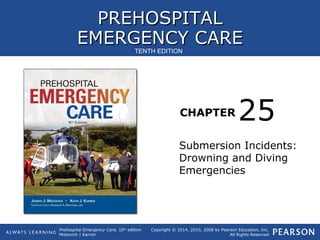
Submersion Incidents:
Drowning and Diving
Emergencies
25
Prehospital Emergency Care, 10th
edition
Mistovich | Karren
Copyright © 2014, 2010, 2008 by Pearson Education, Inc.
All Rights Reserved
Learning ReadinessLearning Readiness
• EMS Education Standards, text p. 713
Prehospital Emergency Care, 10th
edition
Mistovich | Karren
Copyright © 2014, 2010, 2008 by Pearson Education, Inc.
All Rights Reserved
Learning ReadinessLearning Readiness
ObjectivesObjectives
• Please refer to page 713 of your text to
view the objectives for this chapter.
Prehospital Emergency Care, 10th
edition
Mistovich | Karren
Copyright © 2014, 2010, 2008 by Pearson Education, Inc.
All Rights Reserved
Learning ReadinessLearning Readiness
Key TermsKey Terms
• Please refer to page 713 of your text to
view the key terms for this chapter.
Prehospital Emergency Care, 10th
edition
Mistovich | Karren
Copyright © 2014, 2010, 2008 by Pearson Education, Inc.
All Rights Reserved
Setting the StageSetting the Stage
• Overview of Lesson Topics
 Water-Related Emergencies
 Scuba or Deep-Water Diving
Emergencies
Prehospital Emergency Care, 10th
edition
Mistovich | Karren
Copyright © 2014, 2010, 2008 by Pearson Education, Inc.
All Rights Reserved
Case Study IntroductionCase Study Introduction
EMTs Jacob Stilts and Lydia Huse are
responding to a report of a child drown in a
backyard pool. When they arrive, the see a
woman performing CPR on a toddler. The
initial report from family members is that
the child was not seen for five to ten
minutes before being discovered on the
bottom of the pool. The patient was pulled
from the pool by a family member, who
immediately began CPR.
Prehospital Emergency Care, 10th
edition
Mistovich | Karren
Copyright © 2014, 2010, 2008 by Pearson Education, Inc.
All Rights Reserved
Case StudyCase Study
• What are some ways in which this
incident could have been prevented?
• What factors will influence the patient's
chances of survival?
Prehospital Emergency Care, 10th
edition
Mistovich | Karren
Copyright © 2014, 2010, 2008 by Pearson Education, Inc.
All Rights Reserved
IntroductionIntroduction
• Water-related emergencies include
drowning, diving, deep-water diving,
and boating and skiing injuries.
• Many deaths could be prevented by the
use of personal flotation devices
(PFDs).
Prehospital Emergency Care, 10th
edition
Mistovich | Karren
Copyright © 2014, 2010, 2008 by Pearson Education, Inc.
All Rights Reserved
Water-Related EmergenciesWater-Related Emergencies
• Prevention measures
 All pools should be fenced.
 Constantly supervise children who are in
the area of any body of water or large
container of water.
 Do not use alcohol when engaged in
water activities.
continued on next slide
Prehospital Emergency Care, 10th
edition
Mistovich | Karren
Copyright © 2014, 2010, 2008 by Pearson Education, Inc.
All Rights Reserved
Water-Related EmergenciesWater-Related Emergencies
• Prevention measures
 Always wear a PFD when boating.
 Do not dive into shallow or unexplored
bodies of water.
 Patients with seizure disorders must use
extreme care around water.
continued on next slide
Prehospital Emergency Care, 10th
edition
Mistovich | Karren
Copyright © 2014, 2010, 2008 by Pearson Education, Inc.
All Rights Reserved
Water-Related EmergenciesWater-Related Emergencies
• Definition
 Drowning is an incident in which
someone is submerged or immersed in a
liquid that results in a primary
respiratory impairment.
 The liquid prevents the patient from
breathing air.
 The patient may live or may die from
the event.
continued on next slide
Prehospital Emergency Care, 10th
edition
Mistovich | Karren
Copyright © 2014, 2010, 2008 by Pearson Education, Inc.
All Rights Reserved
Water-Related EmergenciesWater-Related Emergencies
• Incidence
 4,500 drowning deaths per year in U.S.
 40% of deaths are of children younger
than 5 years old.
 The second-highest incidence is among
teenagers.
 85% of drownings are in males.
 Alcohol is frequently involved in
drowning.
continued on next slide
Prehospital Emergency Care, 10th
edition
Mistovich | Karren
Copyright © 2014, 2010, 2008 by Pearson Education, Inc.
All Rights Reserved
Water-Related EmergenciesWater-Related Emergencies
• Conditions that can lead to submersion
 Hypoglycemia
 Myocardial infarction
 Cardiac dysrhythmia
 Syncope
 Seizure
 Suicide attempt
continued on next slide
Prehospital Emergency Care, 10th
edition
Mistovich | Karren
Copyright © 2014, 2010, 2008 by Pearson Education, Inc.
All Rights Reserved
Water-Related EmergenciesWater-Related Emergencies
• Conditions that can lead to submersion
 Anxiety or panic disorder
 Arthritis, Parkinson's disease, poor body
control
 Exhaustion
 Hypothermia
 Alcohol or drug use
 Trauma
continued on next slide
Prehospital Emergency Care, 10th
edition
Mistovich | Karren
Copyright © 2014, 2010, 2008 by Pearson Education, Inc.
All Rights Reserved
Water-Related EmergenciesWater-Related Emergencies
• Water sports pose a risk of drowning
and of head and spinal trauma.
• Scuba accidents may involve exertion,
inexperience panic, and poor judgment.
continued on next slide
Prehospital Emergency Care, 10th
edition
Mistovich | Karren
Copyright © 2014, 2010, 2008 by Pearson Education, Inc.
All Rights Reserved
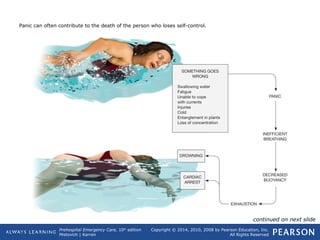
Panic can often contribute to the death of the person who loses self-control.
continued on next slide
Prehospital Emergency Care, 10th
edition
Mistovich | Karren
Copyright © 2014, 2010, 2008 by Pearson Education, Inc.
All Rights Reserved
Water-Related EmergenciesWater-Related Emergencies
• Chances of survival are greatest in
patients with two or fewer of these
characteristics:
 Age 3 years or older
 Submerged >5 minutes
 Resuscitation delayed >10 minutes after
rescue
 Comatose on arrival at the ED
 Arterial blood pH <7.10
continued on next slide
Prehospital Emergency Care, 10th
edition
Mistovich | Karren
Copyright © 2014, 2010, 2008 by Pearson Education, Inc.
All Rights Reserved
Water-Related EmergenciesWater-Related Emergencies
• Pathophysiology of drowning
 Submersion results in aspiration of
water or laryngeal spasms, leading to
suffocation.
 Hypoxia and acidosis lead to brain
damage and death.
continued on next slide
Prehospital Emergency Care, 10th
edition
Mistovich | Karren
Copyright © 2014, 2010, 2008 by Pearson Education, Inc.
All Rights Reserved
Water-Related EmergenciesWater-Related Emergencies
• Pathophysiology of drowning
 In dry drowning, laryngeal spasm
prevents water from entering the lungs.
 When water does enter the lungs, the
amount is small, and it is usually
absorbed into the bloodstream.
continued on next slide
Prehospital Emergency Care, 10th
edition
Mistovich | Karren
Copyright © 2014, 2010, 2008 by Pearson Education, Inc.
All Rights Reserved
Water-Related EmergenciesWater-Related Emergencies
• Pathophysiology of drowning
 Whether drowning is in fresh water or
salt water, water in the lungs washes
out surfactant.
 When surfactant is washed out, the
alveoli collapse.
 Alveolar-capillary damage leads to
pulmonary edema and acute respiratory
distress syndrome (ARDS).
continued on next slide
Prehospital Emergency Care, 10th
edition
Mistovich | Karren
Copyright © 2014, 2010, 2008 by Pearson Education, Inc.
All Rights Reserved
Water-Related EmergenciesWater-Related Emergencies
• Pathophysiology of drowning
 Hypothermia results from submersion in
cold water, and may play a protective
role.
 Complications of hypothermia include
hypovolemia from increased capillary
permeability, and cardiac dysrhythmias.
continued on next slide
Prehospital Emergency Care, 10th
edition
Mistovich | Karren
Copyright © 2014, 2010, 2008 by Pearson Education, Inc.
All Rights Reserved
Water-Related EmergenciesWater-Related Emergencies
• Factors that influence the seriousness
of drowning:
 Persistent cough
 Dyspnea or apnea
 Altered mental status during submersion
 Vomiting
 Drug or alcohol use
continued on next slide
Prehospital Emergency Care, 10th
edition
Mistovich | Karren
Copyright © 2014, 2010, 2008 by Pearson Education, Inc.
All Rights Reserved
Water-Related EmergenciesWater-Related Emergencies
• Factors that influence the seriousness
of drowning:
 History of seizures, diabetes, or
neuromuscular disorder
 Hypothermia
 Duration of cardiac or respiratory arrest
 Age of the patient
 Pre-existing diseases or conditions
continued on next slide
Prehospital Emergency Care, 10th
edition
Mistovich | Karren
Copyright © 2014, 2010, 2008 by Pearson Education, Inc.
All Rights Reserved
Water-Related EmergenciesWater-Related Emergencies
• Diving emergencies
 Usually occur in pools or other shallow
water
 Head and spine injuries may occur, as
well as fractures of the extremities or
ribs.
 Assume neck and spine injuries in diving
emergencies.
continued on next slide
Prehospital Emergency Care, 10th
edition
Mistovich | Karren
Copyright © 2014, 2010, 2008 by Pearson Education, Inc.
All Rights Reserved
Water-Related EmergenciesWater-Related Emergencies
• Safety measures
 Unless the emergency involves open,
shallow water with a stable uniform
bottom, do not attempt rescue unless
you meet all of these criteria:
• You are a good swimmer
• You are specially trained in water rescue
techniques
continued on next slide
Prehospital Emergency Care, 10th
edition
Mistovich | Karren
Copyright © 2014, 2010, 2008 by Pearson Education, Inc.
All Rights Reserved
Water-Related EmergenciesWater-Related Emergencies
• Safety measures
 Unless the emergency involves open,
shallow water with a stable uniform
bottom, do not attempt rescue unless
you meet all of these criteria:
• You are wearing a PFD
• You are accompanied by other rescuers
continued on next slide
Prehospital Emergency Care, 10th
edition
Mistovich | Karren
Copyright © 2014, 2010, 2008 by Pearson Education, Inc.
All Rights Reserved
Water-Related EmergenciesWater-Related Emergencies
• Safety measures
 If the patient is close to shore, use the
reach, throw, row, go strategy
continued on next slide
Prehospital Emergency Care, 10th
edition
Mistovich | Karren
Copyright © 2014, 2010, 2008 by Pearson Education, Inc.
All Rights Reserved
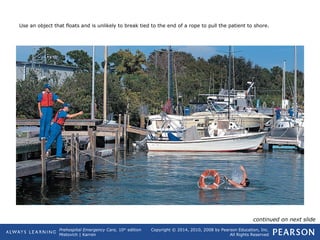
Use an object that floats and is unlikely to break tied to the end of a rope to pull the patient to shore.
continued on next slide
Prehospital Emergency Care, 10th
edition
Mistovich | Karren
Copyright © 2014, 2010, 2008 by Pearson Education, Inc.
All Rights Reserved
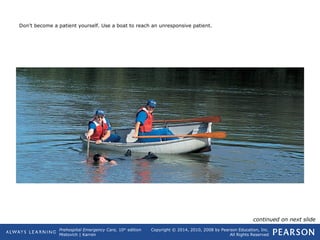
Don’t become a patient yourself. Use a boat to reach an unresponsive patient.
continued on next slide
Prehospital Emergency Care, 10th
edition
Mistovich | Karren
Copyright © 2014, 2010, 2008 by Pearson Education, Inc.
All Rights Reserved
Water-Related EmergenciesWater-Related Emergencies
• Suspect spinal injury if:
 There was a diving accident
 The patient may have been struck by a
skier, surfboard, or other object
 The swimmer was using a water slide
 There is suspicion of intoxication
 There is evidence of traumatic injury
continued on next slide
Prehospital Emergency Care, 10th
edition
Mistovich | Karren
Copyright © 2014, 2010, 2008 by Pearson Education, Inc.
All Rights Reserved
Water-Related EmergenciesWater-Related Emergencies
• Resuscitation
 The mammalian diving reflex may be
activated in cold water drowning.
 The mammalian diving reflex results in a
drastic decrease in the metabolic rate.
 The patient may be able to be
resuscitated even after prolonged
submersion.
continued on next slide
Prehospital Emergency Care, 10th
edition
Mistovich | Karren
Copyright © 2014, 2010, 2008 by Pearson Education, Inc.
All Rights Reserved
Water-Related EmergenciesWater-Related Emergencies
• Assessment-based approach
 Scene size-up
• Ensure your own safety.
• If you are within 10 feet of the edge of
the water, wear a PFD.
• Take Standard Precautions.
• Request additional resources, as needed.
continued on next slide
Prehospital Emergency Care, 10th
edition
Mistovich | Karren
Copyright © 2014, 2010, 2008 by Pearson Education, Inc.
All Rights Reserved
Water-Related EmergenciesWater-Related Emergencies
• Assessment-based approach
 Primary assessment
• Form a general impression.
• Assess the mental status.
• Consider the possibility of spinal injury.
• Establish a patent airway.
continued on next slide
Prehospital Emergency Care, 10th
edition
Mistovich | Karren
Copyright © 2014, 2010, 2008 by Pearson Education, Inc.
All Rights Reserved
Water-Related EmergenciesWater-Related Emergencies
• Assessment-based approach
 Primary assessment
• Positive pressure ventilation for
inadequate breathing.
• Maintain oxygenation.
• Assess for bleeding and hypoperfusion.
• Determine priority for transport.
continued on next slide
Prehospital Emergency Care, 10th
edition
Mistovich | Karren
Copyright © 2014, 2010, 2008 by Pearson Education, Inc.
All Rights Reserved
Water-Related EmergenciesWater-Related Emergencies
• Assessment-based approach
 Secondary assessment
• Perform a physical exam.
• Obtain a history.
continued on next slide
Prehospital Emergency Care, 10th
edition
Mistovich | Karren
Copyright © 2014, 2010, 2008 by Pearson Education, Inc.
All Rights Reserved
Water-Related EmergenciesWater-Related Emergencies
• Signs and symptoms
 Airway obstruction.
 Absent or inadequate breathing.
 Pulselessness.
 Spinal or head injury.
continued on next slide
Prehospital Emergency Care, 10th
edition
Mistovich | Karren
Copyright © 2014, 2010, 2008 by Pearson Education, Inc.
All Rights Reserved
Water-Related EmergenciesWater-Related Emergencies
• Signs and symptoms
 Soft tissue injuries.
 Musculoskeletal injuries.
 External or internal bleeding.
 Shock.
continued on next slide
Prehospital Emergency Care, 10th
edition
Mistovich | Karren
Copyright © 2014, 2010, 2008 by Pearson Education, Inc.
All Rights Reserved
Water-Related EmergenciesWater-Related Emergencies
• Signs and symptoms
 Hypothermia.
 Alcohol or drug abuse.
 Drowning or submersion.
continued on next slide
Prehospital Emergency Care, 10th
edition
Mistovich | Karren
Copyright © 2014, 2010, 2008 by Pearson Education, Inc.
All Rights Reserved
Water-Related EmergenciesWater-Related Emergencies
• Categorize drowning patients as one of
these four categories:
 Asymptomatic
 Symptomatic
 Cardiac arrest
 Obviously dead
continued on next slide
Prehospital Emergency Care, 10th
edition
Mistovich | Karren
Copyright © 2014, 2010, 2008 by Pearson Education, Inc.
All Rights Reserved
Water-Related EmergenciesWater-Related Emergencies
• Asymptomatic
 No signs or symptoms
continued on next slide
Prehospital Emergency Care, 10th
edition
Mistovich | Karren
Copyright © 2014, 2010, 2008 by Pearson Education, Inc.
All Rights Reserved
Water-Related EmergenciesWater-Related Emergencies
• Symptomatic
 Altered mental status
 Altered vital signs
 Respiratory distress or arrest
 Dyspnea
 SpO2 <94%
 Persistent cough
continued on next slide
Prehospital Emergency Care, 10th
edition
Mistovich | Karren
Copyright © 2014, 2010, 2008 by Pearson Education, Inc.
All Rights Reserved
Water-Related EmergenciesWater-Related Emergencies
• Symptomatic
 Wheezes or crackles in the lungs
 Hypothermia
 Vomiting, diarrhea
 Anxiety
continued on next slide
Prehospital Emergency Care, 10th
edition
Mistovich | Karren
Copyright © 2014, 2010, 2008 by Pearson Education, Inc.
All Rights Reserved
Water-Related EmergenciesWater-Related Emergencies
• Cardiac arrest
 No pulses
 Apnea
continued on next slide
Prehospital Emergency Care, 10th
edition
Mistovich | Karren
Copyright © 2014, 2010, 2008 by Pearson Education, Inc.
All Rights Reserved
Water-Related EmergenciesWater-Related Emergencies
• Obviously dead
 Rigor mortis
 Dependent lividity
Prehospital Emergency Care, 10th
edition
Mistovich | Karren
Copyright © 2014, 2010, 2008 by Pearson Education, Inc.
All Rights Reserved
Case StudyCase Study
Jacob directs another rescuer to take over CPR
from the family member, and quickly verifies
the absence of a pulse as the switch is made.
Lydia makes observations of the scene to
determine if there are any other mechanisms of
injury or important factors to consider. She
questions family members to try to determine
exactly how long the child was submerged, and
to find out about the child's medical history.
continued on next slide
Prehospital Emergency Care, 10th
edition
Mistovich | Karren
Copyright © 2014, 2010, 2008 by Pearson Education, Inc.
All Rights Reserved
Case StudyCase Study
• What are the steps in managing this
patient?
Prehospital Emergency Care, 10th
edition
Mistovich | Karren
Copyright © 2014, 2010, 2008 by Pearson Education, Inc.
All Rights Reserved
Water-Related EmergenciesWater-Related Emergencies
• Emergency medical care
 Remove the patient from the water as
quickly and safely as possible.
 If spinal injury is suspected, protect the
spine.
continued on next slide
Prehospital Emergency Care, 10th
edition
Mistovich | Karren
Copyright © 2014, 2010, 2008 by Pearson Education, Inc.
All Rights Reserved
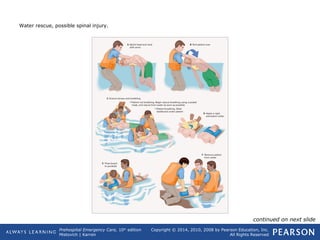
Water rescue, possible spinal injury.
continued on next slide
Prehospital Emergency Care, 10th
edition
Mistovich | Karren
Copyright © 2014, 2010, 2008 by Pearson Education, Inc.
All Rights Reserved
Water-Related EmergenciesWater-Related Emergencies
• Emergency medical care
 If there is no spinal injury, place the
patient on his left side (if the patient is
breathing and has a pulse).
 Be prepared to suction.
 For absent or inadequate breathing,
establish an airway and begin
ventilations with supplemental oxygen.
continued on next slide
Prehospital Emergency Care, 10th
edition
Mistovich | Karren
Copyright © 2014, 2010, 2008 by Pearson Education, Inc.
All Rights Reserved
Water-Related EmergenciesWater-Related Emergencies
• Emergency medical care
 Maintain an SpO2 of 94% or greater.
 If the patient is pulseless and apneic,
begin CPR and apply the AED.
 If gastric distention interferes with
ventilation, decompress the stomach.
continued on next slide
Prehospital Emergency Care, 10th
edition
Mistovich | Karren
Copyright © 2014, 2010, 2008 by Pearson Education, Inc.
All Rights Reserved
Water-Related EmergenciesWater-Related Emergencies
• Emergency medical care
 Manage any other medical or traumatic
conditions present.
 Transport with resuscitation continuing.
continued on next slide
Prehospital Emergency Care, 10th
edition
Mistovich | Karren
Copyright © 2014, 2010, 2008 by Pearson Education, Inc.
All Rights Reserved
Water-Related EmergenciesWater-Related Emergencies
• Always transport a drowning patient,
even if he is not experiencing
symptoms. Complications can arise up
to 72 hours after the incident.
continued on next slide
Prehospital Emergency Care, 10th
edition
Mistovich | Karren
Copyright © 2014, 2010, 2008 by Pearson Education, Inc.
All Rights Reserved
Water-Related EmergenciesWater-Related Emergencies
• Reassessment
 Repeat the primary and secondary
assessments and vital signs
• Every 5 minutes for unstable patients
• Every 15 minutes for stable patients
Prehospital Emergency Care, 10th
edition
Mistovich | Karren
Copyright © 2014, 2010, 2008 by Pearson Education, Inc.
All Rights Reserved
Scuba and Deep-Water DivingScuba and Deep-Water Diving
EmergenciesEmergencies
• Dysbarism results from the effects of
changes in pressure on gases within
the the body.
• Basic laws of physics explain the
changes.
continued on next slide
Prehospital Emergency Care, 10th
edition
Mistovich | Karren
Copyright © 2014, 2010, 2008 by Pearson Education, Inc.
All Rights Reserved
Scuba and Deep-Water DivingScuba and Deep-Water Diving
EmergenciesEmergencies
• Boyle law
 At a constant temperature, the volume
of a gas is inversely related to the
pressure.
• As the pressure increases, the volume of
the gas decreases.
• As the pressure decreases, the volume of
the gas increases.
continued on next slide
Prehospital Emergency Care, 10th
edition
Mistovich | Karren
Copyright © 2014, 2010, 2008 by Pearson Education, Inc.
All Rights Reserved
Scuba and Deep-Water DivingScuba and Deep-Water Diving
EmergenciesEmergencies
• Dalton law
 The total pressure of a mixture of gases
equals the sum of the partial pressures
of the individual gases that make up the
mixture.
• As a diver descends, the pressure of each
component gas in the air increases
proportionately.
• As the pressure of nitrogen increases, it
begins to dissolve into the blood.
continued on next slide
Prehospital Emergency Care, 10th
edition
Mistovich | Karren
Copyright © 2014, 2010, 2008 by Pearson Education, Inc.
All Rights Reserved
Scuba and Deep-Water DivingScuba and Deep-Water Diving
EmergenciesEmergencies
• Henry law
 At a constant temperature, the amount
of gas that dissolves in a liquid is
proportionate to the pressure of the gas
around it.
 With increasing depth, gases that have
dissolved into the blood will dissolve into
and accumulate in the body fat and
tissues.
continued on next slide
Prehospital Emergency Care, 10th
edition
Mistovich | Karren
Copyright © 2014, 2010, 2008 by Pearson Education, Inc.
All Rights Reserved
Scuba and Deep-Water DivingScuba and Deep-Water Diving
EmergenciesEmergencies
• Charles law
 All gases expand equally upon being
heated.
• As a diver descends into colder water
temperatures, the inhaled and dissolved
gases contract.
• As the diver ascends, the temperature
increases and the gases expand.
continued on next slide
Prehospital Emergency Care, 10th
edition
Mistovich | Karren
Copyright © 2014, 2010, 2008 by Pearson Education, Inc.
All Rights Reserved
Scuba and Deep-Water DivingScuba and Deep-Water Diving
EmergenciesEmergencies
• Decompression sickness
 Occurs as the result of the bubbles
formed by the expansion of nitrogen in
the blood and tissues.
continued on next slide
Prehospital Emergency Care, 10th
edition
Mistovich | Karren
Copyright © 2014, 2010, 2008 by Pearson Education, Inc.
All Rights Reserved
Scuba and Deep-Water DivingScuba and Deep-Water Diving
EmergenciesEmergencies
• Decompression sickness
 The bubbles have two primary effects on
the body:
• They act as emboli and cause obstruction
in the circulation.
• They compress or stretch the blood
vessels and nerves.
continued on next slide
Prehospital Emergency Care, 10th
edition
Mistovich | Karren
Copyright © 2014, 2010, 2008 by Pearson Education, Inc.
All Rights Reserved
Scuba and Deep-Water DivingScuba and Deep-Water Diving
EmergenciesEmergencies
• Factors that predispose to
decompression sickness
 Flying or going to a high altitude too
soon after a dive.
 Failure to take the necessary safety
stops while ascending from a dive.
 Inadequate surface intervals.
continued on next slide
Prehospital Emergency Care, 10th
edition
Mistovich | Karren
Copyright © 2014, 2010, 2008 by Pearson Education, Inc.
All Rights Reserved
Scuba and Deep-Water DivingScuba and Deep-Water Diving
EmergenciesEmergencies
• Factors that predispose to
decompression sickness
 Inadequate decompression or passing
the no-decompression limit.
 Diving at depths for too long a period of
time.
 Repeated dives at depth on the same
day.
continued on next slide
Prehospital Emergency Care, 10th
edition
Mistovich | Karren
Copyright © 2014, 2010, 2008 by Pearson Education, Inc.
All Rights Reserved
Scuba and Deep-Water DivingScuba and Deep-Water Diving
EmergenciesEmergencies
• Physical factors that predispose to
decompression sickness
 Poor physical condition
 Obesity
 Age
 Dehydration
continued on next slide
Prehospital Emergency Care, 10th
edition
Mistovich | Karren
Copyright © 2014, 2010, 2008 by Pearson Education, Inc.
All Rights Reserved
Scuba and Deep-Water DivingScuba and Deep-Water Diving
EmergenciesEmergencies
• Physical factors that predispose to
decompression sickness
 Heart or lung diseases or conditions
 Pre-existing musculoskeletal injury
 Fatigue
continued on next slide
Prehospital Emergency Care, 10th
edition
Mistovich | Karren
Copyright © 2014, 2010, 2008 by Pearson Education, Inc.
All Rights Reserved
Scuba and Deep-Water DivingScuba and Deep-Water Diving
EmergenciesEmergencies
• Environmental factors that predispose
to decompression sickness
 Cold water
 Rough seas
 Heated diving suits
 Heavy work
continued on next slide
Prehospital Emergency Care, 10th
edition
Mistovich | Karren
Copyright © 2014, 2010, 2008 by Pearson Education, Inc.
All Rights Reserved
Scuba and Deep-Water DivingScuba and Deep-Water Diving
EmergenciesEmergencies
• Categories of decompression sickness
(DCS)
 Type I DCS
 Type II DCS
 Arterial gas embolism (AGE)
continued on next slide
Prehospital Emergency Care, 10th
edition
Mistovich | Karren
Copyright © 2014, 2010, 2008 by Pearson Education, Inc.
All Rights Reserved
Scuba and Deep-Water DivingScuba and Deep-Water Diving
EmergenciesEmergencies
• Type I DCS signs and symptoms
 Pain
 Pruritus and burning of the skin
 Skin rash
 Orange peel appearance of skin
 Painless pitting edema
continued on next slide
Prehospital Emergency Care, 10th
edition
Mistovich | Karren
Copyright © 2014, 2010, 2008 by Pearson Education, Inc.
All Rights Reserved
Scuba and Deep-Water DivingScuba and Deep-Water Diving
EmergenciesEmergencies
• Type II DCS signs and symptoms
 Nervous system
• Low back pain progressing to weakness,
paralysis, numbness, tingling, loss of
sphincter control, and abdominal pain
• Headache, visual disturbances, dizziness,
tunnel vision
• Altered mental status
• Nausea, vomiting, vertigo, tinnitus,
partial deafness
continued on next slide
Prehospital Emergency Care, 10th
edition
Mistovich | Karren
Copyright © 2014, 2010, 2008 by Pearson Education, Inc.
All Rights Reserved
Scuba and Deep-Water DivingScuba and Deep-Water Diving
EmergenciesEmergencies
• Type II DCS signs and symptoms
 Respiratory system
• Substernal burning on inhalation
• Nonproductive cough
• Respiratory distress
continued on next slide
Prehospital Emergency Care, 10th
edition
Mistovich | Karren
Copyright © 2014, 2010, 2008 by Pearson Education, Inc.
All Rights Reserved
Scuba and Deep-Water DivingScuba and Deep-Water Diving
EmergenciesEmergencies
• Type II DCS signs and symptoms
 Circulatory system
• Signs of hypovolemic shock
• Thrombus formation
continued on next slide
Prehospital Emergency Care, 10th
edition
Mistovich | Karren
Copyright © 2014, 2010, 2008 by Pearson Education, Inc.
All Rights Reserved
Scuba and Deep-Water DivingScuba and Deep-Water Diving
EmergenciesEmergencies
• In assessment for DCS, look for:
 Fatigue
 Signs and symptoms of shock
 Pupillary changes
 Pallor of the tongue
 Bloody sputum
 Nasal flaring, retractions, accessory
muscle use
continued on next slide
Prehospital Emergency Care, 10th
edition
Mistovich | Karren
Copyright © 2014, 2010, 2008 by Pearson Education, Inc.
All Rights Reserved
Scuba and Deep-Water DivingScuba and Deep-Water Diving
EmergenciesEmergencies
• In assessment for DCS, look for:
 Tachypnea
 Crackles in the lungs
 SpO2 <94%
 Vomiting
 Urinary bladder distention
continued on next slide
Prehospital Emergency Care, 10th
edition
Mistovich | Karren
Copyright © 2014, 2010, 2008 by Pearson Education, Inc.
All Rights Reserved
Scuba and Deep-Water DivingScuba and Deep-Water Diving
EmergenciesEmergencies
• In assessment for DCS, look for:
 Seizure
 Uncoordinated movements, weakness,
motor and sensory deficits
 Joint pain, decreased range of motion
 Edema
 Cyanosis, pallor, itching, mottling,
marbling
continued on next slide
Prehospital Emergency Care, 10th
edition
Mistovich | Karren
Copyright © 2014, 2010, 2008 by Pearson Education, Inc.
All Rights Reserved
Scuba and Deep-Water DivingScuba and Deep-Water Diving
EmergenciesEmergencies
• In assessment for DCS, ask the
following:
 Where did the patient dive?
 What was the deepest depth, and for
how long?
 What were the other depths and times?
 What was the rate of ascent?
 What has the patient done since the
dive?
continued on next slide
Prehospital Emergency Care, 10th
edition
Mistovich | Karren
Copyright © 2014, 2010, 2008 by Pearson Education, Inc.
All Rights Reserved
Scuba and Deep-Water DivingScuba and Deep-Water Diving
EmergenciesEmergencies
• In assessment for DCS, ask the
following:
 What did the patient do in the 72 hours
before the dive?
 Did the patient do work during the dive?
 What gases were used during the dive?
 Did the patient have any problems
during the dive?
continued on next slide
Prehospital Emergency Care, 10th
edition
Mistovich | Karren
Copyright © 2014, 2010, 2008 by Pearson Education, Inc.
All Rights Reserved
Scuba and Deep-Water DivingScuba and Deep-Water Diving
EmergenciesEmergencies
• In assessment for DCS, ask the
following:
 What was the patient's physical
condition before, during, and after the
dive?
 Was any first aid provided?
continued on next slide
Prehospital Emergency Care, 10th
edition
Mistovich | Karren
Copyright © 2014, 2010, 2008 by Pearson Education, Inc.
All Rights Reserved
Scuba and Deep-Water DivingScuba and Deep-Water Diving
EmergenciesEmergencies
• Arterial gas embolism
 An artery is obstructed by a bubble or
cluster of bubbles.
 Rapid ascent with breath-holding can
cause alveolar rupture, allowing air to
enter the bloodstream.
 Signs and symptoms have a rapid onset.
continued on next slide
Prehospital Emergency Care, 10th
edition
Mistovich | Karren
Copyright © 2014, 2010, 2008 by Pearson Education, Inc.
All Rights Reserved
Scuba and Deep-Water DivingScuba and Deep-Water Diving
EmergenciesEmergencies
• AGE signs and symptoms
 Itchy, blotchy, mottled skin
 Difficulty breathing
 Dizziness
 Chest pain
 Severe, deep aching pain in muscles,
joints, tendons
continued on next slide
Prehospital Emergency Care, 10th
edition
Mistovich | Karren
Copyright © 2014, 2010, 2008 by Pearson Education, Inc.
All Rights Reserved
Scuba and Deep-Water DivingScuba and Deep-Water Diving
EmergenciesEmergencies
• AGE signs and symptoms
 Blurred or distorted vision
 Partial deafness
 Nausea, vomiting
 Numbness, paralysis
 Weakness or numbness on one side of
the body
 Staggering gait or lack of coordination
continued on next slide
Prehospital Emergency Care, 10th
edition
Mistovich | Karren
Copyright © 2014, 2010, 2008 by Pearson Education, Inc.
All Rights Reserved
Scuba and Deep-Water DivingScuba and Deep-Water Diving
EmergenciesEmergencies
• AGE signs and symptoms
 Frothy blood in the nose or mouth
 Swelling and crepitus in the neck
 Loss or distortion of memory
 Coma
 Cardiac or respiratory arrest
 Behavioral changes
continued on next slide
Prehospital Emergency Care, 10th
edition
Mistovich | Karren
Copyright © 2014, 2010, 2008 by Pearson Education, Inc.
All Rights Reserved
Scuba and Deep-Water DivingScuba and Deep-Water Diving
EmergenciesEmergencies
• Barotrauma
 During ascent or descent, pressure
becomes too great within the body's air-
filled cavities, such as the sinuses or
middle ear.
continued on next slide
Prehospital Emergency Care, 10th
edition
Mistovich | Karren
Copyright © 2014, 2010, 2008 by Pearson Education, Inc.
All Rights Reserved
Scuba and Deep-Water DivingScuba and Deep-Water Diving
EmergenciesEmergencies
• Barotrauma signs and symptoms
 Pain in the affected area
 Clear or bloody discharge from the nose
or ears
 Extreme dizziness
 Nausea
 Disorientation
continued on next slide
Prehospital Emergency Care, 10th
edition
Mistovich | Karren
Copyright © 2014, 2010, 2008 by Pearson Education, Inc.
All Rights Reserved
Scuba and Deep-Water DivingScuba and Deep-Water Diving
EmergenciesEmergencies
• Emergency medical care for diving
emergencies
 Consider the need for spinal
stabilization.
 Keep the patient supine or in lateral
recumbent position.
 Establish an airway and assess
breathing.
continued on next slide
Prehospital Emergency Care, 10th
edition
Mistovich | Karren
Copyright © 2014, 2010, 2008 by Pearson Education, Inc.
All Rights Reserved
Scuba and Deep-Water DivingScuba and Deep-Water Diving
EmergenciesEmergencies
• Emergency medical care for diving
emergencies
 Administer oxygen 15 lpm by
nonrebreather mask if breathing is
adequate.
 Assist ventilations with supplemental
oxygen for inadequate breathing.
continued on next slide
Prehospital Emergency Care, 10th
edition
Mistovich | Karren
Copyright © 2014, 2010, 2008 by Pearson Education, Inc.
All Rights Reserved
Scuba and Deep-Water DivingScuba and Deep-Water Diving
EmergenciesEmergencies
• Emergency medical care for diving
emergencies
 Initiate CPR and apply the AED, if
indicated.
 Transport immediately.
Prehospital Emergency Care, 10th
edition
Mistovich | Karren
Copyright © 2014, 2010, 2008 by Pearson Education, Inc.
All Rights Reserved
Click on the mechanism that explains theClick on the mechanism that explains the
reduction in metabolic rate associated with coldreduction in metabolic rate associated with cold
water drowning.water drowning.
A. The mammalian diving reflex
B. The Boyle law
C. Dissolved nitrogen in the bloodstream
D. Laryngospasm
Prehospital Emergency Care, 10th
edition
Mistovich | Karren
Copyright © 2014, 2010, 2008 by Pearson Education, Inc.
All Rights Reserved
Case Study ConclusionCase Study Conclusion
The patient, a two-year old girl, was most likely
submerged between five and seven minutes.
There does not appear to be a reason to
suspect spinal injury.
Jacob is particularly concerned with providing a
patent airway and adequate ventilation and
oxygenation. He opens the airway with a head-
tilt, chin-lift, and places a folded towel beneath
the patient's shoulders. He suctions the airway,
and inserts an oropharyngeal airway as another
EMT continues chest compressions.
continued on next slide
Prehospital Emergency Care, 10th
edition
Mistovich | Karren
Copyright © 2014, 2010, 2008 by Pearson Education, Inc.
All Rights Reserved
Case Study ConclusionCase Study Conclusion
Meanwhile, Lydia dries the patient and applies
the AED. However, no shock is indicated. Jacob
performs positive pressure ventilation with
supplemental oxygen, but he finds that there is
increasing resistance to ventilation. The
patient's stomach appears very distended, so
the EMTs position her on her side and
decompress the stomach, suctioning away the
stomach contents to prevent aspiration.
continued on next slide
Prehospital Emergency Care, 10th
edition
Mistovich | Karren
Copyright © 2014, 2010, 2008 by Pearson Education, Inc.
All Rights Reserved
Case Study ConclusionCase Study Conclusion
The EMTs begin immediate transport, and
request intercept with an ALS unit because of
their 20-minute transport time.
The patient regains a pulse prior to arriving at
the emergency department, but remains
unresponsive. She is admitted to pediatric
critical care, where she is carefully monitored
for neurological damage and respiratory
complications. Currently, her prognosis for
recovery is uncertain.
Prehospital Emergency Care, 10th
edition
Mistovich | Karren
Copyright © 2014, 2010, 2008 by Pearson Education, Inc.
All Rights Reserved
Lesson SummaryLesson Summary
• Drowning is immersion in a liquid that
impairs the ability to breathe.
• Drowning causes a significant number
of deaths, but is preventable.
• In some cases, drowning is associated
with the possibility of spinal injury.
continued on next slide
Prehospital Emergency Care, 10th
edition
Mistovich | Karren
Copyright © 2014, 2010, 2008 by Pearson Education, Inc.
All Rights Reserved
Lesson SummaryLesson Summary
• Scuba diving emergencies can be
explained by basic gas laws.
• Treatment of drowning and diving
emergencies focuses on airway,
ventilation, oxygenation, and, if the
pulse is absent, CPR and AED.

DMACC EMT Chapter 25

  • 1.
    PREHOSPITALPREHOSPITAL EMERGENCY CAREEMERGENCY CARE CHAPTER Copyright© 2014, 2010, 2008 by Pearson Education, Inc. All Rights Reserved Prehospital Emergency Care, 10th edition Mistovich | Karren TENTH EDITION Submersion Incidents: Drowning and Diving Emergencies 25
  • 2.
    Prehospital Emergency Care,10th edition Mistovich | Karren Copyright © 2014, 2010, 2008 by Pearson Education, Inc. All Rights Reserved Learning ReadinessLearning Readiness • EMS Education Standards, text p. 713
  • 3.
    Prehospital Emergency Care,10th edition Mistovich | Karren Copyright © 2014, 2010, 2008 by Pearson Education, Inc. All Rights Reserved Learning ReadinessLearning Readiness ObjectivesObjectives • Please refer to page 713 of your text to view the objectives for this chapter.
  • 4.
    Prehospital Emergency Care,10th edition Mistovich | Karren Copyright © 2014, 2010, 2008 by Pearson Education, Inc. All Rights Reserved Learning ReadinessLearning Readiness Key TermsKey Terms • Please refer to page 713 of your text to view the key terms for this chapter.
  • 5.
    Prehospital Emergency Care,10th edition Mistovich | Karren Copyright © 2014, 2010, 2008 by Pearson Education, Inc. All Rights Reserved Setting the StageSetting the Stage • Overview of Lesson Topics  Water-Related Emergencies  Scuba or Deep-Water Diving Emergencies
  • 6.
    Prehospital Emergency Care,10th edition Mistovich | Karren Copyright © 2014, 2010, 2008 by Pearson Education, Inc. All Rights Reserved Case Study IntroductionCase Study Introduction EMTs Jacob Stilts and Lydia Huse are responding to a report of a child drown in a backyard pool. When they arrive, the see a woman performing CPR on a toddler. The initial report from family members is that the child was not seen for five to ten minutes before being discovered on the bottom of the pool. The patient was pulled from the pool by a family member, who immediately began CPR.
  • 7.
    Prehospital Emergency Care,10th edition Mistovich | Karren Copyright © 2014, 2010, 2008 by Pearson Education, Inc. All Rights Reserved Case StudyCase Study • What are some ways in which this incident could have been prevented? • What factors will influence the patient's chances of survival?
  • 8.
    Prehospital Emergency Care,10th edition Mistovich | Karren Copyright © 2014, 2010, 2008 by Pearson Education, Inc. All Rights Reserved IntroductionIntroduction • Water-related emergencies include drowning, diving, deep-water diving, and boating and skiing injuries. • Many deaths could be prevented by the use of personal flotation devices (PFDs).
  • 9.
    Prehospital Emergency Care,10th edition Mistovich | Karren Copyright © 2014, 2010, 2008 by Pearson Education, Inc. All Rights Reserved Water-Related EmergenciesWater-Related Emergencies • Prevention measures  All pools should be fenced.  Constantly supervise children who are in the area of any body of water or large container of water.  Do not use alcohol when engaged in water activities. continued on next slide
  • 10.
    Prehospital Emergency Care,10th edition Mistovich | Karren Copyright © 2014, 2010, 2008 by Pearson Education, Inc. All Rights Reserved Water-Related EmergenciesWater-Related Emergencies • Prevention measures  Always wear a PFD when boating.  Do not dive into shallow or unexplored bodies of water.  Patients with seizure disorders must use extreme care around water. continued on next slide
  • 11.
    Prehospital Emergency Care,10th edition Mistovich | Karren Copyright © 2014, 2010, 2008 by Pearson Education, Inc. All Rights Reserved Water-Related EmergenciesWater-Related Emergencies • Definition  Drowning is an incident in which someone is submerged or immersed in a liquid that results in a primary respiratory impairment.  The liquid prevents the patient from breathing air.  The patient may live or may die from the event. continued on next slide
  • 12.
    Prehospital Emergency Care,10th edition Mistovich | Karren Copyright © 2014, 2010, 2008 by Pearson Education, Inc. All Rights Reserved Water-Related EmergenciesWater-Related Emergencies • Incidence  4,500 drowning deaths per year in U.S.  40% of deaths are of children younger than 5 years old.  The second-highest incidence is among teenagers.  85% of drownings are in males.  Alcohol is frequently involved in drowning. continued on next slide
  • 13.
    Prehospital Emergency Care,10th edition Mistovich | Karren Copyright © 2014, 2010, 2008 by Pearson Education, Inc. All Rights Reserved Water-Related EmergenciesWater-Related Emergencies • Conditions that can lead to submersion  Hypoglycemia  Myocardial infarction  Cardiac dysrhythmia  Syncope  Seizure  Suicide attempt continued on next slide
  • 14.
    Prehospital Emergency Care,10th edition Mistovich | Karren Copyright © 2014, 2010, 2008 by Pearson Education, Inc. All Rights Reserved Water-Related EmergenciesWater-Related Emergencies • Conditions that can lead to submersion  Anxiety or panic disorder  Arthritis, Parkinson's disease, poor body control  Exhaustion  Hypothermia  Alcohol or drug use  Trauma continued on next slide
  • 15.
    Prehospital Emergency Care,10th edition Mistovich | Karren Copyright © 2014, 2010, 2008 by Pearson Education, Inc. All Rights Reserved Water-Related EmergenciesWater-Related Emergencies • Water sports pose a risk of drowning and of head and spinal trauma. • Scuba accidents may involve exertion, inexperience panic, and poor judgment. continued on next slide
  • 16.
    Prehospital Emergency Care,10th edition Mistovich | Karren Copyright © 2014, 2010, 2008 by Pearson Education, Inc. All Rights Reserved Panic can often contribute to the death of the person who loses self-control. continued on next slide
  • 17.
    Prehospital Emergency Care,10th edition Mistovich | Karren Copyright © 2014, 2010, 2008 by Pearson Education, Inc. All Rights Reserved Water-Related EmergenciesWater-Related Emergencies • Chances of survival are greatest in patients with two or fewer of these characteristics:  Age 3 years or older  Submerged >5 minutes  Resuscitation delayed >10 minutes after rescue  Comatose on arrival at the ED  Arterial blood pH <7.10 continued on next slide
  • 18.
    Prehospital Emergency Care,10th edition Mistovich | Karren Copyright © 2014, 2010, 2008 by Pearson Education, Inc. All Rights Reserved Water-Related EmergenciesWater-Related Emergencies • Pathophysiology of drowning  Submersion results in aspiration of water or laryngeal spasms, leading to suffocation.  Hypoxia and acidosis lead to brain damage and death. continued on next slide
  • 19.
    Prehospital Emergency Care,10th edition Mistovich | Karren Copyright © 2014, 2010, 2008 by Pearson Education, Inc. All Rights Reserved Water-Related EmergenciesWater-Related Emergencies • Pathophysiology of drowning  In dry drowning, laryngeal spasm prevents water from entering the lungs.  When water does enter the lungs, the amount is small, and it is usually absorbed into the bloodstream. continued on next slide
  • 20.
    Prehospital Emergency Care,10th edition Mistovich | Karren Copyright © 2014, 2010, 2008 by Pearson Education, Inc. All Rights Reserved Water-Related EmergenciesWater-Related Emergencies • Pathophysiology of drowning  Whether drowning is in fresh water or salt water, water in the lungs washes out surfactant.  When surfactant is washed out, the alveoli collapse.  Alveolar-capillary damage leads to pulmonary edema and acute respiratory distress syndrome (ARDS). continued on next slide
  • 21.
    Prehospital Emergency Care,10th edition Mistovich | Karren Copyright © 2014, 2010, 2008 by Pearson Education, Inc. All Rights Reserved Water-Related EmergenciesWater-Related Emergencies • Pathophysiology of drowning  Hypothermia results from submersion in cold water, and may play a protective role.  Complications of hypothermia include hypovolemia from increased capillary permeability, and cardiac dysrhythmias. continued on next slide
  • 22.
    Prehospital Emergency Care,10th edition Mistovich | Karren Copyright © 2014, 2010, 2008 by Pearson Education, Inc. All Rights Reserved Water-Related EmergenciesWater-Related Emergencies • Factors that influence the seriousness of drowning:  Persistent cough  Dyspnea or apnea  Altered mental status during submersion  Vomiting  Drug or alcohol use continued on next slide
  • 23.
    Prehospital Emergency Care,10th edition Mistovich | Karren Copyright © 2014, 2010, 2008 by Pearson Education, Inc. All Rights Reserved Water-Related EmergenciesWater-Related Emergencies • Factors that influence the seriousness of drowning:  History of seizures, diabetes, or neuromuscular disorder  Hypothermia  Duration of cardiac or respiratory arrest  Age of the patient  Pre-existing diseases or conditions continued on next slide
  • 24.
    Prehospital Emergency Care,10th edition Mistovich | Karren Copyright © 2014, 2010, 2008 by Pearson Education, Inc. All Rights Reserved Water-Related EmergenciesWater-Related Emergencies • Diving emergencies  Usually occur in pools or other shallow water  Head and spine injuries may occur, as well as fractures of the extremities or ribs.  Assume neck and spine injuries in diving emergencies. continued on next slide
  • 25.
    Prehospital Emergency Care,10th edition Mistovich | Karren Copyright © 2014, 2010, 2008 by Pearson Education, Inc. All Rights Reserved Water-Related EmergenciesWater-Related Emergencies • Safety measures  Unless the emergency involves open, shallow water with a stable uniform bottom, do not attempt rescue unless you meet all of these criteria: • You are a good swimmer • You are specially trained in water rescue techniques continued on next slide
  • 26.
    Prehospital Emergency Care,10th edition Mistovich | Karren Copyright © 2014, 2010, 2008 by Pearson Education, Inc. All Rights Reserved Water-Related EmergenciesWater-Related Emergencies • Safety measures  Unless the emergency involves open, shallow water with a stable uniform bottom, do not attempt rescue unless you meet all of these criteria: • You are wearing a PFD • You are accompanied by other rescuers continued on next slide
  • 27.
    Prehospital Emergency Care,10th edition Mistovich | Karren Copyright © 2014, 2010, 2008 by Pearson Education, Inc. All Rights Reserved Water-Related EmergenciesWater-Related Emergencies • Safety measures  If the patient is close to shore, use the reach, throw, row, go strategy continued on next slide
  • 28.
    Prehospital Emergency Care,10th edition Mistovich | Karren Copyright © 2014, 2010, 2008 by Pearson Education, Inc. All Rights Reserved Use an object that floats and is unlikely to break tied to the end of a rope to pull the patient to shore. continued on next slide
  • 29.
    Prehospital Emergency Care,10th edition Mistovich | Karren Copyright © 2014, 2010, 2008 by Pearson Education, Inc. All Rights Reserved Don’t become a patient yourself. Use a boat to reach an unresponsive patient. continued on next slide
  • 30.
    Prehospital Emergency Care,10th edition Mistovich | Karren Copyright © 2014, 2010, 2008 by Pearson Education, Inc. All Rights Reserved Water-Related EmergenciesWater-Related Emergencies • Suspect spinal injury if:  There was a diving accident  The patient may have been struck by a skier, surfboard, or other object  The swimmer was using a water slide  There is suspicion of intoxication  There is evidence of traumatic injury continued on next slide
  • 31.
    Prehospital Emergency Care,10th edition Mistovich | Karren Copyright © 2014, 2010, 2008 by Pearson Education, Inc. All Rights Reserved Water-Related EmergenciesWater-Related Emergencies • Resuscitation  The mammalian diving reflex may be activated in cold water drowning.  The mammalian diving reflex results in a drastic decrease in the metabolic rate.  The patient may be able to be resuscitated even after prolonged submersion. continued on next slide
  • 32.
    Prehospital Emergency Care,10th edition Mistovich | Karren Copyright © 2014, 2010, 2008 by Pearson Education, Inc. All Rights Reserved Water-Related EmergenciesWater-Related Emergencies • Assessment-based approach  Scene size-up • Ensure your own safety. • If you are within 10 feet of the edge of the water, wear a PFD. • Take Standard Precautions. • Request additional resources, as needed. continued on next slide
  • 33.
    Prehospital Emergency Care,10th edition Mistovich | Karren Copyright © 2014, 2010, 2008 by Pearson Education, Inc. All Rights Reserved Water-Related EmergenciesWater-Related Emergencies • Assessment-based approach  Primary assessment • Form a general impression. • Assess the mental status. • Consider the possibility of spinal injury. • Establish a patent airway. continued on next slide
  • 34.
    Prehospital Emergency Care,10th edition Mistovich | Karren Copyright © 2014, 2010, 2008 by Pearson Education, Inc. All Rights Reserved Water-Related EmergenciesWater-Related Emergencies • Assessment-based approach  Primary assessment • Positive pressure ventilation for inadequate breathing. • Maintain oxygenation. • Assess for bleeding and hypoperfusion. • Determine priority for transport. continued on next slide
  • 35.
    Prehospital Emergency Care,10th edition Mistovich | Karren Copyright © 2014, 2010, 2008 by Pearson Education, Inc. All Rights Reserved Water-Related EmergenciesWater-Related Emergencies • Assessment-based approach  Secondary assessment • Perform a physical exam. • Obtain a history. continued on next slide
  • 36.
    Prehospital Emergency Care,10th edition Mistovich | Karren Copyright © 2014, 2010, 2008 by Pearson Education, Inc. All Rights Reserved Water-Related EmergenciesWater-Related Emergencies • Signs and symptoms  Airway obstruction.  Absent or inadequate breathing.  Pulselessness.  Spinal or head injury. continued on next slide
  • 37.
    Prehospital Emergency Care,10th edition Mistovich | Karren Copyright © 2014, 2010, 2008 by Pearson Education, Inc. All Rights Reserved Water-Related EmergenciesWater-Related Emergencies • Signs and symptoms  Soft tissue injuries.  Musculoskeletal injuries.  External or internal bleeding.  Shock. continued on next slide
  • 38.
    Prehospital Emergency Care,10th edition Mistovich | Karren Copyright © 2014, 2010, 2008 by Pearson Education, Inc. All Rights Reserved Water-Related EmergenciesWater-Related Emergencies • Signs and symptoms  Hypothermia.  Alcohol or drug abuse.  Drowning or submersion. continued on next slide
  • 39.
    Prehospital Emergency Care,10th edition Mistovich | Karren Copyright © 2014, 2010, 2008 by Pearson Education, Inc. All Rights Reserved Water-Related EmergenciesWater-Related Emergencies • Categorize drowning patients as one of these four categories:  Asymptomatic  Symptomatic  Cardiac arrest  Obviously dead continued on next slide
  • 40.
    Prehospital Emergency Care,10th edition Mistovich | Karren Copyright © 2014, 2010, 2008 by Pearson Education, Inc. All Rights Reserved Water-Related EmergenciesWater-Related Emergencies • Asymptomatic  No signs or symptoms continued on next slide
  • 41.
    Prehospital Emergency Care,10th edition Mistovich | Karren Copyright © 2014, 2010, 2008 by Pearson Education, Inc. All Rights Reserved Water-Related EmergenciesWater-Related Emergencies • Symptomatic  Altered mental status  Altered vital signs  Respiratory distress or arrest  Dyspnea  SpO2 <94%  Persistent cough continued on next slide
  • 42.
    Prehospital Emergency Care,10th edition Mistovich | Karren Copyright © 2014, 2010, 2008 by Pearson Education, Inc. All Rights Reserved Water-Related EmergenciesWater-Related Emergencies • Symptomatic  Wheezes or crackles in the lungs  Hypothermia  Vomiting, diarrhea  Anxiety continued on next slide
  • 43.
    Prehospital Emergency Care,10th edition Mistovich | Karren Copyright © 2014, 2010, 2008 by Pearson Education, Inc. All Rights Reserved Water-Related EmergenciesWater-Related Emergencies • Cardiac arrest  No pulses  Apnea continued on next slide
  • 44.
    Prehospital Emergency Care,10th edition Mistovich | Karren Copyright © 2014, 2010, 2008 by Pearson Education, Inc. All Rights Reserved Water-Related EmergenciesWater-Related Emergencies • Obviously dead  Rigor mortis  Dependent lividity
  • 45.
    Prehospital Emergency Care,10th edition Mistovich | Karren Copyright © 2014, 2010, 2008 by Pearson Education, Inc. All Rights Reserved Case StudyCase Study Jacob directs another rescuer to take over CPR from the family member, and quickly verifies the absence of a pulse as the switch is made. Lydia makes observations of the scene to determine if there are any other mechanisms of injury or important factors to consider. She questions family members to try to determine exactly how long the child was submerged, and to find out about the child's medical history. continued on next slide
  • 46.
    Prehospital Emergency Care,10th edition Mistovich | Karren Copyright © 2014, 2010, 2008 by Pearson Education, Inc. All Rights Reserved Case StudyCase Study • What are the steps in managing this patient?
  • 47.
    Prehospital Emergency Care,10th edition Mistovich | Karren Copyright © 2014, 2010, 2008 by Pearson Education, Inc. All Rights Reserved Water-Related EmergenciesWater-Related Emergencies • Emergency medical care  Remove the patient from the water as quickly and safely as possible.  If spinal injury is suspected, protect the spine. continued on next slide
  • 48.
    Prehospital Emergency Care,10th edition Mistovich | Karren Copyright © 2014, 2010, 2008 by Pearson Education, Inc. All Rights Reserved Water rescue, possible spinal injury. continued on next slide
  • 49.
    Prehospital Emergency Care,10th edition Mistovich | Karren Copyright © 2014, 2010, 2008 by Pearson Education, Inc. All Rights Reserved Water-Related EmergenciesWater-Related Emergencies • Emergency medical care  If there is no spinal injury, place the patient on his left side (if the patient is breathing and has a pulse).  Be prepared to suction.  For absent or inadequate breathing, establish an airway and begin ventilations with supplemental oxygen. continued on next slide
  • 50.
    Prehospital Emergency Care,10th edition Mistovich | Karren Copyright © 2014, 2010, 2008 by Pearson Education, Inc. All Rights Reserved Water-Related EmergenciesWater-Related Emergencies • Emergency medical care  Maintain an SpO2 of 94% or greater.  If the patient is pulseless and apneic, begin CPR and apply the AED.  If gastric distention interferes with ventilation, decompress the stomach. continued on next slide
  • 51.
    Prehospital Emergency Care,10th edition Mistovich | Karren Copyright © 2014, 2010, 2008 by Pearson Education, Inc. All Rights Reserved Water-Related EmergenciesWater-Related Emergencies • Emergency medical care  Manage any other medical or traumatic conditions present.  Transport with resuscitation continuing. continued on next slide
  • 52.
    Prehospital Emergency Care,10th edition Mistovich | Karren Copyright © 2014, 2010, 2008 by Pearson Education, Inc. All Rights Reserved Water-Related EmergenciesWater-Related Emergencies • Always transport a drowning patient, even if he is not experiencing symptoms. Complications can arise up to 72 hours after the incident. continued on next slide
  • 53.
    Prehospital Emergency Care,10th edition Mistovich | Karren Copyright © 2014, 2010, 2008 by Pearson Education, Inc. All Rights Reserved Water-Related EmergenciesWater-Related Emergencies • Reassessment  Repeat the primary and secondary assessments and vital signs • Every 5 minutes for unstable patients • Every 15 minutes for stable patients
  • 54.
    Prehospital Emergency Care,10th edition Mistovich | Karren Copyright © 2014, 2010, 2008 by Pearson Education, Inc. All Rights Reserved Scuba and Deep-Water DivingScuba and Deep-Water Diving EmergenciesEmergencies • Dysbarism results from the effects of changes in pressure on gases within the the body. • Basic laws of physics explain the changes. continued on next slide
  • 55.
    Prehospital Emergency Care,10th edition Mistovich | Karren Copyright © 2014, 2010, 2008 by Pearson Education, Inc. All Rights Reserved Scuba and Deep-Water DivingScuba and Deep-Water Diving EmergenciesEmergencies • Boyle law  At a constant temperature, the volume of a gas is inversely related to the pressure. • As the pressure increases, the volume of the gas decreases. • As the pressure decreases, the volume of the gas increases. continued on next slide
  • 56.
    Prehospital Emergency Care,10th edition Mistovich | Karren Copyright © 2014, 2010, 2008 by Pearson Education, Inc. All Rights Reserved Scuba and Deep-Water DivingScuba and Deep-Water Diving EmergenciesEmergencies • Dalton law  The total pressure of a mixture of gases equals the sum of the partial pressures of the individual gases that make up the mixture. • As a diver descends, the pressure of each component gas in the air increases proportionately. • As the pressure of nitrogen increases, it begins to dissolve into the blood. continued on next slide
  • 57.
    Prehospital Emergency Care,10th edition Mistovich | Karren Copyright © 2014, 2010, 2008 by Pearson Education, Inc. All Rights Reserved Scuba and Deep-Water DivingScuba and Deep-Water Diving EmergenciesEmergencies • Henry law  At a constant temperature, the amount of gas that dissolves in a liquid is proportionate to the pressure of the gas around it.  With increasing depth, gases that have dissolved into the blood will dissolve into and accumulate in the body fat and tissues. continued on next slide
  • 58.
    Prehospital Emergency Care,10th edition Mistovich | Karren Copyright © 2014, 2010, 2008 by Pearson Education, Inc. All Rights Reserved Scuba and Deep-Water DivingScuba and Deep-Water Diving EmergenciesEmergencies • Charles law  All gases expand equally upon being heated. • As a diver descends into colder water temperatures, the inhaled and dissolved gases contract. • As the diver ascends, the temperature increases and the gases expand. continued on next slide
  • 59.
    Prehospital Emergency Care,10th edition Mistovich | Karren Copyright © 2014, 2010, 2008 by Pearson Education, Inc. All Rights Reserved Scuba and Deep-Water DivingScuba and Deep-Water Diving EmergenciesEmergencies • Decompression sickness  Occurs as the result of the bubbles formed by the expansion of nitrogen in the blood and tissues. continued on next slide
  • 60.
    Prehospital Emergency Care,10th edition Mistovich | Karren Copyright © 2014, 2010, 2008 by Pearson Education, Inc. All Rights Reserved Scuba and Deep-Water DivingScuba and Deep-Water Diving EmergenciesEmergencies • Decompression sickness  The bubbles have two primary effects on the body: • They act as emboli and cause obstruction in the circulation. • They compress or stretch the blood vessels and nerves. continued on next slide
  • 61.
    Prehospital Emergency Care,10th edition Mistovich | Karren Copyright © 2014, 2010, 2008 by Pearson Education, Inc. All Rights Reserved Scuba and Deep-Water DivingScuba and Deep-Water Diving EmergenciesEmergencies • Factors that predispose to decompression sickness  Flying or going to a high altitude too soon after a dive.  Failure to take the necessary safety stops while ascending from a dive.  Inadequate surface intervals. continued on next slide
  • 62.
    Prehospital Emergency Care,10th edition Mistovich | Karren Copyright © 2014, 2010, 2008 by Pearson Education, Inc. All Rights Reserved Scuba and Deep-Water DivingScuba and Deep-Water Diving EmergenciesEmergencies • Factors that predispose to decompression sickness  Inadequate decompression or passing the no-decompression limit.  Diving at depths for too long a period of time.  Repeated dives at depth on the same day. continued on next slide
  • 63.
    Prehospital Emergency Care,10th edition Mistovich | Karren Copyright © 2014, 2010, 2008 by Pearson Education, Inc. All Rights Reserved Scuba and Deep-Water DivingScuba and Deep-Water Diving EmergenciesEmergencies • Physical factors that predispose to decompression sickness  Poor physical condition  Obesity  Age  Dehydration continued on next slide
  • 64.
    Prehospital Emergency Care,10th edition Mistovich | Karren Copyright © 2014, 2010, 2008 by Pearson Education, Inc. All Rights Reserved Scuba and Deep-Water DivingScuba and Deep-Water Diving EmergenciesEmergencies • Physical factors that predispose to decompression sickness  Heart or lung diseases or conditions  Pre-existing musculoskeletal injury  Fatigue continued on next slide
  • 65.
    Prehospital Emergency Care,10th edition Mistovich | Karren Copyright © 2014, 2010, 2008 by Pearson Education, Inc. All Rights Reserved Scuba and Deep-Water DivingScuba and Deep-Water Diving EmergenciesEmergencies • Environmental factors that predispose to decompression sickness  Cold water  Rough seas  Heated diving suits  Heavy work continued on next slide
  • 66.
    Prehospital Emergency Care,10th edition Mistovich | Karren Copyright © 2014, 2010, 2008 by Pearson Education, Inc. All Rights Reserved Scuba and Deep-Water DivingScuba and Deep-Water Diving EmergenciesEmergencies • Categories of decompression sickness (DCS)  Type I DCS  Type II DCS  Arterial gas embolism (AGE) continued on next slide
  • 67.
    Prehospital Emergency Care,10th edition Mistovich | Karren Copyright © 2014, 2010, 2008 by Pearson Education, Inc. All Rights Reserved Scuba and Deep-Water DivingScuba and Deep-Water Diving EmergenciesEmergencies • Type I DCS signs and symptoms  Pain  Pruritus and burning of the skin  Skin rash  Orange peel appearance of skin  Painless pitting edema continued on next slide
  • 68.
    Prehospital Emergency Care,10th edition Mistovich | Karren Copyright © 2014, 2010, 2008 by Pearson Education, Inc. All Rights Reserved Scuba and Deep-Water DivingScuba and Deep-Water Diving EmergenciesEmergencies • Type II DCS signs and symptoms  Nervous system • Low back pain progressing to weakness, paralysis, numbness, tingling, loss of sphincter control, and abdominal pain • Headache, visual disturbances, dizziness, tunnel vision • Altered mental status • Nausea, vomiting, vertigo, tinnitus, partial deafness continued on next slide
  • 69.
    Prehospital Emergency Care,10th edition Mistovich | Karren Copyright © 2014, 2010, 2008 by Pearson Education, Inc. All Rights Reserved Scuba and Deep-Water DivingScuba and Deep-Water Diving EmergenciesEmergencies • Type II DCS signs and symptoms  Respiratory system • Substernal burning on inhalation • Nonproductive cough • Respiratory distress continued on next slide
  • 70.
    Prehospital Emergency Care,10th edition Mistovich | Karren Copyright © 2014, 2010, 2008 by Pearson Education, Inc. All Rights Reserved Scuba and Deep-Water DivingScuba and Deep-Water Diving EmergenciesEmergencies • Type II DCS signs and symptoms  Circulatory system • Signs of hypovolemic shock • Thrombus formation continued on next slide
  • 71.
    Prehospital Emergency Care,10th edition Mistovich | Karren Copyright © 2014, 2010, 2008 by Pearson Education, Inc. All Rights Reserved Scuba and Deep-Water DivingScuba and Deep-Water Diving EmergenciesEmergencies • In assessment for DCS, look for:  Fatigue  Signs and symptoms of shock  Pupillary changes  Pallor of the tongue  Bloody sputum  Nasal flaring, retractions, accessory muscle use continued on next slide
  • 72.
    Prehospital Emergency Care,10th edition Mistovich | Karren Copyright © 2014, 2010, 2008 by Pearson Education, Inc. All Rights Reserved Scuba and Deep-Water DivingScuba and Deep-Water Diving EmergenciesEmergencies • In assessment for DCS, look for:  Tachypnea  Crackles in the lungs  SpO2 <94%  Vomiting  Urinary bladder distention continued on next slide
  • 73.
    Prehospital Emergency Care,10th edition Mistovich | Karren Copyright © 2014, 2010, 2008 by Pearson Education, Inc. All Rights Reserved Scuba and Deep-Water DivingScuba and Deep-Water Diving EmergenciesEmergencies • In assessment for DCS, look for:  Seizure  Uncoordinated movements, weakness, motor and sensory deficits  Joint pain, decreased range of motion  Edema  Cyanosis, pallor, itching, mottling, marbling continued on next slide
  • 74.
    Prehospital Emergency Care,10th edition Mistovich | Karren Copyright © 2014, 2010, 2008 by Pearson Education, Inc. All Rights Reserved Scuba and Deep-Water DivingScuba and Deep-Water Diving EmergenciesEmergencies • In assessment for DCS, ask the following:  Where did the patient dive?  What was the deepest depth, and for how long?  What were the other depths and times?  What was the rate of ascent?  What has the patient done since the dive? continued on next slide
  • 75.
    Prehospital Emergency Care,10th edition Mistovich | Karren Copyright © 2014, 2010, 2008 by Pearson Education, Inc. All Rights Reserved Scuba and Deep-Water DivingScuba and Deep-Water Diving EmergenciesEmergencies • In assessment for DCS, ask the following:  What did the patient do in the 72 hours before the dive?  Did the patient do work during the dive?  What gases were used during the dive?  Did the patient have any problems during the dive? continued on next slide
  • 76.
    Prehospital Emergency Care,10th edition Mistovich | Karren Copyright © 2014, 2010, 2008 by Pearson Education, Inc. All Rights Reserved Scuba and Deep-Water DivingScuba and Deep-Water Diving EmergenciesEmergencies • In assessment for DCS, ask the following:  What was the patient's physical condition before, during, and after the dive?  Was any first aid provided? continued on next slide
  • 77.
    Prehospital Emergency Care,10th edition Mistovich | Karren Copyright © 2014, 2010, 2008 by Pearson Education, Inc. All Rights Reserved Scuba and Deep-Water DivingScuba and Deep-Water Diving EmergenciesEmergencies • Arterial gas embolism  An artery is obstructed by a bubble or cluster of bubbles.  Rapid ascent with breath-holding can cause alveolar rupture, allowing air to enter the bloodstream.  Signs and symptoms have a rapid onset. continued on next slide
  • 78.
    Prehospital Emergency Care,10th edition Mistovich | Karren Copyright © 2014, 2010, 2008 by Pearson Education, Inc. All Rights Reserved Scuba and Deep-Water DivingScuba and Deep-Water Diving EmergenciesEmergencies • AGE signs and symptoms  Itchy, blotchy, mottled skin  Difficulty breathing  Dizziness  Chest pain  Severe, deep aching pain in muscles, joints, tendons continued on next slide
  • 79.
    Prehospital Emergency Care,10th edition Mistovich | Karren Copyright © 2014, 2010, 2008 by Pearson Education, Inc. All Rights Reserved Scuba and Deep-Water DivingScuba and Deep-Water Diving EmergenciesEmergencies • AGE signs and symptoms  Blurred or distorted vision  Partial deafness  Nausea, vomiting  Numbness, paralysis  Weakness or numbness on one side of the body  Staggering gait or lack of coordination continued on next slide
  • 80.
    Prehospital Emergency Care,10th edition Mistovich | Karren Copyright © 2014, 2010, 2008 by Pearson Education, Inc. All Rights Reserved Scuba and Deep-Water DivingScuba and Deep-Water Diving EmergenciesEmergencies • AGE signs and symptoms  Frothy blood in the nose or mouth  Swelling and crepitus in the neck  Loss or distortion of memory  Coma  Cardiac or respiratory arrest  Behavioral changes continued on next slide
  • 81.
    Prehospital Emergency Care,10th edition Mistovich | Karren Copyright © 2014, 2010, 2008 by Pearson Education, Inc. All Rights Reserved Scuba and Deep-Water DivingScuba and Deep-Water Diving EmergenciesEmergencies • Barotrauma  During ascent or descent, pressure becomes too great within the body's air- filled cavities, such as the sinuses or middle ear. continued on next slide
  • 82.
    Prehospital Emergency Care,10th edition Mistovich | Karren Copyright © 2014, 2010, 2008 by Pearson Education, Inc. All Rights Reserved Scuba and Deep-Water DivingScuba and Deep-Water Diving EmergenciesEmergencies • Barotrauma signs and symptoms  Pain in the affected area  Clear or bloody discharge from the nose or ears  Extreme dizziness  Nausea  Disorientation continued on next slide
  • 83.
    Prehospital Emergency Care,10th edition Mistovich | Karren Copyright © 2014, 2010, 2008 by Pearson Education, Inc. All Rights Reserved Scuba and Deep-Water DivingScuba and Deep-Water Diving EmergenciesEmergencies • Emergency medical care for diving emergencies  Consider the need for spinal stabilization.  Keep the patient supine or in lateral recumbent position.  Establish an airway and assess breathing. continued on next slide
  • 84.
    Prehospital Emergency Care,10th edition Mistovich | Karren Copyright © 2014, 2010, 2008 by Pearson Education, Inc. All Rights Reserved Scuba and Deep-Water DivingScuba and Deep-Water Diving EmergenciesEmergencies • Emergency medical care for diving emergencies  Administer oxygen 15 lpm by nonrebreather mask if breathing is adequate.  Assist ventilations with supplemental oxygen for inadequate breathing. continued on next slide
  • 85.
    Prehospital Emergency Care,10th edition Mistovich | Karren Copyright © 2014, 2010, 2008 by Pearson Education, Inc. All Rights Reserved Scuba and Deep-Water DivingScuba and Deep-Water Diving EmergenciesEmergencies • Emergency medical care for diving emergencies  Initiate CPR and apply the AED, if indicated.  Transport immediately.
  • 86.
    Prehospital Emergency Care,10th edition Mistovich | Karren Copyright © 2014, 2010, 2008 by Pearson Education, Inc. All Rights Reserved Click on the mechanism that explains theClick on the mechanism that explains the reduction in metabolic rate associated with coldreduction in metabolic rate associated with cold water drowning.water drowning. A. The mammalian diving reflex B. The Boyle law C. Dissolved nitrogen in the bloodstream D. Laryngospasm
  • 87.
    Prehospital Emergency Care,10th edition Mistovich | Karren Copyright © 2014, 2010, 2008 by Pearson Education, Inc. All Rights Reserved Case Study ConclusionCase Study Conclusion The patient, a two-year old girl, was most likely submerged between five and seven minutes. There does not appear to be a reason to suspect spinal injury. Jacob is particularly concerned with providing a patent airway and adequate ventilation and oxygenation. He opens the airway with a head- tilt, chin-lift, and places a folded towel beneath the patient's shoulders. He suctions the airway, and inserts an oropharyngeal airway as another EMT continues chest compressions. continued on next slide
  • 88.
    Prehospital Emergency Care,10th edition Mistovich | Karren Copyright © 2014, 2010, 2008 by Pearson Education, Inc. All Rights Reserved Case Study ConclusionCase Study Conclusion Meanwhile, Lydia dries the patient and applies the AED. However, no shock is indicated. Jacob performs positive pressure ventilation with supplemental oxygen, but he finds that there is increasing resistance to ventilation. The patient's stomach appears very distended, so the EMTs position her on her side and decompress the stomach, suctioning away the stomach contents to prevent aspiration. continued on next slide
  • 89.
    Prehospital Emergency Care,10th edition Mistovich | Karren Copyright © 2014, 2010, 2008 by Pearson Education, Inc. All Rights Reserved Case Study ConclusionCase Study Conclusion The EMTs begin immediate transport, and request intercept with an ALS unit because of their 20-minute transport time. The patient regains a pulse prior to arriving at the emergency department, but remains unresponsive. She is admitted to pediatric critical care, where she is carefully monitored for neurological damage and respiratory complications. Currently, her prognosis for recovery is uncertain.
  • 90.
    Prehospital Emergency Care,10th edition Mistovich | Karren Copyright © 2014, 2010, 2008 by Pearson Education, Inc. All Rights Reserved Lesson SummaryLesson Summary • Drowning is immersion in a liquid that impairs the ability to breathe. • Drowning causes a significant number of deaths, but is preventable. • In some cases, drowning is associated with the possibility of spinal injury. continued on next slide
  • 91.
    Prehospital Emergency Care,10th edition Mistovich | Karren Copyright © 2014, 2010, 2008 by Pearson Education, Inc. All Rights Reserved Lesson SummaryLesson Summary • Scuba diving emergencies can be explained by basic gas laws. • Treatment of drowning and diving emergencies focuses on airway, ventilation, oxygenation, and, if the pulse is absent, CPR and AED.

Editor's Notes

  • #2 During this lesson, students will learn about the roles and responsibilities of an EMT. Advance Preparation Student Readiness Assign the associated section of MyBRADYLab and review student scores. Review the chapter material in the Instructor Resources, which includes Student Handouts, PowerPoint slides, and the MyTest Program. Prepare Make copies of course policies and procedures, the syllabus, handouts from the Instructor Resources, and other materials for distribution or post them in your learning management system. Preview the media resources and Master Teaching Notes in this lesson. Preview the case study presented in the PowerPoint slides. Invite the medical director to the first class session. Make arrangements to tour an emergency department or local PSAP. Obtain 911 recordings to play for the class. Arrange to have an ambulance present at the class location. Bring in a couple of current EMS research articles from a peer-reviewed publication. Ask a health department representative to speak on public health. Plan 100 to 120 minutes for this class as follows: The Emergency Medical Services System: 30 minutes Provides a brief history of EMS system development Describes the current state of EMS and where EMS should be in the future The EMT: 30 minutes Students learn about the characteristics of EMTs, the roles they will play, and the responsibilities of being a health care provider. Research and EMS Care: 20 minutes Describes the concept of evidence-based medicine and the use of research data to improve patient outcomes Public health: 20 minutes Public health is a recent focus for EMS. EMTs can make a difference in public health by participating in health education and illness and injury prevention activities in their communities. The total teaching time recommended is only a guideline. Take into consideration factors such as the pace at which students learn, the size of the class, breaks, and classroom activities. The actual time devoted to teaching objectives is the responsibility of the instructor.
  • #3 Explain to students what the National EMS Education Standards are. The National EMS Education Standards communicate the expectations of entry-level EMS providers. As EMTs, students will be expected to be competent in these areas. Acknowledge that the Standards are broad, general statements. Although this lesson addresses the listed competencies, the competencies are often complex and require completion of more than one lesson to accomplish.
  • #4 Objectives are more specific statements of what students should be able to do after completing all reading and activities related to a specific chapter. Remind students they are responsible for the learning objectives and key terms for this chapter.
  • #5 Assess and reinforce the objectives and key terms using quizzes, handouts from the electronic instructor resources, and workbook pages.
  • #7 Case Study Present the Case Study Introduction provided in the PowerPoint slide set. Lead a discussion using the case study questions provided on the subsequent slide(s). The Case Study with discussion questions continues throughout the PowerPoint presentation. Case Study Discussion Use the case study content and questions to foreshadow the upcoming lesson content
  • #9 During this lesson, students will learn special considerations of assessment and care for patient in water-related emergencies.
  • #10 Teaching Tips Describe local bodies of water where drowning is a public health concern.   Discussion Question Why are adolescent males more prone to water-related emergencies?   Class Activity Assign a type of body of water (river, home swimming pool, public swimming pool, and so on) to each of several groups of students. Ask each group to come up with a drowning prevention plan.  
  • #18 Critical Thinking Discussion If you were to design a research project on improving survival from drowning, how would you go about it?
  • #19 Discussion Question Is a patient&amp;apos;s outcome affected by whether it is a dry or wet drowning?   Critical Thinking Discussion How does surfactant work to keep the lungs open?
  • #26 Discussion Question Under what conditions should you attempt to rescue a patient still in the water?
  • #27 Discussion Question Under what conditions should you attempt to rescue a patient still in the water?
  • #31 Discussion Question What is the relationship between drowning and spinal injury?
  • #32 Discussion Question What is the relationship between hypothermia and survival from drowning?   Class Activity Have students research and report on the most recent evidence regarding the mammalian diving reflex.
  • #55 Discussion Questions What is meant by the partial pressure of a gas? Use Boyle&amp;apos;s law to explain what happens when a diver holds his breath on ascent.   Teaching Tips If teaching in cold weather, blow up a balloon at the beginning of class and place it outside. (If the weather is warm, put the balloon in a refrigerator). Have the class go outside on breaks and after class to observe what happens to the balloon to demonstrate Charles&amp;apos;s law.   Class Activity Have students search the Internet to get ideas for quick science fair-type experiments to demonstrate relevant gas laws.
  • #60 Discussion Question How does decompression sickness occur?   Critical Thinking Discussion How does flying immediately after deep water diving increase the risk for dysbarism?  
  • #91 Follow-Up Answer student questions. Follow-Up Assignments Review Chapter 25 Summary. Complete Chapter 25 In Review questions. Complete Chapter 25 Critical Thinking questions. Assessments Handouts Chapter 25 quiz
  • #92 Class Activity As an alternative to assigning the follow-up exercises in the lesson plan as homework, assign each question to a small group of students for in-class discussion.   Teaching Tips Answers to In Review questions are in the appendix of the text. Advise students to review the questions again as they study the chapter.