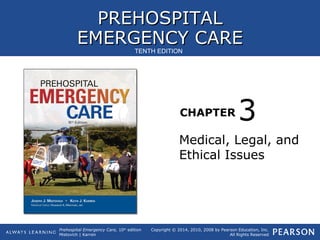
PREHOSPITALPREHOSPITAL
EMERGENCY CAREEMERGENCY CARE
CHAPTER
Copyright © 2014, 2010, 2008 by Pearson Education, Inc.
All Rights Reserved
Prehospital Emergency Care, 10th
edition
Mistovich | Karren
TENTH EDITION
Medical, Legal, and
Ethical Issues
3
Prehospital Emergency Care, 10th
edition
Mistovich | Karren
Copyright © 2014, 2010, 2008 by Pearson Education, Inc.
All Rights Reserved
Learning ReadinessLearning Readiness
• EMS Education Standards, text p. 39
Prehospital Emergency Care, 10th
edition
Mistovich | Karren
Copyright © 2014, 2010, 2008 by Pearson Education, Inc.
All Rights Reserved
Learning ReadinessLearning Readiness
ObjectivesObjectives
• Please refer to page 39 of your text to
view the objectives for this chapter.
Prehospital Emergency Care, 10th
edition
Mistovich | Karren
Copyright © 2014, 2010, 2008 by Pearson Education, Inc.
All Rights Reserved
Learning ReadinessLearning Readiness
Key TermsKey Terms
• Please refer to page 40 of your text to
view the key terms for this chapter.
Prehospital Emergency Care, 10th
edition
Mistovich | Karren
Copyright © 2014, 2010, 2008 by Pearson Education, Inc.
All Rights Reserved
Setting the StageSetting the Stage
• Overview of Lesson Topics
 Scope of practice
 Issues of consent and refusal
 Negligence and intentional torts
 HIPAA and EMTALA
 Other legal situations
Prehospital Emergency Care, 10th
edition
Mistovich | Karren
Copyright © 2014, 2010, 2008 by Pearson Education, Inc.
All Rights Reserved
Case Study IntroductionCase Study Introduction
EMTs Phil Baker and Caitlyn O'Shea have
responded to an alley behind a strip mall
for an unresponsive person. Police are on
the scene and have been able to get a
response from the patient, who is now
sitting up. The patient, who is disheveled
and smells of alcohol and urine, shouts,
"I'm not going to the hospital. Get out of
here!"
Prehospital Emergency Care, 10th
edition
Mistovich | Karren
Copyright © 2014, 2010, 2008 by Pearson Education, Inc.
All Rights Reserved
Case StudyCase Study
• What are the EMTs' legal obligations in
this situation?
• What ethical obligations do the EMTs
have?
• What information should the EMTs
attempt to obtain?
Prehospital Emergency Care, 10th
edition
Mistovich | Karren
Copyright © 2014, 2010, 2008 by Pearson Education, Inc.
All Rights Reserved
IntroductionIntroduction
• Every EMS call involves legal and
ethical decision making.
• Most cases are clear.
• In some cases EMTs must weigh
complex information to act in the
patient's best interests.
Prehospital Emergency Care, 10th
edition
Mistovich | Karren
Copyright © 2014, 2010, 2008 by Pearson Education, Inc.
All Rights Reserved
Scope of PracticeScope of Practice
• Scope of practice
 The actions and care that EMTs are
legally allowed to perform by the state
in which they work
 Establishes boundaries among
professionals
continued on next slide
Prehospital Emergency Care, 10th
edition
Mistovich | Karren
Copyright © 2014, 2010, 2008 by Pearson Education, Inc.
All Rights Reserved
Scope of PracticeScope of Practice
• Sources used to define scope of
practice
 National EMS Scope of Practice Model
 National EMS Education Standards
 State laws, regulations, policies
continued on next slide
Prehospital Emergency Care, 10th
edition
Mistovich | Karren
Copyright © 2014, 2010, 2008 by Pearson Education, Inc.
All Rights Reserved
Scope of PracticeScope of Practice
• Scope of practice is not a practice
guideline or protocol.
• Scope of practice does not define the
standard of care.
continued on next slide
Prehospital Emergency Care, 10th
edition
Mistovich | Karren
Copyright © 2014, 2010, 2008 by Pearson Education, Inc.
All Rights Reserved
Scope of PracticeScope of Practice
• Standard of care
 The care that is expected to be provided
by an EMT
 Defined by what a reasonably prudent
person with similar training would do in
the same situation
continued on next slide
Prehospital Emergency Care, 10th
edition
Mistovich | Karren
Copyright © 2014, 2010, 2008 by Pearson Education, Inc.
All Rights Reserved
Scope of PracticeScope of Practice
• Standard of care
 Two principles
• Did the EMT provide the right
assessment and care?
• Did the EMT perform the assessment and
care properly?
continued on next slide
Prehospital Emergency Care, 10th
edition
Mistovich | Karren
Copyright © 2014, 2010, 2008 by Pearson Education, Inc.
All Rights Reserved
Scope of PracticeScope of Practice
• Standard of care
 May be determined by:
• EMT textbooks
• The care that would be expected by other
EMTs
• Local and state protocols
• National EMS Education Standards
• The EMS system's operating policies and
procedures
continued on next slide
Prehospital Emergency Care, 10th
edition
Mistovich | Karren
Copyright © 2014, 2010, 2008 by Pearson Education, Inc.
All Rights Reserved
Scope of PracticeScope of Practice
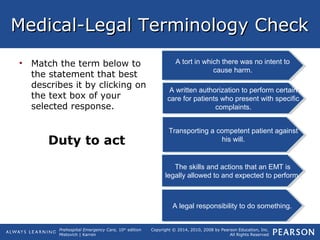
• Duty to act is the legal obligation to
provide service.
 You have a duty to act while you are on
duty with your service.
continued on next slide
Prehospital Emergency Care, 10th
edition
Mistovich | Karren
Copyright © 2014, 2010, 2008 by Pearson Education, Inc.
All Rights Reserved
Scope of PracticeScope of Practice
• Duty to act is the legal obligation to
provide service.
 When you are not on duty, you do not
have a duty to act in most states.
 When beginning care while off duty, you
create a duty to act and may not leave
until someone with the appropriate
expertise arrives.
continued on next slide
Prehospital Emergency Care, 10th
edition
Mistovich | Karren
Copyright © 2014, 2010, 2008 by Pearson Education, Inc.
All Rights Reserved
Scope of PracticeScope of Practice
• Duty to act involves an obligation to
carry out all aspects of the EMT's
responsibilities.
 Patient advocacy and protection of
rights
 Maintaining proficiency in knowledge
and skills
 Ensuring equipment is available and in
working order
continued on next slide
Prehospital Emergency Care, 10th
edition
Mistovich | Karren
Copyright © 2014, 2010, 2008 by Pearson Education, Inc.
All Rights Reserved
Scope of PracticeScope of Practice
• Good Samaritan laws
 Protect a person who is not being paid
for his services from liability for acts
performed in good faith except in cases
of gross negligence
continued on next slide
Prehospital Emergency Care, 10th
edition
Mistovich | Karren
Copyright © 2014, 2010, 2008 by Pearson Education, Inc.
All Rights Reserved
Scope of PracticeScope of Practice
• Good Samaritan laws
 You must:
• Render care to the best of your ability.
• Work within the scope of practice and to
the standard of care.
• Act professionally.
 Professional liability insurance can help
protect you if you are sued.
continued on next slide
Prehospital Emergency Care, 10th
edition
Mistovich | Karren
Copyright © 2014, 2010, 2008 by Pearson Education, Inc.
All Rights Reserved
Scope of PracticeScope of Practice
• Other legal protections
 Sovereign immunity is afforded in some
cases to government employees.
 Statutes of limitations restrict the
amount of time a person has to file a
lawsuit.
 Contributory negligence on the part of
the patient
continued on next slide
Prehospital Emergency Care, 10th
edition
Mistovich | Karren
Copyright © 2014, 2010, 2008 by Pearson Education, Inc.
All Rights Reserved
Scope of PracticeScope of Practice
• Medical direction
 The legal right to function as an EMT is
contingent on approval by medical
direction.
continued on next slide
Prehospital Emergency Care, 10th
edition
Mistovich | Karren
Copyright © 2014, 2010, 2008 by Pearson Education, Inc.
All Rights Reserved
Scope of PracticeScope of Practice
• With regard to medical direction, you
must do the following:
 Follow approved standing orders and
protocols
 Communicate with medical direction
when needed
continued on next slide
Prehospital Emergency Care, 10th
edition
Mistovich | Karren
Copyright © 2014, 2010, 2008 by Pearson Education, Inc.
All Rights Reserved
Scope of PracticeScope of Practice
• With regard to medical direction, you
must do the following:
 Communicate clearly and completely;
follow orders given by medical direction
 Whenever there is a question about the
scope or direction of care, consult
medical direction
continued on next slide
Prehospital Emergency Care, 10th
edition
Mistovich | Karren
Copyright © 2014, 2010, 2008 by Pearson Education, Inc.
All Rights Reserved
Scope of PracticeScope of Practice
• Ethics
 Branch of philosophy focused on the
study of morality
• Morals
 Concepts of right and wrong
continued on next slide
Prehospital Emergency Care, 10th
edition
Mistovich | Karren
Copyright © 2014, 2010, 2008 by Pearson Education, Inc.
All Rights Reserved
Scope of PracticeScope of Practice
• EMT Code of Ethics
 Places welfare of the patient above all
else when providing medical care
 Ethical responsibilities include those
listed on the following slides.
continued on next slide
Prehospital Emergency Care, 10th
edition
Mistovich | Karren
Copyright © 2014, 2010, 2008 by Pearson Education, Inc.
All Rights Reserved
Scope of PracticeScope of Practice
• Serve the needs of the patient with
respect for human dignity, without
regard to nationality, race, gender,
creed, or status.
• Maintain skill mastery.
• Keep abreast of changes in EMS that
affect patient care; uphold professional
standards.
continued on next slide
Prehospital Emergency Care, 10th
edition
Mistovich | Karren
Copyright © 2014, 2010, 2008 by Pearson Education, Inc.
All Rights Reserved
Scope of PracticeScope of Practice
• Critically review performance, seeking
ways to improve; assume responsibility
for individual actions and judgment.
• Report with honesty; maintain
confidentiality.
• Work harmoniously with other
members of the health care team.
continued on next slide
Prehospital Emergency Care, 10th
edition
Mistovich | Karren
Copyright © 2014, 2010, 2008 by Pearson Education, Inc.
All Rights Reserved
Scope of PracticeScope of Practice
• When legal, ethical, and moral
obligations are in conflict:
 Follow protocols.
 Contact medical direction.
Prehospital Emergency Care, 10th
edition
Mistovich | Karren
Copyright © 2014, 2010, 2008 by Pearson Education, Inc.
All Rights Reserved
Case StudyCase Study
The EMTs approach the patient. "Hi,"
says Caitlyn. "My name is Caitlyn, and
I'm an EMT. We're here because
someone called to say you were
unconscious. How are you feeling?"
"Like I've got too many people not
minding their business, that's how I
feel!" says the patient. "Why don't you all
just go away and leave me alone?"
continued on next slide
Prehospital Emergency Care, 10th
edition
Mistovich | Karren
Copyright © 2014, 2010, 2008 by Pearson Education, Inc.
All Rights Reserved
Case StudyCase Study
• Should Caitlyn and Phil do as the
patient has requested, and leave him
alone?
• What is the legal basis for your answer?
• If you believe Caitlyn and Phil should
stay, what do you think they should do
next?
Prehospital Emergency Care, 10th
edition
Mistovich | Karren
Copyright © 2014, 2010, 2008 by Pearson Education, Inc.
All Rights Reserved
Consent and RefusalConsent and Refusal
• Competent patients have the right to
accept or refuse emergency medical
care.
• You must obtain consent before
providing care.
• Informed consent
 The patient must be informed of the
care to be provided and its risks and
consequences.
continued on next slide
Prehospital Emergency Care, 10th
edition
Mistovich | Karren
Copyright © 2014, 2010, 2008 by Pearson Education, Inc.
All Rights Reserved
Consent and RefusalConsent and Refusal
• Indicate to the patient that you would
like to perform an assessment, provide
emergency care, and transport him to a
hospital.
• Ensure the patient's understanding and
ask if he has questions.
• Obtain explicit permission before
proceeding.
continued on next slide
Prehospital Emergency Care, 10th
edition
Mistovich | Karren
Copyright © 2014, 2010, 2008 by Pearson Education, Inc.
All Rights Reserved
Consent and RefusalConsent and Refusal
• Types of consent
 Informed
 Expressed
 Implied
 Involuntary
continued on next slide
Prehospital Emergency Care, 10th
edition
Mistovich | Karren
Copyright © 2014, 2010, 2008 by Pearson Education, Inc.
All Rights Reserved
Consent and RefusalConsent and Refusal
• Types of consent
 Informed consent
• The patient agrees to be treated after
being advised about the treatment and
its risks and consequences.
 Expressed consent
• The patient's verbal or nonverbal
confirmation that he agrees to treatment.
continued on next slide
Prehospital Emergency Care, 10th
edition
Mistovich | Karren
Copyright © 2014, 2010, 2008 by Pearson Education, Inc.
All Rights Reserved
Consent and RefusalConsent and Refusal
• Types of consent
 Implied consent
• Emergency doctrine
• Assumes that a patient who is
unresponsive or not competent to give
consent would consent to care if he were
able to
continued on next slide
Prehospital Emergency Care, 10th
edition
Mistovich | Karren
Copyright © 2014, 2010, 2008 by Pearson Education, Inc.
All Rights Reserved
Consent and RefusalConsent and Refusal
• Types of consent
 Consent to treat minors
• Consent must be obtained by parent,
legal guardian, or authorized caregiver.
• If the parent cannot be reached, implied
consent is used.
• Parental consent is not needed for
emancipated minors.
continued on next slide
Prehospital Emergency Care, 10th
edition
Mistovich | Karren
Copyright © 2014, 2010, 2008 by Pearson Education, Inc.
All Rights Reserved
Consent and RefusalConsent and Refusal
• Types of consent
 Involuntary consent
• Applies to mentally incompetent adults or
individuals in law enforcement custody
• Consent is obtained from a third party,
such as a legal guardian or law
enforcement officer.
continued on next slide
Prehospital Emergency Care, 10th
edition
Mistovich | Karren
Copyright © 2014, 2010, 2008 by Pearson Education, Inc.
All Rights Reserved
Consent and RefusalConsent and Refusal
• Advance directive
 Based on patients' right to self-
determination
 Documents the wish of the chronically or
terminally ill patient not to be
resuscitated
 Legally allows the health care provider
to withhold resuscitation
continued on next slide
Prehospital Emergency Care, 10th
edition
Mistovich | Karren
Copyright © 2014, 2010, 2008 by Pearson Education, Inc.
All Rights Reserved
Consent and RefusalConsent and Refusal
• Advance directive
 Types
• Do not resuscitate (DNR) order
• Living will
• Physician's orders for life-sustaining
treatment (POLST)
• Health care durable power of attorney
(health care proxy)
continued on next slide
Prehospital Emergency Care, 10th
edition
Mistovich | Karren
Copyright © 2014, 2010, 2008 by Pearson Education, Inc.
All Rights Reserved
Consent and RefusalConsent and Refusal
• Advance directive
 Do not resuscitate order
• Legal document that governs only
resuscitation issues
 Living will
• Addresses broader health care issues,
including long-term use of life-support
equipment and feeding tubes
continued on next slide
Prehospital Emergency Care, 10th
edition
Mistovich | Karren
Copyright © 2014, 2010, 2008 by Pearson Education, Inc.
All Rights Reserved
Consent and RefusalConsent and Refusal
• Advance directive
 Durable power of attorney
• Designates a person who can legally
make health care decisions if the patient
is unable to do so
• Usually pertain to in-hospital and long-
term care
continued on next slide
Prehospital Emergency Care, 10th
edition
Mistovich | Karren
Copyright © 2014, 2010, 2008 by Pearson Education, Inc.
All Rights Reserved
Consent and RefusalConsent and Refusal
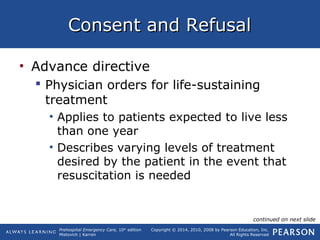
• Advance directive
 Physician orders for life-sustaining
treatment
• Applies to patients expected to live less
than one year
• Describes varying levels of treatment
desired by the patient in the event that
resuscitation is needed
continued on next slide
Prehospital Emergency Care, 10th
edition
Mistovich | Karren
Copyright © 2014, 2010, 2008 by Pearson Education, Inc.
All Rights Reserved
Consent and RefusalConsent and Refusal
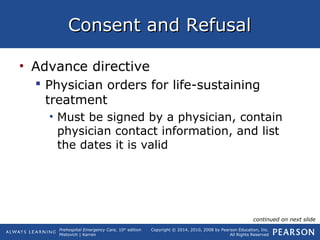
• Advance directive
 Physician orders for life-sustaining
treatment
• Must be signed by a physician, contain
physician contact information, and list
the dates it is valid
continued on next slide
Prehospital Emergency Care, 10th
edition
Mistovich | Karren
Copyright © 2014, 2010, 2008 by Pearson Education, Inc.
All Rights Reserved
Consent and RefusalConsent and Refusal
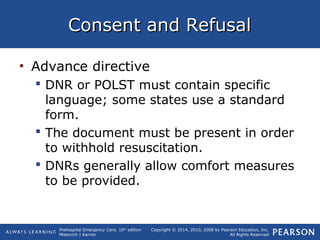
• Advance directive
 DNR or POLST must contain specific
language; some states use a standard
form.
 The document must be present in order
to withhold resuscitation.
 DNRs generally allow comfort measures
to be provided.
Prehospital Emergency Care, 10th
edition
Mistovich | Karren
Copyright © 2014, 2010, 2008 by Pearson Education, Inc.
All Rights Reserved
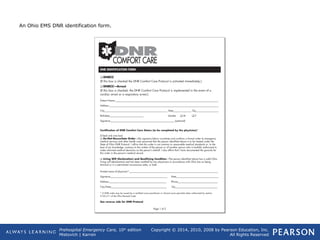
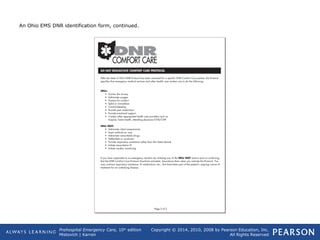
An Ohio EMS DNR identification form.
Prehospital Emergency Care, 10th
edition
Mistovich | Karren
Copyright © 2014, 2010, 2008 by Pearson Education, Inc.
All Rights Reserved
An Ohio EMS DNR identification form, continued.
Prehospital Emergency Care, 10th
edition
Mistovich | Karren
Copyright © 2014, 2010, 2008 by Pearson Education, Inc.
All Rights Reserved
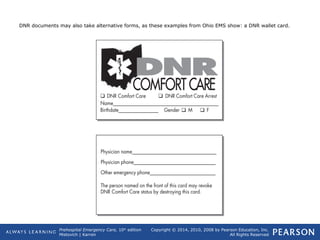
DNR documents may also take alternative forms, as these examples from Ohio EMS show: a DNR wallet card.
Prehospital Emergency Care, 10th
edition
Mistovich | Karren
Copyright © 2014, 2010, 2008 by Pearson Education, Inc.
All Rights Reserved
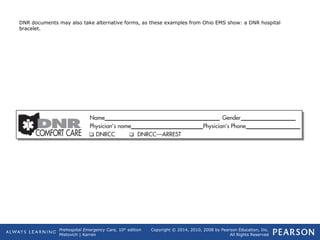
DNR documents may also take alternative forms, as these examples from Ohio EMS show: a DNR hospital
bracelet.
Prehospital Emergency Care, 10th
edition
Mistovich | Karren
Copyright © 2014, 2010, 2008 by Pearson Education, Inc.
All Rights Reserved
Consent and RefusalConsent and Refusal
• Advance directive issues
 Determining validity of the document
 Interpreting the orders
 Conflict between the DNR or POLST and
wishes of the family
continued on next slide
Prehospital Emergency Care, 10th
edition
Mistovich | Karren
Copyright © 2014, 2010, 2008 by Pearson Education, Inc.
All Rights Reserved
Consent and RefusalConsent and Refusal
• How to proceed with advance directive
issues
 If in doubt, consider initiating immediate
treatment.
 Contact medical direction.
 Continue treatment until the issue is
resolved.
continued on next slide
Prehospital Emergency Care, 10th
edition
Mistovich | Karren
Copyright © 2014, 2010, 2008 by Pearson Education, Inc.
All Rights Reserved
Consent and RefusalConsent and Refusal
• Refusing treatment
 Competency
• A patient has the right to refuse care,
even if it will result in death.
• For the patient to refuse, he must be
competent.
continued on next slide
Prehospital Emergency Care, 10th
edition
Mistovich | Karren
Copyright © 2014, 2010, 2008 by Pearson Education, Inc.
All Rights Reserved
Consent and RefusalConsent and Refusal
• Refusing treatment
 Competence means the ability to make
an informed decision.
• Alert and oriented
• Does not have altered mental status, is
not under the influence of drugs or
alcohol
continued on next slide
Prehospital Emergency Care, 10th
edition
Mistovich | Karren
Copyright © 2014, 2010, 2008 by Pearson Education, Inc.
All Rights Reserved
Consent and RefusalConsent and Refusal
• Refusing treatment
 The patient must be informed of and
fully understand the treatment and the
potential risks or consequences of
refusing treatment.
 The patient must sign the release form,
or if he refuses, attempt to have
someone witness the refusal.
continued on next slide
Prehospital Emergency Care, 10th
edition
Mistovich | Karren
Copyright © 2014, 2010, 2008 by Pearson Education, Inc.
All Rights Reserved
Consent and RefusalConsent and Refusal
• Refusing treatment
 Document what you told the patient
about treatment and risks of refusal.
 Document the patient's response.
continued on next slide
Prehospital Emergency Care, 10th
edition
Mistovich | Karren
Copyright © 2014, 2010, 2008 by Pearson Education, Inc.
All Rights Reserved
Consent and RefusalConsent and Refusal
• Protecting yourself in a refusal situation
 Exhaust your attempts to persuade the
patient.
 Make sure the patient is competent.
 Consult medical direction according to
protocol, or if otherwise needed.
 Clearly document what you told the
patient and his response to it.
continued on next slide
Prehospital Emergency Care, 10th
edition
Mistovich | Karren
Copyright © 2014, 2010, 2008 by Pearson Education, Inc.
All Rights Reserved
Consent and RefusalConsent and Refusal
• Protecting yourself in a refusal situation
 Encourage the patient to seek help if
problems continue or other problems
occur.
 If you are uncertain as to the patient's
competence, contact medical direction
Prehospital Emergency Care, 10th
edition
Mistovich | Karren
Copyright © 2014, 2010, 2008 by Pearson Education, Inc.
All Rights Reserved
Case StudyCase Study
"I can understand how you might feel like
people are in your business right now," says
Caitlyn. "We are here to help, but before we
can decide what to do, I need to ask you a few
questions. What is your name?"
"Mike Blevins."
"Mr. Blevins, do you know where you are right
now?" asks Caitlyn, beginning the process of
determining the patient's decision-making
ability.
continued on next slide
Prehospital Emergency Care, 10th
edition
Mistovich | Karren
Copyright © 2014, 2010, 2008 by Pearson Education, Inc.
All Rights Reserved
Case StudyCase Study
What questions should Caitlyn ask to
help her decide whether the patient has
the capacity to make an important
decision, such as consenting to or
refusing medical care?
Prehospital Emergency Care, 10th
edition
Mistovich | Karren
Copyright © 2014, 2010, 2008 by Pearson Education, Inc.
All Rights Reserved
NegligenceNegligence
• A breach of legal duty creates a
liability.
continued on next slide
Prehospital Emergency Care, 10th
edition
Mistovich | Karren
Copyright © 2014, 2010, 2008 by Pearson Education, Inc.
All Rights Reserved
NegligenceNegligence
• A breach of legal duty creates a
liability.
• Two types of liability
 Criminal
• The government brings charges against
the EMT.
• May result in fines or imprisonment
continued on next slide
Prehospital Emergency Care, 10th
edition
Mistovich | Karren
Copyright © 2014, 2010, 2008 by Pearson Education, Inc.
All Rights Reserved
NegligenceNegligence
• Two types of liability
 Civil
• The party who claims injury, the plaintiff,
files a lawsuit.
• The injury is a result of a wrongdoing,
called a tort.
• The lawsuit seeks monetary
compensation for damages.
continued on next slide
Prehospital Emergency Care, 10th
edition
Mistovich | Karren
Copyright © 2014, 2010, 2008 by Pearson Education, Inc.
All Rights Reserved
NegligenceNegligence
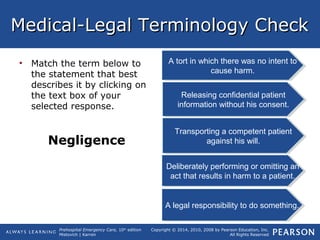
• Negligence is a tort in which:
 There was no intent to do harm
 But there was a breach of duty to act
continued on next slide
Prehospital Emergency Care, 10th
edition
Mistovich | Karren
Copyright © 2014, 2010, 2008 by Pearson Education, Inc.
All Rights Reserved
NegligenceNegligence
• Elements to prove negligence:
 The EMT had a duty to act.
 The EMT breached the duty to act.
 The patient suffered harm or injury.
 The injury was a result of the breach of
duty (proximate cause).
continued on next slide
Prehospital Emergency Care, 10th
edition
Mistovich | Karren
Copyright © 2014, 2010, 2008 by Pearson Education, Inc.
All Rights Reserved
NegligenceNegligence
• Associated legal principles
 Res ipsa loquitur
• "The thing speaks for itself."
• The inappropriate actions are obvious.
 Negligence per se
• The act is negligent simply because it
violates a statute or regulation.
continued on next slide
Prehospital Emergency Care, 10th
edition
Mistovich | Karren
Copyright © 2014, 2010, 2008 by Pearson Education, Inc.
All Rights Reserved
NegligenceNegligence
• Duty to act
 Legal obligation to respond and provide
emergency care
 Once the patient-provider relationship
has been established, the provider
cannot terminate it without consent of
the patient, or turning over patient care
to a qualified provider of equal or higher
training.
continued on next slide
Prehospital Emergency Care, 10th
edition
Mistovich | Karren
Copyright © 2014, 2010, 2008 by Pearson Education, Inc.
All Rights Reserved
NegligenceNegligence
• Breach of duty to act
 Occurs when the EMT's care deviates
from the standard of care
 Simple negligence occurs when an EMT
fails to perform care or makes a mistake
in treatment.
 Gross negligence occurs when there is
willful, wanton, or reckless action
beyond just carelessness.
continued on next slide
Prehospital Emergency Care, 10th
edition
Mistovich | Karren
Copyright © 2014, 2010, 2008 by Pearson Education, Inc.
All Rights Reserved
NegligenceNegligence
• Damages
 Real, demonstrable injuries that are
recognized by law
 Cannot be trivial or minor
continued on next slide
Prehospital Emergency Care, 10th
edition
Mistovich | Karren
Copyright © 2014, 2010, 2008 by Pearson Education, Inc.
All Rights Reserved
NegligenceNegligence
• Proximate cause
 It must be determined that the patient's
injury was a result of the EMT's actions.
Prehospital Emergency Care, 10th
edition
Mistovich | Karren
Copyright © 2014, 2010, 2008 by Pearson Education, Inc.
All Rights Reserved
Intentional TortIntentional Tort
• An action knowingly committed by an
individual that is considered civilly
wrong
• Includes abandonment, assault,
battery, false imprisonment, and
defamation
• Differs in that negligence is a failure to
meet the standard of care, whereas an
intentional tort is knowingly committed
continued on next slide
Prehospital Emergency Care, 10th
edition
Mistovich | Karren
Copyright © 2014, 2010, 2008 by Pearson Education, Inc.
All Rights Reserved
Intentional TortIntentional Tort
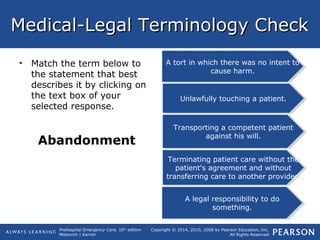
• Abandonment
 Occurs when you stop treatment without
appropriate transfer of care
 You must transfer care with a report to
the health care provider accepting the
patient.
 The accepting provider must be trained
to your level or higher.
continued on next slide
Prehospital Emergency Care, 10th
edition
Mistovich | Karren
Copyright © 2014, 2010, 2008 by Pearson Education, Inc.
All Rights Reserved
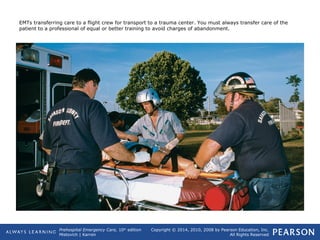
EMTs transferring care to a flight crew for transport to a trauma center. You must always transfer care of the
patient to a professional of equal or better training to avoid charges of abandonment.
Prehospital Emergency Care, 10th
edition
Mistovich | Karren
Copyright © 2014, 2010, 2008 by Pearson Education, Inc.
All Rights Reserved
Intentional TortIntentional Tort
• Assault
 Willful threat to inflict harm on a patient
 Can occur without actually touching the
patient
continued on next slide
Prehospital Emergency Care, 10th
edition
Mistovich | Karren
Copyright © 2014, 2010, 2008 by Pearson Education, Inc.
All Rights Reserved
Intentional TortIntentional Tort
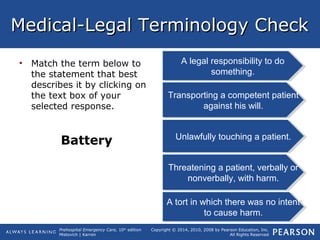
• Battery
 Unlawfully touching a patient
 Without consent, touching a patient is
unlawful
continued on next slide
Prehospital Emergency Care, 10th
edition
Mistovich | Karren
Copyright © 2014, 2010, 2008 by Pearson Education, Inc.
All Rights Reserved
Intentional TortIntentional Tort
• False imprisonment or kidnapping
 Intentionally transporting a competent
patient without his consent
 Failing to allow a competent patient to
withdraw from treatment when he
desires to do so
continued on next slide
Prehospital Emergency Care, 10th
edition
Mistovich | Karren
Copyright © 2014, 2010, 2008 by Pearson Education, Inc.
All Rights Reserved
Intentional TortIntentional Tort
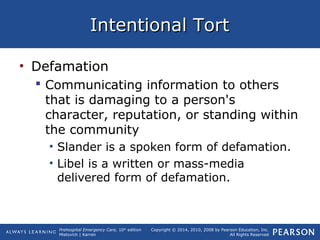
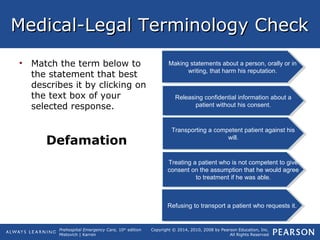
• Defamation
 Communicating information to others
that is damaging to a person's
character, reputation, or standing within
the community
• Slander is a spoken form of defamation.
• Libel is a written or mass-media
delivered form of defamation.
Prehospital Emergency Care, 10th
edition
Mistovich | Karren
Copyright © 2014, 2010, 2008 by Pearson Education, Inc.
All Rights Reserved
Medical-Legal Terminology CheckMedical-Legal Terminology Check
• Match the term below to
the statement that best
describes it by clicking on
the text box of your
selected response.
Abandonment
A tort in which there was no intent to
cause harm.
A tort in which there was no intent to
cause harm.
Transporting a competent patient
against his will.
Transporting a competent patient
against his will.
A legal responsibility to do
something.
A legal responsibility to do
something.
Unlawfully touching a patient.Unlawfully touching a patient.
Terminating patient care without the
patient's agreement and without
transferring care to another provider.
Terminating patient care without the
patient's agreement and without
transferring care to another provider.
Prehospital Emergency Care, 10th
edition
Mistovich | Karren
Copyright © 2014, 2010, 2008 by Pearson Education, Inc.
All Rights Reserved
Medical-Legal Terminology CheckMedical-Legal Terminology Check
• Match the term below to
the statement that best
describes it by clicking on
the text box of your
selected response.
Battery
A tort in which there was no intent
to cause harm.
A tort in which there was no intent
to cause harm.
Transporting a competent patient
against his will.
Transporting a competent patient
against his will.
A legal responsibility to do
something.
A legal responsibility to do
something.
Unlawfully touching a patient.Unlawfully touching a patient.
Threatening a patient, verbally or
nonverbally, with harm.
Threatening a patient, verbally or
nonverbally, with harm.
Prehospital Emergency Care, 10th
edition
Mistovich | Karren
Copyright © 2014, 2010, 2008 by Pearson Education, Inc.
All Rights Reserved
Medical-Legal Terminology CheckMedical-Legal Terminology Check
• Match the term below to
the statement that best
describes it by clicking on
the text box of your
selected response.
Negligence
A tort in which there was no intent to
cause harm.
A tort in which there was no intent to
cause harm.
Transporting a competent patient
against his will.
Transporting a competent patient
against his will.
A legal responsibility to do something.A legal responsibility to do something.
Releasing confidential patient
information without his consent.
Releasing confidential patient
information without his consent.
Deliberately performing or omitting an
act that results in harm to a patient.
Deliberately performing or omitting an
act that results in harm to a patient.
Prehospital Emergency Care, 10th
edition
Mistovich | Karren
Copyright © 2014, 2010, 2008 by Pearson Education, Inc.
All Rights Reserved
Medical-Legal Terminology CheckMedical-Legal Terminology Check
• Match the term below to
the statement that best
describes it by clicking on
the text box of your
selected response.
Duty to act
A tort in which there was no intent to
cause harm.
A tort in which there was no intent to
cause harm.
Transporting a competent patient against
his will.
Transporting a competent patient against
his will.
A legal responsibility to do something.A legal responsibility to do something.
A written authorization to perform certain
care for patients who present with specific
complaints.
A written authorization to perform certain
care for patients who present with specific
complaints.
The skills and actions that an EMT is
legally allowed to and expected to perform.
The skills and actions that an EMT is
legally allowed to and expected to perform.
Prehospital Emergency Care, 10th
edition
Mistovich | Karren
Copyright © 2014, 2010, 2008 by Pearson Education, Inc.
All Rights Reserved
Medical-Legal Terminology CheckMedical-Legal Terminology Check
• Match the term below to
the statement that best
describes it by clicking on
the text box of your
selected response.
Defamation
Making statements about a person, orally or in
writing, that harm his reputation.
Making statements about a person, orally or in
writing, that harm his reputation.
Transporting a competent patient against his
will.
Transporting a competent patient against his
will.
Refusing to transport a patient who requests it.Refusing to transport a patient who requests it.
Releasing confidential information about a
patient without his consent.
Releasing confidential information about a
patient without his consent.
Treating a patient who is not competent to give
consent on the assumption that he would agree
to treatment if he was able.
Treating a patient who is not competent to give
consent on the assumption that he would agree
to treatment if he was able.
Prehospital Emergency Care, 10th
edition
Mistovich | Karren
Copyright © 2014, 2010, 2008 by Pearson Education, Inc.
All Rights Reserved
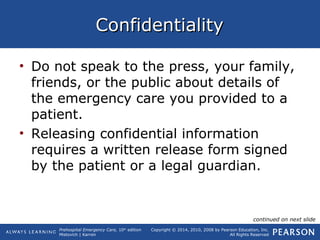
ConfidentialityConfidentiality
• Do not speak to the press, your family,
friends, or the public about details of
the emergency care you provided to a
patient.
• Releasing confidential information
requires a written release form signed
by the patient or a legal guardian.
continued on next slide
Prehospital Emergency Care, 10th
edition
Mistovich | Karren
Copyright © 2014, 2010, 2008 by Pearson Education, Inc.
All Rights Reserved
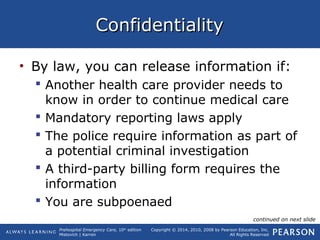
ConfidentialityConfidentiality
• By law, you can release information if:
 Another health care provider needs to
know in order to continue medical care
 Mandatory reporting laws apply
 The police require information as part of
a potential criminal investigation
 A third-party billing form requires the
information
 You are subpoenaed
continued on next slide
Prehospital Emergency Care, 10th
edition
Mistovich | Karren
Copyright © 2014, 2010, 2008 by Pearson Education, Inc.
All Rights Reserved
ConfidentialityConfidentiality
• Health Insurance Portability and
Accountability Act (HIPAA)
 Federal law protects the privacy of
patient health care information.
continued on next slide
Prehospital Emergency Care, 10th
edition
Mistovich | Karren
Copyright © 2014, 2010, 2008 by Pearson Education, Inc.
All Rights Reserved
ConfidentialityConfidentiality
• HIPAA and EMS
 You may discuss patient-specific
information only when there is a medical
necessity.
 You must receive training in your
agency's policies.
 Patients must be provided with privacy
policies.
continued on next slide
Prehospital Emergency Care, 10th
edition
Mistovich | Karren
Copyright © 2014, 2010, 2008 by Pearson Education, Inc.
All Rights Reserved
ConfidentialityConfidentiality
• HIPAA and EMS
 EMS agencies have a designated privacy
officer to oversee HIPAA regulations.
 Refer requests for information to the
privacy officer.
Prehospital Emergency Care, 10th
edition
Mistovich | Karren
Copyright © 2014, 2010, 2008 by Pearson Education, Inc.
All Rights Reserved
COBRA and EMTALACOBRA and EMTALA
• Consolidated Omnibus Budget
Reconciliation Act (COBRA)
• Emergency Medical Treatment and
Active Labor Act (EMTALA)
• Federal regulations that ensure access
to emergency health care regardless of
ability to pay
continued on next slide
Prehospital Emergency Care, 10th
edition
Mistovich | Karren
Copyright © 2014, 2010, 2008 by Pearson Education, Inc.
All Rights Reserved
COBRA and EMTALACOBRA and EMTALA
• EMS becomes involved when patients
are being transferred from a hospital to
another medical facility.
• The patient must first be stabilized to
the best of the medical facility's ability.
• The ambulance crew performing the
transfer must be qualified and capable
of managing the patient and his
condition.
continued on next slide
Prehospital Emergency Care, 10th
edition
Mistovich | Karren
Copyright © 2014, 2010, 2008 by Pearson Education, Inc.
All Rights Reserved
COBRA and EMTALACOBRA and EMTALA
• In an emergency transport do not make
a decision to transport to a specific
facility based on the patient's ability to
pay.
• Do not bypass a facility that is able to
treat the patient, unless directed to do
so by medical direction or protocol.
• Document the reason for bypassing the
facility.
continued on next slide
Prehospital Emergency Care, 10th
edition
Mistovich | Karren
Copyright © 2014, 2010, 2008 by Pearson Education, Inc.
All Rights Reserved
COBRA and EMTALACOBRA and EMTALA
• For interfacility transfers
 Get a full report about the patient's
condition.
 Ensure that you are able to provide the
level of care necessary .
 Obtain the patient's informed consent
for the transfer.
continued on next slide
Prehospital Emergency Care, 10th
edition
Mistovich | Karren
Copyright © 2014, 2010, 2008 by Pearson Education, Inc.
All Rights Reserved
COBRA and EMTALACOBRA and EMTALA
• For interfacility transfers
 Obtain written certification for the
transfer from the transferring physician.
 Know where you are going and take the
quickest possible route.
Prehospital Emergency Care, 10th
edition
Mistovich | Karren
Copyright © 2014, 2010, 2008 by Pearson Education, Inc.
All Rights Reserved
Special SituationsSpecial Situations
• Organ donation
 Organs can be donated only if there is a
legal signed document giving
permission.
 A signed donor card is a legal
document; driver's license organ donor
status provides an intent to donate
organs.
continued on next slide
Prehospital Emergency Care, 10th
edition
Mistovich | Karren
Copyright © 2014, 2010, 2008 by Pearson Education, Inc.
All Rights Reserved
Special SituationsSpecial Situations
• Organ donation
 Treat a potential organ donor no
differently from any other patient.
 Patients who are about to die or who
have died within hours are potential
organ donors.
 Hospital staff and family make the
ultimate decision.
continued on next slide
Prehospital Emergency Care, 10th
edition
Mistovich | Karren
Copyright © 2014, 2010, 2008 by Pearson Education, Inc.
All Rights Reserved
Special SituationsSpecial Situations
• Organ donation
 Communicate with medical direction
regarding the possibility of organ
donation.
 Provide emergency care as you would
for any other patient.
continued on next slide
Prehospital Emergency Care, 10th
edition
Mistovich | Karren
Copyright © 2014, 2010, 2008 by Pearson Education, Inc.
All Rights Reserved
Special SituationsSpecial Situations
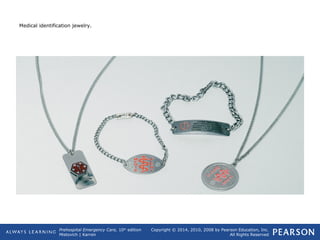
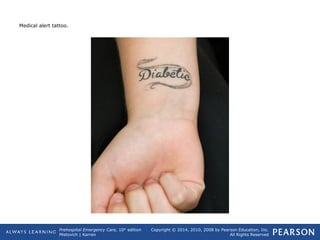
• Medical identification
 Bracelets, necklaces, or cards
 Medical tattoos may not use standard
insignia.
Prehospital Emergency Care, 10th
edition
Mistovich | Karren
Copyright © 2014, 2010, 2008 by Pearson Education, Inc.
All Rights Reserved
Medical identification jewelry.
Prehospital Emergency Care, 10th
edition
Mistovich | Karren
Copyright © 2014, 2010, 2008 by Pearson Education, Inc.
All Rights Reserved
Medical alert tattoo.
Prehospital Emergency Care, 10th
edition
Mistovich | Karren
Copyright © 2014, 2010, 2008 by Pearson Education, Inc.
All Rights Reserved
Recognizing Death in the FieldRecognizing Death in the Field
• Generally, if the patient is still warm
and does not exhibit any obvious signs
of death, begin resuscitation.
• There is an exception for patients with
hypothermia.
continued on next slide
Prehospital Emergency Care, 10th
edition
Mistovich | Karren
Copyright © 2014, 2010, 2008 by Pearson Education, Inc.
All Rights Reserved
Recognizing Death in the FieldRecognizing Death in the Field
• For patients with a DNR, assess for
presumptive signs of death.
 Absence of a pulse, breathing, and
breath sounds
 Complete unresponsiveness to any
stimuli
 No eye movement or pupil response
 Absence of a blood pressure
 No reflexes
continued on next slide
Prehospital Emergency Care, 10th
edition
Mistovich | Karren
Copyright © 2014, 2010, 2008 by Pearson Education, Inc.
All Rights Reserved
Recognizing Death in the FieldRecognizing Death in the Field
• Obvious signs of death in which
resuscitation is not attempted.
 Decapitation
 Rigor mortis
 Decomposition
 Dependent lividity
Prehospital Emergency Care, 10th
edition
Mistovich | Karren
Copyright © 2014, 2010, 2008 by Pearson Education, Inc.
All Rights Reserved
Recognizing Death in the FieldRecognizing Death in the Field
• Cases requiring investigation by the
coroner or medical examiner
 Homicide
 Suicide
 Violent death
 Crash-related death
 Unusual scene characteristics
 Sudden infant death syndrome (SIDS)
 Dead on arrival (in some locations)
Prehospital Emergency Care, 10th
edition
Mistovich | Karren
Copyright © 2014, 2010, 2008 by Pearson Education, Inc.
All Rights Reserved
Crime ScenesCrime Scenes
• Your first concern upon approaching a
crime scene should be for your own
safety.
• Recognizing a possible crime scene
requires a high index of suspicion.
• Potential crime scenes require police
support.
continued on next slide
Prehospital Emergency Care, 10th
edition
Mistovich | Karren
Copyright © 2014, 2010, 2008 by Pearson Education, Inc.
All Rights Reserved
Crime ScenesCrime Scenes
• Wait until the police declare that the
scene is safe.
• Even when the police declare the scene
safe it can still be potentially
dangerous.
• Once the scene is secure, your priority
is emergency care of the patient.
continued on next slide
Prehospital Emergency Care, 10th
edition
Mistovich | Karren
Copyright © 2014, 2010, 2008 by Pearson Education, Inc.
All Rights Reserved
Crime ScenesCrime Scenes
• Potential or actual crime scenes
 Suicide
 Homicide
 Drug overdose
 Domestic dispute
 Rape
 Abuse
continued on next slide
Prehospital Emergency Care, 10th
edition
Mistovich | Karren
Copyright © 2014, 2010, 2008 by Pearson Education, Inc.
All Rights Reserved
Crime ScenesCrime Scenes
• Potential or actual crime scenes
 Hit-and-run accident
 Riot
 Robbery
 Gunfire
 Weapons
continued on next slide
Prehospital Emergency Care, 10th
edition
Mistovich | Karren
Copyright © 2014, 2010, 2008 by Pearson Education, Inc.
All Rights Reserved
Crime ScenesCrime Scenes
• Avoid disturbing potential evidence.
 Take one way in and out.
 Touch only what you must; tell a police
officer if you move or touch anything.
 Move only what you must.
 Do not use a crime scene telephone.
continued on next slide
Prehospital Emergency Care, 10th
edition
Mistovich | Karren
Copyright © 2014, 2010, 2008 by Pearson Education, Inc.
All Rights Reserved
Crime ScenesCrime Scenes
• Avoid disturbing potential evidence.
 In the absence of police permission,
move the patient only if he is in danger
or must be moved for you to provide
care.
 Observe and document carefully.
 Do not cut through holes in clothing.
continued on next slide
Prehospital Emergency Care, 10th
edition
Mistovich | Karren
Copyright © 2014, 2010, 2008 by Pearson Education, Inc.
All Rights Reserved
Crime ScenesCrime Scenes
• Avoid disturbing potential evidence.
 Do not cut through any knot in a rope or
tie.
 Do not cover the patient with a sheet.
 If the crime is rape:
• Do not wash the patient or allow the
patient to wash.
• Ask the patient not to change clothing,
use the bathroom, or take anything by
mouth.
Prehospital Emergency Care, 10th
edition
Mistovich | Karren
Copyright © 2014, 2010, 2008 by Pearson Education, Inc.
All Rights Reserved
Special Reporting SituationsSpecial Reporting Situations
• Commonly required reporting situations
 Abuse
 Crime
 Drug-related injuries
Prehospital Emergency Care, 10th
edition
Mistovich | Karren
Copyright © 2014, 2010, 2008 by Pearson Education, Inc.
All Rights Reserved
Baby Safe Haven LawsBaby Safe Haven Laws
• Designed to prevent child abandonment
• Allow a parent to relinquish custody of
an unharmed infant to a proper
authority
• An EMS station may be a designated
safe haven.
Prehospital Emergency Care, 10th
edition
Mistovich | Karren
Copyright © 2014, 2010, 2008 by Pearson Education, Inc.
All Rights Reserved
Lesson SummaryLesson Summary
• Emergency care involves medical, legal,
and ethical issues.
• Scope of practice identifies what care
can legally be performed.
• Standard of care identifies the accepted
level of care.
continued on next slide
Prehospital Emergency Care, 10th
edition
Mistovich | Karren
Copyright © 2014, 2010, 2008 by Pearson Education, Inc.
All Rights Reserved
Lesson SummaryLesson Summary
• EMTs have a duty to act.
• Medical direction is required for medical
oversight of an EMS system.
• Consent applies in all patient care
situations.
• A competent adult can refuse care.
continued on next slide
Prehospital Emergency Care, 10th
edition
Mistovich | Karren
Copyright © 2014, 2010, 2008 by Pearson Education, Inc.
All Rights Reserved
Lesson SummaryLesson Summary
• Four elements must be proven to
establish negligence.
• EMTs must maintain patient
confidentiality.
• HIPAA, COBRA, and EMTALA apply to
EMS.
• There are special considerations in
responding to crime scenes.

DMACC EMT Chapter 3

  • 1.
    PREHOSPITALPREHOSPITAL EMERGENCY CAREEMERGENCY CARE CHAPTER Copyright© 2014, 2010, 2008 by Pearson Education, Inc. All Rights Reserved Prehospital Emergency Care, 10th edition Mistovich | Karren TENTH EDITION Medical, Legal, and Ethical Issues 3
  • 2.
    Prehospital Emergency Care,10th edition Mistovich | Karren Copyright © 2014, 2010, 2008 by Pearson Education, Inc. All Rights Reserved Learning ReadinessLearning Readiness • EMS Education Standards, text p. 39
  • 3.
    Prehospital Emergency Care,10th edition Mistovich | Karren Copyright © 2014, 2010, 2008 by Pearson Education, Inc. All Rights Reserved Learning ReadinessLearning Readiness ObjectivesObjectives • Please refer to page 39 of your text to view the objectives for this chapter.
  • 4.
    Prehospital Emergency Care,10th edition Mistovich | Karren Copyright © 2014, 2010, 2008 by Pearson Education, Inc. All Rights Reserved Learning ReadinessLearning Readiness Key TermsKey Terms • Please refer to page 40 of your text to view the key terms for this chapter.
  • 5.
    Prehospital Emergency Care,10th edition Mistovich | Karren Copyright © 2014, 2010, 2008 by Pearson Education, Inc. All Rights Reserved Setting the StageSetting the Stage • Overview of Lesson Topics  Scope of practice  Issues of consent and refusal  Negligence and intentional torts  HIPAA and EMTALA  Other legal situations
  • 6.
    Prehospital Emergency Care,10th edition Mistovich | Karren Copyright © 2014, 2010, 2008 by Pearson Education, Inc. All Rights Reserved Case Study IntroductionCase Study Introduction EMTs Phil Baker and Caitlyn O'Shea have responded to an alley behind a strip mall for an unresponsive person. Police are on the scene and have been able to get a response from the patient, who is now sitting up. The patient, who is disheveled and smells of alcohol and urine, shouts, "I'm not going to the hospital. Get out of here!"
  • 7.
    Prehospital Emergency Care,10th edition Mistovich | Karren Copyright © 2014, 2010, 2008 by Pearson Education, Inc. All Rights Reserved Case StudyCase Study • What are the EMTs' legal obligations in this situation? • What ethical obligations do the EMTs have? • What information should the EMTs attempt to obtain?
  • 8.
    Prehospital Emergency Care,10th edition Mistovich | Karren Copyright © 2014, 2010, 2008 by Pearson Education, Inc. All Rights Reserved IntroductionIntroduction • Every EMS call involves legal and ethical decision making. • Most cases are clear. • In some cases EMTs must weigh complex information to act in the patient's best interests.
  • 9.
    Prehospital Emergency Care,10th edition Mistovich | Karren Copyright © 2014, 2010, 2008 by Pearson Education, Inc. All Rights Reserved Scope of PracticeScope of Practice • Scope of practice  The actions and care that EMTs are legally allowed to perform by the state in which they work  Establishes boundaries among professionals continued on next slide
  • 10.
    Prehospital Emergency Care,10th edition Mistovich | Karren Copyright © 2014, 2010, 2008 by Pearson Education, Inc. All Rights Reserved Scope of PracticeScope of Practice • Sources used to define scope of practice  National EMS Scope of Practice Model  National EMS Education Standards  State laws, regulations, policies continued on next slide
  • 11.
    Prehospital Emergency Care,10th edition Mistovich | Karren Copyright © 2014, 2010, 2008 by Pearson Education, Inc. All Rights Reserved Scope of PracticeScope of Practice • Scope of practice is not a practice guideline or protocol. • Scope of practice does not define the standard of care. continued on next slide
  • 12.
    Prehospital Emergency Care,10th edition Mistovich | Karren Copyright © 2014, 2010, 2008 by Pearson Education, Inc. All Rights Reserved Scope of PracticeScope of Practice • Standard of care  The care that is expected to be provided by an EMT  Defined by what a reasonably prudent person with similar training would do in the same situation continued on next slide
  • 13.
    Prehospital Emergency Care,10th edition Mistovich | Karren Copyright © 2014, 2010, 2008 by Pearson Education, Inc. All Rights Reserved Scope of PracticeScope of Practice • Standard of care  Two principles • Did the EMT provide the right assessment and care? • Did the EMT perform the assessment and care properly? continued on next slide
  • 14.
    Prehospital Emergency Care,10th edition Mistovich | Karren Copyright © 2014, 2010, 2008 by Pearson Education, Inc. All Rights Reserved Scope of PracticeScope of Practice • Standard of care  May be determined by: • EMT textbooks • The care that would be expected by other EMTs • Local and state protocols • National EMS Education Standards • The EMS system's operating policies and procedures continued on next slide
  • 15.
    Prehospital Emergency Care,10th edition Mistovich | Karren Copyright © 2014, 2010, 2008 by Pearson Education, Inc. All Rights Reserved Scope of PracticeScope of Practice • Duty to act is the legal obligation to provide service.  You have a duty to act while you are on duty with your service. continued on next slide
  • 16.
    Prehospital Emergency Care,10th edition Mistovich | Karren Copyright © 2014, 2010, 2008 by Pearson Education, Inc. All Rights Reserved Scope of PracticeScope of Practice • Duty to act is the legal obligation to provide service.  When you are not on duty, you do not have a duty to act in most states.  When beginning care while off duty, you create a duty to act and may not leave until someone with the appropriate expertise arrives. continued on next slide
  • 17.
    Prehospital Emergency Care,10th edition Mistovich | Karren Copyright © 2014, 2010, 2008 by Pearson Education, Inc. All Rights Reserved Scope of PracticeScope of Practice • Duty to act involves an obligation to carry out all aspects of the EMT's responsibilities.  Patient advocacy and protection of rights  Maintaining proficiency in knowledge and skills  Ensuring equipment is available and in working order continued on next slide
  • 18.
    Prehospital Emergency Care,10th edition Mistovich | Karren Copyright © 2014, 2010, 2008 by Pearson Education, Inc. All Rights Reserved Scope of PracticeScope of Practice • Good Samaritan laws  Protect a person who is not being paid for his services from liability for acts performed in good faith except in cases of gross negligence continued on next slide
  • 19.
    Prehospital Emergency Care,10th edition Mistovich | Karren Copyright © 2014, 2010, 2008 by Pearson Education, Inc. All Rights Reserved Scope of PracticeScope of Practice • Good Samaritan laws  You must: • Render care to the best of your ability. • Work within the scope of practice and to the standard of care. • Act professionally.  Professional liability insurance can help protect you if you are sued. continued on next slide
  • 20.
    Prehospital Emergency Care,10th edition Mistovich | Karren Copyright © 2014, 2010, 2008 by Pearson Education, Inc. All Rights Reserved Scope of PracticeScope of Practice • Other legal protections  Sovereign immunity is afforded in some cases to government employees.  Statutes of limitations restrict the amount of time a person has to file a lawsuit.  Contributory negligence on the part of the patient continued on next slide
  • 21.
    Prehospital Emergency Care,10th edition Mistovich | Karren Copyright © 2014, 2010, 2008 by Pearson Education, Inc. All Rights Reserved Scope of PracticeScope of Practice • Medical direction  The legal right to function as an EMT is contingent on approval by medical direction. continued on next slide
  • 22.
    Prehospital Emergency Care,10th edition Mistovich | Karren Copyright © 2014, 2010, 2008 by Pearson Education, Inc. All Rights Reserved Scope of PracticeScope of Practice • With regard to medical direction, you must do the following:  Follow approved standing orders and protocols  Communicate with medical direction when needed continued on next slide
  • 23.
    Prehospital Emergency Care,10th edition Mistovich | Karren Copyright © 2014, 2010, 2008 by Pearson Education, Inc. All Rights Reserved Scope of PracticeScope of Practice • With regard to medical direction, you must do the following:  Communicate clearly and completely; follow orders given by medical direction  Whenever there is a question about the scope or direction of care, consult medical direction continued on next slide
  • 24.
    Prehospital Emergency Care,10th edition Mistovich | Karren Copyright © 2014, 2010, 2008 by Pearson Education, Inc. All Rights Reserved Scope of PracticeScope of Practice • Ethics  Branch of philosophy focused on the study of morality • Morals  Concepts of right and wrong continued on next slide
  • 25.
    Prehospital Emergency Care,10th edition Mistovich | Karren Copyright © 2014, 2010, 2008 by Pearson Education, Inc. All Rights Reserved Scope of PracticeScope of Practice • EMT Code of Ethics  Places welfare of the patient above all else when providing medical care  Ethical responsibilities include those listed on the following slides. continued on next slide
  • 26.
    Prehospital Emergency Care,10th edition Mistovich | Karren Copyright © 2014, 2010, 2008 by Pearson Education, Inc. All Rights Reserved Scope of PracticeScope of Practice • Serve the needs of the patient with respect for human dignity, without regard to nationality, race, gender, creed, or status. • Maintain skill mastery. • Keep abreast of changes in EMS that affect patient care; uphold professional standards. continued on next slide
  • 27.
    Prehospital Emergency Care,10th edition Mistovich | Karren Copyright © 2014, 2010, 2008 by Pearson Education, Inc. All Rights Reserved Scope of PracticeScope of Practice • Critically review performance, seeking ways to improve; assume responsibility for individual actions and judgment. • Report with honesty; maintain confidentiality. • Work harmoniously with other members of the health care team. continued on next slide
  • 28.
    Prehospital Emergency Care,10th edition Mistovich | Karren Copyright © 2014, 2010, 2008 by Pearson Education, Inc. All Rights Reserved Scope of PracticeScope of Practice • When legal, ethical, and moral obligations are in conflict:  Follow protocols.  Contact medical direction.
  • 29.
    Prehospital Emergency Care,10th edition Mistovich | Karren Copyright © 2014, 2010, 2008 by Pearson Education, Inc. All Rights Reserved Case StudyCase Study The EMTs approach the patient. "Hi," says Caitlyn. "My name is Caitlyn, and I'm an EMT. We're here because someone called to say you were unconscious. How are you feeling?" "Like I've got too many people not minding their business, that's how I feel!" says the patient. "Why don't you all just go away and leave me alone?" continued on next slide
  • 30.
    Prehospital Emergency Care,10th edition Mistovich | Karren Copyright © 2014, 2010, 2008 by Pearson Education, Inc. All Rights Reserved Case StudyCase Study • Should Caitlyn and Phil do as the patient has requested, and leave him alone? • What is the legal basis for your answer? • If you believe Caitlyn and Phil should stay, what do you think they should do next?
  • 31.
    Prehospital Emergency Care,10th edition Mistovich | Karren Copyright © 2014, 2010, 2008 by Pearson Education, Inc. All Rights Reserved Consent and RefusalConsent and Refusal • Competent patients have the right to accept or refuse emergency medical care. • You must obtain consent before providing care. • Informed consent  The patient must be informed of the care to be provided and its risks and consequences. continued on next slide
  • 32.
    Prehospital Emergency Care,10th edition Mistovich | Karren Copyright © 2014, 2010, 2008 by Pearson Education, Inc. All Rights Reserved Consent and RefusalConsent and Refusal • Indicate to the patient that you would like to perform an assessment, provide emergency care, and transport him to a hospital. • Ensure the patient's understanding and ask if he has questions. • Obtain explicit permission before proceeding. continued on next slide
  • 33.
    Prehospital Emergency Care,10th edition Mistovich | Karren Copyright © 2014, 2010, 2008 by Pearson Education, Inc. All Rights Reserved Consent and RefusalConsent and Refusal • Types of consent  Informed  Expressed  Implied  Involuntary continued on next slide
  • 34.
    Prehospital Emergency Care,10th edition Mistovich | Karren Copyright © 2014, 2010, 2008 by Pearson Education, Inc. All Rights Reserved Consent and RefusalConsent and Refusal • Types of consent  Informed consent • The patient agrees to be treated after being advised about the treatment and its risks and consequences.  Expressed consent • The patient's verbal or nonverbal confirmation that he agrees to treatment. continued on next slide
  • 35.
    Prehospital Emergency Care,10th edition Mistovich | Karren Copyright © 2014, 2010, 2008 by Pearson Education, Inc. All Rights Reserved Consent and RefusalConsent and Refusal • Types of consent  Implied consent • Emergency doctrine • Assumes that a patient who is unresponsive or not competent to give consent would consent to care if he were able to continued on next slide
  • 36.
    Prehospital Emergency Care,10th edition Mistovich | Karren Copyright © 2014, 2010, 2008 by Pearson Education, Inc. All Rights Reserved Consent and RefusalConsent and Refusal • Types of consent  Consent to treat minors • Consent must be obtained by parent, legal guardian, or authorized caregiver. • If the parent cannot be reached, implied consent is used. • Parental consent is not needed for emancipated minors. continued on next slide
  • 37.
    Prehospital Emergency Care,10th edition Mistovich | Karren Copyright © 2014, 2010, 2008 by Pearson Education, Inc. All Rights Reserved Consent and RefusalConsent and Refusal • Types of consent  Involuntary consent • Applies to mentally incompetent adults or individuals in law enforcement custody • Consent is obtained from a third party, such as a legal guardian or law enforcement officer. continued on next slide
  • 38.
    Prehospital Emergency Care,10th edition Mistovich | Karren Copyright © 2014, 2010, 2008 by Pearson Education, Inc. All Rights Reserved Consent and RefusalConsent and Refusal • Advance directive  Based on patients' right to self- determination  Documents the wish of the chronically or terminally ill patient not to be resuscitated  Legally allows the health care provider to withhold resuscitation continued on next slide
  • 39.
    Prehospital Emergency Care,10th edition Mistovich | Karren Copyright © 2014, 2010, 2008 by Pearson Education, Inc. All Rights Reserved Consent and RefusalConsent and Refusal • Advance directive  Types • Do not resuscitate (DNR) order • Living will • Physician's orders for life-sustaining treatment (POLST) • Health care durable power of attorney (health care proxy) continued on next slide
  • 40.
    Prehospital Emergency Care,10th edition Mistovich | Karren Copyright © 2014, 2010, 2008 by Pearson Education, Inc. All Rights Reserved Consent and RefusalConsent and Refusal • Advance directive  Do not resuscitate order • Legal document that governs only resuscitation issues  Living will • Addresses broader health care issues, including long-term use of life-support equipment and feeding tubes continued on next slide
  • 41.
    Prehospital Emergency Care,10th edition Mistovich | Karren Copyright © 2014, 2010, 2008 by Pearson Education, Inc. All Rights Reserved Consent and RefusalConsent and Refusal • Advance directive  Durable power of attorney • Designates a person who can legally make health care decisions if the patient is unable to do so • Usually pertain to in-hospital and long- term care continued on next slide
  • 42.
    Prehospital Emergency Care,10th edition Mistovich | Karren Copyright © 2014, 2010, 2008 by Pearson Education, Inc. All Rights Reserved Consent and RefusalConsent and Refusal • Advance directive  Physician orders for life-sustaining treatment • Applies to patients expected to live less than one year • Describes varying levels of treatment desired by the patient in the event that resuscitation is needed continued on next slide
  • 43.
    Prehospital Emergency Care,10th edition Mistovich | Karren Copyright © 2014, 2010, 2008 by Pearson Education, Inc. All Rights Reserved Consent and RefusalConsent and Refusal • Advance directive  Physician orders for life-sustaining treatment • Must be signed by a physician, contain physician contact information, and list the dates it is valid continued on next slide
  • 44.
    Prehospital Emergency Care,10th edition Mistovich | Karren Copyright © 2014, 2010, 2008 by Pearson Education, Inc. All Rights Reserved Consent and RefusalConsent and Refusal • Advance directive  DNR or POLST must contain specific language; some states use a standard form.  The document must be present in order to withhold resuscitation.  DNRs generally allow comfort measures to be provided.
  • 45.
    Prehospital Emergency Care,10th edition Mistovich | Karren Copyright © 2014, 2010, 2008 by Pearson Education, Inc. All Rights Reserved An Ohio EMS DNR identification form.
  • 46.
    Prehospital Emergency Care,10th edition Mistovich | Karren Copyright © 2014, 2010, 2008 by Pearson Education, Inc. All Rights Reserved An Ohio EMS DNR identification form, continued.
  • 47.
    Prehospital Emergency Care,10th edition Mistovich | Karren Copyright © 2014, 2010, 2008 by Pearson Education, Inc. All Rights Reserved DNR documents may also take alternative forms, as these examples from Ohio EMS show: a DNR wallet card.
  • 48.
    Prehospital Emergency Care,10th edition Mistovich | Karren Copyright © 2014, 2010, 2008 by Pearson Education, Inc. All Rights Reserved DNR documents may also take alternative forms, as these examples from Ohio EMS show: a DNR hospital bracelet.
  • 49.
    Prehospital Emergency Care,10th edition Mistovich | Karren Copyright © 2014, 2010, 2008 by Pearson Education, Inc. All Rights Reserved Consent and RefusalConsent and Refusal • Advance directive issues  Determining validity of the document  Interpreting the orders  Conflict between the DNR or POLST and wishes of the family continued on next slide
  • 50.
    Prehospital Emergency Care,10th edition Mistovich | Karren Copyright © 2014, 2010, 2008 by Pearson Education, Inc. All Rights Reserved Consent and RefusalConsent and Refusal • How to proceed with advance directive issues  If in doubt, consider initiating immediate treatment.  Contact medical direction.  Continue treatment until the issue is resolved. continued on next slide
  • 51.
    Prehospital Emergency Care,10th edition Mistovich | Karren Copyright © 2014, 2010, 2008 by Pearson Education, Inc. All Rights Reserved Consent and RefusalConsent and Refusal • Refusing treatment  Competency • A patient has the right to refuse care, even if it will result in death. • For the patient to refuse, he must be competent. continued on next slide
  • 52.
    Prehospital Emergency Care,10th edition Mistovich | Karren Copyright © 2014, 2010, 2008 by Pearson Education, Inc. All Rights Reserved Consent and RefusalConsent and Refusal • Refusing treatment  Competence means the ability to make an informed decision. • Alert and oriented • Does not have altered mental status, is not under the influence of drugs or alcohol continued on next slide
  • 53.
    Prehospital Emergency Care,10th edition Mistovich | Karren Copyright © 2014, 2010, 2008 by Pearson Education, Inc. All Rights Reserved Consent and RefusalConsent and Refusal • Refusing treatment  The patient must be informed of and fully understand the treatment and the potential risks or consequences of refusing treatment.  The patient must sign the release form, or if he refuses, attempt to have someone witness the refusal. continued on next slide
  • 54.
    Prehospital Emergency Care,10th edition Mistovich | Karren Copyright © 2014, 2010, 2008 by Pearson Education, Inc. All Rights Reserved Consent and RefusalConsent and Refusal • Refusing treatment  Document what you told the patient about treatment and risks of refusal.  Document the patient's response. continued on next slide
  • 55.
    Prehospital Emergency Care,10th edition Mistovich | Karren Copyright © 2014, 2010, 2008 by Pearson Education, Inc. All Rights Reserved Consent and RefusalConsent and Refusal • Protecting yourself in a refusal situation  Exhaust your attempts to persuade the patient.  Make sure the patient is competent.  Consult medical direction according to protocol, or if otherwise needed.  Clearly document what you told the patient and his response to it. continued on next slide
  • 56.
    Prehospital Emergency Care,10th edition Mistovich | Karren Copyright © 2014, 2010, 2008 by Pearson Education, Inc. All Rights Reserved Consent and RefusalConsent and Refusal • Protecting yourself in a refusal situation  Encourage the patient to seek help if problems continue or other problems occur.  If you are uncertain as to the patient's competence, contact medical direction
  • 57.
    Prehospital Emergency Care,10th edition Mistovich | Karren Copyright © 2014, 2010, 2008 by Pearson Education, Inc. All Rights Reserved Case StudyCase Study "I can understand how you might feel like people are in your business right now," says Caitlyn. "We are here to help, but before we can decide what to do, I need to ask you a few questions. What is your name?" "Mike Blevins." "Mr. Blevins, do you know where you are right now?" asks Caitlyn, beginning the process of determining the patient's decision-making ability. continued on next slide
  • 58.
    Prehospital Emergency Care,10th edition Mistovich | Karren Copyright © 2014, 2010, 2008 by Pearson Education, Inc. All Rights Reserved Case StudyCase Study What questions should Caitlyn ask to help her decide whether the patient has the capacity to make an important decision, such as consenting to or refusing medical care?
  • 59.
    Prehospital Emergency Care,10th edition Mistovich | Karren Copyright © 2014, 2010, 2008 by Pearson Education, Inc. All Rights Reserved NegligenceNegligence • A breach of legal duty creates a liability. continued on next slide
  • 60.
    Prehospital Emergency Care,10th edition Mistovich | Karren Copyright © 2014, 2010, 2008 by Pearson Education, Inc. All Rights Reserved NegligenceNegligence • A breach of legal duty creates a liability. • Two types of liability  Criminal • The government brings charges against the EMT. • May result in fines or imprisonment continued on next slide
  • 61.
    Prehospital Emergency Care,10th edition Mistovich | Karren Copyright © 2014, 2010, 2008 by Pearson Education, Inc. All Rights Reserved NegligenceNegligence • Two types of liability  Civil • The party who claims injury, the plaintiff, files a lawsuit. • The injury is a result of a wrongdoing, called a tort. • The lawsuit seeks monetary compensation for damages. continued on next slide
  • 62.
    Prehospital Emergency Care,10th edition Mistovich | Karren Copyright © 2014, 2010, 2008 by Pearson Education, Inc. All Rights Reserved NegligenceNegligence • Negligence is a tort in which:  There was no intent to do harm  But there was a breach of duty to act continued on next slide
  • 63.
    Prehospital Emergency Care,10th edition Mistovich | Karren Copyright © 2014, 2010, 2008 by Pearson Education, Inc. All Rights Reserved NegligenceNegligence • Elements to prove negligence:  The EMT had a duty to act.  The EMT breached the duty to act.  The patient suffered harm or injury.  The injury was a result of the breach of duty (proximate cause). continued on next slide
  • 64.
    Prehospital Emergency Care,10th edition Mistovich | Karren Copyright © 2014, 2010, 2008 by Pearson Education, Inc. All Rights Reserved NegligenceNegligence • Associated legal principles  Res ipsa loquitur • "The thing speaks for itself." • The inappropriate actions are obvious.  Negligence per se • The act is negligent simply because it violates a statute or regulation. continued on next slide
  • 65.
    Prehospital Emergency Care,10th edition Mistovich | Karren Copyright © 2014, 2010, 2008 by Pearson Education, Inc. All Rights Reserved NegligenceNegligence • Duty to act  Legal obligation to respond and provide emergency care  Once the patient-provider relationship has been established, the provider cannot terminate it without consent of the patient, or turning over patient care to a qualified provider of equal or higher training. continued on next slide
  • 66.
    Prehospital Emergency Care,10th edition Mistovich | Karren Copyright © 2014, 2010, 2008 by Pearson Education, Inc. All Rights Reserved NegligenceNegligence • Breach of duty to act  Occurs when the EMT's care deviates from the standard of care  Simple negligence occurs when an EMT fails to perform care or makes a mistake in treatment.  Gross negligence occurs when there is willful, wanton, or reckless action beyond just carelessness. continued on next slide
  • 67.
    Prehospital Emergency Care,10th edition Mistovich | Karren Copyright © 2014, 2010, 2008 by Pearson Education, Inc. All Rights Reserved NegligenceNegligence • Damages  Real, demonstrable injuries that are recognized by law  Cannot be trivial or minor continued on next slide
  • 68.
    Prehospital Emergency Care,10th edition Mistovich | Karren Copyright © 2014, 2010, 2008 by Pearson Education, Inc. All Rights Reserved NegligenceNegligence • Proximate cause  It must be determined that the patient's injury was a result of the EMT's actions.
  • 69.
    Prehospital Emergency Care,10th edition Mistovich | Karren Copyright © 2014, 2010, 2008 by Pearson Education, Inc. All Rights Reserved Intentional TortIntentional Tort • An action knowingly committed by an individual that is considered civilly wrong • Includes abandonment, assault, battery, false imprisonment, and defamation • Differs in that negligence is a failure to meet the standard of care, whereas an intentional tort is knowingly committed continued on next slide
  • 70.
    Prehospital Emergency Care,10th edition Mistovich | Karren Copyright © 2014, 2010, 2008 by Pearson Education, Inc. All Rights Reserved Intentional TortIntentional Tort • Abandonment  Occurs when you stop treatment without appropriate transfer of care  You must transfer care with a report to the health care provider accepting the patient.  The accepting provider must be trained to your level or higher. continued on next slide
  • 71.
    Prehospital Emergency Care,10th edition Mistovich | Karren Copyright © 2014, 2010, 2008 by Pearson Education, Inc. All Rights Reserved EMTs transferring care to a flight crew for transport to a trauma center. You must always transfer care of the patient to a professional of equal or better training to avoid charges of abandonment.
  • 72.
    Prehospital Emergency Care,10th edition Mistovich | Karren Copyright © 2014, 2010, 2008 by Pearson Education, Inc. All Rights Reserved Intentional TortIntentional Tort • Assault  Willful threat to inflict harm on a patient  Can occur without actually touching the patient continued on next slide
  • 73.
    Prehospital Emergency Care,10th edition Mistovich | Karren Copyright © 2014, 2010, 2008 by Pearson Education, Inc. All Rights Reserved Intentional TortIntentional Tort • Battery  Unlawfully touching a patient  Without consent, touching a patient is unlawful continued on next slide
  • 74.
    Prehospital Emergency Care,10th edition Mistovich | Karren Copyright © 2014, 2010, 2008 by Pearson Education, Inc. All Rights Reserved Intentional TortIntentional Tort • False imprisonment or kidnapping  Intentionally transporting a competent patient without his consent  Failing to allow a competent patient to withdraw from treatment when he desires to do so continued on next slide
  • 75.
    Prehospital Emergency Care,10th edition Mistovich | Karren Copyright © 2014, 2010, 2008 by Pearson Education, Inc. All Rights Reserved Intentional TortIntentional Tort • Defamation  Communicating information to others that is damaging to a person's character, reputation, or standing within the community • Slander is a spoken form of defamation. • Libel is a written or mass-media delivered form of defamation.
  • 76.
    Prehospital Emergency Care,10th edition Mistovich | Karren Copyright © 2014, 2010, 2008 by Pearson Education, Inc. All Rights Reserved Medical-Legal Terminology CheckMedical-Legal Terminology Check • Match the term below to the statement that best describes it by clicking on the text box of your selected response. Abandonment A tort in which there was no intent to cause harm. A tort in which there was no intent to cause harm. Transporting a competent patient against his will. Transporting a competent patient against his will. A legal responsibility to do something. A legal responsibility to do something. Unlawfully touching a patient.Unlawfully touching a patient. Terminating patient care without the patient's agreement and without transferring care to another provider. Terminating patient care without the patient's agreement and without transferring care to another provider.
  • 77.
    Prehospital Emergency Care,10th edition Mistovich | Karren Copyright © 2014, 2010, 2008 by Pearson Education, Inc. All Rights Reserved Medical-Legal Terminology CheckMedical-Legal Terminology Check • Match the term below to the statement that best describes it by clicking on the text box of your selected response. Battery A tort in which there was no intent to cause harm. A tort in which there was no intent to cause harm. Transporting a competent patient against his will. Transporting a competent patient against his will. A legal responsibility to do something. A legal responsibility to do something. Unlawfully touching a patient.Unlawfully touching a patient. Threatening a patient, verbally or nonverbally, with harm. Threatening a patient, verbally or nonverbally, with harm.
  • 78.
    Prehospital Emergency Care,10th edition Mistovich | Karren Copyright © 2014, 2010, 2008 by Pearson Education, Inc. All Rights Reserved Medical-Legal Terminology CheckMedical-Legal Terminology Check • Match the term below to the statement that best describes it by clicking on the text box of your selected response. Negligence A tort in which there was no intent to cause harm. A tort in which there was no intent to cause harm. Transporting a competent patient against his will. Transporting a competent patient against his will. A legal responsibility to do something.A legal responsibility to do something. Releasing confidential patient information without his consent. Releasing confidential patient information without his consent. Deliberately performing or omitting an act that results in harm to a patient. Deliberately performing or omitting an act that results in harm to a patient.
  • 79.
    Prehospital Emergency Care,10th edition Mistovich | Karren Copyright © 2014, 2010, 2008 by Pearson Education, Inc. All Rights Reserved Medical-Legal Terminology CheckMedical-Legal Terminology Check • Match the term below to the statement that best describes it by clicking on the text box of your selected response. Duty to act A tort in which there was no intent to cause harm. A tort in which there was no intent to cause harm. Transporting a competent patient against his will. Transporting a competent patient against his will. A legal responsibility to do something.A legal responsibility to do something. A written authorization to perform certain care for patients who present with specific complaints. A written authorization to perform certain care for patients who present with specific complaints. The skills and actions that an EMT is legally allowed to and expected to perform. The skills and actions that an EMT is legally allowed to and expected to perform.
  • 80.
    Prehospital Emergency Care,10th edition Mistovich | Karren Copyright © 2014, 2010, 2008 by Pearson Education, Inc. All Rights Reserved Medical-Legal Terminology CheckMedical-Legal Terminology Check • Match the term below to the statement that best describes it by clicking on the text box of your selected response. Defamation Making statements about a person, orally or in writing, that harm his reputation. Making statements about a person, orally or in writing, that harm his reputation. Transporting a competent patient against his will. Transporting a competent patient against his will. Refusing to transport a patient who requests it.Refusing to transport a patient who requests it. Releasing confidential information about a patient without his consent. Releasing confidential information about a patient without his consent. Treating a patient who is not competent to give consent on the assumption that he would agree to treatment if he was able. Treating a patient who is not competent to give consent on the assumption that he would agree to treatment if he was able.
  • 81.
    Prehospital Emergency Care,10th edition Mistovich | Karren Copyright © 2014, 2010, 2008 by Pearson Education, Inc. All Rights Reserved ConfidentialityConfidentiality • Do not speak to the press, your family, friends, or the public about details of the emergency care you provided to a patient. • Releasing confidential information requires a written release form signed by the patient or a legal guardian. continued on next slide
  • 82.
    Prehospital Emergency Care,10th edition Mistovich | Karren Copyright © 2014, 2010, 2008 by Pearson Education, Inc. All Rights Reserved ConfidentialityConfidentiality • By law, you can release information if:  Another health care provider needs to know in order to continue medical care  Mandatory reporting laws apply  The police require information as part of a potential criminal investigation  A third-party billing form requires the information  You are subpoenaed continued on next slide
  • 83.
    Prehospital Emergency Care,10th edition Mistovich | Karren Copyright © 2014, 2010, 2008 by Pearson Education, Inc. All Rights Reserved ConfidentialityConfidentiality • Health Insurance Portability and Accountability Act (HIPAA)  Federal law protects the privacy of patient health care information. continued on next slide
  • 84.
    Prehospital Emergency Care,10th edition Mistovich | Karren Copyright © 2014, 2010, 2008 by Pearson Education, Inc. All Rights Reserved ConfidentialityConfidentiality • HIPAA and EMS  You may discuss patient-specific information only when there is a medical necessity.  You must receive training in your agency's policies.  Patients must be provided with privacy policies. continued on next slide
  • 85.
    Prehospital Emergency Care,10th edition Mistovich | Karren Copyright © 2014, 2010, 2008 by Pearson Education, Inc. All Rights Reserved ConfidentialityConfidentiality • HIPAA and EMS  EMS agencies have a designated privacy officer to oversee HIPAA regulations.  Refer requests for information to the privacy officer.
  • 86.
    Prehospital Emergency Care,10th edition Mistovich | Karren Copyright © 2014, 2010, 2008 by Pearson Education, Inc. All Rights Reserved COBRA and EMTALACOBRA and EMTALA • Consolidated Omnibus Budget Reconciliation Act (COBRA) • Emergency Medical Treatment and Active Labor Act (EMTALA) • Federal regulations that ensure access to emergency health care regardless of ability to pay continued on next slide
  • 87.
    Prehospital Emergency Care,10th edition Mistovich | Karren Copyright © 2014, 2010, 2008 by Pearson Education, Inc. All Rights Reserved COBRA and EMTALACOBRA and EMTALA • EMS becomes involved when patients are being transferred from a hospital to another medical facility. • The patient must first be stabilized to the best of the medical facility's ability. • The ambulance crew performing the transfer must be qualified and capable of managing the patient and his condition. continued on next slide
  • 88.
    Prehospital Emergency Care,10th edition Mistovich | Karren Copyright © 2014, 2010, 2008 by Pearson Education, Inc. All Rights Reserved COBRA and EMTALACOBRA and EMTALA • In an emergency transport do not make a decision to transport to a specific facility based on the patient's ability to pay. • Do not bypass a facility that is able to treat the patient, unless directed to do so by medical direction or protocol. • Document the reason for bypassing the facility. continued on next slide
  • 89.
    Prehospital Emergency Care,10th edition Mistovich | Karren Copyright © 2014, 2010, 2008 by Pearson Education, Inc. All Rights Reserved COBRA and EMTALACOBRA and EMTALA • For interfacility transfers  Get a full report about the patient's condition.  Ensure that you are able to provide the level of care necessary .  Obtain the patient's informed consent for the transfer. continued on next slide
  • 90.
    Prehospital Emergency Care,10th edition Mistovich | Karren Copyright © 2014, 2010, 2008 by Pearson Education, Inc. All Rights Reserved COBRA and EMTALACOBRA and EMTALA • For interfacility transfers  Obtain written certification for the transfer from the transferring physician.  Know where you are going and take the quickest possible route.
  • 91.
    Prehospital Emergency Care,10th edition Mistovich | Karren Copyright © 2014, 2010, 2008 by Pearson Education, Inc. All Rights Reserved Special SituationsSpecial Situations • Organ donation  Organs can be donated only if there is a legal signed document giving permission.  A signed donor card is a legal document; driver's license organ donor status provides an intent to donate organs. continued on next slide
  • 92.
    Prehospital Emergency Care,10th edition Mistovich | Karren Copyright © 2014, 2010, 2008 by Pearson Education, Inc. All Rights Reserved Special SituationsSpecial Situations • Organ donation  Treat a potential organ donor no differently from any other patient.  Patients who are about to die or who have died within hours are potential organ donors.  Hospital staff and family make the ultimate decision. continued on next slide
  • 93.
    Prehospital Emergency Care,10th edition Mistovich | Karren Copyright © 2014, 2010, 2008 by Pearson Education, Inc. All Rights Reserved Special SituationsSpecial Situations • Organ donation  Communicate with medical direction regarding the possibility of organ donation.  Provide emergency care as you would for any other patient. continued on next slide
  • 94.
    Prehospital Emergency Care,10th edition Mistovich | Karren Copyright © 2014, 2010, 2008 by Pearson Education, Inc. All Rights Reserved Special SituationsSpecial Situations • Medical identification  Bracelets, necklaces, or cards  Medical tattoos may not use standard insignia.
  • 95.
    Prehospital Emergency Care,10th edition Mistovich | Karren Copyright © 2014, 2010, 2008 by Pearson Education, Inc. All Rights Reserved Medical identification jewelry.
  • 96.
    Prehospital Emergency Care,10th edition Mistovich | Karren Copyright © 2014, 2010, 2008 by Pearson Education, Inc. All Rights Reserved Medical alert tattoo.
  • 97.
    Prehospital Emergency Care,10th edition Mistovich | Karren Copyright © 2014, 2010, 2008 by Pearson Education, Inc. All Rights Reserved Recognizing Death in the FieldRecognizing Death in the Field • Generally, if the patient is still warm and does not exhibit any obvious signs of death, begin resuscitation. • There is an exception for patients with hypothermia. continued on next slide
  • 98.
    Prehospital Emergency Care,10th edition Mistovich | Karren Copyright © 2014, 2010, 2008 by Pearson Education, Inc. All Rights Reserved Recognizing Death in the FieldRecognizing Death in the Field • For patients with a DNR, assess for presumptive signs of death.  Absence of a pulse, breathing, and breath sounds  Complete unresponsiveness to any stimuli  No eye movement or pupil response  Absence of a blood pressure  No reflexes continued on next slide
  • 99.
    Prehospital Emergency Care,10th edition Mistovich | Karren Copyright © 2014, 2010, 2008 by Pearson Education, Inc. All Rights Reserved Recognizing Death in the FieldRecognizing Death in the Field • Obvious signs of death in which resuscitation is not attempted.  Decapitation  Rigor mortis  Decomposition  Dependent lividity
  • 100.
    Prehospital Emergency Care,10th edition Mistovich | Karren Copyright © 2014, 2010, 2008 by Pearson Education, Inc. All Rights Reserved Recognizing Death in the FieldRecognizing Death in the Field • Cases requiring investigation by the coroner or medical examiner  Homicide  Suicide  Violent death  Crash-related death  Unusual scene characteristics  Sudden infant death syndrome (SIDS)  Dead on arrival (in some locations)
  • 101.
    Prehospital Emergency Care,10th edition Mistovich | Karren Copyright © 2014, 2010, 2008 by Pearson Education, Inc. All Rights Reserved Crime ScenesCrime Scenes • Your first concern upon approaching a crime scene should be for your own safety. • Recognizing a possible crime scene requires a high index of suspicion. • Potential crime scenes require police support. continued on next slide
  • 102.
    Prehospital Emergency Care,10th edition Mistovich | Karren Copyright © 2014, 2010, 2008 by Pearson Education, Inc. All Rights Reserved Crime ScenesCrime Scenes • Wait until the police declare that the scene is safe. • Even when the police declare the scene safe it can still be potentially dangerous. • Once the scene is secure, your priority is emergency care of the patient. continued on next slide
  • 103.
    Prehospital Emergency Care,10th edition Mistovich | Karren Copyright © 2014, 2010, 2008 by Pearson Education, Inc. All Rights Reserved Crime ScenesCrime Scenes • Potential or actual crime scenes  Suicide  Homicide  Drug overdose  Domestic dispute  Rape  Abuse continued on next slide
  • 104.
    Prehospital Emergency Care,10th edition Mistovich | Karren Copyright © 2014, 2010, 2008 by Pearson Education, Inc. All Rights Reserved Crime ScenesCrime Scenes • Potential or actual crime scenes  Hit-and-run accident  Riot  Robbery  Gunfire  Weapons continued on next slide
  • 105.
    Prehospital Emergency Care,10th edition Mistovich | Karren Copyright © 2014, 2010, 2008 by Pearson Education, Inc. All Rights Reserved Crime ScenesCrime Scenes • Avoid disturbing potential evidence.  Take one way in and out.  Touch only what you must; tell a police officer if you move or touch anything.  Move only what you must.  Do not use a crime scene telephone. continued on next slide
  • 106.
    Prehospital Emergency Care,10th edition Mistovich | Karren Copyright © 2014, 2010, 2008 by Pearson Education, Inc. All Rights Reserved Crime ScenesCrime Scenes • Avoid disturbing potential evidence.  In the absence of police permission, move the patient only if he is in danger or must be moved for you to provide care.  Observe and document carefully.  Do not cut through holes in clothing. continued on next slide
  • 107.
    Prehospital Emergency Care,10th edition Mistovich | Karren Copyright © 2014, 2010, 2008 by Pearson Education, Inc. All Rights Reserved Crime ScenesCrime Scenes • Avoid disturbing potential evidence.  Do not cut through any knot in a rope or tie.  Do not cover the patient with a sheet.  If the crime is rape: • Do not wash the patient or allow the patient to wash. • Ask the patient not to change clothing, use the bathroom, or take anything by mouth.
  • 108.
    Prehospital Emergency Care,10th edition Mistovich | Karren Copyright © 2014, 2010, 2008 by Pearson Education, Inc. All Rights Reserved Special Reporting SituationsSpecial Reporting Situations • Commonly required reporting situations  Abuse  Crime  Drug-related injuries
  • 109.
    Prehospital Emergency Care,10th edition Mistovich | Karren Copyright © 2014, 2010, 2008 by Pearson Education, Inc. All Rights Reserved Baby Safe Haven LawsBaby Safe Haven Laws • Designed to prevent child abandonment • Allow a parent to relinquish custody of an unharmed infant to a proper authority • An EMS station may be a designated safe haven.
  • 110.
    Prehospital Emergency Care,10th edition Mistovich | Karren Copyright © 2014, 2010, 2008 by Pearson Education, Inc. All Rights Reserved Lesson SummaryLesson Summary • Emergency care involves medical, legal, and ethical issues. • Scope of practice identifies what care can legally be performed. • Standard of care identifies the accepted level of care. continued on next slide
  • 111.
    Prehospital Emergency Care,10th edition Mistovich | Karren Copyright © 2014, 2010, 2008 by Pearson Education, Inc. All Rights Reserved Lesson SummaryLesson Summary • EMTs have a duty to act. • Medical direction is required for medical oversight of an EMS system. • Consent applies in all patient care situations. • A competent adult can refuse care. continued on next slide
  • 112.
    Prehospital Emergency Care,10th edition Mistovich | Karren Copyright © 2014, 2010, 2008 by Pearson Education, Inc. All Rights Reserved Lesson SummaryLesson Summary • Four elements must be proven to establish negligence. • EMTs must maintain patient confidentiality. • HIPAA, COBRA, and EMTALA apply to EMS. • There are special considerations in responding to crime scenes.

Editor's Notes

  • #2 During this lesson, students will learn about the roles and responsibilities of an EMT. Advance Preparation Student Readiness Assign the associated section of MyBRADYLab and review student scores. Review the chapter material in the Instructor Resources, which includes Student Handouts, PowerPoint slides, and the MyTest Program. Prepare Make copies of course policies and procedures, the syllabus, handouts from the Instructor Resources, and other materials for distribution or post them in your learning management system. Preview the media resources and Master Teaching Notes in this lesson. Preview the case study presented in the PowerPoint slides. Invite the medical director to the first class session. Make arrangements to tour an emergency department or local PSAP. Obtain 911 recordings to play for the class. Arrange to have an ambulance present at the class location. Bring in a couple of current EMS research articles from a peer-reviewed publication. Ask a health department representative to speak on public health. Plan 100 to 120 minutes for this class as follows: The Emergency Medical Services System: 30 minutes Provides a brief history of EMS system development. Describes the current state of EMS and where EMS should be in the future The EMT: 30 minutes Students learn about the characteristics of EMTs, the roles they will play, and the responsibilities of being a health care provider. Research and EMS Care: 20 minutes Describes the concept of evidence-based medicine and the use of research data to improve patient outcomes Public health: 20 minutes Public health is a recent focus for EMS. EMTs can make a difference in public health by participating in health education and illness and injury prevention activities in their communities. The total teaching time recommended is only a guideline. Take into consideration factors such as the pace at which students learn, the size of the class, breaks, and classroom activities. The actual time devoted to teaching objectives is the responsibility of the instructor.
  • #3 Explain to students what the National EMS Education Standards are. The National EMS Education Standards communicate the expectations of entry-level EMS providers. As EMTs, students will be expected to be competent in these areas. Acknowledge that the Standards are broad, general statements. Although this lesson addresses the listed competencies, the competencies are often complex and require completion of more than one lesson to accomplish.
  • #4 Objectives are more specific statements of what students should be able to do after completing all reading and activities related to a specific chapter. Remind students they are responsible for the learning objectives and key terms for this chapter.
  • #5 Assess and reinforce the objectives and key terms using quizzes, handouts from the electronic instructor resources, and workbook pages.
  • #7 Case Study Present the Case Study Introduction provided in the PowerPoint slide set. Lead a discussion using the case study questions provided on the subsequent slide(s). The Case Study with discussion questions continues throughout the PowerPoint presentation. Case Study Discussion Use the case study content and questions to foreshadow the upcoming lesson content
  • #9 Critical Thinking Discussion Why is it important for EMT students to understand the legal and ethical issues of EMS early in the EMT course?
  • #11 Discussion Questions How are scope of practice and standard of care different? What is an example that illustrates this difference? How are scopes of practice and standards of care determined?
  • #12 Teaching Tips Ask students to give examples of actions that are within the EMT's scope of practice and actions that are not within the EMT's scope of practice. Points to Emphasize State laws define the level of care that EMTs can provide. EMTs may not perform care that is outside their scope of practice. There is a difference between an EMT's scope of knowledge and the scope of practice. EMTs cannot perform skills outside the legal scope of practice, even if they know how to perform the skill. The standard of care defines what is considered competent care by an EMT in a given situation.
  • #17 Points to Emphasize Duty to act is determined at the state level and addresses whether or not an EMT is obligated to provide patient care in specific situations.
  • #18 Knowledge Application Given various scenarios in which an EMT encounters an ill or injured patient, determine whether or not the EMT has a duty to act.
  • #20 Critical Thinking Discussion What are some pros and cons of Good Samaritan laws?
  • #21 Points to Emphasize EMTs are provided with certain legal protections, which can vary from state to state.
  • #23 Points to Emphasize EMTs may practice only under the direction of a physician medical director according to standing orders, protocols, or direct communication.
  • #24 Points to Emphasize EMTs may practice only under the direction of a physician medical director according to standing orders, protocols, or direct communication.
  • #26 Points to Emphasize The basic principle of ethics in EMS is to place the welfare of the patient above all else.   Teaching Tips Ask students to give examples to illustrate each of the ethical responsibilities listed in the text.   Discussion Question Can you think of an example of something that is legal, but not ethical? What is an example of something that is ethical, but not legal?
  • #27 Class Activity Have students divide into small groups and draft a class code of ethics. Allow 10 to 15 minutes for the activity, and then have groups read their codes aloud for class discussion.  
  • #33 Points to Emphasize Patients have the right to decide for themselves whether or not to receive health care, but they must be advised of and be able to understand the proposed treatment, as well as the risks, options, and consequences of not accepting care. Patients who are under legal age or otherwise not competent to decide for themselves what is best must have someone else consent for them.   Discussion Question How is expressed consent different from informed consent?   Teaching Tips Have students role play both EMTs and patients. Have the EMTs obtain expressed, informed consent and counsel patients who refuse treatment.
  • #40 Points to Emphasize Advance directives include do not resuscitate orders, living wills, and health care proxies.   Discussion Question How is a DNR different from a living will?   Class Activity Ask students to draft living wills. Have them document what types of end-of-life care they would consent to and under what conditions. Have several students volunteer to read their document aloud to illustrate that people have different beliefs and wishes about what kind of health care they want and do not want at the end of life.   Knowledge Application Given a scenario in which a family member states a patient has a DNR, describe what actions EMTs should take. Given a scenario in which a patient has a DNR, describe what actions EMTs can take in caring for the patient.   Critical Thinking Discussion What are some reasons patients may refuse medical care, even though they are ill?
  • #51 Points to Emphasize EMTs must respect the decisions of patients who refuse care but must advise them of the potential risks of their decision and let them know that they can call EMS again, if needed.   Discussion Questions What are some indications that a patient is not competent to consent to or refuse treatment? What actions can you take to protect yourself in situations in which a patient refuses treatment?   Critical Thinking Discussion What are some of the difficulties in determining whether or not a patient is competent to consent to or refuse medical care?   Teaching Tips Pass around copies of refusal-of-treatment forms from local EMS agencies.   Class Activity Have pairs of students role-play EMTs and patients refusing treatment. Have the EMT document the refusal. Pairs can read their documentation aloud to the class for discussion and feedback.
  • #63 Points to Emphasize Two types of liability in EMS care are criminal liability and civil liability. In criminal cases, a law is broken and the government brings legal action. In civil cases, a person sues for damages. To prove negligence, the plaintiff (complaining party) must prove that the EMT had a duty to act, he breached that duty, the patient was injured, and the breach of duty caused the injuries.   Knowledge Application Give several scenarios of EMTs' actions. Ask students to determine whether or not a claim of negligence could be supported.   Critical Thinking Discussion A patient in a motor vehicle collision refuses to allow EMTs to immobilize his spine. The patient's X-ray shows a fracture of his spine. The patient receives surgery and recovers. Are the EMTs negligent? Why or why not?
  • #71 Points to Emphasize Types of intentional torts include abandonment, assault, battery, false imprisonment, and defamation.    Discussion Question How can you protect yourself from claims of patient abandonment?   Critical Thinking Discussion An EMT becomes angry at a patient whom he thinks is "faking" unresponsiveness. The EMT tells the patient if she doesn't open her eyes he will have to stick a big tube up her nose. Of what tort could the EMT be accused?
  • #83 Discussion Question Under what conditions are you allowed to share a patient's protected (confidential) health information?
  • #85 Points to Emphasize HIPAA is a federal law that protects the privacy of patients' health care information.  
  • #86 Points to Emphasize HIPAA is a federal law that protects the privacy of patients' health care information.  
  • #88 Points to Emphasize COBRA and EMTALA are federal laws that prohibit refusal of emergency health care to patients who cannot pay for it.   Discussion Question To what types of situations does EMTALA apply?
  • #92 Knowledge Application Give a scenario in which EMTs are called to transfer a patient from one hospital to another. Have students discuss considerations in determining whether the EMT should perform the transfer.
  • #93 Teaching Tips Have someone from the local organ procurement services talk to students about organ donation.   Class Activity Have students research the tissues and organs that can be donated and write a one-page report on tissue and organ donation.   Points to Emphasize EMTs should identify patients who are organ donors but should not treat them differently from other patients.
  • #94 Teaching Tip Have someone from the local organ procurement services talk to students about organ donation.   Class Activity Have students research the tissues and organs that can be donated and write a one-page report on tissue and organ donation.   Points to Emphasize EMTs should identify patients who are organ donors but should not treat them differently from other patients.
  • #98 Points to Emphasize Obvious signs of death that preclude resuscitation attempts include decapitation, decomposition, rigor mortis, and dependent lividity. EMTs must recognize causes that require contacting legal authorities, including the medical examiner or coroner, police, and authorities who investigate abuse.
  • #103 Points to Emphasize Patient care takes priority, but EMS should disturb crime scenes and potential evidence as little as possible.    Discussion Question What are some considerations for preserving evidence at a crime scene while caring for a patient?
  • #111 Follow-Up Answer student questions. Follow-Up Assignments Review Chapter 3 Summary. Complete Chapter 3 In Review questions. Complete Chapter 3 Critical Thinking questions. Assessments Handouts Chapter 3 quiz
  • #112 Class Activity As an alternative to assigning the follow-up exercises in the lesson plan as homework, assign each question to a small group of students for in-class discussion.   Teaching Tips Answers to In Review questions are in the appendix of the text. Advise students to review the questions again as they study the chapter.