“I’m all Itchy”

Anaphylaxis in the Pediatric ER
Dr. Rebecca Starr

Pediatric Emergency Medicine Fellow
February 6, 2014
certifiedallergysa.com
Objectives
 Discuss the most current definition of anaphylaxis
 Explain the causes and pathophysiology of anaphylaxis
 Analyze symptoms and be able to diagnose and
effectively treat anaphylaxis
 Review biphasic anaphylactic reactions
 List appropriate discharge materials from the ED
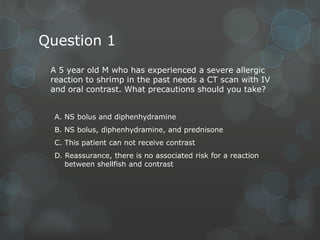
Question 1
A 5 year old M who has experienced a severe allergic
reaction to shrimp in the past needs a CT scan with IV
and oral contrast. What precautions should you take?
A. NS bolus and diphenhydramine
B. NS bolus, diphenhydramine, and prednisone
C. This patient can not receive contrast

D. Reassurance, there is no associated risk for a reaction
between shellfish and contrast
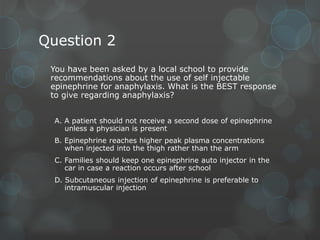
Question 2
You have been asked by a local school to provide
recommendations about the use of self injectable
epinephrine for anaphylaxis. What is the BEST response
to give regarding anaphylaxis?
A. A patient should not receive a second dose of epinephrine
unless a physician is present
B. Epinephrine reaches higher peak plasma concentrations
when injected into the thigh rather than the arm
C. Families should keep one epinephrine auto injector in the
car in case a reaction occurs after school
D. Subcutaneous injection of epinephrine is preferable to
intramuscular injection
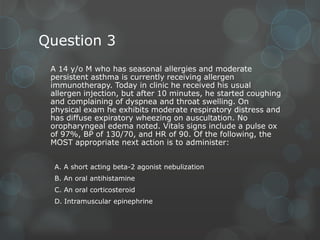
Question 3
A 14 y/o M who has seasonal allergies and moderate
persistent asthma is currently receiving allergen
immunotherapy. Today in clinic he received his usual
allergen injection, but after 10 minutes, he started coughing
and complaining of dyspnea and throat swelling. On
physical exam he exhibits moderate respiratory distress and
has diffuse expiratory wheezing on auscultation. No
oropharyngeal edema noted. Vitals signs include a pulse ox
of 97%, BP of 130/70, and HR of 90. Of the following, the
MOST appropriate next action is to administer:
A. A short acting beta-2 agonist nebulization
B. An oral antihistamine
C. An oral corticosteroid
D. Intramuscular epinephrine
Question 4
A 10 y/o M with a history of peanut allergy presents with diffuse
itching and trouble breathing after eating a friend’s candy bar
that contained nuts during school lunch. At the nurse’s office
the patient received IM epinephrine with his EpiPen with
symptom resolution. EMS was called and the patient was
brought to the local pediatric ED (about a 12 minute ride). On
arrival to the ED, the patient is again complaining of itching
with an urticarial rash on his chest and per EMS the patient
began vomiting as they were pulling up to the ambulance bay.
Arrival vitals include a pulse ox of 96%, BP of 88/67, and HR of
95. Of the following, the MOST appropriate treatment plan is:
A. Intramuscular epinephrine, oral antihistamine, oral
corticosteroid, and a short acting beta-2 agonist neb treatment
B. Intramuscular epinephrine, IV antihistamine, IV corticosteroid,
NS bolus
C. Intramuscular epinephrine, IV antihistamine, IV Zantac, NS
bolus

D. Intramuscular epinephrine, oral antihistamine, and oral
corticosteroid
What is Anaphylaxis?
 Big Bang
Anaphylaxis 411
 “Severe allergic reaction that can be life threatening”
 IgE-mediated hypersensitivity reaction resulting in the
release of potent chemical mediators
 Mast Cells
 Basophils

 Affects multiple organ systems
 Respiratory

 Cardiovascular
 Gastrointestinal
 Dermatologic

 Clinical Diagnosis
 Biphasic Reactions

Russell et al.,Pediatric Emergency Care, 2010
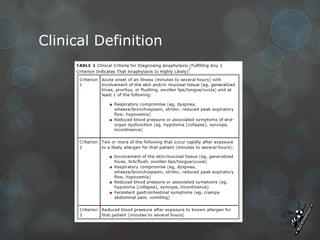
Clinical Definition
History
 First death from anaphylaxis was documented in
Egyptian hieroglyphics in 2641 BC
 Pharaoh Menes dying after a hornet sting
 Questionable and now not supported by historians
History
 First described in scientific literature in 1902 by two
French physiologists, Charles Richet and Paul Portier
 Prince Albert I of Monaco
 Investigating jellyfish toxins

 Initially coined “aphylaxis” with “a” meaning contrary to
and “phylaxis” meaning protection
 Richet won the Nobel Prize in Medicine

Lane et al, Pediatric Emergency Care, 2007
Pediatric Epidemiology
 10.5 per 100,000
 Increasing over the past 4 decades
 2:1 Male to female ratio
 25% require admission
 1500 deaths per year in US (adults and children)

 40% had prior history of allergic reaction
 Only 20% of prior anaphylaxis patients had an Epipen
available during repeat anaphylaxis encounter

Lane et al, Pediatric Emergency Care, 2007
Russell et al.,Pediatric Emergency Care, 2010
Pediatric Epidemiology
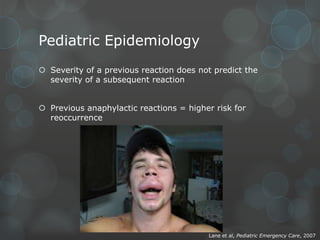
 Severity of a previous reaction does not predict the
severity of a subsequent reaction
 Previous anaphylactic reactions = higher risk for
reoccurrence

Lane et al, Pediatric Emergency Care, 2007
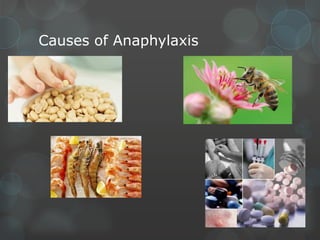
Causes of Anaphylaxis
 Food
 Leading cause of all anaphylaxis in children
 50% of anaphylactic triggers

 Peanuts, tree nuts and shellfish are the most common
 Usually the most life-threatening reactions
 Older children

 Milk, soy, eggs
 Most common in younger children
 Potential to outgrow

 Food dyes

Lane et al, Pediatric Emergency Care, 2007
Russell et al.,Pediatric Emergency Care, 2010
Causes of Anaphylaxis
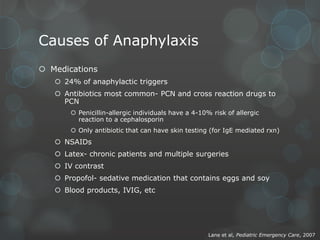
 Medications
 24% of anaphylactic triggers
 Antibiotics most common- PCN and cross reaction drugs to
PCN
 Penicillin-allergic individuals have a 4-10% risk of allergic
reaction to a cephalosporin
 Only antibiotic that can have skin testing (for IgE mediated rxn)

 NSAIDs

 Latex- chronic patients and multiple surgeries
 IV contrast
 Propofol- sedative medication that contains eggs and soy
 Blood products, IVIG, etc

Lane et al, Pediatric Emergency Care, 2007
Causes of Anaphylaxis
 Hymenoptera envenomation
 12% of anaphylactic triggers
 Honeybees, yellow jackets, hornets, wasps, and fire ants
 Life threatening reactions require venom immunotherapy
 20-60% risk per sting of anaphylaxis

Lane et al, Pediatric Emergency Care, 2007
Causes of Anaphylaxis
 Immunizations- estimated 1.5 events per 1 million
 MMR and influenza are the most common
 Prepared using chick-derived cells
 AAP recommends giving MMR to children with egg
sensitivity
 Per CDC, egg sensitivity a contraindication for influenza
vaccine
 Unknown exposure
 16% of anaphylactic triggers
Contrast Media
 Anaphylactoid reaction- not IgE mediated
 Osmolality-hypertonicity reaction
 Triggers degranulation of mast cells and basophils

 Association of shellfish allergy and contrast media
(because of iodine content) is a myth
 Pretreatment with prednisone and
diphenhydramine is only indicated in documented
history of an adverse reaction to contrast media
Question 1
A 5 year old M who has experienced a severe allergic
reaction to shrimp in the past needs a CT scan with IV
and oral contrast. What precautions should you take?
A. NS bolus and diphenhydramine
B. NS bolus, diphenhydramine, and prednisone
C. This patient can not receive contrast

D. Reassurance, there is no associated risk for a reaction
between shellfish and contrast
Question 1
A 5 year old M who has experienced a severe allergic
reaction to shrimp in the past needs a CT scan with IV
and oral contrast. What precautions should you take?
A. NS bolus and diphenhydramine
B. NS bolus, diphenhydramine, and prednisone
C. This patient can not receive contrast.

D. Reassurance, there is no associated risk for a
reaction between shellfish and contrast.
Route of Exposure
 Insect stings and parenterally injected medication may
have rapid onset of symptoms
 PO ingestions may develop over several minutes to
hours
 Most symptoms occur within 5-30 minutes post
exposure

Lane et al, Pediatric Emergency Care, 2007
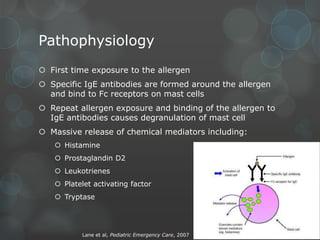
Pathophysiology
 First time exposure to the allergen
 Specific IgE antibodies are formed around the allergen
and bind to Fc receptors on mast cells
 Repeat allergen exposure and binding of the allergen to
IgE antibodies causes degranulation of mast cell
 Massive release of chemical mediators including:
 Histamine

 Prostaglandin D2
 Leukotrienes
 Platelet activating factor
 Tryptase

Lane et al, Pediatric Emergency Care, 2007
Pathophysiology
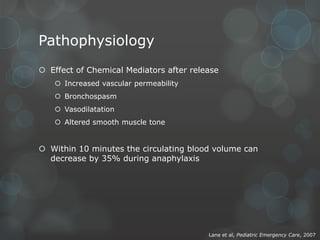
 Effect of Chemical Mediators after release
 Increased vascular permeability
 Bronchospasm
 Vasodilatation
 Altered smooth muscle tone

 Within 10 minutes the circulating blood volume can
decrease by 35% during anaphylaxis

Lane et al, Pediatric Emergency Care, 2007
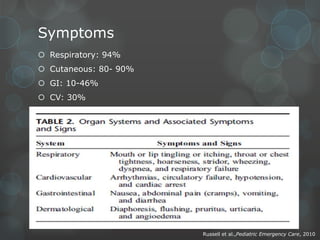
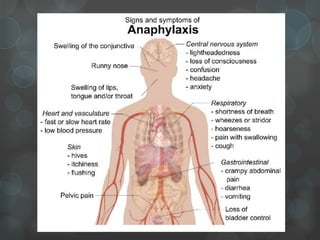
Symptoms
 Respiratory: 94%
 Cutaneous: 80- 90%

 GI: 10-46%
 CV: 30%

Russell et al.,Pediatric Emergency Care, 2010
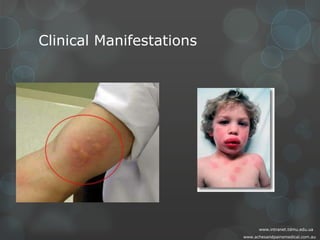
Clinical Manifestations

www.intranet.tdmu.edu.ua
www.achesandpainsmedical.com.au
Treatment

ABC’s!!!

IM EPINEPHRINE!!!!
IM Epinephrine
 First line therapy!
 Has alpha-1, beta-1, and beta-2 agonist actions
 Increased vascular resistance and decreased mucosal
edema (alpha-1)
 Increased inotrophy and chronotrophy (beta-1)
 Increased bronchodilation and decreases release of mast
cell and basophil mediators (beta-2)

 Only 18% reported use in pediatric anaphylaxis cases
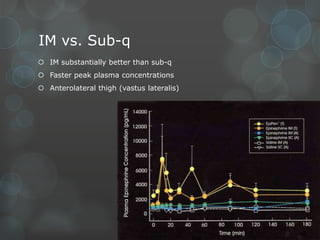
IM vs. Sub-q
 IM substantially better than sub-q
 Faster peak plasma concentrations
 Anterolateral thigh (vastus lateralis)
IM Epinephrine
 Dose: 0.01mg/kg of 1:1000
 Max dose is 0.3mg
 May repeat every 5-15 minutes
 20% require subsequent dosing
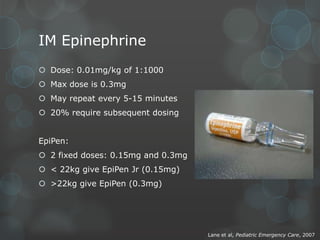
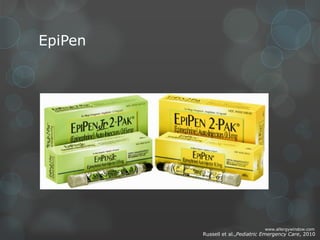
EpiPen:

 2 fixed doses: 0.15mg and 0.3mg
 < 22kg give EpiPen Jr (0.15mg)
 >22kg give EpiPen (0.3mg)

Lane et al, Pediatric Emergency Care, 2007
EpiPen

www.allergywindow.com

Russell et al.,Pediatric Emergency Care, 2010
Question 2
You have been asked by a local school to provide
recommendations about the use of self injectable
epinephrine for anaphylaxis. What is the BEST response
to give regarding anaphylaxis?
A. A patient should not receive a second dose of epinephrine
unless a physician is present
B. Epinephrine reaches higher peak plasma concentrations in
injected into the thigh rather than the arm
C. Families should keep one epinephrine auto injector in the
car in case a reaction occurs after school
D. Subcutaneous injection of epinephrine is preferable to
intramuscular injection
Question 2
You have been asked by a local school to provide
recommendations about the use of self injectable
epinephrine for anaphylaxis. What is the BEST response
to give regarding anaphylaxis?
A. A patient should not receive a second dose of epinephrine
unless a physician is present
B. Epinephrine reaches higher peak plasma
concentrations in injected into the thigh rather than
the arm
C. Families should keep one epinephrine auto injector in the
car in case a reaction occurs after school
D. Subcutaneous injection of epinephrine is preferable to
intramuscular injection
Question 3
A 14 y/o M who has seasonal allergies and moderate
persistent asthma is currently receiving allergen
immunotherapy. Today in clinic he received his usual
allergen injection, but after 10 minutes, he started coughing
and complaining of dyspnea and throat swelling. On
physical exam he exhibits moderate respiratory distress and
has diffuse expiratory wheezing on auscultation. No
oropharyngeal edema noted. Vitals signs include a pulse ox
of 97%, BP of 130/70, and HR of 90. Of the following, the
MOST appropriate next action is to administer:
A. A short acting beta-2 agonist nebulization
B. An oral antihistamine
C. An oral corticosteroid
D. Intramuscular epinephrine
Question 3
A 14 y/o M who has seasonal allergies and moderate
persistent asthma is currently receiving allergen
immunotherapy. Today in clinic he received his usual
allergen injection, but after 10 minutes, he started coughing
and complaining of dyspnea and throat swelling. On
physical exam he exhibits moderate respiratory distress and
has diffuse expiratory wheezing on auscultation. No
oropharyngeal edema noted. Vitals signs include a pulse ox
of 97%, BP of 130/70, and HR of 90. Of the following, the
MOST appropriate next action is to administer:
A. A short acting beta-2 agonist nebulization
B. An oral antihistamine
C. An oral corticosteroid
D. Intramuscular epinephrine
Treatment
 IM Epinephrine
 May repeat

 IV fluids- 20ml/kg bolus
 Repeat boluses if hypotension persists

 IV Epinephrine for persistent hypotension/symptoms
 0.01mg/kg of 1:10,000
 Max dose 1gm

 Histamine (H1/H2) blockers
 Benadryl (H1) and Zantac (H2)
 Slow onset of action
 Shown to be effective on dermatologic manifestations especially
in combo

 Albuterol treatment if indicated

Russell et al.,Pediatric Emergency Care, 2010
Role of Corticosteroids?
 Corticosteroids
 NO clinical evidence-based support for steroids in acute
management of anaphylaxis
 NO support for steroids against biphasic reactions

 Reported use of corticosteroids is more prevalent than
IM epinephrine in anaphylaxis

Lane et al, Pediatric Emergency Care, 2007
Russell et al.,Pediatric Emergency Care, 2010
Question 4
A 10 y/o M with a history of peanut allergy presents with
diffuse itching and trouble breathing after eating a friend’s
candy bar that contained nuts during school lunch. At the
nurse’s office the patient received IM epinephrine with his
EpiPen with symptom resolution. EMS was called and the
patient was brought to the local pediatric ED (about a 12
minute ride). On arrival to the ED, the patient is again
complaining of itching with an urticarial rash on his chest and
per EMS the patient began vomiting as they were pulling up to
the ambulance bay. Arrival vitals include a pulse ox of 96%, BP
of 88/67, and HR of 95. Of the following, the MOST appropriate
treatment plan is:
A. Intramuscular epinephrine, oral antihistamine, oral
corticosteroid, and a short acting beta-2 agonist neb treatment
B. Intramuscular epinephrine, IV antihistamine, IV corticosteroid,
NS bolus
C. Intramuscular epinephrine, IV antihistamine, IV Zantac, NS
bolus
D. Intramuscular epinephrine, oral antihistamine, oral
corticosteroid
Question 4
A 10 y/o M with a history of peanut allergy presents with
diffuse itching and trouble breathing after eating a friend’s
candy bar that contained nuts during school lunch. At the
nurse’s office the patient received IM epinephrine with his
EpiPen with symptom resolution. EMS was called and the
patient was brought to the local pediatric ED (about a 12
minute ride). On arrival to the ED, the patient is again
complaining of itching with an urticarial rash on his chest and
per EMS the patient began vomiting as they were pulling up to
the ambulance bay. Arrival vitals include a pulse ox of 96%, BP
of 88/67, and HR of 95. Of the following, the MOST appropriate
treatment plan is:
A. Intramuscular epinephrine, oral antihistamine, oral
corticosteroid, and a short acting beta-2 agonist neb treatment
B. Intramuscular epinephrine, IV antihistamine, IV corticosteroid,
NS bolus
C. Intramuscular epinephrine, IV antihistamine, IV Zantac,
NS bolus
D. Intramuscular epinephrine, oral antihistamine, oral
corticosteroid
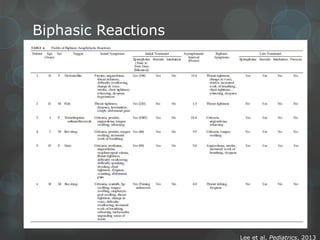
Biphasic Reactions
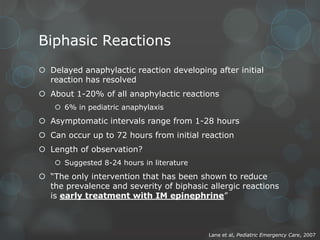
 Delayed anaphylactic reaction developing after initial
reaction has resolved
 About 1-20% of all anaphylactic reactions
 6% in pediatric anaphylaxis

 Asymptomatic intervals range from 1-28 hours
 Can occur up to 72 hours from initial reaction
 Length of observation?
 Suggested 8-24 hours in literature

 “The only intervention that has been shown to reduce
the prevalence and severity of biphasic allergic reactions
is early treatment with IM epinephrine”

Lane et al, Pediatric Emergency Care, 2007
Biphasic Reactions

Lee et al, Pediatrics, 2013
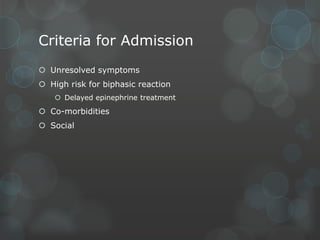
Criteria for Admission
 Unresolved symptoms
 High risk for biphasic reaction
 Delayed epinephrine treatment

 Co-morbidities
 Social
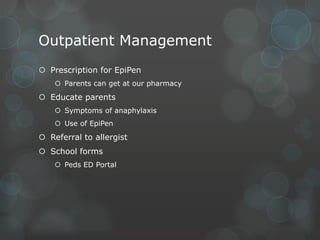
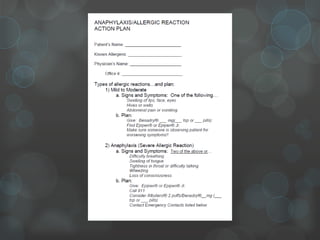
Outpatient Management
 Prescription for EpiPen
 Parents can get at our pharmacy

 Educate parents
 Symptoms of anaphylaxis
 Use of EpiPen

 Referral to allergist
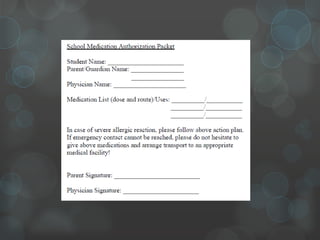
 School forms
 Peds ED Portal
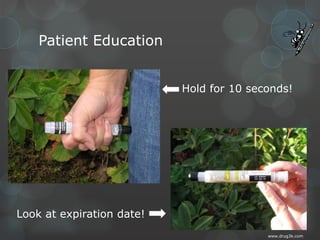
Patient Education
Hold for 10 seconds!

Look at expiration date!
www.drug3k.com
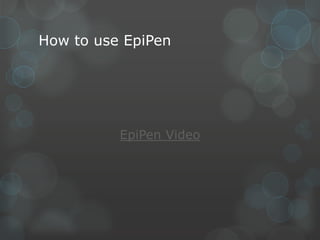
How to use EpiPen

EpiPen Video
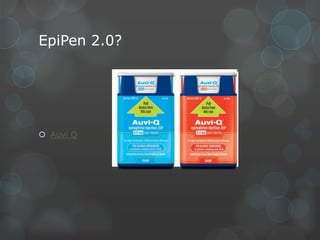
EpiPen 2.0?

 Auvi Q
Summary
 Anaphylaxis- acute onset, involvement of 2 or more organ
systems or presence of hypotension
 Severity of a previous reaction does not predict the severity
of a subsequent reaction
 Patients with previous anaphylactic reactions are at a higher
risk for reoccurrence
 First line treatment is IM epinephrine
 < 22kg give EpiPen Jr (0.15mg)

 >22kg give EpiPen (0.3mg)

 Early IM epinephrine can reduce the risk of a biphasic
reaction
 Discharge home with EpiPen, education, allergist referral,
and school forms
References
 Lee, J.M. and Greenes, D.S., Biphasic Anaphylactic
Reactions in Pediatrics. Pediatrics. 2000;106(4):762-6.
 Nowak, R., Farrar, J.R., Brenner, B.E. et al., Customizing
anaphylaxis guidelines for emergency medicine. The
Journal of Emergency Medicine. 2013;45(2):299-305.
 Lane, R.D. and Bolte, R.G., Pediatric anaphylaxis.
Pediatric Emergency Care. 2007;23(1):49-56.
 Russell, S., Monroe, K., and Losek, J., Anaphylaxis
management in the pediatric emergency department.
Pediatric Emergency Care. 2010;26(2):71-76.
Any Questions?

Management of Anaphylaxis

  • 1.
    “I’m all Itchy” Anaphylaxisin the Pediatric ER Dr. Rebecca Starr Pediatric Emergency Medicine Fellow February 6, 2014 certifiedallergysa.com
  • 2.
    Objectives  Discuss themost current definition of anaphylaxis  Explain the causes and pathophysiology of anaphylaxis  Analyze symptoms and be able to diagnose and effectively treat anaphylaxis  Review biphasic anaphylactic reactions  List appropriate discharge materials from the ED
  • 3.
    Question 1 A 5year old M who has experienced a severe allergic reaction to shrimp in the past needs a CT scan with IV and oral contrast. What precautions should you take? A. NS bolus and diphenhydramine B. NS bolus, diphenhydramine, and prednisone C. This patient can not receive contrast D. Reassurance, there is no associated risk for a reaction between shellfish and contrast
  • 4.
    Question 2 You havebeen asked by a local school to provide recommendations about the use of self injectable epinephrine for anaphylaxis. What is the BEST response to give regarding anaphylaxis? A. A patient should not receive a second dose of epinephrine unless a physician is present B. Epinephrine reaches higher peak plasma concentrations when injected into the thigh rather than the arm C. Families should keep one epinephrine auto injector in the car in case a reaction occurs after school D. Subcutaneous injection of epinephrine is preferable to intramuscular injection
  • 5.
    Question 3 A 14y/o M who has seasonal allergies and moderate persistent asthma is currently receiving allergen immunotherapy. Today in clinic he received his usual allergen injection, but after 10 minutes, he started coughing and complaining of dyspnea and throat swelling. On physical exam he exhibits moderate respiratory distress and has diffuse expiratory wheezing on auscultation. No oropharyngeal edema noted. Vitals signs include a pulse ox of 97%, BP of 130/70, and HR of 90. Of the following, the MOST appropriate next action is to administer: A. A short acting beta-2 agonist nebulization B. An oral antihistamine C. An oral corticosteroid D. Intramuscular epinephrine
  • 6.
    Question 4 A 10y/o M with a history of peanut allergy presents with diffuse itching and trouble breathing after eating a friend’s candy bar that contained nuts during school lunch. At the nurse’s office the patient received IM epinephrine with his EpiPen with symptom resolution. EMS was called and the patient was brought to the local pediatric ED (about a 12 minute ride). On arrival to the ED, the patient is again complaining of itching with an urticarial rash on his chest and per EMS the patient began vomiting as they were pulling up to the ambulance bay. Arrival vitals include a pulse ox of 96%, BP of 88/67, and HR of 95. Of the following, the MOST appropriate treatment plan is: A. Intramuscular epinephrine, oral antihistamine, oral corticosteroid, and a short acting beta-2 agonist neb treatment B. Intramuscular epinephrine, IV antihistamine, IV corticosteroid, NS bolus C. Intramuscular epinephrine, IV antihistamine, IV Zantac, NS bolus D. Intramuscular epinephrine, oral antihistamine, and oral corticosteroid
  • 7.
  • 8.
    Anaphylaxis 411  “Severeallergic reaction that can be life threatening”  IgE-mediated hypersensitivity reaction resulting in the release of potent chemical mediators  Mast Cells  Basophils  Affects multiple organ systems  Respiratory  Cardiovascular  Gastrointestinal  Dermatologic  Clinical Diagnosis  Biphasic Reactions Russell et al.,Pediatric Emergency Care, 2010
  • 9.
  • 10.
    History  First deathfrom anaphylaxis was documented in Egyptian hieroglyphics in 2641 BC  Pharaoh Menes dying after a hornet sting  Questionable and now not supported by historians
  • 12.
    History  First describedin scientific literature in 1902 by two French physiologists, Charles Richet and Paul Portier  Prince Albert I of Monaco  Investigating jellyfish toxins  Initially coined “aphylaxis” with “a” meaning contrary to and “phylaxis” meaning protection  Richet won the Nobel Prize in Medicine Lane et al, Pediatric Emergency Care, 2007
  • 13.
    Pediatric Epidemiology  10.5per 100,000  Increasing over the past 4 decades  2:1 Male to female ratio  25% require admission  1500 deaths per year in US (adults and children)  40% had prior history of allergic reaction  Only 20% of prior anaphylaxis patients had an Epipen available during repeat anaphylaxis encounter Lane et al, Pediatric Emergency Care, 2007 Russell et al.,Pediatric Emergency Care, 2010
  • 14.
    Pediatric Epidemiology  Severityof a previous reaction does not predict the severity of a subsequent reaction  Previous anaphylactic reactions = higher risk for reoccurrence Lane et al, Pediatric Emergency Care, 2007
  • 15.
  • 16.
    Causes of Anaphylaxis Food  Leading cause of all anaphylaxis in children  50% of anaphylactic triggers  Peanuts, tree nuts and shellfish are the most common  Usually the most life-threatening reactions  Older children  Milk, soy, eggs  Most common in younger children  Potential to outgrow  Food dyes Lane et al, Pediatric Emergency Care, 2007 Russell et al.,Pediatric Emergency Care, 2010
  • 17.
    Causes of Anaphylaxis Medications  24% of anaphylactic triggers  Antibiotics most common- PCN and cross reaction drugs to PCN  Penicillin-allergic individuals have a 4-10% risk of allergic reaction to a cephalosporin  Only antibiotic that can have skin testing (for IgE mediated rxn)  NSAIDs  Latex- chronic patients and multiple surgeries  IV contrast  Propofol- sedative medication that contains eggs and soy  Blood products, IVIG, etc Lane et al, Pediatric Emergency Care, 2007
  • 18.
    Causes of Anaphylaxis Hymenoptera envenomation  12% of anaphylactic triggers  Honeybees, yellow jackets, hornets, wasps, and fire ants  Life threatening reactions require venom immunotherapy  20-60% risk per sting of anaphylaxis Lane et al, Pediatric Emergency Care, 2007
  • 19.
    Causes of Anaphylaxis Immunizations- estimated 1.5 events per 1 million  MMR and influenza are the most common  Prepared using chick-derived cells  AAP recommends giving MMR to children with egg sensitivity  Per CDC, egg sensitivity a contraindication for influenza vaccine  Unknown exposure  16% of anaphylactic triggers
  • 20.
    Contrast Media  Anaphylactoidreaction- not IgE mediated  Osmolality-hypertonicity reaction  Triggers degranulation of mast cells and basophils  Association of shellfish allergy and contrast media (because of iodine content) is a myth  Pretreatment with prednisone and diphenhydramine is only indicated in documented history of an adverse reaction to contrast media
  • 21.
    Question 1 A 5year old M who has experienced a severe allergic reaction to shrimp in the past needs a CT scan with IV and oral contrast. What precautions should you take? A. NS bolus and diphenhydramine B. NS bolus, diphenhydramine, and prednisone C. This patient can not receive contrast D. Reassurance, there is no associated risk for a reaction between shellfish and contrast
  • 22.
    Question 1 A 5year old M who has experienced a severe allergic reaction to shrimp in the past needs a CT scan with IV and oral contrast. What precautions should you take? A. NS bolus and diphenhydramine B. NS bolus, diphenhydramine, and prednisone C. This patient can not receive contrast. D. Reassurance, there is no associated risk for a reaction between shellfish and contrast.
  • 23.
    Route of Exposure Insect stings and parenterally injected medication may have rapid onset of symptoms  PO ingestions may develop over several minutes to hours  Most symptoms occur within 5-30 minutes post exposure Lane et al, Pediatric Emergency Care, 2007
  • 24.
    Pathophysiology  First timeexposure to the allergen  Specific IgE antibodies are formed around the allergen and bind to Fc receptors on mast cells  Repeat allergen exposure and binding of the allergen to IgE antibodies causes degranulation of mast cell  Massive release of chemical mediators including:  Histamine  Prostaglandin D2  Leukotrienes  Platelet activating factor  Tryptase Lane et al, Pediatric Emergency Care, 2007
  • 25.
    Pathophysiology  Effect ofChemical Mediators after release  Increased vascular permeability  Bronchospasm  Vasodilatation  Altered smooth muscle tone  Within 10 minutes the circulating blood volume can decrease by 35% during anaphylaxis Lane et al, Pediatric Emergency Care, 2007
  • 26.
    Symptoms  Respiratory: 94% Cutaneous: 80- 90%  GI: 10-46%  CV: 30% Russell et al.,Pediatric Emergency Care, 2010
  • 28.
  • 29.
  • 30.
    IM Epinephrine  Firstline therapy!  Has alpha-1, beta-1, and beta-2 agonist actions  Increased vascular resistance and decreased mucosal edema (alpha-1)  Increased inotrophy and chronotrophy (beta-1)  Increased bronchodilation and decreases release of mast cell and basophil mediators (beta-2)  Only 18% reported use in pediatric anaphylaxis cases
  • 31.
    IM vs. Sub-q IM substantially better than sub-q  Faster peak plasma concentrations  Anterolateral thigh (vastus lateralis)
  • 32.
    IM Epinephrine  Dose:0.01mg/kg of 1:1000  Max dose is 0.3mg  May repeat every 5-15 minutes  20% require subsequent dosing EpiPen:  2 fixed doses: 0.15mg and 0.3mg  < 22kg give EpiPen Jr (0.15mg)  >22kg give EpiPen (0.3mg) Lane et al, Pediatric Emergency Care, 2007
  • 33.
  • 34.
    Question 2 You havebeen asked by a local school to provide recommendations about the use of self injectable epinephrine for anaphylaxis. What is the BEST response to give regarding anaphylaxis? A. A patient should not receive a second dose of epinephrine unless a physician is present B. Epinephrine reaches higher peak plasma concentrations in injected into the thigh rather than the arm C. Families should keep one epinephrine auto injector in the car in case a reaction occurs after school D. Subcutaneous injection of epinephrine is preferable to intramuscular injection
  • 35.
    Question 2 You havebeen asked by a local school to provide recommendations about the use of self injectable epinephrine for anaphylaxis. What is the BEST response to give regarding anaphylaxis? A. A patient should not receive a second dose of epinephrine unless a physician is present B. Epinephrine reaches higher peak plasma concentrations in injected into the thigh rather than the arm C. Families should keep one epinephrine auto injector in the car in case a reaction occurs after school D. Subcutaneous injection of epinephrine is preferable to intramuscular injection
  • 36.
    Question 3 A 14y/o M who has seasonal allergies and moderate persistent asthma is currently receiving allergen immunotherapy. Today in clinic he received his usual allergen injection, but after 10 minutes, he started coughing and complaining of dyspnea and throat swelling. On physical exam he exhibits moderate respiratory distress and has diffuse expiratory wheezing on auscultation. No oropharyngeal edema noted. Vitals signs include a pulse ox of 97%, BP of 130/70, and HR of 90. Of the following, the MOST appropriate next action is to administer: A. A short acting beta-2 agonist nebulization B. An oral antihistamine C. An oral corticosteroid D. Intramuscular epinephrine
  • 37.
    Question 3 A 14y/o M who has seasonal allergies and moderate persistent asthma is currently receiving allergen immunotherapy. Today in clinic he received his usual allergen injection, but after 10 minutes, he started coughing and complaining of dyspnea and throat swelling. On physical exam he exhibits moderate respiratory distress and has diffuse expiratory wheezing on auscultation. No oropharyngeal edema noted. Vitals signs include a pulse ox of 97%, BP of 130/70, and HR of 90. Of the following, the MOST appropriate next action is to administer: A. A short acting beta-2 agonist nebulization B. An oral antihistamine C. An oral corticosteroid D. Intramuscular epinephrine
  • 38.
    Treatment  IM Epinephrine May repeat  IV fluids- 20ml/kg bolus  Repeat boluses if hypotension persists  IV Epinephrine for persistent hypotension/symptoms  0.01mg/kg of 1:10,000  Max dose 1gm  Histamine (H1/H2) blockers  Benadryl (H1) and Zantac (H2)  Slow onset of action  Shown to be effective on dermatologic manifestations especially in combo  Albuterol treatment if indicated Russell et al.,Pediatric Emergency Care, 2010
  • 39.
    Role of Corticosteroids? Corticosteroids  NO clinical evidence-based support for steroids in acute management of anaphylaxis  NO support for steroids against biphasic reactions  Reported use of corticosteroids is more prevalent than IM epinephrine in anaphylaxis Lane et al, Pediatric Emergency Care, 2007 Russell et al.,Pediatric Emergency Care, 2010
  • 40.
    Question 4 A 10y/o M with a history of peanut allergy presents with diffuse itching and trouble breathing after eating a friend’s candy bar that contained nuts during school lunch. At the nurse’s office the patient received IM epinephrine with his EpiPen with symptom resolution. EMS was called and the patient was brought to the local pediatric ED (about a 12 minute ride). On arrival to the ED, the patient is again complaining of itching with an urticarial rash on his chest and per EMS the patient began vomiting as they were pulling up to the ambulance bay. Arrival vitals include a pulse ox of 96%, BP of 88/67, and HR of 95. Of the following, the MOST appropriate treatment plan is: A. Intramuscular epinephrine, oral antihistamine, oral corticosteroid, and a short acting beta-2 agonist neb treatment B. Intramuscular epinephrine, IV antihistamine, IV corticosteroid, NS bolus C. Intramuscular epinephrine, IV antihistamine, IV Zantac, NS bolus D. Intramuscular epinephrine, oral antihistamine, oral corticosteroid
  • 41.
    Question 4 A 10y/o M with a history of peanut allergy presents with diffuse itching and trouble breathing after eating a friend’s candy bar that contained nuts during school lunch. At the nurse’s office the patient received IM epinephrine with his EpiPen with symptom resolution. EMS was called and the patient was brought to the local pediatric ED (about a 12 minute ride). On arrival to the ED, the patient is again complaining of itching with an urticarial rash on his chest and per EMS the patient began vomiting as they were pulling up to the ambulance bay. Arrival vitals include a pulse ox of 96%, BP of 88/67, and HR of 95. Of the following, the MOST appropriate treatment plan is: A. Intramuscular epinephrine, oral antihistamine, oral corticosteroid, and a short acting beta-2 agonist neb treatment B. Intramuscular epinephrine, IV antihistamine, IV corticosteroid, NS bolus C. Intramuscular epinephrine, IV antihistamine, IV Zantac, NS bolus D. Intramuscular epinephrine, oral antihistamine, oral corticosteroid
  • 42.
    Biphasic Reactions  Delayedanaphylactic reaction developing after initial reaction has resolved  About 1-20% of all anaphylactic reactions  6% in pediatric anaphylaxis  Asymptomatic intervals range from 1-28 hours  Can occur up to 72 hours from initial reaction  Length of observation?  Suggested 8-24 hours in literature  “The only intervention that has been shown to reduce the prevalence and severity of biphasic allergic reactions is early treatment with IM epinephrine” Lane et al, Pediatric Emergency Care, 2007
  • 43.
    Biphasic Reactions Lee etal, Pediatrics, 2013
  • 44.
    Criteria for Admission Unresolved symptoms  High risk for biphasic reaction  Delayed epinephrine treatment  Co-morbidities  Social
  • 45.
    Outpatient Management  Prescriptionfor EpiPen  Parents can get at our pharmacy  Educate parents  Symptoms of anaphylaxis  Use of EpiPen  Referral to allergist  School forms  Peds ED Portal
  • 46.
    Patient Education Hold for10 seconds! Look at expiration date! www.drug3k.com
  • 47.
    How to useEpiPen EpiPen Video
  • 50.
  • 51.
    Summary  Anaphylaxis- acuteonset, involvement of 2 or more organ systems or presence of hypotension  Severity of a previous reaction does not predict the severity of a subsequent reaction  Patients with previous anaphylactic reactions are at a higher risk for reoccurrence  First line treatment is IM epinephrine  < 22kg give EpiPen Jr (0.15mg)  >22kg give EpiPen (0.3mg)  Early IM epinephrine can reduce the risk of a biphasic reaction  Discharge home with EpiPen, education, allergist referral, and school forms
  • 53.
    References  Lee, J.M.and Greenes, D.S., Biphasic Anaphylactic Reactions in Pediatrics. Pediatrics. 2000;106(4):762-6.  Nowak, R., Farrar, J.R., Brenner, B.E. et al., Customizing anaphylaxis guidelines for emergency medicine. The Journal of Emergency Medicine. 2013;45(2):299-305.  Lane, R.D. and Bolte, R.G., Pediatric anaphylaxis. Pediatric Emergency Care. 2007;23(1):49-56.  Russell, S., Monroe, K., and Losek, J., Anaphylaxis management in the pediatric emergency department. Pediatric Emergency Care. 2010;26(2):71-76.
  • 54.
Editor's Notes

  • #10 Met with Food Allergy and Anaphlaxis Network in July 2005. Essentially 2 or more organ systems or hypotension
  • #12 Krombach et al, Allergy, 2004http://onlinelibrary.wiley.com/doi/10.1111/j.1398-9995.2004.00603.x/pdf
  • #17 Allergan type does not seem to be a predictor of hospitalization
  • #47 Prescription must be refilled annually. Heat, cold and sunlight can affect degradation of Epi