PREHOSPITALPREHOSPITAL
EMERGENCY CAREEMERGENCY CARE
CHAPTER
Copyright © 2014, 2010, 2008 by Pearson Education, Inc.
All Rights Reserved
Prehospital Emergency Care, 10th
edition
Mistovich | Karren
TENTH EDITION
Multisystem Trauma
and Trauma in Special
Patient Populations
36
Prehospital Emergency Care, 10th
edition
Mistovich | Karren
Copyright © 2014, 2010, 2008 by Pearson Education, Inc.
All Rights Reserved
Learning ReadinessLearning Readiness
• EMS Education Standards, text p. 976
Prehospital Emergency Care, 10th
edition
Mistovich | Karren
Copyright © 2014, 2010, 2008 by Pearson Education, Inc.
All Rights Reserved
Learning ReadinessLearning Readiness
ObjectivesObjectives
• Please refer to page 976 of your text to
view the objectives for this chapter.
Prehospital Emergency Care, 10th
edition
Mistovich | Karren
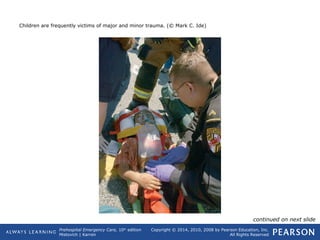
Copyright © 2014, 2010, 2008 by Pearson Education, Inc.
All Rights Reserved
Learning ReadinessLearning Readiness
Key TermsKey Terms
• Please refer to page 976 of your text to
view the key terms for this chapter.
Prehospital Emergency Care, 10th
edition
Mistovich | Karren
Copyright © 2014, 2010, 2008 by Pearson Education, Inc.
All Rights Reserved
Setting the StageSetting the Stage
• Overview of Lesson Topics
 Multisystem Trauma
 Trauma in Special Patient Populations
 Assessment-Based Approach:
Multisystem Trauma and Trauma in
Special Patient Populations
Prehospital Emergency Care, 10th
edition
Mistovich | Karren
Copyright © 2014, 2010, 2008 by Pearson Education, Inc.
All Rights Reserved
Case Study IntroductionCase Study Introduction
Excited to hear the approach of the ice
cream truck in his neighborhood, seven-
year-old Russ Moffat runs into the street to
look for it. He fails to see the car
approaching from the opposite direction until
it is too late, turning toward it at the last
second. The bumper strikes Russ in the
torso, throwing his head forward onto the
hood, before throwing him down to the
ground as the driver screeches to a halt.
Prehospital Emergency Care, 10th
edition
Mistovich | Karren
Copyright © 2014, 2010, 2008 by Pearson Education, Inc.
All Rights Reserved
Case StudyCase Study
• How will Russ's age affect the type and
distribution of his injuries?
• How might Russ's injuries present
differently from the same injuries in an
adult patient?
• What differences are required in the
assessment and management of this
patient, as compared to an adult?
Prehospital Emergency Care, 10th
edition
Mistovich | Karren
Copyright © 2014, 2010, 2008 by Pearson Education, Inc.
All Rights Reserved
IntroductionIntroduction
• The involvement of multiple body
systems in trauma makes management
of the trauma patient more challenging.
• There are special considerations in
assessment and management of
pediatric, geriatric, pregnant, and
cognitively impaired trauma patients.
Prehospital Emergency Care, 10th
edition
Mistovich | Karren
Copyright © 2014, 2010, 2008 by Pearson Education, Inc.
All Rights Reserved
Multisystem TraumaMultisystem Trauma
• Significant forces increase the risk for
injuries to multiple systems.
• Morbidity and mortality are higher in
patients with multisystem trauma.
• The risk of developing shock is higher
with multisystem trauma.
continued on next slide
Prehospital Emergency Care, 10th
edition
Mistovich | Karren
Copyright © 2014, 2010, 2008 by Pearson Education, Inc.
All Rights Reserved
Multisystem TraumaMultisystem Trauma
• The care for multisystem trauma
patients depends on the systems
involved.
• The definitive care is often surgery.
continued on next slide
Prehospital Emergency Care, 10th
edition
Mistovich | Karren
Copyright © 2014, 2010, 2008 by Pearson Education, Inc.
All Rights Reserved
Multisystem TraumaMultisystem Trauma
• Golden principles of prehospital
multisystem trauma care
 Ensure the safety of the rescue
personnel and patient.
 Determine additional resources needed.
 Understand kinematics.
continued on next slide
Prehospital Emergency Care, 10th
edition
Mistovich | Karren
Copyright © 2014, 2010, 2008 by Pearson Education, Inc.
All Rights Reserved
Multisystem TraumaMultisystem Trauma
• Golden principles of prehospital
multisystem trauma care
 Identify and manage life threats.
 Manage the airway while maintaining
cervical spine stabilization.
 Support ventilation and oxygenation.
continued on next slide
Prehospital Emergency Care, 10th
edition
Mistovich | Karren
Copyright © 2014, 2010, 2008 by Pearson Education, Inc.
All Rights Reserved
Multisystem TraumaMultisystem Trauma
• Golden principles of prehospital
multisystem trauma care
 Control external hemorrhage and treat
for shock.
 Perform a secondary assessment and
obtain a medical history.
continued on next slide
Prehospital Emergency Care, 10th
edition
Mistovich | Karren
Copyright © 2014, 2010, 2008 by Pearson Education, Inc.
All Rights Reserved
Multisystem TraumaMultisystem Trauma
• Golden principles of prehospital
multisystem trauma care
 Splint musculoskeletal injuries and
maintain spinal immobilization on a long
spine board.
 Make transport decisions.
Prehospital Emergency Care, 10th
edition
Mistovich | Karren
Copyright © 2014, 2010, 2008 by Pearson Education, Inc.
All Rights Reserved
Trauma in Pregnant PatientsTrauma in Pregnant Patients
• Trauma is the leading cause of death
for pregnant patients.
• Mechanisms include abuse, falls, and
motor vehicle collisions.
continued on next slide
Prehospital Emergency Care, 10th
edition
Mistovich | Karren
Copyright © 2014, 2010, 2008 by Pearson Education, Inc.
All Rights Reserved
Trauma in Pregnant PatientsTrauma in Pregnant Patients
• It is difficult to assess the fetus, so
manage the mother aggressively.
• All pregnant trauma patients should be
evaluated in the emergency
department.
continued on next slide
Prehospital Emergency Care, 10th
edition
Mistovich | Karren
Copyright © 2014, 2010, 2008 by Pearson Education, Inc.
All Rights Reserved
Trauma in Pregnant PatientsTrauma in Pregnant Patients
• Anatomical and physiological
considerations
 The blood volume is increased by 50%
in late pregnancy.
 The heart rate increases by 10 to 15
bpm by the 3rd
trimester.
 The uterus becomes highly vascular.
continued on next slide
Prehospital Emergency Care, 10th
edition
Mistovich | Karren
Copyright © 2014, 2010, 2008 by Pearson Education, Inc.
All Rights Reserved
Trauma in Pregnant PatientsTrauma in Pregnant Patients
• Anatomical and physiological
considerations
 The diaphragm is elevated.
 Pain perception in the abdomen is
altered.
 Decreased gastric motility and increased
risk of vomiting.
 The uterus and bladder are at greater
risk of injury.
continued on next slide
Prehospital Emergency Care, 10th
edition
Mistovich | Karren
Copyright © 2014, 2010, 2008 by Pearson Education, Inc.
All Rights Reserved
Trauma in Pregnant PatientsTrauma in Pregnant Patients
• Anatomical and physiological
considerations
 Musculoskeletal changes and changes in
the center of gravity increase the risk of
falls.
 In the 3rd
trimester, fetal size can impair
venous return when the mother is in a
supine position.
continued on next slide
Prehospital Emergency Care, 10th
edition
Mistovich | Karren
Copyright © 2014, 2010, 2008 by Pearson Education, Inc.
All Rights Reserved
Trauma in Pregnant PatientsTrauma in Pregnant Patients
• Assessment considerations
 1% to 3% of minor traumas in pregnant
women result in fetal loss.
 The more severe the injury to the
mother, the greater the chances of fetal
injury.
 Fetal death rates are nine times higher
than maternal death rates following
trauma
continued on next slide
Prehospital Emergency Care, 10th
edition
Mistovich | Karren
Copyright © 2014, 2010, 2008 by Pearson Education, Inc.
All Rights Reserved
Trauma in Pregnant PatientsTrauma in Pregnant Patients
• Assessment considerations
 The most common problem caused by
maternal trauma is uterine contractions
that may progress into labor.
continued on next slide
Prehospital Emergency Care, 10th
edition
Mistovich | Karren
Copyright © 2014, 2010, 2008 by Pearson Education, Inc.
All Rights Reserved
Trauma in Pregnant PatientsTrauma in Pregnant Patients
• Abruptio placentae is premature
separation of the placenta from the
uterine wall.
 It most commonly occurs with blunt
trauma.
 There may be abdominal pain and
vaginal bleeding.
 There is a high risk of fetal and maternal
death.
continued on next slide
Prehospital Emergency Care, 10th
edition
Mistovich | Karren
Copyright © 2014, 2010, 2008 by Pearson Education, Inc.
All Rights Reserved
Trauma in Pregnant PatientsTrauma in Pregnant Patients
• Fetal and maternal outcomes from
motor vehicle collisions are more
favorable when the mother wears a
seatbelt.
• Uterine rupture may occur as a result
of motor vehicle trauma.
continued on next slide
Prehospital Emergency Care, 10th
edition
Mistovich | Karren
Copyright © 2014, 2010, 2008 by Pearson Education, Inc.
All Rights Reserved
Trauma in Pregnant PatientsTrauma in Pregnant Patients
• Fetal distress can be caused by hypoxia
or hypovolemia, but signs of shock can
be delayed or masked in pregnant
patients.
• Attempt resuscitation of the pulseless
pregnant trauma patient according to
your protocol.
continued on next slide
Prehospital Emergency Care, 10th
edition
Mistovich | Karren
Copyright © 2014, 2010, 2008 by Pearson Education, Inc.
All Rights Reserved
Trauma in Pregnant PatientsTrauma in Pregnant Patients
• Management considerations
 When spinal immobilization is required,
tilt the spine board to the left to prevent
supine hypotensive syndrome.
continued on next slide
Prehospital Emergency Care, 10th
edition
Mistovich | Karren
Copyright © 2014, 2010, 2008 by Pearson Education, Inc.
All Rights Reserved
Trauma in Pregnant PatientsTrauma in Pregnant Patients
• Management considerations
 Airway and ventilation
• Anticipate vomiting.
• Assist inadequate ventilations.
• Administer oxygen and maintain as high
an SpO2 as possible.
• The fetus can be severely hypoxic before
the mother shows signs of hypoxia.
continued on next slide
Prehospital Emergency Care, 10th
edition
Mistovich | Karren
Copyright © 2014, 2010, 2008 by Pearson Education, Inc.
All Rights Reserved
Trauma in Pregnant PatientsTrauma in Pregnant Patients
• Management considerations
 Circulation
• Check for major bleeding.
• Absorb vaginal bleeding with a pad; do
not pack the vagina.
• Anticipate and treat for shock.
continued on next slide
Prehospital Emergency Care, 10th
edition
Mistovich | Karren
Copyright © 2014, 2010, 2008 by Pearson Education, Inc.
All Rights Reserved
Trauma in Pregnant PatientsTrauma in Pregnant Patients
• Management considerations
 Assess for crowning.
 Anticipate the need for additional
resources if delivery is imminent.
continued on next slide
Prehospital Emergency Care, 10th
edition
Mistovich | Karren
Copyright © 2014, 2010, 2008 by Pearson Education, Inc.
All Rights Reserved
Trauma in Pregnant PatientsTrauma in Pregnant Patients
• Management considerations
 Consider ALS intercept; notify the
receiving facility.
 The best management of the fetus is to
anticipate and manage the mother's
injuries.
Prehospital Emergency Care, 10th
edition
Mistovich | Karren
Copyright © 2014, 2010, 2008 by Pearson Education, Inc.
All Rights Reserved
Click on the intervention that is required toClick on the intervention that is required to
prevent supine hypotensive syndrome whenprevent supine hypotensive syndrome when
managing a pregnant trauma patient.managing a pregnant trauma patient.
A. Fill all voids beneath the patient's back with
padding when immobilizing to a long backboard.
B. Administer oxygen at 15 lpm by nonrebreather
mask to all pregnant trauma patients.
C. Tilt the long backboard to the patient's left once
she is fully immobilized.
D. Transport the patient in semi-Fowler's position
with the knees and hips flexed.
Prehospital Emergency Care, 10th
edition
Mistovich | Karren
Copyright © 2014, 2010, 2008 by Pearson Education, Inc.
All Rights Reserved
Trauma in Pediatric PatientsTrauma in Pediatric Patients
• Mechanisms include drowning, burns,
falls, penetrating trauma, motor vehicle
collisions, and pedestrian-vehicle
collisions.
continued on next slide
Prehospital Emergency Care, 10th
edition
Mistovich | Karren
Copyright © 2014, 2010, 2008 by Pearson Education, Inc.
All Rights Reserved
Children are frequently victims of major and minor trauma. (© Mark C. Ide)
continued on next slide
Prehospital Emergency Care, 10th
edition
Mistovich | Karren
Copyright © 2014, 2010, 2008 by Pearson Education, Inc.
All Rights Reserved
Trauma in Pediatric PatientsTrauma in Pediatric Patients
• Half of all pediatric deaths are due to
trauma.
• Motor vehicle collisions account for the
majority or trauma, and almost half of
trauma deaths.
• Improper car seat usage contributes to
injury.
continued on next slide
Prehospital Emergency Care, 10th
edition
Mistovich | Karren
Copyright © 2014, 2010, 2008 by Pearson Education, Inc.
All Rights Reserved
Trauma in Pediatric PatientsTrauma in Pediatric Patients
• 25% to 35% of deaths are due to
abuse.
continued on next slide
Prehospital Emergency Care, 10th
edition
Mistovich | Karren
Copyright © 2014, 2010, 2008 by Pearson Education, Inc.
All Rights Reserved
Trauma in Pediatric PatientsTrauma in Pediatric Patients
• Suspected abuse findings include:
 Bruises or burns in unusual shapes and
locations
 An injury that doesn't seem to correlate
with the cause provided
 More injuries than usual for a child that
same age
 Multiple injuries in various healing
stages
continued on next slide
Prehospital Emergency Care, 10th
edition
Mistovich | Karren
Copyright © 2014, 2010, 2008 by Pearson Education, Inc.
All Rights Reserved
Trauma in Pediatric PatientsTrauma in Pediatric Patients
• Calls involving pediatric patients can be
difficult for EMS providers.
 The event is stressful for family and
bystanders.
 Professional, competent, compassionate
care is a must.
continued on next slide
Prehospital Emergency Care, 10th
edition
Mistovich | Karren
Copyright © 2014, 2010, 2008 by Pearson Education, Inc.
All Rights Reserved
Trauma in Pediatric PatientsTrauma in Pediatric Patients
• Anatomical and physiological
considerations
 Traumatic forces are more widely
distributed in pediatric patients than in
adults, making them more prone to
multisystem trauma.
 The body surface area is greater;
patients can lose heat faster.
continued on next slide
Prehospital Emergency Care, 10th
edition
Mistovich | Karren
Copyright © 2014, 2010, 2008 by Pearson Education, Inc.
All Rights Reserved
Trauma in Pediatric PatientsTrauma in Pediatric Patients
• Anatomical and physiological
considerations
 Heavy head and weak neck muscles
increase their risk of head and cervical
spinal injuries
 Internal organ placement makes them
more susceptible to injuries to the
spleen and liver.
continued on next slide
Prehospital Emergency Care, 10th
edition
Mistovich | Karren
Copyright © 2014, 2010, 2008 by Pearson Education, Inc.
All Rights Reserved
Trauma in Pediatric PatientsTrauma in Pediatric Patients
• Anatomical and physiological
considerations
 Greater chest wall flexibility can allow
for injuries with few external signs of
trauma.
 Maintain a high index of suspicion that
severe underlying trauma exists.
continued on next slide
Prehospital Emergency Care, 10th
edition
Mistovich | Karren
Copyright © 2014, 2010, 2008 by Pearson Education, Inc.
All Rights Reserved
Trauma in Pediatric PatientsTrauma in Pediatric Patients
• Anatomical and physiological
considerations
 Trauma to growth plates may impact
the bones' normal growth.
 Higher energy requirements and can
lead to fatigue faster than in adults.
continued on next slide
Prehospital Emergency Care, 10th
edition
Mistovich | Karren
Copyright © 2014, 2010, 2008 by Pearson Education, Inc.
All Rights Reserved
Trauma in Pediatric PatientsTrauma in Pediatric Patients
• Assessment considerations
 The Pediatric Assessment Triangle (PAT)
helps with formation of a general
impression.
 PAT assesses appearance, work of
breathing, and circulation to the skin.
continued on next slide
Prehospital Emergency Care, 10th
edition
Mistovich | Karren
Copyright © 2014, 2010, 2008 by Pearson Education, Inc.
All Rights Reserved
Trauma in Pediatric PatientsTrauma in Pediatric Patients
• Assessment considerations
 The Pediatric Advanced Life Support
(PALS) assessment is similar to PAT.
 PALS assesses consciousness,
breathing, and color.
continued on next slide
Prehospital Emergency Care, 10th
edition
Mistovich | Karren
Copyright © 2014, 2010, 2008 by Pearson Education, Inc.
All Rights Reserved
Trauma in Pediatric PatientsTrauma in Pediatric Patients
• Assessment considerations
 Subtle changes in heart rate, blood
pressure, and skin perfusion may
indicate cardiorespiratory failure.
 A slow heart rate may indicate hypoxia.
continued on next slide
Prehospital Emergency Care, 10th
edition
Mistovich | Karren
Copyright © 2014, 2010, 2008 by Pearson Education, Inc.
All Rights Reserved
Trauma in Pediatric PatientsTrauma in Pediatric Patients
• Assessment considerations
 Assess a brachial pulse in patients over
1 year old.
 Blood pressure is assessed in patients 3
or more years old.
continued on next slide
Prehospital Emergency Care, 10th
edition
Mistovich | Karren
Copyright © 2014, 2010, 2008 by Pearson Education, Inc.
All Rights Reserved
Trauma in Pediatric PatientsTrauma in Pediatric Patients
• Management considerations
 In spinal immobilization, pad beneath
the child who is less than 8 years of age
from the shoulders to the hips to
prevent neck flexion.
 Open the airway and assess for any
possible obstructions; gurgling or stridor
indicate upper airway obstruction.
continued on next slide
Prehospital Emergency Care, 10th
edition
Mistovich | Karren
Copyright © 2014, 2010, 2008 by Pearson Education, Inc.
All Rights Reserved
Trauma in Pediatric PatientsTrauma in Pediatric Patients
• Management considerations
 Assess breathing rate and tidal volume,
assist inadequate ventilations.
 Maintain an SpO2 greater than or equal
to 94%.
 Assess circulation and control direct
bleeding.
continued on next slide
Prehospital Emergency Care, 10th
edition
Mistovich | Karren
Copyright © 2014, 2010, 2008 by Pearson Education, Inc.
All Rights Reserved
Trauma in Pediatric PatientsTrauma in Pediatric Patients
• Management considerations
 Manage hypovolemia and shock.
 Prevent hypothermia.
 Transport to an appropriate facility.
 Continually reassess.
Prehospital Emergency Care, 10th
edition
Mistovich | Karren
Copyright © 2014, 2010, 2008 by Pearson Education, Inc.
All Rights Reserved
Trauma in Geriatric PatientsTrauma in Geriatric Patients
• Geriatric patients account for 10% to
14% of trauma patients.
• The risk of death and significant injury
is greater than for younger patients.
• A number of physiological changes
predispose the elderly to injuries.
continued on next slide
Prehospital Emergency Care, 10th
edition
Mistovich | Karren
Copyright © 2014, 2010, 2008 by Pearson Education, Inc.
All Rights Reserved
Trauma in Geriatric PatientsTrauma in Geriatric Patients
• Falls are the most common cause of
injury.
• Many falls are the result of medical
conditions.
• The most common injury associated
with falls is fractures.
continued on next slide
Prehospital Emergency Care, 10th
edition
Mistovich | Karren
Copyright © 2014, 2010, 2008 by Pearson Education, Inc.
All Rights Reserved
Trauma in Geriatric PatientsTrauma in Geriatric Patients
• Anatomical and physiological
considerations
 Changes in the pulmonary,
cardiovascular, neurological, and
musculoskeletal systems occur with
aging.
 These changes make injury more likely
and make it harder for the elderly
patient to compensate when injury
occurs.
continued on next slide
Prehospital Emergency Care, 10th
edition
Mistovich | Karren
Copyright © 2014, 2010, 2008 by Pearson Education, Inc.
All Rights Reserved
Trauma in Geriatric PatientsTrauma in Geriatric Patients
• Assessment considerations
 Pre-existing medical conditions and
medications affect the patient's
outcome.
 Altered mental status is a significant
sign.
 Be alert to airway obstruction from
dentures and impaired cough reflex.
continued on next slide
Prehospital Emergency Care, 10th
edition
Mistovich | Karren
Copyright © 2014, 2010, 2008 by Pearson Education, Inc.
All Rights Reserved
Trauma in Geriatric PatientsTrauma in Geriatric Patients
• Assessment considerations
 Chest wall injuries can quickly lead to
respiratory failure.
 Pre-existing hypertension can make
detecting shock difficult.
 Pelvic and hip fractures are common.
continued on next slide
Prehospital Emergency Care, 10th
edition
Mistovich | Karren
Copyright © 2014, 2010, 2008 by Pearson Education, Inc.
All Rights Reserved
Trauma in Geriatric PatientsTrauma in Geriatric Patients
• Management considerations
 Use padding when spinal immobilization
is necessary.
 Maintain a clear airway, be prepared to
suction.
 Support ventilation as needed, maintain
an SpO2 greater than or equal to 94%.
continued on next slide
Prehospital Emergency Care, 10th
edition
Mistovich | Karren
Copyright © 2014, 2010, 2008 by Pearson Education, Inc.
All Rights Reserved
Trauma in Geriatric PatientsTrauma in Geriatric Patients
• Management considerations
 Prevent hypothermia.
 Splint fractures.
 Provide rapid transportation to the
closest appropriate facility.
Prehospital Emergency Care, 10th
edition
Mistovich | Karren
Copyright © 2014, 2010, 2008 by Pearson Education, Inc.
All Rights Reserved
Trauma in Cognitively ImpairedTrauma in Cognitively Impaired
PatientsPatients
• Cognitively impaired patients are more
prone to trauma.
• Conditions include dementia, autism,
brain injuries, stroke, Alzheimer's
disease, and Down syndrome.
• Cognitive impairments can affect
assessment and management.
continued on next slide
Prehospital Emergency Care, 10th
edition
Mistovich | Karren
Copyright © 2014, 2010, 2008 by Pearson Education, Inc.
All Rights Reserved
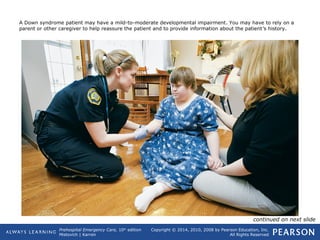
A Down syndrome patient may have a mild-to-moderate developmental impairment. You may have to rely on a
parent or other caregiver to help reassure the patient and to provide information about the patient’s history.
continued on next slide
Prehospital Emergency Care, 10th
edition
Mistovich | Karren
Copyright © 2014, 2010, 2008 by Pearson Education, Inc.
All Rights Reserved
Trauma in Cognitively ImpairedTrauma in Cognitively Impaired
PatientsPatients
• Anatomical and physiological
considerations
 Physiological changes can accompany
some forms of cognitive impairment,
depending on the underlying cause.
continued on next slide
Prehospital Emergency Care, 10th
edition
Mistovich | Karren
Copyright © 2014, 2010, 2008 by Pearson Education, Inc.
All Rights Reserved
Trauma in Cognitively ImpairedTrauma in Cognitively Impaired
PatientsPatients
• Assessment considerations
 History and consent may be difficult to
obtain.
• First attempt to get information from the
patient.
• Rely on others for information, if
necessary.
 Patients may be confused, upset, and
uncooperative.
continued on next slide
Prehospital Emergency Care, 10th
edition
Mistovich | Karren
Copyright © 2014, 2010, 2008 by Pearson Education, Inc.
All Rights Reserved
Trauma in Cognitively ImpairedTrauma in Cognitively Impaired
PatientsPatients
• Assessment considerations
 Pain perception may be altered.
 Gain information through the trauma
assessment; reassess frequently.
 Maintain a high index of suspicion that
impairment resulted from injury, rather
than being related to the pre-existing
condition.
continued on next slide
Prehospital Emergency Care, 10th
edition
Mistovich | Karren
Copyright © 2014, 2010, 2008 by Pearson Education, Inc.
All Rights Reserved
Trauma in Cognitively ImpairedTrauma in Cognitively Impaired
PatientsPatients
• Management considerations
 Involve the caregivers to increase
cooperation.
 Err on the side of caution, treat as if the
patient has a head injury.
Prehospital Emergency Care, 10th
edition
Mistovich | Karren
Copyright © 2014, 2010, 2008 by Pearson Education, Inc.
All Rights Reserved
Assessment-Based ApproachAssessment-Based Approach
• Scene size-up
 Assess the mechanism of injury; suspect
injury of more than one body system.
 Identify whether the patient belongs to
any special patient populations.
 Do not assume altered mental status is
due to a pre-existing condition.
continued on next slide
Prehospital Emergency Care, 10th
edition
Mistovich | Karren
Copyright © 2014, 2010, 2008 by Pearson Education, Inc.
All Rights Reserved
Assessment-Based ApproachAssessment-Based Approach
• Primary assessment
 Suspect spinal injury, provide in-line
stabilization.
 Assess the mental status.
 Establish an airway using a jaw-thrust
maneuver.
 Anticipate vomiting, be prepared to
suction.
continued on next slide
Prehospital Emergency Care, 10th
edition
Mistovich | Karren
Copyright © 2014, 2010, 2008 by Pearson Education, Inc.
All Rights Reserved
Assessment-Based ApproachAssessment-Based Approach
• Primary assessment
 Provide oxygen for adequately breathing
patients.
 Provide positive pressure ventilation if
breathing is inadequate.
 For bradycardic pediatric patients, assist
ventilations.
continued on next slide
Prehospital Emergency Care, 10th
edition
Mistovich | Karren
Copyright © 2014, 2010, 2008 by Pearson Education, Inc.
All Rights Reserved
Assessment-Based ApproachAssessment-Based Approach
• Primary assessment
 For pregnant patients, maintain an SpO2
of 100%, if possible.
 Look for and control external bleeding.
continued on next slide
Prehospital Emergency Care, 10th
edition
Mistovich | Karren
Copyright © 2014, 2010, 2008 by Pearson Education, Inc.
All Rights Reserved
Assessment-Based ApproachAssessment-Based Approach
• Secondary assessment
 Perform a rapid secondary assessment.
 Anticipate altered reactions to pain
among special patient populations.
 Obtain vital signs and a history.
continued on next slide
Prehospital Emergency Care, 10th
edition
Mistovich | Karren
Copyright © 2014, 2010, 2008 by Pearson Education, Inc.
All Rights Reserved
Assessment-Based ApproachAssessment-Based Approach
• Questions to consider in the history
 When and how did the incident occur?
 What is the chief complaint?
 Are there any signs or symptoms
associated with the trauma?
 Is the patient pregnant? If so, how far
along is she? Is there any vaginal
bleeding or crowning?
continued on next slide
Prehospital Emergency Care, 10th
edition
Mistovich | Karren
Copyright © 2014, 2010, 2008 by Pearson Education, Inc.
All Rights Reserved
Assessment-Based ApproachAssessment-Based Approach
• Questions to consider in the history
 How old is the patient?
 Does the patient take any medications?
Is the patient allergic to anything?
 What is the patient's medical history? Is
there a history of previous trauma or a
cognitive impairment?
continued on next slide
Prehospital Emergency Care, 10th
edition
Mistovich | Karren
Copyright © 2014, 2010, 2008 by Pearson Education, Inc.
All Rights Reserved
Assessment-Based ApproachAssessment-Based Approach
• Emergency medical care
 Use Standard Precautions.
 Establish and maintain in-line spinal
stabilization.
• For third-trimester pregnancy, tilt the
backboard to the left.
• For children younger than 8 years old,
pad from the shoulders to the hips.
• For the elderly, pad voids beneath the
back.
continued on next slide
Prehospital Emergency Care, 10th
edition
Mistovich | Karren
Copyright © 2014, 2010, 2008 by Pearson Education, Inc.
All Rights Reserved
Assessment-Based ApproachAssessment-Based Approach
• Emergency medical care
 Maintain a patient airway, and adequate
breathing and oxygenation.
• Use a jaw-thrust maneuver.
• Be prepared to suction.
• Administer oxygen.
continued on next slide
Prehospital Emergency Care, 10th
edition
Mistovich | Karren
Copyright © 2014, 2010, 2008 by Pearson Education, Inc.
All Rights Reserved
Assessment-Based ApproachAssessment-Based Approach
• Emergency medical care
 Monitor the airway, breathing, pulse,
and mental status for deterioration.
 Control bleeding.
 Treat for shock.
continued on next slide
Prehospital Emergency Care, 10th
edition
Mistovich | Karren
Copyright © 2014, 2010, 2008 by Pearson Education, Inc.
All Rights Reserved
Assessment-Based ApproachAssessment-Based Approach
• Emergency medical care
 Identify and treat other injuries.
 Transport immediately.
• Notify the receiving facility.
• Consider requesting ALS.
 Reassess vital signs every 5 minutes.
Prehospital Emergency Care, 10th
edition
Mistovich | Karren
Copyright © 2014, 2010, 2008 by Pearson Education, Inc.
All Rights Reserved
Case Study ConclusionCase Study Conclusion
EMTs arrive and, as they approach to
apply in-line stabilization to the spine and
open the airway, they note a pale patient
who appears unresponsive, and who has
labored breathing.
continued on next slide
Prehospital Emergency Care, 10th
edition
Mistovich | Karren
Copyright © 2014, 2010, 2008 by Pearson Education, Inc.
All Rights Reserved
Case Study ConclusionCase Study Conclusion
One EMT uses a jaw-thrust maneuver to
open the airway, as another completes the
primary assessment. The EMTs insert an
oropharyngeal airway and begin assisting
ventilations and administering supplemental
oxygen.
Russ has several superficial abrasions and
minor lacerations, but no major external
bleeding.
continued on next slide
Prehospital Emergency Care, 10th
edition
Mistovich | Karren
Copyright © 2014, 2010, 2008 by Pearson Education, Inc.
All Rights Reserved
Case Study ConclusionCase Study Conclusion
The EMTs perform a rapid secondary
assessment, and immobilize the spine,
padding from the shoulders to the hips to
maintain the neck in neutral alignment.
The EMTs are transporting within six
minutes of arriving, and immediately notify
the receiving facility.
continued on next slide
Prehospital Emergency Care, 10th
edition
Mistovich | Karren
Copyright © 2014, 2010, 2008 by Pearson Education, Inc.
All Rights Reserved
Case Study ConclusionCase Study Conclusion
En route, they continue management of the
airway and breathing, and keep Russ warm,
as well as obtaining baseline vital signs.
Russ is stabilized at a Level III trauma
center, and then flown to a children's
hospital for further management. Although
he faces months of rehabilitation, the quick
action of the EMTs provided him with the
best opportunity for a full recovery.
Prehospital Emergency Care, 10th
edition
Mistovich | Karren
Copyright © 2014, 2010, 2008 by Pearson Education, Inc.
All Rights Reserved
Lesson SummaryLesson Summary
• Suspect multisystem trauma in any
patient who has been subjected to a
significant external force.
• Use the golden principles of trauma
care to manage patients with
multisystem trauma.
continued on next slide
Prehospital Emergency Care, 10th
edition
Mistovich | Karren
Copyright © 2014, 2010, 2008 by Pearson Education, Inc.
All Rights Reserved
Lesson SummaryLesson Summary
• Special populations of patients require
additional assessment and
management considerations.
• The EMT must incorporate knowledge
of the special needs of these patients
into the care provided.

DMACC EMT Chapter 36

  • 1.
    PREHOSPITALPREHOSPITAL EMERGENCY CAREEMERGENCY CARE CHAPTER Copyright© 2014, 2010, 2008 by Pearson Education, Inc. All Rights Reserved Prehospital Emergency Care, 10th edition Mistovich | Karren TENTH EDITION Multisystem Trauma and Trauma in Special Patient Populations 36
  • 2.
    Prehospital Emergency Care,10th edition Mistovich | Karren Copyright © 2014, 2010, 2008 by Pearson Education, Inc. All Rights Reserved Learning ReadinessLearning Readiness • EMS Education Standards, text p. 976
  • 3.
    Prehospital Emergency Care,10th edition Mistovich | Karren Copyright © 2014, 2010, 2008 by Pearson Education, Inc. All Rights Reserved Learning ReadinessLearning Readiness ObjectivesObjectives • Please refer to page 976 of your text to view the objectives for this chapter.
  • 4.
    Prehospital Emergency Care,10th edition Mistovich | Karren Copyright © 2014, 2010, 2008 by Pearson Education, Inc. All Rights Reserved Learning ReadinessLearning Readiness Key TermsKey Terms • Please refer to page 976 of your text to view the key terms for this chapter.
  • 5.
    Prehospital Emergency Care,10th edition Mistovich | Karren Copyright © 2014, 2010, 2008 by Pearson Education, Inc. All Rights Reserved Setting the StageSetting the Stage • Overview of Lesson Topics  Multisystem Trauma  Trauma in Special Patient Populations  Assessment-Based Approach: Multisystem Trauma and Trauma in Special Patient Populations
  • 6.
    Prehospital Emergency Care,10th edition Mistovich | Karren Copyright © 2014, 2010, 2008 by Pearson Education, Inc. All Rights Reserved Case Study IntroductionCase Study Introduction Excited to hear the approach of the ice cream truck in his neighborhood, seven- year-old Russ Moffat runs into the street to look for it. He fails to see the car approaching from the opposite direction until it is too late, turning toward it at the last second. The bumper strikes Russ in the torso, throwing his head forward onto the hood, before throwing him down to the ground as the driver screeches to a halt.
  • 7.
    Prehospital Emergency Care,10th edition Mistovich | Karren Copyright © 2014, 2010, 2008 by Pearson Education, Inc. All Rights Reserved Case StudyCase Study • How will Russ's age affect the type and distribution of his injuries? • How might Russ's injuries present differently from the same injuries in an adult patient? • What differences are required in the assessment and management of this patient, as compared to an adult?
  • 8.
    Prehospital Emergency Care,10th edition Mistovich | Karren Copyright © 2014, 2010, 2008 by Pearson Education, Inc. All Rights Reserved IntroductionIntroduction • The involvement of multiple body systems in trauma makes management of the trauma patient more challenging. • There are special considerations in assessment and management of pediatric, geriatric, pregnant, and cognitively impaired trauma patients.
  • 9.
    Prehospital Emergency Care,10th edition Mistovich | Karren Copyright © 2014, 2010, 2008 by Pearson Education, Inc. All Rights Reserved Multisystem TraumaMultisystem Trauma • Significant forces increase the risk for injuries to multiple systems. • Morbidity and mortality are higher in patients with multisystem trauma. • The risk of developing shock is higher with multisystem trauma. continued on next slide
  • 10.
    Prehospital Emergency Care,10th edition Mistovich | Karren Copyright © 2014, 2010, 2008 by Pearson Education, Inc. All Rights Reserved Multisystem TraumaMultisystem Trauma • The care for multisystem trauma patients depends on the systems involved. • The definitive care is often surgery. continued on next slide
  • 11.
    Prehospital Emergency Care,10th edition Mistovich | Karren Copyright © 2014, 2010, 2008 by Pearson Education, Inc. All Rights Reserved Multisystem TraumaMultisystem Trauma • Golden principles of prehospital multisystem trauma care  Ensure the safety of the rescue personnel and patient.  Determine additional resources needed.  Understand kinematics. continued on next slide
  • 12.
    Prehospital Emergency Care,10th edition Mistovich | Karren Copyright © 2014, 2010, 2008 by Pearson Education, Inc. All Rights Reserved Multisystem TraumaMultisystem Trauma • Golden principles of prehospital multisystem trauma care  Identify and manage life threats.  Manage the airway while maintaining cervical spine stabilization.  Support ventilation and oxygenation. continued on next slide
  • 13.
    Prehospital Emergency Care,10th edition Mistovich | Karren Copyright © 2014, 2010, 2008 by Pearson Education, Inc. All Rights Reserved Multisystem TraumaMultisystem Trauma • Golden principles of prehospital multisystem trauma care  Control external hemorrhage and treat for shock.  Perform a secondary assessment and obtain a medical history. continued on next slide
  • 14.
    Prehospital Emergency Care,10th edition Mistovich | Karren Copyright © 2014, 2010, 2008 by Pearson Education, Inc. All Rights Reserved Multisystem TraumaMultisystem Trauma • Golden principles of prehospital multisystem trauma care  Splint musculoskeletal injuries and maintain spinal immobilization on a long spine board.  Make transport decisions.
  • 15.
    Prehospital Emergency Care,10th edition Mistovich | Karren Copyright © 2014, 2010, 2008 by Pearson Education, Inc. All Rights Reserved Trauma in Pregnant PatientsTrauma in Pregnant Patients • Trauma is the leading cause of death for pregnant patients. • Mechanisms include abuse, falls, and motor vehicle collisions. continued on next slide
  • 16.
    Prehospital Emergency Care,10th edition Mistovich | Karren Copyright © 2014, 2010, 2008 by Pearson Education, Inc. All Rights Reserved Trauma in Pregnant PatientsTrauma in Pregnant Patients • It is difficult to assess the fetus, so manage the mother aggressively. • All pregnant trauma patients should be evaluated in the emergency department. continued on next slide
  • 17.
    Prehospital Emergency Care,10th edition Mistovich | Karren Copyright © 2014, 2010, 2008 by Pearson Education, Inc. All Rights Reserved Trauma in Pregnant PatientsTrauma in Pregnant Patients • Anatomical and physiological considerations  The blood volume is increased by 50% in late pregnancy.  The heart rate increases by 10 to 15 bpm by the 3rd trimester.  The uterus becomes highly vascular. continued on next slide
  • 18.
    Prehospital Emergency Care,10th edition Mistovich | Karren Copyright © 2014, 2010, 2008 by Pearson Education, Inc. All Rights Reserved Trauma in Pregnant PatientsTrauma in Pregnant Patients • Anatomical and physiological considerations  The diaphragm is elevated.  Pain perception in the abdomen is altered.  Decreased gastric motility and increased risk of vomiting.  The uterus and bladder are at greater risk of injury. continued on next slide
  • 19.
    Prehospital Emergency Care,10th edition Mistovich | Karren Copyright © 2014, 2010, 2008 by Pearson Education, Inc. All Rights Reserved Trauma in Pregnant PatientsTrauma in Pregnant Patients • Anatomical and physiological considerations  Musculoskeletal changes and changes in the center of gravity increase the risk of falls.  In the 3rd trimester, fetal size can impair venous return when the mother is in a supine position. continued on next slide
  • 20.
    Prehospital Emergency Care,10th edition Mistovich | Karren Copyright © 2014, 2010, 2008 by Pearson Education, Inc. All Rights Reserved Trauma in Pregnant PatientsTrauma in Pregnant Patients • Assessment considerations  1% to 3% of minor traumas in pregnant women result in fetal loss.  The more severe the injury to the mother, the greater the chances of fetal injury.  Fetal death rates are nine times higher than maternal death rates following trauma continued on next slide
  • 21.
    Prehospital Emergency Care,10th edition Mistovich | Karren Copyright © 2014, 2010, 2008 by Pearson Education, Inc. All Rights Reserved Trauma in Pregnant PatientsTrauma in Pregnant Patients • Assessment considerations  The most common problem caused by maternal trauma is uterine contractions that may progress into labor. continued on next slide
  • 22.
    Prehospital Emergency Care,10th edition Mistovich | Karren Copyright © 2014, 2010, 2008 by Pearson Education, Inc. All Rights Reserved Trauma in Pregnant PatientsTrauma in Pregnant Patients • Abruptio placentae is premature separation of the placenta from the uterine wall.  It most commonly occurs with blunt trauma.  There may be abdominal pain and vaginal bleeding.  There is a high risk of fetal and maternal death. continued on next slide
  • 23.
    Prehospital Emergency Care,10th edition Mistovich | Karren Copyright © 2014, 2010, 2008 by Pearson Education, Inc. All Rights Reserved Trauma in Pregnant PatientsTrauma in Pregnant Patients • Fetal and maternal outcomes from motor vehicle collisions are more favorable when the mother wears a seatbelt. • Uterine rupture may occur as a result of motor vehicle trauma. continued on next slide
  • 24.
    Prehospital Emergency Care,10th edition Mistovich | Karren Copyright © 2014, 2010, 2008 by Pearson Education, Inc. All Rights Reserved Trauma in Pregnant PatientsTrauma in Pregnant Patients • Fetal distress can be caused by hypoxia or hypovolemia, but signs of shock can be delayed or masked in pregnant patients. • Attempt resuscitation of the pulseless pregnant trauma patient according to your protocol. continued on next slide
  • 25.
    Prehospital Emergency Care,10th edition Mistovich | Karren Copyright © 2014, 2010, 2008 by Pearson Education, Inc. All Rights Reserved Trauma in Pregnant PatientsTrauma in Pregnant Patients • Management considerations  When spinal immobilization is required, tilt the spine board to the left to prevent supine hypotensive syndrome. continued on next slide
  • 26.
    Prehospital Emergency Care,10th edition Mistovich | Karren Copyright © 2014, 2010, 2008 by Pearson Education, Inc. All Rights Reserved Trauma in Pregnant PatientsTrauma in Pregnant Patients • Management considerations  Airway and ventilation • Anticipate vomiting. • Assist inadequate ventilations. • Administer oxygen and maintain as high an SpO2 as possible. • The fetus can be severely hypoxic before the mother shows signs of hypoxia. continued on next slide
  • 27.
    Prehospital Emergency Care,10th edition Mistovich | Karren Copyright © 2014, 2010, 2008 by Pearson Education, Inc. All Rights Reserved Trauma in Pregnant PatientsTrauma in Pregnant Patients • Management considerations  Circulation • Check for major bleeding. • Absorb vaginal bleeding with a pad; do not pack the vagina. • Anticipate and treat for shock. continued on next slide
  • 28.
    Prehospital Emergency Care,10th edition Mistovich | Karren Copyright © 2014, 2010, 2008 by Pearson Education, Inc. All Rights Reserved Trauma in Pregnant PatientsTrauma in Pregnant Patients • Management considerations  Assess for crowning.  Anticipate the need for additional resources if delivery is imminent. continued on next slide
  • 29.
    Prehospital Emergency Care,10th edition Mistovich | Karren Copyright © 2014, 2010, 2008 by Pearson Education, Inc. All Rights Reserved Trauma in Pregnant PatientsTrauma in Pregnant Patients • Management considerations  Consider ALS intercept; notify the receiving facility.  The best management of the fetus is to anticipate and manage the mother's injuries.
  • 30.
    Prehospital Emergency Care,10th edition Mistovich | Karren Copyright © 2014, 2010, 2008 by Pearson Education, Inc. All Rights Reserved Click on the intervention that is required toClick on the intervention that is required to prevent supine hypotensive syndrome whenprevent supine hypotensive syndrome when managing a pregnant trauma patient.managing a pregnant trauma patient. A. Fill all voids beneath the patient's back with padding when immobilizing to a long backboard. B. Administer oxygen at 15 lpm by nonrebreather mask to all pregnant trauma patients. C. Tilt the long backboard to the patient's left once she is fully immobilized. D. Transport the patient in semi-Fowler's position with the knees and hips flexed.
  • 31.
    Prehospital Emergency Care,10th edition Mistovich | Karren Copyright © 2014, 2010, 2008 by Pearson Education, Inc. All Rights Reserved Trauma in Pediatric PatientsTrauma in Pediatric Patients • Mechanisms include drowning, burns, falls, penetrating trauma, motor vehicle collisions, and pedestrian-vehicle collisions. continued on next slide
  • 32.
    Prehospital Emergency Care,10th edition Mistovich | Karren Copyright © 2014, 2010, 2008 by Pearson Education, Inc. All Rights Reserved Children are frequently victims of major and minor trauma. (© Mark C. Ide) continued on next slide
  • 33.
    Prehospital Emergency Care,10th edition Mistovich | Karren Copyright © 2014, 2010, 2008 by Pearson Education, Inc. All Rights Reserved Trauma in Pediatric PatientsTrauma in Pediatric Patients • Half of all pediatric deaths are due to trauma. • Motor vehicle collisions account for the majority or trauma, and almost half of trauma deaths. • Improper car seat usage contributes to injury. continued on next slide
  • 34.
    Prehospital Emergency Care,10th edition Mistovich | Karren Copyright © 2014, 2010, 2008 by Pearson Education, Inc. All Rights Reserved Trauma in Pediatric PatientsTrauma in Pediatric Patients • 25% to 35% of deaths are due to abuse. continued on next slide
  • 35.
    Prehospital Emergency Care,10th edition Mistovich | Karren Copyright © 2014, 2010, 2008 by Pearson Education, Inc. All Rights Reserved Trauma in Pediatric PatientsTrauma in Pediatric Patients • Suspected abuse findings include:  Bruises or burns in unusual shapes and locations  An injury that doesn't seem to correlate with the cause provided  More injuries than usual for a child that same age  Multiple injuries in various healing stages continued on next slide
  • 36.
    Prehospital Emergency Care,10th edition Mistovich | Karren Copyright © 2014, 2010, 2008 by Pearson Education, Inc. All Rights Reserved Trauma in Pediatric PatientsTrauma in Pediatric Patients • Calls involving pediatric patients can be difficult for EMS providers.  The event is stressful for family and bystanders.  Professional, competent, compassionate care is a must. continued on next slide
  • 37.
    Prehospital Emergency Care,10th edition Mistovich | Karren Copyright © 2014, 2010, 2008 by Pearson Education, Inc. All Rights Reserved Trauma in Pediatric PatientsTrauma in Pediatric Patients • Anatomical and physiological considerations  Traumatic forces are more widely distributed in pediatric patients than in adults, making them more prone to multisystem trauma.  The body surface area is greater; patients can lose heat faster. continued on next slide
  • 38.
    Prehospital Emergency Care,10th edition Mistovich | Karren Copyright © 2014, 2010, 2008 by Pearson Education, Inc. All Rights Reserved Trauma in Pediatric PatientsTrauma in Pediatric Patients • Anatomical and physiological considerations  Heavy head and weak neck muscles increase their risk of head and cervical spinal injuries  Internal organ placement makes them more susceptible to injuries to the spleen and liver. continued on next slide
  • 39.
    Prehospital Emergency Care,10th edition Mistovich | Karren Copyright © 2014, 2010, 2008 by Pearson Education, Inc. All Rights Reserved Trauma in Pediatric PatientsTrauma in Pediatric Patients • Anatomical and physiological considerations  Greater chest wall flexibility can allow for injuries with few external signs of trauma.  Maintain a high index of suspicion that severe underlying trauma exists. continued on next slide
  • 40.
    Prehospital Emergency Care,10th edition Mistovich | Karren Copyright © 2014, 2010, 2008 by Pearson Education, Inc. All Rights Reserved Trauma in Pediatric PatientsTrauma in Pediatric Patients • Anatomical and physiological considerations  Trauma to growth plates may impact the bones' normal growth.  Higher energy requirements and can lead to fatigue faster than in adults. continued on next slide
  • 41.
    Prehospital Emergency Care,10th edition Mistovich | Karren Copyright © 2014, 2010, 2008 by Pearson Education, Inc. All Rights Reserved Trauma in Pediatric PatientsTrauma in Pediatric Patients • Assessment considerations  The Pediatric Assessment Triangle (PAT) helps with formation of a general impression.  PAT assesses appearance, work of breathing, and circulation to the skin. continued on next slide
  • 42.
    Prehospital Emergency Care,10th edition Mistovich | Karren Copyright © 2014, 2010, 2008 by Pearson Education, Inc. All Rights Reserved Trauma in Pediatric PatientsTrauma in Pediatric Patients • Assessment considerations  The Pediatric Advanced Life Support (PALS) assessment is similar to PAT.  PALS assesses consciousness, breathing, and color. continued on next slide
  • 43.
    Prehospital Emergency Care,10th edition Mistovich | Karren Copyright © 2014, 2010, 2008 by Pearson Education, Inc. All Rights Reserved Trauma in Pediatric PatientsTrauma in Pediatric Patients • Assessment considerations  Subtle changes in heart rate, blood pressure, and skin perfusion may indicate cardiorespiratory failure.  A slow heart rate may indicate hypoxia. continued on next slide
  • 44.
    Prehospital Emergency Care,10th edition Mistovich | Karren Copyright © 2014, 2010, 2008 by Pearson Education, Inc. All Rights Reserved Trauma in Pediatric PatientsTrauma in Pediatric Patients • Assessment considerations  Assess a brachial pulse in patients over 1 year old.  Blood pressure is assessed in patients 3 or more years old. continued on next slide
  • 45.
    Prehospital Emergency Care,10th edition Mistovich | Karren Copyright © 2014, 2010, 2008 by Pearson Education, Inc. All Rights Reserved Trauma in Pediatric PatientsTrauma in Pediatric Patients • Management considerations  In spinal immobilization, pad beneath the child who is less than 8 years of age from the shoulders to the hips to prevent neck flexion.  Open the airway and assess for any possible obstructions; gurgling or stridor indicate upper airway obstruction. continued on next slide
  • 46.
    Prehospital Emergency Care,10th edition Mistovich | Karren Copyright © 2014, 2010, 2008 by Pearson Education, Inc. All Rights Reserved Trauma in Pediatric PatientsTrauma in Pediatric Patients • Management considerations  Assess breathing rate and tidal volume, assist inadequate ventilations.  Maintain an SpO2 greater than or equal to 94%.  Assess circulation and control direct bleeding. continued on next slide
  • 47.
    Prehospital Emergency Care,10th edition Mistovich | Karren Copyright © 2014, 2010, 2008 by Pearson Education, Inc. All Rights Reserved Trauma in Pediatric PatientsTrauma in Pediatric Patients • Management considerations  Manage hypovolemia and shock.  Prevent hypothermia.  Transport to an appropriate facility.  Continually reassess.
  • 48.
    Prehospital Emergency Care,10th edition Mistovich | Karren Copyright © 2014, 2010, 2008 by Pearson Education, Inc. All Rights Reserved Trauma in Geriatric PatientsTrauma in Geriatric Patients • Geriatric patients account for 10% to 14% of trauma patients. • The risk of death and significant injury is greater than for younger patients. • A number of physiological changes predispose the elderly to injuries. continued on next slide
  • 49.
    Prehospital Emergency Care,10th edition Mistovich | Karren Copyright © 2014, 2010, 2008 by Pearson Education, Inc. All Rights Reserved Trauma in Geriatric PatientsTrauma in Geriatric Patients • Falls are the most common cause of injury. • Many falls are the result of medical conditions. • The most common injury associated with falls is fractures. continued on next slide
  • 50.
    Prehospital Emergency Care,10th edition Mistovich | Karren Copyright © 2014, 2010, 2008 by Pearson Education, Inc. All Rights Reserved Trauma in Geriatric PatientsTrauma in Geriatric Patients • Anatomical and physiological considerations  Changes in the pulmonary, cardiovascular, neurological, and musculoskeletal systems occur with aging.  These changes make injury more likely and make it harder for the elderly patient to compensate when injury occurs. continued on next slide
  • 51.
    Prehospital Emergency Care,10th edition Mistovich | Karren Copyright © 2014, 2010, 2008 by Pearson Education, Inc. All Rights Reserved Trauma in Geriatric PatientsTrauma in Geriatric Patients • Assessment considerations  Pre-existing medical conditions and medications affect the patient's outcome.  Altered mental status is a significant sign.  Be alert to airway obstruction from dentures and impaired cough reflex. continued on next slide
  • 52.
    Prehospital Emergency Care,10th edition Mistovich | Karren Copyright © 2014, 2010, 2008 by Pearson Education, Inc. All Rights Reserved Trauma in Geriatric PatientsTrauma in Geriatric Patients • Assessment considerations  Chest wall injuries can quickly lead to respiratory failure.  Pre-existing hypertension can make detecting shock difficult.  Pelvic and hip fractures are common. continued on next slide
  • 53.
    Prehospital Emergency Care,10th edition Mistovich | Karren Copyright © 2014, 2010, 2008 by Pearson Education, Inc. All Rights Reserved Trauma in Geriatric PatientsTrauma in Geriatric Patients • Management considerations  Use padding when spinal immobilization is necessary.  Maintain a clear airway, be prepared to suction.  Support ventilation as needed, maintain an SpO2 greater than or equal to 94%. continued on next slide
  • 54.
    Prehospital Emergency Care,10th edition Mistovich | Karren Copyright © 2014, 2010, 2008 by Pearson Education, Inc. All Rights Reserved Trauma in Geriatric PatientsTrauma in Geriatric Patients • Management considerations  Prevent hypothermia.  Splint fractures.  Provide rapid transportation to the closest appropriate facility.
  • 55.
    Prehospital Emergency Care,10th edition Mistovich | Karren Copyright © 2014, 2010, 2008 by Pearson Education, Inc. All Rights Reserved Trauma in Cognitively ImpairedTrauma in Cognitively Impaired PatientsPatients • Cognitively impaired patients are more prone to trauma. • Conditions include dementia, autism, brain injuries, stroke, Alzheimer's disease, and Down syndrome. • Cognitive impairments can affect assessment and management. continued on next slide
  • 56.
    Prehospital Emergency Care,10th edition Mistovich | Karren Copyright © 2014, 2010, 2008 by Pearson Education, Inc. All Rights Reserved A Down syndrome patient may have a mild-to-moderate developmental impairment. You may have to rely on a parent or other caregiver to help reassure the patient and to provide information about the patient’s history. continued on next slide
  • 57.
    Prehospital Emergency Care,10th edition Mistovich | Karren Copyright © 2014, 2010, 2008 by Pearson Education, Inc. All Rights Reserved Trauma in Cognitively ImpairedTrauma in Cognitively Impaired PatientsPatients • Anatomical and physiological considerations  Physiological changes can accompany some forms of cognitive impairment, depending on the underlying cause. continued on next slide
  • 58.
    Prehospital Emergency Care,10th edition Mistovich | Karren Copyright © 2014, 2010, 2008 by Pearson Education, Inc. All Rights Reserved Trauma in Cognitively ImpairedTrauma in Cognitively Impaired PatientsPatients • Assessment considerations  History and consent may be difficult to obtain. • First attempt to get information from the patient. • Rely on others for information, if necessary.  Patients may be confused, upset, and uncooperative. continued on next slide
  • 59.
    Prehospital Emergency Care,10th edition Mistovich | Karren Copyright © 2014, 2010, 2008 by Pearson Education, Inc. All Rights Reserved Trauma in Cognitively ImpairedTrauma in Cognitively Impaired PatientsPatients • Assessment considerations  Pain perception may be altered.  Gain information through the trauma assessment; reassess frequently.  Maintain a high index of suspicion that impairment resulted from injury, rather than being related to the pre-existing condition. continued on next slide
  • 60.
    Prehospital Emergency Care,10th edition Mistovich | Karren Copyright © 2014, 2010, 2008 by Pearson Education, Inc. All Rights Reserved Trauma in Cognitively ImpairedTrauma in Cognitively Impaired PatientsPatients • Management considerations  Involve the caregivers to increase cooperation.  Err on the side of caution, treat as if the patient has a head injury.
  • 61.
    Prehospital Emergency Care,10th edition Mistovich | Karren Copyright © 2014, 2010, 2008 by Pearson Education, Inc. All Rights Reserved Assessment-Based ApproachAssessment-Based Approach • Scene size-up  Assess the mechanism of injury; suspect injury of more than one body system.  Identify whether the patient belongs to any special patient populations.  Do not assume altered mental status is due to a pre-existing condition. continued on next slide
  • 62.
    Prehospital Emergency Care,10th edition Mistovich | Karren Copyright © 2014, 2010, 2008 by Pearson Education, Inc. All Rights Reserved Assessment-Based ApproachAssessment-Based Approach • Primary assessment  Suspect spinal injury, provide in-line stabilization.  Assess the mental status.  Establish an airway using a jaw-thrust maneuver.  Anticipate vomiting, be prepared to suction. continued on next slide
  • 63.
    Prehospital Emergency Care,10th edition Mistovich | Karren Copyright © 2014, 2010, 2008 by Pearson Education, Inc. All Rights Reserved Assessment-Based ApproachAssessment-Based Approach • Primary assessment  Provide oxygen for adequately breathing patients.  Provide positive pressure ventilation if breathing is inadequate.  For bradycardic pediatric patients, assist ventilations. continued on next slide
  • 64.
    Prehospital Emergency Care,10th edition Mistovich | Karren Copyright © 2014, 2010, 2008 by Pearson Education, Inc. All Rights Reserved Assessment-Based ApproachAssessment-Based Approach • Primary assessment  For pregnant patients, maintain an SpO2 of 100%, if possible.  Look for and control external bleeding. continued on next slide
  • 65.
    Prehospital Emergency Care,10th edition Mistovich | Karren Copyright © 2014, 2010, 2008 by Pearson Education, Inc. All Rights Reserved Assessment-Based ApproachAssessment-Based Approach • Secondary assessment  Perform a rapid secondary assessment.  Anticipate altered reactions to pain among special patient populations.  Obtain vital signs and a history. continued on next slide
  • 66.
    Prehospital Emergency Care,10th edition Mistovich | Karren Copyright © 2014, 2010, 2008 by Pearson Education, Inc. All Rights Reserved Assessment-Based ApproachAssessment-Based Approach • Questions to consider in the history  When and how did the incident occur?  What is the chief complaint?  Are there any signs or symptoms associated with the trauma?  Is the patient pregnant? If so, how far along is she? Is there any vaginal bleeding or crowning? continued on next slide
  • 67.
    Prehospital Emergency Care,10th edition Mistovich | Karren Copyright © 2014, 2010, 2008 by Pearson Education, Inc. All Rights Reserved Assessment-Based ApproachAssessment-Based Approach • Questions to consider in the history  How old is the patient?  Does the patient take any medications? Is the patient allergic to anything?  What is the patient's medical history? Is there a history of previous trauma or a cognitive impairment? continued on next slide
  • 68.
    Prehospital Emergency Care,10th edition Mistovich | Karren Copyright © 2014, 2010, 2008 by Pearson Education, Inc. All Rights Reserved Assessment-Based ApproachAssessment-Based Approach • Emergency medical care  Use Standard Precautions.  Establish and maintain in-line spinal stabilization. • For third-trimester pregnancy, tilt the backboard to the left. • For children younger than 8 years old, pad from the shoulders to the hips. • For the elderly, pad voids beneath the back. continued on next slide
  • 69.
    Prehospital Emergency Care,10th edition Mistovich | Karren Copyright © 2014, 2010, 2008 by Pearson Education, Inc. All Rights Reserved Assessment-Based ApproachAssessment-Based Approach • Emergency medical care  Maintain a patient airway, and adequate breathing and oxygenation. • Use a jaw-thrust maneuver. • Be prepared to suction. • Administer oxygen. continued on next slide
  • 70.
    Prehospital Emergency Care,10th edition Mistovich | Karren Copyright © 2014, 2010, 2008 by Pearson Education, Inc. All Rights Reserved Assessment-Based ApproachAssessment-Based Approach • Emergency medical care  Monitor the airway, breathing, pulse, and mental status for deterioration.  Control bleeding.  Treat for shock. continued on next slide
  • 71.
    Prehospital Emergency Care,10th edition Mistovich | Karren Copyright © 2014, 2010, 2008 by Pearson Education, Inc. All Rights Reserved Assessment-Based ApproachAssessment-Based Approach • Emergency medical care  Identify and treat other injuries.  Transport immediately. • Notify the receiving facility. • Consider requesting ALS.  Reassess vital signs every 5 minutes.
  • 72.
    Prehospital Emergency Care,10th edition Mistovich | Karren Copyright © 2014, 2010, 2008 by Pearson Education, Inc. All Rights Reserved Case Study ConclusionCase Study Conclusion EMTs arrive and, as they approach to apply in-line stabilization to the spine and open the airway, they note a pale patient who appears unresponsive, and who has labored breathing. continued on next slide
  • 73.
    Prehospital Emergency Care,10th edition Mistovich | Karren Copyright © 2014, 2010, 2008 by Pearson Education, Inc. All Rights Reserved Case Study ConclusionCase Study Conclusion One EMT uses a jaw-thrust maneuver to open the airway, as another completes the primary assessment. The EMTs insert an oropharyngeal airway and begin assisting ventilations and administering supplemental oxygen. Russ has several superficial abrasions and minor lacerations, but no major external bleeding. continued on next slide
  • 74.
    Prehospital Emergency Care,10th edition Mistovich | Karren Copyright © 2014, 2010, 2008 by Pearson Education, Inc. All Rights Reserved Case Study ConclusionCase Study Conclusion The EMTs perform a rapid secondary assessment, and immobilize the spine, padding from the shoulders to the hips to maintain the neck in neutral alignment. The EMTs are transporting within six minutes of arriving, and immediately notify the receiving facility. continued on next slide
  • 75.
    Prehospital Emergency Care,10th edition Mistovich | Karren Copyright © 2014, 2010, 2008 by Pearson Education, Inc. All Rights Reserved Case Study ConclusionCase Study Conclusion En route, they continue management of the airway and breathing, and keep Russ warm, as well as obtaining baseline vital signs. Russ is stabilized at a Level III trauma center, and then flown to a children's hospital for further management. Although he faces months of rehabilitation, the quick action of the EMTs provided him with the best opportunity for a full recovery.
  • 76.
    Prehospital Emergency Care,10th edition Mistovich | Karren Copyright © 2014, 2010, 2008 by Pearson Education, Inc. All Rights Reserved Lesson SummaryLesson Summary • Suspect multisystem trauma in any patient who has been subjected to a significant external force. • Use the golden principles of trauma care to manage patients with multisystem trauma. continued on next slide
  • 77.
    Prehospital Emergency Care,10th edition Mistovich | Karren Copyright © 2014, 2010, 2008 by Pearson Education, Inc. All Rights Reserved Lesson SummaryLesson Summary • Special populations of patients require additional assessment and management considerations. • The EMT must incorporate knowledge of the special needs of these patients into the care provided.

Editor's Notes

  • #2 During this lesson, students will learn about the roles and responsibilities of an EMT. Advance Preparation Student Readiness Assign the associated section of MyBRADYLab and review student scores. Review the chapter material in the Instructor Resources, which includes Student Handouts, PowerPoint slides, and the MyTest Program. Prepare Make copies of course policies and procedures, the syllabus, handouts from the Instructor Resources, and other materials for distribution or post them in your learning management system. Preview the media resources and Master Teaching Notes in this lesson. Preview the case study presented in the PowerPoint slides. Invite the medical director to the first class session. Make arrangements to tour an emergency department or local PSAP. Obtain 911 recordings to play for the class. Arrange to have an ambulance present at the class location. Bring in a couple of current EMS research articles from a peer-reviewed publication. Ask a health department representative to speak on public health. Plan 100 to 120 minutes for this class as follows: The Emergency Medical Services System: 30 minutes Provides a brief history of EMS system development Describes the current state of EMS and where EMS should be in the future The EMT: 30 minutes Students learn about the characteristics of EMTs, the roles they will play, and the responsibilities of being a health care provider. Research and EMS Care: 20 minutes Describes the concept of evidence-based medicine and the use of research data to improve patient outcomes Public health: 20 minutes Public health is a recent focus for EMS. EMTs can make a difference in public health by participating in health education and illness and injury prevention activities in their communities. The total teaching time recommended is only a guideline. Take into consideration factors such as the pace at which students learn, the size of the class, breaks, and classroom activities. The actual time devoted to teaching objectives is the responsibility of the instructor.
  • #3 Explain to students what the National EMS Education Standards are. The National EMS Education Standards communicate the expectations of entry-level EMS providers. As EMTs, students will be expected to be competent in these areas. Acknowledge that the Standards are broad, general statements. Although this lesson addresses the listed competencies, the competencies are often complex and require completion of more than one lesson to accomplish.
  • #4 Objectives are more specific statements of what students should be able to do after completing all reading and activities related to a specific chapter. Remind students they are responsible for the learning objectives and key terms for this chapter.
  • #5 Assess and reinforce the objectives and key terms using quizzes, handouts from the electronic instructor resources, and workbook pages.
  • #7 Case Study Present the Case Study Introduction provided in the PowerPoint slide set. Lead a discussion using the case study questions provided on the subsequent slide(s). The Case Study with discussion questions continues throughout the PowerPoint presentation. Case Study Discussion Use the case study content and questions to foreshadow the upcoming lesson content
  • #9 During this lesson, students will learn about special considerations an EMT should have when caring for specific trauma populations.
  • #10 Discussion Questions What is the relationship between multisystem trauma and shock? Under what circumstances should you request ALS or air medical support when caring for a multisystem trauma patient? What are the priorities when managing a multisystem trauma patient? Why is it important to perform a secondary assessment and obtain a medical history from a trauma patient?
  • #11 Knowledge Application Students should be able to apply the principles of managing multisystem trauma patients to a variety of lab scenarios.   Class Activity Have groups of students prepare multisystem trauma scenarios to demonstrate their understanding of the effects of multisystem trauma. Review the scenarios for accuracy during a break, and use the scenarios for lab practice.   Teaching Tips Allow ample opportunity for students to apply the principles in lab scenarios. If weather and resources allow, have students practice outdoors.   Critical Thinking Discussion How can you develop the level of skill and efficiency needed to care for critically injured multisystem trauma patients?
  • #16 Discussion Questions What are common causes of injury in pregnant patients? How do the anatomy and physiology of pregnancy affect the response to injuries?
  • #32 Discussion Question What are the differences in pediatric patients that account for their greater severity of injuries as compared with adults exposed to similar forces?   Teaching Tips Arrange a tour of a pediatric emergency department or, if this is not possible, consider a tour of the area of the ED in which pediatric patients are treated.
  • #49 Discussion Question What are some things that affect the elderly patient's ability to compensate from hemorrhage?   Teaching Tips Arrange with an extended care facility to have students assess elderly patients under nursing supervision.
  • #56 Discussion Question What are some guidelines to follow when dealing with the cognitively impaired trauma patient?   Knowledge Application Students should be able to apply the information in this section to scenarios involving assessment and management of pregnant, pediatric, geriatric, and cognitively impaired patients.
  • #66 Critical Thinking Discussion How do the psychosocial developmental stages of children of various ages affect their responses to trauma and to treatment by health care providers?
  • #69 Discussion Questions What are the priorities of care for multisystem trauma patients? How is the management of pediatric trauma patients different from that of adults? What are some special considerations in management of geriatric trauma patients? Knowledge Application Given a series of scenarios, students should be able to assess and manage a variety of patients from special populations.
  • #77 Follow-Up Answer student questions. Follow-Up Assignments Review Chapter 36 Summary. Complete Chapter 36 In Review questions. Complete Chapter 36 Critical Thinking questions. Assessments Handouts Chapter 36 quiz
  • #78 Class Activity As an alternative to assigning the follow-up exercises in the lesson plan as homework, assign each question to a small group of students for in-class discussion.   Teaching Tips Answers to In Review questions are in the appendix of the text. Advise students to review the questions again as they study the chapter.