PREHOSPITALPREHOSPITAL
EMERGENCY CAREEMERGENCY CARE
CHAPTER
Copyright © 2014, 2010, 2008 by Pearson Education, Inc.
All Rights Reserved
Prehospital Emergency Care, 10th
edition
Mistovich | Karren
TENTH EDITION
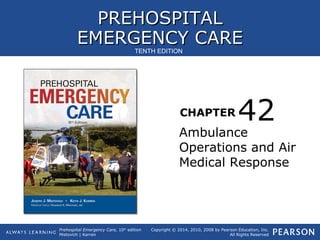
Ambulance
Operations and Air
Medical Response
42
Prehospital Emergency Care, 10th
edition
Mistovich | Karren
Copyright © 2014, 2010, 2008 by Pearson Education, Inc.
All Rights Reserved
Learning ReadinessLearning Readiness
• EMS Education Standards, text p. 1155
Prehospital Emergency Care, 10th
edition
Mistovich | Karren
Copyright © 2014, 2010, 2008 by Pearson Education, Inc.
All Rights Reserved
Learning ReadinessLearning Readiness
ObjectivesObjectives
• Please refer to page 1155 of your text
to view the objectives for this chapter.
Prehospital Emergency Care, 10th
edition
Mistovich | Karren
Copyright © 2014, 2010, 2008 by Pearson Education, Inc.
All Rights Reserved
Learning ReadinessLearning Readiness
Key TermsKey Terms
• Please refer to page 1155 of your text
to view the key terms for this chapter.
Prehospital Emergency Care, 10th
edition
Mistovich | Karren
Copyright © 2014, 2010, 2008 by Pearson Education, Inc.
All Rights Reserved
Setting the StageSetting the Stage
• Overview of Lesson Topics
 Driving the Ambulance
 Warning Devices
 Roadway Incident Safety
 Phases of an Ambulance Call
 Air Medical Transport
 Security and Safety
Prehospital Emergency Care, 10th
edition
Mistovich | Karren
Copyright © 2014, 2010, 2008 by Pearson Education, Inc.
All Rights Reserved
Case Study IntroductionCase Study Introduction
EMTs Gary Farmer and Harold Begay are
completing their pre-shift vehicle
inspection when they are dispatched for a
report of a vehicle collision.
Prehospital Emergency Care, 10th
edition
Mistovich | Karren
Copyright © 2014, 2010, 2008 by Pearson Education, Inc.
All Rights Reserved
Case StudyCase Study
• What steps do Gary and Harold need to
take before heading to the scene?
• How will Gary and Harold decide the
best route to travel to reach their
destination?
• What actions must they take to
minimize their chances of being in a
collision during the response?
Prehospital Emergency Care, 10th
edition
Mistovich | Karren
Copyright © 2014, 2010, 2008 by Pearson Education, Inc.
All Rights Reserved
IntroductionIntroduction
• An ambulance should be a place of
comfort and support to patients.
• There are 5,000 ambulance crashes
each year in the United States.
• EMTs must be able to skillfully operate
an ambulance.
Prehospital Emergency Care, 10th
edition
Mistovich | Karren
Copyright © 2014, 2010, 2008 by Pearson Education, Inc.
All Rights Reserved
Driving the AmbulanceDriving the Ambulance
• Laws, regulations, and ordinances
apply to the operation of ambulances.
• Certain privileges are afforded to
ambulance operators.
• It is never justified to operate an
ambulance unsafely.
continued on next slide
Prehospital Emergency Care, 10th
edition
Mistovich | Karren
Copyright © 2014, 2010, 2008 by Pearson Education, Inc.
All Rights Reserved
Driving the AmbulanceDriving the Ambulance
• Generally, an ambulance may do the
following in an emergency:
 Exceed the posted speed limit as long as
lives or property are not endangered.
 Drive the wrong way down a one-way
street or drive down the opposite side of
the road.
continued on next slide
Prehospital Emergency Care, 10th
edition
Mistovich | Karren
Copyright © 2014, 2010, 2008 by Pearson Education, Inc.
All Rights Reserved
Driving the AmbulanceDriving the Ambulance
• Generally, an ambulance may do the
following in an emergency:
 Turn in any direction at any intersection.
 Park anywhere as long as lives or
property are not endangered.
 Leave the ambulance standing in the
middle of a street or intersection.
continued on next slide
Prehospital Emergency Care, 10th
edition
Mistovich | Karren
Copyright © 2014, 2010, 2008 by Pearson Education, Inc.
All Rights Reserved
Driving the AmbulanceDriving the Ambulance
• Generally, an ambulance may do the
following in an emergency:
 Cautiously proceed through a red light
or red flashing signal.
 Pass other vehicles in no-passing zones.
continued on next slide
Prehospital Emergency Care, 10th
edition
Mistovich | Karren
Copyright © 2014, 2010, 2008 by Pearson Education, Inc.
All Rights Reserved
Driving the AmbulanceDriving the Ambulance
• To exercise emergency privileges, you
must:
 Have a valid driver's license and
possibly complete a driving course.
 Be responding to an emergency.
 Use warning devices.
continued on next slide
Prehospital Emergency Care, 10th
edition
Mistovich | Karren
Copyright © 2014, 2010, 2008 by Pearson Education, Inc.
All Rights Reserved
Driving the AmbulanceDriving the Ambulance
• To exercise emergency privileges, you
must:
 Exercise due regard for the safety of
others.
 Follow additional guidance from your
EMS system.
continued on next slide
Prehospital Emergency Care, 10th
edition
Mistovich | Karren
Copyright © 2014, 2010, 2008 by Pearson Education, Inc.
All Rights Reserved
Driving the AmbulanceDriving the Ambulance
• Good driving basics
 Wear seatbelts.
 Hold the steering wheel with both
hands.
 Practice with the vehicle you will be
driving.
 Respond to weather and road
conditions.
continued on next slide
Prehospital Emergency Care, 10th
edition
Mistovich | Karren
Copyright © 2014, 2010, 2008 by Pearson Education, Inc.
All Rights Reserved
Driving the AmbulanceDriving the Ambulance
• Good driving basics
 Select the best route for safe travel.
 Maintain a safe following distance.
 Use headlights.
 Exercise caution when using warning
devices.
continued on next slide
Prehospital Emergency Care, 10th
edition
Mistovich | Karren
Copyright © 2014, 2010, 2008 by Pearson Education, Inc.
All Rights Reserved
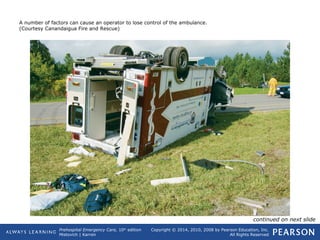
A number of factors can cause an operator to lose control of the ambulance.
(Courtesy Canandaigua Fire and Rescue)
continued on next slide
Prehospital Emergency Care, 10th
edition
Mistovich | Karren
Copyright © 2014, 2010, 2008 by Pearson Education, Inc.
All Rights Reserved
Driving the AmbulanceDriving the Ambulance
• Maintaining control of the vehicle
 Go the posted speed limit unless the
situation is critical.
 Avoid sudden braking.
 Minimize distractions; realize other
drivers may be distracted.
continued on next slide
Prehospital Emergency Care, 10th
edition
Mistovich | Karren
Copyright © 2014, 2010, 2008 by Pearson Education, Inc.
All Rights Reserved
Driving the AmbulanceDriving the Ambulance
• Maintaining control of the vehicle
 Avoid driving while fatigued.
 Be cautious at railroad crossings and
when approaching school buses,
bridges, or tunnels.
 Anticipate traffic patterns for weekdays
and weekends.
continued on next slide
Prehospital Emergency Care, 10th
edition
Mistovich | Karren
Copyright © 2014, 2010, 2008 by Pearson Education, Inc.
All Rights Reserved
Driving the AmbulanceDriving the Ambulance
• Maintaining control of the vehicle
 Be aware of the road surface.
 Use caution when backing.
 Be aware of aggressive drivers.
 Do not use escorts.
continued on next slide
Prehospital Emergency Care, 10th
edition
Mistovich | Karren
Copyright © 2014, 2010, 2008 by Pearson Education, Inc.
All Rights Reserved
Driving the AmbulanceDriving the Ambulance
• When driving at higher speeds:
 Be cautious with curves that lead to
populated areas, and those that crest
hills.
 Brake before you enter the curve, not in
the curve; enter the curve at the
outside.
 Accelerate carefully as you leave the
curve.
continued on next slide
Prehospital Emergency Care, 10th
edition
Mistovich | Karren
Copyright © 2014, 2010, 2008 by Pearson Education, Inc.
All Rights Reserved
Driving the AmbulanceDriving the Ambulance
• When driving at higher speeds:
 Use a lower gear when going down a
long hill.
 Brake smoothly.
continued on next slide
Prehospital Emergency Care, 10th
edition
Mistovich | Karren
Copyright © 2014, 2010, 2008 by Pearson Education, Inc.
All Rights Reserved
Driving the AmbulanceDriving the Ambulance
• Intersection collisions
 Slow down at each intersection to make
sure that it is clear.
 If you are crossing against the light,
come to a complete stop, proceed only
when traffic is clear stopped.
continued on next slide
Prehospital Emergency Care, 10th
edition
Mistovich | Karren
Copyright © 2014, 2010, 2008 by Pearson Education, Inc.
All Rights Reserved
Driving the AmbulanceDriving the Ambulance
• Intersection collisions
 When there are two emergency
vehicles:
• Maintain a safe distance between your
vehicle and the one in front of you, but
follow closely enough so that the
motorist can see both.
• Do not use the same siren mode on both
vehicles.
continued on next slide
Prehospital Emergency Care, 10th
edition
Mistovich | Karren
Copyright © 2014, 2010, 2008 by Pearson Education, Inc.
All Rights Reserved
Driving the AmbulanceDriving the Ambulance
• Intersection collisions
 Vehicles may block your view of
crosswalks.
 Slow down and anticipate pedestrians.
continued on next slide
Prehospital Emergency Care, 10th
edition
Mistovich | Karren
Copyright © 2014, 2010, 2008 by Pearson Education, Inc.
All Rights Reserved
Driving the AmbulanceDriving the Ambulance
• Inclement weather
 An ambulance requires twice the
stopping distance on wet pavement, and
five times as much on sleet or ice.
 Maintain a safe following distance.
continued on next slide
Prehospital Emergency Care, 10th
edition
Mistovich | Karren
Copyright © 2014, 2010, 2008 by Pearson Education, Inc.
All Rights Reserved
Driving the AmbulanceDriving the Ambulance
• Inclement weather
 Wet weather
• Wet roads can lead to hydroplaning.
• Keep mirrors cleared of water.
• Avoid sudden braking and sudden
steering changes.
continued on next slide
Prehospital Emergency Care, 10th
edition
Mistovich | Karren
Copyright © 2014, 2010, 2008 by Pearson Education, Inc.
All Rights Reserved
Driving the AmbulanceDriving the Ambulance
• Inclement weather
 Wet weather
• Slow down and turn on wipers before
driving through large puddles; tap the
brakes to dry them out.
• If you are hydroplaning, keep the
steering wheel steady and gently pump
the brake.
continued on next slide
Prehospital Emergency Care, 10th
edition
Mistovich | Karren
Copyright © 2014, 2010, 2008 by Pearson Education, Inc.
All Rights Reserved
Driving the AmbulanceDriving the Ambulance
• Inclement weather
 Winter weather
• Ensure the vehicle is in good working
order
• Carry emergency equipment (chains,
shovel, etc.)
• Use snow tires, if possible
continued on next slide
Prehospital Emergency Care, 10th
edition
Mistovich | Karren
Copyright © 2014, 2010, 2008 by Pearson Education, Inc.
All Rights Reserved
Driving the AmbulanceDriving the Ambulance
• Inclement weather
 Winter weather
• Stay aware of the temperature
• Avoid sudden movement of the steering
wheel and sudden braking
continued on next slide
Prehospital Emergency Care, 10th
edition
Mistovich | Karren
Copyright © 2014, 2010, 2008 by Pearson Education, Inc.
All Rights Reserved
Driving the AmbulanceDriving the Ambulance
• Inclement weather
 Poor visibility
• Slow down, but avoid sudden
deceleration.
• Watch the road ahead and behind.
• Turn on your lights, using low beams.
• If you slow to 15 mph below the speed
limit, use four-way flashers.
continued on next slide
Prehospital Emergency Care, 10th
edition
Mistovich | Karren
Copyright © 2014, 2010, 2008 by Pearson Education, Inc.
All Rights Reserved
Driving the AmbulanceDriving the Ambulance
• Inclement weather
 Poor visibility
• Use the defroster to keep fog off the
windshield
• If you need to slow down, tap the brake
pedal to warn motorists behind
• Anticipate that vehicles behind you will
come to a sudden stop
continued on next slide
Prehospital Emergency Care, 10th
edition
Mistovich | Karren
Copyright © 2014, 2010, 2008 by Pearson Education, Inc.
All Rights Reserved
Driving the AmbulanceDriving the Ambulance
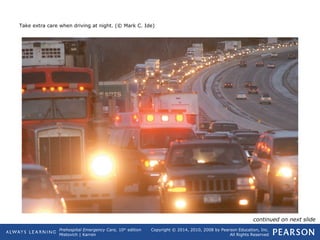
• Night driving
 The risk of fatal collisions is higher at
night.
continued on next slide
Prehospital Emergency Care, 10th
edition
Mistovich | Karren
Copyright © 2014, 2010, 2008 by Pearson Education, Inc.
All Rights Reserved
Take extra care when driving at night. (© Mark C. Ide)
continued on next slide
Prehospital Emergency Care, 10th
edition
Mistovich | Karren
Copyright © 2014, 2010, 2008 by Pearson Education, Inc.
All Rights Reserved
Driving the AmbulanceDriving the Ambulance
• Night driving
 Quartz-halogen headlights provide more
light.
 Have headlights on whenever you are
traveling in an emergency.
 Keep headlights clean and properly
aimed.
continued on next slide
Prehospital Emergency Care, 10th
edition
Mistovich | Karren
Copyright © 2014, 2010, 2008 by Pearson Education, Inc.
All Rights Reserved
Driving the AmbulanceDriving the Ambulance
• Night driving
 Replace burned-out bulbs immediately.
 Dim high beams within 500 feet of an
approaching vehicle or within 300 feet
of a vehicle in front of you.
 Never stare into the high beams of
another car.
continued on next slide
Prehospital Emergency Care, 10th
edition
Mistovich | Karren
Copyright © 2014, 2010, 2008 by Pearson Education, Inc.
All Rights Reserved
Driving the AmbulanceDriving the Ambulance
• Night driving
 Do not flick high beams up and down to
remind another driver to dim his lights.
 Never use high beams going into a
curve.
 Keep the windshield clean, inside and
out.
 Keep the instrument panel dim.
continued on next slide
Prehospital Emergency Care, 10th
edition
Mistovich | Karren
Copyright © 2014, 2010, 2008 by Pearson Education, Inc.
All Rights Reserved
Driving the AmbulanceDriving the Ambulance
• Night driving
 Keep your eyes moving; avoid focusing
on any one object.
 If the washing solution does not leave
the glass clean after ten wiper cycles,
replace the blades.
 Be rested before you begin a night
driving shift; be alert to impaired
drivers.
Prehospital Emergency Care, 10th
edition
Mistovich | Karren
Copyright © 2014, 2010, 2008 by Pearson Education, Inc.
All Rights Reserved
Warning DevicesWarning Devices
• Warning devices can save time, but
have risks.
• Follow protocols for use of warning
devices.
• Warning devices only request the right
of way; they do not guarantee it.
• You must exercise due regard when
using warning devices.
continued on next slide
Prehospital Emergency Care, 10th
edition
Mistovich | Karren
Copyright © 2014, 2010, 2008 by Pearson Education, Inc.
All Rights Reserved
Warning DevicesWarning Devices
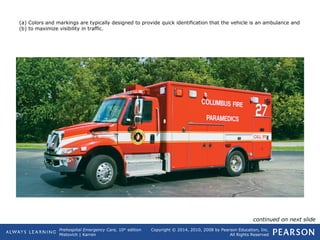
• Colors and markings
 Colors and markings provide for quick
identification of ambulances and make
them visible in traffic.
continued on next slide
Prehospital Emergency Care, 10th
edition
Mistovich | Karren
Copyright © 2014, 2010, 2008 by Pearson Education, Inc.
All Rights Reserved
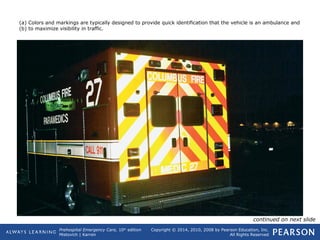
(a) Colors and markings are typically designed to provide quick identification that the vehicle is an ambulance and
(b) to maximize visibility in traffic.
continued on next slide
Prehospital Emergency Care, 10th
edition
Mistovich | Karren
Copyright © 2014, 2010, 2008 by Pearson Education, Inc.
All Rights Reserved
(a) Colors and markings are typically designed to provide quick identification that the vehicle is an ambulance and
(b) to maximize visibility in traffic.
continued on next slide
Prehospital Emergency Care, 10th
edition
Mistovich | Karren
Copyright © 2014, 2010, 2008 by Pearson Education, Inc.
All Rights Reserved
Warning DevicesWarning Devices
• Warning and emergency lights
 Activate emergency lights on emergency
calls.
 Use headlights, even in daylight.
 Lights are placed at various locations on
the ambulance for visibility.
continued on next slide
Prehospital Emergency Care, 10th
edition
Mistovich | Karren
Copyright © 2014, 2010, 2008 by Pearson Education, Inc.
All Rights Reserved
Warning DevicesWarning Devices
• Warning and emergency lights
 White lights are more visible than red
and blue.
 Minimize lights in fog and when parked.
continued on next slide
Prehospital Emergency Care, 10th
edition
Mistovich | Karren
Copyright © 2014, 2010, 2008 by Pearson Education, Inc.
All Rights Reserved
Warning DevicesWarning Devices
• Sirens
 Siren noise is greatly reduced on the
inside of vehicles.
 Do not startle drivers with sudden siren
noise.
 Siren noise is stressful for patients.
continued on next slide
Prehospital Emergency Care, 10th
edition
Mistovich | Karren
Copyright © 2014, 2010, 2008 by Pearson Education, Inc.
All Rights Reserved
Warning DevicesWarning Devices
• Sirens
 Ambulance operators drive faster when
sirens are on.
 The siren can prevent you from hearing
other emergency vehicles.
continued on next slide
Prehospital Emergency Care, 10th
edition
Mistovich | Karren
Copyright © 2014, 2010, 2008 by Pearson Education, Inc.
All Rights Reserved
Warning DevicesWarning Devices
• Air horns
 Consider using the air horn when you
need to clear traffic quickly.
 Do not sound the horn when you are
close to other vehicles.
Prehospital Emergency Care, 10th
edition
Mistovich | Karren
Copyright © 2014, 2010, 2008 by Pearson Education, Inc.
All Rights Reserved
Case StudyCase Study
Gary and Harold spot the collision just
ahead of them, and Gary notifies
dispatch that they are on the scene.
continued on next slide
Prehospital Emergency Care, 10th
edition
Mistovich | Karren
Copyright © 2014, 2010, 2008 by Pearson Education, Inc.
All Rights Reserved
Case StudyCase Study
• What should Gary and Harold consider
in determining how and where to park
the ambulance?
• What steps should the EMTs take to
make the scene as safe a working
environment as possible?
• What responsibilities must be
completed to carry the ambulance call
to completion?
Prehospital Emergency Care, 10th
edition
Mistovich | Karren
Copyright © 2014, 2010, 2008 by Pearson Education, Inc.
All Rights Reserved
Roadway Incident SafetyRoadway Incident Safety
• EMS personnel must set up a safe
environment when working on or near
a roadway.
• Poor visibility and impaired, distracted,
or inexperienced drivers are all factors
in roadway incident injuries.
continued on next slide
Prehospital Emergency Care, 10th
edition
Mistovich | Karren
Copyright © 2014, 2010, 2008 by Pearson Education, Inc.
All Rights Reserved
Roadway Incident SafetyRoadway Incident Safety
• High-visibility apparel
 EMTs and other rescue personnel
responding to emergencies on or near a
roadway must wear approved high-
visibility apparel.
 EMTs must wear apparel that meets the
Class 2 or 3 standards of ANSI/ISEA
107-2004 or the Public Safety Vest
standard ANSI/ISEA 207-2006.
continued on next slide
Prehospital Emergency Care, 10th
edition
Mistovich | Karren
Copyright © 2014, 2010, 2008 by Pearson Education, Inc.
All Rights Reserved
Roadway Incident SafetyRoadway Incident Safety
• Safety benchmarks
 Do not trust approaching traffic.
 Do not turn your back on approaching
traffic.
 Use the first-arriving emergency vehicle
to create a barrier between traffic and
the scene.
continued on next slide
Prehospital Emergency Care, 10th
edition
Mistovich | Karren
Copyright © 2014, 2010, 2008 by Pearson Education, Inc.
All Rights Reserved
Roadway Incident SafetyRoadway Incident Safety
• Safety benchmarks
 Wear personal protective equipment and
ANSI high-visibility vests.
 At night, turn off vision-impairing lights
 Use other emergency vehicles to slow
and redirect traffic.
continued on next slide
Prehospital Emergency Care, 10th
edition
Mistovich | Karren
Copyright © 2014, 2010, 2008 by Pearson Education, Inc.
All Rights Reserved
Roadway Incident SafetyRoadway Incident Safety
• Safety benchmarks
 Use advance warning signs and traffic
control measures upstream of the
scene.
 Use traffic cones to divert traffic.
 Assign a person to monitor traffic.
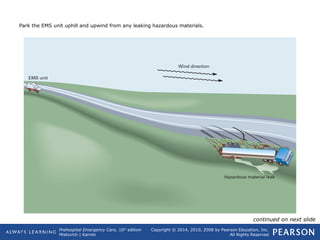
 Place vehicles uphill/upwind when
hazardous materials may be involved.
Prehospital Emergency Care, 10th
edition
Mistovich | Karren
Copyright © 2014, 2010, 2008 by Pearson Education, Inc.
All Rights Reserved
Phases of an Ambulance CallPhases of an Ambulance Call
• The major phases are:
 Daily prerun vehicle and equipment
preparation
 Dispatch
 En route to the scene
 At the scene
continued on next slide
Prehospital Emergency Care, 10th
edition
Mistovich | Karren
Copyright © 2014, 2010, 2008 by Pearson Education, Inc.
All Rights Reserved
Phases of an Ambulance CallPhases of an Ambulance Call
• The major phases are:
 En route to the receiving facility
 At the receiving facility
 En route to the station
 Post run
continued on next slide
Prehospital Emergency Care, 10th
edition
Mistovich | Karren
Copyright © 2014, 2010, 2008 by Pearson Education, Inc.
All Rights Reserved
Phases of an Ambulance CallPhases of an Ambulance Call
• Daily prerun vehicle preparation
 Basic ambulance maintenance includes
oil and filter changes, transmission and
differential checks, wheel bearing check,
brake check, and tie rod end inspection.
 Know your service's policies and
procedures for reporting and correcting
vehicle problems.
continued on next slide
Prehospital Emergency Care, 10th
edition
Mistovich | Karren
Copyright © 2014, 2010, 2008 by Pearson Education, Inc.
All Rights Reserved
Phases of an Ambulance CallPhases of an Ambulance Call
• Daily prerun vehicle preparation
 Includes checking the vehicle and
ensuring all supplies and equipment are
present and in working order
continued on next slide
Prehospital Emergency Care, 10th
edition
Mistovich | Karren
Copyright © 2014, 2010, 2008 by Pearson Education, Inc.
All Rights Reserved
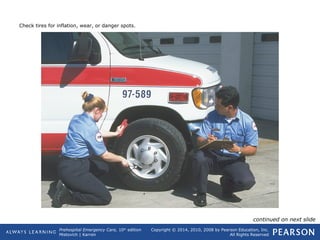
Check tires for inflation, wear, or danger spots.
continued on next slide
Prehospital Emergency Care, 10th
edition
Mistovich | Karren
Copyright © 2014, 2010, 2008 by Pearson Education, Inc.
All Rights Reserved
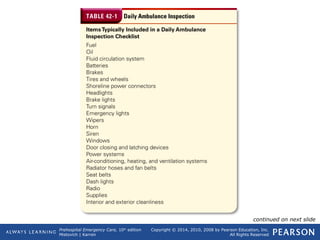
Table 42-1 Daily Ambulance InspectionM42_
continued on next slide
Prehospital Emergency Care, 10th
edition
Mistovich | Karren
Copyright © 2014, 2010, 2008 by Pearson Education, Inc.
All Rights Reserved
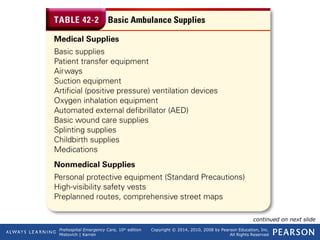
Table 42-2 Basic Ambulance Supplies
continued on next slide
Prehospital Emergency Care, 10th
edition
Mistovich | Karren
Copyright © 2014, 2010, 2008 by Pearson Education, Inc.
All Rights Reserved
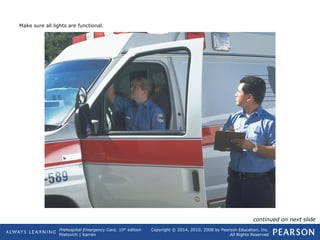
Make sure all lights are functional.
continued on next slide
Prehospital Emergency Care, 10th
edition
Mistovich | Karren
Copyright © 2014, 2010, 2008 by Pearson Education, Inc.
All Rights Reserved
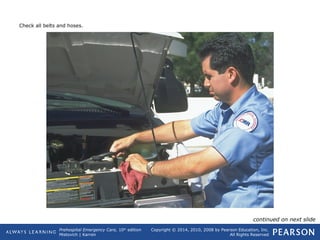
Check all belts and hoses.
continued on next slide
Prehospital Emergency Care, 10th
edition
Mistovich | Karren
Copyright © 2014, 2010, 2008 by Pearson Education, Inc.
All Rights Reserved
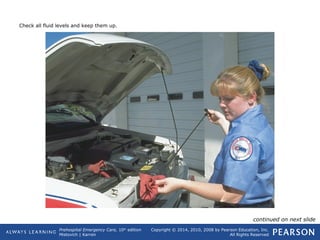
Check all fluid levels and keep them up.
continued on next slide
Prehospital Emergency Care, 10th
edition
Mistovich | Karren
Copyright © 2014, 2010, 2008 by Pearson Education, Inc.
All Rights Reserved
Phases of an Ambulance CallPhases of an Ambulance Call
• Dispatch
 A message from the communications
center will start you on your run.
 Ask the dispatcher to repeat any
information that seems unclear.
continued on next slide
Prehospital Emergency Care, 10th
edition
Mistovich | Karren
Copyright © 2014, 2010, 2008 by Pearson Education, Inc.
All Rights Reserved
Phases of an Ambulance CallPhases of an Ambulance Call
• En route to the scene
 Quickly check the vehicle before leaving
for the scene.
 Fasten your seatbelt.
 Verify dispatch information.
 Listen for status updates.
 Anticipate the equipment you will need.
continued on next slide
Prehospital Emergency Care, 10th
edition
Mistovich | Karren
Copyright © 2014, 2010, 2008 by Pearson Education, Inc.
All Rights Reserved
Phases of an Ambulance CallPhases of an Ambulance Call
• En route to the scene
 Drive responsibly.
 Determine what the crew members will
do at the scene.
 Request ALS, if necessary.
continued on next slide
Prehospital Emergency Care, 10th
edition
Mistovich | Karren
Copyright © 2014, 2010, 2008 by Pearson Education, Inc.
All Rights Reserved
Phases of an Ambulance CallPhases of an Ambulance Call
• At the scene
 Notify dispatch of arrival.
 Park in the most appropriate location.
 Perform a scene survey.
continued on next slide
Prehospital Emergency Care, 10th
edition
Mistovich | Karren
Copyright © 2014, 2010, 2008 by Pearson Education, Inc.
All Rights Reserved
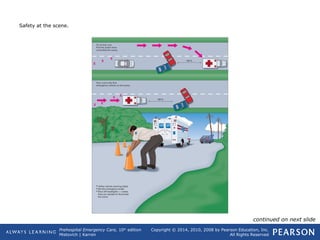
Safety at the scene.
continued on next slide
Prehospital Emergency Care, 10th
edition
Mistovich | Karren
Copyright © 2014, 2010, 2008 by Pearson Education, Inc.
All Rights Reserved
Park the EMS unit uphill and upwind from any leaking hazardous materials.
continued on next slide
Prehospital Emergency Care, 10th
edition
Mistovich | Karren
Copyright © 2014, 2010, 2008 by Pearson Education, Inc.
All Rights Reserved
Phases of an Ambulance CallPhases of an Ambulance Call
• At the scene
 Put on high-visibility apparel for
roadway scenes.
 Take Standard Precautions.
 Determine if it is safe to approach the
patient.
 Observe the scene, determine the
nature of the problem/mechanism of
injury.
continued on next slide
Prehospital Emergency Care, 10th
edition
Mistovich | Karren
Copyright © 2014, 2010, 2008 by Pearson Education, Inc.
All Rights Reserved
Phases of an Ambulance CallPhases of an Ambulance Call
• At the scene
 Determine the number of patients.
 Determine priorities of care.
 If needed, gain access to the patient.
 Provide treatment.
 Move the patient to the ambulance,
observing safety precautions.
continued on next slide
Prehospital Emergency Care, 10th
edition
Mistovich | Karren
Copyright © 2014, 2010, 2008 by Pearson Education, Inc.
All Rights Reserved
Phases of an Ambulance CallPhases of an Ambulance Call
• En route to the receiving facility
continued on next slide
Prehospital Emergency Care, 10th
edition
Mistovich | Karren
Copyright © 2014, 2010, 2008 by Pearson Education, Inc.
All Rights Reserved
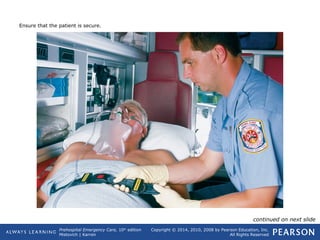
Ensure that the patient is secure.
continued on next slide
Prehospital Emergency Care, 10th
edition
Mistovich | Karren
Copyright © 2014, 2010, 2008 by Pearson Education, Inc.
All Rights Reserved
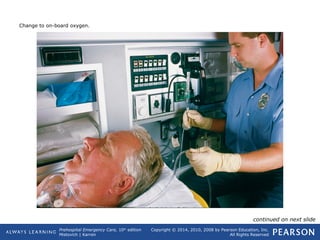
Change to on-board oxygen.
continued on next slide
Prehospital Emergency Care, 10th
edition
Mistovich | Karren
Copyright © 2014, 2010, 2008 by Pearson Education, Inc.
All Rights Reserved
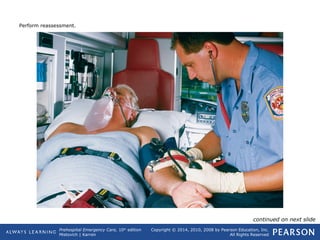
Perform reassessment.
continued on next slide
Prehospital Emergency Care, 10th
edition
Mistovich | Karren
Copyright © 2014, 2010, 2008 by Pearson Education, Inc.
All Rights Reserved
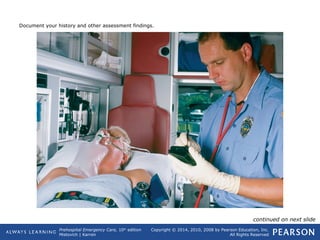
Document your history and other assessment findings.
continued on next slide
Prehospital Emergency Care, 10th
edition
Mistovich | Karren
Copyright © 2014, 2010, 2008 by Pearson Education, Inc.
All Rights Reserved
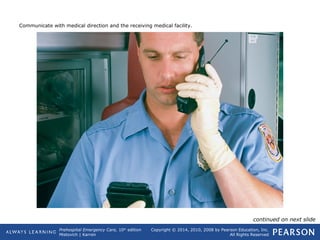
Communicate with medical direction and the receiving medical facility.
continued on next slide
Prehospital Emergency Care, 10th
edition
Mistovich | Karren
Copyright © 2014, 2010, 2008 by Pearson Education, Inc.
All Rights Reserved
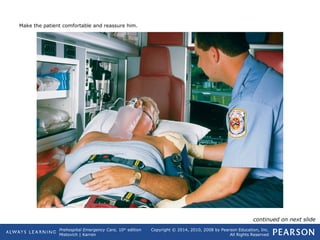
Make the patient comfortable and reassure him.
continued on next slide
Prehospital Emergency Care, 10th
edition
Mistovich | Karren
Copyright © 2014, 2010, 2008 by Pearson Education, Inc.
All Rights Reserved
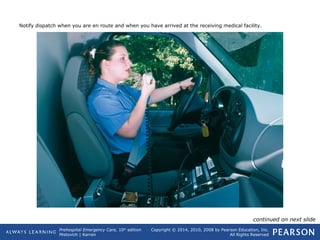
Notify dispatch when you are en route and when you have arrived at the receiving medical facility.
continued on next slide
Prehospital Emergency Care, 10th
edition
Mistovich | Karren
Copyright © 2014, 2010, 2008 by Pearson Education, Inc.
All Rights Reserved
Phases of an Ambulance CallPhases of an Ambulance Call
• At the receiving facility
 Transfer patient care, with all records,
personal belongings and an oral report
 Assist in moving the patient
 Exchange linen and equipment that may
be left with the patient
 Complete the patient care report
continued on next slide
Prehospital Emergency Care, 10th
edition
Mistovich | Karren
Copyright © 2014, 2010, 2008 by Pearson Education, Inc.
All Rights Reserved
Phases of an Ambulance CallPhases of an Ambulance Call
• En route to station or response area
 Before leaving the hospital, clean,
inspect, and restock the ambulance.
 Wash your hands.
 Notify dispatch.
 Return to station.
 Refuel if needed.
continued on next slide
Prehospital Emergency Care, 10th
edition
Mistovich | Karren
Copyright © 2014, 2010, 2008 by Pearson Education, Inc.
All Rights Reserved
Phases of an Ambulance CallPhases of an Ambulance Call
• Post run
 Fill out and file any reports as required
by local protocol.
 After each run, check fuel.
 Replace what you used during the run;
clean and disinfect nondisposable
equipment used.
 Change soiled uniforms.
Prehospital Emergency Care, 10th
edition
Mistovich | Karren
Copyright © 2014, 2010, 2008 by Pearson Education, Inc.
All Rights Reserved
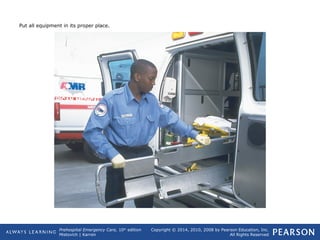
Put all equipment in its proper place.
Prehospital Emergency Care, 10th
edition
Mistovich | Karren
Copyright © 2014, 2010, 2008 by Pearson Education, Inc.
All Rights Reserved
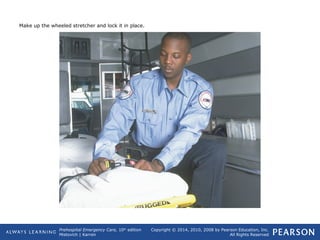
Make up the wheeled stretcher and lock it in place.
Prehospital Emergency Care, 10th
edition
Mistovich | Karren
Copyright © 2014, 2010, 2008 by Pearson Education, Inc.
All Rights Reserved
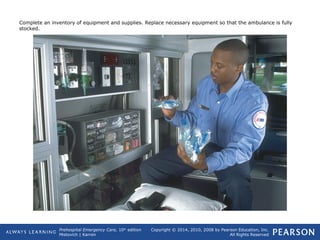
Complete an inventory of equipment and supplies. Replace necessary equipment so that the ambulance is fully
stocked.
Prehospital Emergency Care, 10th
edition
Mistovich | Karren
Copyright © 2014, 2010, 2008 by Pearson Education, Inc.
All Rights Reserved
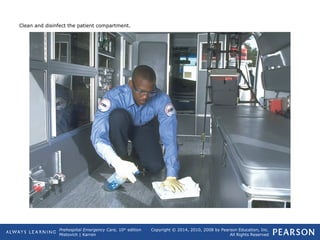
Clean and disinfect the patient compartment.
Prehospital Emergency Care, 10th
edition
Mistovich | Karren
Copyright © 2014, 2010, 2008 by Pearson Education, Inc.
All Rights Reserved
Click on the phase of an ambulance call during whichClick on the phase of an ambulance call during which
EMTs complete checklists to ensure the vehicle is inEMTs complete checklists to ensure the vehicle is in
working order and all equipment is available.working order and all equipment is available.
A. Post run
C. At the receiving facility
B. Prerun preparation
D. Dispatch
Prehospital Emergency Care, 10th
edition
Mistovich | Karren
Copyright © 2014, 2010, 2008 by Pearson Education, Inc.
All Rights Reserved
Air Medical TransportAir Medical Transport
• When to request air medical transport
 Operational guidelines
• The patient needs to be transported to a
distant facility.
• Prolonged extrication is expected for a
high-priority.
• Air transport will clearly save time over
ground transport in a time-critical
patient.
continued on next slide
Prehospital Emergency Care, 10th
edition
Mistovich | Karren
Copyright © 2014, 2010, 2008 by Pearson Education, Inc.
All Rights Reserved
Air Medical TransportAir Medical Transport
• When to request air medical transport
 Operational guidelines
• The patient is in a remote area
unreachable by ground vehicles.
• Ground ambulance transport is blocked.
• The air transport crew possesses
specialty medical skills, supplies, or
equipment not available with the ground
ambulance.
continued on next slide
Prehospital Emergency Care, 10th
edition
Mistovich | Karren
Copyright © 2014, 2010, 2008 by Pearson Education, Inc.
All Rights Reserved
Air Medical TransportAir Medical Transport
• When to request air medical transport
 Medical guidelines
• Time-critical illness or injury, such as:
• Acute stroke
• Head injury with altered mental status and
signs of herniation
• Chest or abdominal trauma with signs of
respiratory distress or shock
continued on next slide
Prehospital Emergency Care, 10th
edition
Mistovich | Karren
Copyright © 2014, 2010, 2008 by Pearson Education, Inc.
All Rights Reserved
Air Medical TransportAir Medical Transport
• When to request air medical transport
 Medical guidelines
• Time-critical illness or injury, such as:
• Serious mechanism of injury with unstable
primary assessment findings or unstable
vital signs
• Penetrating injury to the body cavity with
unstable primary assessment findings
continued on next slide
Prehospital Emergency Care, 10th
edition
Mistovich | Karren
Copyright © 2014, 2010, 2008 by Pearson Education, Inc.
All Rights Reserved
Air Medical TransportAir Medical Transport
• When requesting helicopter transport,
provide:
 Your name
 Department name
 Callback number
 Nature of the incident
 Exact location of the incident
 Your radio frequency
 Exact location of the landing zone
continued on next slide
Prehospital Emergency Care, 10th
edition
Mistovich | Karren
Copyright © 2014, 2010, 2008 by Pearson Education, Inc.
All Rights Reserved
Air Medical TransportAir Medical Transport
• Limitations of air medical transport
 Weather/environmental limitations
 Altitude limitations
 Airspeed limitations
 Aircraft cabin size
continued on next slide
Prehospital Emergency Care, 10th
edition
Mistovich | Karren
Copyright © 2014, 2010, 2008 by Pearson Education, Inc.
All Rights Reserved
Air Medical TransportAir Medical Transport
• Limitations of air medical transport
 Terrain
 Cost
 Patient preparation
 Noise-limited assessment
continued on next slide
Prehospital Emergency Care, 10th
edition
Mistovich | Karren
Copyright © 2014, 2010, 2008 by Pearson Education, Inc.
All Rights Reserved
Air Medical TransportAir Medical Transport
• Guidelines for setting up a landing zone
 Make sure the landing area is clear of
obstructions, flat, free of debris, and
150 feet from collision vehicles.
 Minimum 60 feet by 60 feet for day;
100 feet by 100 feet for night
continued on next slide
Prehospital Emergency Care, 10th
edition
Mistovich | Karren
Copyright © 2014, 2010, 2008 by Pearson Education, Inc.
All Rights Reserved
Air Medical TransportAir Medical Transport
• Guidelines for setting up a landing zone
 Stop traffic on both sides of a divided
highway.
 Consider the wind direction.
 Mark the corners of the landing area.
 Wet the area, if possible, if it is dry or
dusty.
continued on next slide
Prehospital Emergency Care, 10th
edition
Mistovich | Karren
Copyright © 2014, 2010, 2008 by Pearson Education, Inc.
All Rights Reserved
Air Medical TransportAir Medical Transport
• Guidelines for setting up a landing zone
 Keep clear of the downwash area.
 Assign one person to guide the pilot in.
 Follow the directions of the pilot and
crew.
 Be cautious of rotor blades and only
approach or leave the aircraft at the
pilot's direction.
continued on next slide
Prehospital Emergency Care, 10th
edition
Mistovich | Karren
Copyright © 2014, 2010, 2008 by Pearson Education, Inc.
All Rights Reserved
Always crouch when approaching or leaving a helicopter.
continued on next slide
Prehospital Emergency Care, 10th
edition
Mistovich | Karren
Copyright © 2014, 2010, 2008 by Pearson Education, Inc.
All Rights Reserved
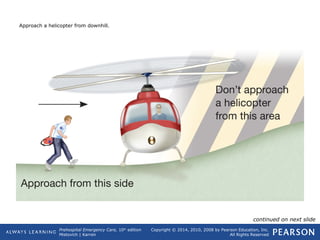
Approach a helicopter from downhill.
continued on next slide
Prehospital Emergency Care, 10th
edition
Mistovich | Karren
Copyright © 2014, 2010, 2008 by Pearson Education, Inc.
All Rights Reserved
Air Medical TransportAir Medical Transport
• Guidelines for setting up a landing zone
 Secure loose items.
 No smoking within 50 feet of the
aircraft.
 On an incline, approach the aircraft from
the downhill side.
 Do not point spotlights at the helicopter
on its final approach.
Prehospital Emergency Care, 10th
edition
Mistovich | Karren
Copyright © 2014, 2010, 2008 by Pearson Education, Inc.
All Rights Reserved
Security and SafetySecurity and Safety
• There are recommended guidelines to
avoid use of emergency vehicles in
terrorist attacks and to reduce the risk
of theft.
continued on next slide
Prehospital Emergency Care, 10th
edition
Mistovich | Karren
Copyright © 2014, 2010, 2008 by Pearson Education, Inc.
All Rights Reserved
Security and SafetySecurity and Safety
• Personnel
 Conduct security briefings at the
beginning of each shift.
 EMS crews should be well-informed and
allowed to participate in development of
security measures.
continued on next slide
Prehospital Emergency Care, 10th
edition
Mistovich | Karren
Copyright © 2014, 2010, 2008 by Pearson Education, Inc.
All Rights Reserved
Security and SafetySecurity and Safety
• Vehicle
 All vehicles must be tracked at all times.
 EMS vehicles should not be left running
or unattended with the keys in the
vehicle.
continued on next slide
Prehospital Emergency Care, 10th
edition
Mistovich | Karren
Copyright © 2014, 2010, 2008 by Pearson Education, Inc.
All Rights Reserved
Security and SafetySecurity and Safety
• Tracking vehicle access
 No access by unauthorized persons
 Keeping a key log
 Security measures to be followed during
repairs
 All markings must be destroyed when
vehicles are sold or salvaged and
warning devices must be removed.
continued on next slide
Prehospital Emergency Care, 10th
edition
Mistovich | Karren
Copyright © 2014, 2010, 2008 by Pearson Education, Inc.
All Rights Reserved
Security and SafetySecurity and Safety
• Uniforms and identification
 Safeguard identification cards and
patches from unauthorized persons.
 ID cards and badges should be
counterfeit resistant and have a photo
of the provider.
 Uniform stores must verify the
identification of persons buying uniforms
or identification items.
continued on next slide
Prehospital Emergency Care, 10th
edition
Mistovich | Karren
Copyright © 2014, 2010, 2008 by Pearson Education, Inc.
All Rights Reserved
Security and SafetySecurity and Safety
• Carbon monoxide in ambulances may
come from:
 The vehicle's exhaust
 Equipment powered by gasoline or fuel
 Exhaust of vehicles parked next to or
traveling by the ambulance
 Greater outside air pressure, which
forces the CO into the ambulance
continued on next slide
Prehospital Emergency Care, 10th
edition
Mistovich | Karren
Copyright © 2014, 2010, 2008 by Pearson Education, Inc.
All Rights Reserved
Security and SafetySecurity and Safety
• Signs and symptoms of carbon
monoxide poisoning include:
 Yawning
 Dizziness
 Dimmed vision
 Headache
 Irregular heart rhythm
 Nausea, vomiting
 Seizures, coma, death
continued on next slide
Prehospital Emergency Care, 10th
edition
Mistovich | Karren
Copyright © 2014, 2010, 2008 by Pearson Education, Inc.
All Rights Reserved
Security and SafetySecurity and Safety
• To prevent carbon monoxide poisoning:
 Have frequent engine tune-ups
 Have an adequate exhaust system that
discharges beyond the side of the
vehicle
 Keep rear windows shut
 Make sure doors shut tightly
continued on next slide
Prehospital Emergency Care, 10th
edition
Mistovich | Karren
Copyright © 2014, 2010, 2008 by Pearson Education, Inc.
All Rights Reserved
Security and SafetySecurity and Safety
• To prevent carbon monoxide poisoning:
 Cover any opening to the outside
 Don't use ventilation exhaust fans or
static roof vents
 Keep the heater or air conditioner on
 Don't use equipment powered by
gasoline or fuel inside the ambulance
Prehospital Emergency Care, 10th
edition
Mistovich | Karren
Copyright © 2014, 2010, 2008 by Pearson Education, Inc.
All Rights Reserved
Case Study ConclusionCase Study Conclusion
Gary and Harold park the ambulance and
put on their reflective gear. They perform
a careful scene size-up, and determine
that they have a single patient.
After assessing the patient and beginning
treatment, they begin transport to the
hospital, where they transfer patient care
to the emergency department staff.
continued on next slide
Prehospital Emergency Care, 10th
edition
Mistovich | Karren
Copyright © 2014, 2010, 2008 by Pearson Education, Inc.
All Rights Reserved
Case Study ConclusionCase Study Conclusion
Gary finishes the patient care report,
while Harold takes the steps necessary to
return the ambulance to service.
Prehospital Emergency Care, 10th
edition
Mistovich | Karren
Copyright © 2014, 2010, 2008 by Pearson Education, Inc.
All Rights Reserved
Lesson SummaryLesson Summary
• Ambulances crashes kill and severely
injure many EMTs, patients, and
others.
• EMTs must obey all laws and
regulations when operating an
ambulance, and must exercise due
regard.
continued on next slide
Prehospital Emergency Care, 10th
edition
Mistovich | Karren
Copyright © 2014, 2010, 2008 by Pearson Education, Inc.
All Rights Reserved
Lesson SummaryLesson Summary
• EMTs have specific responsibilities
during each phase of an ambulance
call.
• EMTs must take special steps in
preparing to interact with an air
medical transport crew
continued on next slide
Prehospital Emergency Care, 10th
edition
Mistovich | Karren
Copyright © 2014, 2010, 2008 by Pearson Education, Inc.
All Rights Reserved
Lesson SummaryLesson Summary
• Safety and security issues with
ambulances include safeguarding
against improper use of ambulances
and preventing carbon monoxide
exposure

DMACC EMT Chapter 42

  • 1.
    PREHOSPITALPREHOSPITAL EMERGENCY CAREEMERGENCY CARE CHAPTER Copyright© 2014, 2010, 2008 by Pearson Education, Inc. All Rights Reserved Prehospital Emergency Care, 10th edition Mistovich | Karren TENTH EDITION Ambulance Operations and Air Medical Response 42
  • 2.
    Prehospital Emergency Care,10th edition Mistovich | Karren Copyright © 2014, 2010, 2008 by Pearson Education, Inc. All Rights Reserved Learning ReadinessLearning Readiness • EMS Education Standards, text p. 1155
  • 3.
    Prehospital Emergency Care,10th edition Mistovich | Karren Copyright © 2014, 2010, 2008 by Pearson Education, Inc. All Rights Reserved Learning ReadinessLearning Readiness ObjectivesObjectives • Please refer to page 1155 of your text to view the objectives for this chapter.
  • 4.
    Prehospital Emergency Care,10th edition Mistovich | Karren Copyright © 2014, 2010, 2008 by Pearson Education, Inc. All Rights Reserved Learning ReadinessLearning Readiness Key TermsKey Terms • Please refer to page 1155 of your text to view the key terms for this chapter.
  • 5.
    Prehospital Emergency Care,10th edition Mistovich | Karren Copyright © 2014, 2010, 2008 by Pearson Education, Inc. All Rights Reserved Setting the StageSetting the Stage • Overview of Lesson Topics  Driving the Ambulance  Warning Devices  Roadway Incident Safety  Phases of an Ambulance Call  Air Medical Transport  Security and Safety
  • 6.
    Prehospital Emergency Care,10th edition Mistovich | Karren Copyright © 2014, 2010, 2008 by Pearson Education, Inc. All Rights Reserved Case Study IntroductionCase Study Introduction EMTs Gary Farmer and Harold Begay are completing their pre-shift vehicle inspection when they are dispatched for a report of a vehicle collision.
  • 7.
    Prehospital Emergency Care,10th edition Mistovich | Karren Copyright © 2014, 2010, 2008 by Pearson Education, Inc. All Rights Reserved Case StudyCase Study • What steps do Gary and Harold need to take before heading to the scene? • How will Gary and Harold decide the best route to travel to reach their destination? • What actions must they take to minimize their chances of being in a collision during the response?
  • 8.
    Prehospital Emergency Care,10th edition Mistovich | Karren Copyright © 2014, 2010, 2008 by Pearson Education, Inc. All Rights Reserved IntroductionIntroduction • An ambulance should be a place of comfort and support to patients. • There are 5,000 ambulance crashes each year in the United States. • EMTs must be able to skillfully operate an ambulance.
  • 9.
    Prehospital Emergency Care,10th edition Mistovich | Karren Copyright © 2014, 2010, 2008 by Pearson Education, Inc. All Rights Reserved Driving the AmbulanceDriving the Ambulance • Laws, regulations, and ordinances apply to the operation of ambulances. • Certain privileges are afforded to ambulance operators. • It is never justified to operate an ambulance unsafely. continued on next slide
  • 10.
    Prehospital Emergency Care,10th edition Mistovich | Karren Copyright © 2014, 2010, 2008 by Pearson Education, Inc. All Rights Reserved Driving the AmbulanceDriving the Ambulance • Generally, an ambulance may do the following in an emergency:  Exceed the posted speed limit as long as lives or property are not endangered.  Drive the wrong way down a one-way street or drive down the opposite side of the road. continued on next slide
  • 11.
    Prehospital Emergency Care,10th edition Mistovich | Karren Copyright © 2014, 2010, 2008 by Pearson Education, Inc. All Rights Reserved Driving the AmbulanceDriving the Ambulance • Generally, an ambulance may do the following in an emergency:  Turn in any direction at any intersection.  Park anywhere as long as lives or property are not endangered.  Leave the ambulance standing in the middle of a street or intersection. continued on next slide
  • 12.
    Prehospital Emergency Care,10th edition Mistovich | Karren Copyright © 2014, 2010, 2008 by Pearson Education, Inc. All Rights Reserved Driving the AmbulanceDriving the Ambulance • Generally, an ambulance may do the following in an emergency:  Cautiously proceed through a red light or red flashing signal.  Pass other vehicles in no-passing zones. continued on next slide
  • 13.
    Prehospital Emergency Care,10th edition Mistovich | Karren Copyright © 2014, 2010, 2008 by Pearson Education, Inc. All Rights Reserved Driving the AmbulanceDriving the Ambulance • To exercise emergency privileges, you must:  Have a valid driver's license and possibly complete a driving course.  Be responding to an emergency.  Use warning devices. continued on next slide
  • 14.
    Prehospital Emergency Care,10th edition Mistovich | Karren Copyright © 2014, 2010, 2008 by Pearson Education, Inc. All Rights Reserved Driving the AmbulanceDriving the Ambulance • To exercise emergency privileges, you must:  Exercise due regard for the safety of others.  Follow additional guidance from your EMS system. continued on next slide
  • 15.
    Prehospital Emergency Care,10th edition Mistovich | Karren Copyright © 2014, 2010, 2008 by Pearson Education, Inc. All Rights Reserved Driving the AmbulanceDriving the Ambulance • Good driving basics  Wear seatbelts.  Hold the steering wheel with both hands.  Practice with the vehicle you will be driving.  Respond to weather and road conditions. continued on next slide
  • 16.
    Prehospital Emergency Care,10th edition Mistovich | Karren Copyright © 2014, 2010, 2008 by Pearson Education, Inc. All Rights Reserved Driving the AmbulanceDriving the Ambulance • Good driving basics  Select the best route for safe travel.  Maintain a safe following distance.  Use headlights.  Exercise caution when using warning devices. continued on next slide
  • 17.
    Prehospital Emergency Care,10th edition Mistovich | Karren Copyright © 2014, 2010, 2008 by Pearson Education, Inc. All Rights Reserved A number of factors can cause an operator to lose control of the ambulance. (Courtesy Canandaigua Fire and Rescue) continued on next slide
  • 18.
    Prehospital Emergency Care,10th edition Mistovich | Karren Copyright © 2014, 2010, 2008 by Pearson Education, Inc. All Rights Reserved Driving the AmbulanceDriving the Ambulance • Maintaining control of the vehicle  Go the posted speed limit unless the situation is critical.  Avoid sudden braking.  Minimize distractions; realize other drivers may be distracted. continued on next slide
  • 19.
    Prehospital Emergency Care,10th edition Mistovich | Karren Copyright © 2014, 2010, 2008 by Pearson Education, Inc. All Rights Reserved Driving the AmbulanceDriving the Ambulance • Maintaining control of the vehicle  Avoid driving while fatigued.  Be cautious at railroad crossings and when approaching school buses, bridges, or tunnels.  Anticipate traffic patterns for weekdays and weekends. continued on next slide
  • 20.
    Prehospital Emergency Care,10th edition Mistovich | Karren Copyright © 2014, 2010, 2008 by Pearson Education, Inc. All Rights Reserved Driving the AmbulanceDriving the Ambulance • Maintaining control of the vehicle  Be aware of the road surface.  Use caution when backing.  Be aware of aggressive drivers.  Do not use escorts. continued on next slide
  • 21.
    Prehospital Emergency Care,10th edition Mistovich | Karren Copyright © 2014, 2010, 2008 by Pearson Education, Inc. All Rights Reserved Driving the AmbulanceDriving the Ambulance • When driving at higher speeds:  Be cautious with curves that lead to populated areas, and those that crest hills.  Brake before you enter the curve, not in the curve; enter the curve at the outside.  Accelerate carefully as you leave the curve. continued on next slide
  • 22.
    Prehospital Emergency Care,10th edition Mistovich | Karren Copyright © 2014, 2010, 2008 by Pearson Education, Inc. All Rights Reserved Driving the AmbulanceDriving the Ambulance • When driving at higher speeds:  Use a lower gear when going down a long hill.  Brake smoothly. continued on next slide
  • 23.
    Prehospital Emergency Care,10th edition Mistovich | Karren Copyright © 2014, 2010, 2008 by Pearson Education, Inc. All Rights Reserved Driving the AmbulanceDriving the Ambulance • Intersection collisions  Slow down at each intersection to make sure that it is clear.  If you are crossing against the light, come to a complete stop, proceed only when traffic is clear stopped. continued on next slide
  • 24.
    Prehospital Emergency Care,10th edition Mistovich | Karren Copyright © 2014, 2010, 2008 by Pearson Education, Inc. All Rights Reserved Driving the AmbulanceDriving the Ambulance • Intersection collisions  When there are two emergency vehicles: • Maintain a safe distance between your vehicle and the one in front of you, but follow closely enough so that the motorist can see both. • Do not use the same siren mode on both vehicles. continued on next slide
  • 25.
    Prehospital Emergency Care,10th edition Mistovich | Karren Copyright © 2014, 2010, 2008 by Pearson Education, Inc. All Rights Reserved Driving the AmbulanceDriving the Ambulance • Intersection collisions  Vehicles may block your view of crosswalks.  Slow down and anticipate pedestrians. continued on next slide
  • 26.
    Prehospital Emergency Care,10th edition Mistovich | Karren Copyright © 2014, 2010, 2008 by Pearson Education, Inc. All Rights Reserved Driving the AmbulanceDriving the Ambulance • Inclement weather  An ambulance requires twice the stopping distance on wet pavement, and five times as much on sleet or ice.  Maintain a safe following distance. continued on next slide
  • 27.
    Prehospital Emergency Care,10th edition Mistovich | Karren Copyright © 2014, 2010, 2008 by Pearson Education, Inc. All Rights Reserved Driving the AmbulanceDriving the Ambulance • Inclement weather  Wet weather • Wet roads can lead to hydroplaning. • Keep mirrors cleared of water. • Avoid sudden braking and sudden steering changes. continued on next slide
  • 28.
    Prehospital Emergency Care,10th edition Mistovich | Karren Copyright © 2014, 2010, 2008 by Pearson Education, Inc. All Rights Reserved Driving the AmbulanceDriving the Ambulance • Inclement weather  Wet weather • Slow down and turn on wipers before driving through large puddles; tap the brakes to dry them out. • If you are hydroplaning, keep the steering wheel steady and gently pump the brake. continued on next slide
  • 29.
    Prehospital Emergency Care,10th edition Mistovich | Karren Copyright © 2014, 2010, 2008 by Pearson Education, Inc. All Rights Reserved Driving the AmbulanceDriving the Ambulance • Inclement weather  Winter weather • Ensure the vehicle is in good working order • Carry emergency equipment (chains, shovel, etc.) • Use snow tires, if possible continued on next slide
  • 30.
    Prehospital Emergency Care,10th edition Mistovich | Karren Copyright © 2014, 2010, 2008 by Pearson Education, Inc. All Rights Reserved Driving the AmbulanceDriving the Ambulance • Inclement weather  Winter weather • Stay aware of the temperature • Avoid sudden movement of the steering wheel and sudden braking continued on next slide
  • 31.
    Prehospital Emergency Care,10th edition Mistovich | Karren Copyright © 2014, 2010, 2008 by Pearson Education, Inc. All Rights Reserved Driving the AmbulanceDriving the Ambulance • Inclement weather  Poor visibility • Slow down, but avoid sudden deceleration. • Watch the road ahead and behind. • Turn on your lights, using low beams. • If you slow to 15 mph below the speed limit, use four-way flashers. continued on next slide
  • 32.
    Prehospital Emergency Care,10th edition Mistovich | Karren Copyright © 2014, 2010, 2008 by Pearson Education, Inc. All Rights Reserved Driving the AmbulanceDriving the Ambulance • Inclement weather  Poor visibility • Use the defroster to keep fog off the windshield • If you need to slow down, tap the brake pedal to warn motorists behind • Anticipate that vehicles behind you will come to a sudden stop continued on next slide
  • 33.
    Prehospital Emergency Care,10th edition Mistovich | Karren Copyright © 2014, 2010, 2008 by Pearson Education, Inc. All Rights Reserved Driving the AmbulanceDriving the Ambulance • Night driving  The risk of fatal collisions is higher at night. continued on next slide
  • 34.
    Prehospital Emergency Care,10th edition Mistovich | Karren Copyright © 2014, 2010, 2008 by Pearson Education, Inc. All Rights Reserved Take extra care when driving at night. (© Mark C. Ide) continued on next slide
  • 35.
    Prehospital Emergency Care,10th edition Mistovich | Karren Copyright © 2014, 2010, 2008 by Pearson Education, Inc. All Rights Reserved Driving the AmbulanceDriving the Ambulance • Night driving  Quartz-halogen headlights provide more light.  Have headlights on whenever you are traveling in an emergency.  Keep headlights clean and properly aimed. continued on next slide
  • 36.
    Prehospital Emergency Care,10th edition Mistovich | Karren Copyright © 2014, 2010, 2008 by Pearson Education, Inc. All Rights Reserved Driving the AmbulanceDriving the Ambulance • Night driving  Replace burned-out bulbs immediately.  Dim high beams within 500 feet of an approaching vehicle or within 300 feet of a vehicle in front of you.  Never stare into the high beams of another car. continued on next slide
  • 37.
    Prehospital Emergency Care,10th edition Mistovich | Karren Copyright © 2014, 2010, 2008 by Pearson Education, Inc. All Rights Reserved Driving the AmbulanceDriving the Ambulance • Night driving  Do not flick high beams up and down to remind another driver to dim his lights.  Never use high beams going into a curve.  Keep the windshield clean, inside and out.  Keep the instrument panel dim. continued on next slide
  • 38.
    Prehospital Emergency Care,10th edition Mistovich | Karren Copyright © 2014, 2010, 2008 by Pearson Education, Inc. All Rights Reserved Driving the AmbulanceDriving the Ambulance • Night driving  Keep your eyes moving; avoid focusing on any one object.  If the washing solution does not leave the glass clean after ten wiper cycles, replace the blades.  Be rested before you begin a night driving shift; be alert to impaired drivers.
  • 39.
    Prehospital Emergency Care,10th edition Mistovich | Karren Copyright © 2014, 2010, 2008 by Pearson Education, Inc. All Rights Reserved Warning DevicesWarning Devices • Warning devices can save time, but have risks. • Follow protocols for use of warning devices. • Warning devices only request the right of way; they do not guarantee it. • You must exercise due regard when using warning devices. continued on next slide
  • 40.
    Prehospital Emergency Care,10th edition Mistovich | Karren Copyright © 2014, 2010, 2008 by Pearson Education, Inc. All Rights Reserved Warning DevicesWarning Devices • Colors and markings  Colors and markings provide for quick identification of ambulances and make them visible in traffic. continued on next slide
  • 41.
    Prehospital Emergency Care,10th edition Mistovich | Karren Copyright © 2014, 2010, 2008 by Pearson Education, Inc. All Rights Reserved (a) Colors and markings are typically designed to provide quick identification that the vehicle is an ambulance and (b) to maximize visibility in traffic. continued on next slide
  • 42.
    Prehospital Emergency Care,10th edition Mistovich | Karren Copyright © 2014, 2010, 2008 by Pearson Education, Inc. All Rights Reserved (a) Colors and markings are typically designed to provide quick identification that the vehicle is an ambulance and (b) to maximize visibility in traffic. continued on next slide
  • 43.
    Prehospital Emergency Care,10th edition Mistovich | Karren Copyright © 2014, 2010, 2008 by Pearson Education, Inc. All Rights Reserved Warning DevicesWarning Devices • Warning and emergency lights  Activate emergency lights on emergency calls.  Use headlights, even in daylight.  Lights are placed at various locations on the ambulance for visibility. continued on next slide
  • 44.
    Prehospital Emergency Care,10th edition Mistovich | Karren Copyright © 2014, 2010, 2008 by Pearson Education, Inc. All Rights Reserved Warning DevicesWarning Devices • Warning and emergency lights  White lights are more visible than red and blue.  Minimize lights in fog and when parked. continued on next slide
  • 45.
    Prehospital Emergency Care,10th edition Mistovich | Karren Copyright © 2014, 2010, 2008 by Pearson Education, Inc. All Rights Reserved Warning DevicesWarning Devices • Sirens  Siren noise is greatly reduced on the inside of vehicles.  Do not startle drivers with sudden siren noise.  Siren noise is stressful for patients. continued on next slide
  • 46.
    Prehospital Emergency Care,10th edition Mistovich | Karren Copyright © 2014, 2010, 2008 by Pearson Education, Inc. All Rights Reserved Warning DevicesWarning Devices • Sirens  Ambulance operators drive faster when sirens are on.  The siren can prevent you from hearing other emergency vehicles. continued on next slide
  • 47.
    Prehospital Emergency Care,10th edition Mistovich | Karren Copyright © 2014, 2010, 2008 by Pearson Education, Inc. All Rights Reserved Warning DevicesWarning Devices • Air horns  Consider using the air horn when you need to clear traffic quickly.  Do not sound the horn when you are close to other vehicles.
  • 48.
    Prehospital Emergency Care,10th edition Mistovich | Karren Copyright © 2014, 2010, 2008 by Pearson Education, Inc. All Rights Reserved Case StudyCase Study Gary and Harold spot the collision just ahead of them, and Gary notifies dispatch that they are on the scene. continued on next slide
  • 49.
    Prehospital Emergency Care,10th edition Mistovich | Karren Copyright © 2014, 2010, 2008 by Pearson Education, Inc. All Rights Reserved Case StudyCase Study • What should Gary and Harold consider in determining how and where to park the ambulance? • What steps should the EMTs take to make the scene as safe a working environment as possible? • What responsibilities must be completed to carry the ambulance call to completion?
  • 50.
    Prehospital Emergency Care,10th edition Mistovich | Karren Copyright © 2014, 2010, 2008 by Pearson Education, Inc. All Rights Reserved Roadway Incident SafetyRoadway Incident Safety • EMS personnel must set up a safe environment when working on or near a roadway. • Poor visibility and impaired, distracted, or inexperienced drivers are all factors in roadway incident injuries. continued on next slide
  • 51.
    Prehospital Emergency Care,10th edition Mistovich | Karren Copyright © 2014, 2010, 2008 by Pearson Education, Inc. All Rights Reserved Roadway Incident SafetyRoadway Incident Safety • High-visibility apparel  EMTs and other rescue personnel responding to emergencies on or near a roadway must wear approved high- visibility apparel.  EMTs must wear apparel that meets the Class 2 or 3 standards of ANSI/ISEA 107-2004 or the Public Safety Vest standard ANSI/ISEA 207-2006. continued on next slide
  • 52.
    Prehospital Emergency Care,10th edition Mistovich | Karren Copyright © 2014, 2010, 2008 by Pearson Education, Inc. All Rights Reserved Roadway Incident SafetyRoadway Incident Safety • Safety benchmarks  Do not trust approaching traffic.  Do not turn your back on approaching traffic.  Use the first-arriving emergency vehicle to create a barrier between traffic and the scene. continued on next slide
  • 53.
    Prehospital Emergency Care,10th edition Mistovich | Karren Copyright © 2014, 2010, 2008 by Pearson Education, Inc. All Rights Reserved Roadway Incident SafetyRoadway Incident Safety • Safety benchmarks  Wear personal protective equipment and ANSI high-visibility vests.  At night, turn off vision-impairing lights  Use other emergency vehicles to slow and redirect traffic. continued on next slide
  • 54.
    Prehospital Emergency Care,10th edition Mistovich | Karren Copyright © 2014, 2010, 2008 by Pearson Education, Inc. All Rights Reserved Roadway Incident SafetyRoadway Incident Safety • Safety benchmarks  Use advance warning signs and traffic control measures upstream of the scene.  Use traffic cones to divert traffic.  Assign a person to monitor traffic.  Place vehicles uphill/upwind when hazardous materials may be involved.
  • 55.
    Prehospital Emergency Care,10th edition Mistovich | Karren Copyright © 2014, 2010, 2008 by Pearson Education, Inc. All Rights Reserved Phases of an Ambulance CallPhases of an Ambulance Call • The major phases are:  Daily prerun vehicle and equipment preparation  Dispatch  En route to the scene  At the scene continued on next slide
  • 56.
    Prehospital Emergency Care,10th edition Mistovich | Karren Copyright © 2014, 2010, 2008 by Pearson Education, Inc. All Rights Reserved Phases of an Ambulance CallPhases of an Ambulance Call • The major phases are:  En route to the receiving facility  At the receiving facility  En route to the station  Post run continued on next slide
  • 57.
    Prehospital Emergency Care,10th edition Mistovich | Karren Copyright © 2014, 2010, 2008 by Pearson Education, Inc. All Rights Reserved Phases of an Ambulance CallPhases of an Ambulance Call • Daily prerun vehicle preparation  Basic ambulance maintenance includes oil and filter changes, transmission and differential checks, wheel bearing check, brake check, and tie rod end inspection.  Know your service's policies and procedures for reporting and correcting vehicle problems. continued on next slide
  • 58.
    Prehospital Emergency Care,10th edition Mistovich | Karren Copyright © 2014, 2010, 2008 by Pearson Education, Inc. All Rights Reserved Phases of an Ambulance CallPhases of an Ambulance Call • Daily prerun vehicle preparation  Includes checking the vehicle and ensuring all supplies and equipment are present and in working order continued on next slide
  • 59.
    Prehospital Emergency Care,10th edition Mistovich | Karren Copyright © 2014, 2010, 2008 by Pearson Education, Inc. All Rights Reserved Check tires for inflation, wear, or danger spots. continued on next slide
  • 60.
    Prehospital Emergency Care,10th edition Mistovich | Karren Copyright © 2014, 2010, 2008 by Pearson Education, Inc. All Rights Reserved Table 42-1 Daily Ambulance InspectionM42_ continued on next slide
  • 61.
    Prehospital Emergency Care,10th edition Mistovich | Karren Copyright © 2014, 2010, 2008 by Pearson Education, Inc. All Rights Reserved Table 42-2 Basic Ambulance Supplies continued on next slide
  • 62.
    Prehospital Emergency Care,10th edition Mistovich | Karren Copyright © 2014, 2010, 2008 by Pearson Education, Inc. All Rights Reserved Make sure all lights are functional. continued on next slide
  • 63.
    Prehospital Emergency Care,10th edition Mistovich | Karren Copyright © 2014, 2010, 2008 by Pearson Education, Inc. All Rights Reserved Check all belts and hoses. continued on next slide
  • 64.
    Prehospital Emergency Care,10th edition Mistovich | Karren Copyright © 2014, 2010, 2008 by Pearson Education, Inc. All Rights Reserved Check all fluid levels and keep them up. continued on next slide
  • 65.
    Prehospital Emergency Care,10th edition Mistovich | Karren Copyright © 2014, 2010, 2008 by Pearson Education, Inc. All Rights Reserved Phases of an Ambulance CallPhases of an Ambulance Call • Dispatch  A message from the communications center will start you on your run.  Ask the dispatcher to repeat any information that seems unclear. continued on next slide
  • 66.
    Prehospital Emergency Care,10th edition Mistovich | Karren Copyright © 2014, 2010, 2008 by Pearson Education, Inc. All Rights Reserved Phases of an Ambulance CallPhases of an Ambulance Call • En route to the scene  Quickly check the vehicle before leaving for the scene.  Fasten your seatbelt.  Verify dispatch information.  Listen for status updates.  Anticipate the equipment you will need. continued on next slide
  • 67.
    Prehospital Emergency Care,10th edition Mistovich | Karren Copyright © 2014, 2010, 2008 by Pearson Education, Inc. All Rights Reserved Phases of an Ambulance CallPhases of an Ambulance Call • En route to the scene  Drive responsibly.  Determine what the crew members will do at the scene.  Request ALS, if necessary. continued on next slide
  • 68.
    Prehospital Emergency Care,10th edition Mistovich | Karren Copyright © 2014, 2010, 2008 by Pearson Education, Inc. All Rights Reserved Phases of an Ambulance CallPhases of an Ambulance Call • At the scene  Notify dispatch of arrival.  Park in the most appropriate location.  Perform a scene survey. continued on next slide
  • 69.
    Prehospital Emergency Care,10th edition Mistovich | Karren Copyright © 2014, 2010, 2008 by Pearson Education, Inc. All Rights Reserved Safety at the scene. continued on next slide
  • 70.
    Prehospital Emergency Care,10th edition Mistovich | Karren Copyright © 2014, 2010, 2008 by Pearson Education, Inc. All Rights Reserved Park the EMS unit uphill and upwind from any leaking hazardous materials. continued on next slide
  • 71.
    Prehospital Emergency Care,10th edition Mistovich | Karren Copyright © 2014, 2010, 2008 by Pearson Education, Inc. All Rights Reserved Phases of an Ambulance CallPhases of an Ambulance Call • At the scene  Put on high-visibility apparel for roadway scenes.  Take Standard Precautions.  Determine if it is safe to approach the patient.  Observe the scene, determine the nature of the problem/mechanism of injury. continued on next slide
  • 72.
    Prehospital Emergency Care,10th edition Mistovich | Karren Copyright © 2014, 2010, 2008 by Pearson Education, Inc. All Rights Reserved Phases of an Ambulance CallPhases of an Ambulance Call • At the scene  Determine the number of patients.  Determine priorities of care.  If needed, gain access to the patient.  Provide treatment.  Move the patient to the ambulance, observing safety precautions. continued on next slide
  • 73.
    Prehospital Emergency Care,10th edition Mistovich | Karren Copyright © 2014, 2010, 2008 by Pearson Education, Inc. All Rights Reserved Phases of an Ambulance CallPhases of an Ambulance Call • En route to the receiving facility continued on next slide
  • 74.
    Prehospital Emergency Care,10th edition Mistovich | Karren Copyright © 2014, 2010, 2008 by Pearson Education, Inc. All Rights Reserved Ensure that the patient is secure. continued on next slide
  • 75.
    Prehospital Emergency Care,10th edition Mistovich | Karren Copyright © 2014, 2010, 2008 by Pearson Education, Inc. All Rights Reserved Change to on-board oxygen. continued on next slide
  • 76.
    Prehospital Emergency Care,10th edition Mistovich | Karren Copyright © 2014, 2010, 2008 by Pearson Education, Inc. All Rights Reserved Perform reassessment. continued on next slide
  • 77.
    Prehospital Emergency Care,10th edition Mistovich | Karren Copyright © 2014, 2010, 2008 by Pearson Education, Inc. All Rights Reserved Document your history and other assessment findings. continued on next slide
  • 78.
    Prehospital Emergency Care,10th edition Mistovich | Karren Copyright © 2014, 2010, 2008 by Pearson Education, Inc. All Rights Reserved Communicate with medical direction and the receiving medical facility. continued on next slide
  • 79.
    Prehospital Emergency Care,10th edition Mistovich | Karren Copyright © 2014, 2010, 2008 by Pearson Education, Inc. All Rights Reserved Make the patient comfortable and reassure him. continued on next slide
  • 80.
    Prehospital Emergency Care,10th edition Mistovich | Karren Copyright © 2014, 2010, 2008 by Pearson Education, Inc. All Rights Reserved Notify dispatch when you are en route and when you have arrived at the receiving medical facility. continued on next slide
  • 81.
    Prehospital Emergency Care,10th edition Mistovich | Karren Copyright © 2014, 2010, 2008 by Pearson Education, Inc. All Rights Reserved Phases of an Ambulance CallPhases of an Ambulance Call • At the receiving facility  Transfer patient care, with all records, personal belongings and an oral report  Assist in moving the patient  Exchange linen and equipment that may be left with the patient  Complete the patient care report continued on next slide
  • 82.
    Prehospital Emergency Care,10th edition Mistovich | Karren Copyright © 2014, 2010, 2008 by Pearson Education, Inc. All Rights Reserved Phases of an Ambulance CallPhases of an Ambulance Call • En route to station or response area  Before leaving the hospital, clean, inspect, and restock the ambulance.  Wash your hands.  Notify dispatch.  Return to station.  Refuel if needed. continued on next slide
  • 83.
    Prehospital Emergency Care,10th edition Mistovich | Karren Copyright © 2014, 2010, 2008 by Pearson Education, Inc. All Rights Reserved Phases of an Ambulance CallPhases of an Ambulance Call • Post run  Fill out and file any reports as required by local protocol.  After each run, check fuel.  Replace what you used during the run; clean and disinfect nondisposable equipment used.  Change soiled uniforms.
  • 84.
    Prehospital Emergency Care,10th edition Mistovich | Karren Copyright © 2014, 2010, 2008 by Pearson Education, Inc. All Rights Reserved Put all equipment in its proper place.
  • 85.
    Prehospital Emergency Care,10th edition Mistovich | Karren Copyright © 2014, 2010, 2008 by Pearson Education, Inc. All Rights Reserved Make up the wheeled stretcher and lock it in place.
  • 86.
    Prehospital Emergency Care,10th edition Mistovich | Karren Copyright © 2014, 2010, 2008 by Pearson Education, Inc. All Rights Reserved Complete an inventory of equipment and supplies. Replace necessary equipment so that the ambulance is fully stocked.
  • 87.
    Prehospital Emergency Care,10th edition Mistovich | Karren Copyright © 2014, 2010, 2008 by Pearson Education, Inc. All Rights Reserved Clean and disinfect the patient compartment.
  • 88.
    Prehospital Emergency Care,10th edition Mistovich | Karren Copyright © 2014, 2010, 2008 by Pearson Education, Inc. All Rights Reserved Click on the phase of an ambulance call during whichClick on the phase of an ambulance call during which EMTs complete checklists to ensure the vehicle is inEMTs complete checklists to ensure the vehicle is in working order and all equipment is available.working order and all equipment is available. A. Post run C. At the receiving facility B. Prerun preparation D. Dispatch
  • 89.
    Prehospital Emergency Care,10th edition Mistovich | Karren Copyright © 2014, 2010, 2008 by Pearson Education, Inc. All Rights Reserved Air Medical TransportAir Medical Transport • When to request air medical transport  Operational guidelines • The patient needs to be transported to a distant facility. • Prolonged extrication is expected for a high-priority. • Air transport will clearly save time over ground transport in a time-critical patient. continued on next slide
  • 90.
    Prehospital Emergency Care,10th edition Mistovich | Karren Copyright © 2014, 2010, 2008 by Pearson Education, Inc. All Rights Reserved Air Medical TransportAir Medical Transport • When to request air medical transport  Operational guidelines • The patient is in a remote area unreachable by ground vehicles. • Ground ambulance transport is blocked. • The air transport crew possesses specialty medical skills, supplies, or equipment not available with the ground ambulance. continued on next slide
  • 91.
    Prehospital Emergency Care,10th edition Mistovich | Karren Copyright © 2014, 2010, 2008 by Pearson Education, Inc. All Rights Reserved Air Medical TransportAir Medical Transport • When to request air medical transport  Medical guidelines • Time-critical illness or injury, such as: • Acute stroke • Head injury with altered mental status and signs of herniation • Chest or abdominal trauma with signs of respiratory distress or shock continued on next slide
  • 92.
    Prehospital Emergency Care,10th edition Mistovich | Karren Copyright © 2014, 2010, 2008 by Pearson Education, Inc. All Rights Reserved Air Medical TransportAir Medical Transport • When to request air medical transport  Medical guidelines • Time-critical illness or injury, such as: • Serious mechanism of injury with unstable primary assessment findings or unstable vital signs • Penetrating injury to the body cavity with unstable primary assessment findings continued on next slide
  • 93.
    Prehospital Emergency Care,10th edition Mistovich | Karren Copyright © 2014, 2010, 2008 by Pearson Education, Inc. All Rights Reserved Air Medical TransportAir Medical Transport • When requesting helicopter transport, provide:  Your name  Department name  Callback number  Nature of the incident  Exact location of the incident  Your radio frequency  Exact location of the landing zone continued on next slide
  • 94.
    Prehospital Emergency Care,10th edition Mistovich | Karren Copyright © 2014, 2010, 2008 by Pearson Education, Inc. All Rights Reserved Air Medical TransportAir Medical Transport • Limitations of air medical transport  Weather/environmental limitations  Altitude limitations  Airspeed limitations  Aircraft cabin size continued on next slide
  • 95.
    Prehospital Emergency Care,10th edition Mistovich | Karren Copyright © 2014, 2010, 2008 by Pearson Education, Inc. All Rights Reserved Air Medical TransportAir Medical Transport • Limitations of air medical transport  Terrain  Cost  Patient preparation  Noise-limited assessment continued on next slide
  • 96.
    Prehospital Emergency Care,10th edition Mistovich | Karren Copyright © 2014, 2010, 2008 by Pearson Education, Inc. All Rights Reserved Air Medical TransportAir Medical Transport • Guidelines for setting up a landing zone  Make sure the landing area is clear of obstructions, flat, free of debris, and 150 feet from collision vehicles.  Minimum 60 feet by 60 feet for day; 100 feet by 100 feet for night continued on next slide
  • 97.
    Prehospital Emergency Care,10th edition Mistovich | Karren Copyright © 2014, 2010, 2008 by Pearson Education, Inc. All Rights Reserved Air Medical TransportAir Medical Transport • Guidelines for setting up a landing zone  Stop traffic on both sides of a divided highway.  Consider the wind direction.  Mark the corners of the landing area.  Wet the area, if possible, if it is dry or dusty. continued on next slide
  • 98.
    Prehospital Emergency Care,10th edition Mistovich | Karren Copyright © 2014, 2010, 2008 by Pearson Education, Inc. All Rights Reserved Air Medical TransportAir Medical Transport • Guidelines for setting up a landing zone  Keep clear of the downwash area.  Assign one person to guide the pilot in.  Follow the directions of the pilot and crew.  Be cautious of rotor blades and only approach or leave the aircraft at the pilot's direction. continued on next slide
  • 99.
    Prehospital Emergency Care,10th edition Mistovich | Karren Copyright © 2014, 2010, 2008 by Pearson Education, Inc. All Rights Reserved Always crouch when approaching or leaving a helicopter. continued on next slide
  • 100.
    Prehospital Emergency Care,10th edition Mistovich | Karren Copyright © 2014, 2010, 2008 by Pearson Education, Inc. All Rights Reserved Approach a helicopter from downhill. continued on next slide
  • 101.
    Prehospital Emergency Care,10th edition Mistovich | Karren Copyright © 2014, 2010, 2008 by Pearson Education, Inc. All Rights Reserved Air Medical TransportAir Medical Transport • Guidelines for setting up a landing zone  Secure loose items.  No smoking within 50 feet of the aircraft.  On an incline, approach the aircraft from the downhill side.  Do not point spotlights at the helicopter on its final approach.
  • 102.
    Prehospital Emergency Care,10th edition Mistovich | Karren Copyright © 2014, 2010, 2008 by Pearson Education, Inc. All Rights Reserved Security and SafetySecurity and Safety • There are recommended guidelines to avoid use of emergency vehicles in terrorist attacks and to reduce the risk of theft. continued on next slide
  • 103.
    Prehospital Emergency Care,10th edition Mistovich | Karren Copyright © 2014, 2010, 2008 by Pearson Education, Inc. All Rights Reserved Security and SafetySecurity and Safety • Personnel  Conduct security briefings at the beginning of each shift.  EMS crews should be well-informed and allowed to participate in development of security measures. continued on next slide
  • 104.
    Prehospital Emergency Care,10th edition Mistovich | Karren Copyright © 2014, 2010, 2008 by Pearson Education, Inc. All Rights Reserved Security and SafetySecurity and Safety • Vehicle  All vehicles must be tracked at all times.  EMS vehicles should not be left running or unattended with the keys in the vehicle. continued on next slide
  • 105.
    Prehospital Emergency Care,10th edition Mistovich | Karren Copyright © 2014, 2010, 2008 by Pearson Education, Inc. All Rights Reserved Security and SafetySecurity and Safety • Tracking vehicle access  No access by unauthorized persons  Keeping a key log  Security measures to be followed during repairs  All markings must be destroyed when vehicles are sold or salvaged and warning devices must be removed. continued on next slide
  • 106.
    Prehospital Emergency Care,10th edition Mistovich | Karren Copyright © 2014, 2010, 2008 by Pearson Education, Inc. All Rights Reserved Security and SafetySecurity and Safety • Uniforms and identification  Safeguard identification cards and patches from unauthorized persons.  ID cards and badges should be counterfeit resistant and have a photo of the provider.  Uniform stores must verify the identification of persons buying uniforms or identification items. continued on next slide
  • 107.
    Prehospital Emergency Care,10th edition Mistovich | Karren Copyright © 2014, 2010, 2008 by Pearson Education, Inc. All Rights Reserved Security and SafetySecurity and Safety • Carbon monoxide in ambulances may come from:  The vehicle's exhaust  Equipment powered by gasoline or fuel  Exhaust of vehicles parked next to or traveling by the ambulance  Greater outside air pressure, which forces the CO into the ambulance continued on next slide
  • 108.
    Prehospital Emergency Care,10th edition Mistovich | Karren Copyright © 2014, 2010, 2008 by Pearson Education, Inc. All Rights Reserved Security and SafetySecurity and Safety • Signs and symptoms of carbon monoxide poisoning include:  Yawning  Dizziness  Dimmed vision  Headache  Irregular heart rhythm  Nausea, vomiting  Seizures, coma, death continued on next slide
  • 109.
    Prehospital Emergency Care,10th edition Mistovich | Karren Copyright © 2014, 2010, 2008 by Pearson Education, Inc. All Rights Reserved Security and SafetySecurity and Safety • To prevent carbon monoxide poisoning:  Have frequent engine tune-ups  Have an adequate exhaust system that discharges beyond the side of the vehicle  Keep rear windows shut  Make sure doors shut tightly continued on next slide
  • 110.
    Prehospital Emergency Care,10th edition Mistovich | Karren Copyright © 2014, 2010, 2008 by Pearson Education, Inc. All Rights Reserved Security and SafetySecurity and Safety • To prevent carbon monoxide poisoning:  Cover any opening to the outside  Don't use ventilation exhaust fans or static roof vents  Keep the heater or air conditioner on  Don't use equipment powered by gasoline or fuel inside the ambulance
  • 111.
    Prehospital Emergency Care,10th edition Mistovich | Karren Copyright © 2014, 2010, 2008 by Pearson Education, Inc. All Rights Reserved Case Study ConclusionCase Study Conclusion Gary and Harold park the ambulance and put on their reflective gear. They perform a careful scene size-up, and determine that they have a single patient. After assessing the patient and beginning treatment, they begin transport to the hospital, where they transfer patient care to the emergency department staff. continued on next slide
  • 112.
    Prehospital Emergency Care,10th edition Mistovich | Karren Copyright © 2014, 2010, 2008 by Pearson Education, Inc. All Rights Reserved Case Study ConclusionCase Study Conclusion Gary finishes the patient care report, while Harold takes the steps necessary to return the ambulance to service.
  • 113.
    Prehospital Emergency Care,10th edition Mistovich | Karren Copyright © 2014, 2010, 2008 by Pearson Education, Inc. All Rights Reserved Lesson SummaryLesson Summary • Ambulances crashes kill and severely injure many EMTs, patients, and others. • EMTs must obey all laws and regulations when operating an ambulance, and must exercise due regard. continued on next slide
  • 114.
    Prehospital Emergency Care,10th edition Mistovich | Karren Copyright © 2014, 2010, 2008 by Pearson Education, Inc. All Rights Reserved Lesson SummaryLesson Summary • EMTs have specific responsibilities during each phase of an ambulance call. • EMTs must take special steps in preparing to interact with an air medical transport crew continued on next slide
  • 115.
    Prehospital Emergency Care,10th edition Mistovich | Karren Copyright © 2014, 2010, 2008 by Pearson Education, Inc. All Rights Reserved Lesson SummaryLesson Summary • Safety and security issues with ambulances include safeguarding against improper use of ambulances and preventing carbon monoxide exposure

Editor's Notes

  • #2 During this lesson, students will learn about the roles and responsibilities of an EMT. Advance Preparation Student Readiness Assign the associated section of MyBRADYLab and review student scores. Review the chapter material in the Instructor Resources, which includes Student Handouts, PowerPoint slides, and the MyTest Program. Prepare Make copies of course policies and procedures, the syllabus, handouts from the Instructor Resources, and other materials for distribution or post them in your learning management system. Preview the media resources and Master Teaching Notes in this lesson. Preview the case study presented in the PowerPoint slides. Invite the medical director to the first class session. Make arrangements to tour an emergency department or local PSAP. Obtain 911 recordings to play for the class. Arrange to have an ambulance present at the class location. Bring in a couple of current EMS research articles from a peer-reviewed publication. Ask a health department representative to speak on public health. Plan 100 to 120 minutes for this class as follows: The Emergency Medical Services System: 30 minutes Provides a brief history of EMS system development Describes the current state of EMS and where EMS should be in the future The EMT: 30 minutes Students learn about the characteristics of EMTs, the roles they will play, and the responsibilities of being a health care provider. Research and EMS Care: 20 minutes Describes the concept of evidence-based medicine and the use of research data to improve patient outcomes Public health: 20 minutes Public health is a recent focus for EMS. EMTs can make a difference in public health by participating in health education and illness and injury prevention activities in their communities. The total teaching time recommended is only a guideline. Take into consideration factors such as the pace at which students learn, the size of the class, breaks, and classroom activities. The actual time devoted to teaching objectives is the responsibility of the instructor.
  • #3 Explain to students what the National EMS Education Standards are. The National EMS Education Standards communicate the expectations of entry-level EMS providers. As EMTs, students will be expected to be competent in these areas. Acknowledge that the Standards are broad, general statements. Although this lesson addresses the listed competencies, the competencies are often complex and require completion of more than one lesson to accomplish.
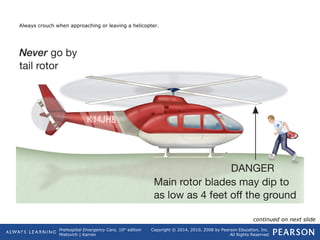
  • #4 Objectives are more specific statements of what students should be able to do after completing all reading and activities related to a specific chapter. Remind students they are responsible for the learning objectives and key terms for this chapter.
  • #5 Assess and reinforce the objectives and key terms using quizzes, handouts from the electronic instructor resources, and workbook pages.
  • #7 Case Study Present the Case Study Introduction provided in the PowerPoint slide set. Lead a discussion using the case study questions provided on the subsequent slide(s). The Case Study with discussion questions continues throughout the PowerPoint presentation. Case Study Discussion Use the case study content and questions to foreshadow the upcoming lesson content
  • #9 During this lesson, students will learn to prepare themselves, their equipment, their medical supplies, and their vehicle for an ambulance run.
  • #10 Teaching Tips Be prepared to discuss local regulations, policies, and practices regarding emergency vehicle operations.   Discussion Question What are some of the privileges generally granted to emergency drivers?
  • #16 Discussion Questions What are some considerations in selecting the safest, as opposed to the quickest, route of travel to a destination? What are some issues that may cause the driver to lose control of a vehicle? What is the proper way to negotiate curves when driving?   Knowledge Application Students should be able to apply principles of safe driving, both in personal vehicles and when driving the ambulance.   Critical Thinking Discussion If you were a policy maker, what would you do to decrease the number of injuries and deaths from ambulance crashes?
  • #17 Class Activity If your circumstances (location, liability issues and so on) allow, let students drive the ambulance in a vacant parking lot under the direction of an experienced emergency vehicle operator to get an idea of how an ambulance handles differently from a personal vehicle.   Discussion Question What are some special considerations for driving in poor weather and at night?
  • #44 Discussion Question What are the risks and benefits of using warning devices?   Knowledge Application Given several scenarios, students should be able to select the appropriate use of warning devices on the ambulance.
  • #46 Critical Thinking Discussion Does siren noise pose a risk to the hearing of EMS personnel? If so, how can they minimize that risk?
  • #48 Discussion Question What are some reasons sirens and air horns may not be effective?
  • #51 Teaching Tips Demonstrate the use of safety apparel and other items used to increase safety when working at roadway incidents.
  • #53 Discussion Questions What steps can you take to keep yourself safer at roadway incidents? What can cause driver distraction despite the safety measures you may take at roadway scenes?   Knowledge Application Given several scenarios, students should be able to identify and manage hazards when responding to roadway incidents.   Critical Thinking Discussion What can be done to increase EMS provider safety at roadway incidents?
  • #54 Class Activity If your circumstances (location, liability issues, and so on) allow, use a vacant parking lot to provide students with scenarios in which they must set up a safe roadway response scene.  
  • #58 Teaching Tips Have students carry out all phases of an ambulance run on mock calls.   Discussion Question What are the EMT's responsibilities in the prerun phase?   Knowledge Application Students should be able to perform their responsibilities in all phases of an EMS call.  
  • #74 Discussion Question What are the EMT's responsibilities en route to, during, and when transporting patients from calls?
  • #84 Discussion Question What are the EMT's responsibilities in the post-run phase?
  • #90 Teaching Tips Arrange for a safety demonstration by an air medical transport service. Discuss local policies and protocols related to air medical transport.   Discussion Question What are the considerations in determining whether air medical transport is appropriate?   Knowledge Application Students should be able to evaluate criteria for considering air medical transport.
  • #95 Critical Thinking Discussion What are some disadvantages to using air medical transport?
  • #104 Knowledge Application Students should be able to apply basic safety and security measures to prevent unauthorized use of ambulances and to prevent carbon monoxide poisoning.
  • #108 Teaching Tips Discuss local policies relating to security and prevention of carbon monoxide poisoning.   Discussion Questions What are the signs and symptoms of carbon monoxide poisoning? What measures can you take to decrease your risk of carbon monoxide poisoning?
  • #114 Follow-Up Answer student questions. Follow-Up Assignments Review Chapter 42 Summary. Complete Chapter 42 In Review questions. Complete Chapter 42 Critical Thinking questions. Assessments Handouts Chapter 42 quiz
  • #115 Follow-Up Answer student questions. Follow-Up Assignments Review Chapter 42 Summary. Complete Chapter 42 In Review questions. Complete Chapter 42 Critical Thinking questions. Assessments Handouts Chapter 42 quiz
  • #116 Class Activity As an alternative to assigning the follow-up exercises in the lesson plan as homework, assign each question to a small group of students for in-class discussion.   Teaching Tips Answers to In Review questions are in the appendix of the text. Advise students to review the questions again as they study the chapter.