PREHOSPITALPREHOSPITAL
EMERGENCY CAREEMERGENCY CARE
CHAPTER
Copyright © 2014, 2010, 2008 by Pearson Education, Inc.
All Rights Reserved
Prehospital Emergency Care, 10th
edition
Mistovich | Karren
TENTH EDITION
Part I
Airway Management,
Artificial Ventilation,
and Oxygenation
10
Prehospital Emergency Care, 10th
edition
Mistovich | Karren
Copyright © 2014, 2010, 2008 by Pearson Education, Inc.
All Rights Reserved
Learning ReadinessLearning Readiness
• EMS Education Standards, text p. 202
Prehospital Emergency Care, 10th
edition
Mistovich | Karren
Copyright © 2014, 2010, 2008 by Pearson Education, Inc.
All Rights Reserved
Learning ReadinessLearning Readiness
ObjectivesObjectives
• Please refer to pages 202 and 203 of
your text to view the objectives for this
chapter.
Prehospital Emergency Care, 10th
edition
Mistovich | Karren
Copyright © 2014, 2010, 2008 by Pearson Education, Inc.
All Rights Reserved
Learning ReadinessLearning Readiness
Key TermsKey Terms
• Please refer to page 203 of your text to
view the key terms for this chapter.
Prehospital Emergency Care, 10th
edition
Mistovich | Karren
Copyright © 2014, 2010, 2008 by Pearson Education, Inc.
All Rights Reserved
Setting the StageSetting the Stage
• Overview of Lesson Topics
 Part I
• Respiration and Respiratory System
Review
• Airway Assessment
continued on next slide
Prehospital Emergency Care, 10th
edition
Mistovich | Karren
Copyright © 2014, 2010, 2008 by Pearson Education, Inc.
All Rights Reserved
Setting the StageSetting the Stage
• Overview of Lesson Topics
 Part II
• Breathing Assessment
• Deciding to Ventilate
• Techniques of Artificial Ventilation
• Special Considerations
• Oxygen Therapy
Prehospital Emergency Care, 10th
edition
Mistovich | Karren
Copyright © 2014, 2010, 2008 by Pearson Education, Inc.
All Rights Reserved
Case Study IntroductionCase Study Introduction
EMTs Chris Frost and Brittany Sullivan
arrive on the scene of a call for a, "sick
person, unknown problem," where they
immediately see a man in his 40s lying
on his right side on the floor. There is a
makeshift tourniquet beneath the man's
arm, and a hypodermic syringe and
needle lying next to him.
continued on next slide
Prehospital Emergency Care, 10th
edition
Mistovich | Karren
Copyright © 2014, 2010, 2008 by Pearson Education, Inc.
All Rights Reserved
Case Study IntroductionCase Study Introduction
The patient is pale, with cyanosis of his
lips. He has very shallow, slow breathing,
and he has vomited.
Prehospital Emergency Care, 10th
edition
Mistovich | Karren
Copyright © 2014, 2010, 2008 by Pearson Education, Inc.
All Rights Reserved
Case StudyCase Study
• What threats to the patient's life are
apparent so far?
• What do Chris and Brittany need to do
to intervene in the life threats?
• What equipment will the EMTs need to
carry out those interventions?
Prehospital Emergency Care, 10th
edition
Mistovich | Karren
Copyright © 2014, 2010, 2008 by Pearson Education, Inc.
All Rights Reserved
IntroductionIntroduction
• An open airway, adequate ventilation,
and sufficient oxygenation are
necessary to sustain life.
• You must recognize when to intervene
to open and maintain the airway,
provide artificial ventilation, and
administer supplemental oxygen.
Prehospital Emergency Care, 10th
edition
Mistovich | Karren
Copyright © 2014, 2010, 2008 by Pearson Education, Inc.
All Rights Reserved
RespirationRespiration
• Four components
 Pulmonary ventilation
 External respiration
 Internal respiration
 Cellular respiration
continued on next slide
Prehospital Emergency Care, 10th
edition
Mistovich | Karren
Copyright © 2014, 2010, 2008 by Pearson Education, Inc.
All Rights Reserved
RespirationRespiration
• Pulmonary ventilation
 Mechanical process
 Air moves in and out of the lungs.
continued on next slide
Prehospital Emergency Care, 10th
edition
Mistovich | Karren
Copyright © 2014, 2010, 2008 by Pearson Education, Inc.
All Rights Reserved
RespirationRespiration
• External respiration
 Gas exchange between alveoli and
pulmonary capillaries
 Oxygenates and removes carbon dioxide
from the lungs
continued on next slide
Prehospital Emergency Care, 10th
edition
Mistovich | Karren
Copyright © 2014, 2010, 2008 by Pearson Education, Inc.
All Rights Reserved
RespirationRespiration
• Internal respiration
 Gas exchange between systemic
capillaries and cells
 Delivery of oxygen to the cells and
removal of carbon dioxide
continued on next slide
Prehospital Emergency Care, 10th
edition
Mistovich | Karren
Copyright © 2014, 2010, 2008 by Pearson Education, Inc.
All Rights Reserved
RespirationRespiration
• Cellular respiration and metabolism
 Aerobic metabolism requires oxygen to
break down glucose to produce ATP.
 By-products of aerobic metabolism are
water and carbon dioxide.
continued on next slide
Prehospital Emergency Care, 10th
edition
Mistovich | Karren
Copyright © 2014, 2010, 2008 by Pearson Education, Inc.
All Rights Reserved
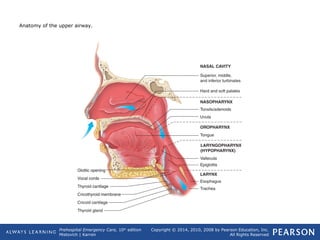
Respiratory System ReviewRespiratory System Review
• Upper airway extends from nose and
mouth to the cricoid cartilage at the
inferior edge of the larynx.
• The tongue can obstruct the upper
airway in patients with altered mental
status.
continued on next slide
Prehospital Emergency Care, 10th
edition
Mistovich | Karren
Copyright © 2014, 2010, 2008 by Pearson Education, Inc.
All Rights Reserved
Anatomy of the upper airway.
Prehospital Emergency Care, 10th
edition
Mistovich | Karren
Copyright © 2014, 2010, 2008 by Pearson Education, Inc.
All Rights Reserved
Respiratory System ReviewRespiratory System Review
• The epiglottis protects the larynx.
 May fail to close in unresponsive
patients
 In altered mental status, relaxation of
muscles can cause the epiglottis to
obstruct the larynx.
continued on next slide
Prehospital Emergency Care, 10th
edition
Mistovich | Karren
Copyright © 2014, 2010, 2008 by Pearson Education, Inc.
All Rights Reserved
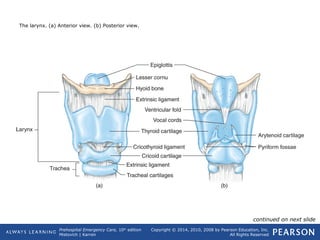
The larynx. (a) Anterior view. (b) Posterior view.
continued on next slide
Prehospital Emergency Care, 10th
edition
Mistovich | Karren
Copyright © 2014, 2010, 2008 by Pearson Education, Inc.
All Rights Reserved
Respiratory System ReviewRespiratory System Review
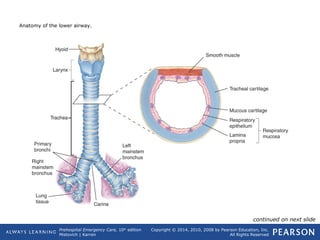
• The lower airway extends from the
cricoid cartilage to alveoli.
continued on next slide
Prehospital Emergency Care, 10th
edition
Mistovich | Karren
Copyright © 2014, 2010, 2008 by Pearson Education, Inc.
All Rights Reserved
Anatomy of the lower airway.
continued on next slide
Prehospital Emergency Care, 10th
edition
Mistovich | Karren
Copyright © 2014, 2010, 2008 by Pearson Education, Inc.
All Rights Reserved
Respiratory System ReviewRespiratory System Review
• The trachea divides into two mainstem
bronchi at the carina.
• The bronchioles contain smooth
muscle, which can contract and narrow
the air passages.
continued on next slide
Prehospital Emergency Care, 10th
edition
Mistovich | Karren
Copyright © 2014, 2010, 2008 by Pearson Education, Inc.
All Rights Reserved
Respiratory System ReviewRespiratory System Review
• The lungs are surrounded by the
visceral and parietal pleura.
• The seal between the layers of pleura
must remain intact for ventilation to
occur.
• The diaphragm provides 60% to 70%
of the effort of breathing.
continued on next slide
Prehospital Emergency Care, 10th
edition
Mistovich | Karren
Copyright © 2014, 2010, 2008 by Pearson Education, Inc.
All Rights Reserved
Click to indicate which process below involves theClick to indicate which process below involves the
exchange of gases between the capillaries andexchange of gases between the capillaries and
tissue cells.tissue cells.
Pulmonary ventilation
External respiration
Internal respiration
Metabolism
Prehospital Emergency Care, 10th
edition
Mistovich | Karren
Copyright © 2014, 2010, 2008 by Pearson Education, Inc.
All Rights Reserved
Mechanics of VentilationMechanics of Ventilation
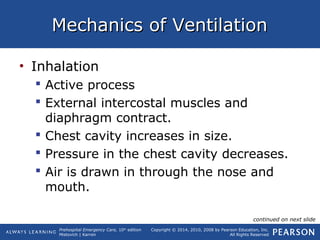
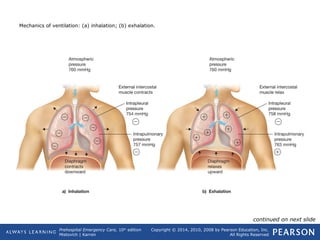
• Inhalation
 Active process
 External intercostal muscles and
diaphragm contract.
 Chest cavity increases in size.
 Pressure in the chest cavity decreases.
 Air is drawn in through the nose and
mouth.
continued on next slide
Prehospital Emergency Care, 10th
edition
Mistovich | Karren
Copyright © 2014, 2010, 2008 by Pearson Education, Inc.
All Rights Reserved
Mechanics of VentilationMechanics of Ventilation
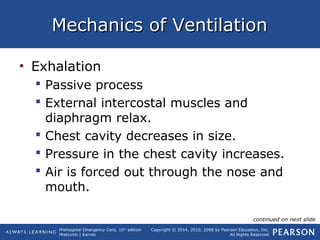
• Exhalation
 Passive process
 External intercostal muscles and
diaphragm relax.
 Chest cavity decreases in size.
 Pressure in the chest cavity increases.
 Air is forced out through the nose and
mouth.
continued on next slide
Prehospital Emergency Care, 10th
edition
Mistovich | Karren
Copyright © 2014, 2010, 2008 by Pearson Education, Inc.
All Rights Reserved
Mechanics of ventilation: (a) inhalation; (b) exhalation.
continued on next slide
Prehospital Emergency Care, 10th
edition
Mistovich | Karren
Copyright © 2014, 2010, 2008 by Pearson Education, Inc.
All Rights Reserved
Mechanics of VentilationMechanics of Ventilation
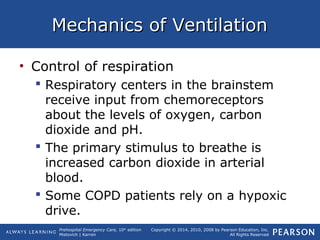
• Control of respiration
 Respiratory centers in the brainstem
receive input from chemoreceptors
about the levels of oxygen, carbon
dioxide and pH.
 The primary stimulus to breathe is
increased carbon dioxide in arterial
blood.
 Some COPD patients rely on a hypoxic
drive.
Prehospital Emergency Care, 10th
edition
Mistovich | Karren
Copyright © 2014, 2010, 2008 by Pearson Education, Inc.
All Rights Reserved
Respiratory PhysiologyRespiratory Physiology
• Respiration is the process of gas
exchange.
• Oxygenation and removal of carbon
dioxide occur as a result of external
and internal respiration.
continued on next slide
Prehospital Emergency Care, 10th
edition
Mistovich | Karren
Copyright © 2014, 2010, 2008 by Pearson Education, Inc.
All Rights Reserved
Respiratory PhysiologyRespiratory Physiology
• Hypoxemia is a low oxygen content in
arterial blood that may occur from:
 Inadequate ventilation of alveoli despite
adequate lung perfusion
 Inadequate lung perfusion despite
adequate ventilation
 Combination of poor ventilation and
perfusion
continued on next slide
Prehospital Emergency Care, 10th
edition
Mistovich | Karren
Copyright © 2014, 2010, 2008 by Pearson Education, Inc.
All Rights Reserved
Respiratory PhysiologyRespiratory Physiology
• Hypoxia means inadequate oxygen is
being delivered to the cells. It may
occur from:
 Airway obstruction
 Inadequate breathing
 Shock
continued on next slide
Prehospital Emergency Care, 10th
edition
Mistovich | Karren
Copyright © 2014, 2010, 2008 by Pearson Education, Inc.
All Rights Reserved
Respiratory PhysiologyRespiratory Physiology
• Signs of mild to moderate hypoxia
 Tachypnea
 Dyspnea
 Pale, cool, clammy skin
 Tachycardia
 Elevation in blood pressure
 Restlessness and agitation
continued on next slide
Prehospital Emergency Care, 10th
edition
Mistovich | Karren
Copyright © 2014, 2010, 2008 by Pearson Education, Inc.
All Rights Reserved
Respiratory PhysiologyRespiratory Physiology
• Signs of severe hypoxia
 Tachypnea
 Dyspnea
 Cyanosis
 Tachycardia, dysrhythmias, bradycardia
 Severe confusion
continued on next slide
Prehospital Emergency Care, 10th
edition
Mistovich | Karren
Copyright © 2014, 2010, 2008 by Pearson Education, Inc.
All Rights Reserved
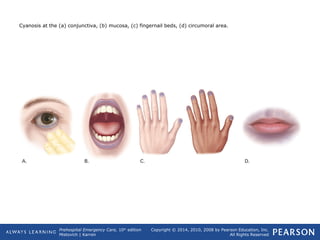
Cyanosis at the (a) conjunctiva, (b) mucosa, (c) fingernail beds, (d) circumoral area.
Prehospital Emergency Care, 10th
edition
Mistovich | Karren
Copyright © 2014, 2010, 2008 by Pearson Education, Inc.
All Rights Reserved
Respiratory PhysiologyRespiratory Physiology
• Signs of severe hypoxia
 Loss of coordination
 Sleepy appearance
 Head bobbing
 Slow reaction time
 Altered mental status
continued on next slide
Prehospital Emergency Care, 10th
edition
Mistovich | Karren
Copyright © 2014, 2010, 2008 by Pearson Education, Inc.
All Rights Reserved
Respiratory PhysiologyRespiratory Physiology
• In infants and children, hypoxia may
result in bradycardia, instead of
tachycardia.
continued on next slide
Prehospital Emergency Care, 10th
edition
Mistovich | Karren
Copyright © 2014, 2010, 2008 by Pearson Education, Inc.
All Rights Reserved
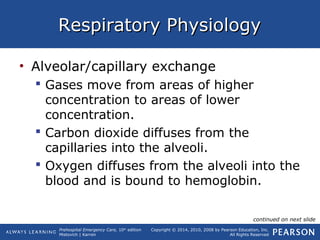
Respiratory PhysiologyRespiratory Physiology
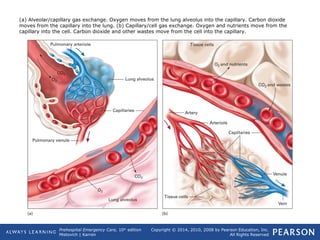
• Alveolar/capillary exchange
 Gases move from areas of higher
concentration to areas of lower
concentration.
 Carbon dioxide diffuses from the
capillaries into the alveoli.
 Oxygen diffuses from the alveoli into the
blood and is bound to hemoglobin.
continued on next slide
Prehospital Emergency Care, 10th
edition
Mistovich | Karren
Copyright © 2014, 2010, 2008 by Pearson Education, Inc.
All Rights Reserved
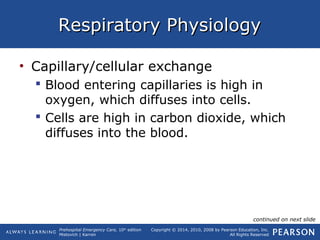
Respiratory PhysiologyRespiratory Physiology
• Capillary/cellular exchange
 Blood entering capillaries is high in
oxygen, which diffuses into cells.
 Cells are high in carbon dioxide, which
diffuses into the blood.
continued on next slide
Prehospital Emergency Care, 10th
edition
Mistovich | Karren
Copyright © 2014, 2010, 2008 by Pearson Education, Inc.
All Rights Reserved
(a) Alveolar/capillary gas exchange. Oxygen moves from the lung alveolus into the capillary. Carbon dioxide
moves from the capillary into the lung. (b) Capillary/cell gas exchange. Oxygen and nutrients move from the
capillary into the cell. Carbon dioxide and other wastes move from the cell into the capillary.
Prehospital Emergency Care, 10th
edition
Mistovich | Karren
Copyright © 2014, 2010, 2008 by Pearson Education, Inc.
All Rights Reserved
Pathophysiology of Ventilation andPathophysiology of Ventilation and
RespirationRespiration
• Disturbance in ventilation or respiration
can lead to cellular hypoxia.
 Anaerobic metabolism results in:
• Insufficient energy production
• Buildup of lactic acid
• Cell dysfunction
continued on next slide
Prehospital Emergency Care, 10th
edition
Mistovich | Karren
Copyright © 2014, 2010, 2008 by Pearson Education, Inc.
All Rights Reserved
Pathophysiology of Ventilation andPathophysiology of Ventilation and
RespirationRespiration
• Pulmonary ventilation may be impaired
by:
 Interruption of nervous control
 Damage to thorax
 Increased airway resistance
 Loss of airway patency
continued on next slide
Prehospital Emergency Care, 10th
edition
Mistovich | Karren
Copyright © 2014, 2010, 2008 by Pearson Education, Inc.
All Rights Reserved
Pathophysiology of Ventilation andPathophysiology of Ventilation and
RespirationRespiration
• Gas exchange may be impaired by:
 Decreased ambient oxygen content
 Lung disease, drowning
 Toxic gases
continued on next slide
Prehospital Emergency Care, 10th
edition
Mistovich | Karren
Copyright © 2014, 2010, 2008 by Pearson Education, Inc.
All Rights Reserved
Pathophysiology of Ventilation andPathophysiology of Ventilation and
RespirationRespiration
• Poor perfusion also leads to cellular
hypoxia. It may be caused by:
 Obstructed forward movement of blood
 Hypovolemia
Prehospital Emergency Care, 10th
edition
Mistovich | Karren
Copyright © 2014, 2010, 2008 by Pearson Education, Inc.
All Rights Reserved
Airway Anatomy in Infants andAirway Anatomy in Infants and
ChildrenChildren
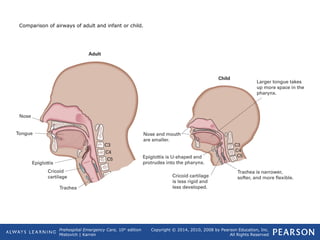
• Chest wall is pliable.
• Increased reliance on diaphragm.
• Lungs are easily overinflated in artificial
ventilation.
continued on next slide
Prehospital Emergency Care, 10th
edition
Mistovich | Karren
Copyright © 2014, 2010, 2008 by Pearson Education, Inc.
All Rights Reserved
Comparison of airways of adult and infant or child.
Prehospital Emergency Care, 10th
edition
Mistovich | Karren
Copyright © 2014, 2010, 2008 by Pearson Education, Inc.
All Rights Reserved
Airway Anatomy in Infants andAirway Anatomy in Infants and
ChildrenChildren
• Limited oxygen reserves
• High metabolic rate and oxygen needs
• Hypoxia is the most common cause of
cardiac arrest.
Prehospital Emergency Care, 10th
edition
Mistovich | Karren
Copyright © 2014, 2010, 2008 by Pearson Education, Inc.
All Rights Reserved
Airway AssessmentAirway Assessment
• The airway and respiratory tract are the
conduit that allows air movement in
and out of the lungs.
• The airway must remain patent at all
times.
continued on next slide
Prehospital Emergency Care, 10th
edition
Mistovich | Karren
Copyright © 2014, 2010, 2008 by Pearson Education, Inc.
All Rights Reserved
Airway AssessmentAirway Assessment
• Any obstruction of the airway results in
less air movement and potential
hypoxia.
• The degree of the obstruction directly
affects the amount of air available for
gas exchange.
continued on next slide
Prehospital Emergency Care, 10th
edition
Mistovich | Karren
Copyright © 2014, 2010, 2008 by Pearson Education, Inc.
All Rights Reserved
Airway AssessmentAirway Assessment
• Patients with altered mental status are
susceptible to airway obstruction and
aspiration.
• The airway may be obstructed by
injuries.
continued on next slide
Prehospital Emergency Care, 10th
edition
Mistovich | Karren
Copyright © 2014, 2010, 2008 by Pearson Education, Inc.
All Rights Reserved
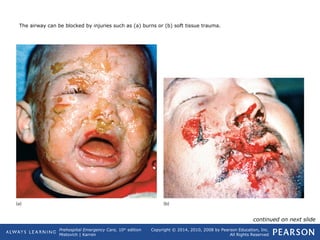
The airway can be blocked by injuries such as (a) burns or (b) soft tissue trauma.
continued on next slide
Prehospital Emergency Care, 10th
edition
Mistovich | Karren
Copyright © 2014, 2010, 2008 by Pearson Education, Inc.
All Rights Reserved
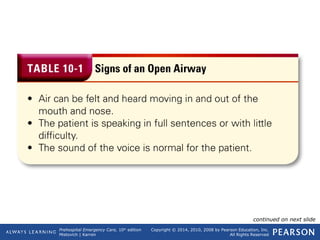
Table 10-1 Signs of an Open Airway
continued on next slide
Prehospital Emergency Care, 10th
edition
Mistovich | Karren
Copyright © 2014, 2010, 2008 by Pearson Education, Inc.
All Rights Reserved
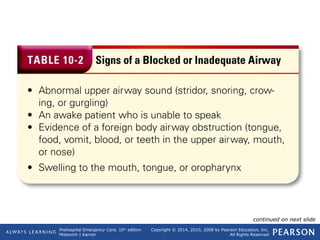
Table 10-2 Signs of a Blocked or Inadequate Airway
continued on next slide
Prehospital Emergency Care, 10th
edition
Mistovich | Karren
Copyright © 2014, 2010, 2008 by Pearson Education, Inc.
All Rights Reserved
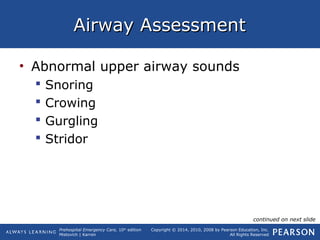
Airway AssessmentAirway Assessment
• Abnormal upper airway sounds
 Snoring
 Crowing
 Gurgling
 Stridor
continued on next slide
Prehospital Emergency Care, 10th
edition
Mistovich | Karren
Copyright © 2014, 2010, 2008 by Pearson Education, Inc.
All Rights Reserved
Airway AssessmentAirway Assessment
• You must open the mouth of an
unresponsive patient to assess the
airway.
• Clear the airway of liquids or foreign
bodies.
continued on next slide
Prehospital Emergency Care, 10th
edition
Mistovich | Karren
Copyright © 2014, 2010, 2008 by Pearson Education, Inc.
All Rights Reserved
Airway AssessmentAirway Assessment
• Opening the airway
 Manual maneuvers
 Suction
 Mechanical airways
continued on next slide
Prehospital Emergency Care, 10th
edition
Mistovich | Karren
Copyright © 2014, 2010, 2008 by Pearson Education, Inc.
All Rights Reserved
Airway AssessmentAirway Assessment
• Head-tilt, chin-lift maneuver
 Used when no spinal injury is suspected
 Used in unresponsive patients, cardiac
arrest
 Must be supplemented with a
mechanical airway if ineffective on its
own
continued on next slide
Prehospital Emergency Care, 10th
edition
Mistovich | Karren
Copyright © 2014, 2010, 2008 by Pearson Education, Inc.
All Rights Reserved
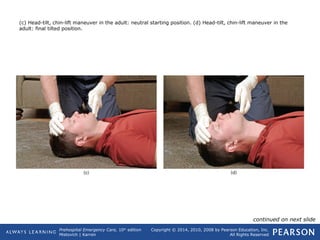
(c) Head-tilt, chin-lift maneuver in the adult: neutral starting position. (d) Head-tilt, chin-lift maneuver in the
adult: final tilted position.
continued on next slide
Prehospital Emergency Care, 10th
edition
Mistovich | Karren
Copyright © 2014, 2010, 2008 by Pearson Education, Inc.
All Rights Reserved
Airway AssessmentAirway Assessment
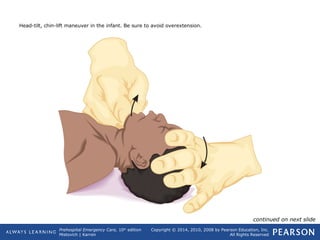
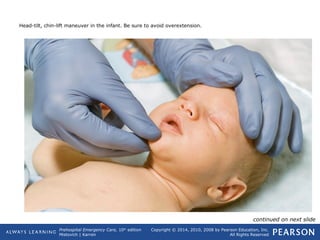
• Head-tilt, chin-lift in children
 Avoid overextension of the neck.
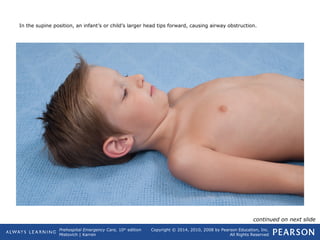
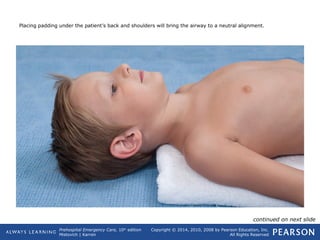
 It may be necessary to pad beneath the
shoulders.
continued on next slide
Prehospital Emergency Care, 10th
edition
Mistovich | Karren
Copyright © 2014, 2010, 2008 by Pearson Education, Inc.
All Rights Reserved
Head-tilt, chin-lift maneuver in the infant. Be sure to avoid overextension.
continued on next slide
Prehospital Emergency Care, 10th
edition
Mistovich | Karren
Copyright © 2014, 2010, 2008 by Pearson Education, Inc.
All Rights Reserved
Head-tilt, chin-lift maneuver in the infant. Be sure to avoid overextension.
continued on next slide
Prehospital Emergency Care, 10th
edition
Mistovich | Karren
Copyright © 2014, 2010, 2008 by Pearson Education, Inc.
All Rights Reserved
In the supine position, an infant’s or child’s larger head tips forward, causing airway obstruction.
continued on next slide
Prehospital Emergency Care, 10th
edition
Mistovich | Karren
Copyright © 2014, 2010, 2008 by Pearson Education, Inc.
All Rights Reserved
Placing padding under the patient’s back and shoulders will bring the airway to a neutral alignment.
continued on next slide
Prehospital Emergency Care, 10th
edition
Mistovich | Karren
Copyright © 2014, 2010, 2008 by Pearson Education, Inc.
All Rights Reserved
Airway AssessmentAirway Assessment
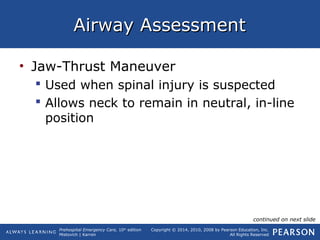
• Jaw-Thrust Maneuver
 Used when spinal injury is suspected
 Allows neck to remain in neutral, in-line
position
continued on next slide
Prehospital Emergency Care, 10th
edition
Mistovich | Karren
Copyright © 2014, 2010, 2008 by Pearson Education, Inc.
All Rights Reserved
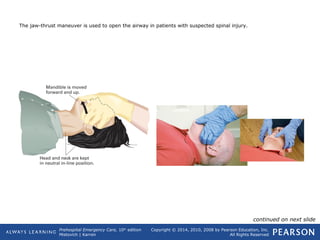
The jaw-thrust maneuver is used to open the airway in patients with suspected spinal injury.
continued on next slide
Prehospital Emergency Care, 10th
edition
Mistovich | Karren
Copyright © 2014, 2010, 2008 by Pearson Education, Inc.
All Rights Reserved
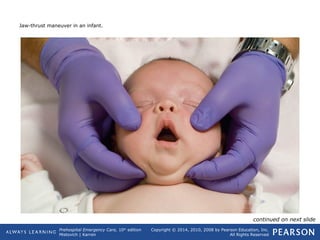
Jaw-thrust maneuver in an infant.
continued on next slide
Prehospital Emergency Care, 10th
edition
Mistovich | Karren
Copyright © 2014, 2010, 2008 by Pearson Education, Inc.
All Rights Reserved
Airway AssessmentAirway Assessment
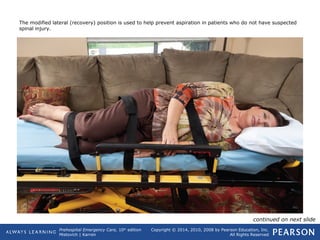
• Recovery position
 Used if a patient has an altered mental
status and is at risk of aspiration
 Contraindicated in suspected spinal
injury and patients who need positive
pressure ventilation
continued on next slide
Prehospital Emergency Care, 10th
edition
Mistovich | Karren
Copyright © 2014, 2010, 2008 by Pearson Education, Inc.
All Rights Reserved
The modified lateral (recovery) position is used to help prevent aspiration in patients who do not have suspected
spinal injury.
continued on next slide
Prehospital Emergency Care, 10th
edition
Mistovich | Karren
Copyright © 2014, 2010, 2008 by Pearson Education, Inc.
All Rights Reserved
Airway AssessmentAirway Assessment
• Suction
 Gurgling indicates liquid in the airway.
 Use suction to remove blood, vomitus,
secretions, and any other liquids, food
particles, or objects from the mouth and
airway.
continued on next slide
Prehospital Emergency Care, 10th
edition
Mistovich | Karren
Copyright © 2014, 2010, 2008 by Pearson Education, Inc.
All Rights Reserved
Airway AssessmentAirway Assessment
• Standard Precautions during suctioning
 Protective eyewear
 Mask
 Gloves
 N-95 or HEPA respirator for suspected
tuberculosis
continued on next slide
Prehospital Emergency Care, 10th
edition
Mistovich | Karren
Copyright © 2014, 2010, 2008 by Pearson Education, Inc.
All Rights Reserved
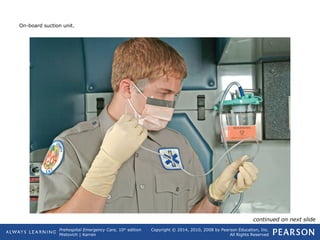
On-board suction unit.
continued on next slide
Prehospital Emergency Care, 10th
edition
Mistovich | Karren
Copyright © 2014, 2010, 2008 by Pearson Education, Inc.
All Rights Reserved
Airway AssessmentAirway Assessment
• Suction equipment
 May be mounted in the ambulance or
portable
 Must generate enough vacuum and
airflow to clear the airway
 Must have wide-bore, thick tubing, a
collection bottle, and water supply
continued on next slide
Prehospital Emergency Care, 10th
edition
Mistovich | Karren
Copyright © 2014, 2010, 2008 by Pearson Education, Inc.
All Rights Reserved
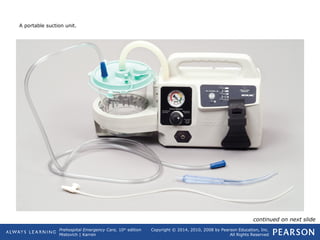
A portable suction unit.
continued on next slide
Prehospital Emergency Care, 10th
edition
Mistovich | Karren
Copyright © 2014, 2010, 2008 by Pearson Education, Inc.
All Rights Reserved
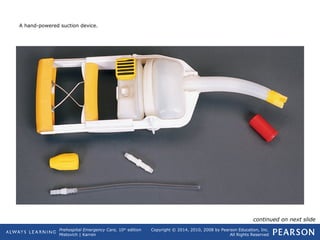
A hand-powered suction device.
continued on next slide
Prehospital Emergency Care, 10th
edition
Mistovich | Karren
Copyright © 2014, 2010, 2008 by Pearson Education, Inc.
All Rights Reserved
Airway AssessmentAirway Assessment
• Suction catheters
 Rigid catheter for suctioning the mouth
and oropharynx
• Used in unresponsive patients
• Insert only as far as you can see into the
mouth.
• Avoid touching the back of the
oropharynx.
continued on next slide
Prehospital Emergency Care, 10th
edition
Mistovich | Karren
Copyright © 2014, 2010, 2008 by Pearson Education, Inc.
All Rights Reserved
Airway AssessmentAirway Assessment
• Suction catheters
 Soft catheter
• Can be used to suction nose or
nasopharynx
• Avoid inserting too far.
continued on next slide
Prehospital Emergency Care, 10th
edition
Mistovich | Karren
Copyright © 2014, 2010, 2008 by Pearson Education, Inc.
All Rights Reserved
Airway AssessmentAirway Assessment
• Suctioning technique
 Assemble and turn on the suction unit.
 Measure and insert the catheter.
 Suction on the way out only.
 If possible, do not suction for more than
15 seconds at a time (5 seconds in
infants and children).
 Rinse the catheter.
continued on next slide
Prehospital Emergency Care, 10th
edition
Mistovich | Karren
Copyright © 2014, 2010, 2008 by Pearson Education, Inc.
All Rights Reserved
EMT SKILLS 10-1
Suctioning Technique
continued on next slide
Prehospital Emergency Care, 10th
edition
Mistovich | Karren
Copyright © 2014, 2010, 2008 by Pearson Education, Inc.
All Rights Reserved
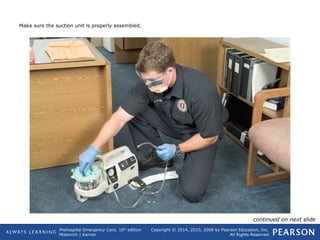
Make sure the suction unit is properly assembled.
continued on next slide
Prehospital Emergency Care, 10th
edition
Mistovich | Karren
Copyright © 2014, 2010, 2008 by Pearson Education, Inc.
All Rights Reserved
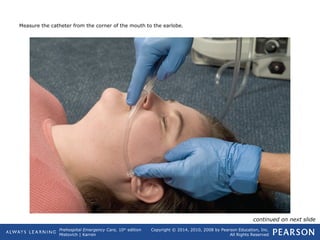
Measure the catheter from the corner of the mouth to the earlobe.
continued on next slide
Prehospital Emergency Care, 10th
edition
Mistovich | Karren
Copyright © 2014, 2010, 2008 by Pearson Education, Inc.
All Rights Reserved
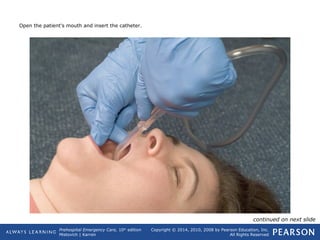
Open the patient's mouth and insert the catheter.
continued on next slide
Prehospital Emergency Care, 10th
edition
Mistovich | Karren
Copyright © 2014, 2010, 2008 by Pearson Education, Inc.
All Rights Reserved
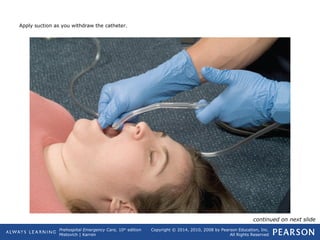
Apply suction as you withdraw the catheter.
continued on next slide
Prehospital Emergency Care, 10th
edition
Mistovich | Karren
Copyright © 2014, 2010, 2008 by Pearson Education, Inc.
All Rights Reserved
Airway AssessmentAirway Assessment
• Special considerations in suctioning
 If there is too much to suction quickly,
roll the patient onto his side and
manually sweep the mouth.
 Alternate 15 seconds of suction with 2
minutes of ventilation for copious, frothy
secretions.
continued on next slide
Prehospital Emergency Care, 10th
edition
Mistovich | Karren
Copyright © 2014, 2010, 2008 by Pearson Education, Inc.
All Rights Reserved
Airway AssessmentAirway Assessment
• Special considerations in suctioning
 Suctioning removes residual volume and
causes hypoxia.
 Oxygenate the patient and monitor the
heart rate and oxygenation.
Prehospital Emergency Care, 10th
edition
Mistovich | Karren
Copyright © 2014, 2010, 2008 by Pearson Education, Inc.
All Rights Reserved
Case StudyCase Study
Before moving the patient to a supine
position, Chris quickly grabs the portable
suction unit and uses a rigid suction
catheter to clear the patient's mouth. The
EMTs log roll the patient, and Chris uses
a head-tilt, chin-lift to open the airway.
The patient's respiratory rate is 6 per
minute and his tidal volume is very
shallow.
continued on next slide
Prehospital Emergency Care, 10th
edition
Mistovich | Karren
Copyright © 2014, 2010, 2008 by Pearson Education, Inc.
All Rights Reserved
Case StudyCase Study
• As Chris prepares to provide positive-
pressure ventilation, what airway
adjunct should he consider to assist in
keeping the patient's airway open?
• What are the advantages and
disadvantages of that choice?
Prehospital Emergency Care, 10th
edition
Mistovich | Karren
Copyright © 2014, 2010, 2008 by Pearson Education, Inc.
All Rights Reserved
Airway AssessmentAirway Assessment
• Airway adjuncts
 Used in conjunction with manual airway
maneuvers
 Includes oropharyngeal and
nasopharyngeal airways
continued on next slide
Prehospital Emergency Care, 10th
edition
Mistovich | Karren
Copyright © 2014, 2010, 2008 by Pearson Education, Inc.
All Rights Reserved
Airway AssessmentAirway Assessment
• The adjunct must be clean and clear of
obstructions.
• The proper size airway adjunct must be
selected.
• Airway adjuncts do not protect from
aspiration into the lungs.
continued on next slide
Prehospital Emergency Care, 10th
edition
Mistovich | Karren
Copyright © 2014, 2010, 2008 by Pearson Education, Inc.
All Rights Reserved
Airway AssessmentAirway Assessment
• If the patient becomes more responsive
or gags, remove the airway adjunct.
• A head-tilt, chin-lift or jaw-thrust
maneuver must still be maintained.
continued on next slide
Prehospital Emergency Care, 10th
edition
Mistovich | Karren
Copyright © 2014, 2010, 2008 by Pearson Education, Inc.
All Rights Reserved
Airway AssessmentAirway Assessment
• Oropharyngeal airways are used in
patients who are unresponsive, without
a gag reflex.
• The device must be sized properly.
continued on next slide
Prehospital Emergency Care, 10th
edition
Mistovich | Karren
Copyright © 2014, 2010, 2008 by Pearson Education, Inc.
All Rights Reserved
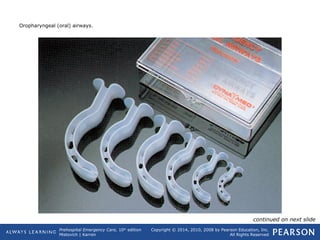
Oropharyngeal (oral) airways.
continued on next slide
Prehospital Emergency Care, 10th
edition
Mistovich | Karren
Copyright © 2014, 2010, 2008 by Pearson Education, Inc.
All Rights Reserved
EMT SKILLS 10-2
Inserting an Oropharyngeal Airway
continued on next slide
Prehospital Emergency Care, 10th
edition
Mistovich | Karren
Copyright © 2014, 2010, 2008 by Pearson Education, Inc.
All Rights Reserved
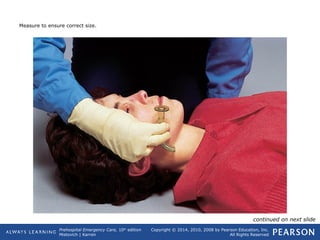
Measure to ensure correct size.
continued on next slide
Prehospital Emergency Care, 10th
edition
Mistovich | Karren
Copyright © 2014, 2010, 2008 by Pearson Education, Inc.
All Rights Reserved
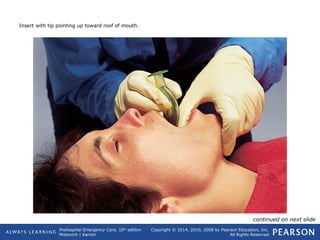
Insert with tip pointing up toward roof of mouth.
continued on next slide
Prehospital Emergency Care, 10th
edition
Mistovich | Karren
Copyright © 2014, 2010, 2008 by Pearson Education, Inc.
All Rights Reserved
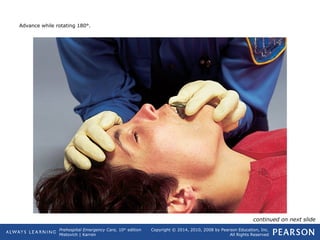
Advance while rotating 180°.
continued on next slide
Prehospital Emergency Care, 10th
edition
Mistovich | Karren
Copyright © 2014, 2010, 2008 by Pearson Education, Inc.
All Rights Reserved
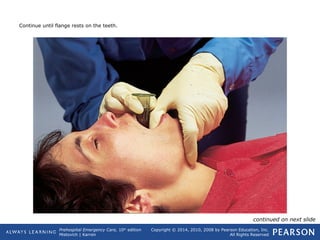
Continue until flange rests on the teeth.
continued on next slide
Prehospital Emergency Care, 10th
edition
Mistovich | Karren
Copyright © 2014, 2010, 2008 by Pearson Education, Inc.
All Rights Reserved
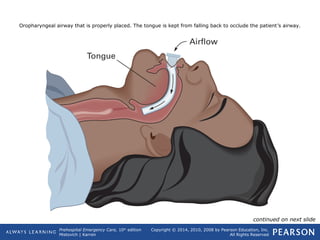
Oropharyngeal airway that is properly placed. The tongue is kept from falling back to occlude the patient’s airway.
continued on next slide
Prehospital Emergency Care, 10th
edition
Mistovich | Karren
Copyright © 2014, 2010, 2008 by Pearson Education, Inc.
All Rights Reserved
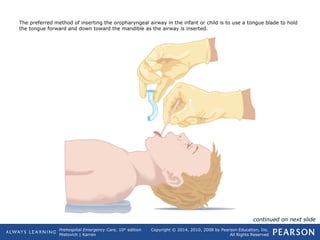
The preferred method of inserting the oropharyngeal airway in the infant or child is to use a tongue blade to hold
the tongue forward and down toward the mandible as the airway is inserted.
continued on next slide
Prehospital Emergency Care, 10th
edition
Mistovich | Karren
Copyright © 2014, 2010, 2008 by Pearson Education, Inc.
All Rights Reserved
Airway AssessmentAirway Assessment
• Nasopharyngeal airway
 Useful in patients with clenched teeth,
some facial injuries, and those unable to
tolerate an oropharyngeal airway
 Should not be used in a patient with
suspected fracture of the base of the
skull or severe facial trauma
continued on next slide
Prehospital Emergency Care, 10th
edition
Mistovich | Karren
Copyright © 2014, 2010, 2008 by Pearson Education, Inc.
All Rights Reserved
Airway AssessmentAirway Assessment
• Nasopharyngeal airway
 May cause gagging or vomiting
 Does not prevent aspiration
 May cause trauma to nasal mucosa;
must be lubricated
continued on next slide
Prehospital Emergency Care, 10th
edition
Mistovich | Karren
Copyright © 2014, 2010, 2008 by Pearson Education, Inc.
All Rights Reserved
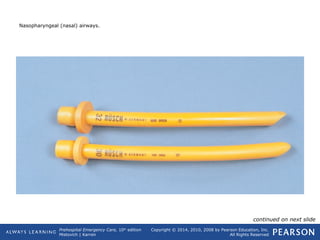
Nasopharyngeal (nasal) airways.
continued on next slide
Prehospital Emergency Care, 10th
edition
Mistovich | Karren
Copyright © 2014, 2010, 2008 by Pearson Education, Inc.
All Rights Reserved
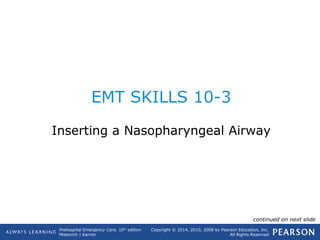
EMT SKILLS 10-3
Inserting a Nasopharyngeal Airway
continued on next slide
Prehospital Emergency Care, 10th
edition
Mistovich | Karren
Copyright © 2014, 2010, 2008 by Pearson Education, Inc.
All Rights Reserved
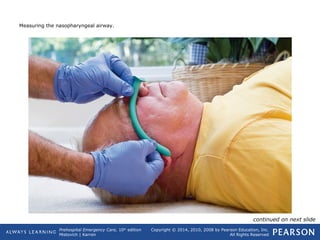
Measuring the nasopharyngeal airway.
continued on next slide
Prehospital Emergency Care, 10th
edition
Mistovich | Karren
Copyright © 2014, 2010, 2008 by Pearson Education, Inc.
All Rights Reserved
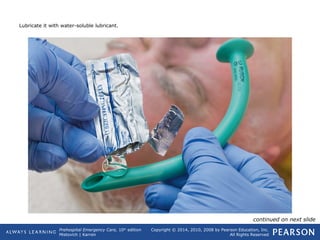
Lubricate it with water-soluble lubricant.
continued on next slide
Prehospital Emergency Care, 10th
edition
Mistovich | Karren
Copyright © 2014, 2010, 2008 by Pearson Education, Inc.
All Rights Reserved
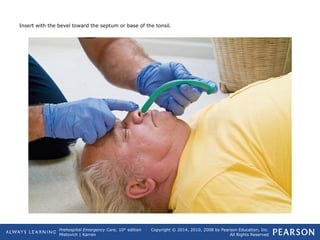
Insert with the bevel toward the septum or base of the tonsil.
Prehospital Emergency Care, 10th
edition
Mistovich | Karren
Copyright © 2014, 2010, 2008 by Pearson Education, Inc.
All Rights Reserved
Case Study ConclusionCase Study Conclusion
Chris selects and inserts an
oropharyngeal airway, and begins
positive pressure ventilation. The patient
vomits again, and Chris immediately
stops ventilating, as Brittany helps him
turn the patient onto his left side.
continued on next slide
Prehospital Emergency Care, 10th
edition
Mistovich | Karren
Copyright © 2014, 2010, 2008 by Pearson Education, Inc.
All Rights Reserved
Case Study ConclusionCase Study Conclusion
Chris removes the oropharyngeal airway
and suctions the patient's mouth. As
Chris begins ventilations again, a second
crew arrives to assist with packaging and
transport.
continued on next slide
Prehospital Emergency Care, 10th
edition
Mistovich | Karren
Copyright © 2014, 2010, 2008 by Pearson Education, Inc.
All Rights Reserved
Case Study ConclusionCase Study Conclusion
Chris continues airway management en
route to the emergency department.
Soon after arriving, Chris's suspicion that
the patient suffered a heroin overdose is
confirmed when the emergency
department staff administers naloxone, a
drug to counteract the effects of
narcotics. Within minutes, the patient is
awake and talking.
Prehospital Emergency Care, 10th
edition
Mistovich | Karren
Copyright © 2014, 2010, 2008 by Pearson Education, Inc.
All Rights Reserved
Lesson SummaryLesson Summary
• Without an open airway and adequate
ventilation, patients rapidly deteriorate
and die.
• EMTs must quickly recognize an
inadequate airway and breathing and
immediately intervene.
PREHOSPITALPREHOSPITAL
EMERGENCY CAREEMERGENCY CARE
CHAPTER
Copyright © 2014, 2010, 2008 by Pearson Education, Inc.
All Rights Reserved
Prehospital Emergency Care, 10th
edition
Mistovich | Karren
TENTH EDITION
Part II
Airway Management,
Artificial Ventilation &
Oxygenation
10
Prehospital Emergency Care, 10th
edition
Mistovich | Karren
Copyright © 2014, 2010, 2008 by Pearson Education, Inc.
All Rights Reserved
Learning ReadinessLearning Readiness
• EMS Education Standards, text p. 202
Prehospital Emergency Care, 10th
edition
Mistovich | Karren
Copyright © 2014, 2010, 2008 by Pearson Education, Inc.
All Rights Reserved
Learning ReadinessLearning Readiness
ObjectivesObjectives
• Please refer to pages 202 and 203 of
your text to view the objectives for this
chapter.
Prehospital Emergency Care, 10th
edition
Mistovich | Karren
Copyright © 2014, 2010, 2008 by Pearson Education, Inc.
All Rights Reserved
Learning ReadinessLearning Readiness
Key TermsKey Terms
• Please refer to page 203 of your text to
view the key terms for this chapter.
Prehospital Emergency Care, 10th
edition
Mistovich | Karren
Copyright © 2014, 2010, 2008 by Pearson Education, Inc.
All Rights Reserved
Setting the StageSetting the Stage
• Overview of Lesson Topics
 Part I
• Respiration and Respiratory System
Review
• Airway Assessment
continued on next slide
Prehospital Emergency Care, 10th
edition
Mistovich | Karren
Copyright © 2014, 2010, 2008 by Pearson Education, Inc.
All Rights Reserved
Setting the StageSetting the Stage
• Overview of Lesson Topics
 Part II
• Breathing Assessment
• Deciding to Ventilate
• Techniques of Artificial Ventilation
• Special Considerations
• Oxygen Therapy
Prehospital Emergency Care, 10th
edition
Mistovich | Karren
Copyright © 2014, 2010, 2008 by Pearson Education, Inc.
All Rights Reserved
Case Study IntroductionCase Study Introduction
EMTs Carlos Rivera and Alan Abrams are
caring for Mrs. Elena Diaz, who is 63
years old. Mrs. Diaz has COPD and
presents today with shortness of breath.
She can speak only a few words at time
before gasping for breath.
Prehospital Emergency Care, 10th
edition
Mistovich | Karren
Copyright © 2014, 2010, 2008 by Pearson Education, Inc.
All Rights Reserved
Case StudyCase Study
• How will the EMTs determine the
severity of patient's difficulty
breathing? What will they be looking
for?
• How will the EMTs decide what
interventions the patient requires?
Prehospital Emergency Care, 10th
edition
Mistovich | Karren
Copyright © 2014, 2010, 2008 by Pearson Education, Inc.
All Rights Reserved
IntroductionIntroduction
• An open airway, adequate ventilation,
and sufficient oxygenation are
necessary to sustain life.
• You must recognize when to intervene
to open and maintain the airway,
provide artificial ventilation, and
administer supplemental oxygen.
Prehospital Emergency Care, 10th
edition
Mistovich | Karren
Copyright © 2014, 2010, 2008 by Pearson Education, Inc.
All Rights Reserved
Assessment of BreathingAssessment of Breathing
• After establishing a patent airway,
assess the adequacy of the patient's
breathing.
• Inadequate breathing leads to poor gas
exchange in the alveoli inadequate
oxygenation.
• Focus on both the rate of breathing and
the volume of each breath.
continued on next slide
Prehospital Emergency Care, 10th
edition
Mistovich | Karren
Copyright © 2014, 2010, 2008 by Pearson Education, Inc.
All Rights Reserved
Assessment of BreathingAssessment of Breathing
• The relationship between the volume of
air breathed in, the respiratory rate,
and the volume of air that reaches the
alveoli is critical in determining if the
patient is breathing adequately.
continued on next slide
Prehospital Emergency Care, 10th
edition
Mistovich | Karren
Copyright © 2014, 2010, 2008 by Pearson Education, Inc.
All Rights Reserved
Assessment of BreathingAssessment of Breathing
• Minute volume
 A function of both respiratory rate and
tidal volume
 A change in either respiratory rate or
tidal volume affects minute volume.
continued on next slide
Prehospital Emergency Care, 10th
edition
Mistovich | Karren
Copyright © 2014, 2010, 2008 by Pearson Education, Inc.
All Rights Reserved
Assessment of BreathingAssessment of Breathing
• Alveolar ventilation is the amount of air
breathed in that reaches the alveoli.
• Dead air space does not change when
tidal volume decreases.
• Rapid respirations can decrease the
tidal volume.
continued on next slide
Prehospital Emergency Care, 10th
edition
Mistovich | Karren
Copyright © 2014, 2010, 2008 by Pearson Education, Inc.
All Rights Reserved
Assessment of BreathingAssessment of Breathing
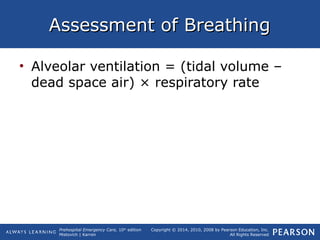
• Alveolar ventilation = (tidal volume –
dead space air) × respiratory rate
Prehospital Emergency Care, 10th
edition
Mistovich | Karren
Copyright © 2014, 2010, 2008 by Pearson Education, Inc.
All Rights Reserved
Assessing for Adequate BreathingAssessing for Adequate Breathing
• Assess the rate, rhythm, quality, and
depth by looking, listening, feeling, and
auscultating.
continued on next slide
Prehospital Emergency Care, 10th
edition
Mistovich | Karren
Copyright © 2014, 2010, 2008 by Pearson Education, Inc.
All Rights Reserved
Assessing for Adequate BreathingAssessing for Adequate Breathing
• Look
 Inspect the chest.
 Observe the patient's general
appearance.
 Determine if the breathing pattern is
regular or irregular.
 Look for nasal flaring.
continued on next slide
Prehospital Emergency Care, 10th
edition
Mistovich | Karren
Copyright © 2014, 2010, 2008 by Pearson Education, Inc.
All Rights Reserved
Assessing for Adequate BreathingAssessing for Adequate Breathing
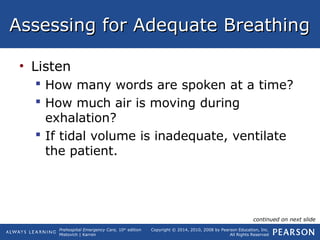
• Listen
 How many words are spoken at a time?
 How much air is moving during
exhalation?
 If tidal volume is inadequate, ventilate
the patient.
continued on next slide
Prehospital Emergency Care, 10th
edition
Mistovich | Karren
Copyright © 2014, 2010, 2008 by Pearson Education, Inc.
All Rights Reserved
Assessing for Adequate BreathingAssessing for Adequate Breathing
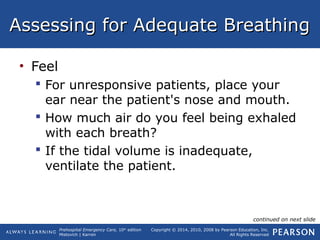
• Feel
 For unresponsive patients, place your
ear near the patient's nose and mouth.
 How much air do you feel being exhaled
with each breath?
 If the tidal volume is inadequate,
ventilate the patient.
continued on next slide
Prehospital Emergency Care, 10th
edition
Mistovich | Karren
Copyright © 2014, 2010, 2008 by Pearson Education, Inc.
All Rights Reserved
Assessing for Adequate BreathingAssessing for Adequate Breathing
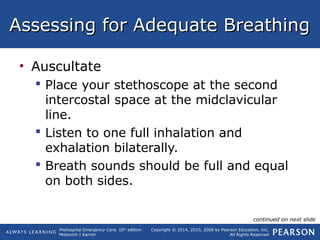
• Auscultate
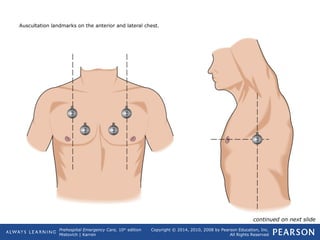
 Place your stethoscope at the second
intercostal space at the midclavicular
line.
 Listen to one full inhalation and
exhalation bilaterally.
 Breath sounds should be full and equal
on both sides.
continued on next slide
Prehospital Emergency Care, 10th
edition
Mistovich | Karren
Copyright © 2014, 2010, 2008 by Pearson Education, Inc.
All Rights Reserved
Auscultation landmarks on the anterior and lateral chest.
continued on next slide
Prehospital Emergency Care, 10th
edition
Mistovich | Karren
Copyright © 2014, 2010, 2008 by Pearson Education, Inc.
All Rights Reserved
Assessing for Adequate BreathingAssessing for Adequate Breathing
• Assess the following:
 Rate
 Rhythm
 Quality
 Depth
continued on next slide
Prehospital Emergency Care, 10th
edition
Mistovich | Karren
Copyright © 2014, 2010, 2008 by Pearson Education, Inc.
All Rights Reserved
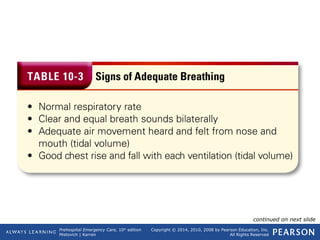
Table 10-3 Signs of Adequate Breathing
continued on next slide
Prehospital Emergency Care, 10th
edition
Mistovich | Karren
Copyright © 2014, 2010, 2008 by Pearson Education, Inc.
All Rights Reserved
Assessing for Adequate BreathingAssessing for Adequate Breathing
• Breathing can be adequate, but if the
patient is working harder to breathe, he
is in respiratory distress.
continued on next slide
Prehospital Emergency Care, 10th
edition
Mistovich | Karren
Copyright © 2014, 2010, 2008 by Pearson Education, Inc.
All Rights Reserved
Assessing for Adequate BreathingAssessing for Adequate Breathing
• Inadequate breathing leads to hypoxia.
• If breathing remains inadequate, the
brain begins to die within 4 to 6
minutes.
• Inadequate breathing can be
categorized as respiratory failure or
respiratory arrest.
continued on next slide
Prehospital Emergency Care, 10th
edition
Mistovich | Karren
Copyright © 2014, 2010, 2008 by Pearson Education, Inc.
All Rights Reserved
Assessing for Adequate BreathingAssessing for Adequate Breathing
• Patients with respiratory failure or
arrest require immediate positive
pressure ventilation.
continued on next slide
Prehospital Emergency Care, 10th
edition
Mistovich | Karren
Copyright © 2014, 2010, 2008 by Pearson Education, Inc.
All Rights Reserved
Assessing for Adequate BreathingAssessing for Adequate Breathing
• Causes of respiratory arrest
 Stroke
 Myocardial infarction
 Drug overdose
 Toxic inhalation
 Electrocution
continued on next slide
Prehospital Emergency Care, 10th
edition
Mistovich | Karren
Copyright © 2014, 2010, 2008 by Pearson Education, Inc.
All Rights Reserved
Assessing for Adequate BreathingAssessing for Adequate Breathing
• Causes of respiratory arrest
 Suffocation
 Traumatic injuries
 Infection of the epiglottis
 Airway obstruction
continued on next slide
Prehospital Emergency Care, 10th
edition
Mistovich | Karren
Copyright © 2014, 2010, 2008 by Pearson Education, Inc.
All Rights Reserved
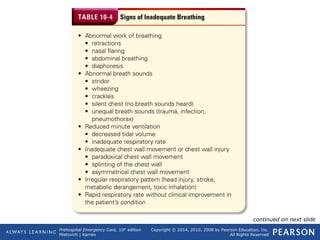
Table 10-4 Signs of Inadequate Breathing
continued on next slide
Prehospital Emergency Care, 10th
edition
Mistovich | Karren
Copyright © 2014, 2010, 2008 by Pearson Education, Inc.
All Rights Reserved
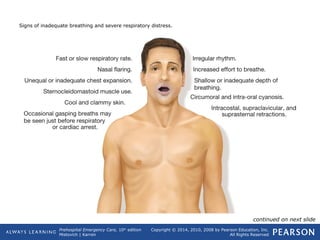
Signs of inadequate breathing and severe respiratory distress.
continued on next slide
Prehospital Emergency Care, 10th
edition
Mistovich | Karren
Copyright © 2014, 2010, 2008 by Pearson Education, Inc.
All Rights Reserved
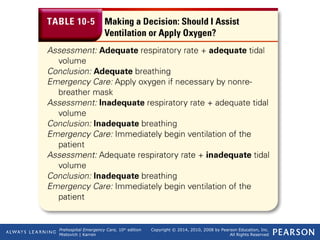
Table 10-5 Making a Decision: Should I Assist
Ventilation or Apply Oxygen?
Prehospital Emergency Care, 10th
edition
Mistovich | Karren
Copyright © 2014, 2010, 2008 by Pearson Education, Inc.
All Rights Reserved
Case StudyCase Study
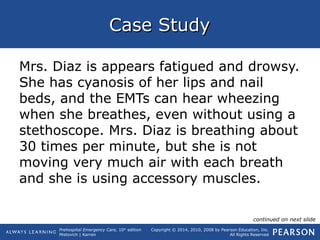
Mrs. Diaz is appears fatigued and drowsy.
She has cyanosis of her lips and nail
beds, and the EMTs can hear wheezing
when she breathes, even without using a
stethoscope. Mrs. Diaz is breathing about
30 times per minute, but she is not
moving very much air with each breath
and she is using accessory muscles.
continued on next slide
Prehospital Emergency Care, 10th
edition
Mistovich | Karren
Copyright © 2014, 2010, 2008 by Pearson Education, Inc.
All Rights Reserved
Case StudyCase Study
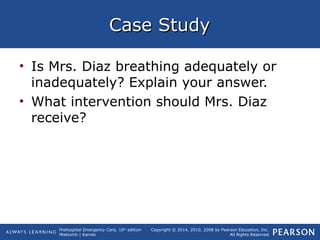
• Is Mrs. Diaz breathing adequately or
inadequately? Explain your answer.
• What intervention should Mrs. Diaz
receive?
Prehospital Emergency Care, 10th
edition
Mistovich | Karren
Copyright © 2014, 2010, 2008 by Pearson Education, Inc.
All Rights Reserved
Artificial VentilationArtificial Ventilation
• There are physiological differences
between spontaneous breathing and
positive pressure ventilation.
continued on next slide
Prehospital Emergency Care, 10th
edition
Mistovich | Karren
Copyright © 2014, 2010, 2008 by Pearson Education, Inc.
All Rights Reserved
Artificial VentilationArtificial Ventilation
• PPV does not rely on negative
pressure; air is forced into the alveoli.
• PPV increases airway wall pressure.
continued on next slide
Prehospital Emergency Care, 10th
edition
Mistovich | Karren
Copyright © 2014, 2010, 2008 by Pearson Education, Inc.
All Rights Reserved
Artificial VentilationArtificial Ventilation
• PPV can overcome esophageal opening
pressure, leading to gastric distention.
• Negative pressure from spontaneous
breathing assists blood return to the
heart; PPV decreases cardiac output.
continued on next slide
Prehospital Emergency Care, 10th
edition
Mistovich | Karren
Copyright © 2014, 2010, 2008 by Pearson Education, Inc.
All Rights Reserved
Artificial VentilationArtificial Ventilation
• Basic considerations
 You must be able to maintain a good
mask seal.
 The device must deliver an adequate
volume of air to inflate the lungs.
 There must be a connection to allow
oxygen delivery while artificially
ventilating.
continued on next slide
Prehospital Emergency Care, 10th
edition
Mistovich | Karren
Copyright © 2014, 2010, 2008 by Pearson Education, Inc.
All Rights Reserved
Artificial VentilationArtificial Ventilation
• Standard Precautions
 Gloves
 Eyewear
 Face mask, for large amounts of blood
or secretions
 HEPA or N-95 respirator for suspected
tuberculosis
continued on next slide
Prehospital Emergency Care, 10th
edition
Mistovich | Karren
Copyright © 2014, 2010, 2008 by Pearson Education, Inc.
All Rights Reserved
Artificial VentilationArtificial Ventilation
• Adequate ventilation
 Sufficient rate (patients with a pulse)
• Newborns
• 40 to 60 times per minute
• Infants and children
• 12 to 20 times per minute, or once every
3 to 5 seconds
• Adults
• 10 to 12 times per minute, or once every
5 seconds
continued on next slide
Prehospital Emergency Care, 10th
edition
Mistovich | Karren
Copyright © 2014, 2010, 2008 by Pearson Education, Inc.
All Rights Reserved
Artificial VentilationArtificial Ventilation
• Adequate ventilation
 Sufficient rate (patients with a pulse)
• Deliver each breath over 1 second.
continued on next slide
Prehospital Emergency Care, 10th
edition
Mistovich | Karren
Copyright © 2014, 2010, 2008 by Pearson Education, Inc.
All Rights Reserved
Artificial VentilationArtificial Ventilation
• Adequate ventilation
 Sufficient rate (cardiac arrest)
• Perform ventilations in conjunction with
chest compressions.
• Infants, children and adults
• Ratio of 30 compressions to 2 ventilations
• Newborns
• Ratio of 3 compressions to 1 ventilation
continued on next slide
Prehospital Emergency Care, 10th
edition
Mistovich | Karren
Copyright © 2014, 2010, 2008 by Pearson Education, Inc.
All Rights Reserved
Artificial VentilationArtificial Ventilation
• Adequate ventilation
 Consistent tidal volume, sufficient to
cause chest rise
 Heart rate returns to normal.
 Color improves.
continued on next slide
Prehospital Emergency Care, 10th
edition
Mistovich | Karren
Copyright © 2014, 2010, 2008 by Pearson Education, Inc.
All Rights Reserved
Artificial VentilationArtificial Ventilation
• Inadequate ventilation
 Ventilation rate is too fast or too slow.
 The chest does not rise and fall.
 The heart rate does not return to
normal.
 Color does not improve.
continued on next slide
Prehospital Emergency Care, 10th
edition
Mistovich | Karren
Copyright © 2014, 2010, 2008 by Pearson Education, Inc.
All Rights Reserved
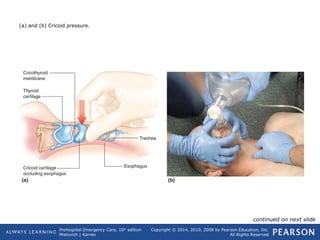
Artificial VentilationArtificial Ventilation
• Cricoid pressure is not recommended
for routine use, but can be used in
some situations.
 Adult intubation
 Pediatric patient when an extra EMT is
available
continued on next slide
Prehospital Emergency Care, 10th
edition
Mistovich | Karren
Copyright © 2014, 2010, 2008 by Pearson Education, Inc.
All Rights Reserved
(a) and (b) Cricoid pressure.
continued on next slide
Prehospital Emergency Care, 10th
edition
Mistovich | Karren
Copyright © 2014, 2010, 2008 by Pearson Education, Inc.
All Rights Reserved
Artificial VentilationArtificial Ventilation
• Mouth-to-mouth ventilation
 Allows delivery of 16% oxygen
 A barrier device must be used.
 Form a seal around the patient's mouth
and pinch the nose.
 Mouth-to-nose ventilation can be used if
the patient's mouth cannot be opened.
continued on next slide
Prehospital Emergency Care, 10th
edition
Mistovich | Karren
Copyright © 2014, 2010, 2008 by Pearson Education, Inc.
All Rights Reserved
Artificial VentilationArtificial Ventilation
• Mouth-to-mask and bag-valve
ventilation
 Adjust the rate and volume based on:
• The patient's age
• Whether the patient has a pulse
• Whether the patient has an advanced
airway in place
 Avoid overventilation.
 Refer to text Table 10-6.
continued on next slide
Prehospital Emergency Care, 10th
edition
Mistovich | Karren
Copyright © 2014, 2010, 2008 by Pearson Education, Inc.
All Rights Reserved
Artificial VentilationArtificial Ventilation
• Avoid gastric inflation.
 Leads to regurgitation and aspiration,
and impaired ventilation
 Reduce the tidal volume delivered and
use supplemental oxygen to maintain
oxygenation with a smaller tidal volume.
continued on next slide
Prehospital Emergency Care, 10th
edition
Mistovich | Karren
Copyright © 2014, 2010, 2008 by Pearson Education, Inc.
All Rights Reserved
Mouth-to-Mask VentilationMouth-to-Mask Ventilation
• Advantages
 A single EMT can maintain a good seal
with the mask.
 Eliminates direct contact with the
patient
 One-way valve prevents exposure to the
patient's exhaled air.
continued on next slide
Prehospital Emergency Care, 10th
edition
Mistovich | Karren
Copyright © 2014, 2010, 2008 by Pearson Education, Inc.
All Rights Reserved
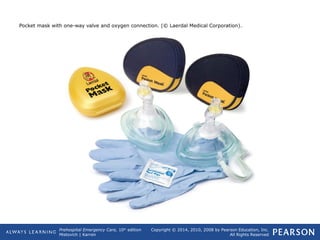
Pocket mask with one-way valve and oxygen connection. (© Laerdal Medical Corporation).
Prehospital Emergency Care, 10th
edition
Mistovich | Karren
Copyright © 2014, 2010, 2008 by Pearson Education, Inc.
All Rights Reserved
Mouth-to-Mask VentilationMouth-to-Mask Ventilation
• Advantages
 Provides adequate tidal volume
 Supplemental oxygen can be
administered.
continued on next slide
Prehospital Emergency Care, 10th
edition
Mistovich | Karren
Copyright © 2014, 2010, 2008 by Pearson Education, Inc.
All Rights Reserved
Mouth-to-Mask VentilationMouth-to-Mask Ventilation
• Disadvantages
 The mask is perceived by some EMTs as
having an increased risk of infection.
 The EMT providing ventilation may
fatigue.
 Doesn't allow for the highest possible
concentration of oxygen to be delivered
continued on next slide
Prehospital Emergency Care, 10th
edition
Mistovich | Karren
Copyright © 2014, 2010, 2008 by Pearson Education, Inc.
All Rights Reserved
Mouth-to-Mask VentilationMouth-to-Mask Ventilation
• Technique
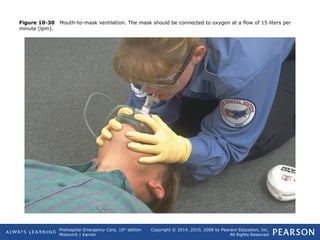
 Connect mask to oxygen.
 Position yourself at the patient's head.
 Use a "C-E" technique to seal the mask
and perform a head-tilt, chin-lift.
 Blow into the ventilation port.
continued on next slide
Prehospital Emergency Care, 10th
edition
Mistovich | Karren
Copyright © 2014, 2010, 2008 by Pearson Education, Inc.
All Rights Reserved
Figure 10-30 Mouth-to-mask ventilation. The mask should be connected to oxygen at a flow of 15 liters per
minute (lpm).
Prehospital Emergency Care, 10th
edition
Mistovich | Karren
Copyright © 2014, 2010, 2008 by Pearson Education, Inc.
All Rights Reserved
Mouth-to-Mask VentilationMouth-to-Mask Ventilation
• Technique
 Modify technique for suspected spinal
injury.
 Recognize and correct ineffective
ventilations.
continued on next slide
Prehospital Emergency Care, 10th
edition
Mistovich | Karren
Copyright © 2014, 2010, 2008 by Pearson Education, Inc.
All Rights Reserved
Bag-Valve-MaskBag-Valve-Mask
• Select the appropriate size and use
only enough volume to cause the chest
to rise.
• Two-person technique is preferred.
• Can deliver close to 100% oxygen
• May allow medication administration
• May allow end-tidal CO2 sampling
continued on next slide
Prehospital Emergency Care, 10th
edition
Mistovich | Karren
Copyright © 2014, 2010, 2008 by Pearson Education, Inc.
All Rights Reserved
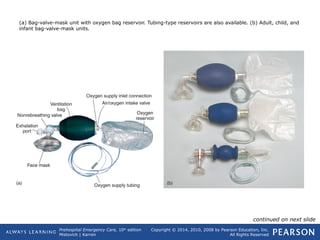
(a) Bag-valve-mask unit with oxygen bag reservoir. Tubing-type reservoirs are also available. (b) Adult, child, and
infant bag-valve-mask units.
continued on next slide
Prehospital Emergency Care, 10th
edition
Mistovich | Karren
Copyright © 2014, 2010, 2008 by Pearson Education, Inc.
All Rights Reserved
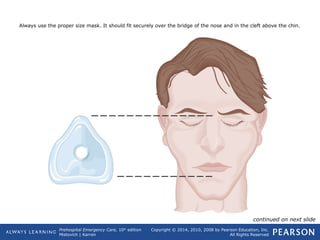
Always use the proper size mask. It should fit securely over the bridge of the nose and in the cleft above the chin.
continued on next slide
Prehospital Emergency Care, 10th
edition
Mistovich | Karren
Copyright © 2014, 2010, 2008 by Pearson Education, Inc.
All Rights Reserved
Bag-Valve-MaskBag-Valve-Mask
• Technique
 Use a head-tilt, chin-lift.
 Select the correct-size mask and bag-
valve device.
 Position the mask, use an "E-C"
technique.
 A second EMT squeezes the bag.
Prehospital Emergency Care, 10th
edition
Mistovich | Karren
Copyright © 2014, 2010, 2008 by Pearson Education, Inc.
All Rights Reserved
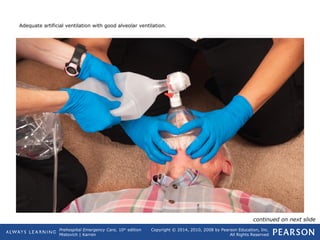
Adequate artificial ventilation with good alveolar ventilation.
continued on next slide
Prehospital Emergency Care, 10th
edition
Mistovich | Karren
Copyright © 2014, 2010, 2008 by Pearson Education, Inc.
All Rights Reserved
Bag-Valve-MaskBag-Valve-Mask
• Technique
 Modify technique for suspected spinal
injury.
 Recognize and correct ineffective
ventilations.
continued on next slide
Prehospital Emergency Care, 10th
edition
Mistovich | Karren
Copyright © 2014, 2010, 2008 by Pearson Education, Inc.
All Rights Reserved
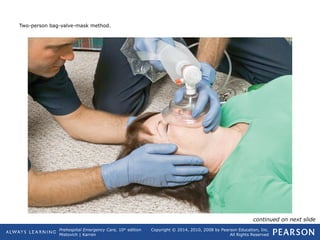
Two-person bag-valve-mask method.
continued on next slide
Prehospital Emergency Care, 10th
edition
Mistovich | Karren
Copyright © 2014, 2010, 2008 by Pearson Education, Inc.
All Rights Reserved
EMT SKILLS 10-5
In-Line Stabilization During Bag-Valve
Ventilation
continued on next slide
Prehospital Emergency Care, 10th
edition
Mistovich | Karren
Copyright © 2014, 2010, 2008 by Pearson Education, Inc.
All Rights Reserved
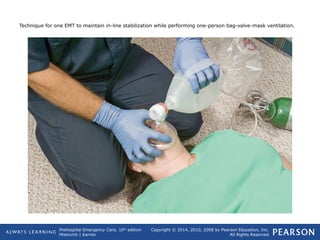
Technique for one EMT to maintain in-line stabilization while performing one-person bag-valve-mask ventilation.
Prehospital Emergency Care, 10th
edition
Mistovich | Karren
Copyright © 2014, 2010, 2008 by Pearson Education, Inc.
All Rights Reserved
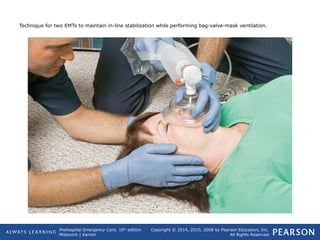
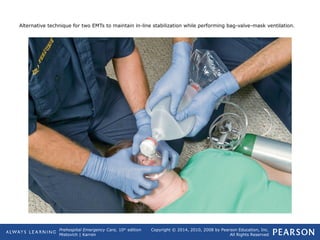
Technique for two EMTs to maintain in-line stabilization while performing bag-valve-mask ventilation.
Prehospital Emergency Care, 10th
edition
Mistovich | Karren
Copyright © 2014, 2010, 2008 by Pearson Education, Inc.
All Rights Reserved
Alternative technique for two EMTs to maintain in-line stabilization while performing bag-valve-mask ventilation.
Prehospital Emergency Care, 10th
edition
Mistovich | Karren
Copyright © 2014, 2010, 2008 by Pearson Education, Inc.
All Rights Reserved
FROPVDFROPVD
• Flow-restricted, oxygen-powered
ventilation device
• A manually triggered ventilation device
• Delivers 100% ventilation
• Can be used by one EMT using a two-
handed technique to seal the mask
• Only for adult patients
continued on next slide
Prehospital Emergency Care, 10th
edition
Mistovich | Karren
Copyright © 2014, 2010, 2008 by Pearson Education, Inc.
All Rights Reserved
FROPVDFROPVD
• Technique
 Check the unit and oxygen source.
 Open the airway and establish a seal
with the mask.
 Depress the trigger; release it as the
chest begins to rise.
Prehospital Emergency Care, 10th
edition
Mistovich | Karren
Copyright © 2014, 2010, 2008 by Pearson Education, Inc.
All Rights Reserved
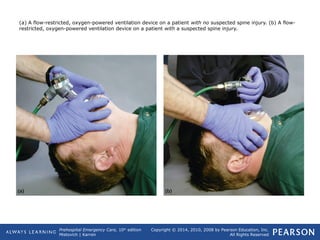
(a) A flow-restricted, oxygen-powered ventilation device on a patient with no suspected spine injury. (b) A flow-
restricted, oxygen-powered ventilation device on a patient with a suspected spine injury.
Prehospital Emergency Care, 10th
edition
Mistovich | Karren
Copyright © 2014, 2010, 2008 by Pearson Education, Inc.
All Rights Reserved
Automatic Transport VentilatorAutomatic Transport Ventilator
• Advantages
 Can deliver consistent rate and tidal
volume
 Delivers 100% oxygen
 Lower risk of gastric distention
continued on next slide
Prehospital Emergency Care, 10th
edition
Mistovich | Karren
Copyright © 2014, 2010, 2008 by Pearson Education, Inc.
All Rights Reserved
Automatic Transport VentilatorAutomatic Transport Ventilator
• Advantages
 EMT can use both hands to seal the
mask.
 Allows specific tidal volumes and rates
 Alarms indicate low pressure and
disconnection.
continued on next slide
Prehospital Emergency Care, 10th
edition
Mistovich | Karren
Copyright © 2014, 2010, 2008 by Pearson Education, Inc.
All Rights Reserved
Automatic Transport VentilatorAutomatic Transport Ventilator
• Disadvantages
 Requires oxygen source to operate
 Some ATVs cannot be used in small
children.
 Inability to feel lung compliance
continued on next slide
Prehospital Emergency Care, 10th
edition
Mistovich | Karren
Copyright © 2014, 2010, 2008 by Pearson Education, Inc.
All Rights Reserved
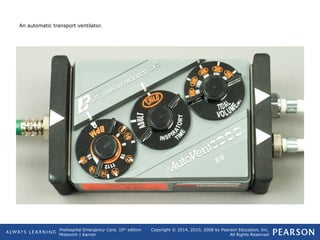
An automatic transport ventilator.
Prehospital Emergency Care, 10th
edition
Mistovich | Karren
Copyright © 2014, 2010, 2008 by Pearson Education, Inc.
All Rights Reserved
Automatic Transport VentilatorAutomatic Transport Ventilator
• Technique
 Check the device.
 Seal the mask to the face.
 Select the tidal volume and rate.
 Observe for adequate chest rise and fall.
 Recognize and correct ineffective
ventilations.
Prehospital Emergency Care, 10th
edition
Mistovich | Karren
Copyright © 2014, 2010, 2008 by Pearson Education, Inc.
All Rights Reserved
Ventilating a SpontaneouslyVentilating a Spontaneously
Breathing PatientBreathing Patient
• Recognize the need to ventilate a
patient who is breathing, but breathing
inadequately.
• Complications include uncooperative
patients, inadequate mask seal, and
overinflation of the lungs.
continued on next slide
Prehospital Emergency Care, 10th
edition
Mistovich | Karren
Copyright © 2014, 2010, 2008 by Pearson Education, Inc.
All Rights Reserved
Ventilating a SpontaneouslyVentilating a Spontaneously
Breathing PatientBreathing Patient
• Explain the procedure to the patient.
• Ventilate to achieve the normal rate
and/or tidal volume.
Prehospital Emergency Care, 10th
edition
Mistovich | Karren
Copyright © 2014, 2010, 2008 by Pearson Education, Inc.
All Rights Reserved
CPAPCPAP
• Continuous positive airway pressure
• A form of noninvasive positive pressure
ventilation
• Used in awake, spontaneously
breathing patients who need ventilatory
support
continued on next slide
Prehospital Emergency Care, 10th
edition
Mistovich | Karren
Copyright © 2014, 2010, 2008 by Pearson Education, Inc.
All Rights Reserved
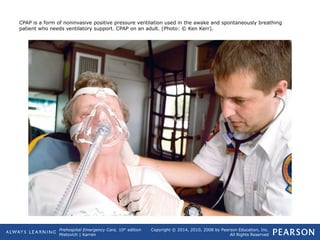
CPAP is a form of noninvasive positive pressure ventilation used in the awake and spontaneously breathing
patient who needs ventilatory support. CPAP on an adult. (Photo: © Ken Kerr).
Prehospital Emergency Care, 10th
edition
Mistovich | Karren
Copyright © 2014, 2010, 2008 by Pearson Education, Inc.
All Rights Reserved
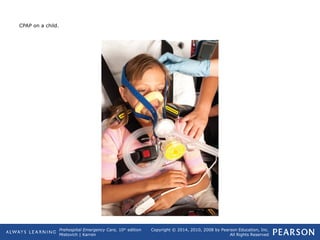
CPAP on a child.
Prehospital Emergency Care, 10th
edition
Mistovich | Karren
Copyright © 2014, 2010, 2008 by Pearson Education, Inc.
All Rights Reserved
CPAPCPAP
• CPAP can help avoid the need for
endotracheal intubation in some
patients.
• Oxygen should be titrated to the
patient's SpO2 reading, and signs and
symptoms.
continued on next slide
Prehospital Emergency Care, 10th
edition
Mistovich | Karren
Copyright © 2014, 2010, 2008 by Pearson Education, Inc.
All Rights Reserved
CPAPCPAP
• Positive pressure is measured in cmH2O.
• Positive pressure helps inflate collapsed
alveoli and improve oxygenation.
• Decreases the work of breathing
• Helps displace fluid in alveoli in left
ventricular failure
continued on next slide
Prehospital Emergency Care, 10th
edition
Mistovich | Karren
Copyright © 2014, 2010, 2008 by Pearson Education, Inc.
All Rights Reserved
CPAPCPAP
• Delivered at 2 to 20 cmH2O, but most
orders do not exceed 10 cmH2O
• Begin at the lowest setting and titrate.
continued on next slide
Prehospital Emergency Care, 10th
edition
Mistovich | Karren
Copyright © 2014, 2010, 2008 by Pearson Education, Inc.
All Rights Reserved
CPAPCPAP
• Patient criteria
 Awake and can obey commands
 Can maintain his airway
 Breathing on his own, respiratory rate
>25/min.
 Has signs and symptoms of moderate to
severe respiratory distress, or early
respiratory failure
continued on next slide
Prehospital Emergency Care, 10th
edition
Mistovich | Karren
Copyright © 2014, 2010, 2008 by Pearson Education, Inc.
All Rights Reserved
CPAPCPAP
• Indications
 Congestive heart failure
 Pulmonary edema
 COPD
 Asthma
 Pneumonia
continued on next slide
Prehospital Emergency Care, 10th
edition
Mistovich | Karren
Copyright © 2014, 2010, 2008 by Pearson Education, Inc.
All Rights Reserved
CPAPCPAP
• Contraindications
 Apnea or agonal respirations
 Inability to follow commands
 Inability to maintain an airway
 Unresponsive
 Shock with cardiac insufficiency
 Cardiac arrest
 Vomiting
continued on next slide
Prehospital Emergency Care, 10th
edition
Mistovich | Karren
Copyright © 2014, 2010, 2008 by Pearson Education, Inc.
All Rights Reserved
CPAPCPAP
• Contraindications
 Upper GI bleeding
 Pneumothorax or chest trauma
 Tracheotomy
 Facial trauma
 Increased intrathoracic pressure
continued on next slide
Prehospital Emergency Care, 10th
edition
Mistovich | Karren
Copyright © 2014, 2010, 2008 by Pearson Education, Inc.
All Rights Reserved
CPAPCPAP
• Procedure
 Inform and coach the patient.
 Minimize the patient's anxiety.
 Obtain vital signs and SpO2.
 Have an adequate oxygen supply.
 Place the patient in seated or semi-
Fowler's position.
continued on next slide
Prehospital Emergency Care, 10th
edition
Mistovich | Karren
Copyright © 2014, 2010, 2008 by Pearson Education, Inc.
All Rights Reserved
CPAPCPAP
• Procedure
 Assemble and check the device.
 Secure the mask with straps.
 Increase pressure in increments of 2
cmH2O.
 Continue to coach the patient.
continued on next slide
Prehospital Emergency Care, 10th
edition
Mistovich | Karren
Copyright © 2014, 2010, 2008 by Pearson Education, Inc.
All Rights Reserved
CPAPCPAP
• Procedure
 Do not discontinue CPAP unless
contraindications arise or you are
advised by medical direction.
 Notify the receiving facility so they can
prepare to transfer CPAP.
continued on next slide
Prehospital Emergency Care, 10th
edition
Mistovich | Karren
Copyright © 2014, 2010, 2008 by Pearson Education, Inc.
All Rights Reserved
CPAPCPAP
• Assess effectiveness with these
measures:
 Respiratory rate
 Heart rate
 Systolic blood pressure
 Oxygen saturation
 End-tidal CO2
 Complaint of dyspnea
continued on next slide
Prehospital Emergency Care, 10th
edition
Mistovich | Karren
Copyright © 2014, 2010, 2008 by Pearson Education, Inc.
All Rights Reserved
CPAPCPAP
• Monitor for:
 Pneumothorax
 Gastric distention
 Vomiting
 Worsening of respiratory distress or
failure
 Decreased mental status
 Intolerance of the device
Prehospital Emergency Care, 10th
edition
Mistovich | Karren
Copyright © 2014, 2010, 2008 by Pearson Education, Inc.
All Rights Reserved
Hazards of OverinflationHazards of Overinflation
• Overinflation leads to serious
complications.
 In cardiac arrest, perfusion is
decreased.
 In spontaneously breathing patients,
return to the left ventricle can be
reduced.
Prehospital Emergency Care, 10th
edition
Mistovich | Karren
Copyright © 2014, 2010, 2008 by Pearson Education, Inc.
All Rights Reserved
Case StudyCase Study
The EMTs quickly decide to assist Mrs.
Diaz's ventilations with a bag-valve-mask
device. Alan explains to her what they
are going to do as Carlos prepares the
equipment.
continued on next slide
Prehospital Emergency Care, 10th
edition
Mistovich | Karren
Copyright © 2014, 2010, 2008 by Pearson Education, Inc.
All Rights Reserved
Case StudyCase Study
• What should be the goals for the depth
and rate of ventilation for Mrs. Diaz?
• What complications should the EMTs
anticipate?
• How will the EMTs know if the assisted
ventilations are effective?
Prehospital Emergency Care, 10th
edition
Mistovich | Karren
Copyright © 2014, 2010, 2008 by Pearson Education, Inc.
All Rights Reserved
Special Considerations in AirwaySpecial Considerations in Airway
Management and VentilationManagement and Ventilation
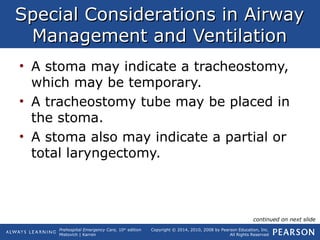
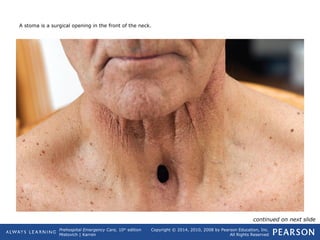
• A stoma may indicate a tracheostomy,
which may be temporary.
• A tracheostomy tube may be placed in
the stoma.
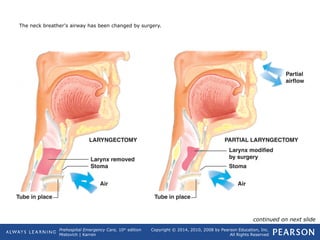
• A stoma also may indicate a partial or
total laryngectomy.
continued on next slide
Prehospital Emergency Care, 10th
edition
Mistovich | Karren
Copyright © 2014, 2010, 2008 by Pearson Education, Inc.
All Rights Reserved
A stoma is a surgical opening in the front of the neck.
continued on next slide
Prehospital Emergency Care, 10th
edition
Mistovich | Karren
Copyright © 2014, 2010, 2008 by Pearson Education, Inc.
All Rights Reserved
The neck breather's airway has been changed by surgery.
continued on next slide
Prehospital Emergency Care, 10th
edition
Mistovich | Karren
Copyright © 2014, 2010, 2008 by Pearson Education, Inc.
All Rights Reserved
Special Considerations in AirwaySpecial Considerations in Airway
Management and VentilationManagement and Ventilation
• A bag-valve device can connect to a
tracheostomy tube.
• If there is not a tracheostomy tube,
place a mask over the stoma to provide
bag-valve ventilations.
continued on next slide
Prehospital Emergency Care, 10th
edition
Mistovich | Karren
Copyright © 2014, 2010, 2008 by Pearson Education, Inc.
All Rights Reserved
Artificial ventilation can be accomplished in the patient with a tracheostomy tube by attaching the bag-valve-mask
device directly to the tube.
continued on next slide
Prehospital Emergency Care, 10th
edition
Mistovich | Karren
Copyright © 2014, 2010, 2008 by Pearson Education, Inc.
All Rights Reserved
Special Considerations in AirwaySpecial Considerations in Airway
Management and VentilationManagement and Ventilation
• It may be necessary to suction the
stoma.
• It may be necessary to seal the mouth
and nose.
continued on next slide
Prehospital Emergency Care, 10th
edition
Mistovich | Karren
Copyright © 2014, 2010, 2008 by Pearson Education, Inc.
All Rights Reserved
Special Considerations in AirwaySpecial Considerations in Airway
Management and VentilationManagement and Ventilation
• Infants and children
 Place the infant's head in a neutral
position.
 Avoid excessive volumes and pressures
with ventilation.
 Use a BVM with minimum 450 to 500
mL volume and without a pop-off valve.
continued on next slide
Prehospital Emergency Care, 10th
edition
Mistovich | Karren
Copyright © 2014, 2010, 2008 by Pearson Education, Inc.
All Rights Reserved
Special Considerations in AirwaySpecial Considerations in Airway
Management and VentilationManagement and Ventilation
• Infants and children
 If manual airway maneuvers are not
effective, use an oropharyngeal or
nasopharyngeal airway.
 Ventilate at 12 to 20/min., or once every
3 to 5 seconds.
continued on next slide
Prehospital Emergency Care, 10th
edition
Mistovich | Karren
Copyright © 2014, 2010, 2008 by Pearson Education, Inc.
All Rights Reserved
Special Considerations in AirwaySpecial Considerations in Airway
Management and VentilationManagement and Ventilation
• Facial injuries
 Swelling can occlude the airway.
 Use an airway adjunct if needed.
 Avoid a nasopharyngeal airway in
patients with mid-face trauma.
 Bleeding may require frequent
suctioning.
continued on next slide
Prehospital Emergency Care, 10th
edition
Mistovich | Karren
Copyright © 2014, 2010, 2008 by Pearson Education, Inc.
All Rights Reserved
Special Considerations in AirwaySpecial Considerations in Airway
Management and VentilationManagement and Ventilation
• Foreign body airway obstruction
 If a patient is choking but is effectively
moving air, instruct him to cough;
administer high-concentration oxygen.
 If air exchange is poor, manage as for a
complete airway obstruction.
continued on next slide
Prehospital Emergency Care, 10th
edition
Mistovich | Karren
Copyright © 2014, 2010, 2008 by Pearson Education, Inc.
All Rights Reserved
Special Considerations in AirwaySpecial Considerations in Airway
Management and VentilationManagement and Ventilation
• Foreign body airway obstruction
 For a child or adult, perform abdominal
thrusts for complete airway obstruction.
 For an infant, perform chest thrusts and
back blows for a complete airway
obstruction.
continued on next slide
Prehospital Emergency Care, 10th
edition
Mistovich | Karren
Copyright © 2014, 2010, 2008 by Pearson Education, Inc.
All Rights Reserved
Special Considerations in AirwaySpecial Considerations in Airway
Management and VentilationManagement and Ventilation
• Dental appliances
 Manage in place when dentures are
secure.
 If dentures are loose, remove them.
Prehospital Emergency Care, 10th
edition
Mistovich | Karren
Copyright © 2014, 2010, 2008 by Pearson Education, Inc.
All Rights Reserved
Oxygen TherapyOxygen Therapy
• 100% oxygen is stored in cylinders.
• Cylinder volume varies.
• Pressure in a full cylinder is 2,000 psi.
• For long transports, calculate the
duration of flow for the cylinder.
continued on next slide
Prehospital Emergency Care, 10th
edition
Mistovich | Karren
Copyright © 2014, 2010, 2008 by Pearson Education, Inc.
All Rights Reserved
Table 10-7 Oxygen Duration
Prehospital Emergency Care, 10th
edition
Mistovich | Karren
Copyright © 2014, 2010, 2008 by Pearson Education, Inc.
All Rights Reserved
Oxygen TherapyOxygen Therapy
• Safety precautions
 Never allow combustible materials such
as oil or grease to touch the cylinder,
regulator, fittings, valves, or hoses.
 Never allow smoking near oxygen
cylinders.
 Store cylinders below 125°F.
continued on next slide
Prehospital Emergency Care, 10th
edition
Mistovich | Karren
Copyright © 2014, 2010, 2008 by Pearson Education, Inc.
All Rights Reserved
Oxygen TherapyOxygen Therapy
• Safety precautions
 Never use without a properly fitting
regulator.
 Keep all valves closed when the cylinder
is not in use.
 Keep cylinders secured.
 Do not place your body over the cylinder
valve.
continued on next slide
Prehospital Emergency Care, 10th
edition
Mistovich | Karren
Copyright © 2014, 2010, 2008 by Pearson Education, Inc.
All Rights Reserved
Oxygen TherapyOxygen Therapy
• Pressure regulators
 Reduce the pressure in the cylinder to a
safe range and control the flow of
oxygen.
 A therapy regulator delivers oxygen
from 0.5 to 25 lpm.
continued on next slide
Prehospital Emergency Care, 10th
edition
Mistovich | Karren
Copyright © 2014, 2010, 2008 by Pearson Education, Inc.
All Rights Reserved
Oxygen TherapyOxygen Therapy
• Oxygen humidifiers
 Oxygen leaving the cylinder is dry,
which can be irritating to the respiratory
tract.
 An oxygen humidifier can add moisture
to the oxygen.
 Generally used for long-term therapy
continued on next slide
Prehospital Emergency Care, 10th
edition
Mistovich | Karren
Copyright © 2014, 2010, 2008 by Pearson Education, Inc.
All Rights Reserved
An oxygen humidifier.
Prehospital Emergency Care, 10th
edition
Mistovich | Karren
Copyright © 2014, 2010, 2008 by Pearson Education, Inc.
All Rights Reserved
Oxygen TherapyOxygen Therapy
• Indications for oxygen use
 Cardiac or respiratory arrest
 Any patient receiving positive pressure
ventilation
 Signs of hypoxia and adequate
respirations
 SpO2 of less than 94%
continued on next slide
Prehospital Emergency Care, 10th
edition
Mistovich | Karren
Copyright © 2014, 2010, 2008 by Pearson Education, Inc.
All Rights Reserved
Oxygen TherapyOxygen Therapy
• Indications for oxygen use
 Any medical condition that may cause
hypoxia
 Altered mental status or
unresponsiveness
 Injuries to a body cavity or the central
nervous system
 Multiple fractures or soft tissue injuries
continued on next slide
Prehospital Emergency Care, 10th
edition
Mistovich | Karren
Copyright © 2014, 2010, 2008 by Pearson Education, Inc.
All Rights Reserved
Oxygen TherapyOxygen Therapy
• Indications for oxygen use
 Severe external or internal bleeding
 Any evidence of shock
 Exposure to toxins
continued on next slide
Prehospital Emergency Care, 10th
edition
Mistovich | Karren
Copyright © 2014, 2010, 2008 by Pearson Education, Inc.
All Rights Reserved
Oxygen TherapyOxygen Therapy
• When in doubt, give oxygen.
• Never withhold oxygen from a patient
who needs it!
continued on next slide
Prehospital Emergency Care, 10th
edition
Mistovich | Karren
Copyright © 2014, 2010, 2008 by Pearson Education, Inc.
All Rights Reserved
Oxygen TherapyOxygen Therapy
• Determine the patient's breathing
status to decide how to supply the
oxygen.
• If either the respiratory rate or tidal
volume is inadequate, provide positive
pressure ventilation.
• A mask or nasal cannula is used for
patients with adequate breathing.
continued on next slide
Prehospital Emergency Care, 10th
edition
Mistovich | Karren
Copyright © 2014, 2010, 2008 by Pearson Education, Inc.
All Rights Reserved
Oxygen TherapyOxygen Therapy
• Hazards
 Oxygen toxicity is rare, but can happen
over long periods of time.
 Damage to the retina can occur in
premature newborns with excessive
oxygen administration.
 Respiratory depression may occur in
some COPD patients.
continued on next slide
Prehospital Emergency Care, 10th
edition
Mistovich | Karren
Copyright © 2014, 2010, 2008 by Pearson Education, Inc.
All Rights Reserved
Oxygen TherapyOxygen Therapy
• Clinical decision making
 Too much oxygen can worsen conditions
such as ischemic stroke and acute
coronary syndrome.
 Such patients should only receive
oxygen if they have evidence of hypoxia
or dyspnea, or an SpO2 <94%.
 Begin administration at 2 to 4 lpm by
nasal cannula.
 Always follow protocols. continued on next slide
Prehospital Emergency Care, 10th
edition
Mistovich | Karren
Copyright © 2014, 2010, 2008 by Pearson Education, Inc.
All Rights Reserved
Oxygen TherapyOxygen Therapy
• Administer supplemental oxygen if any
of the following are present:
 SpO2 <94%
 Dyspnea or respiratory distress
 Signs of poor perfusion
 Signs of heart failure
 Suspected shock
 Whenever hypoxia or hypoxemia is
suspected
continued on next slide
Prehospital Emergency Care, 10th
edition
Mistovich | Karren
Copyright © 2014, 2010, 2008 by Pearson Education, Inc.
All Rights Reserved
Click on the condition that is NOT an indicationClick on the condition that is NOT an indication
for the administration of supplemental oxygen.for the administration of supplemental oxygen.
Acute coronary syndrome
Severe bleeding
SpO2 of 90%
A patient with a stab
wound to the chest
continued on next slide
Prehospital Emergency Care, 10th
edition
Mistovich | Karren
Copyright © 2014, 2010, 2008 by Pearson Education, Inc.
All Rights Reserved
Oxygen TherapyOxygen Therapy
• Procedures for initiating oxygen
administration
continued on next slide
Prehospital Emergency Care, 10th
edition
Mistovich | Karren
Copyright © 2014, 2010, 2008 by Pearson Education, Inc.
All Rights Reserved
EMT SKILLS 10-7
Initiating Oxygen Administration
Prehospital Emergency Care, 10th
edition
Mistovich | Karren
Copyright © 2014, 2010, 2008 by Pearson Education, Inc.
All Rights Reserved
Identify the cylinder as oxygen and remove the protective seal.
Prehospital Emergency Care, 10th
edition
Mistovich | Karren
Copyright © 2014, 2010, 2008 by Pearson Education, Inc.
All Rights Reserved
Crack the main cylinder for 1 second to remove dust and debris.
Prehospital Emergency Care, 10th
edition
Mistovich | Karren
Copyright © 2014, 2010, 2008 by Pearson Education, Inc.
All Rights Reserved
Place the yoke of the regulator over the cylinder valve and align the pins.
Prehospital Emergency Care, 10th
edition
Mistovich | Karren
Copyright © 2014, 2010, 2008 by Pearson Education, Inc.
All Rights Reserved
Hand-tighten the T-screw on the regulator.
Prehospital Emergency Care, 10th
edition
Mistovich | Karren
Copyright © 2014, 2010, 2008 by Pearson Education, Inc.
All Rights Reserved
Open the main cylinder valve to check the pressure.
Prehospital Emergency Care, 10th
edition
Mistovich | Karren
Copyright © 2014, 2010, 2008 by Pearson Education, Inc.
All Rights Reserved
Attach the oxygen delivery device to the regulator.
Prehospital Emergency Care, 10th
edition
Mistovich | Karren
Copyright © 2014, 2010, 2008 by Pearson Education, Inc.
All Rights Reserved
Adjust the flowmeter to the appropriate liter flow.
Prehospital Emergency Care, 10th
edition
Mistovich | Karren
Copyright © 2014, 2010, 2008 by Pearson Education, Inc.
All Rights Reserved
Apply an oxygen device to the patient.
Prehospital Emergency Care, 10th
edition
Mistovich | Karren
Copyright © 2014, 2010, 2008 by Pearson Education, Inc.
All Rights Reserved
Oxygen TherapyOxygen Therapy
• When terminating oxygen therapy or
transferring from one oxygen source to
another, first remove the mask from
the patient before turning off the
oxygen or disconnecting the oxygen
tubing.
continued on next slide
Prehospital Emergency Care, 10th
edition
Mistovich | Karren
Copyright © 2014, 2010, 2008 by Pearson Education, Inc.
All Rights Reserved
Oxygen TherapyOxygen Therapy
• A nonrebreather mask is used to
deliver a high concentration of oxygen.
• The flow rate is usually 15 lpm.
• Always keep the reservoir bag inflated.
continued on next slide
Prehospital Emergency Care, 10th
edition
Mistovich | Karren
Copyright © 2014, 2010, 2008 by Pearson Education, Inc.
All Rights Reserved
Nonrebreather mask.
continued on next slide
Prehospital Emergency Care, 10th
edition
Mistovich | Karren
Copyright © 2014, 2010, 2008 by Pearson Education, Inc.
All Rights Reserved
Cutaway view of nonrebreather mask.
continued on next slide
Prehospital Emergency Care, 10th
edition
Mistovich | Karren
Copyright © 2014, 2010, 2008 by Pearson Education, Inc.
All Rights Reserved
Oxygen TherapyOxygen Therapy
• A nasal cannula is used to deliver a
lower concentration of oxygen.
• The flow rate is between 1 lpm and 6
lpm.
continued on next slide
Prehospital Emergency Care, 10th
edition
Mistovich | Karren
Copyright © 2014, 2010, 2008 by Pearson Education, Inc.
All Rights Reserved
Nasal cannula.
continued on next slide
Prehospital Emergency Care, 10th
edition
Mistovich | Karren
Copyright © 2014, 2010, 2008 by Pearson Education, Inc.
All Rights Reserved
Cutaway view of nasal cannula.
continued on next slide
Prehospital Emergency Care, 10th
edition
Mistovich | Karren
Copyright © 2014, 2010, 2008 by Pearson Education, Inc.
All Rights Reserved
Oxygen TherapyOxygen Therapy
• Other oxygen delivery devices
 Simple face mask
 Partial rebreather mask
 Venturi mask
 Tracheostomy mask
continued on next slide
Prehospital Emergency Care, 10th
edition
Mistovich | Karren
Copyright © 2014, 2010, 2008 by Pearson Education, Inc.
All Rights Reserved
Simple face mask.
continued on next slide
Prehospital Emergency Care, 10th
edition
Mistovich | Karren
Copyright © 2014, 2010, 2008 by Pearson Education, Inc.
All Rights Reserved
Partial rebreather mask.
continued on next slide
Prehospital Emergency Care, 10th
edition
Mistovich | Karren
Copyright © 2014, 2010, 2008 by Pearson Education, Inc.
All Rights Reserved
Venturi mask.
Prehospital Emergency Care, 10th
edition
Mistovich | Karren
Copyright © 2014, 2010, 2008 by Pearson Education, Inc.
All Rights Reserved
Case Study ConclusionCase Study Conclusion
Carlos attaches supplemental oxygen to
the bag-valve-mask device at a flow rate
of 15 lpm. He assists Mrs. Diaz's
respirations 16 times per minute,
assisting every other breath with a tidal
volume of approximately 600 mL. En
route to the hospital, Mrs. Diaz's
respiratory rate and heart rate decrease,
and her SpO2 increases from 88% to
94%. continued on next slide
Prehospital Emergency Care, 10th
edition
Mistovich | Karren
Copyright © 2014, 2010, 2008 by Pearson Education, Inc.
All Rights Reserved
Case Study ConclusionCase Study Conclusion
The EMTs release Mrs. Diaz to the care of
the emergency department staff.
Following stabilization in the ED, Mrs.
Diaz is admitted to the hospital for
treatment of the exacerbation of her
COPD.
The EMTs write their report, clean the
ambulance, and replace supplies in
preparation for the next call.
Prehospital Emergency Care, 10th
edition
Mistovich | Karren
Copyright © 2014, 2010, 2008 by Pearson Education, Inc.
All Rights Reserved
Lesson SummaryLesson Summary
• Without an open airway and adequate
ventilation, patients rapidly deteriorate
and die.
• EMTs must quickly recognize an
inadequate airway and breathing and
immediately intervene.

DMACC EMT Chapter 10

  • 1.
    PREHOSPITALPREHOSPITAL EMERGENCY CAREEMERGENCY CARE CHAPTER Copyright© 2014, 2010, 2008 by Pearson Education, Inc. All Rights Reserved Prehospital Emergency Care, 10th edition Mistovich | Karren TENTH EDITION Part I Airway Management, Artificial Ventilation, and Oxygenation 10
  • 2.
    Prehospital Emergency Care,10th edition Mistovich | Karren Copyright © 2014, 2010, 2008 by Pearson Education, Inc. All Rights Reserved Learning ReadinessLearning Readiness • EMS Education Standards, text p. 202
  • 3.
    Prehospital Emergency Care,10th edition Mistovich | Karren Copyright © 2014, 2010, 2008 by Pearson Education, Inc. All Rights Reserved Learning ReadinessLearning Readiness ObjectivesObjectives • Please refer to pages 202 and 203 of your text to view the objectives for this chapter.
  • 4.
    Prehospital Emergency Care,10th edition Mistovich | Karren Copyright © 2014, 2010, 2008 by Pearson Education, Inc. All Rights Reserved Learning ReadinessLearning Readiness Key TermsKey Terms • Please refer to page 203 of your text to view the key terms for this chapter.
  • 5.
    Prehospital Emergency Care,10th edition Mistovich | Karren Copyright © 2014, 2010, 2008 by Pearson Education, Inc. All Rights Reserved Setting the StageSetting the Stage • Overview of Lesson Topics  Part I • Respiration and Respiratory System Review • Airway Assessment continued on next slide
  • 6.
    Prehospital Emergency Care,10th edition Mistovich | Karren Copyright © 2014, 2010, 2008 by Pearson Education, Inc. All Rights Reserved Setting the StageSetting the Stage • Overview of Lesson Topics  Part II • Breathing Assessment • Deciding to Ventilate • Techniques of Artificial Ventilation • Special Considerations • Oxygen Therapy
  • 7.
    Prehospital Emergency Care,10th edition Mistovich | Karren Copyright © 2014, 2010, 2008 by Pearson Education, Inc. All Rights Reserved Case Study IntroductionCase Study Introduction EMTs Chris Frost and Brittany Sullivan arrive on the scene of a call for a, "sick person, unknown problem," where they immediately see a man in his 40s lying on his right side on the floor. There is a makeshift tourniquet beneath the man's arm, and a hypodermic syringe and needle lying next to him. continued on next slide
  • 8.
    Prehospital Emergency Care,10th edition Mistovich | Karren Copyright © 2014, 2010, 2008 by Pearson Education, Inc. All Rights Reserved Case Study IntroductionCase Study Introduction The patient is pale, with cyanosis of his lips. He has very shallow, slow breathing, and he has vomited.
  • 9.
    Prehospital Emergency Care,10th edition Mistovich | Karren Copyright © 2014, 2010, 2008 by Pearson Education, Inc. All Rights Reserved Case StudyCase Study • What threats to the patient's life are apparent so far? • What do Chris and Brittany need to do to intervene in the life threats? • What equipment will the EMTs need to carry out those interventions?
  • 10.
    Prehospital Emergency Care,10th edition Mistovich | Karren Copyright © 2014, 2010, 2008 by Pearson Education, Inc. All Rights Reserved IntroductionIntroduction • An open airway, adequate ventilation, and sufficient oxygenation are necessary to sustain life. • You must recognize when to intervene to open and maintain the airway, provide artificial ventilation, and administer supplemental oxygen.
  • 11.
    Prehospital Emergency Care,10th edition Mistovich | Karren Copyright © 2014, 2010, 2008 by Pearson Education, Inc. All Rights Reserved RespirationRespiration • Four components  Pulmonary ventilation  External respiration  Internal respiration  Cellular respiration continued on next slide
  • 12.
    Prehospital Emergency Care,10th edition Mistovich | Karren Copyright © 2014, 2010, 2008 by Pearson Education, Inc. All Rights Reserved RespirationRespiration • Pulmonary ventilation  Mechanical process  Air moves in and out of the lungs. continued on next slide
  • 13.
    Prehospital Emergency Care,10th edition Mistovich | Karren Copyright © 2014, 2010, 2008 by Pearson Education, Inc. All Rights Reserved RespirationRespiration • External respiration  Gas exchange between alveoli and pulmonary capillaries  Oxygenates and removes carbon dioxide from the lungs continued on next slide
  • 14.
    Prehospital Emergency Care,10th edition Mistovich | Karren Copyright © 2014, 2010, 2008 by Pearson Education, Inc. All Rights Reserved RespirationRespiration • Internal respiration  Gas exchange between systemic capillaries and cells  Delivery of oxygen to the cells and removal of carbon dioxide continued on next slide
  • 15.
    Prehospital Emergency Care,10th edition Mistovich | Karren Copyright © 2014, 2010, 2008 by Pearson Education, Inc. All Rights Reserved RespirationRespiration • Cellular respiration and metabolism  Aerobic metabolism requires oxygen to break down glucose to produce ATP.  By-products of aerobic metabolism are water and carbon dioxide. continued on next slide
  • 16.
    Prehospital Emergency Care,10th edition Mistovich | Karren Copyright © 2014, 2010, 2008 by Pearson Education, Inc. All Rights Reserved Respiratory System ReviewRespiratory System Review • Upper airway extends from nose and mouth to the cricoid cartilage at the inferior edge of the larynx. • The tongue can obstruct the upper airway in patients with altered mental status. continued on next slide
  • 17.
    Prehospital Emergency Care,10th edition Mistovich | Karren Copyright © 2014, 2010, 2008 by Pearson Education, Inc. All Rights Reserved Anatomy of the upper airway.
  • 18.
    Prehospital Emergency Care,10th edition Mistovich | Karren Copyright © 2014, 2010, 2008 by Pearson Education, Inc. All Rights Reserved Respiratory System ReviewRespiratory System Review • The epiglottis protects the larynx.  May fail to close in unresponsive patients  In altered mental status, relaxation of muscles can cause the epiglottis to obstruct the larynx. continued on next slide
  • 19.
    Prehospital Emergency Care,10th edition Mistovich | Karren Copyright © 2014, 2010, 2008 by Pearson Education, Inc. All Rights Reserved The larynx. (a) Anterior view. (b) Posterior view. continued on next slide
  • 20.
    Prehospital Emergency Care,10th edition Mistovich | Karren Copyright © 2014, 2010, 2008 by Pearson Education, Inc. All Rights Reserved Respiratory System ReviewRespiratory System Review • The lower airway extends from the cricoid cartilage to alveoli. continued on next slide
  • 21.
    Prehospital Emergency Care,10th edition Mistovich | Karren Copyright © 2014, 2010, 2008 by Pearson Education, Inc. All Rights Reserved Anatomy of the lower airway. continued on next slide
  • 22.
    Prehospital Emergency Care,10th edition Mistovich | Karren Copyright © 2014, 2010, 2008 by Pearson Education, Inc. All Rights Reserved Respiratory System ReviewRespiratory System Review • The trachea divides into two mainstem bronchi at the carina. • The bronchioles contain smooth muscle, which can contract and narrow the air passages. continued on next slide
  • 23.
    Prehospital Emergency Care,10th edition Mistovich | Karren Copyright © 2014, 2010, 2008 by Pearson Education, Inc. All Rights Reserved Respiratory System ReviewRespiratory System Review • The lungs are surrounded by the visceral and parietal pleura. • The seal between the layers of pleura must remain intact for ventilation to occur. • The diaphragm provides 60% to 70% of the effort of breathing. continued on next slide
  • 24.
    Prehospital Emergency Care,10th edition Mistovich | Karren Copyright © 2014, 2010, 2008 by Pearson Education, Inc. All Rights Reserved Click to indicate which process below involves theClick to indicate which process below involves the exchange of gases between the capillaries andexchange of gases between the capillaries and tissue cells.tissue cells. Pulmonary ventilation External respiration Internal respiration Metabolism
  • 25.
    Prehospital Emergency Care,10th edition Mistovich | Karren Copyright © 2014, 2010, 2008 by Pearson Education, Inc. All Rights Reserved Mechanics of VentilationMechanics of Ventilation • Inhalation  Active process  External intercostal muscles and diaphragm contract.  Chest cavity increases in size.  Pressure in the chest cavity decreases.  Air is drawn in through the nose and mouth. continued on next slide
  • 26.
    Prehospital Emergency Care,10th edition Mistovich | Karren Copyright © 2014, 2010, 2008 by Pearson Education, Inc. All Rights Reserved Mechanics of VentilationMechanics of Ventilation • Exhalation  Passive process  External intercostal muscles and diaphragm relax.  Chest cavity decreases in size.  Pressure in the chest cavity increases.  Air is forced out through the nose and mouth. continued on next slide
  • 27.
    Prehospital Emergency Care,10th edition Mistovich | Karren Copyright © 2014, 2010, 2008 by Pearson Education, Inc. All Rights Reserved Mechanics of ventilation: (a) inhalation; (b) exhalation. continued on next slide
  • 28.
    Prehospital Emergency Care,10th edition Mistovich | Karren Copyright © 2014, 2010, 2008 by Pearson Education, Inc. All Rights Reserved Mechanics of VentilationMechanics of Ventilation • Control of respiration  Respiratory centers in the brainstem receive input from chemoreceptors about the levels of oxygen, carbon dioxide and pH.  The primary stimulus to breathe is increased carbon dioxide in arterial blood.  Some COPD patients rely on a hypoxic drive.
  • 29.
    Prehospital Emergency Care,10th edition Mistovich | Karren Copyright © 2014, 2010, 2008 by Pearson Education, Inc. All Rights Reserved Respiratory PhysiologyRespiratory Physiology • Respiration is the process of gas exchange. • Oxygenation and removal of carbon dioxide occur as a result of external and internal respiration. continued on next slide
  • 30.
    Prehospital Emergency Care,10th edition Mistovich | Karren Copyright © 2014, 2010, 2008 by Pearson Education, Inc. All Rights Reserved Respiratory PhysiologyRespiratory Physiology • Hypoxemia is a low oxygen content in arterial blood that may occur from:  Inadequate ventilation of alveoli despite adequate lung perfusion  Inadequate lung perfusion despite adequate ventilation  Combination of poor ventilation and perfusion continued on next slide
  • 31.
    Prehospital Emergency Care,10th edition Mistovich | Karren Copyright © 2014, 2010, 2008 by Pearson Education, Inc. All Rights Reserved Respiratory PhysiologyRespiratory Physiology • Hypoxia means inadequate oxygen is being delivered to the cells. It may occur from:  Airway obstruction  Inadequate breathing  Shock continued on next slide
  • 32.
    Prehospital Emergency Care,10th edition Mistovich | Karren Copyright © 2014, 2010, 2008 by Pearson Education, Inc. All Rights Reserved Respiratory PhysiologyRespiratory Physiology • Signs of mild to moderate hypoxia  Tachypnea  Dyspnea  Pale, cool, clammy skin  Tachycardia  Elevation in blood pressure  Restlessness and agitation continued on next slide
  • 33.
    Prehospital Emergency Care,10th edition Mistovich | Karren Copyright © 2014, 2010, 2008 by Pearson Education, Inc. All Rights Reserved Respiratory PhysiologyRespiratory Physiology • Signs of severe hypoxia  Tachypnea  Dyspnea  Cyanosis  Tachycardia, dysrhythmias, bradycardia  Severe confusion continued on next slide
  • 34.
    Prehospital Emergency Care,10th edition Mistovich | Karren Copyright © 2014, 2010, 2008 by Pearson Education, Inc. All Rights Reserved Cyanosis at the (a) conjunctiva, (b) mucosa, (c) fingernail beds, (d) circumoral area.
  • 35.
    Prehospital Emergency Care,10th edition Mistovich | Karren Copyright © 2014, 2010, 2008 by Pearson Education, Inc. All Rights Reserved Respiratory PhysiologyRespiratory Physiology • Signs of severe hypoxia  Loss of coordination  Sleepy appearance  Head bobbing  Slow reaction time  Altered mental status continued on next slide
  • 36.
    Prehospital Emergency Care,10th edition Mistovich | Karren Copyright © 2014, 2010, 2008 by Pearson Education, Inc. All Rights Reserved Respiratory PhysiologyRespiratory Physiology • In infants and children, hypoxia may result in bradycardia, instead of tachycardia. continued on next slide
  • 37.
    Prehospital Emergency Care,10th edition Mistovich | Karren Copyright © 2014, 2010, 2008 by Pearson Education, Inc. All Rights Reserved Respiratory PhysiologyRespiratory Physiology • Alveolar/capillary exchange  Gases move from areas of higher concentration to areas of lower concentration.  Carbon dioxide diffuses from the capillaries into the alveoli.  Oxygen diffuses from the alveoli into the blood and is bound to hemoglobin. continued on next slide
  • 38.
    Prehospital Emergency Care,10th edition Mistovich | Karren Copyright © 2014, 2010, 2008 by Pearson Education, Inc. All Rights Reserved Respiratory PhysiologyRespiratory Physiology • Capillary/cellular exchange  Blood entering capillaries is high in oxygen, which diffuses into cells.  Cells are high in carbon dioxide, which diffuses into the blood. continued on next slide
  • 39.
    Prehospital Emergency Care,10th edition Mistovich | Karren Copyright © 2014, 2010, 2008 by Pearson Education, Inc. All Rights Reserved (a) Alveolar/capillary gas exchange. Oxygen moves from the lung alveolus into the capillary. Carbon dioxide moves from the capillary into the lung. (b) Capillary/cell gas exchange. Oxygen and nutrients move from the capillary into the cell. Carbon dioxide and other wastes move from the cell into the capillary.
  • 40.
    Prehospital Emergency Care,10th edition Mistovich | Karren Copyright © 2014, 2010, 2008 by Pearson Education, Inc. All Rights Reserved Pathophysiology of Ventilation andPathophysiology of Ventilation and RespirationRespiration • Disturbance in ventilation or respiration can lead to cellular hypoxia.  Anaerobic metabolism results in: • Insufficient energy production • Buildup of lactic acid • Cell dysfunction continued on next slide
  • 41.
    Prehospital Emergency Care,10th edition Mistovich | Karren Copyright © 2014, 2010, 2008 by Pearson Education, Inc. All Rights Reserved Pathophysiology of Ventilation andPathophysiology of Ventilation and RespirationRespiration • Pulmonary ventilation may be impaired by:  Interruption of nervous control  Damage to thorax  Increased airway resistance  Loss of airway patency continued on next slide
  • 42.
    Prehospital Emergency Care,10th edition Mistovich | Karren Copyright © 2014, 2010, 2008 by Pearson Education, Inc. All Rights Reserved Pathophysiology of Ventilation andPathophysiology of Ventilation and RespirationRespiration • Gas exchange may be impaired by:  Decreased ambient oxygen content  Lung disease, drowning  Toxic gases continued on next slide
  • 43.
    Prehospital Emergency Care,10th edition Mistovich | Karren Copyright © 2014, 2010, 2008 by Pearson Education, Inc. All Rights Reserved Pathophysiology of Ventilation andPathophysiology of Ventilation and RespirationRespiration • Poor perfusion also leads to cellular hypoxia. It may be caused by:  Obstructed forward movement of blood  Hypovolemia
  • 44.
    Prehospital Emergency Care,10th edition Mistovich | Karren Copyright © 2014, 2010, 2008 by Pearson Education, Inc. All Rights Reserved Airway Anatomy in Infants andAirway Anatomy in Infants and ChildrenChildren • Chest wall is pliable. • Increased reliance on diaphragm. • Lungs are easily overinflated in artificial ventilation. continued on next slide
  • 45.
    Prehospital Emergency Care,10th edition Mistovich | Karren Copyright © 2014, 2010, 2008 by Pearson Education, Inc. All Rights Reserved Comparison of airways of adult and infant or child.
  • 46.
    Prehospital Emergency Care,10th edition Mistovich | Karren Copyright © 2014, 2010, 2008 by Pearson Education, Inc. All Rights Reserved Airway Anatomy in Infants andAirway Anatomy in Infants and ChildrenChildren • Limited oxygen reserves • High metabolic rate and oxygen needs • Hypoxia is the most common cause of cardiac arrest.
  • 47.
    Prehospital Emergency Care,10th edition Mistovich | Karren Copyright © 2014, 2010, 2008 by Pearson Education, Inc. All Rights Reserved Airway AssessmentAirway Assessment • The airway and respiratory tract are the conduit that allows air movement in and out of the lungs. • The airway must remain patent at all times. continued on next slide continued on next slide
  • 48.
    Prehospital Emergency Care,10th edition Mistovich | Karren Copyright © 2014, 2010, 2008 by Pearson Education, Inc. All Rights Reserved Airway AssessmentAirway Assessment • Any obstruction of the airway results in less air movement and potential hypoxia. • The degree of the obstruction directly affects the amount of air available for gas exchange. continued on next slide
  • 49.
    Prehospital Emergency Care,10th edition Mistovich | Karren Copyright © 2014, 2010, 2008 by Pearson Education, Inc. All Rights Reserved Airway AssessmentAirway Assessment • Patients with altered mental status are susceptible to airway obstruction and aspiration. • The airway may be obstructed by injuries. continued on next slide
  • 50.
    Prehospital Emergency Care,10th edition Mistovich | Karren Copyright © 2014, 2010, 2008 by Pearson Education, Inc. All Rights Reserved The airway can be blocked by injuries such as (a) burns or (b) soft tissue trauma. continued on next slide
  • 51.
    Prehospital Emergency Care,10th edition Mistovich | Karren Copyright © 2014, 2010, 2008 by Pearson Education, Inc. All Rights Reserved Table 10-1 Signs of an Open Airway continued on next slide
  • 52.
    Prehospital Emergency Care,10th edition Mistovich | Karren Copyright © 2014, 2010, 2008 by Pearson Education, Inc. All Rights Reserved Table 10-2 Signs of a Blocked or Inadequate Airway continued on next slide
  • 53.
    Prehospital Emergency Care,10th edition Mistovich | Karren Copyright © 2014, 2010, 2008 by Pearson Education, Inc. All Rights Reserved Airway AssessmentAirway Assessment • Abnormal upper airway sounds  Snoring  Crowing  Gurgling  Stridor continued on next slide
  • 54.
    Prehospital Emergency Care,10th edition Mistovich | Karren Copyright © 2014, 2010, 2008 by Pearson Education, Inc. All Rights Reserved Airway AssessmentAirway Assessment • You must open the mouth of an unresponsive patient to assess the airway. • Clear the airway of liquids or foreign bodies. continued on next slide
  • 55.
    Prehospital Emergency Care,10th edition Mistovich | Karren Copyright © 2014, 2010, 2008 by Pearson Education, Inc. All Rights Reserved Airway AssessmentAirway Assessment • Opening the airway  Manual maneuvers  Suction  Mechanical airways continued on next slide
  • 56.
    Prehospital Emergency Care,10th edition Mistovich | Karren Copyright © 2014, 2010, 2008 by Pearson Education, Inc. All Rights Reserved Airway AssessmentAirway Assessment • Head-tilt, chin-lift maneuver  Used when no spinal injury is suspected  Used in unresponsive patients, cardiac arrest  Must be supplemented with a mechanical airway if ineffective on its own continued on next slide
  • 57.
    Prehospital Emergency Care,10th edition Mistovich | Karren Copyright © 2014, 2010, 2008 by Pearson Education, Inc. All Rights Reserved (c) Head-tilt, chin-lift maneuver in the adult: neutral starting position. (d) Head-tilt, chin-lift maneuver in the adult: final tilted position. continued on next slide
  • 58.
    Prehospital Emergency Care,10th edition Mistovich | Karren Copyright © 2014, 2010, 2008 by Pearson Education, Inc. All Rights Reserved Airway AssessmentAirway Assessment • Head-tilt, chin-lift in children  Avoid overextension of the neck.  It may be necessary to pad beneath the shoulders. continued on next slide
  • 59.
    Prehospital Emergency Care,10th edition Mistovich | Karren Copyright © 2014, 2010, 2008 by Pearson Education, Inc. All Rights Reserved Head-tilt, chin-lift maneuver in the infant. Be sure to avoid overextension. continued on next slide
  • 60.
    Prehospital Emergency Care,10th edition Mistovich | Karren Copyright © 2014, 2010, 2008 by Pearson Education, Inc. All Rights Reserved Head-tilt, chin-lift maneuver in the infant. Be sure to avoid overextension. continued on next slide
  • 61.
    Prehospital Emergency Care,10th edition Mistovich | Karren Copyright © 2014, 2010, 2008 by Pearson Education, Inc. All Rights Reserved In the supine position, an infant’s or child’s larger head tips forward, causing airway obstruction. continued on next slide
  • 62.
    Prehospital Emergency Care,10th edition Mistovich | Karren Copyright © 2014, 2010, 2008 by Pearson Education, Inc. All Rights Reserved Placing padding under the patient’s back and shoulders will bring the airway to a neutral alignment. continued on next slide
  • 63.
    Prehospital Emergency Care,10th edition Mistovich | Karren Copyright © 2014, 2010, 2008 by Pearson Education, Inc. All Rights Reserved Airway AssessmentAirway Assessment • Jaw-Thrust Maneuver  Used when spinal injury is suspected  Allows neck to remain in neutral, in-line position continued on next slide
  • 64.
    Prehospital Emergency Care,10th edition Mistovich | Karren Copyright © 2014, 2010, 2008 by Pearson Education, Inc. All Rights Reserved The jaw-thrust maneuver is used to open the airway in patients with suspected spinal injury. continued on next slide
  • 65.
    Prehospital Emergency Care,10th edition Mistovich | Karren Copyright © 2014, 2010, 2008 by Pearson Education, Inc. All Rights Reserved Jaw-thrust maneuver in an infant. continued on next slide
  • 66.
    Prehospital Emergency Care,10th edition Mistovich | Karren Copyright © 2014, 2010, 2008 by Pearson Education, Inc. All Rights Reserved Airway AssessmentAirway Assessment • Recovery position  Used if a patient has an altered mental status and is at risk of aspiration  Contraindicated in suspected spinal injury and patients who need positive pressure ventilation continued on next slide
  • 67.
    Prehospital Emergency Care,10th edition Mistovich | Karren Copyright © 2014, 2010, 2008 by Pearson Education, Inc. All Rights Reserved The modified lateral (recovery) position is used to help prevent aspiration in patients who do not have suspected spinal injury. continued on next slide
  • 68.
    Prehospital Emergency Care,10th edition Mistovich | Karren Copyright © 2014, 2010, 2008 by Pearson Education, Inc. All Rights Reserved Airway AssessmentAirway Assessment • Suction  Gurgling indicates liquid in the airway.  Use suction to remove blood, vomitus, secretions, and any other liquids, food particles, or objects from the mouth and airway. continued on next slide
  • 69.
    Prehospital Emergency Care,10th edition Mistovich | Karren Copyright © 2014, 2010, 2008 by Pearson Education, Inc. All Rights Reserved Airway AssessmentAirway Assessment • Standard Precautions during suctioning  Protective eyewear  Mask  Gloves  N-95 or HEPA respirator for suspected tuberculosis continued on next slide
  • 70.
    Prehospital Emergency Care,10th edition Mistovich | Karren Copyright © 2014, 2010, 2008 by Pearson Education, Inc. All Rights Reserved On-board suction unit. continued on next slide
  • 71.
    Prehospital Emergency Care,10th edition Mistovich | Karren Copyright © 2014, 2010, 2008 by Pearson Education, Inc. All Rights Reserved Airway AssessmentAirway Assessment • Suction equipment  May be mounted in the ambulance or portable  Must generate enough vacuum and airflow to clear the airway  Must have wide-bore, thick tubing, a collection bottle, and water supply continued on next slide
  • 72.
    Prehospital Emergency Care,10th edition Mistovich | Karren Copyright © 2014, 2010, 2008 by Pearson Education, Inc. All Rights Reserved A portable suction unit. continued on next slide
  • 73.
    Prehospital Emergency Care,10th edition Mistovich | Karren Copyright © 2014, 2010, 2008 by Pearson Education, Inc. All Rights Reserved A hand-powered suction device. continued on next slide
  • 74.
    Prehospital Emergency Care,10th edition Mistovich | Karren Copyright © 2014, 2010, 2008 by Pearson Education, Inc. All Rights Reserved Airway AssessmentAirway Assessment • Suction catheters  Rigid catheter for suctioning the mouth and oropharynx • Used in unresponsive patients • Insert only as far as you can see into the mouth. • Avoid touching the back of the oropharynx. continued on next slide
  • 75.
    Prehospital Emergency Care,10th edition Mistovich | Karren Copyright © 2014, 2010, 2008 by Pearson Education, Inc. All Rights Reserved Airway AssessmentAirway Assessment • Suction catheters  Soft catheter • Can be used to suction nose or nasopharynx • Avoid inserting too far. continued on next slide
  • 76.
    Prehospital Emergency Care,10th edition Mistovich | Karren Copyright © 2014, 2010, 2008 by Pearson Education, Inc. All Rights Reserved Airway AssessmentAirway Assessment • Suctioning technique  Assemble and turn on the suction unit.  Measure and insert the catheter.  Suction on the way out only.  If possible, do not suction for more than 15 seconds at a time (5 seconds in infants and children).  Rinse the catheter. continued on next slide
  • 77.
    Prehospital Emergency Care,10th edition Mistovich | Karren Copyright © 2014, 2010, 2008 by Pearson Education, Inc. All Rights Reserved EMT SKILLS 10-1 Suctioning Technique continued on next slide
  • 78.
    Prehospital Emergency Care,10th edition Mistovich | Karren Copyright © 2014, 2010, 2008 by Pearson Education, Inc. All Rights Reserved Make sure the suction unit is properly assembled. continued on next slide
  • 79.
    Prehospital Emergency Care,10th edition Mistovich | Karren Copyright © 2014, 2010, 2008 by Pearson Education, Inc. All Rights Reserved Measure the catheter from the corner of the mouth to the earlobe. continued on next slide
  • 80.
    Prehospital Emergency Care,10th edition Mistovich | Karren Copyright © 2014, 2010, 2008 by Pearson Education, Inc. All Rights Reserved Open the patient's mouth and insert the catheter. continued on next slide
  • 81.
    Prehospital Emergency Care,10th edition Mistovich | Karren Copyright © 2014, 2010, 2008 by Pearson Education, Inc. All Rights Reserved Apply suction as you withdraw the catheter. continued on next slide
  • 82.
    Prehospital Emergency Care,10th edition Mistovich | Karren Copyright © 2014, 2010, 2008 by Pearson Education, Inc. All Rights Reserved Airway AssessmentAirway Assessment • Special considerations in suctioning  If there is too much to suction quickly, roll the patient onto his side and manually sweep the mouth.  Alternate 15 seconds of suction with 2 minutes of ventilation for copious, frothy secretions. continued on next slide
  • 83.
    Prehospital Emergency Care,10th edition Mistovich | Karren Copyright © 2014, 2010, 2008 by Pearson Education, Inc. All Rights Reserved Airway AssessmentAirway Assessment • Special considerations in suctioning  Suctioning removes residual volume and causes hypoxia.  Oxygenate the patient and monitor the heart rate and oxygenation.
  • 84.
    Prehospital Emergency Care,10th edition Mistovich | Karren Copyright © 2014, 2010, 2008 by Pearson Education, Inc. All Rights Reserved Case StudyCase Study Before moving the patient to a supine position, Chris quickly grabs the portable suction unit and uses a rigid suction catheter to clear the patient's mouth. The EMTs log roll the patient, and Chris uses a head-tilt, chin-lift to open the airway. The patient's respiratory rate is 6 per minute and his tidal volume is very shallow. continued on next slide
  • 85.
    Prehospital Emergency Care,10th edition Mistovich | Karren Copyright © 2014, 2010, 2008 by Pearson Education, Inc. All Rights Reserved Case StudyCase Study • As Chris prepares to provide positive- pressure ventilation, what airway adjunct should he consider to assist in keeping the patient's airway open? • What are the advantages and disadvantages of that choice?
  • 86.
    Prehospital Emergency Care,10th edition Mistovich | Karren Copyright © 2014, 2010, 2008 by Pearson Education, Inc. All Rights Reserved Airway AssessmentAirway Assessment • Airway adjuncts  Used in conjunction with manual airway maneuvers  Includes oropharyngeal and nasopharyngeal airways continued on next slide
  • 87.
    Prehospital Emergency Care,10th edition Mistovich | Karren Copyright © 2014, 2010, 2008 by Pearson Education, Inc. All Rights Reserved Airway AssessmentAirway Assessment • The adjunct must be clean and clear of obstructions. • The proper size airway adjunct must be selected. • Airway adjuncts do not protect from aspiration into the lungs. continued on next slide
  • 88.
    Prehospital Emergency Care,10th edition Mistovich | Karren Copyright © 2014, 2010, 2008 by Pearson Education, Inc. All Rights Reserved Airway AssessmentAirway Assessment • If the patient becomes more responsive or gags, remove the airway adjunct. • A head-tilt, chin-lift or jaw-thrust maneuver must still be maintained. continued on next slide
  • 89.
    Prehospital Emergency Care,10th edition Mistovich | Karren Copyright © 2014, 2010, 2008 by Pearson Education, Inc. All Rights Reserved Airway AssessmentAirway Assessment • Oropharyngeal airways are used in patients who are unresponsive, without a gag reflex. • The device must be sized properly. continued on next slide
  • 90.
    Prehospital Emergency Care,10th edition Mistovich | Karren Copyright © 2014, 2010, 2008 by Pearson Education, Inc. All Rights Reserved Oropharyngeal (oral) airways. continued on next slide
  • 91.
    Prehospital Emergency Care,10th edition Mistovich | Karren Copyright © 2014, 2010, 2008 by Pearson Education, Inc. All Rights Reserved EMT SKILLS 10-2 Inserting an Oropharyngeal Airway continued on next slide
  • 92.
    Prehospital Emergency Care,10th edition Mistovich | Karren Copyright © 2014, 2010, 2008 by Pearson Education, Inc. All Rights Reserved Measure to ensure correct size. continued on next slide
  • 93.
    Prehospital Emergency Care,10th edition Mistovich | Karren Copyright © 2014, 2010, 2008 by Pearson Education, Inc. All Rights Reserved Insert with tip pointing up toward roof of mouth. continued on next slide
  • 94.
    Prehospital Emergency Care,10th edition Mistovich | Karren Copyright © 2014, 2010, 2008 by Pearson Education, Inc. All Rights Reserved Advance while rotating 180°. continued on next slide
  • 95.
    Prehospital Emergency Care,10th edition Mistovich | Karren Copyright © 2014, 2010, 2008 by Pearson Education, Inc. All Rights Reserved Continue until flange rests on the teeth. continued on next slide
  • 96.
    Prehospital Emergency Care,10th edition Mistovich | Karren Copyright © 2014, 2010, 2008 by Pearson Education, Inc. All Rights Reserved Oropharyngeal airway that is properly placed. The tongue is kept from falling back to occlude the patient’s airway. continued on next slide
  • 97.
    Prehospital Emergency Care,10th edition Mistovich | Karren Copyright © 2014, 2010, 2008 by Pearson Education, Inc. All Rights Reserved The preferred method of inserting the oropharyngeal airway in the infant or child is to use a tongue blade to hold the tongue forward and down toward the mandible as the airway is inserted. continued on next slide
  • 98.
    Prehospital Emergency Care,10th edition Mistovich | Karren Copyright © 2014, 2010, 2008 by Pearson Education, Inc. All Rights Reserved Airway AssessmentAirway Assessment • Nasopharyngeal airway  Useful in patients with clenched teeth, some facial injuries, and those unable to tolerate an oropharyngeal airway  Should not be used in a patient with suspected fracture of the base of the skull or severe facial trauma continued on next slide
  • 99.
    Prehospital Emergency Care,10th edition Mistovich | Karren Copyright © 2014, 2010, 2008 by Pearson Education, Inc. All Rights Reserved Airway AssessmentAirway Assessment • Nasopharyngeal airway  May cause gagging or vomiting  Does not prevent aspiration  May cause trauma to nasal mucosa; must be lubricated continued on next slide
  • 100.
    Prehospital Emergency Care,10th edition Mistovich | Karren Copyright © 2014, 2010, 2008 by Pearson Education, Inc. All Rights Reserved Nasopharyngeal (nasal) airways. continued on next slide
  • 101.
    Prehospital Emergency Care,10th edition Mistovich | Karren Copyright © 2014, 2010, 2008 by Pearson Education, Inc. All Rights Reserved EMT SKILLS 10-3 Inserting a Nasopharyngeal Airway continued on next slide
  • 102.
    Prehospital Emergency Care,10th edition Mistovich | Karren Copyright © 2014, 2010, 2008 by Pearson Education, Inc. All Rights Reserved Measuring the nasopharyngeal airway. continued on next slide
  • 103.
    Prehospital Emergency Care,10th edition Mistovich | Karren Copyright © 2014, 2010, 2008 by Pearson Education, Inc. All Rights Reserved Lubricate it with water-soluble lubricant. continued on next slide
  • 104.
    Prehospital Emergency Care,10th edition Mistovich | Karren Copyright © 2014, 2010, 2008 by Pearson Education, Inc. All Rights Reserved Insert with the bevel toward the septum or base of the tonsil.
  • 105.
    Prehospital Emergency Care,10th edition Mistovich | Karren Copyright © 2014, 2010, 2008 by Pearson Education, Inc. All Rights Reserved Case Study ConclusionCase Study Conclusion Chris selects and inserts an oropharyngeal airway, and begins positive pressure ventilation. The patient vomits again, and Chris immediately stops ventilating, as Brittany helps him turn the patient onto his left side. continued on next slide
  • 106.
    Prehospital Emergency Care,10th edition Mistovich | Karren Copyright © 2014, 2010, 2008 by Pearson Education, Inc. All Rights Reserved Case Study ConclusionCase Study Conclusion Chris removes the oropharyngeal airway and suctions the patient's mouth. As Chris begins ventilations again, a second crew arrives to assist with packaging and transport. continued on next slide
  • 107.
    Prehospital Emergency Care,10th edition Mistovich | Karren Copyright © 2014, 2010, 2008 by Pearson Education, Inc. All Rights Reserved Case Study ConclusionCase Study Conclusion Chris continues airway management en route to the emergency department. Soon after arriving, Chris's suspicion that the patient suffered a heroin overdose is confirmed when the emergency department staff administers naloxone, a drug to counteract the effects of narcotics. Within minutes, the patient is awake and talking.
  • 108.
    Prehospital Emergency Care,10th edition Mistovich | Karren Copyright © 2014, 2010, 2008 by Pearson Education, Inc. All Rights Reserved Lesson SummaryLesson Summary • Without an open airway and adequate ventilation, patients rapidly deteriorate and die. • EMTs must quickly recognize an inadequate airway and breathing and immediately intervene.
  • 109.
    PREHOSPITALPREHOSPITAL EMERGENCY CAREEMERGENCY CARE CHAPTER Copyright© 2014, 2010, 2008 by Pearson Education, Inc. All Rights Reserved Prehospital Emergency Care, 10th edition Mistovich | Karren TENTH EDITION Part II Airway Management, Artificial Ventilation & Oxygenation 10
  • 110.
    Prehospital Emergency Care,10th edition Mistovich | Karren Copyright © 2014, 2010, 2008 by Pearson Education, Inc. All Rights Reserved Learning ReadinessLearning Readiness • EMS Education Standards, text p. 202
  • 111.
    Prehospital Emergency Care,10th edition Mistovich | Karren Copyright © 2014, 2010, 2008 by Pearson Education, Inc. All Rights Reserved Learning ReadinessLearning Readiness ObjectivesObjectives • Please refer to pages 202 and 203 of your text to view the objectives for this chapter.
  • 112.
    Prehospital Emergency Care,10th edition Mistovich | Karren Copyright © 2014, 2010, 2008 by Pearson Education, Inc. All Rights Reserved Learning ReadinessLearning Readiness Key TermsKey Terms • Please refer to page 203 of your text to view the key terms for this chapter.
  • 113.
    Prehospital Emergency Care,10th edition Mistovich | Karren Copyright © 2014, 2010, 2008 by Pearson Education, Inc. All Rights Reserved Setting the StageSetting the Stage • Overview of Lesson Topics  Part I • Respiration and Respiratory System Review • Airway Assessment continued on next slide
  • 114.
    Prehospital Emergency Care,10th edition Mistovich | Karren Copyright © 2014, 2010, 2008 by Pearson Education, Inc. All Rights Reserved Setting the StageSetting the Stage • Overview of Lesson Topics  Part II • Breathing Assessment • Deciding to Ventilate • Techniques of Artificial Ventilation • Special Considerations • Oxygen Therapy
  • 115.
    Prehospital Emergency Care,10th edition Mistovich | Karren Copyright © 2014, 2010, 2008 by Pearson Education, Inc. All Rights Reserved Case Study IntroductionCase Study Introduction EMTs Carlos Rivera and Alan Abrams are caring for Mrs. Elena Diaz, who is 63 years old. Mrs. Diaz has COPD and presents today with shortness of breath. She can speak only a few words at time before gasping for breath.
  • 116.
    Prehospital Emergency Care,10th edition Mistovich | Karren Copyright © 2014, 2010, 2008 by Pearson Education, Inc. All Rights Reserved Case StudyCase Study • How will the EMTs determine the severity of patient's difficulty breathing? What will they be looking for? • How will the EMTs decide what interventions the patient requires?
  • 117.
    Prehospital Emergency Care,10th edition Mistovich | Karren Copyright © 2014, 2010, 2008 by Pearson Education, Inc. All Rights Reserved IntroductionIntroduction • An open airway, adequate ventilation, and sufficient oxygenation are necessary to sustain life. • You must recognize when to intervene to open and maintain the airway, provide artificial ventilation, and administer supplemental oxygen.
  • 118.
    Prehospital Emergency Care,10th edition Mistovich | Karren Copyright © 2014, 2010, 2008 by Pearson Education, Inc. All Rights Reserved Assessment of BreathingAssessment of Breathing • After establishing a patent airway, assess the adequacy of the patient's breathing. • Inadequate breathing leads to poor gas exchange in the alveoli inadequate oxygenation. • Focus on both the rate of breathing and the volume of each breath. continued on next slide
  • 119.
    Prehospital Emergency Care,10th edition Mistovich | Karren Copyright © 2014, 2010, 2008 by Pearson Education, Inc. All Rights Reserved Assessment of BreathingAssessment of Breathing • The relationship between the volume of air breathed in, the respiratory rate, and the volume of air that reaches the alveoli is critical in determining if the patient is breathing adequately. continued on next slide
  • 120.
    Prehospital Emergency Care,10th edition Mistovich | Karren Copyright © 2014, 2010, 2008 by Pearson Education, Inc. All Rights Reserved Assessment of BreathingAssessment of Breathing • Minute volume  A function of both respiratory rate and tidal volume  A change in either respiratory rate or tidal volume affects minute volume. continued on next slide
  • 121.
    Prehospital Emergency Care,10th edition Mistovich | Karren Copyright © 2014, 2010, 2008 by Pearson Education, Inc. All Rights Reserved Assessment of BreathingAssessment of Breathing • Alveolar ventilation is the amount of air breathed in that reaches the alveoli. • Dead air space does not change when tidal volume decreases. • Rapid respirations can decrease the tidal volume. continued on next slide
  • 122.
    Prehospital Emergency Care,10th edition Mistovich | Karren Copyright © 2014, 2010, 2008 by Pearson Education, Inc. All Rights Reserved Assessment of BreathingAssessment of Breathing • Alveolar ventilation = (tidal volume – dead space air) × respiratory rate
  • 123.
    Prehospital Emergency Care,10th edition Mistovich | Karren Copyright © 2014, 2010, 2008 by Pearson Education, Inc. All Rights Reserved Assessing for Adequate BreathingAssessing for Adequate Breathing • Assess the rate, rhythm, quality, and depth by looking, listening, feeling, and auscultating. continued on next slide
  • 124.
    Prehospital Emergency Care,10th edition Mistovich | Karren Copyright © 2014, 2010, 2008 by Pearson Education, Inc. All Rights Reserved Assessing for Adequate BreathingAssessing for Adequate Breathing • Look  Inspect the chest.  Observe the patient's general appearance.  Determine if the breathing pattern is regular or irregular.  Look for nasal flaring. continued on next slide
  • 125.
    Prehospital Emergency Care,10th edition Mistovich | Karren Copyright © 2014, 2010, 2008 by Pearson Education, Inc. All Rights Reserved Assessing for Adequate BreathingAssessing for Adequate Breathing • Listen  How many words are spoken at a time?  How much air is moving during exhalation?  If tidal volume is inadequate, ventilate the patient. continued on next slide
  • 126.
    Prehospital Emergency Care,10th edition Mistovich | Karren Copyright © 2014, 2010, 2008 by Pearson Education, Inc. All Rights Reserved Assessing for Adequate BreathingAssessing for Adequate Breathing • Feel  For unresponsive patients, place your ear near the patient's nose and mouth.  How much air do you feel being exhaled with each breath?  If the tidal volume is inadequate, ventilate the patient. continued on next slide
  • 127.
    Prehospital Emergency Care,10th edition Mistovich | Karren Copyright © 2014, 2010, 2008 by Pearson Education, Inc. All Rights Reserved Assessing for Adequate BreathingAssessing for Adequate Breathing • Auscultate  Place your stethoscope at the second intercostal space at the midclavicular line.  Listen to one full inhalation and exhalation bilaterally.  Breath sounds should be full and equal on both sides. continued on next slide
  • 128.
    Prehospital Emergency Care,10th edition Mistovich | Karren Copyright © 2014, 2010, 2008 by Pearson Education, Inc. All Rights Reserved Auscultation landmarks on the anterior and lateral chest. continued on next slide
  • 129.
    Prehospital Emergency Care,10th edition Mistovich | Karren Copyright © 2014, 2010, 2008 by Pearson Education, Inc. All Rights Reserved Assessing for Adequate BreathingAssessing for Adequate Breathing • Assess the following:  Rate  Rhythm  Quality  Depth continued on next slide
  • 130.
    Prehospital Emergency Care,10th edition Mistovich | Karren Copyright © 2014, 2010, 2008 by Pearson Education, Inc. All Rights Reserved Table 10-3 Signs of Adequate Breathing continued on next slide
  • 131.
    Prehospital Emergency Care,10th edition Mistovich | Karren Copyright © 2014, 2010, 2008 by Pearson Education, Inc. All Rights Reserved Assessing for Adequate BreathingAssessing for Adequate Breathing • Breathing can be adequate, but if the patient is working harder to breathe, he is in respiratory distress. continued on next slide
  • 132.
    Prehospital Emergency Care,10th edition Mistovich | Karren Copyright © 2014, 2010, 2008 by Pearson Education, Inc. All Rights Reserved Assessing for Adequate BreathingAssessing for Adequate Breathing • Inadequate breathing leads to hypoxia. • If breathing remains inadequate, the brain begins to die within 4 to 6 minutes. • Inadequate breathing can be categorized as respiratory failure or respiratory arrest. continued on next slide
  • 133.
    Prehospital Emergency Care,10th edition Mistovich | Karren Copyright © 2014, 2010, 2008 by Pearson Education, Inc. All Rights Reserved Assessing for Adequate BreathingAssessing for Adequate Breathing • Patients with respiratory failure or arrest require immediate positive pressure ventilation. continued on next slide
  • 134.
    Prehospital Emergency Care,10th edition Mistovich | Karren Copyright © 2014, 2010, 2008 by Pearson Education, Inc. All Rights Reserved Assessing for Adequate BreathingAssessing for Adequate Breathing • Causes of respiratory arrest  Stroke  Myocardial infarction  Drug overdose  Toxic inhalation  Electrocution continued on next slide
  • 135.
    Prehospital Emergency Care,10th edition Mistovich | Karren Copyright © 2014, 2010, 2008 by Pearson Education, Inc. All Rights Reserved Assessing for Adequate BreathingAssessing for Adequate Breathing • Causes of respiratory arrest  Suffocation  Traumatic injuries  Infection of the epiglottis  Airway obstruction continued on next slide
  • 136.
    Prehospital Emergency Care,10th edition Mistovich | Karren Copyright © 2014, 2010, 2008 by Pearson Education, Inc. All Rights Reserved Table 10-4 Signs of Inadequate Breathing continued on next slide
  • 137.
    Prehospital Emergency Care,10th edition Mistovich | Karren Copyright © 2014, 2010, 2008 by Pearson Education, Inc. All Rights Reserved Signs of inadequate breathing and severe respiratory distress. continued on next slide
  • 138.
    Prehospital Emergency Care,10th edition Mistovich | Karren Copyright © 2014, 2010, 2008 by Pearson Education, Inc. All Rights Reserved Table 10-5 Making a Decision: Should I Assist Ventilation or Apply Oxygen?
  • 139.
    Prehospital Emergency Care,10th edition Mistovich | Karren Copyright © 2014, 2010, 2008 by Pearson Education, Inc. All Rights Reserved Case StudyCase Study Mrs. Diaz is appears fatigued and drowsy. She has cyanosis of her lips and nail beds, and the EMTs can hear wheezing when she breathes, even without using a stethoscope. Mrs. Diaz is breathing about 30 times per minute, but she is not moving very much air with each breath and she is using accessory muscles. continued on next slide
  • 140.
    Prehospital Emergency Care,10th edition Mistovich | Karren Copyright © 2014, 2010, 2008 by Pearson Education, Inc. All Rights Reserved Case StudyCase Study • Is Mrs. Diaz breathing adequately or inadequately? Explain your answer. • What intervention should Mrs. Diaz receive?
  • 141.
    Prehospital Emergency Care,10th edition Mistovich | Karren Copyright © 2014, 2010, 2008 by Pearson Education, Inc. All Rights Reserved Artificial VentilationArtificial Ventilation • There are physiological differences between spontaneous breathing and positive pressure ventilation. continued on next slide
  • 142.
    Prehospital Emergency Care,10th edition Mistovich | Karren Copyright © 2014, 2010, 2008 by Pearson Education, Inc. All Rights Reserved Artificial VentilationArtificial Ventilation • PPV does not rely on negative pressure; air is forced into the alveoli. • PPV increases airway wall pressure. continued on next slide
  • 143.
    Prehospital Emergency Care,10th edition Mistovich | Karren Copyright © 2014, 2010, 2008 by Pearson Education, Inc. All Rights Reserved Artificial VentilationArtificial Ventilation • PPV can overcome esophageal opening pressure, leading to gastric distention. • Negative pressure from spontaneous breathing assists blood return to the heart; PPV decreases cardiac output. continued on next slide
  • 144.
    Prehospital Emergency Care,10th edition Mistovich | Karren Copyright © 2014, 2010, 2008 by Pearson Education, Inc. All Rights Reserved Artificial VentilationArtificial Ventilation • Basic considerations  You must be able to maintain a good mask seal.  The device must deliver an adequate volume of air to inflate the lungs.  There must be a connection to allow oxygen delivery while artificially ventilating. continued on next slide
  • 145.
    Prehospital Emergency Care,10th edition Mistovich | Karren Copyright © 2014, 2010, 2008 by Pearson Education, Inc. All Rights Reserved Artificial VentilationArtificial Ventilation • Standard Precautions  Gloves  Eyewear  Face mask, for large amounts of blood or secretions  HEPA or N-95 respirator for suspected tuberculosis continued on next slide
  • 146.
    Prehospital Emergency Care,10th edition Mistovich | Karren Copyright © 2014, 2010, 2008 by Pearson Education, Inc. All Rights Reserved Artificial VentilationArtificial Ventilation • Adequate ventilation  Sufficient rate (patients with a pulse) • Newborns • 40 to 60 times per minute • Infants and children • 12 to 20 times per minute, or once every 3 to 5 seconds • Adults • 10 to 12 times per minute, or once every 5 seconds continued on next slide
  • 147.
    Prehospital Emergency Care,10th edition Mistovich | Karren Copyright © 2014, 2010, 2008 by Pearson Education, Inc. All Rights Reserved Artificial VentilationArtificial Ventilation • Adequate ventilation  Sufficient rate (patients with a pulse) • Deliver each breath over 1 second. continued on next slide
  • 148.
    Prehospital Emergency Care,10th edition Mistovich | Karren Copyright © 2014, 2010, 2008 by Pearson Education, Inc. All Rights Reserved Artificial VentilationArtificial Ventilation • Adequate ventilation  Sufficient rate (cardiac arrest) • Perform ventilations in conjunction with chest compressions. • Infants, children and adults • Ratio of 30 compressions to 2 ventilations • Newborns • Ratio of 3 compressions to 1 ventilation continued on next slide
  • 149.
    Prehospital Emergency Care,10th edition Mistovich | Karren Copyright © 2014, 2010, 2008 by Pearson Education, Inc. All Rights Reserved Artificial VentilationArtificial Ventilation • Adequate ventilation  Consistent tidal volume, sufficient to cause chest rise  Heart rate returns to normal.  Color improves. continued on next slide
  • 150.
    Prehospital Emergency Care,10th edition Mistovich | Karren Copyright © 2014, 2010, 2008 by Pearson Education, Inc. All Rights Reserved Artificial VentilationArtificial Ventilation • Inadequate ventilation  Ventilation rate is too fast or too slow.  The chest does not rise and fall.  The heart rate does not return to normal.  Color does not improve. continued on next slide
  • 151.
    Prehospital Emergency Care,10th edition Mistovich | Karren Copyright © 2014, 2010, 2008 by Pearson Education, Inc. All Rights Reserved Artificial VentilationArtificial Ventilation • Cricoid pressure is not recommended for routine use, but can be used in some situations.  Adult intubation  Pediatric patient when an extra EMT is available continued on next slide
  • 152.
    Prehospital Emergency Care,10th edition Mistovich | Karren Copyright © 2014, 2010, 2008 by Pearson Education, Inc. All Rights Reserved (a) and (b) Cricoid pressure. continued on next slide
  • 153.
    Prehospital Emergency Care,10th edition Mistovich | Karren Copyright © 2014, 2010, 2008 by Pearson Education, Inc. All Rights Reserved Artificial VentilationArtificial Ventilation • Mouth-to-mouth ventilation  Allows delivery of 16% oxygen  A barrier device must be used.  Form a seal around the patient's mouth and pinch the nose.  Mouth-to-nose ventilation can be used if the patient's mouth cannot be opened. continued on next slide
  • 154.
    Prehospital Emergency Care,10th edition Mistovich | Karren Copyright © 2014, 2010, 2008 by Pearson Education, Inc. All Rights Reserved Artificial VentilationArtificial Ventilation • Mouth-to-mask and bag-valve ventilation  Adjust the rate and volume based on: • The patient's age • Whether the patient has a pulse • Whether the patient has an advanced airway in place  Avoid overventilation.  Refer to text Table 10-6. continued on next slide
  • 155.
    Prehospital Emergency Care,10th edition Mistovich | Karren Copyright © 2014, 2010, 2008 by Pearson Education, Inc. All Rights Reserved Artificial VentilationArtificial Ventilation • Avoid gastric inflation.  Leads to regurgitation and aspiration, and impaired ventilation  Reduce the tidal volume delivered and use supplemental oxygen to maintain oxygenation with a smaller tidal volume. continued on next slide
  • 156.
    Prehospital Emergency Care,10th edition Mistovich | Karren Copyright © 2014, 2010, 2008 by Pearson Education, Inc. All Rights Reserved Mouth-to-Mask VentilationMouth-to-Mask Ventilation • Advantages  A single EMT can maintain a good seal with the mask.  Eliminates direct contact with the patient  One-way valve prevents exposure to the patient's exhaled air. continued on next slide
  • 157.
    Prehospital Emergency Care,10th edition Mistovich | Karren Copyright © 2014, 2010, 2008 by Pearson Education, Inc. All Rights Reserved Pocket mask with one-way valve and oxygen connection. (© Laerdal Medical Corporation).
  • 158.
    Prehospital Emergency Care,10th edition Mistovich | Karren Copyright © 2014, 2010, 2008 by Pearson Education, Inc. All Rights Reserved Mouth-to-Mask VentilationMouth-to-Mask Ventilation • Advantages  Provides adequate tidal volume  Supplemental oxygen can be administered. continued on next slide
  • 159.
    Prehospital Emergency Care,10th edition Mistovich | Karren Copyright © 2014, 2010, 2008 by Pearson Education, Inc. All Rights Reserved Mouth-to-Mask VentilationMouth-to-Mask Ventilation • Disadvantages  The mask is perceived by some EMTs as having an increased risk of infection.  The EMT providing ventilation may fatigue.  Doesn't allow for the highest possible concentration of oxygen to be delivered continued on next slide
  • 160.
    Prehospital Emergency Care,10th edition Mistovich | Karren Copyright © 2014, 2010, 2008 by Pearson Education, Inc. All Rights Reserved Mouth-to-Mask VentilationMouth-to-Mask Ventilation • Technique  Connect mask to oxygen.  Position yourself at the patient's head.  Use a "C-E" technique to seal the mask and perform a head-tilt, chin-lift.  Blow into the ventilation port. continued on next slide
  • 161.
    Prehospital Emergency Care,10th edition Mistovich | Karren Copyright © 2014, 2010, 2008 by Pearson Education, Inc. All Rights Reserved Figure 10-30 Mouth-to-mask ventilation. The mask should be connected to oxygen at a flow of 15 liters per minute (lpm).
  • 162.
    Prehospital Emergency Care,10th edition Mistovich | Karren Copyright © 2014, 2010, 2008 by Pearson Education, Inc. All Rights Reserved Mouth-to-Mask VentilationMouth-to-Mask Ventilation • Technique  Modify technique for suspected spinal injury.  Recognize and correct ineffective ventilations. continued on next slide
  • 163.
    Prehospital Emergency Care,10th edition Mistovich | Karren Copyright © 2014, 2010, 2008 by Pearson Education, Inc. All Rights Reserved Bag-Valve-MaskBag-Valve-Mask • Select the appropriate size and use only enough volume to cause the chest to rise. • Two-person technique is preferred. • Can deliver close to 100% oxygen • May allow medication administration • May allow end-tidal CO2 sampling continued on next slide
  • 164.
    Prehospital Emergency Care,10th edition Mistovich | Karren Copyright © 2014, 2010, 2008 by Pearson Education, Inc. All Rights Reserved (a) Bag-valve-mask unit with oxygen bag reservoir. Tubing-type reservoirs are also available. (b) Adult, child, and infant bag-valve-mask units. continued on next slide
  • 165.
    Prehospital Emergency Care,10th edition Mistovich | Karren Copyright © 2014, 2010, 2008 by Pearson Education, Inc. All Rights Reserved Always use the proper size mask. It should fit securely over the bridge of the nose and in the cleft above the chin. continued on next slide
  • 166.
    Prehospital Emergency Care,10th edition Mistovich | Karren Copyright © 2014, 2010, 2008 by Pearson Education, Inc. All Rights Reserved Bag-Valve-MaskBag-Valve-Mask • Technique  Use a head-tilt, chin-lift.  Select the correct-size mask and bag- valve device.  Position the mask, use an "E-C" technique.  A second EMT squeezes the bag.
  • 167.
    Prehospital Emergency Care,10th edition Mistovich | Karren Copyright © 2014, 2010, 2008 by Pearson Education, Inc. All Rights Reserved Adequate artificial ventilation with good alveolar ventilation. continued on next slide
  • 168.
    Prehospital Emergency Care,10th edition Mistovich | Karren Copyright © 2014, 2010, 2008 by Pearson Education, Inc. All Rights Reserved Bag-Valve-MaskBag-Valve-Mask • Technique  Modify technique for suspected spinal injury.  Recognize and correct ineffective ventilations. continued on next slide
  • 169.
    Prehospital Emergency Care,10th edition Mistovich | Karren Copyright © 2014, 2010, 2008 by Pearson Education, Inc. All Rights Reserved Two-person bag-valve-mask method. continued on next slide
  • 170.
    Prehospital Emergency Care,10th edition Mistovich | Karren Copyright © 2014, 2010, 2008 by Pearson Education, Inc. All Rights Reserved EMT SKILLS 10-5 In-Line Stabilization During Bag-Valve Ventilation continued on next slide
  • 171.
    Prehospital Emergency Care,10th edition Mistovich | Karren Copyright © 2014, 2010, 2008 by Pearson Education, Inc. All Rights Reserved Technique for one EMT to maintain in-line stabilization while performing one-person bag-valve-mask ventilation.
  • 172.
    Prehospital Emergency Care,10th edition Mistovich | Karren Copyright © 2014, 2010, 2008 by Pearson Education, Inc. All Rights Reserved Technique for two EMTs to maintain in-line stabilization while performing bag-valve-mask ventilation.
  • 173.
    Prehospital Emergency Care,10th edition Mistovich | Karren Copyright © 2014, 2010, 2008 by Pearson Education, Inc. All Rights Reserved Alternative technique for two EMTs to maintain in-line stabilization while performing bag-valve-mask ventilation.
  • 174.
    Prehospital Emergency Care,10th edition Mistovich | Karren Copyright © 2014, 2010, 2008 by Pearson Education, Inc. All Rights Reserved FROPVDFROPVD • Flow-restricted, oxygen-powered ventilation device • A manually triggered ventilation device • Delivers 100% ventilation • Can be used by one EMT using a two- handed technique to seal the mask • Only for adult patients continued on next slide
  • 175.
    Prehospital Emergency Care,10th edition Mistovich | Karren Copyright © 2014, 2010, 2008 by Pearson Education, Inc. All Rights Reserved FROPVDFROPVD • Technique  Check the unit and oxygen source.  Open the airway and establish a seal with the mask.  Depress the trigger; release it as the chest begins to rise.
  • 176.
    Prehospital Emergency Care,10th edition Mistovich | Karren Copyright © 2014, 2010, 2008 by Pearson Education, Inc. All Rights Reserved (a) A flow-restricted, oxygen-powered ventilation device on a patient with no suspected spine injury. (b) A flow- restricted, oxygen-powered ventilation device on a patient with a suspected spine injury.
  • 177.
    Prehospital Emergency Care,10th edition Mistovich | Karren Copyright © 2014, 2010, 2008 by Pearson Education, Inc. All Rights Reserved Automatic Transport VentilatorAutomatic Transport Ventilator • Advantages  Can deliver consistent rate and tidal volume  Delivers 100% oxygen  Lower risk of gastric distention continued on next slide
  • 178.
    Prehospital Emergency Care,10th edition Mistovich | Karren Copyright © 2014, 2010, 2008 by Pearson Education, Inc. All Rights Reserved Automatic Transport VentilatorAutomatic Transport Ventilator • Advantages  EMT can use both hands to seal the mask.  Allows specific tidal volumes and rates  Alarms indicate low pressure and disconnection. continued on next slide
  • 179.
    Prehospital Emergency Care,10th edition Mistovich | Karren Copyright © 2014, 2010, 2008 by Pearson Education, Inc. All Rights Reserved Automatic Transport VentilatorAutomatic Transport Ventilator • Disadvantages  Requires oxygen source to operate  Some ATVs cannot be used in small children.  Inability to feel lung compliance continued on next slide
  • 180.
    Prehospital Emergency Care,10th edition Mistovich | Karren Copyright © 2014, 2010, 2008 by Pearson Education, Inc. All Rights Reserved An automatic transport ventilator.
  • 181.
    Prehospital Emergency Care,10th edition Mistovich | Karren Copyright © 2014, 2010, 2008 by Pearson Education, Inc. All Rights Reserved Automatic Transport VentilatorAutomatic Transport Ventilator • Technique  Check the device.  Seal the mask to the face.  Select the tidal volume and rate.  Observe for adequate chest rise and fall.  Recognize and correct ineffective ventilations.
  • 182.
    Prehospital Emergency Care,10th edition Mistovich | Karren Copyright © 2014, 2010, 2008 by Pearson Education, Inc. All Rights Reserved Ventilating a SpontaneouslyVentilating a Spontaneously Breathing PatientBreathing Patient • Recognize the need to ventilate a patient who is breathing, but breathing inadequately. • Complications include uncooperative patients, inadequate mask seal, and overinflation of the lungs. continued on next slide
  • 183.
    Prehospital Emergency Care,10th edition Mistovich | Karren Copyright © 2014, 2010, 2008 by Pearson Education, Inc. All Rights Reserved Ventilating a SpontaneouslyVentilating a Spontaneously Breathing PatientBreathing Patient • Explain the procedure to the patient. • Ventilate to achieve the normal rate and/or tidal volume.
  • 184.
    Prehospital Emergency Care,10th edition Mistovich | Karren Copyright © 2014, 2010, 2008 by Pearson Education, Inc. All Rights Reserved CPAPCPAP • Continuous positive airway pressure • A form of noninvasive positive pressure ventilation • Used in awake, spontaneously breathing patients who need ventilatory support continued on next slide
  • 185.
    Prehospital Emergency Care,10th edition Mistovich | Karren Copyright © 2014, 2010, 2008 by Pearson Education, Inc. All Rights Reserved CPAP is a form of noninvasive positive pressure ventilation used in the awake and spontaneously breathing patient who needs ventilatory support. CPAP on an adult. (Photo: © Ken Kerr).
  • 186.
    Prehospital Emergency Care,10th edition Mistovich | Karren Copyright © 2014, 2010, 2008 by Pearson Education, Inc. All Rights Reserved CPAP on a child.
  • 187.
    Prehospital Emergency Care,10th edition Mistovich | Karren Copyright © 2014, 2010, 2008 by Pearson Education, Inc. All Rights Reserved CPAPCPAP • CPAP can help avoid the need for endotracheal intubation in some patients. • Oxygen should be titrated to the patient's SpO2 reading, and signs and symptoms. continued on next slide
  • 188.
    Prehospital Emergency Care,10th edition Mistovich | Karren Copyright © 2014, 2010, 2008 by Pearson Education, Inc. All Rights Reserved CPAPCPAP • Positive pressure is measured in cmH2O. • Positive pressure helps inflate collapsed alveoli and improve oxygenation. • Decreases the work of breathing • Helps displace fluid in alveoli in left ventricular failure continued on next slide
  • 189.
    Prehospital Emergency Care,10th edition Mistovich | Karren Copyright © 2014, 2010, 2008 by Pearson Education, Inc. All Rights Reserved CPAPCPAP • Delivered at 2 to 20 cmH2O, but most orders do not exceed 10 cmH2O • Begin at the lowest setting and titrate. continued on next slide
  • 190.
    Prehospital Emergency Care,10th edition Mistovich | Karren Copyright © 2014, 2010, 2008 by Pearson Education, Inc. All Rights Reserved CPAPCPAP • Patient criteria  Awake and can obey commands  Can maintain his airway  Breathing on his own, respiratory rate >25/min.  Has signs and symptoms of moderate to severe respiratory distress, or early respiratory failure continued on next slide
  • 191.
    Prehospital Emergency Care,10th edition Mistovich | Karren Copyright © 2014, 2010, 2008 by Pearson Education, Inc. All Rights Reserved CPAPCPAP • Indications  Congestive heart failure  Pulmonary edema  COPD  Asthma  Pneumonia continued on next slide
  • 192.
    Prehospital Emergency Care,10th edition Mistovich | Karren Copyright © 2014, 2010, 2008 by Pearson Education, Inc. All Rights Reserved CPAPCPAP • Contraindications  Apnea or agonal respirations  Inability to follow commands  Inability to maintain an airway  Unresponsive  Shock with cardiac insufficiency  Cardiac arrest  Vomiting continued on next slide
  • 193.
    Prehospital Emergency Care,10th edition Mistovich | Karren Copyright © 2014, 2010, 2008 by Pearson Education, Inc. All Rights Reserved CPAPCPAP • Contraindications  Upper GI bleeding  Pneumothorax or chest trauma  Tracheotomy  Facial trauma  Increased intrathoracic pressure continued on next slide
  • 194.
    Prehospital Emergency Care,10th edition Mistovich | Karren Copyright © 2014, 2010, 2008 by Pearson Education, Inc. All Rights Reserved CPAPCPAP • Procedure  Inform and coach the patient.  Minimize the patient's anxiety.  Obtain vital signs and SpO2.  Have an adequate oxygen supply.  Place the patient in seated or semi- Fowler's position. continued on next slide
  • 195.
    Prehospital Emergency Care,10th edition Mistovich | Karren Copyright © 2014, 2010, 2008 by Pearson Education, Inc. All Rights Reserved CPAPCPAP • Procedure  Assemble and check the device.  Secure the mask with straps.  Increase pressure in increments of 2 cmH2O.  Continue to coach the patient. continued on next slide
  • 196.
    Prehospital Emergency Care,10th edition Mistovich | Karren Copyright © 2014, 2010, 2008 by Pearson Education, Inc. All Rights Reserved CPAPCPAP • Procedure  Do not discontinue CPAP unless contraindications arise or you are advised by medical direction.  Notify the receiving facility so they can prepare to transfer CPAP. continued on next slide
  • 197.
    Prehospital Emergency Care,10th edition Mistovich | Karren Copyright © 2014, 2010, 2008 by Pearson Education, Inc. All Rights Reserved CPAPCPAP • Assess effectiveness with these measures:  Respiratory rate  Heart rate  Systolic blood pressure  Oxygen saturation  End-tidal CO2  Complaint of dyspnea continued on next slide
  • 198.
    Prehospital Emergency Care,10th edition Mistovich | Karren Copyright © 2014, 2010, 2008 by Pearson Education, Inc. All Rights Reserved CPAPCPAP • Monitor for:  Pneumothorax  Gastric distention  Vomiting  Worsening of respiratory distress or failure  Decreased mental status  Intolerance of the device
  • 199.
    Prehospital Emergency Care,10th edition Mistovich | Karren Copyright © 2014, 2010, 2008 by Pearson Education, Inc. All Rights Reserved Hazards of OverinflationHazards of Overinflation • Overinflation leads to serious complications.  In cardiac arrest, perfusion is decreased.  In spontaneously breathing patients, return to the left ventricle can be reduced.
  • 200.
    Prehospital Emergency Care,10th edition Mistovich | Karren Copyright © 2014, 2010, 2008 by Pearson Education, Inc. All Rights Reserved Case StudyCase Study The EMTs quickly decide to assist Mrs. Diaz's ventilations with a bag-valve-mask device. Alan explains to her what they are going to do as Carlos prepares the equipment. continued on next slide
  • 201.
    Prehospital Emergency Care,10th edition Mistovich | Karren Copyright © 2014, 2010, 2008 by Pearson Education, Inc. All Rights Reserved Case StudyCase Study • What should be the goals for the depth and rate of ventilation for Mrs. Diaz? • What complications should the EMTs anticipate? • How will the EMTs know if the assisted ventilations are effective?
  • 202.
    Prehospital Emergency Care,10th edition Mistovich | Karren Copyright © 2014, 2010, 2008 by Pearson Education, Inc. All Rights Reserved Special Considerations in AirwaySpecial Considerations in Airway Management and VentilationManagement and Ventilation • A stoma may indicate a tracheostomy, which may be temporary. • A tracheostomy tube may be placed in the stoma. • A stoma also may indicate a partial or total laryngectomy. continued on next slide
  • 203.
    Prehospital Emergency Care,10th edition Mistovich | Karren Copyright © 2014, 2010, 2008 by Pearson Education, Inc. All Rights Reserved A stoma is a surgical opening in the front of the neck. continued on next slide
  • 204.
    Prehospital Emergency Care,10th edition Mistovich | Karren Copyright © 2014, 2010, 2008 by Pearson Education, Inc. All Rights Reserved The neck breather's airway has been changed by surgery. continued on next slide
  • 205.
    Prehospital Emergency Care,10th edition Mistovich | Karren Copyright © 2014, 2010, 2008 by Pearson Education, Inc. All Rights Reserved Special Considerations in AirwaySpecial Considerations in Airway Management and VentilationManagement and Ventilation • A bag-valve device can connect to a tracheostomy tube. • If there is not a tracheostomy tube, place a mask over the stoma to provide bag-valve ventilations. continued on next slide
  • 206.
    Prehospital Emergency Care,10th edition Mistovich | Karren Copyright © 2014, 2010, 2008 by Pearson Education, Inc. All Rights Reserved Artificial ventilation can be accomplished in the patient with a tracheostomy tube by attaching the bag-valve-mask device directly to the tube. continued on next slide
  • 207.
    Prehospital Emergency Care,10th edition Mistovich | Karren Copyright © 2014, 2010, 2008 by Pearson Education, Inc. All Rights Reserved Special Considerations in AirwaySpecial Considerations in Airway Management and VentilationManagement and Ventilation • It may be necessary to suction the stoma. • It may be necessary to seal the mouth and nose. continued on next slide
  • 208.
    Prehospital Emergency Care,10th edition Mistovich | Karren Copyright © 2014, 2010, 2008 by Pearson Education, Inc. All Rights Reserved Special Considerations in AirwaySpecial Considerations in Airway Management and VentilationManagement and Ventilation • Infants and children  Place the infant's head in a neutral position.  Avoid excessive volumes and pressures with ventilation.  Use a BVM with minimum 450 to 500 mL volume and without a pop-off valve. continued on next slide
  • 209.
    Prehospital Emergency Care,10th edition Mistovich | Karren Copyright © 2014, 2010, 2008 by Pearson Education, Inc. All Rights Reserved Special Considerations in AirwaySpecial Considerations in Airway Management and VentilationManagement and Ventilation • Infants and children  If manual airway maneuvers are not effective, use an oropharyngeal or nasopharyngeal airway.  Ventilate at 12 to 20/min., or once every 3 to 5 seconds. continued on next slide
  • 210.
    Prehospital Emergency Care,10th edition Mistovich | Karren Copyright © 2014, 2010, 2008 by Pearson Education, Inc. All Rights Reserved Special Considerations in AirwaySpecial Considerations in Airway Management and VentilationManagement and Ventilation • Facial injuries  Swelling can occlude the airway.  Use an airway adjunct if needed.  Avoid a nasopharyngeal airway in patients with mid-face trauma.  Bleeding may require frequent suctioning. continued on next slide
  • 211.
    Prehospital Emergency Care,10th edition Mistovich | Karren Copyright © 2014, 2010, 2008 by Pearson Education, Inc. All Rights Reserved Special Considerations in AirwaySpecial Considerations in Airway Management and VentilationManagement and Ventilation • Foreign body airway obstruction  If a patient is choking but is effectively moving air, instruct him to cough; administer high-concentration oxygen.  If air exchange is poor, manage as for a complete airway obstruction. continued on next slide
  • 212.
    Prehospital Emergency Care,10th edition Mistovich | Karren Copyright © 2014, 2010, 2008 by Pearson Education, Inc. All Rights Reserved Special Considerations in AirwaySpecial Considerations in Airway Management and VentilationManagement and Ventilation • Foreign body airway obstruction  For a child or adult, perform abdominal thrusts for complete airway obstruction.  For an infant, perform chest thrusts and back blows for a complete airway obstruction. continued on next slide
  • 213.
    Prehospital Emergency Care,10th edition Mistovich | Karren Copyright © 2014, 2010, 2008 by Pearson Education, Inc. All Rights Reserved Special Considerations in AirwaySpecial Considerations in Airway Management and VentilationManagement and Ventilation • Dental appliances  Manage in place when dentures are secure.  If dentures are loose, remove them.
  • 214.
    Prehospital Emergency Care,10th edition Mistovich | Karren Copyright © 2014, 2010, 2008 by Pearson Education, Inc. All Rights Reserved Oxygen TherapyOxygen Therapy • 100% oxygen is stored in cylinders. • Cylinder volume varies. • Pressure in a full cylinder is 2,000 psi. • For long transports, calculate the duration of flow for the cylinder. continued on next slide
  • 215.
    Prehospital Emergency Care,10th edition Mistovich | Karren Copyright © 2014, 2010, 2008 by Pearson Education, Inc. All Rights Reserved Table 10-7 Oxygen Duration
  • 216.
    Prehospital Emergency Care,10th edition Mistovich | Karren Copyright © 2014, 2010, 2008 by Pearson Education, Inc. All Rights Reserved Oxygen TherapyOxygen Therapy • Safety precautions  Never allow combustible materials such as oil or grease to touch the cylinder, regulator, fittings, valves, or hoses.  Never allow smoking near oxygen cylinders.  Store cylinders below 125°F. continued on next slide
  • 217.
    Prehospital Emergency Care,10th edition Mistovich | Karren Copyright © 2014, 2010, 2008 by Pearson Education, Inc. All Rights Reserved Oxygen TherapyOxygen Therapy • Safety precautions  Never use without a properly fitting regulator.  Keep all valves closed when the cylinder is not in use.  Keep cylinders secured.  Do not place your body over the cylinder valve. continued on next slide
  • 218.
    Prehospital Emergency Care,10th edition Mistovich | Karren Copyright © 2014, 2010, 2008 by Pearson Education, Inc. All Rights Reserved Oxygen TherapyOxygen Therapy • Pressure regulators  Reduce the pressure in the cylinder to a safe range and control the flow of oxygen.  A therapy regulator delivers oxygen from 0.5 to 25 lpm. continued on next slide
  • 219.
    Prehospital Emergency Care,10th edition Mistovich | Karren Copyright © 2014, 2010, 2008 by Pearson Education, Inc. All Rights Reserved Oxygen TherapyOxygen Therapy • Oxygen humidifiers  Oxygen leaving the cylinder is dry, which can be irritating to the respiratory tract.  An oxygen humidifier can add moisture to the oxygen.  Generally used for long-term therapy continued on next slide
  • 220.
    Prehospital Emergency Care,10th edition Mistovich | Karren Copyright © 2014, 2010, 2008 by Pearson Education, Inc. All Rights Reserved An oxygen humidifier.
  • 221.
    Prehospital Emergency Care,10th edition Mistovich | Karren Copyright © 2014, 2010, 2008 by Pearson Education, Inc. All Rights Reserved Oxygen TherapyOxygen Therapy • Indications for oxygen use  Cardiac or respiratory arrest  Any patient receiving positive pressure ventilation  Signs of hypoxia and adequate respirations  SpO2 of less than 94% continued on next slide
  • 222.
    Prehospital Emergency Care,10th edition Mistovich | Karren Copyright © 2014, 2010, 2008 by Pearson Education, Inc. All Rights Reserved Oxygen TherapyOxygen Therapy • Indications for oxygen use  Any medical condition that may cause hypoxia  Altered mental status or unresponsiveness  Injuries to a body cavity or the central nervous system  Multiple fractures or soft tissue injuries continued on next slide
  • 223.
    Prehospital Emergency Care,10th edition Mistovich | Karren Copyright © 2014, 2010, 2008 by Pearson Education, Inc. All Rights Reserved Oxygen TherapyOxygen Therapy • Indications for oxygen use  Severe external or internal bleeding  Any evidence of shock  Exposure to toxins continued on next slide
  • 224.
    Prehospital Emergency Care,10th edition Mistovich | Karren Copyright © 2014, 2010, 2008 by Pearson Education, Inc. All Rights Reserved Oxygen TherapyOxygen Therapy • When in doubt, give oxygen. • Never withhold oxygen from a patient who needs it! continued on next slide
  • 225.
    Prehospital Emergency Care,10th edition Mistovich | Karren Copyright © 2014, 2010, 2008 by Pearson Education, Inc. All Rights Reserved Oxygen TherapyOxygen Therapy • Determine the patient's breathing status to decide how to supply the oxygen. • If either the respiratory rate or tidal volume is inadequate, provide positive pressure ventilation. • A mask or nasal cannula is used for patients with adequate breathing. continued on next slide
  • 226.
    Prehospital Emergency Care,10th edition Mistovich | Karren Copyright © 2014, 2010, 2008 by Pearson Education, Inc. All Rights Reserved Oxygen TherapyOxygen Therapy • Hazards  Oxygen toxicity is rare, but can happen over long periods of time.  Damage to the retina can occur in premature newborns with excessive oxygen administration.  Respiratory depression may occur in some COPD patients. continued on next slide
  • 227.
    Prehospital Emergency Care,10th edition Mistovich | Karren Copyright © 2014, 2010, 2008 by Pearson Education, Inc. All Rights Reserved Oxygen TherapyOxygen Therapy • Clinical decision making  Too much oxygen can worsen conditions such as ischemic stroke and acute coronary syndrome.  Such patients should only receive oxygen if they have evidence of hypoxia or dyspnea, or an SpO2 <94%.  Begin administration at 2 to 4 lpm by nasal cannula.  Always follow protocols. continued on next slide
  • 228.
    Prehospital Emergency Care,10th edition Mistovich | Karren Copyright © 2014, 2010, 2008 by Pearson Education, Inc. All Rights Reserved Oxygen TherapyOxygen Therapy • Administer supplemental oxygen if any of the following are present:  SpO2 <94%  Dyspnea or respiratory distress  Signs of poor perfusion  Signs of heart failure  Suspected shock  Whenever hypoxia or hypoxemia is suspected continued on next slide
  • 229.
    Prehospital Emergency Care,10th edition Mistovich | Karren Copyright © 2014, 2010, 2008 by Pearson Education, Inc. All Rights Reserved Click on the condition that is NOT an indicationClick on the condition that is NOT an indication for the administration of supplemental oxygen.for the administration of supplemental oxygen. Acute coronary syndrome Severe bleeding SpO2 of 90% A patient with a stab wound to the chest continued on next slide
  • 230.
    Prehospital Emergency Care,10th edition Mistovich | Karren Copyright © 2014, 2010, 2008 by Pearson Education, Inc. All Rights Reserved Oxygen TherapyOxygen Therapy • Procedures for initiating oxygen administration continued on next slide
  • 231.
    Prehospital Emergency Care,10th edition Mistovich | Karren Copyright © 2014, 2010, 2008 by Pearson Education, Inc. All Rights Reserved EMT SKILLS 10-7 Initiating Oxygen Administration
  • 232.
    Prehospital Emergency Care,10th edition Mistovich | Karren Copyright © 2014, 2010, 2008 by Pearson Education, Inc. All Rights Reserved Identify the cylinder as oxygen and remove the protective seal.
  • 233.
    Prehospital Emergency Care,10th edition Mistovich | Karren Copyright © 2014, 2010, 2008 by Pearson Education, Inc. All Rights Reserved Crack the main cylinder for 1 second to remove dust and debris.
  • 234.
    Prehospital Emergency Care,10th edition Mistovich | Karren Copyright © 2014, 2010, 2008 by Pearson Education, Inc. All Rights Reserved Place the yoke of the regulator over the cylinder valve and align the pins.
  • 235.
    Prehospital Emergency Care,10th edition Mistovich | Karren Copyright © 2014, 2010, 2008 by Pearson Education, Inc. All Rights Reserved Hand-tighten the T-screw on the regulator.
  • 236.
    Prehospital Emergency Care,10th edition Mistovich | Karren Copyright © 2014, 2010, 2008 by Pearson Education, Inc. All Rights Reserved Open the main cylinder valve to check the pressure.
  • 237.
    Prehospital Emergency Care,10th edition Mistovich | Karren Copyright © 2014, 2010, 2008 by Pearson Education, Inc. All Rights Reserved Attach the oxygen delivery device to the regulator.
  • 238.
    Prehospital Emergency Care,10th edition Mistovich | Karren Copyright © 2014, 2010, 2008 by Pearson Education, Inc. All Rights Reserved Adjust the flowmeter to the appropriate liter flow.
  • 239.
    Prehospital Emergency Care,10th edition Mistovich | Karren Copyright © 2014, 2010, 2008 by Pearson Education, Inc. All Rights Reserved Apply an oxygen device to the patient.
  • 240.
    Prehospital Emergency Care,10th edition Mistovich | Karren Copyright © 2014, 2010, 2008 by Pearson Education, Inc. All Rights Reserved Oxygen TherapyOxygen Therapy • When terminating oxygen therapy or transferring from one oxygen source to another, first remove the mask from the patient before turning off the oxygen or disconnecting the oxygen tubing. continued on next slide
  • 241.
    Prehospital Emergency Care,10th edition Mistovich | Karren Copyright © 2014, 2010, 2008 by Pearson Education, Inc. All Rights Reserved Oxygen TherapyOxygen Therapy • A nonrebreather mask is used to deliver a high concentration of oxygen. • The flow rate is usually 15 lpm. • Always keep the reservoir bag inflated. continued on next slide
  • 242.
    Prehospital Emergency Care,10th edition Mistovich | Karren Copyright © 2014, 2010, 2008 by Pearson Education, Inc. All Rights Reserved Nonrebreather mask. continued on next slide
  • 243.
    Prehospital Emergency Care,10th edition Mistovich | Karren Copyright © 2014, 2010, 2008 by Pearson Education, Inc. All Rights Reserved Cutaway view of nonrebreather mask. continued on next slide
  • 244.
    Prehospital Emergency Care,10th edition Mistovich | Karren Copyright © 2014, 2010, 2008 by Pearson Education, Inc. All Rights Reserved Oxygen TherapyOxygen Therapy • A nasal cannula is used to deliver a lower concentration of oxygen. • The flow rate is between 1 lpm and 6 lpm. continued on next slide
  • 245.
    Prehospital Emergency Care,10th edition Mistovich | Karren Copyright © 2014, 2010, 2008 by Pearson Education, Inc. All Rights Reserved Nasal cannula. continued on next slide
  • 246.
    Prehospital Emergency Care,10th edition Mistovich | Karren Copyright © 2014, 2010, 2008 by Pearson Education, Inc. All Rights Reserved Cutaway view of nasal cannula. continued on next slide
  • 247.
    Prehospital Emergency Care,10th edition Mistovich | Karren Copyright © 2014, 2010, 2008 by Pearson Education, Inc. All Rights Reserved Oxygen TherapyOxygen Therapy • Other oxygen delivery devices  Simple face mask  Partial rebreather mask  Venturi mask  Tracheostomy mask continued on next slide
  • 248.
    Prehospital Emergency Care,10th edition Mistovich | Karren Copyright © 2014, 2010, 2008 by Pearson Education, Inc. All Rights Reserved Simple face mask. continued on next slide
  • 249.
    Prehospital Emergency Care,10th edition Mistovich | Karren Copyright © 2014, 2010, 2008 by Pearson Education, Inc. All Rights Reserved Partial rebreather mask. continued on next slide
  • 250.
    Prehospital Emergency Care,10th edition Mistovich | Karren Copyright © 2014, 2010, 2008 by Pearson Education, Inc. All Rights Reserved Venturi mask.
  • 251.
    Prehospital Emergency Care,10th edition Mistovich | Karren Copyright © 2014, 2010, 2008 by Pearson Education, Inc. All Rights Reserved Case Study ConclusionCase Study Conclusion Carlos attaches supplemental oxygen to the bag-valve-mask device at a flow rate of 15 lpm. He assists Mrs. Diaz's respirations 16 times per minute, assisting every other breath with a tidal volume of approximately 600 mL. En route to the hospital, Mrs. Diaz's respiratory rate and heart rate decrease, and her SpO2 increases from 88% to 94%. continued on next slide
  • 252.
    Prehospital Emergency Care,10th edition Mistovich | Karren Copyright © 2014, 2010, 2008 by Pearson Education, Inc. All Rights Reserved Case Study ConclusionCase Study Conclusion The EMTs release Mrs. Diaz to the care of the emergency department staff. Following stabilization in the ED, Mrs. Diaz is admitted to the hospital for treatment of the exacerbation of her COPD. The EMTs write their report, clean the ambulance, and replace supplies in preparation for the next call.
  • 253.
    Prehospital Emergency Care,10th edition Mistovich | Karren Copyright © 2014, 2010, 2008 by Pearson Education, Inc. All Rights Reserved Lesson SummaryLesson Summary • Without an open airway and adequate ventilation, patients rapidly deteriorate and die. • EMTs must quickly recognize an inadequate airway and breathing and immediately intervene.

Editor's Notes

  • #2 Advance Preparation Student Readiness Assign the associated section of MyBRADYLab and review student scores. Review the chapter material in the Instructor Resources, which includes Student Handouts, PowerPoint slides, and the MyTest Program. Prepare Bring copies of skill sheets for airway management, ventilation, and oxygenation skills. Prepare equipment for demonstration of all skills during class. Set up labs with adequate equipment for supervised student practice. Obtain skill instructors. A ratio of one instructor per four students is recommended. Consider contacting a respiratory therapist, flight paramedic, or flight nurse to teach ATVs, CPAP, BiPAP, and ventilation of patients with a tracheostomy tube or stoma. If advanced airway skills are taught at the same time as these basic skills, consult Appendix 2 of the text and increase the allotted teaching time. Plan 480 to 520 minutes (8 to 9 hours) for this class as follows: Respiration: 10 minutes Distinguishes between pulmonary ventilation, external respiration, internal respiration, and cellular respiration Respiratory System Review: 120 minutes Reviews and builds upon the anatomy and physiology of the respiratory system as presented in Chapters 7 and 8 Airway Assessment: 60 minutes Presents techniques and considerations for determining whether or not a patient has and can maintain a patent passageway for air to enter and exit the lungs Assessment of Breathing: 45 minutes Defines adequate breathing and focuses on differentiating between patients whose breathing is adequate for cellular oxygenation and patients whose breathing is inadequate Assessing for Adequate Breathing: 60 minutes Describes the step-by-step assessment of breathing and findings associated with adequate and inadequate breathing Making the Decision to Ventilate or Not: 15 minutes Guides students through the complex process of determining whether or not to assist a patient&amp;apos;s ventilations Techniques of Artificial Ventilation: 120 minutes Focuses on different techniques used by EMTs to provide positive pressure ventilation, along with precautions and complications associated with the methods Special Considerations of Airway Management and Ventilation: 30 minutes Describes approaches to patients with conditions that complicate airway management and positive pressure ventilation Oxygen Therapy: 60 minutes Discusses medical oxygen and the equipment used to administer oxygen to patients The total teaching time recommended is only a guideline. Take into consideration factors such as the pace at which students learn, the size of the class, breaks, and classroom activities. The actual time devoted to teaching objectives is the responsibility of the instructor.
  • #3 Explain to students what the National EMS Education Standards are. The National EMS Education Standards communicate the expectations of entry-level EMS providers. As EMTs, students will be expected to be competent in these areas. Acknowledge that the Standards are broad, general statements. Although this lesson addresses the listed competencies, the competencies are often complex and require completion of more than one lesson to accomplish.
  • #4 Objectives are more specific statements of what students should be able to do after completing all reading and activities related to a specific chapter. Remind students they are responsible for the learning objectives and key terms for this chapter.
  • #5 Assess and reinforce the objectives and key terms using quizzes, handouts from the electronic instructor resources, and workbook pages.
  • #8 Case Study Present the Case Study Introduction provided in the PowerPoint slide set. Lead a discussion using the case study questions provided on the subsequent slide(s). The Case Study with discussion questions continues throughout the PowerPoint presentation. Case Study Discussion Use the case study content and questions to foreshadow the upcoming lesson content
  • #9 Case Study Present the Case Study Introduction provided in the PowerPoint slide set. Lead a discussion using the case study questions provided on the subsequent slide(s). The Case Study with discussion questions continues throughout the PowerPoint presentation. Case Study Discussion Use the case study content and questions to foreshadow the upcoming lesson content
  • #11 Introduction During this lesson, students will learn special considerations of assessment and management of the airway and breathing status and techniques of oxygen administration. Case Study Present the Case Study Introduction provided in the PowerPoint slide set. Lead a discussion using the case study questions provided. The Case Study with discussion questions continues throughout the PowerPoint presentation.
  • #13 Teaching Tips Ask students to explain back to you the four components of respiration to ensure their understanding before moving to the next section.    Critical Thinking Discussion Without glucose circulating in the blood, what component or components of respiration will be affected? Why?
  • #17 Points to Emphasize The upper airway warms, humidifies, and filters air before it enters the lower airway. In patients with a decreased level of consciousness, the tongue can obstruct the upper airway. The protective mechanism of the epiglottis can be lost in unresponsive patients. The trachea and bronchi conduct air to the bronchioles, which terminate in clusters of alveoli.
  • #19 Points to Emphasize The pleura serve to seal the lungs to the chest wall so that the elastic lungs are expanded when the chest wall moves upward and outward. A separation of the pleural layers interferes with ventilation. The diaphragm and intercostal muscles contract to increase the volume of the thoracic cavity. This causes negative pressure within the chest cavity so that air flows into the lungs to equalize the pressure. When the respiratory muscles relax, the chest cavity becomes smaller, putting the air within it under greater pressure. The air flows from the higher pressure within the chest to the lower pressure of the atmosphere.
  • #27 Points to Emphasize Ventilation is controlled by impulses sent to the respiratory system as a result of communication between chemoreceptors and the brain.   Teaching Tips Allow students to demonstrate and increase learning by asking them to explain concepts first, and then fill in gaps and correct inaccuracies.
  • #35 Points to Emphasize Hypoxia occurs when an inadequate amount of oxygen is being delivered to the cells. Cyanosis is an indication of severe hypoxia. Patients with any signs of hypoxia require immediate assessment of the airway and breathing and administration of oxygen. Alveolar-capillary and capillary-cellular exchange of gases depend on differences in the concentration of gases between the blood and the alveoli and between the blood and cells.   Discussion Questions What is the process by which body cells receive oxygen? What are signs of early hypoxia and late hypoxia?   Critical Thinking Discussion A trauma patient has an injury to the lung that has allowed air to separate the pleural layers (pneumothorax). How will this affect ventilation?
  • #43 Points to Emphasize Anything that impairs the nervous system, chest wall, or diaphragm movement, flow of air in and out of the lungs, circulation of blood, or exchange of gases can result in anaerobic metabolism.   Discussion Question What are some illnesses and injuries that can impair oxygenation?   Knowledge Application Describe patient situations with various cardiac, cardiovascular, respiratory, or nervous system problems. Have students explain how each problem can lead to hypoxia and anaerobic metabolism.
  • #45 Points to Emphasize In infants, an early response to hypoxia may be bradycardia, rather than tachycardia. Children&amp;apos;s respiratory systems are significantly different from adults&amp;apos;.   Discussion Question What are differences in pediatric respiratory systems as compared to adults&amp;apos;?  
  • #49 Points to Emphasize A patient who is awake, alert, able to speak easily, and breathing normally has an open airway. Any patient with an alteration in mental status is at risk for airway compromise.   Discussion Questions What are indications that a patient has a patent airway? Why is opening the airway the first step in the primary survey?
  • #55 Points to Emphasize Noisy breathing is impaired breathing. Listen for sounds that indicate upper airway obstruction.   Discussion Question What are indications that a patient&amp;apos;s airway is not patent?
  • #69 Points to Emphasize Suction devices must generate enough negative pressure to remove fluids from the airway effectively. Always measure suction catheters prior to insertion. Apply suction only while withdrawing the suction catheter. If possible, do not suction for more than 15 seconds, but clear the airway before ventilating. Suctioning can cause hypoxia. Monitor the heart rate while suctioning.   Discussion Question What precautions should be taken when suctioning?  
  • #70 Airway Assessment—Suctioning Standard Precautions during suctioning Protective eyewear, mask, and gloves should be worn. An N-95 or high-efficiency particular air (HEPA) respirator should be worn if a patient is known to have tuberculosis.
  • #84 Critical Thinking Discussion What will happen if you ventilate a patient who has blood or vomit in the airway?   Teaching Tips Cover all steps and criteria on the skill check-sheets used for later student testing. It is more difficult to change behaviors, once learned, than to teach them initially.
  • #87 Points to Emphasize Oral and nasal airways are important adjuncts, but do no replace manual maneuvers. Oral and nasal airways can stimulate the gag reflex. Airway management procedures require EMTs to wear appropriate personal protective equipment.  
  • #88 Knowledge Application After students have practiced rote skills, put the skills in context by providing lab scenarios that call for decision making.
  • #108 Follow-Up Answer student questions. Follow-Up Assignments Review Chapter 10 Summary. Complete Chapter 10 In Review questions. Complete Chapter 10 Critical Thinking questions. Assessments Handouts Chapter 10 quiz
  • #109 Class Activity As an alternative to assigning the follow-up exercises in the lesson plan as homework, assign each question to a small group of students for in-class discussion.   Teaching Tips Answers to In Review questions are in the appendix of the text. Advise students to review the questions again as they study the chapter.
  • #114 Advance Preparation Student Readiness Assign the associated section of MyBRADYLab and review student scores. Review the chapter material in the Instructor Resources, which includes Student Handouts, PowerPoint slides, and the MyTest Program. Prepare Bring copies of skill sheets for airway management, ventilation, and oxygenation skills. Prepare equipment for demonstration of all skills during class. Set up labs with adequate equipment for supervised student practice. Obtain skill instructors. A ratio of one instructor per four students is recommended. Consider contacting a respiratory therapist, flight paramedic, or flight nurse to teach ATVs, CPAP, BiPAP, and ventilation of patients with a tracheostomy tube or stoma. If advanced airway skills are taught at the same time as these basic skills, consult Appendix 2 of the text and increase the allotted teaching time. Plan 480 to 520 minutes (8 to 9 hours) for this class as follows: Respiration: 10 minutes Distinguishes between pulmonary ventilation, external respiration, internal respiration, and cellular respiration Respiratory System Review: 120 minutes Reviews and builds upon the anatomy and physiology of the respiratory system as presented in Chapters 7 and 8 Airway Assessment: 60 minutes Presents techniques and considerations for determining whether or not a patient has and can maintain a patent passageway for air to enter and exit the lungs Assessment of Breathing: 45 minutes Defines adequate breathing and focuses on differentiating between patients whose breathing is adequate for cellular oxygenation and patients whose breathing is inadequate Assessing for Adequate Breathing: 60 minutes Describes the step-by-step assessment of breathing and findings associated with adequate and inadequate breathing Making the Decision to Ventilate or Not: 15 minutes Guides students through the complex process of determining whether or not to assist a patient&amp;apos;s ventilations Techniques of Artificial Ventilation: 120 minutes Focuses on different techniques used by EMTs to provide positive pressure ventilation, along with precautions and complications associated with the methods Special Considerations of Airway Management and Ventilation: 30 minutes Describes approaches to patients with conditions that complicate airway management and positive pressure ventilation Oxygen Therapy: 60 minutes Discusses medical oxygen and the equipment used to administer oxygen to patients The total teaching time recommended is only a guideline. Take into consideration factors such as the pace at which students learn, the size of the class, breaks, and classroom activities. The actual time devoted to teaching objectives is the responsibility of the instructor.
  • #115 Explain to students what the National EMS Education Standards are. The National EMS Education Standards communicate the expectations of entry-level EMS providers. As EMTs, students will be expected to be competent in these areas. Acknowledge that the Standards are broad, general statements. Although this lesson addresses the listed competencies, the competencies are often complex and require completion of more than one lesson to accomplish.
  • #116 Objectives are more specific statements of what students should be able to do after completing all reading and activities related to a specific chapter. Remind students they are responsible for the learning objectives and key terms for this chapter.
  • #117 Assess and reinforce the objectives and key terms using quizzes, handouts from the electronic instructor resources, and workbook pages.
  • #120 Case Study Present the Case Study Introduction provided in the PowerPoint slide set. Lead a discussion using the case study questions provided on the subsequent slide(s). The Case Study with discussion questions continues throughout the PowerPoint presentation. Case Study Discussion Use the case study content and questions to foreshadow the upcoming lesson content.
  • #122 Introduction During this lesson, students will learn special considerations of assessment and management of the airway and breathing status and techniques of oxygen administration. Case Study Present the Case Study Introduction provided in the PowerPoint slide set. Lead a discussion using the case study questions provided. The Case Study with discussion questions continues throughout the PowerPoint presentation.
  • #124 Points to Emphasize To make accurate decisions about the adequacy of a patient&amp;apos;s breathing, EMTs must understand the relationships between respiratory rate, tidal volume, and the amount of air reaching the alveoli for gas exchange. Minute volume is determined by multiplying the respiratory rate by the tidal volume. Only part of the tidal volume reaches the alveoli for gas exchange. The dead air space above the alveoli is approximately 150 mL. Assist patients with inadequate alveolar ventilation using positive pressure ventilation to correct and prevent hypoxia. Respiratory rates greater than 40 per minute result in a decrease in tidal volume, reducing the minute volume and alveolar ventilation.
  • #125 Teaching Tips Draw a simple sketch of the respiratory system on the white board and shade in the dead space to illustrate the concept.   Critical Thinking Discussion What are some things that would cause changes in tidal volume and respiratory rate?   Discussion Question Why does tidal volume decrease at abnormally high respiratory rates?
  • #126 Knowledge Application Give several pairs of respiratory rate and tidal volume values and have students calculate the minute volume to illustrate the effects of changes in the values. Give several tidal volumes and respiratory rates and have students calculate alveolar ventilation.
  • #130 Points to Emphasize The basics of breathing assessment are look, listen, and feel. Look for chest rise and fall to assess tidal volume. Use of accessory muscles indicates difficulty in moving air. Listen to the patient speak and for the movement of air. Auscultation is listening with a stethoscope. Listen to one full inhalation and exhalation for air movement, equality of breath sounds, and any abnormal sounds. Check the rate, rhythm, and quality of breathing.
  • #132 Teaching Tips Explain to students that they will more readily recognize what is abnormal if they take every opportunity to observe what is normal, in terms of respiration.   Class Activity Provide pairs of students with stethoscopes and have them practice listening for one full inspiration and expiration for the presence of breath sounds.
  • #139 Discussion Questions What are signs of inadequate breathing? What are causes of inadequate breathing and respiratory arrest?   Critical Thinking Discussion In what circumstances could a patient with a normal respiratory rate and tidal volume be hypoxic?  
  • #140 Discussion Questions What are signs of inadequate breathing? What are causes of inadequate breathing and respiratory arrest?   Critical Thinking Discussion In what circumstances could a patient with a normal respiratory rate and tidal volume be hypoxic?  
  • #157 Points to Emphasize Mouth-to-mouth ventilation is not routinely used by EMTs.
  • #166 Discussion Question What are signs of inadequate ventilation?
  • #167 Discussion Question What are the advantages and disadvantages of mouth-to-mask ventilation?
  • #171 Discussion Question How does the bag-valve-mask technique compare to use of manually triggered devices?
  • #173 Discussion Question What modifications in technique are needed when ventilating a patient with suspected spine injury?
  • #192 Points to Emphasize CPAP offers a way to provide ventilatory support to patients who are awake and spontaneously breathing, decreasing the patient&amp;apos;s work of breathing. CPAP can be useful for patients with congestive heart failure, pulmonary edema, chronic obstructive pulmonary disease, and asthma, but cannot be used for apneic, unresponsive, or uncooperative patients.
  • #212 Discussion Questions What are reasons a patient may have a stoma? What is the difference between a partial and a total laryngectomy?  
  • #215 Discussion Question What are the challenges of airway management in patients with facial trauma?
  • #221 Points to Emphasize Careless use or handling of oxygen can cause fire or other severe injuries.   Discussion Question What precautions must be taken when handling and administering oxygen?
  • #252 Knowledge Application Describe a variety of patient conditions and ask students what type of oxygen delivery device would best suit the patient&amp;apos;s needs.   Class Activity Supply groups of students with a selection of oxygen delivery devices so that they can practice applying the devices on each other under your supervision.  
  • #258 Follow-Up Answer student questions. Follow-Up Assignments Review Chapter 10 Summary. Complete Chapter 10 In Review questions. Complete Chapter 10 Critical Thinking questions. Assessments Handouts Chapter 10 quiz